• Trade
  • Markets
  • Copy
  • Contests
  • News
  • 24/7
  • Calendar
  • Q&A
  • Chats
Trending
Screeners
SYMBOL
LAST
BID
ASK
HIGH
LOW
NET CHG.
%CHG.
SPREAD
SPX
S&P 500 Index
6944.83
6944.83
6944.83
6948.68
6904.01
+42.78
+ 0.62%
--
DJI
Dow Jones Industrial Average
49462.07
49462.07
49462.07
49509.92
48923.83
+484.88
+ 0.99%
--
IXIC
NASDAQ Composite Index
23547.16
23547.16
23547.16
23559.15
23389.57
+151.35
+ 0.65%
--
USDX
US Dollar Index
98.260
98.340
98.260
98.390
98.190
-0.030
-0.03%
--
EURUSD
Euro / US Dollar
1.16902
1.16909
1.16902
1.17024
1.16725
+0.00021
+ 0.02%
--
GBPUSD
Pound Sterling / US Dollar
1.34890
1.34899
1.34890
1.35164
1.34811
-0.00117
-0.09%
--
XAUUSD
Gold / US Dollar
4449.11
4449.54
4449.11
4500.33
4427.73
-45.53
-1.01%
--
WTI
Light Sweet Crude Oil
56.870
56.900
56.870
57.030
55.662
+0.040
+ 0.07%
--

Community Accounts

Signal Accounts
--
Profit Accounts
--
Loss Accounts
--
View More

Become a signal provider

Sell trading signals to earn additional income

View More

Guide to Copy Trading

Get started with ease and confidence

View More

Signal Accounts for Members

All Signal Accounts

Best Return
  • Best Return
  • Best P/L
  • Best MDD
Past 1W
  • Past 1W
  • Past 1M
  • Past 1Y

All Contests

  • All
  • Trump Updates
  • Recommend
  • Stocks
  • Cryptocurrencies
  • Central Banks
  • Featured News
Top News Only
Share

Mexican President Says Her Country Is Not Sending More Oil To Venezuela Than It Has Historically

Share

Executive: Lundin Gold Sees Gold Production At Ecuador's Fruta Del Norte Mine Between 475000 And 525000 Ounces Of Gold In 2026, 2027 And 2028

Share

USA Defense Secretary: Blockade Of Sanctioned And Illicit Venezuelan Oil Remains In Full Effect Anywhere In The World

Share

According To Data From The Federal Reserve Bank Of New York, The Secured Overnight Funding Rate (Sofr) Was 3.66% On The Previous Trading Day (January 6), Compared To 3.70% The Day Before

Share

Fed Data - USA Effective Federal Funds Rate At 3.64 Percent On 06 January On $88 Billion In Trades Versus 3.64 Percent On $88 Billion On 05 January

Share

Swiss Foreign Ministry Says According To International Law, Greenland Belongs To Denmark With Extensive Autonomy

Share

Wright Says US Wants To Import Parts, Equipment, And Services To Rebuild Venezuelan Oil Industry

Share

Slovenia's President Nominates Central Bank Deputy Governor Primoz Dolenc As New Governor

Share

Canada Prime Minister Mark Carney To Visit China Week Of Jan 13 - Spokesperson

Share

Wright Says He Estimates Venezuelan Oil Production Could Grow By Several Hundred Thousand Additional Barrels In Short To Mid-Term

Share

Wright Says Money From Selling Venezuelan Oil Will Flow Back To Benefit Venezuelan Citizens

Share

[Market Update] Spot Silver Fell 5% Intraday, Currently Trading At $77.16 Per Ounce. Spot Palladium Fell Over 6% Intraday, Currently Trading At $1708.87 Per Ounce. Spot Gold Is Currently Down 1.15%, And Spot Platinum Is Down 6%

Share

White House Official - Trump, USA Oil Company Executives Will Meet On Friday

Share

Wright Says US Government Wants To Sell Venezuelan Oil To US Refineries -Goldman Conference

Share

Spot Palladium Extends Losses, Last Down 7% To $1693.25/Oz

Share

Senior Official In Yemen's Southern Separatists (Stc) Says Al Zubaidi Is Fine And He Is On The Ground In Aden

Share

Czech Crown Extends Losses, Falls 0.5% On Day To 24.289 Per Euro

Share

Israel Foreign Currency Reserves $229.484 Billion In December Versus$231.425 Billion In November -Bank Of Israel

Share

Senior Official In Yemen's Southern Separatists (Stc) Says International Community Should Put Pressure To Make Sure Our Delegation In Riyadh Is Safe And Ask Saudi Arabia To De-Escalate

Share

Ukraine President Zelenskiy: USA Should Keep Pressure On Russia

TIME
ACT
FCST
PREV
U.S. IHS Markit Services PMI Final (Dec)

A:--

F: --

P: --

U.S. IHS Markit Composite PMI Final (Dec)

A:--

F: --

P: --

U.S. API Weekly Refined Oil Stocks

A:--

F: --

P: --

U.S. API Weekly Gasoline Stocks

A:--

F: --

P: --

U.S. API Weekly Cushing Crude Oil Stocks

A:--

F: --

P: --

U.S. API Weekly Crude Oil Stocks

A:--

F: --

P: --

Australia Building Permits MoM (SA) (Nov)

A:--

F: --

P: --
Australia Building Approval Total YoY (Nov)

A:--

F: --

P: --
Australia Building Permits YoY (SA) (Nov)

A:--

F: --

P: --

Australia Private Building Permits MoM (SA) (Nov)

A:--

F: --

P: --

Australia RBA Trimmed Mean CPI YoY (Nov)

A:--

F: --

P: --

Japan IHS Markit Composite PMI (Dec)

A:--

F: --

P: --

Japan IHS Markit Services PMI (Dec)

A:--

F: --

P: --

Germany Actual Retail Sales MoM (Nov)

A:--

F: --

P: --
China, Mainland Foreign Exchange Reserves (Dec)

A:--

F: --

P: --

Germany Construction PMI (SA) (Dec)

A:--

F: --

P: --

Euro Zone IHS Markit Construction PMI (Dec)

A:--

F: --

P: --

Italy IHS Markit Construction PMI (Dec)

A:--

F: --

P: --

Germany Unemployment Rate (SA) (Dec)

A:--

F: --

P: --

U.K. Markit/CIPS Construction PMI (Dec)

A:--

F: --

P: --

Italy HICP Prelim YoY (Dec)

A:--

F: --

P: --

Euro Zone HICP Prelim YoY (Dec)

A:--

F: --

P: --

Euro Zone Core CPI Prelim MoM (Dec)

A:--

F: --

P: --

Euro Zone Core CPI Prelim YoY (Dec)

A:--

F: --

P: --

Euro Zone Core HICP Prelim MoM (Dec)

A:--

F: --

P: --

Euro Zone Core HICP Prelim YoY (Dec)

A:--

F: --

P: --

India GDP YoY

A:--

F: --

P: --

Germany 10-Year Bund Auction Avg. Yield

A:--

F: --

P: --

U.S. MBA Mortgage Application Activity Index WoW

A:--

F: --

P: --

U.S. ADP Employment (Dec)

A:--

F: --

P: --
Canada Ivey PMI (SA) (Dec)

--

F: --

P: --

U.S. Factory Orders MoM (Oct)

--

F: --

P: --

Canada Ivey PMI (Not SA) (Dec)

--

F: --

P: --

U.S. Factory Orders MoM (Excl. Transport) (Oct)

--

F: --

P: --

U.S. Factory Orders MoM (Excl. Defense) (Oct)

--

F: --

P: --

U.S. Non-Defense Capital Durable Goods Orders Revised MoM (Excl. Aircraft) (SA) (Oct)

--

F: --

P: --
U.S. ISM Non-Manufacturing PMI (Dec)

--

F: --

P: --

U.S. ISM Non-Manufacturing Price Index (Dec)

--

F: --

P: --

U.S. ISM Non-Manufacturing New Orders Index (Dec)

--

F: --

P: --

U.S. JOLTS Job Openings (SA) (Nov)

--

F: --

P: --

U.S. ISM Non-Manufacturing Employment Index (Dec)

--

F: --

P: --

U.S. ISM Non-Manufacturing Inventories Index (Dec)

--

F: --

P: --

U.S. EIA Weekly Heating Oil Stock Changes

--

F: --

P: --

U.S. EIA Weekly Crude Oil Imports Changes

--

F: --

P: --

U.S. EIA Weekly Cushing, Oklahoma Crude Oil Stocks Change

--

F: --

P: --

U.S. EIA Weekly Crude Stocks Change

--

F: --

P: --

U.S. EIA Weekly Gasoline Stocks Change

--

F: --

P: --

U.S. EIA Weekly Crude Demand Projected by Production

--

F: --

P: --

Japan Wages MoM (Nov)

--

F: --

P: --

Australia Trade Balance (SA) (Nov)

--

F: --

P: --

Australia Exports MoM (SA) (Nov)

--

F: --

P: --

Japan 30-Year JGB Auction Yield

--

F: --

P: --

Japan Household Consumer Confidence Index (Dec)

--

F: --

P: --

U.K. Halifax House Price Index YoY (SA) (Dec)

--

F: --

P: --

U.K. Halifax House Price Index MoM (SA) (Dec)

--

F: --

P: --

France Trade Balance (SA) (Nov)

--

F: --

P: --

France Current Account (Not SA) (Nov)

--

F: --

P: --

South Africa Manufacturing PMI (Dec)

--

F: --

P: --

Italy Unemployment Rate (SA) (Nov)

--

F: --

P: --

Euro Zone Industrial Climate Index (Dec)

--

F: --

P: --

Q&A with Experts
    • All
    • Chatrooms
    • Groups
    • Friends
    Gibran Gib flag
    EuroTrader
    @EuroTrader okay friend
    trish flag
    3206675
    has everyone logged off
    @Visitor3206675 likely to sweep this external liquidity
    EuroTrader flag
    we would het to see gold over 4500 before the release of the non farm payroll numbers
    john flag
    ROK1LVN0E3
    @ROK1LVN0E3 That's a big milestone.Price tells the story.
    Nawhdir. Øt flag
    GrishnakH flag
    EuroTrader
    we would het to see gold over 4500 before the release of the non farm payroll numbers
    @EuroTrader no
    ElanMT5 flag
    Damn it, it neither falls nor rises, it's all just a bunch of weird tricks.
    C.E.O flag
    EuroTrader
    we would het to see gold over 4500 before the release of the non farm payroll numbers
    @EuroTrader my expectation is 4520-4527 maybe even higher
    C.E.O flag
    ElanMT5
    Damn it, it neither falls nor rises, it's all just a bunch of weird tricks.
    @ElanMT5 what do you mean my friend
    Gibran Gib flag
    EuroTrader
    we would het to see gold over 4500 before the release of the non farm payroll numbers
    @EuroTrader must kick 4455
    EuroTrader flag
    GrishnakH
    @GrishnakHtill it happens all we can actually do is speculate on the potential direction of the shiny metal
    Nawhdir. Øt flag
    @EuroTraderInspector, how is the condition of the silver now?
    ElanMT5 flag
    @C.E.OWhat I mean is that it's neither falling nor rising, just hovering there playing with impurities.
    EuroTrader flag
    C.E.O
    @C.E.Osame thoughts here about gold, in less than on one hour from now we still have bews relesse
    C.E.O flag
    ElanMT5
    @C.E.OWhat I mean is that it's neither falling nor rising, just hovering there playing with impurities.
    @ElanMT5
    john flag
    Nawhdir. Øt
    @Nawhdir. Øt Yeah, Hugo brings back the memories.
    ROK1LVN0E3 flag
    john
    @john Sometimes i still hesitate to pull the trigger.
    EuroTrader flag
    Gibran Gib
    @Gibran Gibthats almost of a certainty that gold would trace towards these levels in afew hours from now
    marsgents flag
    silver still dipping
    john flag
    Nawhdir. Øt
    @EuroTraderInspector, how is the condition of the silver now?
    @Nawhdir. Øtsilver is down 5% today
    Type here...
    Add Symbol or Code

      No matching data

      All
      Trump Updates
      Recommend
      Stocks
      Cryptocurrencies
      Central Banks
      Featured News
      • All
      • Russia-Ukraine Conflict
      • Middle East Flashpoint
      • All
      • Russia-Ukraine Conflict
      • Middle East Flashpoint
      Search
      Products

      Charts Free Forever

      Chats Q&A with Experts
      Screeners Economic Calendar Data Tools
      Membership Features
      Data Warehouse Market Trends Institutional Data Policy Rates Macro

      Market Trends

      Market Sentiment Order Book Forex Correlations

      Top Indicators

      Charts Free Forever
      Markets

      News

      News Analysis 24/7 Columns Education
      From Institutions From Analysts
      Topics Columnists

      Latest Views

      Latest Views

      Trending Topics

      Top Columnists

      Latest Update

      Signals

      Copy Rankings Latest Signals Become a signal provider AI Rating
      Contests
      Brokers

      Overview Brokers Assessment Rankings Regulators News Claims
      Broker listing Forex Brokers Comparison Tool Live Spread Comparison Scam
      Q&A Complaint Scam Alert Videos Tips to Detect Scam
      More

      Business
      Events
      Careers About Us Advertising Help Center

      White Label

      Data API

      Web Plug-ins

      Affiliate Program

      Awards Institution Evaluation IB Seminar Salon Event Exhibition
      Vietnam Thailand Singapore Dubai
      Fans Party Investment Sharing Session
      FastBull Summit BrokersView Expo
      Recent Searches
        Top Searches
          Markets
          News
          Analysis
          User
          24/7
          Economic Calendar
          Education
          Data
          • Names
          • Latest
          • Prev

          View All

          No data

          Scan to Download

          Faster Charts, Chat Faster!

          Download App
          English
          • English
          • Español
          • العربية
          • Bahasa Indonesia
          • Bahasa Melayu
          • Tiếng Việt
          • ภาษาไทย
          • Français
          • Italiano
          • Türkçe
          • Русский язык
          • 简中
          • 繁中
          Open Account
          Search
          Products
          Charts Free Forever
          Markets
          News
          Signals

          Copy Rankings Latest Signals Become a signal provider AI Rating
          Contests
          Brokers

          Overview Brokers Assessment Rankings Regulators News Claims
          Broker listing Forex Brokers Comparison Tool Live Spread Comparison Scam
          Q&A Complaint Scam Alert Videos Tips to Detect Scam
          More

          Business
          Events
          Careers About Us Advertising Help Center

          White Label

          Data API

          Web Plug-ins

          Affiliate Program

          Awards Institution Evaluation IB Seminar Salon Event Exhibition
          Vietnam Thailand Singapore Dubai
          Fans Party Investment Sharing Session
          FastBull Summit BrokersView Expo

          Bitcoin 3-Year Chart Pattern Nears Breakout Point as Analyst Expects 312% ROI

          Warren Takunda

          Cryptocurrency

          Summary:

          Bitcoin could be at the precipice of another parabolic rise, which may lead to a price target of $260,000 by the end of 2024.
          Bitcoin’s price is struggling to maintain bullish momentum despite moving above $62,000 for the first time in August. However, one analyst believes BTC is approaching a potential breakout that will result in six-figure prices.

          “Steepest kind of ascent” awaits Bitcoin in Q4

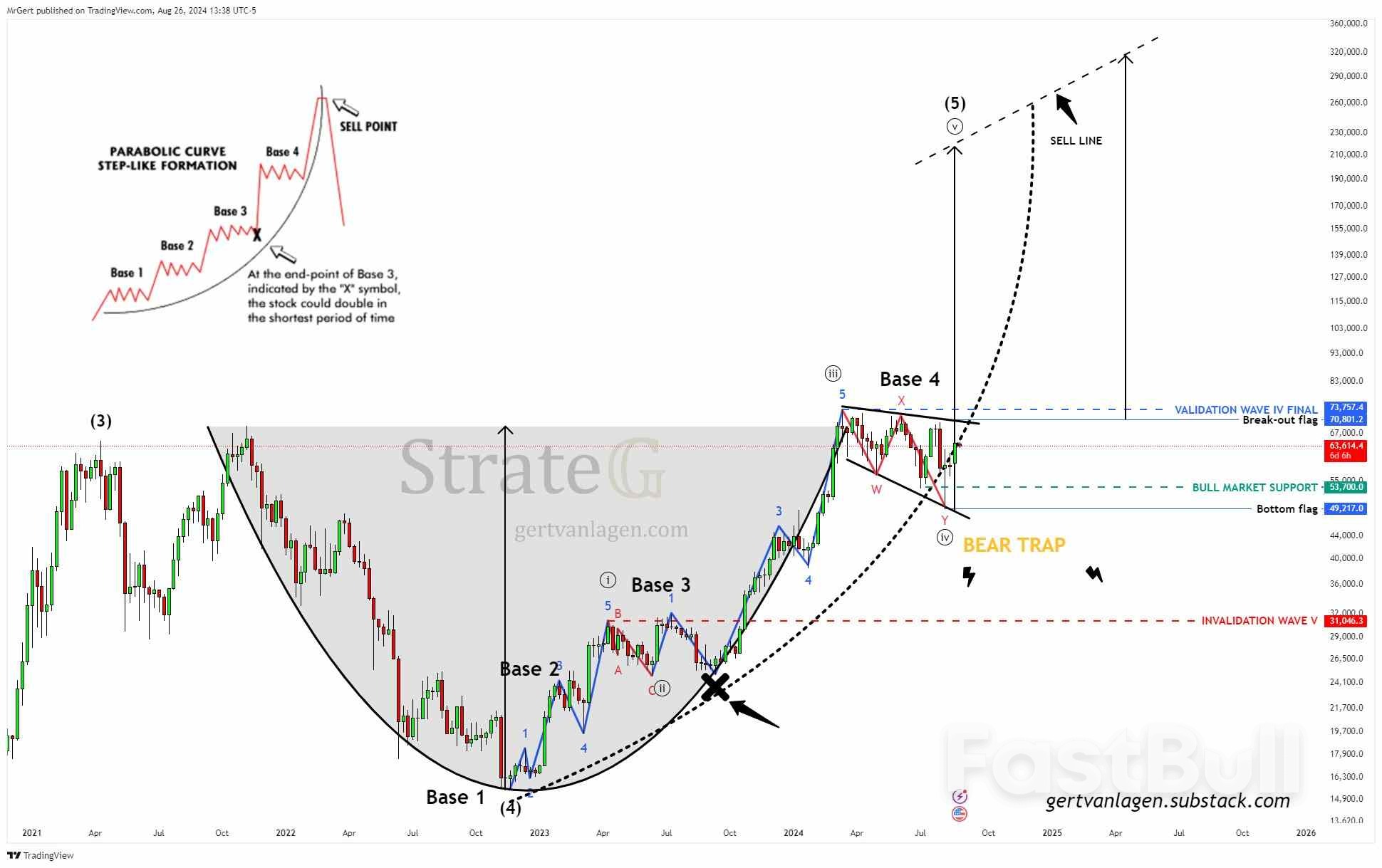
          Gert van Lagen, an independent technical analyst, appears confident that the current price action for BTC will have an explosive outcome. In an Aug. 27 X post, van Lagen highlights the formation of a parabolic curve, where BTC has continued to rise in a step-like formation.
          The chart also illustrates the formation of a rare Cup-and-Handle (CnH) pattern on the weekly chart. The pattern has taken shape over almost three years, dating back to October 2021.
          A successful breakout from a CnH pattern can trigger a parabolic rise since the pattern confirms a trend bottom and then a higher sideways consolidation during its development.
          The success rate of a CnH pattern is also very high at 95%, according to Tom Bulkowski, a well-known trader and creator of Thepatternsite.com.Bitcoin 3-Year Chart Pattern Nears Breakout Point as Analyst Expects 312% ROI_1

          Bitcoin Cup and Handle pattern approaching parabolic breakout. Source: X.com

          In the parabolic curve, Base 1 was formed at the market bottom in November 2022. A recovery from the market bottom at $15,460 to $25,290 confirmed Base 2. Bitcoin’s sideways consolidation between $30,000 and $25,000 during April 2023 and September 2023 led to Base 3.
          Moving forward, Bitcoin witnessed its first parabolic rise of 198%, reaching a new all-time high of $73,737 in March 2024.
          Over the past few weeks, the BTC/USD chart has printed the formation of Base 4, which is the final phase of the parabolic curve. Base 4 is also the “handle” part of the CnH pattern, which is approaching a breakout simultaneously.
          Once Bitcoin breaches above Base 4, the analyst expects “the steepest kind of ascent BTC has ever witnessed,” or a blow-off-top rally.
          By the end of 2024, the price target is above $260,000, which is a 312% gain from BTC’s current prices.

          Over $7B shorts will be liquidated at $70,500

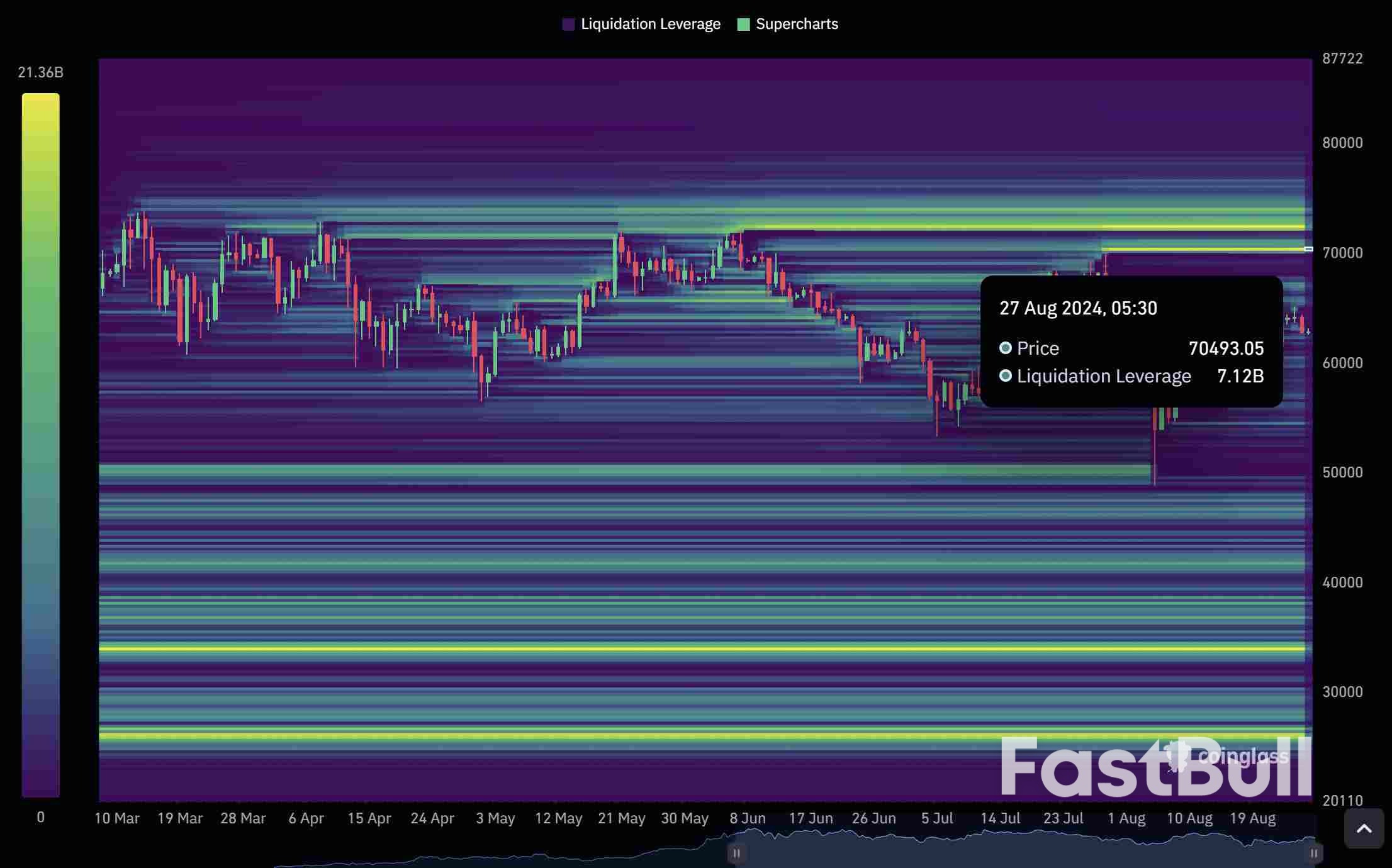
          Bitcoin price, crossing above its previous all-time high range at over $70,000, will not be without a few consequences for futures traders. Data from Coinglass suggests a large liquidation event will occur once BTC crosses $70,493.Bitcoin 3-Year Chart Pattern Nears Breakout Point as Analyst Expects 312% ROI_2

          Bitcoin liquidation heatmap. Source: Coinglass

          As observed, short liquidations amount to $7.18 billion at that price as of Aug. 27. Similarly, at $72,581, another $6.54 billion in short positions will be liquidated, which means the futures market is still strongly positioned between both bullish and bearish traders.
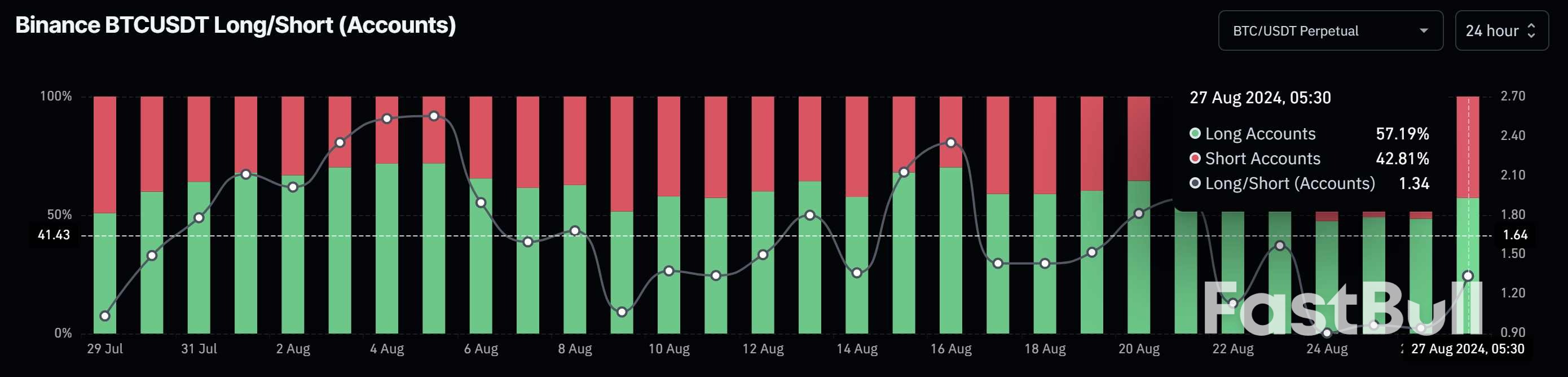
          However, the Long/Short accounts turned strongly bullish over the past 24 hours despite BTC’s price slump.Bitcoin 3-Year Chart Pattern Nears Breakout Point as Analyst Expects 312% ROI_3

          Bitcoin long/short accounts on Binance. Source: Coinglass

          The data indicates that 57.19% of the accounts are currently long. Yet, the taker buy/sell volume between long and short traders was closely matched, as the Longs/Short ratio remained at 1.01.

          Bitcoin to enter “the Banana Zone”

          Cointelegraph reported a similar prediction for Bitcoin by another analyst, who predicts BTC to reach as high as $150,000 by the end of 2024.
          Jame Coutts, Real Vision analyst, touts a familiar tone where he expected BTC price action to enter “batshit season” or the Banana zone.
          A banana zone is defined as a parabolic rally where price and volume witness a significant escalation, which triggers collective market interest and, hence, a further continuation of exponential rise.
          Additionally, Smithson With, a Bitcoin researcher, also shared a study that correctly called Bitcoin’s peak from previous bull cycles. With's price targets varied over the course of 2025, but the minimum expected price is $164,173 by Jan. 1, 2025.
          Overall, these predictions follow a similar pattern where BTC is expected to move rapidly once its previous all-time high is breached.

          Source: Cointelegraph

          Risk Warnings and Disclaimers
          You understand and acknowledge that there is a high degree of risk involved in trading. Following any strategies or investment methods may lead to potential losses. The content on the site is provided by our contributors and analysts for information purposes only. You are solely responsible for determining whether any trading assets, securities, strategy, or any other product is suitable for investing based on your own investment objectives and financial situation.
          Add to Favorites
          Share

          The Outlook for Housing in a Macro Game of Inches

          JPMorgan

          Economic

          The Importance of Housing

          In the second quarter of 2024, U.S. homebuilding accounted for just 4% of GDP. However, over the past 25 years, the sector has been three times as volatile as GDP overall, making it an important swing factor in determining the overall direction of the economy.
          Following a frenzy of homebuilding in early years of this century, housing activity slumped in the Great Financial Crisis, with starts plunging from a peak of over 2 million units in 2005 to less than 600,000 in 2009. Thereafter, activity recovered very slowly but steadily to just under 1.3 million units in 2019.
          The housing industry saw less interruption than most other sectors from the pandemic and, in a post-pandemic economic surge, housing starts climbed to just over 1.6 million in 2021. However, high prices and rising interest rates then took a toll with starts falling to 1.553 million units in 2022, 1.420 million units in 2023 and an annual rate of 1.378 million units in the first six months of this year.But where homebuilding goes from there depends principally on three factors: demographics, inventories and affordability.

          Demographics: A Stabilization in U.S. Population Growth

          Starting with demographics, the U.S. Census Bureau does a woefully bad job in what is presumably its primary task – that is estimating and publishing accurate and timely information on births, deaths, net immigration and the overall growth of the population. Nevertheless, it is possible to piece together a reasonably coherent picture of U.S. demographic trends from a hodge-podge of other sources.
          A good starting point in assessing current U.S. demographic trends is to look at the components of population growth for the year ended on June 30th, 2023 which Census reported, (with its usual urgency), in the middle of last December. In that year, according to the official numbers, there were 3.653 million births, 3.149 million deaths, net immigration of 1.139 million and overall population growth of 1.643 million, or 0.49%, bringing the total population to just under 335 million people.
          The last official monthly data from Census on births and deaths is from September 2023. However, extrapolating from more recent state data suggests that births likely fell further over the past year to roughly 3.6 million, their lowest level, outside of the pandemic, since 1979. Deaths have, thankfully, fallen from their pandemic highs, and should have declined to 3.1 million in the year ended on June 30th, 2024. Still, this would imply just a 500,000 gap between births and deaths which is normally referred to as the “natural” increase in the population.
          On top of this natural increase, however, the Census Bureau could report net immigration over the past year of 1.2 million. Total U.S. immigrant visas issued in foreign countries fell from 609,000 in the year ended in June 2023 to 601,000 in the year ended in June 2024. However, looking at border crossings, while there has been some decline in recent months, the numbers are still far above pre-pandemic levels, and total encounters with border patrol agents were up 8% in the year ended in June 2024 compared to a year earlier, at a level of 3.3 million.
          It is by no means clear how to translate border crossings into net migration numbers. However, it does seems likely that Census underestimated the growth in net migration in the year ended in June 2023 and may take some steps to remedy this in their estimate for the latest year.
          However, even if, under what we think is a conservative estimate, net migration was 1.2 million people and total population growth was therefore 1.7 million over the past year, it would imply a significant demand for new housing units. Moreover, even if migration were to slow dramatically from here, housing demand would likely grow further, as more recent immigrants found employment and became more integrated into the U.S. economy.
          In short, while the natural growth rate of the U.S. population is likely to continue to slow in the years ahead, the recent surge in immigration could boost housing demand for years to come.

          Supply: A Need to Build

          Second, to the great discomfort of home-buyers but to the advantage of home-builders and sellers, supply remains very tight.
          In June, there were just 1.32 million existing homes for sale – higher than a year ago, but still far below the 1.92 million units that were on the market 5 years ago. A similar picture can be seen in vacancy rates. In the second quarter of this year, the vacancy rate for owned homes was just 0.9% while the vacancy rate for rental properties was just 6.6%, both significantly below their levels of five years ago and far below their average levels over the past 50 years.
          The reality is that many younger home-owners are essentially trapped in the home that they bought a few years ago as they cannot afford to move since it would involve replacing their existing mortgage with something carrying a much higher rate. This is less of a problem for older home-owners who have paid off their mortgages. However, this lack of supply is providing builders with an incentive to build new properties – particularly in areas where population growth is strongest.

          Affordability: A Little Relief on Mortgage Rates

          The third key issue for the housing outlook is affordability and here, until very recently, the picture was grim. In June 2019, the monthly mortgage payment on the median-priced existing single-family home was roughly $1,064 – with relatively subdued home prices and mortgage rates averaging 3.80%. Five years later, in June of this year, this payment had more than doubled to $2,253, reflecting a 56% increase in median existing home prices and an almost doubling of mortgage rates to an average of 6.92%. Housing affordability effectively got hit with a one-two punch of soaring prices due to post-pandemic scarcity and then aggressive monetary tightening, between March 2022 and July 2023.
          While per capita personal income has risen by 28% over the same 5-year period, clearly home-ownership has been put out of reach for millions of potential buyers.That being said, there are some positive signs on affordability in recent economic trends.
          First, this drift down in rates should continue in the year ahead as hopes of Fed easing finally become reality.Second, strong stock market gains over the past two years have increased the ability of more affluent households to buy new homes in all-cash deals or with larger down-payments, and,Third, while mortgage payments have increased dramatically, so have rents. According to Zillow, the average listed rent on all single and multi-family homes in June was $2,054 – up 35% from five years earlier. This, of course, gives renters a powerful incentive to buy a home - if they can just find a way to do so.

          The Housing Outlook and Implications

          As mortgage rates drift down further and potential homebuyers accumulate the resources needed to buy a home, home-building activity should begin to revive. While we expect home-building to still drag on third-quarter economic growth, as has been the case for most of the past three years, by the fourth quarter, activity should begin to rebound and should provide a significant boost to economic activity in 2025, an important positive in a economy still delicately balanced between growth and stagnation.
          For investors, in broad terms, it will be important to keep track of housing as a key determinant of whether a soft-landing economy can continue to support both U.S. bonds and stocks. In narrower terms, a potential improvement in housing fundamentals should support both the logic of personal home-ownership and investments in housing for rent as part of a real estate portfolio.
          To stay updated on all economic events of today, please check out our Economic calendar
          Risk Warnings and Disclaimers
          You understand and acknowledge that there is a high degree of risk involved in trading. Following any strategies or investment methods may lead to potential losses. The content on the site is provided by our contributors and analysts for information purposes only. You are solely responsible for determining whether any trading assets, securities, strategy, or any other product is suitable for investing based on your own investment objectives and financial situation.
          Add to Favorites
          Share

          Harris Puts Housing at Center of Economic Pitch to US Voters

          Thomas

          Political

          Economic

          Democratic presidential nominee Kamala Harris is promising to build more housing as the centerpiece of an effort to tackle rising costs that have stressed U.S. households and left home ownership beyond the reach of many Americans.

          While Harris has deliberately steered clear of some policy specifics in her month-old presidential bid, she has laid out detailed plans to spur new construction and reduce costs for renters and homebuyers, largely through tax incentives.

          "We will end America's housing shortage," she said as she accepted the Democratic presidential nomination last week.

          Republican presidential candidate Donald Trump's campaign has also promised to reduce costs through tax breaks and reduced regulations. But on the campaign trail, he has defended local housing restrictions that prevent many types of affordable housing from being built.

          Voters rate housing costs as their second-most important economic worry, after fears of rising prices and stagnating income, a Reuters/Ipsos opinion poll found in May.

          Housing construction collapsed during the 2007-2009 financial crisis and has been slow to recover in the years since, leaving the United States short 2.9 million units, according to Moody's Analytics.

          Pandemic-driven shortages of construction materials pushed up the price of new housing, while rising interest rates made mortgages more expensive.

          U.S. home prices have risen 50% in the last five years and rents have risen 35%, according to real estate firm Zillow.

          Harris' housing plan could help her win over voters in an election where economic concerns are paramount, said Alyssa Cass, a Democratic strategist who says the issue is a top concern in focus groups.

          "Anything that would reduce the cost of housing is music to voters' ears," she said.

          At an Aug. 16 campaign stop in North Carolina, Harris called for building 3 million more housing units in four years, on top of the 1 million or so built annually by the private sector, through a new tax credit for developers who build homes aimed at first-time homebuyers and a $25,000 tax credit for those buyers.

          She also proposed a $40 billion fund to encourage local governments to build more affordable housing, streamlining regulations and expanding rental aid, among other steps.

          The Committee for a Responsible Federal Budget, a nonpartisan watchdog group, estimates those policies would cost at least $200 billion over 10 years.

          If elected president, Harris might have trouble enacting those policies into law as similar proposals from President Joe Biden have failed to clear Congress.

          Trump's position is less clear. The Republican Party's platform calls for boosting home ownership through tax breaks and eliminating regulations, though it does not outline specifics.

          However, Trump also has spoken against proposals to loosen local zoning restrictions that prevent apartments, duplexes and other forms of affordable housing from being built in neighborhoods reserved for single family houses.

          “I keep hearing about the suburban woman doesn't like Trump," he said at a campaign event in Howell, Michigan last week. "I keep the suburbs safe. I stopped low-income towers from rising right alongside of their house, and I'm keeping the illegal aliens away from the suburbs."

          Trump's running mate, U.S. Senator JD Vance, has blamed immigrants for the housing shortage.

          Jenny Schuetz, a housing expert at the nonpartisan Brookings Institution, said that comment amounted to a "not very subtle dog whistle" that recalled the racially charged housing fights of the 1970s, when white residents resisted efforts to integrate suburban areas.

          "Trying to frame housing affordability as a social issue, rather than an economic one, isn't helpful to actually addressing the problem," she said.

          During Trump's 2017-2021 presidency, his housing secretary Ben Carson proposed easing zoning rules but did not take action. More recently, he called for opposing any efforts to weaken single-family zoning in Project 2025, a conservative policy plan that has been disavowed by the Trump campaign.

          Harris has not said whether she would push local governments to loosen zoning regulations, but she has been involved in a broader Biden administration effort to encourage development.

          In June, she announced $85 million in grants to 21 local governments to remove "barriers to affordable housing," including reforming land-use policies in some areas. The Biden administration plans to distribute another $100 million later this year.

          Source: The edge markets

          To stay updated on all economic events of today, please check out our Economic calendar
          Risk Warnings and Disclaimers
          You understand and acknowledge that there is a high degree of risk involved in trading. Following any strategies or investment methods may lead to potential losses. The content on the site is provided by our contributors and analysts for information purposes only. You are solely responsible for determining whether any trading assets, securities, strategy, or any other product is suitable for investing based on your own investment objectives and financial situation.
          Add to Favorites
          Share

          ​Gold Price Dips Close to Record High,​ Brent Crude Oil's Continued Gains, and ​US Natural Gas Futures Drop to Two-week Low

          IG

          Commodity

          ​​​Gold price dips close to record high

          ​The price of spot gold has recovered from Thursday's sharp drop to $2,471.00 per troy ounce on a softening US dollar but so far hasn’t managed to overcome its current record high at $2,531.00.
          ​The short-term bullish outlook will persist as long as prices hold above the recent $2,471.00 low and $2,469.00 July peak. Above it lies the August uptrend line at $2,497.00 which may also hold.
          ​Gold Price Dips Close to Record High,​ Brent Crude Oil's Continued Gains, and ​US Natural Gas Futures Drop to Two-week Low_1

          Brent crude oil

          ​Front month Brent crude oil futures are on track for their fourth straight day of gains from last week’s 75.24 low amid major airborne attacks by Russia on Ukrainian energy infrastructure. This low was made just above the early August low at 74.97.
          ​The break through the July-to-August downtrend line at 79.68 is positive and points to the 55- and 200-day simple moving averages (SMA) at 81.95-to-82.02 now being in focus, together with the 81.97 mid-August high.​Potential support below the breached downtrend line at 79.68 can be found around the late July low at 77.95.
          ​Gold Price Dips Close to Record High,​ Brent Crude Oil's Continued Gains, and ​US Natural Gas Futures Drop to Two-week Low_2

          ​US natural gas futures drop to two-week low

          ​Last week US natural gas front-month futures stalled once again around the 200-day SMA at 2.304, after hitting a minor peak at 2.379 on Tuesday, before resuming their descent. They now trade in two-week lows and are about to hit the mid-July low at 2.045 ahead of the late July low at 2.006 and the early August trough at 1.918.
          ​Minor resistance sits at the 19 August low at 2.197.​​​Gold Price Dips Close to Record High,​ Brent Crude Oil's Continued Gains, and ​US Natural Gas Futures Drop to Two-week Low_3
          Risk Warnings and Disclaimers
          You understand and acknowledge that there is a high degree of risk involved in trading. Following any strategies or investment methods may lead to potential losses. The content on the site is provided by our contributors and analysts for information purposes only. You are solely responsible for determining whether any trading assets, securities, strategy, or any other product is suitable for investing based on your own investment objectives and financial situation.
          Add to Favorites
          Share

          German Economy Shrinks as Consumers Shy Away from Spending

          Warren Takunda

          Economic

          Germany's economy took a step back in the second quarter of 2024, with the gross domestic product contracting by 0.1%, according to final figures released Tuesday by the Federal Statistical Office.
          This downturn, following a modest 0.2% growth in the first quarter, signals growing concerns of an impending recession if economic conditions do not improve in the current quarter.
          "After the slight increase in the previous quarter, the German economy slowed down again in spring," stated Ruth Brand, President of the Federal Statistical Office, highlighting the fragility of Germany's economic recovery.
          Compared to a year earlier, the German economy showed no growth, having last recorded year-on-year expansion in the first quarter of 2023.

          Conr spending and investments weaken

          The economic decline was largely driven by a reduction in household consumption and investment. Household final consumption expenditure fell by 0.2%, reversing the gains seen earlier in the year. On the other hand, government final consumption rose by 1.0% from the previous quarter.
          Investments showed significant weakness underscoring the hesitancy of businesses to commit to new projects amid growing economic uncertainty.
          Gross fixed capital formation, a measure of investment in physical assets, saw a steep decline. Investment in machinery and equipment dropped by an annualized 4.1%, while construction investment fell by 2.0% on the quarter.
          Foreign trade, typically a strong point for the German economy, also failed to provide any positive momentum. Exports of goods and services declined by 0.2% compared to the first quarter of 2024, reflecting weaker global demand and supply chain disruptions.
          Sector-wise, the construction activity faced significant challenges, contracting by 3.2%. The downturn in building construction and completion work highlights the broader slowdown in one of Germany's most critical industries.
          Despite the economic slowdown, employment trends remained positive. The number of employed persons rose by 0.4% compared to the second quarter of 2023. Additionally, average gross wages and salaries per employee increased by 5.1% year-over-year, providing some relief to workers amid rising inflation and economic uncertainty.

          Germany lags behind peers

          Germany's economic performance in the second quarter of 2024 was notably weaker than that of other major economies.
          The European Union as a whole grew by 0.3% during the same period, with Spain leading the way with a 0.8% real growth. France and Italy also posted modest gains of 0.3% and 0.2%, respectively.
          Meanwhile, across the Atlantic, the United States recorded a 2.8% economic growth, further highlighting Germany's sharp underperformance.

          Consumer confidence plummets

          Adding to the gloomy economic outlook, a separate report released on Tuesday by the GfK revealed a sharp decline in consumer confidence.
          The forward-looking Consumer Climate index fell by 3.4 points to -22.0 in September, as income and economic expectations weakened significantly, and the willingness to spend also dropped.
          "Apparently, the euphoria of German consumers triggered by the European Football Championship was only a brief flare-up and faded after the end of the tournament," noted Rolf Buerkl, a consumer expert at the Nuremberg Institute for Market Decisions (NIM).
          He added that "negative news about job security is making consumers more pessimistic, and a fast recovery in consumer sentiment seems unlikely".
          The deteriorating consumer sentiment reflects broader concerns about Germany's economic future. The Federal Employment Agency recently reported a slight increase in unemployment rates, with the number of people registered as unemployed currently around 200,000 higher than a year ago.
          The combination of a weakening economy, planned job cuts in key industries, rising insolvencies, and the increasing risk of a recession has created an atmosphere of uncertainty and economic pessimism that is likely to persist in the coming months.
          Kyle Chapman, FX analyst at Ballinger Group said: "The German economy is finding it difficult to gain enough traction to pull itself out of stagnation, and the confidence survey figures have begun to turn sharply in the wrong direction. We were teased by some optimistic data in Q1, but ultimately, weak foreign demand, budget rigidity, and structural workforce issues are having a big drag effect. The 'sick man of Europe' label is likely to stick for a while longer."

          Source: EuroNews

          To stay updated on all economic events of today, please check out our Economic calendar
          Risk Warnings and Disclaimers
          You understand and acknowledge that there is a high degree of risk involved in trading. Following any strategies or investment methods may lead to potential losses. The content on the site is provided by our contributors and analysts for information purposes only. You are solely responsible for determining whether any trading assets, securities, strategy, or any other product is suitable for investing based on your own investment objectives and financial situation.
          Add to Favorites
          Share

          Global Money Piles into Indonesia as US Fed Easing Cycle Approaches

          Kevin Du

          Economic

          (Aug 27): Global money has flooded into Indonesia’s financial markets this month, signalling the country’s assets have quickly become a preferred investment destination as the US Federal Reserve’s easing cycle nears.

          Overseas investors have bought US$933.8 million (RM4 billion) of the nation’s stocks in August, on course for the biggest monthly purchases since April 2022, while net inflows of US$2.5 billion into bonds is the most in more than a year, according to data compiled by Bloomberg. The influx of money saw the rupiah briefly erase this year’s losses against the dollar, with a gain this month surpassed in Asia only by Malaysia’s ringgit.

          The swing into Indonesia’s assets comes as foreign funds reduce holdings in a number of other regional equity markets including India and China in favour of Southeast Asia, which is seen as being relatively undervalued. The prospect of the nation’s central bank following the Fed to lower borrowing costs to potentially boost economic growth has boosted the appeal of the nation’s assets.

          While net buying of the nation’s bonds is set to be the highest since January 2023, the rotation into stocks has driven the benchmark Jakarta Stock Index to record highs every few days through August. With Indonesia capturing the lion’s share of equity flows this month, foreigners have also been net purchasers of Malaysian and Philippine shares.

          Indonesian stocks have started commanding greater heft as Asian funds ended their underweight stance on the Southeast Asian market, HSBC Holdings Plc strategists including Prerna Garg wrote in a note dated August 26.

          Meanwhile, Nomura Holdings Inc strategists including Chetan Seth upgraded the country’s equities to overweight from neutral this week, saying they are “possibly the best way” to bet on emerging-market stocks as the Fed starts to cut rates.

          Source: The edge markets

          To stay updated on all economic events of today, please check out our Economic calendar
          Risk Warnings and Disclaimers
          You understand and acknowledge that there is a high degree of risk involved in trading. Following any strategies or investment methods may lead to potential losses. The content on the site is provided by our contributors and analysts for information purposes only. You are solely responsible for determining whether any trading assets, securities, strategy, or any other product is suitable for investing based on your own investment objectives and financial situation.
          Add to Favorites
          Share

          Market Thoughts – Tuesday 27 August 2024

          Pepperstone

          Economic

          Stocks

          Where We Stand –

          The tech sector bore the brunt of the aforementioned softness on Wall Street, with the Nasdaq ending the day around 1% lower, likely a result of positioning and de-risking ahead of NVDA’s earnings after market close tomorrow, where options price a move of as much as +/- 10% in the 24 hours following the report. Naturally, NVDA’s guidance, as well as the figures themselves, will be a key driver of not just the tech sector, but broader market sentiment, and stand as the next key event risk for participants to navigate.
          Despite the tech softness, signs of a rotation did emerge under the hood of the US equity market, with the Dow (despite it’s archaic nature) ending at a record high, and the Russell adding around 0.2%. A short-term window of small cap outperformance does appear to have opened here, after Powell’s more dovish-than-expected remarks at Jackson Hole on Friday, as the Fed Chair strengthened the ‘Fed put’, making policy shifts almost solely contingent on developments in the labour market. The August jobs report, due 6th September, is the next major macro catalyst on the horizon, with further softness here likely to cement the case for a 50bp cut at the September FOMC meeting, though my base case remains for a more modest 25bp move at the time of writing.
          Market Thoughts – Tuesday 27 August 2024_1
          Outside of equities, crude remains underpinned by heightened geopolitical risk in the Middle East though, as we have seen many times since last October, the impact of said tensions tends to be relatively short-lived, with the bulls likely requiring a sustained pick-up in demand in order to build a sustainable rally. The spectre of OPEC+ increasing output in Q4, as production cuts come to an end, also continues to hang over the market.
          The FX space, meanwhile, is subdued, with the dollar holding close to yesterday’s highs, albeit with the DXY having been unable to reclaim the 101 handle just yet. Some profit taking continues in the EUR, pulling back from 1.12, and in cable, dipping beneath the 1.32 handle, with both likely having further room to retrace as last week’s aggressive USD selling seems somewhat overdone. The AUD & NZD trade firm, sitting as the best G10 performers this morning, despite the somewhat soggy APAC risk tone, and ahead of Aussie CPI figures due for release in the early hours (London time) of Wednesday morning. Risks to the CPI print are likely to the downside of the 3.4% YoY consensus, given the early-quarter nature of the data leading to a heavily goods-biased composition of the inflation basket used to calculate the figure.
          Treasuries also continue to retrace, led by the front-end, with 2s having now pared around half of last Friday’s advance, as the market continues to modestly hawkishly reprice Fed expectations. The USD OIS curve now discounts around 96bp of cuts by year-end, compared to over 100bp on Friday.
          There appears further room for this retracement to continue, with such an aggressive pace of easing likely not warranted barring an exogenous economic shock. Hence, risks remain tilted to the downside at the front end of the curve, with markets also having to navigate sizeable 2y, 5y, and 7y supply this week. Further selling pressure in Treasuries should help the greenback to continue its modest rebound from YTD lows seen Friday, while also likely posing a modest headwind to gold, which sits around 1% shy of fresh record highs, with spot having seem some slight downside through Asia trade.

          Look Ahead –

          Another day lacking in major macro releases looms, with the August US consumer confidence and Richmond Fed manufacturing figures unlikely to inspire, potentially leading participants to sit on their hands ahead of the aforementioned NVDA earnings risk. Some further position squaring through the session, into earnings, seems likely.
          Remarks from the ECB’s Nagel and Knot should pass without event, as the Governing Council look nailed on for another rate cut at the September meeting, and with E/Z flash CPI figures due Friday morning. 2y US supply due later is also on the radar, after the last auction for the tenor saw a 2.3bp stop through, the largest such stop through the WI yield in over five years.
          To stay updated on all economic events of today, please check out our Economic calendar
          Risk Warnings and Disclaimers
          You understand and acknowledge that there is a high degree of risk involved in trading. Following any strategies or investment methods may lead to potential losses. The content on the site is provided by our contributors and analysts for information purposes only. You are solely responsible for determining whether any trading assets, securities, strategy, or any other product is suitable for investing based on your own investment objectives and financial situation.
          Add to Favorites
          Share
          FastBull
          Copyright © 2026 FastBull Ltd

          728 RM B 7/F GEE LOK IND BLDG NO 34 HUNG TO RD KWUN TONG KLN HONG KONG

          TelegramInstagramTwitterfacebooklinkedin
          App Store Google Play Google Play
          Products
          Charts

          Chats

          Q&A with Experts
          Screeners
          Economic Calendar
          Data
          Tools
          Membership
          Features
          Function
          Markets
          Copy Trading
          Latest Signals
          Contests
          News
          Analysis
          24/7
          Columns
          Education
          Company
          Careers
          About Us
          Contact Us
          Advertising
          Help Center
          Feedback
          User Agreement
          Privacy Policy
          Personal Information Protection Statement
          Business

          White Label

          Data API

          Web Plug-ins

          Poster Maker

          Affiliate Program

          Risk Disclosure

          The risk of loss in trading financial instruments such as stocks, FX, commodities, futures, bonds, ETFs and crypto can be substantial. You may sustain a total loss of the funds that you deposit with your broker. Therefore, you should carefully consider whether such trading is suitable for you in light of your circumstances and financial resources.

          No decision to invest should be made without thoroughly conducting due diligence by yourself or consulting with your financial advisors. Our web content might not suit you since we don't know your financial conditions and investment needs. Our financial information might have latency or contain inaccuracy, so you should be fully responsible for any of your trading and investment decisions. The company will not be responsible for your capital loss.

          Without getting permission from the website, you are not allowed to copy the website's graphics, texts, or trademarks. Intellectual property rights in the content or data incorporated into this website belong to its providers and exchange merchants.

          Not Logged In

          Log in to access more features

          FastBull Membership

          Not yet

          Purchase

          Become a signal provider
          Help Center
          Customer Service
          Dark Mode
          Price Up/Down Colors

          Log In

          Sign Up

          Position
          Layout
          Fullscreen
          Default to Chart
          The chart page opens by default when you visit fastbull.com