• Trade
  • Markets
  • Copy
  • Contests
  • News
  • 24/7
  • Calendar
  • Q&A
  • Chats
Trending
Screeners
SYMBOL
LAST
BID
ASK
HIGH
LOW
NET CHG.
%CHG.
SPREAD
SPX
S&P 500 Index
6827.42
6827.42
6827.42
6899.86
6801.80
-73.58
-1.07%
--
DJI
Dow Jones Industrial Average
48458.04
48458.04
48458.04
48886.86
48334.10
-245.98
-0.51%
--
IXIC
NASDAQ Composite Index
23195.16
23195.16
23195.16
23554.89
23094.51
-398.69
-1.69%
--
USDX
US Dollar Index
97.950
98.030
97.950
98.500
97.950
-0.370
-0.38%
--
EURUSD
Euro / US Dollar
1.17394
1.17409
1.17394
1.17496
1.17192
+0.00011
+ 0.01%
--
GBPUSD
Pound Sterling / US Dollar
1.33707
1.33732
1.33707
1.33997
1.33419
-0.00148
-0.11%
--
XAUUSD
Gold / US Dollar
4299.39
4299.39
4299.39
4353.41
4257.10
+20.10
+ 0.47%
--
WTI
Light Sweet Crude Oil
57.233
57.485
57.233
58.011
56.969
-0.408
-0.71%
--

Community Accounts

Signal Accounts
--
Profit Accounts
--
Loss Accounts
--
View More

Become a signal provider

Sell trading signals to earn additional income

View More

Guide to Copy Trading

Get started with ease and confidence

View More

Signal Accounts for Members

All Signal Accounts

Best Return
  • Best Return
  • Best P/L
  • Best MDD
Past 1W
  • Past 1W
  • Past 1M
  • Past 1Y

All Contests

  • All
  • Trump Updates
  • Recommend
  • Stocks
  • Cryptocurrencies
  • Central Banks
  • Featured News
Top News Only
Share

Norwegian Nobel Committee: Calls On The Belarusian Authorities To Release All Political Prisoners

Share

Norwegian Nobel Committee: His Freedom Is A Deeply Welcome And Long-Awaited Moment

Share

Ukraine Says It Received 114 Prisoners From Belarus

Share

USA Embassy In Lithuania: Maria Kalesnikava Is Not Going To Vilnius

Share

USA Embassy In Lithuania: Other Prisoners Are Being Sent From Belarus To Ukraine

Share

Ukraine President Zelenskiy: Five Ukrainians Released By Belarus In US-Brokered Deal

Share

USA Vilnius Embassy: USA Stands Ready For "Additional Engagement With Belarus That Advances USA Interests"

Share

USA Vilnius Embassy: Belarus, USA, Other Citizens Among The Prisoners Released Into Lithuania

Share

USA Vilnius Embassy: USA Will Continue Diplomatic Efforts To Free The Remaining Political Prisoners In Belarus

Share

USA Vilnius Embassy: Belarus Releases 123 Prisoners Following Meeting Of President Trump's Envoy Coale And Belarus President Lukashenko

Share

USA Vilnius Embassy: Masatoshi Nakanishi, Aliaksandr Syrytsa Are Among The Prisoners Released By Belarus

Share

USA Vilnius Embassy: Maria Kalesnikava And Viktor Babaryka Are Among The Prisoners Released By Belarus

Share

USA Vilnius Embassy: Nobel Peace Prize Laureate Ales Bialiatski Is Among The Prisoners Released By Belarus

Share

Belarusian Presidential Administration Telegram Channel: Lukashenko Has Pardoned 123 Prisoners As Part Of Deal With US

Share

Two Local Syrian Officials: Joint US-Syrian Military Patrol In Central Syria Came Under Fire From Unknown Assailants

Share

Israeli Military Says It Targeted 'Key Hamas Terrorist' In Gaza City

Share

Rwanda's Actions In Eastern Drc Are A Clear Violation Of Washington Accords Signed By President Trump - Secretary Of State Rubio

Share

Israeli Military Issues Evacuation Warning In Southern Lebanon Village Ahead Of Strike - Spokesperson On X

Share

Belarusian State Media Cites US Envoy Coale As Saying He Discussed Ukraine And Venezuela With Lukashenko

Share

Belarusian State Media Cites US Envoy Coale As Saying That US Removes Sanctions On Belarusian Potassium

TIME
ACT
FCST
PREV
U.K. Trade Balance Non-EU (SA) (Oct)

A:--

F: --

P: --

U.K. Trade Balance (Oct)

A:--

F: --

P: --

U.K. Services Index MoM

A:--

F: --

P: --

U.K. Construction Output MoM (SA) (Oct)

A:--

F: --

P: --

U.K. Industrial Output YoY (Oct)

A:--

F: --

P: --

U.K. Trade Balance (SA) (Oct)

A:--

F: --

P: --

U.K. Trade Balance EU (SA) (Oct)

A:--

F: --

P: --

U.K. Manufacturing Output YoY (Oct)

A:--

F: --

P: --

U.K. GDP MoM (Oct)

A:--

F: --

P: --

U.K. GDP YoY (SA) (Oct)

A:--

F: --

P: --

U.K. Industrial Output MoM (Oct)

A:--

F: --

P: --

U.K. Construction Output YoY (Oct)

A:--

F: --

P: --

France HICP Final MoM (Nov)

A:--

F: --

P: --

China, Mainland Outstanding Loans Growth YoY (Nov)

A:--

F: --

P: --

China, Mainland M2 Money Supply YoY (Nov)

A:--

F: --

P: --

China, Mainland M0 Money Supply YoY (Nov)

A:--

F: --

P: --

China, Mainland M1 Money Supply YoY (Nov)

A:--

F: --

P: --

India CPI YoY (Nov)

A:--

F: --

P: --

India Deposit Gowth YoY

A:--

F: --

P: --

Brazil Services Growth YoY (Oct)

A:--

F: --

P: --

Mexico Industrial Output YoY (Oct)

A:--

F: --

P: --

Russia Trade Balance (Oct)

A:--

F: --

P: --

Philadelphia Fed President Henry Paulson delivers a speech
Canada Building Permits MoM (SA) (Oct)

A:--

F: --

P: --

Canada Wholesale Sales YoY (Oct)

A:--

F: --

P: --

Canada Wholesale Inventory MoM (Oct)

A:--

F: --

P: --

Canada Wholesale Inventory YoY (Oct)

A:--

F: --

P: --

Canada Wholesale Sales MoM (SA) (Oct)

A:--

F: --

P: --

Germany Current Account (Not SA) (Oct)

A:--

F: --

P: --

U.S. Weekly Total Rig Count

A:--

F: --

P: --

U.S. Weekly Total Oil Rig Count

A:--

F: --

P: --

Japan Tankan Large Non-Manufacturing Diffusion Index (Q4)

--

F: --

P: --

Japan Tankan Small Manufacturing Outlook Index (Q4)

--

F: --

P: --

Japan Tankan Large Non-Manufacturing Outlook Index (Q4)

--

F: --

P: --

Japan Tankan Large Manufacturing Outlook Index (Q4)

--

F: --

P: --

Japan Tankan Small Manufacturing Diffusion Index (Q4)

--

F: --

P: --

Japan Tankan Large Manufacturing Diffusion Index (Q4)

--

F: --

P: --

Japan Tankan Large-Enterprise Capital Expenditure YoY (Q4)

--

F: --

P: --

U.K. Rightmove House Price Index YoY (Dec)

--

F: --

P: --

China, Mainland Industrial Output YoY (YTD) (Nov)

--

F: --

P: --

China, Mainland Urban Area Unemployment Rate (Nov)

--

F: --

P: --

Saudi Arabia CPI YoY (Nov)

--

F: --

P: --

Euro Zone Industrial Output YoY (Oct)

--

F: --

P: --

Euro Zone Industrial Output MoM (Oct)

--

F: --

P: --

Canada Existing Home Sales MoM (Nov)

--

F: --

P: --

Euro Zone Total Reserve Assets (Nov)

--

F: --

P: --

U.K. Inflation Rate Expectations

--

F: --

P: --

Canada National Economic Confidence Index

--

F: --

P: --

Canada New Housing Starts (Nov)

--

F: --

P: --

U.S. NY Fed Manufacturing Employment Index (Dec)

--

F: --

P: --

U.S. NY Fed Manufacturing Index (Dec)

--

F: --

P: --

Canada Core CPI YoY (Nov)

--

F: --

P: --

Canada Manufacturing Unfilled Orders MoM (Oct)

--

F: --

P: --

Canada Manufacturing New Orders MoM (Oct)

--

F: --

P: --

Canada Core CPI MoM (Nov)

--

F: --

P: --

Canada Manufacturing Inventory MoM (Oct)

--

F: --

P: --

Canada CPI YoY (Nov)

--

F: --

P: --

Canada CPI MoM (Nov)

--

F: --

P: --

Canada CPI YoY (SA) (Nov)

--

F: --

P: --

Canada Core CPI MoM (SA) (Nov)

--

F: --

P: --

Q&A with Experts
    • All
    • Chatrooms
    • Groups
    • Friends
    Connecting
    .
    .
    .
    Type here...
    Add Symbol or Code

      No matching data

      All
      Trump Updates
      Recommend
      Stocks
      Cryptocurrencies
      Central Banks
      Featured News
      • All
      • Russia-Ukraine Conflict
      • Middle East Flashpoint
      • All
      • Russia-Ukraine Conflict
      • Middle East Flashpoint
      Search
      Products

      Charts Free Forever

      Chats Q&A with Experts
      Screeners Economic Calendar Data Tools
      Membership Features
      Data Warehouse Market Trends Institutional Data Policy Rates Macro

      Market Trends

      Market Sentiment Order Book Forex Correlations

      Top Indicators

      Charts Free Forever
      Markets

      News

      News Analysis 24/7 Columns Education
      From Institutions From Analysts
      Topics Columnists

      Latest Views

      Latest Views

      Trending Topics

      Top Columnists

      Latest Update

      Signals

      Copy Rankings Latest Signals Become a signal provider AI Rating
      Contests
      Brokers

      Overview Brokers Assessment Rankings Regulators News Claims
      Broker listing Forex Brokers Comparison Tool Live Spread Comparison Scam
      Q&A Complaint Scam Alert Videos Tips to Detect Scam
      More

      Business
      Events
      Careers About Us Advertising Help Center

      White Label

      Data API

      Web Plug-ins

      Affiliate Program

      Awards Institution Evaluation IB Seminar Salon Event Exhibition
      Vietnam Thailand Singapore Dubai
      Fans Party Investment Sharing Session
      FastBull Summit BrokersView Expo
      Recent Searches
        Top Searches
          Markets
          News
          Analysis
          User
          24/7
          Economic Calendar
          Education
          Data
          • Names
          • Latest
          • Prev

          View All

          No data

          Scan to Download

          Faster Charts, Chat Faster!

          Download App
          English
          • English
          • Español
          • العربية
          • Bahasa Indonesia
          • Bahasa Melayu
          • Tiếng Việt
          • ภาษาไทย
          • Français
          • Italiano
          • Türkçe
          • Русский язык
          • 简中
          • 繁中
          Open Account
          Search
          Products
          Charts Free Forever
          Markets
          News
          Signals

          Copy Rankings Latest Signals Become a signal provider AI Rating
          Contests
          Brokers

          Overview Brokers Assessment Rankings Regulators News Claims
          Broker listing Forex Brokers Comparison Tool Live Spread Comparison Scam
          Q&A Complaint Scam Alert Videos Tips to Detect Scam
          More

          Business
          Events
          Careers About Us Advertising Help Center

          White Label

          Data API

          Web Plug-ins

          Affiliate Program

          Awards Institution Evaluation IB Seminar Salon Event Exhibition
          Vietnam Thailand Singapore Dubai
          Fans Party Investment Sharing Session
          FastBull Summit BrokersView Expo

          AI Boom Seen Driving Next Decade of Emerging-Market Returns

          Adam

          Economic

          Summary:

          Emerging-market funds are betting big on AI, with Taiwan and South Korea leading gains. Analysts expect AI-related stocks to drive up to a third of EM returns over the next decade.
          Emerging-market funds are pivoting to capture the artificial intelligence craze, with some investors predicting that booming technology spending will drive returns for years to come.
          Encouraged by the success of Chinese AI developer DeepSeek and Asia’s powerhouse semiconductor firms, asset managers like AllSpring Global Investments and GIB Asset Management are concentrating more of their portfolio in AI stocks. That’s been a winning trade, with AI companies being the six biggest contributors to the rally in Bloomberg’s EM stocks index this year.
          “This trend could last for the next 10 to 20 years,” said Alison Shimada, head of total emerging markets equity at AllSpring, which oversees $611 billion. “The impact on local populations within EM will be transformational.”
          AI Boom Seen Driving Next Decade of Emerging-Market Returns_1

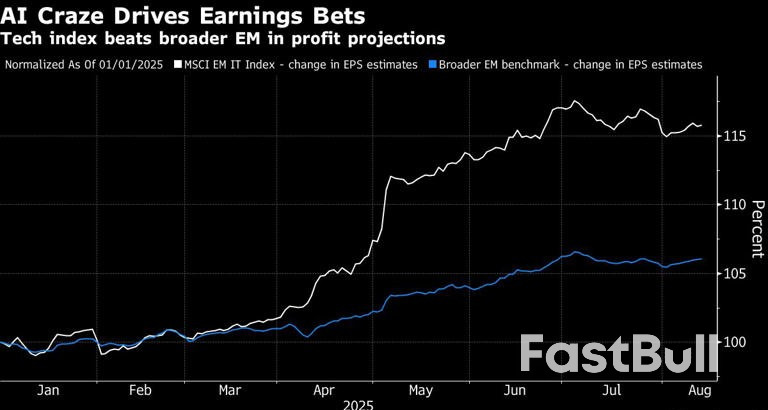
          AI Craze Drives Earnings Bets | Tech index beats broader EM in profit projections

          While much of the AI investment frenzy has focused on a handful of Silicon Valley firms, EM companies that can harness the technology or supply crucial components are benefitting. AI servers, for example, have become the main growth driver for Taiwan’s Hon Hai Precision Industry Co., which is known as Foxconn.
          The top contributors to Bloomberg’s EM stock index this year are Taiwan Semiconductor Manufacturing Co., Tencent Holdings Ltd., Alibaba Group Holding Ltd., Samsung Electronics Co., SK Hynix Inc. and Xiaomi Corporation, together accounting for 37% of the index’s rally.
          Emerging-market stocks that are highly exposed to AI have even outperformed the so-called Magnificent Seven megacap tech firms so far this year, according to equities strategists at Citigroup Inc.
          “You cannot invest in emerging markets without having a sanguine and optimistic view of what this AI story can evolve into from a corporate earnings perspective,” said Kunal Desai, London-based co-portfolio manager for global emerging markets equities at GIB Asset Management.
          On Monday, MSCI Inc. gauges for emerging-market stocks rose on optimism over easing China-US trade tensions, but the MSCI EM IT Index declined due to levies on semiconductors. Chipmakers Samsung and SK Hynix led a selloff in South Korea.
          Desai said that Taiwan and South Korea will be “central drivers” of the EM market story over the next two to three years, with Malaysia, China, India, parts of Latin America and the Middle East seeing “disproportionate gains” due to their exposure to AI data and applications. His fund has invested in AI stocks during recent market dips, predicting that a third of emerging market returns will come from AI-related stocks in the coming years.
          There are signs that the momentum will continue as AI adoption accelerates across segments including cloud computing and electrical vehicles. The average estimate of forward 12-month earnings for EM tech stocks has increased 15% since the start of the year, compared to 6% for EM stocks overall.
          “The share of AI contribution from the performance standpoint will only grow from here,” said Xingchen Yu, an emerging markets strategist at UBS Global Wealth Management. “The rise of AI and tech is creating a new layer of secular growth, especially in North Asia.”
          AI Boom Seen Driving Next Decade of Emerging-Market Returns_2

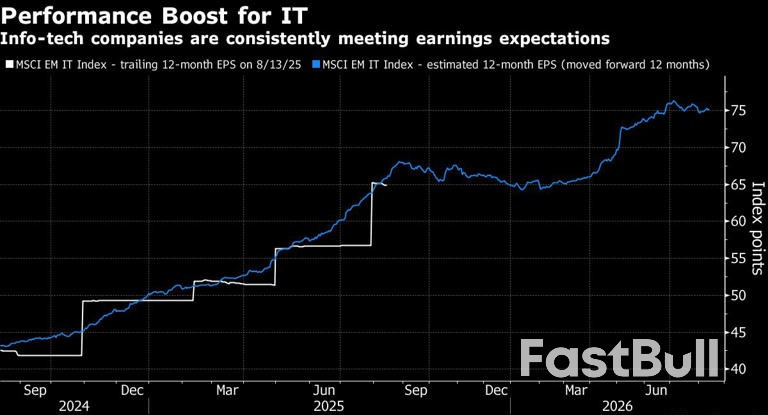
          Performance Boost for IT | Info-tech companies are consistently meeting earnings expectations

          The AI revolution could help EM stocks overcome a key obstacle: earnings performance. Company results have lagged forecasts every quarter since early 2022, with MSCI EM Index companies collectively missing profit expectations by more than 12%, according to data compiled by Bloomberg.
          But firms in the AI-heavy information-technology sector have consistently met earnings projections since the fourth quarter of last year, boosting investor confidence.
          “This sector has been expected to grow explosively and will continue to do so in the future,” said Young Jae Lee, senior investment manager at Pictet Asset Management Ltd. “AI will continue to be a key sector within emerging markets.”

          Source: Bloomberg

          To stay updated on all economic events of today, please check out our Economic calendar
          Risk Warnings and Disclaimers
          You understand and acknowledge that there is a high degree of risk involved in trading. Following any strategies or investment methods may lead to potential losses. The content on the site is provided by our contributors and analysts for information purposes only. You are solely responsible for determining whether any trading assets, securities, strategy, or any other product is suitable for investing based on your own investment objectives and financial situation.
          Add to Favorites
          Share

          'The risk that's on our doorstep': July inflation data has economists on edge

          Adam

          Economic

          Markets ended last week largely unfazed by a hotter wholesale inflation print and signs of firming consumer prices, but some economists warn the underlying story is more concerning than investors seem to believe.
          The Producer Price Index (PPI) for July surged to a three-year high, with services inflation playing a key role in the gains. A similar trend appeared in the latest Consumer Price Index (CPI) report earlier this week as firming prices in services like dental care and airline fares marked a surprise reversal from the prior softening that had been offsetting higher goods prices from tariffs.
          The fresh data now puts the Federal Reserve, which targets 2% inflation, in a precarious position as tensions between its dual mandate of price stability and maximum employment begin to surface.
          Massive downward revisions in July's jobs report fueled concerns that the labor market is softening too quickly, strengthening the case for rate cuts. But the hotter-than-anticipated inflation data could suggest the need for more restraint.
          As of Monday morning, markets continued to price in about an 85% probability that the central bank will cut rates in September, according to the latest CME FedWatch Tool. Federal Reserve Chair Jerome Powell's Jackson Hole speech next week could give hints on the Fed's next policy move.
          The Fed's dual mandate tension
          Some economists argue the Fed should hold off on rate cuts — or even consider raising rates.
          "These are broad-based inflationary pressures," Lauren Saidel-Baker, economist at ITR Economics, told Yahoo Finance following this week's hotter-than-expected PPI print. "I see more reason for rates to be rising in order to not let inflation get away from us."
          Saidel-Baker noted these pressures have been building for years and aren't solely the result of tariffs. She pointed to higher wages and rising energy costs as key drivers now feeding into the data. She also stressed that the full impact of tariffs will take time to emerge.
          "Inflation is the risk that's on our doorstep, much more so than the labor market," Saidel-Baker emphasized. "Fed officials know that."
          Chicago Fed president Austan Goolsbee cautioned on Wednesday that a continued rise in services prices, similar to what was seen in this week's CPI report, would be worrisome
          "Services are not tied to the tariffs," he said. "Everyone is hoping that's just a blip. There's noise in the data. If you start to get multiple months where the components suggest that the impact of tariff inflation is not staying in its lane, that would be more of a concern."
          At the same time, the latest numbers painted a mixed picture.
          Michael Gapen, chief US economist at Morgan Stanley, told Yahoo Finance last week that the July CPI report offered "some good news and some bad news."
          "The good news here is that tariff impulse into inflation wasn't as high as anticipated this month," he said. "The bad news is that services inflation was pretty soft in prior months. And it did give the impression to many that, hey, maybe we could ignore tariff inflation because services weakness will offset it. But now, I think a lot of that's reversed."
          "I'm not ready to say, 'Oh, services is about ready to roar higher," he added, "[but] if it's firming, we do have to watch out."
          Gapen is still calling for no rate cuts this year, despite the market's near certainty that at least one is coming.
          "There's enough inflation momentum here that suggests inflation will continue to deviate from the Fed's mandate," he said. "Immigration controls are likely to keep the unemployment rate low. And that means a tight labor market."

          Source: finance.yahoo

          To stay updated on all economic events of today, please check out our Economic calendar
          Risk Warnings and Disclaimers
          You understand and acknowledge that there is a high degree of risk involved in trading. Following any strategies or investment methods may lead to potential losses. The content on the site is provided by our contributors and analysts for information purposes only. You are solely responsible for determining whether any trading assets, securities, strategy, or any other product is suitable for investing based on your own investment objectives and financial situation.
          Add to Favorites
          Share

          Rate cut watch: All eyes on Fed Chair Powell's final Jackson Hole speech

          Adam

          Economic

          Central Bank

          As Federal Reserve officials gather in Jackson Hole, Wyo., this week for their 43rd annual economic policy symposium, Federal Reserve Chair Jerome Powell and his central bank colleagues face a dilemma: hold interest rates steady in September on account of rising inflation, or lower rates thanks to weaker job market reports.
          That's what a very divided Fed is tussling with as markets are pricing in a quarter percentage point rate cut next month — and President Trump pounds Chair Powell to lower rates.
          Investors will be listening for clues about what the Fed may do in September when Chair Powell gives his speech on Friday at 10 a.m. ET at the storied Jackson Lake Lodge in the middle of Grand Teton National Park. It will be his last speech in Jackson Hole as Fed chair.
          Fed officials have been closely watching for the impact of tariffs on inflation. But recent readings from the Consumer Price Index and the Producer Price Index have shown mild effects from tariffs as services inflation unexpectedly heated up in July, catching the attention of some Fed officials. Services account for the majority of the US economy, while goods just account for 11% of GDP. Chicago Fed president Austan Goolsbee cautioned last week that if we see services inflation heading higher in subsequent reports, that would be a concern.
          Other officials, including Kansas City Fed president Jeff Schmid, Cleveland Fed president Beth Hammack, and Atlanta Fed president Raphael Bostic, have been more concerned about inflation.
          Inflation is now running a full percentage point above the Fed’s 2% target.
          But Bostic also believes that a weaker-than-expected July jobs report raises the risk that the labor market may be weakening. Bostic says the Fed’s task is to figure out how much the job market has slumped by the next policy meeting and whether the central bank should cut rates.
          The latest government jobs report showed a weaker reading on the labor market, with just 73,000 jobs added in July and with downward revisions to the prior two months, bringing the three-month average employment gain down to 35,000.
          Following that report, San Francisco president Mary Daly and Minneapolis Fed president Neel Kashkari both turned from more of a “wait and see” approach to one of concern about the outlook for the job market. They join Fed governors Chris Waller and Michelle Bowman, who both dissented at the July policy meeting, preferring to cut rates by 25 basis points on concerns about jobs.
          Following the July policy meeting, Chair Powell reiterated that more time is needed to assess how Trump’s tariffs will affect the path of inflation and the strength of the economy. He told reporters there is still a "long way to go” to figure out exactly what the impact of tariffs is, adding, "You have to think of this as still quite early days."
          He also made it clear that inflation was still a concern as the Fed balances its dual mandate of stable prices and maximum employment, saying, “The economy is not performing as though restrictive policy is holding it back inappropriately, and modestly restrictive policy seems appropriate. All that said, there’s also downside risk to the labor market.”
          Powell noted that a good amount of data before the September policy meeting will help inform the Fed’s view. The question is whether the weak July jobs report is enough for Powell, who saw downside risks to employment in July.
          Markets are pricing in a rate cut for the next policy meeting on Sept. 17, though odds have receded slightly in recent days following a hotter-than-expected report on wholesale prices.
          “Markets are still wholly convinced that the Fed will cut rates by 25bp at the upcoming FOMC meeting in September and follow that up with at least one other cut in October or December,” said Paul Ashworth, chief North America economist for Capital Economics.
          Ashworth said he expects Powell to caution at Jackson Hole that a “modestly restrictive policy stance remains appropriate,” as the Fed chair did in his press conference following the July policy meeting.
          Luke Tilley, chief economist for Wilmington Trust, said he could also envision Powell expanding on how the Fed takes into account backward-looking data versus forecasted data to make a decision on monetary policy. He is also looking to see whether the Fed chair expounds on how the central bank gauges its progress on its two goals, maximum employment and price stability, and how it calibrates interest rates accordingly.
          Framework unveiled?
          Fed Chair Powell is also set to announce the results of the central bank’s policy framework review at Jackson Hole. The Fed is revisiting changes made to its strategy for monetary policy, tools, and communication last changed in 2020. The central bank adjusts its framework every five years.
          The last iteration of the framework adopted a flexible average inflation target, given that in the years preceding 2020 inflation remained slightly below the Fed’s 2% target. Given the recent bout of inflation, and the risks it poses to inflation expectations and consumer sentiment, the Fed is likely to drop that.
          “While the adoption of the new framework in 2020 was not the primary factor behind the Fed’s delay and the substantial inflation overshoot, it contributed to this outcome,” said Matt Luzzetti, chief US economist for Deutsche Bank.
          As a result, Luzzetti expects Powell’s speech to restore a more preemptive strategy for monetary policy that recognizes risks of supply shocks and return to a balanced view of inflation and the job market.
          “The economic environment has changed significantly since 2020, and our review will reflect our assessment of those changes,” Powell said in a speech in May.
          Powell noted in that May speech that inflation could be more volatile going forward than in the 2010s and that the US may be entering a period of more frequent, and potentially more persistent, supply shocks.
          Powell also said that Fed officials may reconsider “shortfalls” around trying to get to the Fed’s 2% inflation target and average inflation targeting. He also stressed enhancing the central bank's formal policy communications, particularly regarding the role of forecasts and uncertainty.
          Investors will watch for whether the Fed rolls out changes to its quarterly Summary of Economic Projections, which contains the famous “dot plot,” a compilation of each member of the FOMC’s expectations for interest rates that year.

          Source: finance.yahoo

          To stay updated on all economic events of today, please check out our Economic calendar
          Risk Warnings and Disclaimers
          You understand and acknowledge that there is a high degree of risk involved in trading. Following any strategies or investment methods may lead to potential losses. The content on the site is provided by our contributors and analysts for information purposes only. You are solely responsible for determining whether any trading assets, securities, strategy, or any other product is suitable for investing based on your own investment objectives and financial situation.
          Add to Favorites
          Share

          Trump Issues Clearest Greenlight For Netanyahu's Offensive To 'Confront & Destroy' Hamas To Date

          Devin

          Political

          President Trump on Monday issued a scorching message aimed at Hamas as well as the growing internationall and domestic critics of America's Israel policy. He called for the total destruction of Hamas and the return of the hostages, in that order.

          "The sooner this takes place, the better the chances of success will be," he wrote on Truth Social. This is one of the clearest 'greenlights' for Netanyahu's expanded Gaza operations to date, and it cleary backs his government's pursuit of a military solution, as opposed to attempting to renew or prioritize negotiations for a hostage exchange.

          In bizarre language which sounds more like an enthusiastic gambler preparing to enter the casino, Trump declared after reviewing his recent Middle East 'accomplishments': "Play to WIN, or don't play at all!"

          This comes on the heels of a weekend which saw more mass anti-Netanyahu protests across Israeli cities, especially in Tel Aviv. Also, President Trump held a phone call with PM Netanyahu on Sunday.

          Netanyahu's office said they "discussed Israel's plans to take control of the remaining Hamas strongholds in Gaza in order to bring an end to the war through the release of the hostages and the defeat of Hamas."

          Trump in a follow-up interview with Axios said of the terror group, "they can't stay there" - and explained: "I have one thing to say: remember October 7, remember October 7."

          Netananyahu told a Sunday press briefing that he has requested the Israel Defense Forces to present plans for "taking over" Gaza City.

          There are reports saying the Israeli government is planning to 'move' Palestinian civilians into massive tent cities, with tents being provided and erected by the Israelis - but international war monitors and human rights groups have decried this as ethnic cleansing - but dressed up in humanitarian language, given the creation and publicizing of yet more sprawling refugee camps.

          Below is a Monday update of some of the latest major developments via Al Jazeera:

          • The Palestinian Ministry of Health in Gaza says the death toll from Israel’s war has surpassed 62,000 with 60 people killed and 344 injured in the latest 24-hour reporting period.
          • Hospitals say 27 people seeking aid have been killed and 281 injured over the past day, bringing the total death toll of aid seekers to 1,965.
          • The ministry also confirms five new deaths from famine and malnutrition, including two children, raising the overall toll from hunger-related causes to 263, among them 112 children.
          • Israel continues its attacks across the Gaza Strip, including a strike on the Daraj neighbourhood in Gaza City that killed three Palestinians, among them a child.
          • Amnesty International has accused Israel of enacting a “deliberate policy” of starvation in Gaza, citing testimony from displaced Palestinians and doctors treating malnourished children.
          • Israeli Foreign Minister Gideon Saar says he has revoked visas of Australian representatives to the Palestinian Authority after Canberra denied entry to far-right Israeli MP Simcha Rothman.
          • Norway’s sovereign wealth fund, the world’s largest, says it will exclude six companies tied to Gaza and the West Bank from its portfolio after a review of Israeli investments.

          Tent cities have already been expanding outside Gaza city and in various districts.

          Food scarcity has continued to be an immense and dire problem, and something expected to worsen as civilians are driven out of Gaza City by the looming new Israeli ground offensive.

          Source: Zero Hedge

          Risk Warnings and Disclaimers
          You understand and acknowledge that there is a high degree of risk involved in trading. Following any strategies or investment methods may lead to potential losses. The content on the site is provided by our contributors and analysts for information purposes only. You are solely responsible for determining whether any trading assets, securities, strategy, or any other product is suitable for investing based on your own investment objectives and financial situation.
          Add to Favorites
          Share

          Trump Trade War: Tariffs Boost Revenue but Pressure Corporate America

          Adam

          Economic

          The US government collected a record $27.7 billion in tariffs in July. If this pace continues, annual tariff revenue could reach $308 billion in 2025. This growth appears to be a win for the Treasury. However, it may only reduce the budget deficit for FY 2026.
          Trump Trade War: Tariffs Boost Revenue but Pressure Corporate America_1
          The situation is not that simple. Tariffs function as a hidden tax. They increase the cost of imports, which either squeezes corporate earnings or increases consumer prices. In sectors where alternatives are limited, such as rare metals, chemicals, or semiconductor equipment, buyers have little choice but to pay higher prices. When tariffs apply equally to all importers, the cost burden shifts to the domestic supply chain.
          Moreover, the corporations with thin margins struggle to pass these costs on to customers. Auto manufacturers, airlines, and food companies face this pressure daily. The result is weaker earnings and pressure on profitability. However, some stock prices remain elevated due to broader market optimism.

          A Shrinking Trade Deficit Masks Supply Chain Shifts

          America’s trade deficit with China fell to just $9.5 billion in June, the lowest since 2004. Moreover, the overall goods and services deficit also dropped to $60.2 billion, matching 2023 levels. In theory, this marks progress toward a more balanced trade profile.
          However, this decline is not necessarily a sign of economic strength. Most of the drop stems from a surge in early 2025 imports ahead of new tariffs. Meanwhile, surpluses for Taiwan and Vietnam hit record highs. This suggests trans-shipping from China is distorting trade flows.
          On the other hand, the trade with Germany and Canada also dropped. While this reduces dependency, it disrupts existing supply chains. The shifting trade routes may reduce the deficit, but may not always benefit domestic producers.
          Trump Trade War: Tariffs Boost Revenue but Pressure Corporate America_2

          Employment and Inflation Send Warning Signals

          The US services sector is losing steam. The ISM Services PMI dropped to 50.1% in July. Moreover, the ISM non-manufacturing employment dropped to 46.4%, signalling job losses ahead.
          Trump Trade War: Tariffs Boost Revenue but Pressure Corporate America_3
          Manufacturing jobs are already struggling. Meanwhile, the service sector, which is the primary source of U.S. jobs, is also weakening. As a result, recent job data shows the labour market is slowing down.
          Trump Trade War: Tariffs Boost Revenue but Pressure Corporate America_4
          Meanwhile, price pressures are increasing. The ISM Prices Index jumped to 69.9%, as shown in the chart below. Tariffs are driving inflation, and those costs are spreading through the economy. If wage growth fails to keep pace, real incomes will decline, weakening consumer demand.
          Trump Trade War: Tariffs Boost Revenue but Pressure Corporate America_5

          Corporate Earnings Under Pressure from Rising Tariff Costs

          Corporate earnings have come under pressure as tariffs begin to weigh heavily on operating costs. In recent weeks, major US companies either lowered their forward guidance or declined to provide any outlook. The impact is most visible in industries directly exposed to global supply chains. These industries include automakers, airlines, and consumer goods companies.
          General Motors Company (GM) reported a $1.1 billion hit from tariffs in just one quarter. On the other hand, Ford Motor Company (F) expects the total impact for the year to reach $3 billion, while Stellantis N.V. (STLA) faces $1.7 billion in additional expenses. These reports signal a broader shift as US companies adjust to a higher-cost environment.
          The chart below shows that General Motors and Stellantis have moved little in 2025, while Ford has surged with a 173.7% price gain on a strong strategy and demand in electrified vehicles.
          Trump Trade War: Tariffs Boost Revenue but Pressure Corporate America_6
          The airline industry is also under pressure. Delta Air Lines, Inc. (DAL) withdrew its full-year forecast, citing soft travel demand. Moreover, the shares of United Airlines (UAL) and American Airlines (AAL) show intense volatility due to economic uncertainty and rising operating costs. Consumer-focused companies, including Yum Brands Inc. (YUM), also missed earnings expectations as higher input costs reduced their profit margins.
          The chart below shows that the airline industry has continued to consolidate since 2025, with no significant growth in stock prices.
          Trump Trade War: Tariffs Boost Revenue but Pressure Corporate America_7
          If the trend of weaker earnings and cautious guidance continues, it could put renewed pressure on stock prices. With tariffs remaining in place, markets may continue to face significant headwinds.
          Despite headwinds in specific sectors, the S&P 500 (SPX) has moved higher, driven by substantial gains in large-cap stocks. The index’s growth is closely tied to themes like artificial intelligence, cloud computing, and digital infrastructure, which continue to attract significant investor capital. The chart below highlights the bullish potential in the S&P 500, supported by a strong upward price structure.
          Trump Trade War: Tariffs Boost Revenue but Pressure Corporate America_8

          Bottom Line: Trump’s Tariffs and Their Lasting Economic Impact

          Tariffs are boosting government revenue but creating hidden costs for businesses and consumers. The trade deficit is shrinking, yet supply chains remain under pressure. Moreover, the employment is cooling, while the inflation is rising. Corporate America faces weaker earnings, even as the S&P 500 pushes to new highs on tech optimism. The economy now walks a fine line between fiscal gains and broader risks, leaving investors to weigh opportunity against uncertainty.

          Source: fxempire

          To stay updated on all economic events of today, please check out our Economic calendar
          Risk Warnings and Disclaimers
          You understand and acknowledge that there is a high degree of risk involved in trading. Following any strategies or investment methods may lead to potential losses. The content on the site is provided by our contributors and analysts for information purposes only. You are solely responsible for determining whether any trading assets, securities, strategy, or any other product is suitable for investing based on your own investment objectives and financial situation.
          Add to Favorites
          Share

          Bitcoin Price Soars: Unveiling The Astounding $116,000 Surge

          Olivia Brooks

          Cryptocurrency

          The cryptocurrency world is buzzing with excitement as the Bitcoin price has once again captured global attention. According to recent market monitoring, BTC has made a significant move, surging past the impressive $116,000 mark. This remarkable ascent is certainly turning heads across financial sectors, signaling a period of renewed investor confidence and market dynamism.

          What’s Driving This Bitcoin Price Rally?

          Understanding the forces behind such a rapid increase in the Bitcoin price is crucial for any market observer. Several factors often contribute to these significant movements, reflecting a complex interplay of market dynamics and investor sentiment. Let’s explore some key drivers that likely fueled this latest surge:

          ●Increased Institutional Adoption: More large financial institutions are showing concrete interest or actively investing in Bitcoin. This lends significant credibility and brings substantial capital.
          ●Growing Retail Investor Confidence: As Bitcoin gains more mainstream acceptance, more individual investors feel comfortable entering the market, broadening the investor base.
          ●Macroeconomic Factors: Global economic uncertainties, such as inflation concerns, can push investors towards decentralized assets like Bitcoin as a potential hedge.
          ●Supply Dynamics: The long-term effects of past Bitcoin halving events continue to influence its supply. Reduced new supply, coupled with rising demand, supports price appreciation.
          ●Technological Advancements: Continuous improvements within the Bitcoin network and broader crypto infrastructure enhance its utility and appeal, making it more accessible.

          Why Does $116,000 Matter for Bitcoin Price?

          Reaching the $116,000 threshold for the Bitcoin price is more than just a number; it represents a significant psychological and technical milestone. Such levels often indicate strong buying pressure and a break past previous resistance points, which can attract further investment. Historically, breaking key price barriers signals robust market health and can precede further upward momentum. This specific level suggests a powerful validation of Bitcoin’s current market trajectory.

          How Does This Bitcoin Price Impact the Wider Market?

          A substantial jump in the Bitcoin price typically sends ripples across the entire cryptocurrency ecosystem. Bitcoin, being the largest cryptocurrency by market capitalization, often acts as a bellwether for the broader market. When BTC performs strongly, altcoins often follow suit, experiencing their own rallies. Conversely, a Bitcoin downturn can lead to widespread declines. This current surge creates a broadly positive sentiment, potentially drawing new capital and enthusiasm into the crypto space as a whole.

          Navigating the Current Bitcoin Price Landscape

          For investors and enthusiasts, navigating a volatile market, especially during a significant Bitcoin price rally, requires a thoughtful and informed approach. While the excitement is palpable, understanding the inherent risks remains paramount. Here are some actionable insights to consider:

          ●Stay Informed: Continuously monitor market news and economic indicators. Reliable sources like Bitcoin World provide timely updates.
          ●Practice Risk Management: Never invest more than you can afford to lose. Diversifying your portfolio can help mitigate potential losses.
          ●Maintain a Long-Term Perspective: Bitcoin’s history shows periods of significant volatility followed by recovery. A long-term view helps weather short-term fluctuations.
          ●Prioritize Security: Always secure your digital assets. Use strong passwords, 2FA, and reputable exchanges for storage.

          As of this report, the Bitcoin price is actively trading at $116,053.99 on the Binance USDT market. This figure represents a remarkable milestone, highlighting strong buying pressure and sustained market interest. Observers are closely watching to see if this momentum can be maintained or if a period of consolidation will follow this impressive ascent.

          The astounding surge of the Bitcoin price above $116,000 is a testament to the cryptocurrency’s enduring appeal and growing influence in the global financial landscape. While the path ahead may present its own set of challenges and opportunities, this latest rally underscores Bitcoin’s potential as a transformative asset. Staying informed and approaching the market with a clear, strategic mindset will be key for all participants in this exciting journey.

          Frequently Asked Questions (FAQs)

          Q1: What does the Bitcoin price reaching $116,000 mean?A: This milestone indicates strong buying pressure and a significant psychological barrier being broken. It suggests robust market health and can often precede further upward momentum as it attracts more investor interest.

          Q2: What factors are contributing to the current Bitcoin price increase?A: Key factors include increased institutional adoption, growing retail investor confidence, macroeconomic uncertainties pushing investors towards decentralized assets, Bitcoin’s inherent supply dynamics (like halving effects), and ongoing technological advancements in the crypto space.

          Q3: Is it safe to invest in Bitcoin when the price is so high?A: Investing in Bitcoin always carries risks due to its volatility, regardless of the price point. While high prices indicate strong demand, potential corrections can occur. It’s crucial to practice risk management, invest only what you can afford to lose, and conduct thorough research.

          Q4: How does Bitcoin’s price impact other cryptocurrencies?A: As the largest cryptocurrency, Bitcoin often acts as a market leader. When the Bitcoin price rises significantly, it typically creates positive sentiment across the entire crypto market, often leading to rallies in altcoins. Conversely, a Bitcoin downturn can cause broader market declines.

          Q5: Where can I monitor the current Bitcoin price?A: You can monitor the current Bitcoin price on various reputable cryptocurrency exchanges like Binance, Coinbase, or Kraken, as well as on crypto market monitoring websites and financial news platforms that track real-time data.

          If you found this analysis on the astounding Bitcoin price surge insightful, consider sharing it with your friends and fellow crypto enthusiasts on social media! Your shares help us spread valuable market insights.

          To learn more about the latest Bitcoin price trends, explore our article on key developments shaping Bitcoin price action.

          This post Bitcoin Price Soars: Unveiling the Astounding $116,000 Surge first appeared on BitcoinWorld and is written by Editorial Team

          Source: CryptoSlate

          Risk Warnings and Disclaimers
          You understand and acknowledge that there is a high degree of risk involved in trading. Following any strategies or investment methods may lead to potential losses. The content on the site is provided by our contributors and analysts for information purposes only. You are solely responsible for determining whether any trading assets, securities, strategy, or any other product is suitable for investing based on your own investment objectives and financial situation.
          Add to Favorites
          Share

          China’s $11 Trillion Stock Market Is a Headache for Both Xi and Trump

          Adam

          Stocks

          Economic

          At the heart of why consumers in China save so much and spend so little, and why Xi Jinping and Donald Trump will struggle to change that behavior even if they want to, lies the country’s stock market.
          Even after a recent rally, Chinese indexes have only just returned to levels seen in the aftermath of a dramatic bubble burst a decade ago. Instead of incentivizing consumers to spend, poor equity returns have nudged them toward saving. A $10,000 investment in the S&P 500 (^GSPC) Index a decade ago would now have more than tripled in value, while the same amount in China’s CSI 300 (000300.SS) benchmark would’ve added just around $3,000.
          Part of the reason, long-term China watchers say, is structural. Created 35 years ago as a way for state-owned enterprises to channel household savings into building roads, ports and factories, exchanges have lacked a strong focus on delivering returns to investors. That skew has spawned a host of problems from an oversupply of shares to questionable post-listing practices, which continue to weigh on the $11 trillion market.
          The country’s leaders are under pressure to fix this. President Xi is counting on domestic spending to reach the 5% economic growth goal, especially as a tariff war with the US heats up over the massive trade imbalance. At the same time, Beijing has reasons to keep prioritizing the market’s role as a source of capital: the country needs vast funding to nurture companies that underpin its tech ambitions — even if their profitability remains questionable.
          “China’s capital market has long been a paradise for financiers and a hell for investors, although the new securities chief has made some improvements,” Liu Jipeng, a securities veteran who teaches at China University of Political Science and Law, said in an interview. “Regulators and exchanges are always consciously or unconsciously tilting toward the financing side of the business.”
          China’s $11 Trillion Stock Market Is a Headache for Both Xi and Trump_1
          The limits of China’s stock rally have again been evident this year. The CSI 300 has risen less than 7% despite a burst of optimism over AI, trailing benchmarks in the US and Europe. The underperformance — along with factors including an uncertain economic outlook — helps explain China’s extraordinarily high savings rate, which stands at 35% of disposable income.
          Chen Long, who works in the asset management industry, has taken to social media platform Xiaohongshu to warn people of the risks of chasing the recent rally.
          “Many ordinary people come in thinking they could make money, but the majority of them end up poorer,” Chen said in an interview, adding that he has been investing since 2014. “State-owned companies primarily answer to the government rather than shareholders, while many private entrepreneurs have little regard for small investors.”
          Over the past year, China’s top leadership has shown greater awareness of the stock market’s importance as a vehicle for wealth creation. That’s especially the case with an ongoing property slump and a fragmented social safety net, which exacerbates a sense of insecurity.
          The Communist Party’s Politburo pledged to “stabilize housing and stock markets” in a December meeting — a rare expression of support for equities at the high-level gathering. The body also called for “increasing the attractiveness and inclusiveness of domestic capital markets” in July.
          There is no quick fix to boosting household confidence “except for a stock market rebound,” said Hao Hong, chief investment officer at Lotus Asset Management Ltd. “This is a topic that we economists have been discussing in the closed door meetings in Beijing.’’
          China’s $11 Trillion Stock Market Is a Headache for Both Xi and Trump_2
          In some ways, the market’s malaise has been decades in the making.
          “The exchanges are motivated to fulfill the government’s call for increasing companies’ financing,” said Lian Ping, chairman of the China Chief Economist Forum, a think tank that advises the government. “But when it comes to protecting investors’ interests, there are few who are motivated to do it.”
          An explosive growth in new listings made China the world’s biggest IPO market in 2022. Yet insufficient safeguards for shareholders and lax oversight of IPO frauds have led to share price crashes and delistings — what retail investors refer to as “stepping on a land mine.”
          Take Beijing Zuojiang Technology, which listed in 2019. The company said in a 2023 statement that its product was modeled after Nvidia’s BlueField-2 DPU. The company warned in January the following year that it was at risk of being delisted, citing an investigation for disclosure violations. It was subsequently removed from the Shenzhen bourse.
          The China Securities Regulatory Commission didn’t immediately reply to a fax seeking comment.
          Recent years have seen greater efforts to screen poor-quality IPOs and crack down on financial fraud. There’s also a push to reduce additional stock issuances by listed companies and share sales by major stakeholders, while encouraging more corporate profit to be passed on to investors.
          There has been visible progress. Initial public offerings shrank to nearly a third of 2023 levels last year. Shanghai and Shenzhen-listed companies handed out a combined 2.4 trillion yuan ($334 billion) in cash dividends for 2024, up 9% from the previous year, according to state media.
          “The regulations and overall requirements after IPO have become stricter, in terms of reliability, transparency, or information disclosure,” said Ding Wenjie, investment strategist at China Asset Management Co.
          China’s $11 Trillion Stock Market Is a Headache for Both Xi and Trump_3
          Reforms, however, have fallen short of transforming the market into one that prioritizes investor returns.
          Even with the rise in share buybacks, CSI 300 companies spent only 0.2% of their market value on repurchasing shares in 2024, far less than the nearly 2% spent by S&P 500 firms, according to calculations by Bloomberg.
          The recent policy push to attract more tech listings is also a worrying sign for some investors. Regulators are resuming the listing of unprofitable companies on the STAR board, dubbed China’s Nasdaq, while allowing them for the first time for the Shenzhen-based ChiNext board — which is earmarked for growth enterprises. IPOs so far this year have increased by nearly 30% from the same period in 2024.
          That’s an inevitable move to secure capital for firms that are vital to China’s battle against the US for supremacy in AI, semiconductor and robotics, but also signals that authorities may again be putting funding needs ahead of investor protection. Fast-tracking more firms to list without tackling the core problems of corporate credibility will “just add volume without restoring investor trust,’’ said Hebe Chen, an analyst at Vantage Markets in Melbourne.
          Stock exchange officials have been actively reaching out to investment banks and encouraging companies to file for IPOs, according to people familiar with the matter. Some high-quality tech applicants could get access to so-called "green channels" for a faster review and approval process, the people said.
          “The entire regulatory environments are still not up to the task of delivering the best out of those companies,” said Dong Chen, chief Asia strategist at Pictet Wealth Management. It requires a more comprehensive improvement of the institutional environment “to provide the right incentives’’ for companies to deliver values to their shareholders, he said.

          Source: Bloomberg

          To stay updated on all economic events of today, please check out our Economic calendar
          Risk Warnings and Disclaimers
          You understand and acknowledge that there is a high degree of risk involved in trading. Following any strategies or investment methods may lead to potential losses. The content on the site is provided by our contributors and analysts for information purposes only. You are solely responsible for determining whether any trading assets, securities, strategy, or any other product is suitable for investing based on your own investment objectives and financial situation.
          Add to Favorites
          Share
          FastBull
          Copyright © 2025 FastBull Ltd

          728 RM B 7/F GEE LOK IND BLDG NO 34 HUNG TO RD KWUN TONG KLN HONG KONG

          TelegramInstagramTwitterfacebooklinkedin
          App Store Google Play Google Play
          Products
          Charts

          Chats

          Q&A with Experts
          Screeners
          Economic Calendar
          Data
          Tools
          Membership
          Features
          Function
          Markets
          Copy Trading
          Latest Signals
          Contests
          News
          Analysis
          24/7
          Columns
          Education
          Company
          Careers
          About Us
          Contact Us
          Advertising
          Help Center
          Feedback
          User Agreement
          Privacy Policy
          Business

          White Label

          Data API

          Web Plug-ins

          Poster Maker

          Affiliate Program

          Risk Disclosure

          The risk of loss in trading financial instruments such as stocks, FX, commodities, futures, bonds, ETFs and crypto can be substantial. You may sustain a total loss of the funds that you deposit with your broker. Therefore, you should carefully consider whether such trading is suitable for you in light of your circumstances and financial resources.

          No decision to invest should be made without thoroughly conducting due diligence by yourself or consulting with your financial advisors. Our web content might not suit you since we don't know your financial conditions and investment needs. Our financial information might have latency or contain inaccuracy, so you should be fully responsible for any of your trading and investment decisions. The company will not be responsible for your capital loss.

          Without getting permission from the website, you are not allowed to copy the website's graphics, texts, or trademarks. Intellectual property rights in the content or data incorporated into this website belong to its providers and exchange merchants.

          Not Logged In

          Log in to access more features

          FastBull Membership

          Not yet

          Purchase

          Become a signal provider
          Help Center
          Customer Service
          Dark Mode
          Price Up/Down Colors

          Log In

          Sign Up

          Position
          Layout
          Fullscreen
          Default to Chart
          The chart page opens by default when you visit fastbull.com