Markets
News
Analysis
User
24/7
Economic Calendar
Education
Data
- Names
- Latest
- Prev


Signal Accounts for Members
All Signal Accounts
All Contests


U.S. Non-Defense Capital Durable Goods Orders Revised MoM (Excl. Aircraft) (SA) (Sept)A:--
F: --
U.S. Factory Orders MoM (Excl. Transport) (Sept)A:--
F: --
P: --
U.S. Factory Orders MoM (Excl. Defense) (Sept)A:--
F: --
P: --
U.S. EIA Weekly Natural Gas Stocks ChangeA:--
F: --
P: --
Saudi Arabia Crude Oil ProductionA:--
F: --
P: --
U.S. Weekly Treasuries Held by Foreign Central BanksA:--
F: --
P: --
Japan Foreign Exchange Reserves (Nov)A:--
F: --
P: --
India Repo RateA:--
F: --
P: --
India Benchmark Interest RateA:--
F: --
P: --
India Reverse Repo RateA:--
F: --
P: --
India Cash Reserve RatioA:--
F: --
P: --
Japan Leading Indicators Prelim (Oct)A:--
F: --
P: --
U.K. Halifax House Price Index YoY (SA) (Nov)A:--
F: --
P: --
U.K. Halifax House Price Index MoM (SA) (Nov)A:--
F: --
P: --
France Current Account (Not SA) (Oct)A:--
F: --
P: --
France Trade Balance (SA) (Oct)A:--
F: --
P: --
France Industrial Output MoM (SA) (Oct)A:--
F: --
P: --
Italy Retail Sales MoM (SA) (Oct)A:--
F: --
P: --
Euro Zone Employment YoY (SA) (Q3)A:--
F: --
P: --
Euro Zone GDP Final YoY (Q3)A:--
F: --
P: --
Euro Zone GDP Final QoQ (Q3)A:--
F: --
P: --
Euro Zone Employment Final QoQ (SA) (Q3)A:--
F: --
P: --
Euro Zone Employment Final (SA) (Q3)A:--
F: --
Brazil PPI MoM (Oct)A:--
F: --
P: --
Mexico Consumer Confidence Index (Nov)A:--
F: --
P: --
Canada Unemployment Rate (SA) (Nov)A:--
F: --
P: --
Canada Labor Force Participation Rate (SA) (Nov)A:--
F: --
P: --
Canada Employment (SA) (Nov)A:--
F: --
P: --
Canada Part-Time Employment (SA) (Nov)A:--
F: --
P: --
Canada Full-time Employment (SA) (Nov)A:--
F: --
P: --
U.S. Personal Income MoM (Sept)--
F: --
P: --
U.S. Dallas Fed PCE Price Index YoY (Sept)--
F: --
P: --
U.S. PCE Price Index YoY (SA) (Sept)--
F: --
P: --
U.S. PCE Price Index MoM (Sept)--
F: --
P: --
U.S. Personal Outlays MoM (SA) (Sept)--
F: --
P: --
U.S. Core PCE Price Index MoM (Sept)--
F: --
P: --
U.S. UMich 5-Year-Ahead Inflation Expectations Prelim YoY (Dec)--
F: --
P: --
U.S. Core PCE Price Index YoY (Sept)--
F: --
P: --
U.S. Real Personal Consumption Expenditures MoM (Sept)--
F: --
P: --
U.S. 5-10 Year-Ahead Inflation Expectations (Dec)--
F: --
P: --
U.S. UMich Current Economic Conditions Index Prelim (Dec)--
F: --
P: --
U.S. UMich Consumer Sentiment Index Prelim (Dec)--
F: --
P: --
U.S. UMich 1-Year-Ahead Inflation Expectations Prelim (Dec)--
F: --
P: --
U.S. UMich Consumer Expectations Index Prelim (Dec)--
F: --
P: --
U.S. Weekly Total Rig Count--
F: --
P: --
U.S. Weekly Total Oil Rig Count--
F: --
P: --
U.S. Consumer Credit (SA) (Oct)--
F: --
P: --
China, Mainland Foreign Exchange Reserves (Nov)--
F: --
P: --
China, Mainland Exports YoY (USD) (Nov)--
F: --
P: --
China, Mainland Imports YoY (CNH) (Nov)--
F: --
P: --
China, Mainland Imports YoY (USD) (Nov)--
F: --
P: --
China, Mainland Imports (CNH) (Nov)--
F: --
P: --
China, Mainland Trade Balance (CNH) (Nov)--
F: --
P: --
China, Mainland Exports (Nov)--
F: --
P: --
Japan Wages MoM (Oct)--
F: --
P: --
Japan Trade Balance (Oct)--
F: --
P: --


No matching data
Latest Views
Latest Views
Trending Topics
Top Columnists
Latest Update
White Label
Data API
Web Plug-ins
Affiliate Program
View All

No data
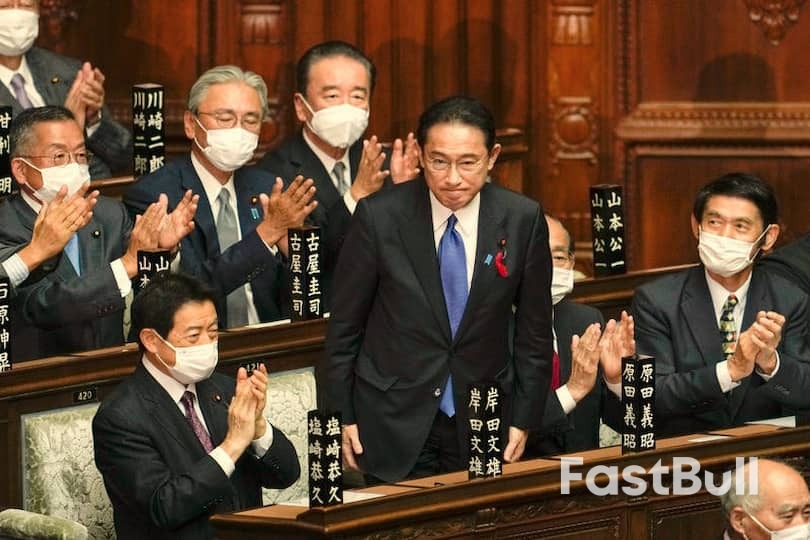
On Nov. 10, Fumio Kishida was re-elected as the 101st prime minister of Japan by parliament in 38 days. Kishida retained the lineup of his first Cabinet, formed on Oct. 4 when he took office, except for naming a new foreign minister - Yoshimasa Hayashi. Though Kishida’s Cabinet has been firmed up, following an approval rating of 53% in an NHK poll, Japan’s economic development still struck in an uncertain state. People’ concern about the Covid-19 pandemic and their expectations for economic recovery and narrowing the disparity between rich and poor, the disarray within the ruling party, the upcoming Senate election, and the intensification of conflicts in the Asia-Pacific region all have cast a shadow over the Japanese economy.
No fatal challenge but the road ahead is uncertain
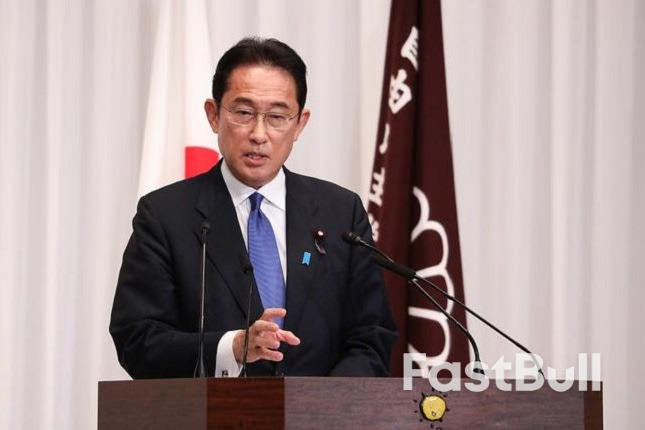
Kishida has stressed that his top priorities were to bring the epidemic under complete control to eliminate public anxiety, to revive economic growth and alleviate the gap between the rich and the poor, including the creation of a self-reinforcing cycle of growth and economic distribution under his “new capitalism” economic policy shifting from the neoliberal policies left in place by his predecessors, Junichiro Koizumi.
Kishida said at a late-night news conference on Nov. 10 that the government's current priorities are the pandemic and the economy, promising to announce its overall strategy for dealing with the novel coronavirus pandemic On Nov. 12. A comprehensive package of economic measures, including how to handle social disparities in wealth, will be compiled on Nov. 19 and Kishida will seek to pass a supplementary budget to implement those measures before year-end.
According to a report by Reuter Tokyo, Kishida vowed to develop a pandemic rescue stimulus plan worth "tens of trillions of yen", which will provide cash payouts and coupons for the coronavirus-hit households, to be announced next week. But according to Kishida's previous public statements, the main source of funding for this plan is likely via the issuance of new Treasury bonds, which in turn will be detrimental to the Japanese government's fiscal position.
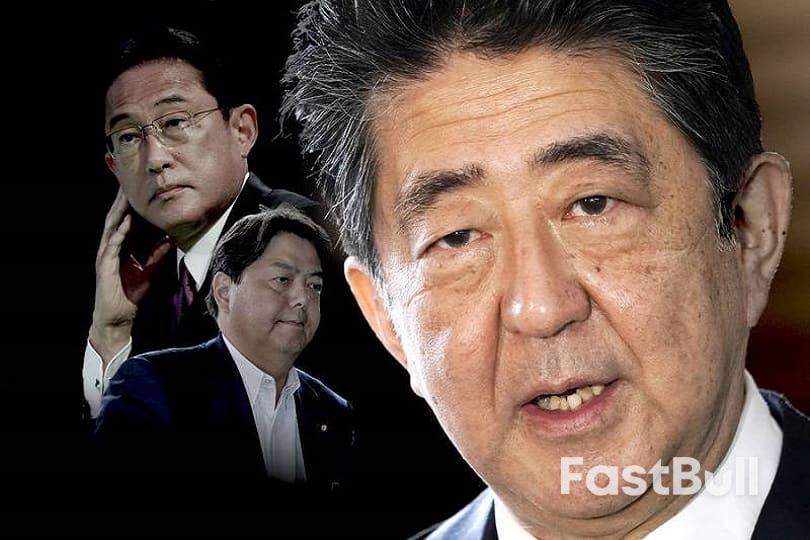
At the plenary session of the House of Representatives on the 10th, Hiroyuki Hosoda, the chairman of the largest intraparty faction of the LDP, the Seiwa political research council, was elected as one of the speakers of the House of Representatives. As a rule, the speaker will leave the party membership. For this reason, senior officials of the faction held a meeting to approve a proposal to make the former Prime Minister Shinzo Abe the next chairman.
In 2012, Abe was elected president of the LDP and then left the Seiwa political research council, and had not joined an intraparty bloc even after stepping down from his leadership post in September last year, but his influence within the faction cannot be ignored. According to Japanese media reports, Abe will return officially at the faction's general meeting on the 11th, when the faction will be commonly known as the Abe faction.
Previously, Kishida was elected president of the LDP in the September election and then became prime minister of Japan, relying mainly on the support of Abe and former Deputy Prime Minister and Minister of Finance Taro Aso and other party bigwigs, therefore, when it comes to the nomination of the top of the LDP and the cabinet, important positions were naturally taken up by Abe and Aso forces.
Currently, Kishida's control over the regime has been strengthened by the resignation of the LDP Secretary General, Akira Amari, who is close to Abe and Aso, and the appointment of the No. 2 figure in a faction headed by Kishida, Yoshimasa Hayashi, to the key cabinet post of foreign minister. However, the change of factional power within the LDP will still have an important impact on Kishida's regime, especially on the issue of how to implement the "new capitalism" policy.
According to Jiji Press, at a press conference on his inauguration of serving the Foreign Minister, Hayashi has decided to quit as the head of a cross-party parliamentary group promoting Japan-China friendship, "to avoid causing unnecessary misunderstanding."
The move is intended to allay fears among some hard-line members of the LDP that his position as foreign minister might lead to a weak stance toward China. It is worth noting that Yoshimasa Hayashi has always described himself as "knowledgeable about China" rather than “pandering to China”, indicating that he has been reserved about the optimism of future Sino-Japanese relations.
Meanwhile, it is important to note that Hayashi is well-connected in U.S. politics, and on Japan-U.S. relations, he advocates that both sides should further deepen the alliance and strengthen deterrence and response power. This is an indication that the Kishida administration's diplomatic framework remains the same stance as that of the Abe administration - Japan places more emphasis on a rules-based international order to safeguard its own national interests and values and hopes to exert traction on countries including China and the U.S. within this framework.
Therefore, it is still difficult for Japan to adjust its diplomacy towards China, and it will continue to actively cooperate with the United States for the US strategic deployment in the Asia-Pacific region. In particular, Hayashi’s speech on 11th about the historical legacy of human rights issues has shown a tense relation with countries in the Asia-Pacific region to a certain extent.
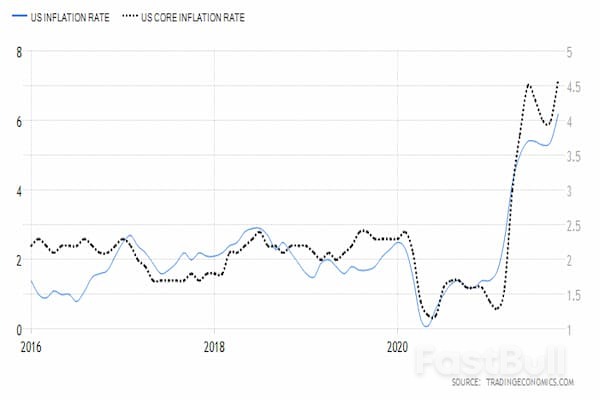
The data released from Labor Department showed that CPI rose for the 17th month in October, increased 6.2% on a year-over-year basis, the highest level in 31 years. Core inflation, stripping out food and energy, increased 4.6%, beating expectations of 4.3% and continuing to set a new record since the outbreak of Covid-19.
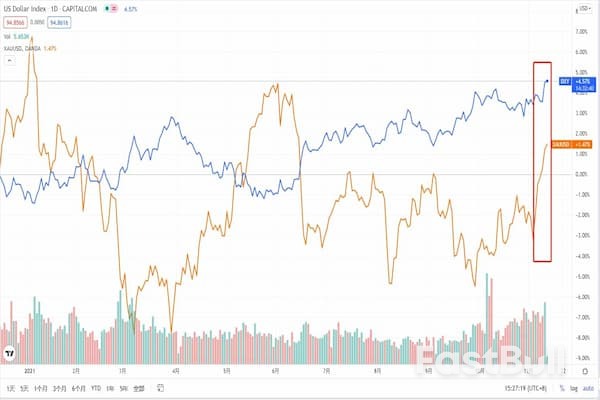
In the face surprising inflation data, the financial market also reacted strongly, the VIX jumped close to 20, the three major US stock indexes that kept hitting new highs fell sharply, the dollar index soared to nearly 100 bps overnight, the US treasury yields soared, and the 5-Year Breakeven Inflation Rate hit 3.1%, the highest since 2002. Crypto currency intraday hit an all-time high again, and gold jumped more than $40......All kinds of rare records burst out.
Dollar surged with gold
It is fair to say that the high inflation data has not only renewed doubts about the credibility of the theory that inflation to be transitory, but also sparked speculation that the Fed may raise interest rates sooner than expected. So what we have seen is an unusual phenomenon: gold rose almost in tandem with the dollar index, breaking the negative relationship between the two.
Dollar surged, if only on the basis of rate hike anticipation builds, but gold rally is counterintuitive. Gold has almost fallen lopsided and moved almost in the opposite direction of the dollar after the release of stronger than expected CPI data this year, as high inflation could lead to tighter monetary policy. But this time gold bears seem to have no resistance, there is no too much entanglement in disk surface, gold even rose above 1860. It is clear that high inflation has sparked fears and riots, and that gold is playing a key role in hedging against inflation.
In fact, since the Fed announced to start tapering its bound purchases in November, which should be a signal of tighter policy, but gold has not been affected by the announcement and has staged an unusually strong rally. Shows that the market has fully digested the tapering in the early days and is now completely indifferent to it. As for the continuity of inflation, the Fed can be described as obsessively confident. The Fed has repeatedly made it clear that it is still premature to start talking about rate increases, at least until June next year, so the expected impact of rate hikes on gold at least at this stage is also minimal.
How does inflation affect gold?
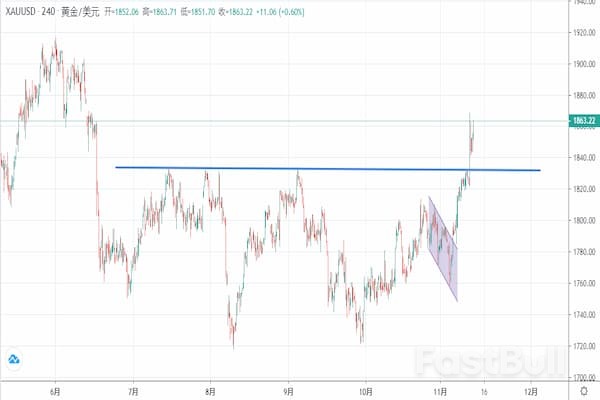
Gold surged this time which also easily broke through a key resistance at 1832 and occurred as the dollar was moving higher, has also led several investment institutions to raise their expectations for the future movement of gold.
Citi lifted its zero- to three-month gold price target by 11% to $1,900 an ounce. David Meger, director of metals trading at High Ridge Futures. He said, gold being the quintessential hedge against inflation, they believe inflation is the underlying positive environment that will foster the gold market rally in the weeks and months ahead. So what is the possible movement next for gold?
Gold itself has two main characteristics, it is both a typical hedge against inflation and very sensitive to interest rates, but when interest rate hike expectations rise and inflation spikes at the same time, many investors become confused.
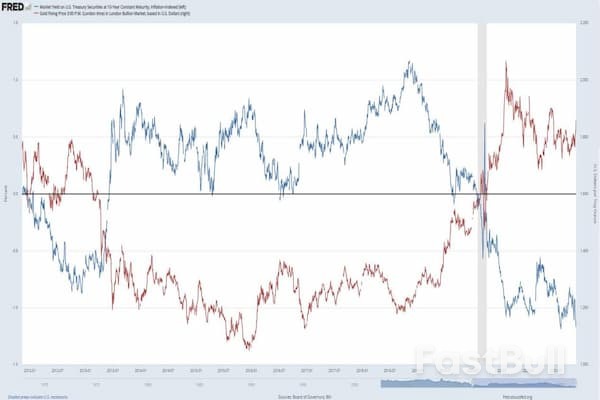
Over the long term, the price of gold actually depends on the U.S. real interest rate, which is the yield of Treasury Inflation-Protected Security (TIPS), the difference between the treasury yields and the expected inflation rate for the same maturity. When the U.S. real interest rate rises, the price of gold falls; when the U.S. real interest rate falls, the price of gold rises.
Looking at just the last decade, gold has maintained a near-perfect inverse relationship with the yield of 10-year TIPS, with few exceptions.
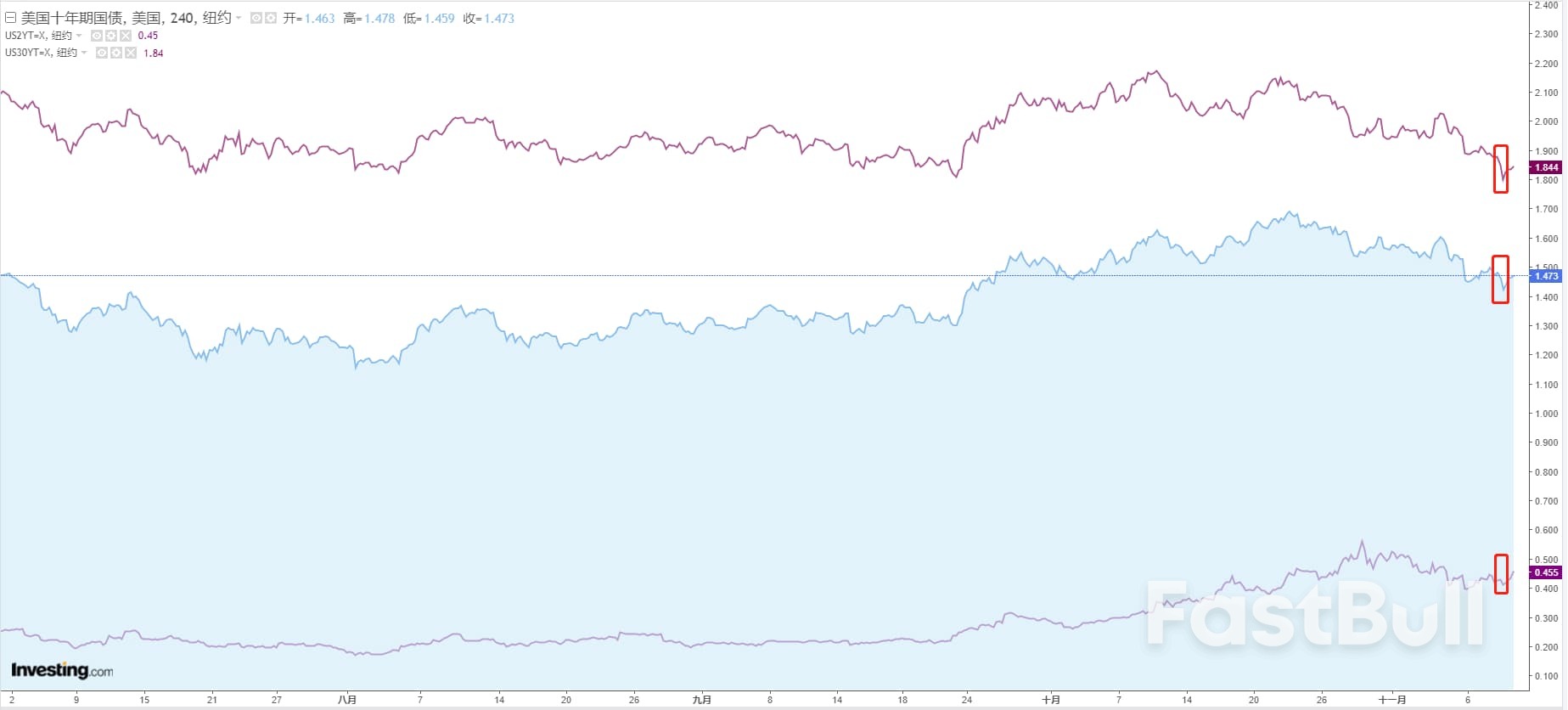
In October, when CPI exceeded 6%, the U.S. bond yields collectively soared, as did the breakeven inflation rate, which represents inflation expectations, while the U.S. real interest rate, which represents the yield of TIPS, fell further. The 10-year TIPS yield fell as low as -1.243%, while the 30-year yield fell to -0.608%, both record lows.
Aside from the Fed's 0-0.25% nominal interest rate, real interest rates fell into negative, indicating that treasury yields, anchor of the global asset pricing, have run down inflation expectations and inflation is becoming more and more serious. As long as the Fed continues "printing money" in short-term, the U.S. real interest rates are likely to remain negative, and gold still has room to rise.
In terms of technical charts, gold broke through the key pressure level of 1832 after the early flag consolidation, and the next primary target are expected near 1900.
Recently, the news about the change of leadership of Fed set off a hot discussion in the whole market. Powell’s term as chairman of the Fed is set to expire in February 2022, and whether he will be reappointed as chairman of the Fed for the next four years is the focus of the market. Especially in the wake of the Fed’s Taper announcement, the market considering betting on future selections and is anxious for some indication of the policy bias.
Competitors
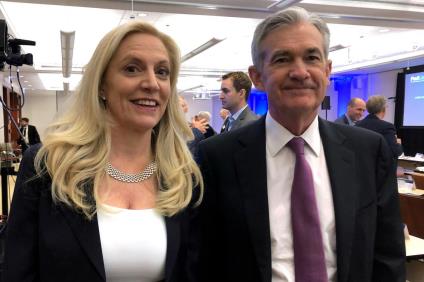
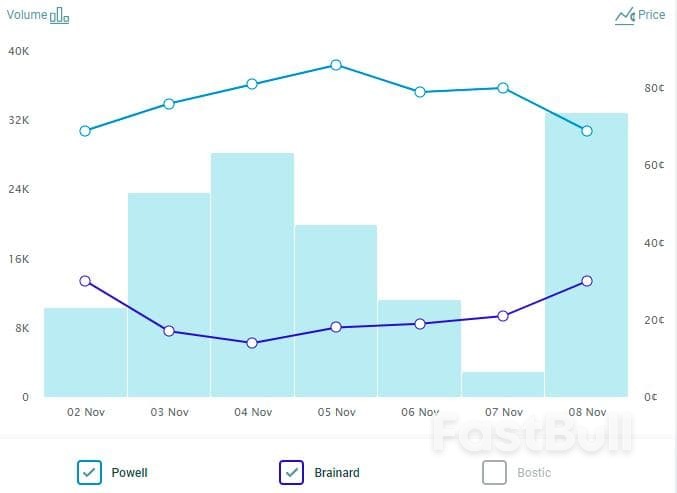
Current market expectations for mainstream Fed chair candidate center on current Fed Chairman Powell and Fed Governor Brainard. Powell is widely expected to win a second term, but Brainard is gaining support.
Powell
As his predecessor Yellen said, Powell has certainly done a good job, particularly in managing the transition without major missteps during a time of great challenges such as the covid-19. Powell, a Republican and former deputy Treasury secretary, joined the Fed board of Governors in May 2012 and has been nominated as chairman of the Fed since Trump took office. Powell is a centrist in monetary policy stance and supports easing financial regulation. Judging from his previous speeches and policy stance, although he had a "hawkish" tendency in monetary policy in the past, he paid more attention to balance and further strengthened the "expectation management" means of the Federal Reserve.
The Fed's monetary policy stance is expected to be more balanced if Powell is reappointed, but that is one of the biggest obstacles to his reappointment. Throughout history, the previous U.S. governments prefer to use relatively loose policies to stimulate and guarantee the growth momentum of the economy and the prosperity of the financial market in order to achieve political achievements. Powell raised interest rates four times in 2018, causing the stock market to tumble, which make the ruling Democrats worried, because they don't want any more fallout in next year's midterm elections.
Brainard
Another candidate, Fed Governor Brainard, a Democrat, was nominated as a member of the Fed board by Obama in 2014. Brainard is also a former deputy Treasury secretary whose monetary policy stance is seen as more dovish than Powell's and more in line with Democratic Party’s needs in the midterm elections. After Brainard was summoned by the White House, there was even more obvious turmoil in the market, with both short and long term treasury yields falling. Markets are beginning to anticipate whether brainard, if nominated, will favor a slower Taper process and a later tapering point.
Moreover, for the Fed's two main policy goals, Brainard prioritized full employment over inflation and was more tolerant of higher inflation. In a Speech in September, She said full employment should be measured not by aggregate measures but by the welfare and job market status of "marginalized" groups like people of color. In terms of financial stability, Brainard supports the development of digital currency in the United States, but does not support those virtual currencies with high volatility, inadequate supervision and severe risks. She strongly advocates the rectification of financial regulation, including the recent stock market turmoil caused by members of the Federal Reserve. On climate change, Brainard believes that the Fed should establish a climate monitoring and analysis model, and timely assess and predict the risk impact of climate change.
Brainard's track record on jobs, financial stability is also consistent with the Democratic Party, which will be an advantage in her chances of getting the Fed nomination.
Easing will continue
According to the latest odds on Predictit, a U.S. political betting website, Powell's chances remain high, even as Brainard's support continues to rise.
However, considering the overall easing environment of the Fed, many industry analysts believe that whoever wins, the basic framework of monetary policy will not change sharply, next June or so will finish the purchase.
Michael Feroli, chief U.S. Economist at J.P. Morgan, said there are many institutional factors that influence the Fed's decisions and provide continuity, including the role of regional banks and the influence of the Fed's staff. With Brainard seen as more dovish, the market could expect inflation expectations to rise further, but the renewed recovery in treasury yields also reflects affirmation of the continuity of Fed policymaking.
In short, there's no need to read too much into a Fed reshuffle or expect a dramatic change in policy, as the Fed does not want to see financial market turmoil.
White Label
Data API
Web Plug-ins
Poster Maker
Affiliate Program
The risk of loss in trading financial instruments such as stocks, FX, commodities, futures, bonds, ETFs and crypto can be substantial. You may sustain a total loss of the funds that you deposit with your broker. Therefore, you should carefully consider whether such trading is suitable for you in light of your circumstances and financial resources.
No decision to invest should be made without thoroughly conducting due diligence by yourself or consulting with your financial advisors. Our web content might not suit you since we don't know your financial conditions and investment needs. Our financial information might have latency or contain inaccuracy, so you should be fully responsible for any of your trading and investment decisions. The company will not be responsible for your capital loss.
Without getting permission from the website, you are not allowed to copy the website's graphics, texts, or trademarks. Intellectual property rights in the content or data incorporated into this website belong to its providers and exchange merchants.
Not Logged In
Log in to access more features

FastBull Membership
Not yet
Purchase
Log In
Sign Up