• Trade
  • Markets
  • Copy
  • Contests
  • News
  • 24/7
  • Calendar
  • Q&A
  • Chats
Trending
Screeners
SYMBOL
LAST
BID
ASK
HIGH
LOW
NET CHG.
%CHG.
SPREAD
SPX
S&P 500 Index
6870.39
6870.39
6870.39
6895.79
6858.28
+13.27
+ 0.19%
--
DJI
Dow Jones Industrial Average
47954.98
47954.98
47954.98
48133.54
47871.51
+104.05
+ 0.22%
--
IXIC
NASDAQ Composite Index
23578.12
23578.12
23578.12
23680.03
23506.00
+72.99
+ 0.31%
--
USDX
US Dollar Index
98.950
99.030
98.950
99.060
98.740
-0.030
-0.03%
--
EURUSD
Euro / US Dollar
1.16426
1.16443
1.16426
1.16715
1.16277
-0.00019
-0.02%
--
GBPUSD
Pound Sterling / US Dollar
1.33312
1.33342
1.33312
1.33622
1.33159
+0.00041
+ 0.03%
--
XAUUSD
Gold / US Dollar
4197.91
4197.91
4197.91
4259.16
4191.87
-9.26
-0.22%
--
WTI
Light Sweet Crude Oil
59.809
60.061
59.809
60.236
59.187
+0.426
+ 0.72%
--

Community Accounts

Signal Accounts
--
Profit Accounts
--
Loss Accounts
--
View More

Become a signal provider

Sell trading signals to earn additional income

View More

Guide to Copy Trading

Get started with ease and confidence

View More

Signal Accounts for Members

All Signal Accounts

Best Return
  • Best Return
  • Best P/L
  • Best MDD
Past 1W
  • Past 1W
  • Past 1M
  • Past 1Y

All Contests

  • All
  • Trump Updates
  • Recommend
  • Stocks
  • Cryptocurrencies
  • Central Banks
  • Featured News
Top News Only
Share

Industry Source: Merz And Macron To Discuss Fate Of Fcas Fighter Jet

Share

Ukraine President Zelenskiy: Has Agreed On The Next Steps, Format For Talks With America

Share

Ukraine President Zelenskiy: Ukraine Is Determined To Continue Working Honestly With The American Side In Order To Bring Real Peace

Share

Ukraine President Zelenskiy: He Spoke With Steve Witkoff And Jared Kushner

Share

South Africa Department Of Home Affairs: Following Abuse Of Palestinian Travellers, Home Affairs Withdraws 90-Day Visa Exemption

Share

Qatar's Prime Minister: Gaza Talks At Critical Moment, Ceasefire Not Complete

Share

French President Macron: I Will Go To London On Monday To Meet Ukraine President Zelenskiy , British Prime Minister, Germany's Merz

Share

French President Macron: We Must Continue To Put Pressure On Russia To Force It Toward Peace

Share

French President Macron: Condemning Most Strongly The Massive Strikes That Hit Ukraine Last Night

Share

Patria: Brazil's Soy Sowing Close To Ending

Share

Apk-Inform Ups Ukraine's 2025 Grain Crop Forecast To 60.6 Million Tons

Share

Apk-Inform Increases Ukraine's 2025 Wheat Harvest Outlook To 23.2 Million Tons From 22.7 Million Tons

Share

[Musk Says The EU Should Be Abolished] Musk Posted On The X Platform, Saying, "The EU Should Be Abolished And Sovereignty Should Be Returned To Individual Countries So That Governments Can Better Represent Their People." Previously, Musk's X Platform Was Fined €120 Million By The EU

Share

India's Fuel Demand Rose 3.0% Year-On-Year In Nov

Share

Turkish Foreign Minister: Israel's "Destabilisation Policies" In Syria Are Main Problem Challenging Efforts Toward Unity

Share

Turkish Foreign Minister: Kurdish Sdf Should Understand That Control And Command Should Come From "One Place"

Share

Turkish Foreign Minister: Ankara Is Not Giving Syrian Government A "Blank Cheque" To Oppress Minorities, Everyone Must Feel Safe And Free

Share

Turkish Foreign Minister Tells Reuters: Signs Show Kurdish Sdf Has No Intention Of Honouring Deal To Integrate Into Syrian State Structures, They Want To Circumvent It

Share

Turkish Foreign Minister: USA 28-Point Plan To End Russia-Ukraine War Was Just Starting Point, It Is Now Evolving

Share

Turkish Foreign Minister: We Are 'On Right Path' In Terms Of Mediation Regarding Ukraine War, Hope Sides Don't Leave Negotiation Table

TIME
ACT
FCST
PREV
Euro Zone Employment YoY (SA) (Q3)

A:--

F: --

P: --

Euro Zone GDP Final YoY (Q3)

A:--

F: --

P: --

Euro Zone GDP Final QoQ (Q3)

A:--

F: --

P: --

Euro Zone Employment Final QoQ (SA) (Q3)

A:--

F: --

P: --

Euro Zone Employment Final (SA) (Q3)

A:--

F: --

P: --
Brazil PPI MoM (Oct)

A:--

F: --

P: --

Mexico Consumer Confidence Index (Nov)

A:--

F: --

P: --

Canada Unemployment Rate (SA) (Nov)

A:--

F: --

P: --

Canada Labor Force Participation Rate (SA) (Nov)

A:--

F: --

P: --

Canada Employment (SA) (Nov)

A:--

F: --

P: --

Canada Part-Time Employment (SA) (Nov)

A:--

F: --

P: --

Canada Full-time Employment (SA) (Nov)

A:--

F: --

P: --

U.S. Personal Income MoM (Sept)

A:--

F: --

P: --

U.S. PCE Price Index YoY (SA) (Sept)

A:--

F: --

P: --

U.S. PCE Price Index MoM (Sept)

A:--

F: --

P: --

U.S. Personal Outlays MoM (SA) (Sept)

A:--

F: --

P: --

U.S. Core PCE Price Index MoM (Sept)

A:--

F: --

P: --

U.S. Core PCE Price Index YoY (Sept)

A:--

F: --

P: --

U.S. UMich 5-Year-Ahead Inflation Expectations Prelim YoY (Dec)

A:--

F: --

P: --

U.S. Real Personal Consumption Expenditures MoM (Sept)

A:--

F: --

P: --

U.S. 5-10 Year-Ahead Inflation Expectations (Dec)

A:--

F: --

P: --

U.S. UMich Current Economic Conditions Index Prelim (Dec)

A:--

F: --

P: --

U.S. UMich Consumer Sentiment Index Prelim (Dec)

A:--

F: --

P: --

U.S. UMich 1-Year-Ahead Inflation Expectations Prelim (Dec)

A:--

F: --

P: --

U.S. UMich Consumer Expectations Index Prelim (Dec)

A:--

F: --

P: --

U.S. Weekly Total Rig Count

A:--

F: --

P: --

U.S. Weekly Total Oil Rig Count

A:--

F: --

P: --

U.S. Unit Labor Cost Prelim (SA) (Q3)

--

F: --

P: --

U.S. Consumer Credit (SA) (Oct)

A:--

F: --

P: --

China, Mainland Foreign Exchange Reserves (Nov)

--

F: --

P: --

China, Mainland Exports YoY (USD) (Nov)

--

F: --

P: --

China, Mainland Imports YoY (CNH) (Nov)

--

F: --

P: --

China, Mainland Imports YoY (USD) (Nov)

--

F: --

P: --

China, Mainland Imports (CNH) (Nov)

--

F: --

P: --

China, Mainland Trade Balance (CNH) (Nov)

--

F: --

P: --

China, Mainland Exports (Nov)

--

F: --

P: --

Japan Wages MoM (Oct)

--

F: --

P: --

Japan Trade Balance (Oct)

--

F: --

P: --

Japan Nominal GDP Revised QoQ (Q3)

--

F: --

P: --

Japan Trade Balance (Customs Data) (SA) (Oct)

--

F: --

P: --

Japan GDP Annualized QoQ Revised (Q3)

--

F: --

P: --
China, Mainland Exports YoY (CNH) (Nov)

--

F: --

P: --

China, Mainland Trade Balance (USD) (Nov)

--

F: --

P: --

Germany Industrial Output MoM (SA) (Oct)

--

F: --

P: --

Euro Zone Sentix Investor Confidence Index (Dec)

--

F: --

P: --

Canada Leading Index MoM (Nov)

--

F: --

P: --

Canada National Economic Confidence Index

--

F: --

P: --

U.S. Dallas Fed PCE Price Index YoY (Sept)

--

F: --

P: --

U.S. 3-Year Note Auction Yield

--

F: --

P: --

U.K. BRC Overall Retail Sales YoY (Nov)

--

F: --

P: --

U.K. BRC Like-For-Like Retail Sales YoY (Nov)

--

F: --

P: --

Australia Overnight (Borrowing) Key Rate

--

F: --

P: --

RBA Rate Statement
RBA Press Conference
Germany Exports MoM (SA) (Oct)

--

F: --

P: --

U.S. NFIB Small Business Optimism Index (SA) (Nov)

--

F: --

P: --

Mexico Core CPI YoY (Nov)

--

F: --

P: --

Mexico 12-Month Inflation (CPI) (Nov)

--

F: --

P: --

Mexico PPI YoY (Nov)

--

F: --

P: --

Mexico CPI YoY (Nov)

--

F: --

P: --

Q&A with Experts
    • All
    • Chatrooms
    • Groups
    • Friends
    Connecting
    .
    .
    .
    Type here...
    Add Symbol or Code

      No matching data

      All
      Trump Updates
      Recommend
      Stocks
      Cryptocurrencies
      Central Banks
      Featured News
      • All
      • Russia-Ukraine Conflict
      • Middle East Flashpoint
      • All
      • Russia-Ukraine Conflict
      • Middle East Flashpoint
      Search
      Products

      Charts Free Forever

      Chats Q&A with Experts
      Screeners Economic Calendar Data Tools
      Membership Features
      Data Warehouse Market Trends Institutional Data Policy Rates Macro

      Market Trends

      Market Sentiment Order Book Forex Correlations

      Top Indicators

      Charts Free Forever
      Markets

      News

      News Analysis 24/7 Columns Education
      From Institutions From Analysts
      Topics Columnists

      Latest Views

      Latest Views

      Trending Topics

      Top Columnists

      Latest Update

      Signals

      Copy Rankings Latest Signals Become a signal provider AI Rating
      Contests
      Brokers

      Overview Brokers Assessment Rankings Regulators News Claims
      Broker listing Forex Brokers Comparison Tool Live Spread Comparison Scam
      Q&A Complaint Scam Alert Videos Tips to Detect Scam
      More

      Business
      Events
      Careers About Us Advertising Help Center

      White Label

      Data API

      Web Plug-ins

      Affiliate Program

      Awards Institution Evaluation IB Seminar Salon Event Exhibition
      Vietnam Thailand Singapore Dubai
      Fans Party Investment Sharing Session
      FastBull Summit BrokersView Expo
      Recent Searches
        Top Searches
          Markets
          News
          Analysis
          User
          24/7
          Economic Calendar
          Education
          Data
          • Names
          • Latest
          • Prev

          View All

          No data

          Scan to Download

          Faster Charts, Chat Faster!

          Download App
          English
          • English
          • Español
          • العربية
          • Bahasa Indonesia
          • Bahasa Melayu
          • Tiếng Việt
          • ภาษาไทย
          • Français
          • Italiano
          • Türkçe
          • Русский язык
          • 简中
          • 繁中
          Open Account
          Search
          Products
          Charts Free Forever
          Markets
          News
          Signals

          Copy Rankings Latest Signals Become a signal provider AI Rating
          Contests
          Brokers

          Overview Brokers Assessment Rankings Regulators News Claims
          Broker listing Forex Brokers Comparison Tool Live Spread Comparison Scam
          Q&A Complaint Scam Alert Videos Tips to Detect Scam
          More

          Business
          Events
          Careers About Us Advertising Help Center

          White Label

          Data API

          Web Plug-ins

          Affiliate Program

          Awards Institution Evaluation IB Seminar Salon Event Exhibition
          Vietnam Thailand Singapore Dubai
          Fans Party Investment Sharing Session
          FastBull Summit BrokersView Expo

          5 big analyst AI moves: AI stocks’ valuations nearing dotcom levels; AMD upgraded

          Investing.com
          NVIDIA
          -0.53%
          Apple
          -0.68%
          Tesla
          +0.10%
          Microsoft
          +0.67%
          Amazon
          +0.26%
          Summary:

          Investing.com -- Here are the biggest analyst moves in the area of artificial intelligence (AI) for this week. InvestingPro...

          Investing.com -- Here are the biggest analyst moves in the area of artificial intelligence (AI) for this week.

          InvestingPro subscribers always get first dibs on market-moving AI analyst comments. Upgrade today!

          AMD upgraded at Truist to Buy on AI traction

          Advanced Micro Devices (NASDAQ:AMD) received an upgrade at Truist Securities this week, to Buy from Hold, with the broker also lifting its price target to $213 from $173. The firm pointed to stronger industry feedback on the company’s data center and AI momentum.

          Truist analysts said “industry contact feedback turns constructive on AMD’s DC/AI traction,” noting that hyperscale customers are increasingly treating AMD as a true partner “expressing true interest in deploying AMD at scale.”

          Analysts said this marks a shift from past years, when AMD was seen mainly as a “price check” against Nvidia (NASDAQ:NVDA).

          The bank acknowledged its long-standing view that Nvidia’s GPU dominance, anchored by CUDA, left little room for a second supplier. But sentiment has turned.

          “Recently, they have told us that hyperscale customers are working with AMD as a potential partner rather than simply as a ‘price check’ to NVDA. This change in messaging from the field is the basis of our upgrade,” Truist’s team wrote.

          Analysts compared the development to AMD’s rise in server CPUs, where its share climbed from less than 1% in 2018 to about 21% after the launch of its “Rome” product as Intel faltered. For GPUs, they don’t expect Nvidia to repeat Intel’s mistakes but now see AMD achieving a sustainable 10% market share.

          Truist raised its earnings forecasts, putting calendar year 2027 (CY27) EPS at $7.89, and highlighted AMD’s MI355 chip, introduced in June, as a catalyst for growth in the coming quarters.

          AI stocks’ valuations getting closer to dotcom levels

          UBS is warning that valuations in artificial intelligence stocks are approaching levels last seen during the dotcom boom, raising concerns over sustainability despite record investment by major U.S. technology firms.

          The bank noted that the U.S. tech sector is trading at an aggregate HOLT Economic price-to-earnings (P/E) above 35 times, a level comparable to the post-dotcom peak.

          HOLT Economic is UBS’s proprietary valuation and performance model, which suggests that much of today’s market value is tied to expectations of future cash flows rather than current earnings.

          That leaves “little room for cash flow disappointments,” said Michel Lerner, head of the HOLT analytical service at UBS, citing uncertainties around massive capex returns, data center energy limits, and intensifying competition from China.

          AI has become a dominant theme in corporate earnings, with one in four company releases now mentioning the technology, Lerner said.

          Spending has surged, with the largest U.S. tech companies expected to commit $350 billion to capex this year—exceeding the combined annual capex of all listed energy and utilities companies in the U.S. and Europe.

          Lerner added that Apple (NASDAQ:AAPL), Nvidia and Broadcom (NASDAQ:AVGO), together with hyperscalers, spent more on R&D in 2024 than all listed European equities combined. Collectively, these firms are projected to generate 37% of U.S. economic profit in 2025, more than six times Europe’s total.

          Still, he cautioned that “many of the use cases are premised on future, rather than current revenue opportunities,” highlighting comments from OpenAI CEO Sam Altman, who has acknowledged the sector may be in a bubble.

          Also, a recent MIT study found 95% of generative AI pilots are failing to deliver immediate revenue growth, underscoring the gap between hype and realization.

          Lerner warned that cash flow resilience for Big Tech could weaken, with consensus pointing to declines in Cash Flow Return on Investment for Amazon (NASDAQ:AMZN), Meta (NASDAQ:META), Microsoft (NASDAQ:MSFT) and Alphabet (NASDAQ:GOOGL) over the next two years.

          Power supply constraints also present risks, as hyperscaler investment far outpaces utilities’ capacity to deliver.

          In light of these risks, UBS advised investors to diversify exposure, pointing to opportunities in non-U.S. quality growth stocks, global names within secular growth ETFs outside U.S. AI, and sectors like real estate, utilities, energy, communication services and staples, which historically show low correlation to U.S. tech performance.

          BofA cuts Marvell to Neutral on softer AI growth outlook

          Bank of America downgraded Marvell Technology Inc (NASDAQ:MRVL) to Neutral from Buy on Friday, citing softer confidence in the chipmaker’s AI growth outlook through 2026. The price target was also cut to $78 from $90.

          The bank now values the stock at 24 times CY26 earnings, down slightly from 25 times but still consistent with Marvell’s historical multiples.

          BofA analysts said they “did not hear the same level of confidence/visibility about MRVL’s AI growth prospects in the near/medium term,” pointing to “incrementally higher uncertainty” around Microsoft’s Maia project and Marvell’s role in Amazon’s next-generation 3nm chip program.

          BofA’s CY26 data center growth forecast was cut to mid-teens from a prior 23-25%. That translates into “a $100mn lower quarterly run-rate, and hence a $400mn drag on projected FY27/CY26 sales.”

          The downgrade follows weaker recent performance. Marvell slightly missed second-quarter data center guidance, delivered 3% sequential growth, and projected flat third-quarter revenue compared with consensus for a 5% increase.

          Even so, BofA highlighted the chipmaker’s valuation support and financial flexibility. “

          At after-hours price, MRVL is trading at 20x-21x PE, which tends to provide a floor to compute stocks with strong breadth of IP,” the analysts said in a note earlier this week, noting $2.5 billion in proceeds from its auto unit sale could be used for buybacks or acquisitions.

          Wall Street starts coverage on ’key Edge AI beneficiary’

          Ambiq Micro (NYSE:AMBQ) has drawn a mix of optimism and caution from Wall Street as analysts initiated coverage on the low-power chipmaker following its July IPO.

          Stifel started with a Buy rating and a $45 target, calling Ambiq’s proprietary “SPOT” platform a key differentiator.

          “Based on SPOT’s unique ability to deliver materially better compute performance/watt at the transistor level, we believe Ambiq is positioned to become a key beneficiary of the rapidly-emerging Edge AI market opportunity,” analysts led by Tore Svanberg wrote.

          The brokerage expects a revenue inflection in 2026, supported by the Atomiq platform and a broader customer base.

          Ambiq shares jumped more than 60% in their debut, closing at $38.53 and valuing the company around $657 million. After some early volatility, the stock has steadied near those levels, last trading at $39.71.

          Other banks were more cautious. UBS began coverage at Neutral with a $40 target, pointing to Ambiq’s strong positioning in wearables but warning that “profitability will take time with Ambiq only turning profitable in 2028E and even this keyed to the launch of Atomiq.”

          UBS highlighted execution risks and customer concentration, though it noted relationships with Google, Garmin, and WHOOP.

          Bank of America also initiated at Neutral with a $42 target, describing Ambiq as a “low-power edge-AI specialist 3+ years from profit.”

          The bank said the company has shipped over 270 million devices but remains reliant on a few key customers. It projects gross margins climbing to about 54% by 2028, the same year Ambiq is expected to achieve profitability.

          AI will not be the ’death of software’, RBC says

          RBC Capital Markets pushed back against the notion that AI will make traditional software obsolete, calling the “death of software” narrative overstated.

          Software stocks have faced pressure recently, though RBC argued much of it reflects misplaced concerns. The IGV software ETF (NYSE:IGV) is up around 8% this year, but gains have been driven largely by Microsoft, Oracle (NYSE:ORCL) and Palantir.

          Excluding those names, the ETF would be down by double-digits, the bank noted.

          RBC analysts said the market is split between two views: one claiming “all software will be replaced by agents and multi-agentic systems” and another that believes incumbents’ “valuable data and distribution” will protect them and enable AI monetization.

          Analysts led by Rishi Jaluria outlined a middle ground, writing that “AI will benefit some, but not all incumbents, while also creating net-new scaled companies and accelerating AI-focused M&A.”

          The team questioned whether incumbents’ data advantage is as strong as often claimed, pointing to ownership uncertainty, data commoditization, and the growing importance of real-time data.

          They also flagged disintermediation risks as AI-native vendors augment existing platforms before competing directly.

          Lower entry barriers, such as “vibe coding,” could intensify competition, but analysts said this may also expand software budgets by fostering more innovation.

          M&A is expected to be a key strategy for traditional vendors, though analysts cautioned that monetization of AI may take longer, with broad adoption across enterprises potentially not arriving until 2028 or later.

          “In the interim, we may start to see indirect monetization of AI, whether that shows up in greater consumption, higher engagement, improved win rates, or better gross retention rates,” they said.

          The bank identified Microsoft, Intuit (NASDAQ:INTU), HubSpot (NYSE:HUBS), MongoDB (NASDAQ:MDB) and Pegasystems (NASDAQ:PEGA) as best positioned to “cross the chasm” in a post-AI world, while being more cautious on Salesforce Inc (NYSE:CRM) and ZoomInfo (NASDAQ:GTM).

          It added that recent pullbacks in names such as Dynatrace (NYSE:DT), HubSpot, MongoDB, ServiceNow (NYSE:NOW) and Snowflake (NYSE:SNOW) may be overdone.

          Risk Warnings and Disclaimers
          You understand and acknowledge that there is a high degree of risk involved in trading. Following any strategies or investment methods may lead to potential losses. The content on the site is provided by our contributors and analysts for information purposes only. You are solely responsible for determining whether any trading assets, securities, strategy, or any other product is suitable for investing based on your own investment objectives and financial situation.
          Add to Favorites
          Share

          Street Calls of the Week

          Investing.com
          Tesla
          +0.10%
          American Eagle
          -4.51%
          NVIDIA
          -0.53%
          Green Plains Inc.
          -5.34%
          Meta Platforms
          +1.74%

          Investing.com -- Here is your Pro Recap of the top takeaways from Wall Street analysts for the past week.

          InvestingPro subscribers always get first dibs on market-moving AI analyst comments. Upgrade today!

          American Eagle Outfitters

          What happened? On Monday, BofA Securities downgraded American Eagle Outfitters Inc (F:AEOS) to Underperform with a $10 price target.

          *TLDR: BofA downgrades AEO, warns on earnings. Stock risks deepen, dividends threatened.

          What’s the full story? BofA slashes AEO to Underperform, gutting its F25/F26 EPS estimates by 8%/30% to $0.65/$0.95. The bank sees tariffs biting and Aerie sales tanking, dragging the earnings outlook into a longer, uglier recovery. With the stock floundering at 5x EV/EBITDA (F26E) and 13.5x P/E, BofA warns of more downside as mall-based peers trade at 5.6x and 11.7x, respectively. The fundamental backdrop? Rotting faster than a 2008 subprime mortgage.

          The bank hacks its price target to $10, down from $11, now pegged to a miserly 4x F26E EV/EBITDA—a discount to peers but still generous in this dumpster fire. The income rating gets a downgrade to 8 (same/lower), flagged for a likely dividend cut with a payout ratio screaming 76%.

          Translation: AEO’s cash flow is on life support, and BofA isn’t buying the hopium. Buckle up—this ride’s about to get uglier.

          AMD

          What happened? On Tuesday, Truist upgraded Advanced Micro Devices Inc (NASDAQ:AMD) to Buy with a $213 price target.

          *TLDR: AMD rises as Nvidia’s challenger. Truist upgrades accordingly..

          What’s the full story? Hyperscalers are flipping the script. For years, Truist’s industry contacts—component buyers and sellers—dismissed AMD as little more than a bargaining chip, a half-hearted "price check" to Nvidia’s AI dominance.

          Now, the narrative is shifting. Over the past month, whispers from the field suggest hyperscalers are warming to AMD, not as a token plaything but as a genuine partner. The firm’s models reflect this: CY27 EPS bumps to $7.89, price target surges to $213 (up from $173), and AMD gets upgraded to a Buy. Why? Because the dynamics are shifting in real time.

          Truist has long viewed the Datacenter AI semiconductor war as a one-vendor show, with Nvidia’s CUDA software moat and parallel compute dominance leaving no room for a sustainable second player. AVGO’s ASIC play was the only credible alternative. But times change. Truist’s contacts now report hyperscalers are seriously engaging AMD, signaling a potential sea change. The firm’s bullish stance on NVDA and AVGO remains intact, but the field is speaking, and the message is clear: AMD is no longer just a pawn in Nvidia’s game.

          Truist listens, upgrades, and watches the chessboard.

          CoreWeave

          What happened? On Wednesday, Cantor Fitzgerald initiated CoreWeave Inc (NASDAQ:CRWV) at Overweight with a $116 price target.

          *TLDR: CoreWeave dominates GPUaaS, targeting trillion-dollar AI. Burning cash, scaling power, crushing competition.

          What’s the full story? Cantor sees CoreWeave as the undisputed kingpin of GPU-as-a-Service, gunning for a $399 billion market by 2028. With AI-optimized Infrastructure-as-a-Service (IaaS) exploding at a 71% CAGR, CoreWeave is on track for a 196% CAGR, gobbling up $17.5 billion by 2027—nearly 29% of the AI IaaS pie. Its secret sauce? Proprietary tools and an integrated platform built on Kubernetes and cutting-edge data tech, slashing costs for AI model training. The analysts note its moat is widening, driven by GPU optimization and strategic partnerships that go beyond mere supply deals.

          But the real game-changer is inference workloads. As semantic and agentic AI scales, CoreWeave stands to ride the wave of accelerated computing, backed by Nvidia’s $2 trillion AI factory and compute megatrend. Its RPO ballooned to $30.1 billion in 2Q25, with OpenAI and Microsoft dominating the backlog. Power, not GPUs, is now the choke point. CoreWeave’s 2.2 GW contracted power—up from 1.3 GW in 2024—fuels its expansion, including a $9 billion acquisition of Core Scientific, adding 1.3 GW to its arsenal.

          Financially, CoreWeave is burning cash (-$6 billion in C24, -$2.7 billion in 2Q25) to fuel growth, but its margins are holding strong (74.9% non-GAAP gross margin in 2Q25). Debt is mounting—$27.5 billion in C25E, surging to $48 billion by 2027—but access to capital remains robust. The analysts see leverage improving as inference workloads scale, unlocking long-term cash flow and option value.

          CoreWeave isn’t just surviving the AI arms race—it’s conquering it.

          Green Plains

          What happened? On Thursday, Oppenheimer upgraded Green Plains Renewable Energy Inc (NASDAQ:GPRE) to Outperform with a $14 price target.

          *TLDR: GPRE upgraded, $14 target set. Macro tailwinds boost outlook.

          What’s the full story? Oppenheimer fires the upgrade flare, lifting GPRE to Outperform from Perform and slapping a $14 price target on the stock. The sale of its Obion plant has obliterated the biggest albatross—its pricey mezzanine debt—while juicing up the balance sheet with a shot of liquidity. This newfound financial strength is the final chess move in GPRE’s 18-month strategic review, a process that’s seen a complete overhaul: new management, a revitalized board, third-party merchandising, and now, a leaner, meaner balance sheet.

          The macro gods are smiling on GPRE, too. The extended 45Z tax credit, a supportive RFS, improved carbon monetization opportunities, and healthier export demand are all stacking the deck in its favor. Crush margins are ticking up as corn prices dip, adding wind to the sails. Bottom line: GPRE isn’t just surviving—it’s primed to thrive in a post-debt, pro-renewables landscape. Bet on it.

          Dollar Tree

          What happened? On Friday, Telsey upgraded Dollar Tree Inc (NASDAQ:DLTR) to Outperform with a $130 price target.

          *TLDR: Multi-price strategy attracts wealthy shoppers.

          What’s the full story? Telsey just went full bull on Dollar Tree, cranking their price target from $100 to $130 as the discount retailer dumps its Family Dollar albatross for a cool billion. The analyst projects low-to-mid single digit comps through 2027 with EPS growth hitting mid-teens annually - because apparently selling Chinese trinkets for $3 instead of $1 is now a "growth story."

          The multi-price point strategy - introducing $3, $4, and $5 items alongside the traditional dollar offerings - mirrors Dollarama’s decade-old playbook that actually worked. Telsey sees Dollar Tree stealing market share while managing the inevitable wage inflation and tariff headwinds that plague every retailer. The analyst notes 85% of merchandise still sits under $2, but the $100K+ income demographic is suddenly flooding these stores - because nothing says "economic strength" like wealthy households shopping at dollar stores.

          With 400 new stores planned (4.5% unit growth), the de minimis loophole closing on Shein and Temu, and operational improvements underway, Telsey slaps a 20x P/E multiple on their $6.50 2026 EPS estimate. The analyst conveniently glosses over tariff uncertainty while celebrating the Family Dollar divestiture as transformational - because in this market, dumping underperforming assets for pennies on the dollar counts as winning.

          Risk Warnings and Disclaimers
          You understand and acknowledge that there is a high degree of risk involved in trading. Following any strategies or investment methods may lead to potential losses. The content on the site is provided by our contributors and analysts for information purposes only. You are solely responsible for determining whether any trading assets, securities, strategy, or any other product is suitable for investing based on your own investment objectives and financial situation.
          Add to Favorites
          Share

          Dj China Has A Different Vision For Ai. It Might Be Smarter.

          Reuters
          Meta Platforms
          +1.74%
          New York Times
          +1.11%
          Risk Warnings and Disclaimers
          You understand and acknowledge that there is a high degree of risk involved in trading. Following any strategies or investment methods may lead to potential losses. The content on the site is provided by our contributors and analysts for information purposes only. You are solely responsible for determining whether any trading assets, securities, strategy, or any other product is suitable for investing based on your own investment objectives and financial situation.
          Add to Favorites
          Share

          Will 2025's 3 Best-Performing "Ten Titans" Stocks Lead the Group Again in 2026?

          Motley Fool
          NVIDIA
          -0.53%
          Oracle
          +1.52%
          Netflix
          -2.64%

          Key Points

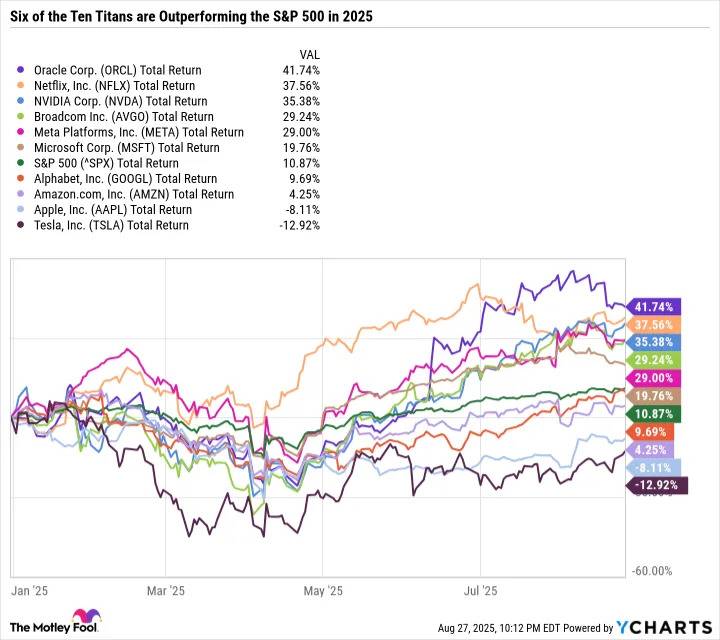
          The 10 largest growth-focused U.S. companies now make up 38% of the S&P 500. Known as the "Ten Titans," the list includes Nvidia (NASDAQ: NVDA), Microsoft, Apple, Amazon, Alphabet, Meta Platforms, Broadcom, Tesla, Oracle (NYSE: ORCL), and Netflix (NASDAQ: NFLX).

          Oracle, Netflix, and Nvidia have been the best performers of the Titans year to date. Let's determine if these growth stocks have what it takes to continue outperforming next year.

          Oracle has innovative ideas, but they come at a price

          Oracle has been the standout among the Titans. With a year-to-date total return of more than 40%, it vaulted its market cap above $660 billion.

          ORCL Total Return Level Chart

          ORCL Total Return Level data by YCharts.

          Oracle was close to dead money in the five years between 2015 and the end of 2019 -- gaining just 17.8% compared to 56.9% for the S&P 500. But since the start of 2020, Oracle is up 345% compared to a 100.6% gain in the S&P 500. A big driver of the outperformance is the build-out and adoption of Oracle Cloud Infrastructure (OCI).

          Oracle transformed from a database-first company to a fully fledged ecosystem. Not long ago, companies were using Oracle's database software on third-party clouds. Oracle decided to capture that revenue by building out its own cloud services.

          Oracle Integration Cloud hosts software-as-a-service offerings for financial reporting, automated workflows, human resources operations, marketing, personalization, and more. Oracle also offers artificial intelligence (AI)-powered database services. And OCI has been shown to be much more cost-effective for data-intensive operations than Amazon Web Services, Microsoft Azure, or Google Cloud. It's an especially ideal offering for industries like financial services and healthcare that have complex regulatory frameworks and sensitive information. On its earnings calls, Oracle often discusses how industries are choosing OCI for its security and compliance capabilities.

          Oracle was already a leader in enterprise software solutions. And now, it is a major player in the cloud business. The main downside of Oracle is that its valuation is expensive, and it is spending extremely aggressively. Oracle is arguably among the higher-risk, higher-potential-reward Titans. If its investments translate to bottom-line earnings growth, it could continue to be one of the best performers in the group. If not, it wouldn't be surprising if the stock underwent a sizable sell-off.

          Netflix is an entertainment giant that is raking in the cash flow

          Netflix's outsized returns in recent years are partly due to how beaten down the stock was going into 2023. Netflix fell over 50% in 2022, outpacing the broader sell-off in the Nasdaq Composite (NASDAQINDEX: ^IXIC) that year. At the time, other streaming platforms were gaining traction, and Netflix was still inconsistently profitable.

          The business model has remained largely unchanged over the past decade. So it's not a transformational story like Oracle. Rather, Netflix has perfected its craft.

          The biggest change has been its content slate -- what it spends on, how it markets that content (like the global success of "KPop Demon Hunters,") and basically just boosting its overall content success rate. The second major change was cracking down on password sharing. This was a resounding success because a lot of new accounts opened up -- showing that customers were willing to pay for Netflix because they value the service (again, despite a lot of competition). And finally, Netflix's ad-supported tier is driving new signups, which accelerates revenue growth.

          Netflix is an industry-leading cash cow with high margins. It has become a near-perfect business. The only issue is that the valuation reflects that, as Netflix trades at 52 times trailing 12-month earnings. Netflix could still be a winning long-term stock, but it may need a year or two to grow into its valuation. Therefore, it may not be a standout performer in 2026.

          Nvidia just delivered another blowout quarter

          Nvidia reported exceptional second-quarter fiscal 2026 results on Aug. 27 despite the company's China business being hindered by export restrictions to China.

          Even with difficult comps from the second-quarter fiscal 2025, Nvidia grew revenue by 56% and adjusted earnings per share by 54%. Arguably, the most impressive aspect of Nvidia's results is that it continues to sustain ultra-high gross margins over 70%. Nvidia's high margins allow it to convert a substantial amount of sales into profit, which is a testament to its edge over the competition and technological leadership on the global stage.

          Nvidia gets a lot of attention for its data center business -- and rightfully so, as it made up 88% of revenue in the recent quarter. But it's worth noting that the rest of the business is doing well too. Nvidia's non-data center revenue, which includes gaming and AI PC professional visualization, automotive, and robotics, was collectively $5.49 billion -- up 48% compared to $3.7 billion a year ago.

          Nvidia is in its third year of what has been an uninterrupted masterclass of exponential growth on a scale unlike any business the world has ever seen. And somehow, the company still has its foot on the gas with no signs of slowing down.

          Nvidia's outlook for the third-quarter fiscal 2026 calls for $54 billion in revenue even if it ships zero H20 chips to China -- all while maintaining a 73% gross margin. That would mark a 54% increase in revenue and just slightly lower gross margins than third-quarter fiscal 2025 and a near three-fold increase in revenue in just two years.

          Despite the impeccable results, Nvidia's valuation isn't cheap, as investors are pricing in a sustained breakneck growth rate. But Nvidia just keeps delivering, so its 58.4 price-to-earnings ratio is reasonable.

          If Nvidia's stock price remained unchanged for a year but the company grew earnings by 50%, the P/E would drop to 38.9. So even now, with the stock on track to crush the S&P 500 for the third consecutive year, Nvidia remains a top AI stock to buy now.

          I expect Nvidia to continue leading the Ten Titans higher in 2026, especially if trade policy with China eases. However, if for whatever reason there's a slowdown in AI spending from key Nvidia customers, Nvidia could drag down the Ten Titans and the broader market with it.

          Should you buy stock in Oracle right now?

          Before you buy stock in Oracle, consider this:

          The Motley Fool Stock Advisor analyst team just identified what they believe are the 10 best stocks for investors to buy now… and Oracle wasn’t one of them. The 10 stocks that made the cut could produce monster returns in the coming years.

          Consider when Netflix made this list on December 17, 2004... if you invested $1,000 at the time of our recommendation, you’d have $651,599!* Or when Nvidia made this list on April 15, 2005... if you invested $1,000 at the time of our recommendation, you’d have $1,067,639!*

          Now, it’s worth noting Stock Advisor’s total average return is 1,049% — a market-crushing outperformance compared to 185% for the S&P 500. Don’t miss out on the latest top 10 list, available when you join Stock Advisor.

          *Stock Advisor returns as of August 25, 2025

          Daniel Foelber has positions in Nvidia. The Motley Fool has positions in and recommends Alphabet, Amazon, Apple, Meta Platforms, Microsoft, Netflix, Nvidia, Oracle, and Tesla. The Motley Fool recommends Broadcom and recommends the following options: long January 2026 $395 calls on Microsoft and short January 2026 $405 calls on Microsoft. The Motley Fool has a disclosure policy.

          Will 2025's 3 Best-Performing "Ten Titans" Stocks Lead the Group Again in 2026? was originally published by The Motley Fool

          Risk Warnings and Disclaimers
          You understand and acknowledge that there is a high degree of risk involved in trading. Following any strategies or investment methods may lead to potential losses. The content on the site is provided by our contributors and analysts for information purposes only. You are solely responsible for determining whether any trading assets, securities, strategy, or any other product is suitable for investing based on your own investment objectives and financial situation.
          Add to Favorites
          Share

          3 Stocks Billionaires Bought Last Month

          Motley Fool
          Amazon
          +0.26%
          Restaurant Brands International
          +2.24%
          Whirlpool
          -4.81%

          Key Points

          Investors love to track which stocks billionaire investors are buying. After all, they've invested successfully to the tune of becoming billionaires, and they clearly know a thing or two about how to do it right.

          It doesn't make sense for most retail investors to completely copy billionaire portfolios, because money managers have different goals, responsibilities, and strategies. However, it certainly makes sense to get some investing inspiration from billionaires' trading activity, especially when a stock they buy aligns with your portfolio needs.

          Money managers don't usually let people know exactly when they buy and sell, but they report quarterly holdings in their 13F filings. In the most recent quarter, well-known billionaire investors bought Amazon (NASDAQ: AMZN), Restaurant Brands International (NYSE: QSR), and Whirlpool (NYSE: WHR). Let's see what might make these good picks for investors now.

          1. Amazon: AI and more

          It's easy to see why billionaires have been piling into Amazon. The e-commerce giant has developed a formidable artificial intelligence (AI) business as part of Amazon Web Services (AWS), its cloud computing division, and it looks like that's a massive opportunity.

          Even though it's the second-largest company in the world by sales, Amazon is still reporting double-digit growth, which is extremely impressive. Sales increased 13% over last year in the second quarter, with a strong showing from AWS at almost 18%. E-commerce was stronger than expected as customers rushed to buy certain items that are likely to increase in price due to tariffs, and sales were up 11% over last year. Advertising revenue accelerated to 23% and was the fastest-growing segment.

          Amazon is also highly profitable. Operating income rose from $14.7 billion last year to $19.2 billion this year in the quarter, coming in way ahead of the high end of management's guidance.

          What makes the Amazon position even more compelling today is its price. Amazon has historically traded at a premium valuation, and it's been looking cheap. At the current price, it trades at a P/E ratio of 34, less than half of its five-year average of 76.

          Billionaire Bill Ackman of Pershing Square Capital bought 5,823,316 shares of Amazon stock worth $1.2 billion in the second quarter, and many of your favorite billionaire investors, including Warren Buffett, own it too.

          It may take some time for Amazon stock to get back to its market-beating performance, but these billionaires see an incredible opportunity here. With its reliable growth and continued potential, Amazon is a nearly universal stock that fits most portfolios.

          2. Restaurant Brands: Resilient model and high dividend

          Restaurant Brands International owns four fast-food chains: Burger King, Tim Hortons, Popeye's, and Firehouse Subs. Burger King is its largest brand, with 19,700 stores globally, and all of its brands together have more than 32,000 stores.

          All of its restaurants are franchises, which is an excellent model for generating cash. Since the company itself doesn't build stores or buy food, it just sells franchises, it has low capital expenditures and just collects franchise fees. Value investors love these kinds of companies.

          Since its companies make fast food, they've been doing well in the pressured environment. On a consolidated basis, total restaurant sales increased 5.3% year over year in the second quarter, and revenue was up 16% year over year.

          Stanley Druckenmiller of Duquesne Management bought 751,100 shares of Restaurant Brands stock worth almost $41 million in the second quarter. Bill Ackman also owns it, having taken a position in the precursor to the current iteration of the company in 2012.It's his fund's third-largest position, at 11%.

          Restaurant Brands is a value stock, and investors buy it because they believe it's undervalued relative to its potential. It also pays a piping-hot dividend yielding 3.8%, which makes it very attractive for passive income investors. If you're in the value camp or looking for a solid dividend stock, Restaurant Brands International could fit the bill.

          3. Whirlpool: Made in the U.S.A.

          Whirlpool is a U.S. manufacturer of home appliances under brand names like its own Whirlpool brand as well as Maytag and KitchenAid. Its products are highly sensitive to the housing market, and it's been struggling with the housing pressure brought on by high interest rates.

          However, things might be turning around. In fact, speaking of stocks that billionaires are buying, several well-known billionaire investors have been scooping up home builder stocks, and Whirlpool is in similar circumstances. Not only will it benefit from a resurgence in home buying and the new appliances that typically accompany that, it also has a $2 billion builders business.

          It also has an edge over foreign competitors as higher tariffs take effect. Whirlpool is actually experiencing some near-term headwinds because of tariffs as the competition front-loads its products in the U.S. to evade coming tariffs, but it's well-positioned to reap the benefits down the line.

          Shares of Whirlpool are a bargain today, trading at a forward 1-year P/E ratio of 11, and billionaire hedge fund manager David Tepper of Appaloosa bought 266,092 shares of Whirlpool stock in the second quarter worth $27 million. However, potential investors should understand the risk with Whirlpool. It may take time for its tariff benefit to kick in, and in the meantime, it's cutting its dividend in half to conserve cash.

          Should you buy stock in Amazon right now?

          Before you buy stock in Amazon, consider this:

          The Motley Fool Stock Advisor analyst team just identified what they believe are the 10 best stocks for investors to buy now… and Amazon wasn’t one of them. The 10 stocks that made the cut could produce monster returns in the coming years.

          Consider when Netflix made this list on December 17, 2004... if you invested $1,000 at the time of our recommendation, you’d have $651,599!* Or when Nvidia made this list on April 15, 2005... if you invested $1,000 at the time of our recommendation, you’d have $1,067,639!*

          Now, it’s worth noting Stock Advisor’s total average return is 1,049% — a market-crushing outperformance compared to 185% for the S&P 500. Don’t miss out on the latest top 10 list, available when you join Stock Advisor.

          *Stock Advisor returns as of August 25, 2025

          Jennifer Saibil has no position in any of the stocks mentioned. The Motley Fool has positions in and recommends Amazon. The Motley Fool recommends Restaurant Brands International and Whirlpool. The Motley Fool has a disclosure policy.

          3 Stocks Billionaires Bought Last Month was originally published by The Motley Fool

          Risk Warnings and Disclaimers
          You understand and acknowledge that there is a high degree of risk involved in trading. Following any strategies or investment methods may lead to potential losses. The content on the site is provided by our contributors and analysts for information purposes only. You are solely responsible for determining whether any trading assets, securities, strategy, or any other product is suitable for investing based on your own investment objectives and financial situation.
          Add to Favorites
          Share

          4 "Ten Titans" Stocks Are Already in the Dow Jones. Could the Rest Join by 2030?

          Motley Fool
          RTX Corp.
          -0.12%
          IBM Corp.
          -0.02%
          Tesla
          +0.10%
          Netflix
          -2.64%
          Oracle
          +1.52%

          Key Points

          The Dow Jones Industrial Average includes 30 industry-leading U.S. companies from a variety of sectors. Despite having far fewer components than the S&P 500 or Nasdaq Composite, the Dow remains one of the most widely followed stock market indexes -- acting as a representative democracy, if you will, of the broader market.

          The composition of the Dow has evolved in lockstep with the U.S. economy. Today, the most heavily represented sectors in the Dow aren't its namesake industrials, but financials and technology.

          The Dow has also been surprisingly flexible as of late. Over the last five years, six of its 30 components have changed. Among the adjustments, Salesforce swapped places with ExxonMobil, Nvidia replaced Intel, and Amazon switched with Walgreens Boots Alliance.

          The current, more tech-focused Dow includes four of the "Ten Titans" -- Nvidia, Amazon, Microsoft, and Apple. The Ten Titans are Wall Street's largest growth stocks by market cap -- making up a combined 38% of the value of the S&P 500. The six that are not members of the Dow -- at least, not yet -- are Alphabet (NASDAQ: GOOG)(NASDAQ: GOOGL), Meta Platforms (NASDAQ: META), Broadcom (NASDAQ: AVGO), Tesla (NASDAQ: TSLA), Oracle (NYSE: ORCL), and Netflix (NASDAQ: NFLX).

          Here's a potential pathway for all the Titans to join the Dow, why some candidates are more likely to achieve inclusion than others, and why the venerable index should continue to evolve to better represent the industries that are driving growth in the U.S. economy.

          Dow housekeeping

          One key difference between the Dow and indexes like the S&P 500 or Nasdaq Composite is that the Dow is price weighted: The nominal price of a company's stock, rather than its market cap, dictates that company's weight in the Dow. This structural distinction is why Ten Titans stocks such as Nvidia, Amazon, Microsoft, and Apple can be included in the Dow without dominating the index. The price-weighted structure isn't perfect, but it does a good job of preventing the index's behavior from being overly influenced by a handful of names.

          If a new stock were to get added to the Dow when its share price was too high, it would disrupt the price-weighted structure. That's something the committee in charge of the index avoids. Before being added to the Dow, Amazon and Nvidia underwent stock splits.

          Today, the median Dow stock trades at around $227 per share, and the highest-priced component, Goldman Sachs, trades at roughly $739 per share, so it's safe to say a company would need to be within that range or even below it to be added to the Dow. In the case of Nvidia, the company last split its stock 10-for-1 in June 2024. That split put Nvidia into the lower-priced range for Dow companies, but its stock has gone up since then, and now, its price is closer to the median.

          Alphabet, Broadcom, Tesla, and Oracle are all trading at reasonable prices where they won't have to split their stocks to be considered for the Dow. But Meta Platforms would probably have to do a 3-for-1 split, and Netflix would have to do at least a 5-for-1 split to be considered.

          Dow musical chairs

          Assuming the need for stock splits isn't an impediment, here are my picks for the most reasonable current Dow components for the remaining six Titans to replace.

          Dow Candidate

          Dow Deletion

          Alphabet

          Verizon Communications

          Meta Platforms

          Honeywell International

          Netflix

          Walt Disney

          Broadcom

          Cisco Systems

          Oracle

          International Business Machines

          Tesla

          Nike

          By far the Dow's most glaring flaw is how underrepresented the communication services sector is in it. The only communication stocks in the index today are Verizon Communications and Walt Disney. The sector makes up just 2.3% of the Dow's value, but a whopping 9.9% of the S&P 500.

          Alphabet for Verizon

          No company deserves to be added to the Dow more than Alphabet. And Verizon, being the lowest weighted Dow component, is the perfect candidate for deletion.

          Alphabet offers tech exposure through its growing cloud business, but also brings a key media play in YouTube. Chatbots are changing the way users interact with information, but Google remains the undisputed leader in internet search. And Alphabet's Gemini chatbot, which powers AI overviews in Google Search, is experiencing a surge in adoption.

          Meta for Honeywell

          If Alphabet is added, I doubt Meta would be before 2030. But if it were, my out-of-left-field pick for it to replace would be manufacturing and tech conglomerate Honeywell. That may seem particularly unlikely given that Honeywell itself was only added in 2020, when it replaced Raytheon Technologies, now RTX.

          Yet Honeywell is splitting into three separate publicly traded companies by the end of next year. The Dow Jones will likely either pick the automation business or the aerospace business to remain in the index. But with Boeing already a component, it may make sense to replace Honeywell altogether.

          Netflix for Disney

          Netflix for Disney would mark the third communications sector shakeup on this list. Therefore, it's highly unlikely that it will happen, especially if Alphabet and Meta are added to the Dow first. While Netflix is the undisputed leader in streaming, Disney brings a lot more to the table, representing a broader range of the economy, including theatrical releases, its growing cruise line, merchandise, and, most importantly, its parks.

          The results of the company's "Experiences" division capture consumer discretionary spending and travel, making Disney an excellent Dow stock. That being said, if Netflix were to get added, Disney is the most likely stock for it to replace -- especially considering that Netflix's stock performance has trounced Disney's over the past decade.

          Broadcom for Cisco

          My second-highest conviction pick would be for Broadcom to replace Cisco Systems. Yes, Nvidia already provides significant semiconductor exposure to the Dow. However, Nvidia is primarily a bet on AI data centers. Broadcom is a far more diversified business, with networking equipment, security solutions, infrastructure software, and hardware for data centers, and a virtualization business supported by its 2023 acquisition of VMware. Broadcom also makes AI accelerator chips and application-specific integrated circuits for AI functions.

          There's a decent amount of overlap between Broadcom and Cisco, especially on the cybersecurity and networking front. It's also worth mentioning that Broadcom has paid and raised its dividend at a rapid rate for 14 straight years. Given that Cisco has a high yield, replacing it with another dividend-paying tech stock seems logical.

          Oracle for IBM

          Similar to a Broadcom-for-Cisco swap, trading Oracle for International Business Machines would replace a Dow veteran with a much larger market-cap tech company. Oracle and IBM are both predominantly enterprise-focused companies with growing cloud businesses.

          That said, Oracle's approach to the cloud is distinctly different from IBM's, with Oracle Cloud Infrastructure (OCI) ideally suited for working with its database services. OCI works well within the Oracle ecosystem, although the company offers multi-cloud solutions via partnerships with Microsoft Azure, Amazon Web Services, and Google Cloud.

          IBM is more flexible. IBM also has a much stronger track record in quantum computing and AI, whereas Oracle is a newcomer to those arenas. And IBM isn't as aggressive from a capital expenditure standpoint, whereas Oracle is pouring investments into growing its AI infrastructure and even taking on debt to accelerate its growth plans.

          Oracle and IBM are both solid examples of legacy tech companies that are revolutionizing their business models to capitalize on the AI trend. IBM is doing a lot right to stay in the Dow, making it unlikely that Oracle will be added to the index anytime soon.

          Tesla for Nike

          This pick is a bit out there, similar to Meta replacing Honeywell. But if the committee adds Tesla to the Dow, it might make sense for it to make room for it by dropping a consumer discretionary stock like Nike.

          When Amazon replaced Walgreens, it boosted the representation of e-commerce in the Dow. Walmart is also a Dow component, bringing retail and e-commerce. If Disney remains in the Dow, it adds more consumer discretionary exposure -- paving the way for Tesla's inclusion.

          It's also worth mentioning that there are no automakers in the Dow currently, although General Motors was at one time a component. Given that Tesla is the most valuable automaker in the world and brings exposure to robotics and renewable energy, the idea of adding it to the Dow isn't as far-fetched as it may seem at first glance.

          The modern blue-chip company

          Speculating about how the Dow's composition could change over the coming years is more than just an intellectual exercise. It gets at the core of what's driving the stock market and why the Dow has underperformed the S&P 500 and Nasdaq by a wide margin over the past decade.

          By no means should the Dow overhaul its holdings overnight. But it won't be surprising if at least a few more of the Ten Titans -- namely Alphabet and Broadcom -- get added to the index between now and 2030.

          Should you invest $1,000 in Alphabet right now?

          Before you buy stock in Alphabet, consider this:

          The Motley Fool Stock Advisor analyst team just identified what they believe are the 10 best stocks for investors to buy now… and Alphabet wasn’t one of them. The 10 stocks that made the cut could produce monster returns in the coming years.

          Consider when Netflix made this list on December 17, 2004... if you invested $1,000 at the time of our recommendation, you’d have $651,599!* Or when Nvidia made this list on April 15, 2005... if you invested $1,000 at the time of our recommendation, you’d have $1,067,639!*

          Now, it’s worth noting Stock Advisor’s total average return is 1,049% — a market-crushing outperformance compared to 185% for the S&P 500. Don’t miss out on the latest top 10 list, available when you join Stock Advisor.

          *Stock Advisor returns as of August 25, 2025

          Daniel Foelber has positions in Nike, Nvidia, and Walt Disney and has the following options: short November 2025 $120 calls on Walt Disney. The Motley Fool has positions in and recommends Alphabet, Amazon, Apple, Cisco Systems, Goldman Sachs Group, Intel, International Business Machines, Meta Platforms, Microsoft, Netflix, Nike, Nvidia, Oracle, Salesforce, Tesla, Walmart, and Walt Disney. The Motley Fool recommends Broadcom, General Motors, RTX, and Verizon Communications and recommends the following options: long January 2026 $395 calls on Microsoft, short August 2025 $24 calls on Intel, and short January 2026 $405 calls on Microsoft. The Motley Fool has a disclosure policy.

          4 "Ten Titans" Stocks Are Already in the Dow Jones. Could the Rest Join by 2030? was originally published by The Motley Fool

          Risk Warnings and Disclaimers
          You understand and acknowledge that there is a high degree of risk involved in trading. Following any strategies or investment methods may lead to potential losses. The content on the site is provided by our contributors and analysts for information purposes only. You are solely responsible for determining whether any trading assets, securities, strategy, or any other product is suitable for investing based on your own investment objectives and financial situation.
          Add to Favorites
          Share

          2 Top AI Stocks Prominent Billionaires Are Buying

          Motley Fool
          Microsoft
          +0.67%
          Amazon
          +0.26%
          Public Service Enterprise Group
          -1.49%

          Key Points

          Buying and holding shares of the best businesses in the world is the easiest way to build wealth over the long term. Some of the largest, most profitable companies in the world also just happen to be in a prime position to benefit from global adoption of artificial intelligence (AI), which is expected to add $15.7 trillion to the global economy by 2030, according to PwC.

          Investors wondering where to place their bets only have to look at the latest round of quarterly disclosures from the wealthiest investors. Billionaire fund managers are required to report their holdings on Form 13F with the Securities and Exchange Commission. Here are two dominant tech companies that prominent billionaires were buying in the second quarter.

          1. Microsoft

          Stanley Druckenmiller bought a new position in Microsoft (NASDAQ: MSFT) for his Duquesne Family Office in the second quarter. Druckenmiller has led a successful career, previously managing billions in assets for clients before closing his hedge fund in 2010. Other billionaire fund managers, such as Daniel Loeb of Third Point and Chase Coleman of Tiger Global, were also adding to their firms' stakes in the stock last quarter.

          There's a lot to like about Microsoft. It has a long history of generating steady growth in revenue and profits. Over the past year, it generated $102 billion in net profit on $282 billion in revenue. While there's talk on Wall Street of a potential AI bubble, Microsoft continues to report strong financial results and point to opportunities that bolster the investment case.

          The reason to like Microsoft right now is that it is seeing strong demand for its Azure cloud service for enterprise. Revenue from Azure and other cloud services grew 39% year over year in the June-ending quarter. This is higher than the previous quarter's 33% growth.

          "We will continue to invest against the expansive opportunity ahead across both capital expenditures and operating expenses, given our leadership position in commercial cloud, strong demand signals for our cloud and AI offerings, and significant contracted backlog," CFO Amy Hood said during the earnings call.

          What this means is that investors are likely still underestimating the demand for AI cloud infrastructure. AI is completely transforming how businesses operate, and we can see this in Microsoft's growing investment in data centers and technology. Its capital expenditures have more than doubled over the past two years to $64 billion, and Hood's statement suggests these investments will keep growing.

          Importantly, Microsoft's strong cloud growth shows that it is competing effectively with Amazon (NASDAQ: AMZN), which has led the cloud market for many years. It's also competing against Alphabet's Google Cloud, which has made great strides over the past year with Gemini -- one of the best AI models out there.

          The dilemma for investors buying Microsoft stock is its valuation. Its forward price-to-earnings (P/E) ratio of 32 is nearly three times Microsoft's expected earnings growth of 12% over the long term. A good rule of thumb is to look for growth stocks trading at a PEG ratio closer to 1. But Druckenmiller may see Wall Street's consensus earnings estimate as too conservative, as it reported a 24% year-over-year increase in earnings last quarter, and management's commentary still points to a lot more growth ahead.

          A blue cloud with the letters AI hovering over a digital rendering of a computer circuit.
          Image source: Getty Images.

          2. Amazon

          Druckenmiller sold out of Amazon in favor of Microsoft last quarter, which may reflect his belief that Azure's momentum puts it in a superior position in AI. But other billionaires see upside for the e-commerce and cloud leader. Pershing Square's Bill Ackman bought over 5.8 million shares of Amazon stock in Q2, a large stake worth nearly $1.3 billion at quarter's end.

          Ackman has a record of delivering market-beating returns for his investors. Over the last 22 years, Pershing Square grew an original investment by a 27-fold, compared to a 9-fold gain if clients had invested in the S&P 500. Ackman prefers to concentrate his portfolio in a handful of carefully selected investment opportunities, usually no more than a dozen holdings. This means only his highest-conviction ideas make it into the portfolio.

          This investment by Ackman comes as Amazon saw a notable acceleration in growth for its e-commerce business in the second quarter. Its total sales grew 12% year over year on a constant-currency basis, driven by a 10% increase in the online store. This is the first quarter of double-digit growth for the online store since Q3 2022.

          Moreover, management continues to focus on improving cost efficiency in processing and shipping orders to customers. Amazon has seen its operating profit increase by a whopping 471% since 2022 to $77 billion over the last year.

          The only negative for Amazon is that its cloud business (Amazon Web Services) is growing at about half the rate of Microsoft Azure and Google Cloud. There could be several reasons why businesses are opting for a competitor over Amazon in the cloud market, but investors shouldn't overlook the value AWS brings to Amazon's business. Amazon has gained valuable AI capabilities that power product recommendations, optimize delivery routes, and improve product experiences with the Alexa voice assistant.

          Amazon Web Services (AWS) could slip to the No. 2 spot in the cloud market, but that doesn't mean AWS is a lost cause. AWS's generative AI business is experiencing triple-digit growth, while 85% of information technology spending is still going to on-premises servers. With the size of that opportunity, AWS should keep growing for many years. Its revenue grew 17% year over year in Q2, after signing new agreements with PepsiCo, Airbnb, and Peloton Interactive.

          Ackman may see more room for management to improve margins in the online retail business, in addition to a lot of opportunity for double-digit growth in cloud computing. The stock's forward P/E of 34 reflects high investor expectations for growth, as the consensus analyst estimate calls for Amazon's earnings to grow at an annualized rate of 18% in the coming years, which is higher than estimates for Microsoft.

          Should you buy stock in Microsoft right now?

          Before you buy stock in Microsoft, consider this:

          The Motley Fool Stock Advisor analyst team just identified what they believe are the 10 best stocks for investors to buy now… and Microsoft wasn’t one of them. The 10 stocks that made the cut could produce monster returns in the coming years.

          Consider when Netflix made this list on December 17, 2004... if you invested $1,000 at the time of our recommendation, you’d have $664,110!* Or when Nvidia made this list on April 15, 2005... if you invested $1,000 at the time of our recommendation, you’d have $1,104,355!*

          Now, it’s worth noting Stock Advisor’s total average return is 1,069% — a market-crushing outperformance compared to 186% for the S&P 500. Don’t miss out on the latest top 10 list, available when you join Stock Advisor.

          *Stock Advisor returns as of August 25, 2025

          John Ballard has no position in any of the stocks mentioned. The Motley Fool has positions in and recommends Airbnb, Alphabet, Amazon, Microsoft, and Peloton Interactive. The Motley Fool recommends the following options: long January 2026 $395 calls on Microsoft and short January 2026 $405 calls on Microsoft. The Motley Fool has a disclosure policy.

          2 Top AI Stocks Prominent Billionaires Are Buying was originally published by The Motley Fool

          Risk Warnings and Disclaimers
          You understand and acknowledge that there is a high degree of risk involved in trading. Following any strategies or investment methods may lead to potential losses. The content on the site is provided by our contributors and analysts for information purposes only. You are solely responsible for determining whether any trading assets, securities, strategy, or any other product is suitable for investing based on your own investment objectives and financial situation.
          Add to Favorites
          Share
          FastBull
          Copyright © 2025 FastBull Ltd

          728 RM B 7/F GEE LOK IND BLDG NO 34 HUNG TO RD KWUN TONG KLN HONG KONG

          TelegramInstagramTwitterfacebooklinkedin
          App Store Google Play Google Play
          Products
          Charts

          Chats

          Q&A with Experts
          Screeners
          Economic Calendar
          Data
          Tools
          Membership
          Features
          Function
          Markets
          Copy Trading
          Latest Signals
          Contests
          News
          Analysis
          24/7
          Columns
          Education
          Company
          Careers
          About Us
          Contact Us
          Advertising
          Help Center
          Feedback
          User Agreement
          Privacy Policy
          Business

          White Label

          Data API

          Web Plug-ins

          Poster Maker

          Affiliate Program

          Risk Disclosure

          The risk of loss in trading financial instruments such as stocks, FX, commodities, futures, bonds, ETFs and crypto can be substantial. You may sustain a total loss of the funds that you deposit with your broker. Therefore, you should carefully consider whether such trading is suitable for you in light of your circumstances and financial resources.

          No decision to invest should be made without thoroughly conducting due diligence by yourself or consulting with your financial advisors. Our web content might not suit you since we don't know your financial conditions and investment needs. Our financial information might have latency or contain inaccuracy, so you should be fully responsible for any of your trading and investment decisions. The company will not be responsible for your capital loss.

          Without getting permission from the website, you are not allowed to copy the website's graphics, texts, or trademarks. Intellectual property rights in the content or data incorporated into this website belong to its providers and exchange merchants.

          Not Logged In

          Log in to access more features

          FastBull Membership

          Not yet

          Purchase

          Become a signal provider
          Help Center
          Customer Service
          Dark Mode
          Price Up/Down Colors

          Log In

          Sign Up

          Position
          Layout
          Fullscreen
          Default to Chart
          The chart page opens by default when you visit fastbull.com