• Trade
  • Markets
  • Copy
  • Contests
  • News
  • 24/7
  • Calendar
  • Q&A
  • Chats
Trending
Screeners
SYMBOL
LAST
BID
ASK
HIGH
LOW
NET CHG.
%CHG.
SPREAD
SPX
S&P 500 Index
6857.13
6857.13
6857.13
6865.94
6827.13
+7.41
+ 0.11%
--
DJI
Dow Jones Industrial Average
47850.93
47850.93
47850.93
48049.72
47692.96
-31.96
-0.07%
--
IXIC
NASDAQ Composite Index
23505.13
23505.13
23505.13
23528.53
23372.33
+51.04
+ 0.22%
--
USDX
US Dollar Index
98.770
98.850
98.770
98.980
98.770
-0.210
-0.21%
--
EURUSD
Euro / US Dollar
1.16665
1.16673
1.16665
1.16671
1.16408
+0.00220
+ 0.19%
--
GBPUSD
Pound Sterling / US Dollar
1.33567
1.33576
1.33567
1.33574
1.33165
+0.00296
+ 0.22%
--
XAUUSD
Gold / US Dollar
4228.17
4228.58
4228.17
4230.48
4194.54
+21.00
+ 0.50%
--
WTI
Light Sweet Crude Oil
59.375
59.412
59.375
59.469
59.187
-0.008
-0.01%
--

Community Accounts

Signal Accounts
--
Profit Accounts
--
Loss Accounts
--
View More

Become a signal provider

Sell trading signals to earn additional income

View More

Guide to Copy Trading

Get started with ease and confidence

View More

Signal Accounts for Members

All Signal Accounts

Best Return
  • Best Return
  • Best P/L
  • Best MDD
Past 1W
  • Past 1W
  • Past 1M
  • Past 1Y

All Contests

  • All
  • Trump Updates
  • Recommend
  • Stocks
  • Cryptocurrencies
  • Central Banks
  • Featured News
Top News Only
Share

Equinor: Preliminary Estimates Indicate Reservoirs May Contain Between 5 -18 Million Standard Cubic Meters Of Recoverable Oil Equivalents

Share

Japan Chief Cabinet Secretary Kihara: Government To Take Appropriate Steps On Excessive And Disorderly Moves In Foreign Exchange Market, If Necessary

Share

Equinor: Made Two New Discoveries Of Gas, Condensate In Sleipner Area Of The North Sea

Share

[Report: Amazon Pays €180 Million To Italy To End Tax And Labor Investigations] Amazon Has Paid A Settlement And Dismantled Its Monitoring System For Delivery Drivers In Italy, Ending An Investigation Into Alleged Tax Fraud And Illegal Labor Practices. In July 2024, The Group's Logistics Services Division Was Accused Of Circumventing Labor And Tax Laws By Relying On Cooperatives Or Limited Liability Companies To Supply Workers, Evading VAT, And Reducing Social Security Payments. Sources Say The Group Has Now Paid Approximately €180 Million To Italian Tax Authorities As Part Of A €1 Billion Settlement Involving 33 Companies

Share

Airbus - Booked 797 Gross Aircraft Orders In January-November

Share

[Market Update] Spot Gold Broke Through $4,230 Per Ounce, Up 0.51% On The Day

Share

Reserve Bank Of India Chief Malhotra: There Will Be Ample Liquidity As Long As We Are In An Easing Cycle

Share

Reserve Bank Of India Chief Malhotra: Quantum Of System Liquidity Will Be Managed To Ensure Monetary Transmission Is Happening

Share

China's Foreign Ministry: World Bank, IMF, WTO Top Officials To Join

Share

China's Foreign Ministry: China To Hold 1+1 Dialogue With International Economic Orgs On Dec 9

Share

Reserve Bank Of India Chief Malhotra: 5% Of Inr Depreciation Leads To 35 Bps Of Inflation

Share

Eurostoxx 50 Futures Up 0.14%, DAX Futures Up 0.12%, CAC 40 Futures Up 0.26%, FTSE Futures Up 0.03%

Share

Getlink - Over 1 Million Trucks Crossed Channel Since January 2025

Share

Malaysia International Reserves At $124.1 Billion On November 28 Versus$124.1 Billion On November 14 - Central Bank

Share

Reserve Bank Of India Chief Malhotra: Conscious Effort On Diversifying Gold Reserves

Share

Russian President Putin Thanks Indian Prime Minister Modi For Attention To Ukraine Peace Efforts

Share

Russian President Putin: India-Russia Relations Should Grow And Touch New Heights

Share

Russian President Putin: India Is Not Neutral, India Is On The Side Of Peace

Share

Russian President Putin: We Support Every Effort Towards Peace

Share

Russian President Putin: The World Should Return To Peace

TIME
ACT
FCST
PREV
Euro Zone IHS Markit Construction PMI (Nov)

A:--

F: --

P: --

Italy IHS Markit Construction PMI (Nov)

A:--

F: --

P: --

U.K. Markit/CIPS Construction PMI (Nov)

A:--

F: --

P: --

France 10-Year OAT Auction Avg. Yield

A:--

F: --

P: --

Euro Zone Retail Sales MoM (Oct)

A:--

F: --

P: --

Euro Zone Retail Sales YoY (Oct)

A:--

F: --

P: --

Brazil GDP YoY (Q3)

A:--

F: --

P: --

U.S. Challenger Job Cuts (Nov)

A:--

F: --

P: --

U.S. Challenger Job Cuts MoM (Nov)

A:--

F: --

P: --

U.S. Challenger Job Cuts YoY (Nov)

A:--

F: --

P: --

U.S. Initial Jobless Claims 4-Week Avg. (SA)

A:--

F: --

P: --

U.S. Weekly Initial Jobless Claims (SA)

A:--

F: --

P: --

U.S. Weekly Continued Jobless Claims (SA)

A:--

F: --

P: --

Canada Ivey PMI (SA) (Nov)

A:--

F: --

P: --

Canada Ivey PMI (Not SA) (Nov)

A:--

F: --

P: --

U.S. Non-Defense Capital Durable Goods Orders Revised MoM (Excl. Aircraft) (SA) (Sept)

A:--

F: --

P: --
U.S. Factory Orders MoM (Excl. Transport) (Sept)

A:--

F: --

P: --

U.S. Factory Orders MoM (Sept)

A:--

F: --

P: --

U.S. Factory Orders MoM (Excl. Defense) (Sept)

A:--

F: --

P: --

U.S. EIA Weekly Natural Gas Stocks Change

A:--

F: --

P: --

Saudi Arabia Crude Oil Production

A:--

F: --

P: --

U.S. Weekly Treasuries Held by Foreign Central Banks

A:--

F: --

P: --

Japan Foreign Exchange Reserves (Nov)

A:--

F: --

P: --

India Repo Rate

A:--

F: --

P: --

India Benchmark Interest Rate

A:--

F: --

P: --

India Reverse Repo Rate

A:--

F: --

P: --

India Cash Reserve Ratio

A:--

F: --

P: --

Japan Leading Indicators Prelim (Oct)

A:--

F: --

P: --

U.K. Halifax House Price Index YoY (SA) (Nov)

A:--

F: --

P: --

U.K. Halifax House Price Index MoM (SA) (Nov)

A:--

F: --

P: --

France Current Account (Not SA) (Oct)

--

F: --

P: --

France Trade Balance (SA) (Oct)

--

F: --

P: --

France Industrial Output MoM (SA) (Oct)

--

F: --

P: --

Italy Retail Sales MoM (SA) (Oct)

--

F: --

P: --

Euro Zone Employment YoY (SA) (Q3)

--

F: --

P: --

Euro Zone GDP Final YoY (Q3)

--

F: --

P: --

Euro Zone GDP Final QoQ (Q3)

--

F: --

P: --

Euro Zone Employment Final QoQ (SA) (Q3)

--

F: --

P: --

Euro Zone Employment Final (SA) (Q3)

--

F: --

P: --
Brazil PPI MoM (Oct)

--

F: --

P: --

Mexico Consumer Confidence Index (Nov)

--

F: --

P: --

Canada Unemployment Rate (SA) (Nov)

--

F: --

P: --

Canada Labor Force Participation Rate (SA) (Nov)

--

F: --

P: --

Canada Employment (SA) (Nov)

--

F: --

P: --

Canada Part-Time Employment (SA) (Nov)

--

F: --

P: --

Canada Full-time Employment (SA) (Nov)

--

F: --

P: --

U.S. Personal Income MoM (Sept)

--

F: --

P: --

U.S. Dallas Fed PCE Price Index YoY (Sept)

--

F: --

P: --

U.S. PCE Price Index YoY (SA) (Sept)

--

F: --

P: --

U.S. PCE Price Index MoM (Sept)

--

F: --

P: --

U.S. Personal Outlays MoM (SA) (Sept)

--

F: --

P: --

U.S. Core PCE Price Index MoM (Sept)

--

F: --

P: --

U.S. UMich 5-Year-Ahead Inflation Expectations Prelim YoY (Dec)

--

F: --

P: --

U.S. Core PCE Price Index YoY (Sept)

--

F: --

P: --

U.S. Real Personal Consumption Expenditures MoM (Sept)

--

F: --

P: --

U.S. 5-10 Year-Ahead Inflation Expectations (Dec)

--

F: --

P: --

U.S. UMich Current Economic Conditions Index Prelim (Dec)

--

F: --

P: --

U.S. UMich Consumer Sentiment Index Prelim (Dec)

--

F: --

P: --

U.S. UMich 1-Year-Ahead Inflation Expectations Prelim (Dec)

--

F: --

P: --

U.S. UMich Consumer Expectations Index Prelim (Dec)

--

F: --

P: --

Q&A with Experts
    • All
    • Chatrooms
    • Groups
    • Friends
    Connecting
    .
    .
    .
    Type here...
    Add Symbol or Code

      No matching data

      All
      Trump Updates
      Recommend
      Stocks
      Cryptocurrencies
      Central Banks
      Featured News
      • All
      • Russia-Ukraine Conflict
      • Middle East Flashpoint
      • All
      • Russia-Ukraine Conflict
      • Middle East Flashpoint

      Search
      Products

      Charts Free Forever

      Chats Q&A with Experts
      Screeners Economic Calendar Data Tools
      Membership Features
      Data Warehouse Market Trends Institutional Data Policy Rates Macro

      Market Trends

      Market Sentiment Order Book Forex Correlations

      Top Indicators

      Charts Free Forever
      Markets

      News

      News Analysis 24/7 Columns Education
      From Institutions From Analysts
      Topics Columnists

      Latest Views

      Latest Views

      Trending Topics

      Top Columnists

      Latest Update

      Signals

      Copy Rankings Latest Signals Become a signal provider AI Rating
      Contests
      Brokers

      Overview Brokers Assessment Rankings Regulators News Claims
      Broker listing Forex Brokers Comparison Tool Live Spread Comparison Scam
      Q&A Complaint Scam Alert Videos Tips to Detect Scam
      More

      Business
      Events
      Careers About Us Advertising Help Center

      White Label

      Data API

      Web Plug-ins

      Affiliate Program

      Awards Institution Evaluation IB Seminar Salon Event Exhibition
      Vietnam Thailand Singapore Dubai
      Fans Party Investment Sharing Session
      FastBull Summit BrokersView Expo
      Recent Searches
        Top Searches
          Markets
          News
          Analysis
          User
          24/7
          Economic Calendar
          Education
          Data
          • Names
          • Latest
          • Prev

          View All

          No data

          Scan to Download

          Faster Charts, Chat Faster!

          Download App
          English
          • English
          • Español
          • العربية
          • Bahasa Indonesia
          • Bahasa Melayu
          • Tiếng Việt
          • ภาษาไทย
          • Français
          • Italiano
          • Türkçe
          • Русский язык
          • 简中
          • 繁中
          Open Account
          Search
          Products
          Charts Free Forever
          Markets
          News
          Signals

          Copy Rankings Latest Signals Become a signal provider AI Rating
          Contests
          Brokers

          Overview Brokers Assessment Rankings Regulators News Claims
          Broker listing Forex Brokers Comparison Tool Live Spread Comparison Scam
          Q&A Complaint Scam Alert Videos Tips to Detect Scam
          More

          Business
          Events
          Careers About Us Advertising Help Center

          White Label

          Data API

          Web Plug-ins

          Affiliate Program

          Awards Institution Evaluation IB Seminar Salon Event Exhibition
          Vietnam Thailand Singapore Dubai
          Fans Party Investment Sharing Session
          FastBull Summit BrokersView Expo

          What Is Ahead: Shutdown, FOMC And ECB Minutes

          FxPro

          Economic

          Forex

          Summary:

          The economic calendar for the week ending 10 October includes Jerome Powell’s speech, the US Government shutdown, postponed statistical releases, and the publication of the FOMC and ECB meetings minutes. Weak private sector employment data paint a bleak picture and.

          The economic calendar for the week ending 10 October includes Jerome Powell’s speech, the US Government shutdown, postponed statistical releases, and the publication of the FOMC and ECB meetings minutes.
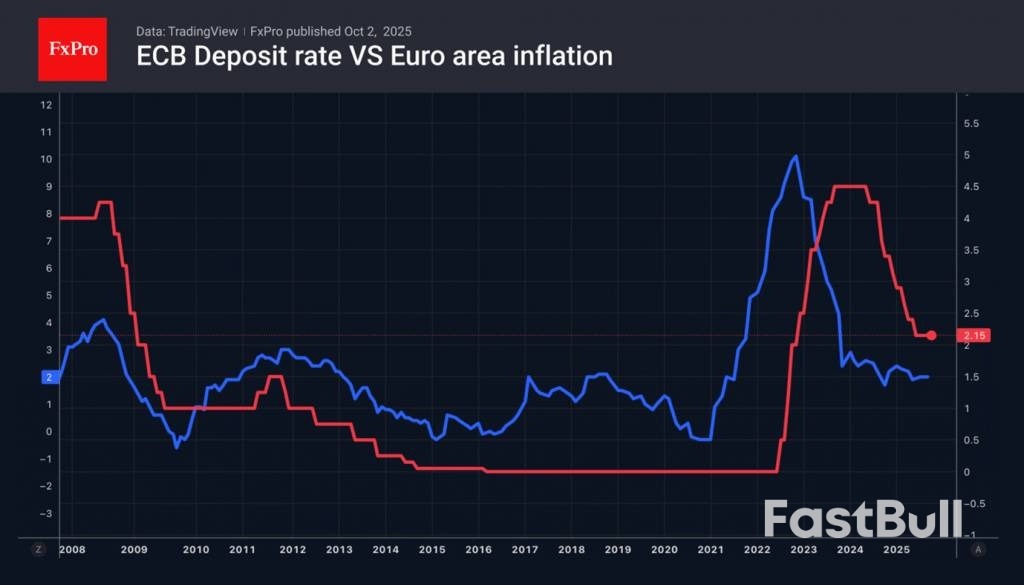
          Weak private sector employment data paint a bleak picture and push the Fed towards aggressive monetary policy easing. This is especially true given that the White House has no intention of easing pressure on the central bank. Donald Trump recently posted a cartoon story about the dismissal of the Fed chairman. In this environment, Jerome Powell’s speech could provide investors with important clues.

          As will the minutes of the meetings of the world’s leading central banks. Top ECB officials, including Philip Lane and Christine Lagarde, argue that the risks of inflation moving in either direction are limited. This allows investors to count on the end of the monetary expansion cycle. For the Fed, it has only just begun. In theory, this divergence should lead to the euro rising against the dollar.

          However, the final word will be given by the US labour market report.

          Source: FxPro

          To stay updated on all economic events of today, please check out our Economic calendar
          Risk Warnings and Disclaimers
          You understand and acknowledge that there is a high degree of risk involved in trading. Following any strategies or investment methods may lead to potential losses. The content on the site is provided by our contributors and analysts for information purposes only. You are solely responsible for determining whether any trading assets, securities, strategy, or any other product is suitable for investing based on your own investment objectives and financial situation.
          Add to Favorites
          Share

          Will Takaichi Sanae Be Japan’s Margaret Thatcher – Or Another Liz Truss?

          Samantha Luan

          Economic

          Forex

          Political

          On October 4, Liberal Democratic Party (LDP) parliamentarians and its rank-and-file members selected a new leader for a party that was in disarray and searching for a purpose. The party spoke: they picked Takaichi Sanae, a conservative politician who last served as economic security minister, as their new leader. And considering that the opposition parties – which hold a majority in both houses – have given up on forming a unified front against the LDP, it is likely that she will become Japan’s first female prime minister.

          The result took experienced pollsters by surprise. It was widely speculated that, by the sheer number of his Diet member votes, Koizumi Shinjiro – whom Takaichi defeated – would triumph in the second round of voting. However, although a wide range of polls suggested that Koizumi would secure more than 90 Diet member votes (there were 92 Diet members, including proxies, at his election launch party), his actual first-round total was only 80, followed by Hayashi Yoshimasa with 72, who finished third in the first round. This proved fatal, as his relatively weak support among the rank-and-file could not convince the Diet members that he was the “favorite son.” Koizumi’s share of the prefectural vote was 11, in contrast to Takaichi’s 36 votes. The final tally in the second round of voting was 185 votes for Takaichi, and 156 votes for Koizumi.

          Takaichi’s victory can be attributed to three main factors. First, when pressed with a choice, a relative majority of the eligible voters viewed Takaichi’s conservative appeal – which could help reclaim disaffected conservative voters – as a greater asset than Koizumi’s youth and inexperience.

          Second, there was division within the group formerly known as the Kishida faction, headed by former Prime Minister Kishida Fumio. According to Yomiuri Shimbun, although Kishida preferred his members to vote for Koizumi rather than Takaichi – whom he described as “Taliban” for her strong conservative beliefs – in the second round, some refused to follow his guidance. This was partly out of respect for Takaichi, who was the most popular candidate in the first round, and partly due to resentment toward Kishida for hedging his bets with Koizumi instead of focusing his efforts on electing Hayashi, who was supposed to represent his faction.

          Finally – and perhaps most importantly – was the strategic maneuvering of party elder Aso Taro, who saw an opportune moment to return to the party mainstream. Aso directed his own faction, the only remaining formal faction within the LDP, and made side deals with Kobayashi Takayuki and Motegi Toshimitsu, who placed fourth and fifth, respectively, in the first round of voting, to throw their support behind Takaichi. The fact that Takaichi appointed Suzuki Shunichi – Aso’s brother-in-law – as the LDP’s secretary general, the party’s second-most powerful position, is widely seen as a reward for Aso’s contribution.

          Takaichi’s path to the premiership is filled with potential stumbling blocks, any of which could shorten her time in power. The first question that arises is how she will unite the party when nearly half of LDP voters did not support her in the leadership race. If she fails to create a “team of rivals” by appointing her competitors to positions that satisfy them – a pledge she appears willing to honor – Takaichi may lack the necessary support to endure difficult times. This could lead to internal opposition that may challenge her leadership as her two-year term as LDP president draws to a close.

          The second hurdle is how to maintain – and potentially expand – her party’s coalition partnership. Prior to the election, the LDP’s more than two-decade-long coalition partner, Komeito, warned that they would only form a government with a “moderate conservative” – a gesture widely seen as an attempt to pressure Takaichi into softening her policy stances. Aware of the LDP’s heavy reliance on Komeito in nearly every electoral district, Takaichi has indeed moderated her positions and reiterated that the coalition with Komeito is vital.

          At the same time, Takaichi, along with other LDP candidates, floated the possibility of including a third party in the coalition, potentially the Democratic Party for the People (DPFP) or Nippon Ishin no Kai, in order to escape minority status in both houses of the Diet. However, Komeito has shown reluctance to include Nippon Ishin in the ruling coalition due to policy differences and electoral rivalry. It may take some time for Takaichi to find a viable path to break the legislative gridlock.

          The extent to which she is willing to compromise her beliefs to enact policy will be a crucial test of her leadership. A fiscal dove herself, Takaichi is an outlier in a party dominated by fiscal hawks – including her benefactor, Aso Taro. Although she has argued for pursuing her dovish fiscal and monetary policies in a “responsible” manner, her decision to challenge party orthodoxy may provoke backlash not only from powerful figures within the LDP but also from the public, particularly if such policies lead to a weaker yen, accelerate inflation, or fuel populist discontent.

          Takaichi’s attitude toward historical issues has also worried some more moderate figures. If, after taking office as prime minister, she follows through with a visit to the Yasukuni Shrine – a custom she has regularly practiced, though she did not explicitly mention it during this election campaign – it would lead to diplomatic friction with South Korea and China. This is something that Komeito has explicitly demanded she refrain from doing. Moreover, her strict stance on public safety, which stems from growing concerns about the increasing number of foreigners, worries Komeito, which prefers more harmonious policies toward immigrants.

          Whether Takaichi can rebrand herself as a pragmatic conservative will be equally important in placating both her domestic partners and foreign neighbors. At the same time, she faces a dilemma: a quick shift to the center before solidifying her support among the right-wing base may undermine her mandate to bring conservatives back into the fold.

          Depending on how everything turns out, it will determine whether Takaichi becomes a Margaret Thatcher – the politician she admires most – or a Liz Truss, whose short tenure as U.K. prime minister was marked by the announcement of an extravagant spending scheme (including tax cuts and subsidies) that resembles Takaichi’s own proposals. Becoming the first female LDP president – and having the premiership within reach – is a remarkable achievement in itself. Takaichi is now entering the arena where she must learn and perform the “art of the possible.”

          Source: The Diplomat

          To stay updated on all economic events of today, please check out our Economic calendar
          Risk Warnings and Disclaimers
          You understand and acknowledge that there is a high degree of risk involved in trading. Following any strategies or investment methods may lead to potential losses. The content on the site is provided by our contributors and analysts for information purposes only. You are solely responsible for determining whether any trading assets, securities, strategy, or any other product is suitable for investing based on your own investment objectives and financial situation.
          Add to Favorites
          Share

          Treasury Yields Climb as Government Shutdown Prolongs Market Uncertainty

          Gerik

          Economic

          Rising Yields Reflect Heightened Fiscal Strain

          Treasury yields inched higher to start the week, signaling renewed anxiety about the government’s fiscal impasse. The 10-year Treasury yield advanced more than 2 basis points to 4.148%, while the 30-year yield rose 4 basis points to 4.755%. Shorter maturities also ticked upward, with the 2-year yield at 3.58%. These moves, though modest, underline investor unease as Washington’s stalemate stretches into another week without a funding resolution.
          Since bond prices move inversely to yields, the uptick suggests selling pressure on longer-term Treasuries as investors reassess political risk. Markets are wary that a drawn-out shutdown could hurt economic momentum and delay monetary policy decisions due to a lack of official data releases.

          Shutdown Stalemate Deepens Market Volatility

          The fiscal deadlock stems from the failure of both Republican and Democratic proposals to secure sufficient support in Congress. Republicans have advocated for a “clean” continuing resolution maintaining current spending levels through November, while Democrats have tied their version to extending health care tax credits and other measures. The inability to reconcile these differences triggered the shutdown at the start of October.
          White House National Economic Council Director Kevin Hassett warned that layoffs of federal employees could begin soon if President Trump concludes that negotiations “are absolutely going nowhere.” Approximately 750,000 federal workers face furloughs or unpaid status, which could slow consumer spending and weaken near-term growth indicators.

          Data Blackout Complicates Fed’s Policy Assessment

          The shutdown has created what analysts describe as an “economic data blackout.” Key reports such as September’s nonfarm payrolls, originally scheduled for release last Friday, remain delayed. This leaves both investors and Federal Reserve policymakers without essential information to gauge the labor market and inflation trends.
          In the absence of government data, attention is shifting toward commentary from central bank officials. Fed Governor Stephen Miran is scheduled to speak Wednesday, followed by Chair Jerome Powell on Thursday. Additionally, the release of the Federal Open Market Committee’s meeting minutes may offer insight into how policymakers view the economic outlook amid fiscal instability.
          Without new data, markets are forced to rely on private surveys and alternative indicators, increasing uncertainty around interest rate expectations. Although traders still anticipate a 0.25% rate cut later this month, the lack of clarity could heighten volatility in both bond and equity markets.

          Market Sentiment and Broader Implications

          The gradual rise in yields signals a subtle shift toward risk aversion. Investors are demanding slightly higher returns to hold long-duration Treasuries in a politically uncertain environment. Yet, yields remain anchored below midyear peaks, reflecting continued belief that the Federal Reserve will maintain an easing bias if fiscal disruptions weaken growth.
          This dynamic illustrates a correlation rather than a direct causal chain: while the shutdown itself does not directly push yields higher, the broader market perception of U.S. fiscal instability contributes to diminished confidence in sovereign debt, leading to incremental yield adjustments.
          Should the standoff persist, delayed data and government spending cuts could suppress economic activity in the fourth quarter, eventually prompting the Fed to adopt a more dovish stance potentially reversing the current uptick in yields.

          Markets Await Policy Clarity Amid Fiscal Gridlock

          The climb in Treasury yields reflects a cautious recalibration of risk rather than outright panic. Investors remain focused on Washington’s next moves and the Fed’s response to limited economic visibility. If Congress continues to stall, the compounding effects ranging from employment disruptions to weakened investor confidence could pressure yields back downward as safe-haven demand returns.
          For now, markets remain trapped between short-term uncertainty and long-term policy expectations, with Treasury yields serving as a barometer of the uneasy balance between political dysfunction and monetary restraint.

          Source: CNBC

          To stay updated on all economic events of today, please check out our Economic calendar
          Risk Warnings and Disclaimers
          You understand and acknowledge that there is a high degree of risk involved in trading. Following any strategies or investment methods may lead to potential losses. The content on the site is provided by our contributors and analysts for information purposes only. You are solely responsible for determining whether any trading assets, securities, strategy, or any other product is suitable for investing based on your own investment objectives and financial situation.
          Add to Favorites
          Share

          Record Tariff Revenue Fails to Ease U.S. Government Shutdown Despite Trump’s Boasts

          Gerik

          Economic

          China–U.S. Trade War

          Tariffs at Record Highs, but No Fiscal Relief

          Amid one of the longest government shutdowns in recent memory, Washington continues to collect unprecedented levels of tariff revenue. According to Treasury data, the U.S. government has gathered $31.7 billion in September alone and $190 billion since January a 160% increase from last year. On the shutdown’s first day, October 1, tariff collections amounted to $315 million, nearly enough to cover three-quarters of the $400 million daily cost of furloughed federal workers’ wages.
          Despite these figures, the inflow of tariff money cannot be redirected to fund government operations without congressional approval. All revenue currently enters the Treasury’s general fund often called “America’s checkbook” which is used for paying pre-approved federal obligations such as tax refunds or outstanding debts. Once a shutdown begins, that account is effectively frozen for any new spending unless Congress passes a continuing resolution or an emergency allocation.
          This creates a paradox: while Trump’s tariffs are generating revenue at historic levels, that income remains unusable until lawmakers agree on a budget, leaving vital public services paralyzed.

          Political Deadlock Blocks Potential Solutions

          The ongoing stalemate in Congress has prevented any consensus on how to use tariff proceeds to cushion the shutdown’s economic blow. The White House blames Democrats for refusing to pass a “clean” resolution, while Democrats argue that the tariffs themselves often described as “trade taxes” are the root cause of inflationary pressure and higher consumer costs.
          White House spokesperson Kush Desai maintained that “no novel solutions” are needed, asserting that Democrats should simply “reopen the government by passing a continuing resolution.” In contrast, Senator Ron Wyden of Oregon, the top Democrat on the Senate Finance Committee, countered that Trump’s tariffs are harming consumers more than they are helping federal finances.
          “Congress should repeal Trump’s trade taxes and give Americans some relief,” Wyden stated. “Even Trump’s bloated tariff scheme brings in only a small fraction of the revenue needed to fund the military, national parks, highways, and other essential government services.”
          Wyden’s criticism highlights a deeper policy divide: Republicans view tariffs as a tool of fiscal independence and economic leverage, while Democrats see them as regressive taxes that burden households through higher import costs.

          Economic Reality: Symbolic Gains, Limited Impact

          While the growth in tariff revenue is striking, its scale remains modest compared to the overall federal budget. The U.S. government spends trillions annually, with major programs like defense, Social Security, and infrastructure dwarfing the tariff inflows. Even if all $190 billion collected this year were redirected, it would only temporarily fund operations for a few weeks, not resolve the underlying budget impasse.
          Moreover, tariffs have had mixed economic consequences. Though they add to Treasury receipts, they also elevate the cost of imported goods effectively shifting the tax burden onto American consumers and businesses. Economically, this dynamic creates a feedback loop: while the government gains short-term income, households face rising inflation and reduced purchasing power, undermining the policy’s broader effectiveness.

          Fiscal Policy Collides with Political Strategy

          The deadlock over tariff use underscores a deeper structural issue in U.S. governance revenue without authorization is inert. Without bipartisan cooperation, even extraordinary collections cannot offset the fiscal paralysis caused by partisan standoffs.
          As the shutdown drags on, economic analysts warn of growing ripple effects: delayed regulatory approvals, suspended food and drug inspections, and reduced consumer confidence. Meanwhile, the symbolism of record tariff revenue contrasts sharply with the image of unpaid workers and shuttered federal services.
          In essence, Trump’s tariffs have become both a political talking point and a fiscal paradox: generating revenue that the government cannot spend, while simultaneously imposing higher costs on the very citizens those funds are meant to support. Until Congress resolves its impasse, that contradiction will remain a defining feature of the current shutdown and a cautionary tale about the limits of unilateral economic policy.

          Source: Yahoo Finance

          To stay updated on all economic events of today, please check out our Economic calendar
          Risk Warnings and Disclaimers
          You understand and acknowledge that there is a high degree of risk involved in trading. Following any strategies or investment methods may lead to potential losses. The content on the site is provided by our contributors and analysts for information purposes only. You are solely responsible for determining whether any trading assets, securities, strategy, or any other product is suitable for investing based on your own investment objectives and financial situation.
          Add to Favorites
          Share

          Reactions to The Resignation of France's One-day Old Government

          Michelle

          Political

          French Prime Minister Sebastien Lecornu tendered the resignation of his government on Monday, less than a day after naming his cabinet, after his ministerial picks provoked consternation amongst ruling alliance allies and opponents whose support is needed to pass a budget for 2026.

          Here are some reactions to Lecornu's resignation:

          MARINE LE PEN, LEADER OF THE FAR-RIGHT NATIONAL RALLY PARTY

          "I call on the President of the Republic to dissolve the National Assembly (...) we are at the end of the joke, the farce has gone on long enough"," Le Pen told BFM TV.

          FRANCOIS-XAVIER BELLAMY, EUROPEAN LAWMAKER, MEMBER OF THE CONSERVATIVE REPUBLICANS PARTY

          "We have nothing to fear for ourselves from a dissolution of parliament."

          DAVID LISNARD, MAYOR OF CANNES AND VICE-PRESIDENT OF THE REPUBLICANS PARTY

          "The interests of France require Emmanuel Macron to resign in order to preserve the institutions and unblock a situation that has been unavoidable since the absurd dissolution. He is primarily responsible for this situation."

          ARTHUR DELAPORTE, SOCIALIST PARTY LAWMAKER

          "Failed by his own people, Lecornu's resignation was inevitable. This short-lived government illustrates only one thing: Macronism is plunging the country once again into chaos," he wrote on X.

          AGNES PANNIER-RUNACHER, OUTGOING ENVIRONMENT MINISTER

          "I despair of this circus where everyone plays their part, but no one takes responsibility," Pannier-Runacher wrote on X.

          "To those who still think that we could govern without the Left, I say: you are mistaken. We can't move forward without sending out strong signals, without reaching out to those who, despite our differences, share the same ambition: to serve France and the French people."

          JORDAN BARDELLA, PRESIDENT OF THE FAR-RIGHT NATIONALIST NATIONAL RALLY PARTY

          "There is no doubt that the ephemeral Prime Minister had no room to manoeuvre, and it was certainly Emmanuel Macron himself who formed his government (...) there can be no stability without a return to the polls and a dissolution of the national assembly," Bardella told BFM TV.

          JEAN-LUC MELENCHON OF THE FAR-LEFT FRANCE UNBOWED PARTY

          "Following the resignation of Sebastien Lecornu, we call for the immediate consideration of the motion tabled by 104 MPs for the impeachment of Emmanuel Macron," Melenchon and other leaders of the France Unbowed party wrote on X.

          FORMER IMF CHIEF ECONOMIST OLIVIER BLANCHARD

          "Hard to understand what was in Macron/Lecornu's minds in presenting more or less the same government, with one largely unpopular addition. But equally striking is the degree to which the discussion is about people, and not about issues," Blanchard said in a post on X.

          Source: TradingView

          Risk Warnings and Disclaimers
          You understand and acknowledge that there is a high degree of risk involved in trading. Following any strategies or investment methods may lead to potential losses. The content on the site is provided by our contributors and analysts for information purposes only. You are solely responsible for determining whether any trading assets, securities, strategy, or any other product is suitable for investing based on your own investment objectives and financial situation.
          Add to Favorites
          Share

          Chinese Self-Driving Tech Firms Accelerate Expansion in Europe Amid U.S. Restrictions

          Gerik

          Economic

          From U.S. Blockade to European Opportunity

          China’s leading autonomous-vehicle technology firms are using Europe as a springboard for global expansion after being effectively barred from the U.S. market. With Washington’s national security restrictions limiting Chinese access to American data and infrastructure, companies like QCraft, Momenta, DeepRoute.ai, and Baidu are betting on Europe’s comparatively open regulatory environment to advance their global ambitions.
          Beijing has encouraged this move by pushing its technology champions to dominate the global autonomous-driving sector, building on its already strong domestic foundation. In China, more than half of all vehicles sold including entry-level models now come equipped with some form of autonomous technology. That figure underscores how far China has progressed toward integrating automation into everyday mobility compared to its Western peers.
          Dong Li, Chief Technology Officer of QCraft, described Europe as “our global future,” emphasizing the region’s accessibility compared to the U.S. market. His firm, which operates Level-4 autonomous buses in 26 Chinese cities, announced plans to open a German headquarters following this year’s Munich Auto Show.

          Strategic Partnerships and Technological Integration

          Chinese companies are leveraging partnerships with Western automakers to establish credibility and gain access to local data ecosystems. Momenta, one of China’s top autonomous-driving developers and a supplier to Toyota and General Motors, will begin testing Level-4 systems with Uber in Germany next year. It also plans to provide driver-assistance software to Mercedes-Benz in China technology that Mercedes is already testing in Europe.
          Similarly, DeepRoute.ai intends to construct a European data center once pending agreements with automakers are finalized. These collaborations allow Chinese firms to operate within European regulatory structures while refining their technology for local conditions.
          Yvette Zhang, an analyst at AlixPartners, noted that Chinese companies are driven by both market saturation at home and investor pressure to sustain growth. “They are looking for other markets to grow,” she explained, highlighting Europe as an attractive destination for higher-margin opportunities compared to China’s fiercely competitive landscape.

          European Pushback and Calls for Fair Competition

          While some European industry leaders see Chinese entrants as catalysts for innovation, others are demanding stronger protectionist measures. Jim Hutchinson, CEO of British startup Fusion Processing, argued that Europe must establish stricter oversight to maintain a “level playing field.” His position reflects mounting anxiety over data security, market fairness, and the potential displacement of European firms.
          Nonetheless, voices such as Wayve CEO Alex Kendall advocate for openness and regulatory clarity. Kendall believes that competition from China will accelerate Europe’s lagging progress, remarking that “there’s acres of space to grow” in a market still in its infancy.
          Tu Le, founder of Sino Auto Insights, offered a more pragmatic interpretation: with U.S. doors closed, “Europe is the only market they can come to.” This assessment captures the geopolitical undercurrent driving the current migration of Chinese technology firms westward.

          Regulatory Fragmentation and the EU’s Response

          Europe’s autonomous-driving landscape remains fragmented, with most countries permitting only limited Level-2 testing that still requires driver supervision. In contrast, Chinese regulators approved nine automakers for Level-3 public-road trials earlier this year, allowing partial hands-free operation.
          Recognizing the competitive gap, European Commission President Ursula von der Leyen recently called for a continent-wide strategy to develop self-driving technology. Efforts are underway to harmonize regulatory frameworks across the bloc to enable broader testing and deployment, particularly in key markets like Germany and the UK.
          Berlin-based startup Vay, which is testing self-driving robotaxis and remote-driven rental cars, supports this EU-level approach. Co-founder Fabrizio Scelsi emphasized that Chinese competition will compel “European players to sharpen their strategies very quickly,” adding that regulatory alignment is crucial for maintaining global competitiveness.

          Economic Dynamics and the Race for Technological Dominance

          The Chinese firms’ European expansion also reveals contrasting economic incentives. In China, where the electric-vehicle price war has compressed margins, automakers increasingly bundle autonomous systems at minimal cost or even free to attract customers. By contrast, these systems remain premium features in Europe, offering Chinese suppliers a more lucrative sales environment.
          However, the surge of Chinese technology into Europe may intensify the policy debate between fostering innovation and safeguarding domestic industries. If Beijing-backed firms gain a strong foothold, European policymakers could face pressure to balance openness with security considerations, similar to the challenges seen in the electric-vehicle sector.

          Europe Becomes the New Battleground for Autonomy

          China’s pivot from the U.S. to Europe marks a pivotal phase in the global race for autonomous-driving supremacy. While Europe provides an entry point for expansion, it also poses regulatory, political, and competitive complexities that will test the adaptability of Chinese firms.
          As the European Commission moves toward unified regulation and local startups prepare for stiffer competition, the continent is emerging as the decisive arena where the next generation of mobility technologies and the geopolitical alignments behind them will take shape.

          Source: Reuters

          To stay updated on all economic events of today, please check out our Economic calendar
          Risk Warnings and Disclaimers
          You understand and acknowledge that there is a high degree of risk involved in trading. Following any strategies or investment methods may lead to potential losses. The content on the site is provided by our contributors and analysts for information purposes only. You are solely responsible for determining whether any trading assets, securities, strategy, or any other product is suitable for investing based on your own investment objectives and financial situation.
          Add to Favorites
          Share

          Oil Rises After OPEC+ Hikes Output Less Than Expected

          Glendon

          Economic

          Commodity

          Oil prices rose more than 1% on Monday after OPEC+'s planned production increase for November was more modest than expected, tempering some concerns about supply additions, though a soft outlook for demand is likely to cap near-term gains.

          Brent crude futures climbed nearly $1, or 1.5%, to $65.52 a barrel by 0905 GMT, while U.S. West Texas Intermediate crude was at $61.83, up 95 cents, or about 1.6%.

          "The market was expecting a somewhat larger increase from OPEC+ as shown in the structure last week," said Janiv Shah, an analyst at Rystad.

          "However the modest 137,000 bpd bloats the already-oversupplied balance for the fourth quarter of 2025 and 2026."

          On Sunday, the Organization of the Petroleum Exporting Countries plus Russia and some smaller producers said it would raise production from November by 137,000 barrels per day (bpd), matching October's figure, amid persistent concern over a looming supply glut.

          In the run-up to the meeting, sources said although Russia was advocating for an increase of 137,000 bpd to avoid pressuring prices, Saudi Arabia would have preferred double, triple or even four times that to quickly regain market share.

          The modest production update also comes at a time of rising Venezuelan exports, the resumption of Kurdish oil flows via Turkey, and the presence of unsold Middle Eastern barrels for November loading, PVM Oil Associates analyst Tamas Varga said.

          Saudi Arabia kept unchanged the official selling price for the Arab Light crude it sells to Asia.

          While refining sources in Asia surveyed by Reuters had expected a slight increase, those expectations diminished as concerns about rising Middle Eastern crude supply felled the premium to a 22-month low last week.

          In the near term, some analysts expect the refinery maintenance season starting soon in the Middle East to also help cap prices.

          Rystad's Shah added that Chinese stockpiling of oil, along with the geopolitical risk premiums and inefficient trade routes and sanctions, were also supporting the benchmarks.

          Expectations of weak demand fundamentals in the fourth quarter are another factor limiting the market's upside.

          U.S. crude oil, gasoline and distillate inventories rose more than expected in the week ended September 26 as refining activity and demand softened, the Energy Information Administration said last week, with total product supplied - a proxy for demand - falling by 627,000 barrels per day in that week.

          "If we see a steadier rise in production then the downside in oil prices may be contained. Much now depends on whether the U.S. economy can reaccelerate over the rest of 2025 and into 2026, which would help demand immensely," said Chris Beauchamp, chief market analyst at IG Group.

          Source: Reuters

          To stay updated on all economic events of today, please check out our Economic calendar
          Risk Warnings and Disclaimers
          You understand and acknowledge that there is a high degree of risk involved in trading. Following any strategies or investment methods may lead to potential losses. The content on the site is provided by our contributors and analysts for information purposes only. You are solely responsible for determining whether any trading assets, securities, strategy, or any other product is suitable for investing based on your own investment objectives and financial situation.
          Add to Favorites
          Share
          FastBull
          Copyright © 2025 FastBull Ltd

          728 RM B 7/F GEE LOK IND BLDG NO 34 HUNG TO RD KWUN TONG KLN HONG KONG

          TelegramInstagramTwitterfacebooklinkedin
          App Store Google Play Google Play
          Products
          Charts

          Chats

          Q&A with Experts
          Screeners
          Economic Calendar
          Data
          Tools
          Membership
          Features
          Function
          Markets
          Copy Trading
          Latest Signals
          Contests
          News
          Analysis
          24/7
          Columns
          Education
          Company
          Careers
          About Us
          Contact Us
          Advertising
          Help Center
          Feedback
          User Agreement
          Privacy Policy
          Business

          White Label

          Data API

          Web Plug-ins

          Poster Maker

          Affiliate Program

          Risk Disclosure

          The risk of loss in trading financial instruments such as stocks, FX, commodities, futures, bonds, ETFs and crypto can be substantial. You may sustain a total loss of the funds that you deposit with your broker. Therefore, you should carefully consider whether such trading is suitable for you in light of your circumstances and financial resources.

          No decision to invest should be made without thoroughly conducting due diligence by yourself or consulting with your financial advisors. Our web content might not suit you since we don't know your financial conditions and investment needs. Our financial information might have latency or contain inaccuracy, so you should be fully responsible for any of your trading and investment decisions. The company will not be responsible for your capital loss.

          Without getting permission from the website, you are not allowed to copy the website's graphics, texts, or trademarks. Intellectual property rights in the content or data incorporated into this website belong to its providers and exchange merchants.

          Not Logged In

          Log in to access more features

          FastBull Membership

          Not yet

          Purchase

          Become a signal provider
          Help Center
          Customer Service
          Dark Mode
          Price Up/Down Colors

          Log In

          Sign Up

          Position
          Layout
          Fullscreen
          Default to Chart
          The chart page opens by default when you visit fastbull.com