• Trade
  • Markets
  • Copy
  • Contests
  • News
  • 24/7
  • Calendar
  • Q&A
  • Chats
Trending
Screeners
SYMBOL
LAST
BID
ASK
HIGH
LOW
NET CHG.
%CHG.
SPREAD
SPX
S&P 500 Index
6870.39
6870.39
6870.39
6895.79
6858.28
+13.27
+ 0.19%
--
DJI
Dow Jones Industrial Average
47954.98
47954.98
47954.98
48133.54
47871.51
+104.05
+ 0.22%
--
IXIC
NASDAQ Composite Index
23578.12
23578.12
23578.12
23680.03
23506.00
+72.99
+ 0.31%
--
USDX
US Dollar Index
98.950
99.030
98.950
99.060
98.740
-0.030
-0.03%
--
EURUSD
Euro / US Dollar
1.16426
1.16443
1.16426
1.16715
1.16277
-0.00019
-0.02%
--
GBPUSD
Pound Sterling / US Dollar
1.33312
1.33342
1.33312
1.33622
1.33159
+0.00041
+ 0.03%
--
XAUUSD
Gold / US Dollar
4197.91
4197.91
4197.91
4259.16
4191.87
-9.26
-0.22%
--
WTI
Light Sweet Crude Oil
59.809
60.061
59.809
60.236
59.187
+0.426
+ 0.72%
--

Community Accounts

Signal Accounts
--
Profit Accounts
--
Loss Accounts
--
View More

Become a signal provider

Sell trading signals to earn additional income

View More

Guide to Copy Trading

Get started with ease and confidence

View More

Signal Accounts for Members

All Signal Accounts

Best Return
  • Best Return
  • Best P/L
  • Best MDD
Past 1W
  • Past 1W
  • Past 1M
  • Past 1Y

All Contests

  • All
  • Trump Updates
  • Recommend
  • Stocks
  • Cryptocurrencies
  • Central Banks
  • Featured News
Top News Only
Share

[Chinese Business Delegation Visits The US To Promote Deeper Economic And Trade Cooperation] At The Invitation Of The U.S. Chamber Of Commerce, The China Council For The Promotion Of International Trade (CCPIT) Organized A Delegation Of Chinese Business Leaders To Visit Washington, San Francisco, And Oakland From February 2nd To 6th To Promote Deeper Economic And Trade Exchanges And Cooperation Between The Two Countries. During The Visit, The CCPIT, In Cooperation With The Oakland City Government, The U.S. Chamber Of Commerce, The U.S.-China Business Council, The Semiconductor Industry Association, U.S. Asia Group, Meridian International Center, And The U.S. Soybean Export Council, Held Several Sino-U.S. Business Matchmaking Events And Held Discussions With More Than 170 U.S. Companies And Institutions

Share

French President Emmanuel Macron Has Called On The European Central Bank (ECB) To Change Its Monetary Policy Approach In Order To Boost The Single Market And Protect It From The Risks Of A Financial Crisis. Macron Stated That The ECB Needs To Think Differently, Reaffirming The Value Of The European Internal Market, Which Means It Cannot Solely Target Inflation But Should Also Focus On Growth And Employment. Macron Argued That The Increasing Deregulation Of Crypto Assets And Stablecoins In The United States Could Create Financial Instability, And That Europe Must Maintain A Stable Monetary Zone

Share

U.S. Treasury Secretary Bessenter: Inflation Is Expected To Decline "strongly" In 2026

Share

USTR Says China's Trade Commitments 'Going In The Right Direction'

Share

India Aviation Regulator: Continues To Monitor The Situation Closely

Share

USA, Israel, And Qatar Are Holding A Trilateral Meeting In New York On Sunday To Rebuild Relations

Share

Kremlin Says New US Security Strategy Accords Largely With Russia's View

Share

United Arab Emirates's Abu Dhabi National Oil Company Sets January Murban Crude Osp At $65.53/Bbl

Share

Bessent: USA Will Finish The Year With 3% GDP Growth

Share

Israeli Prime Minister Netanyahu: He Will Not Quit Politics If He Receives A Pardon

Share

Government Spokesperson: Fourteen Arrested Over Benin Coup Attempt

Share

French President Macron: Nigeria Seeks French Help To Combat Insecurity

Share

Industry Source: EU Commission May Announce Package To Support Auto Industry On December 16

Share

Israel Foreign Currency Reserves $231.425 Billion In November Versus$231.954 Billion In October -Bank Of Israel

Share

[Moodeng Surges Over 43% In The Last 24 Hours, With A Current Market Cap Of $104 Million.] December 7Th, According To Gmgn Market Data, The Solana-Based Meme Coin Moodeng Surged Over 43% In The Past 24 Hours, With A Market Capitalization Currently Standing At 104 Million USD

Share

Jerusalem-German Chancellor Merz: We Have Not Discussed A Visit To Germany By Israeli Prime Minister Benjamin Netanyahu, Not An Issue At The Moment

Share

Israeli Prime Minister Netanyahu: We're Close To The Second Phase Of Trump's Gaza Plan

Share

West Africa's ECOWAS Bloc: 'Strongly Condemns' Attempted Military Coup In Benin

Share

Israeli Prime Minister Netanyahu: Political Annexation Of The West Bank Remains A Subject Of Discussion

Share

Israeli Prime Minister Netanyahu: Sovereign Power Of Security From The Jordan River To The Mediterranean Will Always Remain In Israel's Hands

TIME
ACT
FCST
PREV
Mexico Consumer Confidence Index (Nov)

A:--

F: --

P: --

Canada Unemployment Rate (SA) (Nov)

A:--

F: --

P: --

Canada Labor Force Participation Rate (SA) (Nov)

A:--

F: --

P: --

Canada Employment (SA) (Nov)

A:--

F: --

P: --

Canada Part-Time Employment (SA) (Nov)

A:--

F: --

P: --

Canada Full-time Employment (SA) (Nov)

A:--

F: --

P: --

U.S. Personal Income MoM (Sept)

A:--

F: --

P: --

U.S. PCE Price Index YoY (SA) (Sept)

A:--

F: --

P: --

U.S. PCE Price Index MoM (Sept)

A:--

F: --

P: --

U.S. Personal Outlays MoM (SA) (Sept)

A:--

F: --

P: --

U.S. Core PCE Price Index MoM (Sept)

A:--

F: --

P: --

U.S. Core PCE Price Index YoY (Sept)

A:--

F: --

P: --

U.S. UMich 5-Year-Ahead Inflation Expectations Prelim YoY (Dec)

A:--

F: --

P: --

U.S. Real Personal Consumption Expenditures MoM (Sept)

A:--

F: --

P: --

U.S. 5-10 Year-Ahead Inflation Expectations (Dec)

A:--

F: --

P: --

U.S. UMich Current Economic Conditions Index Prelim (Dec)

A:--

F: --

P: --

U.S. UMich Consumer Sentiment Index Prelim (Dec)

A:--

F: --

P: --

U.S. UMich 1-Year-Ahead Inflation Expectations Prelim (Dec)

A:--

F: --

P: --

U.S. UMich Consumer Expectations Index Prelim (Dec)

A:--

F: --

P: --

U.S. Weekly Total Rig Count

A:--

F: --

P: --

U.S. Weekly Total Oil Rig Count

A:--

F: --

P: --

U.S. Unit Labor Cost Prelim (SA) (Q3)

--

F: --

P: --

U.S. Consumer Credit (SA) (Oct)

A:--

F: --

P: --

China, Mainland Foreign Exchange Reserves (Nov)

A:--

F: --

P: --

China, Mainland Exports YoY (USD) (Nov)

--

F: --

P: --

China, Mainland Imports YoY (CNH) (Nov)

--

F: --

P: --

China, Mainland Imports YoY (USD) (Nov)

--

F: --

P: --

China, Mainland Imports (CNH) (Nov)

--

F: --

P: --

China, Mainland Trade Balance (CNH) (Nov)

--

F: --

P: --

China, Mainland Exports (Nov)

--

F: --

P: --

Japan Wages MoM (Oct)

--

F: --

P: --

Japan Trade Balance (Oct)

--

F: --

P: --

Japan Nominal GDP Revised QoQ (Q3)

--

F: --

P: --

Japan Trade Balance (Customs Data) (SA) (Oct)

--

F: --

P: --

Japan GDP Annualized QoQ Revised (Q3)

--

F: --

P: --
China, Mainland Exports YoY (CNH) (Nov)

--

F: --

P: --

Germany Industrial Output MoM (SA) (Oct)

--

F: --

P: --

Euro Zone Sentix Investor Confidence Index (Dec)

--

F: --

P: --

Canada Leading Index MoM (Nov)

--

F: --

P: --

Canada National Economic Confidence Index

--

F: --

P: --

U.S. Dallas Fed PCE Price Index YoY (Sept)

--

F: --

P: --

China, Mainland Trade Balance (USD) (Nov)

--

F: --

P: --

U.S. 3-Year Note Auction Yield

--

F: --

P: --

U.K. BRC Overall Retail Sales YoY (Nov)

--

F: --

P: --

U.K. BRC Like-For-Like Retail Sales YoY (Nov)

--

F: --

P: --

Australia Overnight (Borrowing) Key Rate

--

F: --

P: --

RBA Rate Statement
RBA Press Conference
Germany Exports MoM (SA) (Oct)

--

F: --

P: --

U.S. NFIB Small Business Optimism Index (SA) (Nov)

--

F: --

P: --

Mexico Core CPI YoY (Nov)

--

F: --

P: --

Mexico 12-Month Inflation (CPI) (Nov)

--

F: --

P: --

Mexico PPI YoY (Nov)

--

F: --

P: --

Mexico CPI YoY (Nov)

--

F: --

P: --

U.S. Weekly Redbook Index YoY

--

F: --

P: --

Q&A with Experts
    • All
    • Chatrooms
    • Groups
    • Friends
    Connecting
    .
    .
    .
    Type here...
    Add Symbol or Code

      No matching data

      All
      Trump Updates
      Recommend
      Stocks
      Cryptocurrencies
      Central Banks
      Featured News
      • All
      • Russia-Ukraine Conflict
      • Middle East Flashpoint
      • All
      • Russia-Ukraine Conflict
      • Middle East Flashpoint

      Search
      Products

      Charts Free Forever

      Chats Q&A with Experts
      Screeners Economic Calendar Data Tools
      Membership Features
      Data Warehouse Market Trends Institutional Data Policy Rates Macro

      Market Trends

      Market Sentiment Order Book Forex Correlations

      Top Indicators

      Charts Free Forever
      Markets

      News

      News Analysis 24/7 Columns Education
      From Institutions From Analysts
      Topics Columnists

      Latest Views

      Latest Views

      Trending Topics

      Top Columnists

      Latest Update

      Signals

      Copy Rankings Latest Signals Become a signal provider AI Rating
      Contests
      Brokers

      Overview Brokers Assessment Rankings Regulators News Claims
      Broker listing Forex Brokers Comparison Tool Live Spread Comparison Scam
      Q&A Complaint Scam Alert Videos Tips to Detect Scam
      More

      Business
      Events
      Careers About Us Advertising Help Center

      White Label

      Data API

      Web Plug-ins

      Affiliate Program

      Awards Institution Evaluation IB Seminar Salon Event Exhibition
      Vietnam Thailand Singapore Dubai
      Fans Party Investment Sharing Session
      FastBull Summit BrokersView Expo
      Recent Searches
        Top Searches
          Markets
          News
          Analysis
          User
          24/7
          Economic Calendar
          Education
          Data
          • Names
          • Latest
          • Prev

          View All

          No data

          Scan to Download

          Faster Charts, Chat Faster!

          Download App
          English
          • English
          • Español
          • العربية
          • Bahasa Indonesia
          • Bahasa Melayu
          • Tiếng Việt
          • ภาษาไทย
          • Français
          • Italiano
          • Türkçe
          • Русский язык
          • 简中
          • 繁中
          Open Account
          Search
          Products
          Charts Free Forever
          Markets
          News
          Signals

          Copy Rankings Latest Signals Become a signal provider AI Rating
          Contests
          Brokers

          Overview Brokers Assessment Rankings Regulators News Claims
          Broker listing Forex Brokers Comparison Tool Live Spread Comparison Scam
          Q&A Complaint Scam Alert Videos Tips to Detect Scam
          More

          Business
          Events
          Careers About Us Advertising Help Center

          White Label

          Data API

          Web Plug-ins

          Affiliate Program

          Awards Institution Evaluation IB Seminar Salon Event Exhibition
          Vietnam Thailand Singapore Dubai
          Fans Party Investment Sharing Session
          FastBull Summit BrokersView Expo

          U.S.-China Trade Tensions Resurface: Volatility Surges, Long-Term Rivalry Continues

          Pepperstone

          Economic

          Forex

          Summary:

          Over the past week, U.S.-China trade tensions escalated once more, heightening policy uncertainty and increasing market volatility.

          Over the past week, U.S.-China trade tensions escalated once more, heightening policy uncertainty and increasing market volatility.

          On one side, China's Ministry of Commerce announced further restrictions on exports of rare earths, lithium batteries, and other critical materials, adding more companies to the “unreliable entities list” and expanding export controls to cover rare earth materials, key equipment, and lithium batteries. On the other side, the U.S. government threatened to impose an additional 100% tariff on Chinese goods and plans to restrict exports of critical software and aircraft components starting November 1.

          Within just a few days, both sides acted swiftly and decisively, alternating between signaling willingness to negotiate and applying pressure. This made it difficult for traders to accurately price in the potential market impact of the U.S.-China standoff.

          Global risk assets came under broad pressure, with the CN50 and Hang Seng Index (HK50) both falling nearly 5% on the day the tariffs were announced. Although investor sentiment in other Asia-Pacific markets, such as Japan and Australia, has since stabilized and partially recovered from the tariff-induced pullback, stocks in mainland China and Hong Kong remain mixed.
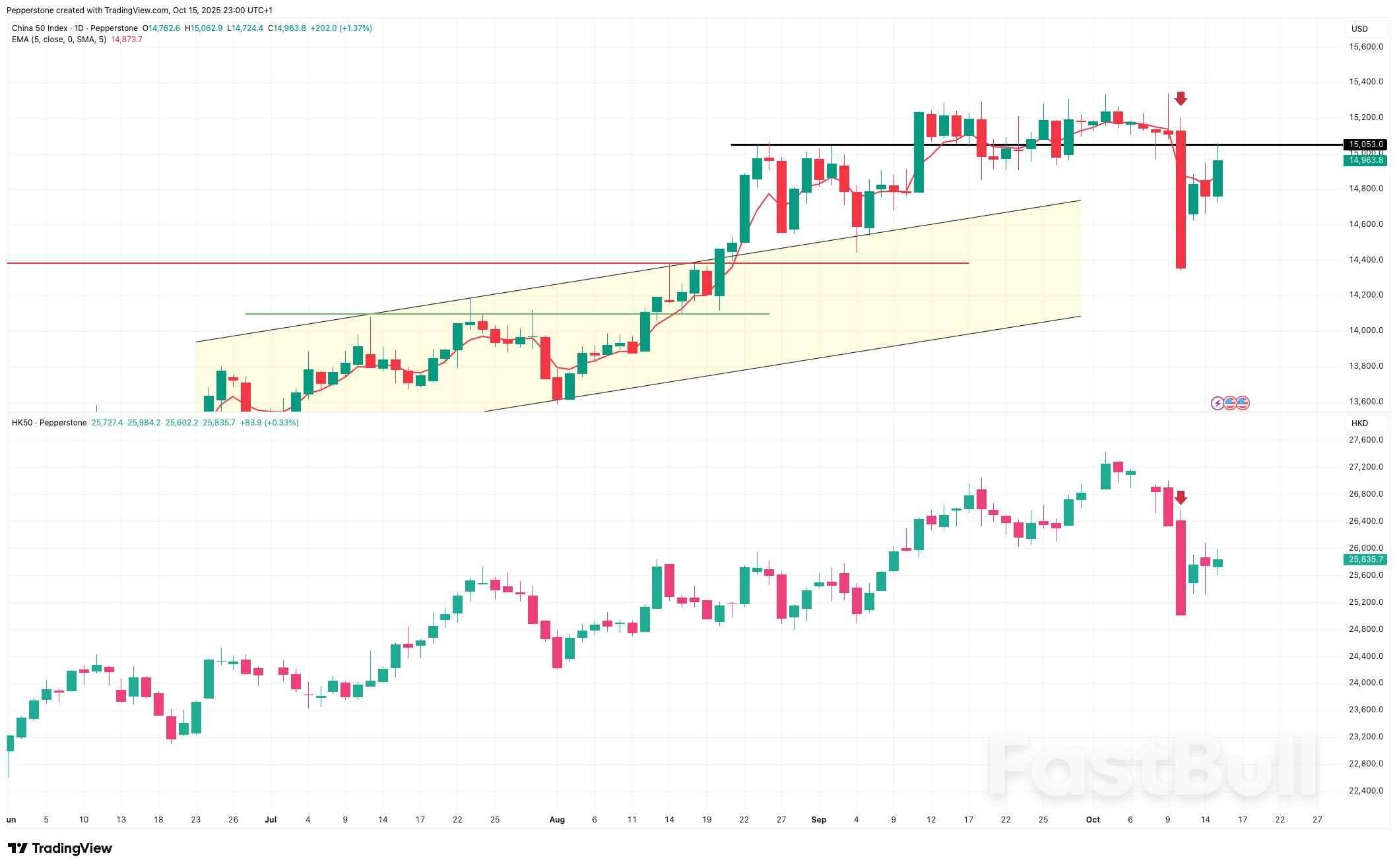
          Chinese market participants are processing the news flow while closely monitoring several key questions: Will these tariffs and export restrictions actually be implemented? If so, what impact could they have on China's economy and capital markets? And which upcoming events or potential risks should investors pay attention to?

          Export Controls in Focus, Technological Independence Urgent

          Compared with the tariffs announced by the U.S. in April, the latest round of U.S.-China frictions shows significant shifts.

          First, the dispute has moved from traditional tariffs to export controls and technology restrictions, particularly in rare earths and high-tech sectors. China controls approximately 70%-80% of global rare earth mining and around 90% of refining and processing capacity. This round of restrictions targets not only raw material exports but also key equipment and processing technology.

          While the U.S. can seek alternative supplies from countries like Brazil, India, and Australia, fully compensating for China's production gap would take significant time. A 2010 precedent—China's two-month rare earth export ban on Japan—took nearly five years for Japan to partially offset the supply shortfall, highlighting the strategic leverage inherent in rare earth controls.

          Similarly, U.S. restrictions on exporting high-end chips to China make technological independence increasingly urgent. Accelerating domestic development of semiconductors and AI chips is not only a necessary step to mitigate supply risks but also strengthens China's bargaining position in tariff and trade negotiations.

          Political factors have also added complexity to this round of talks. Ongoing U.S. government shutdown risks and the Supreme Court's pending ruling on IEEPA tariffs could reduce administrative efficiency and delay policy implementation, complicating negotiations further.

          China Market: Short-Term Impact Contained, Supply Chain Resilience Evident

          Even if the proposed 100% tariffs and export restrictions were fully implemented, the direct impact on China's macroeconomy may be less severe than some market expectations suggest.

          From a trade perspective, while China's effective tariffs are already approaching 40%, diversification of export markets provides a buffer. In September 2025, China's exports to the U.S. fell 27% year-on-year, marking six consecutive months of decline, yet exports to ASEAN, the EU, and Japan rebounded significantly.

          With trade increasingly shifting toward regional partners and emerging markets, China's external demand structure is gradually reshaping. Trade diversion, combined with potential policy offsets from Chinese authorities, should help mitigate the negative effects of U.S. tariffs.

          At a deeper level, this round of friction is not just about tariff rates or export volumes; it is a contest over technological leadership, supply chain control, and global institutional influence.

          Critical materials like rare earths hold strategic positions in global supply chains, giving China an irreplaceable advantage. Restricting exports may raise short-term downstream costs but simultaneously enhances China's leverage in negotiations.

          In addition, U.S. software exports to China account for just 5.8% of total exports in 2024, limiting overall impact. Facing U.S. restrictions on high-end equipment and semiconductors, China's ongoing push for domestic substitutes and technological autonomy is gradually closing the gap while strengthening supply chain resilience.

          Overall, short-term frictions may raise risk premiums, increase capital outflow pressures, and heighten expectations of RMB depreciation. Industries such as technology, semiconductors, electronics, and machinery—especially small and medium-sized enterprises—may bear the initial brunt, with some companies possibly accelerating shipments to avoid tariffs.

          Nevertheless, China's relatively ample foreign exchange reserves, flexible exchange rate management, and solid fiscal tools should help stabilize market sentiment and ease short-term volatility.

          Limited Probability of Tariff Implementation, Focus on Quantifiable Issues

          Despite the continuous news flow, the likelihood of these tariffs being fully implemented remains low.

          President Trump's well-known “TACO Strategy” involves escalating tariff threats and issuing vague statements to create a high-pressure negotiation environment, signaling to other economies that the U.S. is willing to endure short-term pain for long-term gains. China, meanwhile, seeks to condemn and retaliate while signaling to markets that it will not compromise. Their interactions have largely been a credibility game, where political signaling often outweighs immediate economic impact.

          Domestic political uncertainty in the U.S. is the biggest obstacle to implementing these tariffs, with government shutdowns and compliance risks limiting practical execution. In contrast, China has more flexibility to respond with countermeasures, and this timing gap reduces the feasibility of fully implementing U.S. tariffs.

          The APEC summit and planned U.S.-China presidential meetings remain on schedule, and the new tariffs proposed by the White House are not expected to take effect until November, leaving room and time for negotiations.

          In the short term, discussions are likely to focus on quantifiable issues such as trade balance, tariff levels, export controls, and exchange rate fluctuations. The U.S. may push China to increase agricultural purchases and U.S. investments while pressing on issues like fentanyl; China could respond strategically by slowing the pace of foreign investment reforms.

          Over a longer horizon, U.S.-China relations are likely to oscillate between temporary truce and ongoing negotiations. For the U.S., short-term pauses help ease domestic political and market pressures while retaining leverage for future action. For China, they stabilize external conditions, alleviate economic pressure, and provide breathing space for domestic reforms.

          Breaking this cyclical deadlock ultimately depends on building verifiable mechanisms of trust. Setting concrete execution checkpoints to verify commitments, using temporary compromises to gain negotiation space, and gradually establishing reciprocal expectations could open new avenues for bilateral relations. This approach mirrors the framework of the 2019–2020 interim agreements and may again serve as a practical reference for current negotiations.

          Rising Market Volatility: Balancing Defense and Opportunity

          Overall, with temporary agreements becoming part of U.S.-China trade friction, such tensions are likely to represent a recurring feature of bilateral competition. Both sides use policy tools to signal positions and gain bargaining leverage, but the market impact ultimately hinges on the balance between “deterrence” and “executability.”

          Market volatility is inevitable amid this strategic game. In the near term, key points to watch include the leaders' planned meeting in South Korea at the end of the month and the U.S. Supreme Court's IEEPA tariff ruling in early November. Both sides are sending negotiation signals; if tensions ease, risk sentiment could improve, and China-Hong Kong stocks, supported by technology and AI sectors, may show more stable gains.

          In the face of short-term uncertainty, market participants may consider balancing defensive and opportunistic approaches.

          Defensively, attention can be given to export-oriented companies, raw materials, and critical supply chain nodes to reduce short-term volatility risks. Maintaining adequate liquidity, managing exposure to firms heavily reliant on U.S. exports, and hedging systemic risks are also prudent. Close monitoring of foreign exchange and interest rate markets can help respond to potential RMB depreciation pressures.

          On the opportunity side, investors may focus on growth prospects arising from technology upgrades, industrial substitution, and long-term structural reforms. High-quality targets in domestic substitution chains—such as semiconductor equipment, upstream materials, and core components for new energy—could benefit from both policy support and growing demand.

          Source: Pepperstone

          To stay updated on all economic events of today, please check out our Economic calendar
          Risk Warnings and Disclaimers
          You understand and acknowledge that there is a high degree of risk involved in trading. Following any strategies or investment methods may lead to potential losses. The content on the site is provided by our contributors and analysts for information purposes only. You are solely responsible for determining whether any trading assets, securities, strategy, or any other product is suitable for investing based on your own investment objectives and financial situation.
          Add to Favorites
          Share

          U.S. Bank Earnings Soar, Offsetting Trade War Jitters as Markets Rally

          Gerik

          Economic

          Wall Street Cheers Bank Profits as Trade War Tensions Simmer

          U.S. financial markets got a confidence boost this week as Bank of America and Morgan Stanley joined JPMorgan and Goldman Sachs in delivering stellar Q2 2025 earnings, far surpassing analyst forecasts. This strong performance, fueled by a surge in dealmaking and stock market momentum, helped push the S&P 500 and Nasdaq Composite upward, while the Russell 2000 hit a fresh record. The market rally indicates that despite concerns over rising costs from tariffs and persistent U.S.-China tensions, investors remain optimistic about the resilience of the U.S. economy.
          This upbeat sentiment comes as U.S. Federal Reserve’s Beige Book confirmed that many firms are facing elevated import costs due to tariffs, with some businesses passing those costs on to consumers while others try to remain competitive by holding prices steady. Yet, corporate profitability especially in the banking sector has not only held firm but exceeded expectations.

          White House to Impose Price Floors Amid China’s Rare Earth Dominance

          In a strategic move to combat what it deems China's “nonmarket economy,” U.S. Treasury Secretary Scott Bessent announced that the Trump administration will enforce price floors across key industries. This industrial policy will act as a government-backed pricing mechanism, ensuring that U.S. producers aren’t undercut by China's aggressive price-slashing particularly in sectors like rare earth elements, critical to high-tech and defense applications.
          Bessent explicitly rejected the idea that a stock market dip would cause a U.S. policy shift toward China, reinforcing a hardline stance even as the trade environment intensifies. The Treasury also recently finalized a $20 billion currency swap with Argentina, signaling broader financial diplomacy alongside protectionist industrial strategy.

          India’s Shift on Russian Oil Adds Another Layer to Energy Markets

          President Donald Trump further fueled market discussion by revealing that India will gradually stop buying Russian oil, based on a recent conversation with Prime Minister Narendra Modi. Although no official timeline was provided, such a move could tighten global oil supply, with Brent already rebounding from five-month lows. The announcement also came as Western nations expand sanctions on companies handling Russian energy, including Indian refiner Nayara Energy.
          India's redirection of oil sourcing coupled with its trade ambitions with the U.S. may further reinforce diplomatic ties, especially as it eyes an additional $15 billion in U.S. oil imports.

          Small-Cap Stocks and AI Water Concerns: A Tale of Two Trends

          While small-cap stocks (Russell 2000) continue to rally and attract attention from bullish investors, another issue gaining traction is the environmental impact of AI infrastructure. Across Southern Europe, water-stressed regions are raising concerns about the sustainability of mega AI projects, as data centers require massive water volumes to cool down.
          This rising awareness of AI’s hidden environmental costs could spark policy responses in the EU and encourage innovation in greener data solutions, adding another layer of complexity to the rapidly expanding artificial intelligence economy.
          Despite rising protectionism, ongoing trade disputes, and environmental headwinds, global markets remain largely unfazed, supported by strong corporate earnings, investor confidence, and resilient small-cap momentum. However, the path forward remains contingent on upcoming earnings from tech giants like Tesla and Intel, the evolving U.S.-China standoff, and the ability of governments to manage both geopolitical risk and environmental sustainability in an AI-driven world.

          Source: CNBC

          To stay updated on all economic events of today, please check out our Economic calendar
          Risk Warnings and Disclaimers
          You understand and acknowledge that there is a high degree of risk involved in trading. Following any strategies or investment methods may lead to potential losses. The content on the site is provided by our contributors and analysts for information purposes only. You are solely responsible for determining whether any trading assets, securities, strategy, or any other product is suitable for investing based on your own investment objectives and financial situation.
          Add to Favorites
          Share

          TSMC Profit Soars Nearly 40% on AI Demand Surge, Defying Trade Tensions

          Gerik

          Economic

          Stocks

          TSMC Reports Record Profit as AI Boom Drives Demand

          Taiwan Semiconductor Manufacturing Co. (TSMC), the world’s largest chip foundry, announced on Thursday that its net profit jumped nearly 40% year-on-year in the third quarter of 2025, reaching NT$452.3 billion ($15 billion). This significantly beat analysts’ expectations and highlights the company’s central role in the global semiconductor supply chain, particularly amid the explosive growth of AI technologies.
          The company’s 30% revenue increase year-over-year was largely fueled by surging demand for advanced chips used in artificial intelligence applications, especially those powering large language models, high-performance computing, and cloud infrastructure.

          AI Demand Resilience Supports TSMC's Global Expansion

          Morningstar analysts noted that TSMC’s products remain in high demand and see little risk of disruption even amid mounting geopolitical uncertainties. The firm’s deep technological lead, particularly in advanced nodes such as 3nm and 5nm, makes it indispensable to top-tier customers like Apple and Nvidia, both of which are aggressively expanding their AI product lines.
          “Demand for TSMC’s products is unyielding,” Morningstar stated, affirming that the AI wave is providing long-term structural support for the company’s financial performance.
          TSMC’s growing dominance in AI-related semiconductor production has helped shield it from the volatility of broader economic conditions and trade policy shifts.

          Strategic Investments to Diversify Away from Geopolitical Risk

          To mitigate exposure to geopolitical disruptions particularly in light of ongoing U.S.-China trade tensions TSMC has accelerated international capacity expansion, especially in the United States and Japan.
          The company has committed a total of $165 billion in U.S. investments, including its new chip fabrication plants in Arizona, which are slated to serve critical American customers and secure access to U.S. subsidies under the CHIPS Act. These plants also serve as a hedge against any future tariff or export control risks targeting Taiwan-based production.
          Meanwhile, U.S. Commerce Secretary Howard Lutnick recently proposed a 50-50 production split between Taiwan and the U.S., an idea firmly rejected by Taiwan. Still, the scale of TSMC’s overseas investment signals a pragmatic strategy to localize production without compromising its Taiwan-based leadership.

          AI Boom Shields TSMC from Volatility, Fuels Global Strategy

          TSMC’s robust earnings underscore its strategic position at the heart of the global tech ecosystem. As artificial intelligence continues to reshape hardware demand, TSMC’s advanced node technologies, diversified manufacturing base, and deep integration with leading global clients offer it both resilience and upside.
          Even amid geopolitical headwinds and calls for supply chain reshoring, the company is navigating challenges through calculated expansion and unmatched technological capabilities. With AI demand expected to remain strong, TSMC is positioned to continue its growth trajectory well into 2026 and beyond.

          Source: AP

          To stay updated on all economic events of today, please check out our Economic calendar
          Risk Warnings and Disclaimers
          You understand and acknowledge that there is a high degree of risk involved in trading. Following any strategies or investment methods may lead to potential losses. The content on the site is provided by our contributors and analysts for information purposes only. You are solely responsible for determining whether any trading assets, securities, strategy, or any other product is suitable for investing based on your own investment objectives and financial situation.
          Add to Favorites
          Share

          How to Read Stock Market Charts and Graphs for Beginners

          Winkelmann

          Stocks

          How to Read Stock Market Charts and Graphs: A Simple Guide for New Investors

          Learning how to read stock market charts and graphs helps investors identify trends, analyze price action, and make informed decisions.

          Part 1: Common Types of Stock Market Charts

          Stock charts display how a stock’s price changes over time. Each chart type presents data differently, helping investors spot momentum, volatility, and turning points.

          Line Chart

          Connects closing prices across time, offering a clean view of overall direction. Ideal for beginners learning how to read charts in the stock market.

          Bar Chart (OHLC)

          Shows open, high, low, and close for each period. The vertical bar reflects the full range, while left/right ticks mark open/close. Useful for gauging volatility and intraperiod sentiment.

          Candlestick Chart

          Visualizes the same OHLC data with colored bodies and wicks, revealing market psychology. Great for recognizing momentum, reversals, and continuation signals (how to read candle chart in stock market).

          Point & Figure Chart

          Ignores time and focuses on price movement only, filtering noise and highlighting breakouts and long-term trend structure.

          Key Elements of Stock Charts

          • OHLC: Open, High, Low, Close define each period’s price action.
          • Trendlines: Connect swing highs/lows to reveal direction and strength.
          • Support & Resistance: Price zones where demand or supply often shifts.
          • Volume: Confirms the strength behind price moves.
          • Timeframe: From minutes to months; choose based on strategy.

          Common Chart Patterns

          • Head and Shoulders: Often signals a trend reversal.
          • Double Top / Double Bottom: Reversal after failed break attempts.
          • Triangles (Ascending / Descending / Symmetrical): Consolidation before breakout.
          • Cup and Handle: Bullish continuation pattern after a rounded base.

          Part 2: Key Indicators Used in Stock Chart Analysis

          Understanding key indicators is essential when learning how to read stock market charts and graphs. These indicators help investors evaluate trend strength, momentum, and potential reversals in the market.

          1. Moving Averages (MA)

          The moving average smooths price data over a specific period, showing the average value of a stock’s price. It helps identify the overall trend direction — if prices stay above the MA, the market is bullish; below means bearish.

          • Simple Moving Average (SMA): Equal weighting for all data points in the period.
          • Exponential Moving Average (EMA): Gives more importance to recent data for quicker trend signals.
          • Golden Cross / Death Cross: When short-term and long-term MAs cross, signaling trend reversals.

          2. Relative Strength Index (RSI)

          RSI measures price momentum on a scale of 0 to 100, helping identify overbought or oversold conditions. A reading above 70 often means overbought, while below 30 indicates oversold. When analyzing how to read a stock market chart, RSI offers insight into market psychology and timing.

          3. Moving Average Convergence Divergence (MACD)

          The MACD indicator tracks the relationship between two exponential moving averages to show momentum shifts. When the MACD line crosses above the signal line, it’s a bullish signal; when below, it’s bearish.

          4. Volume

          Volume measures how many shares are traded during a given period. When price moves with rising volume, it confirms the strength of that move. This is critical in how to read charts in stock market analysis since it validates breakouts or reversals.

          5. Bollinger Bands

          Bollinger Bands use a moving average with upper and lower bands based on standard deviations. When prices touch the upper band, assets may be overbought; when near the lower band, oversold. It’s a visual way to measure volatility and extremes in how to read candle chart in stock market analysis.

          6. Fibonacci Retracement

          This tool helps identify potential support and resistance levels by dividing a major price move into key ratios (23.6%, 38.2%, 61.8%). Traders use it to predict pullbacks and continuation points.

          7. Trendlines and Channels

          Drawing trendlines helps visualize the market direction. Parallel trendlines form price channels that signal the boundaries of price movement. They’re often combined with indicators for confirmation.

          Part 3: How to Read Stock Market Charts and Graphs

          Learning how to read stock market charts and graphs helps investors interpret price trends, market sentiment, and entry or exit signals. Whether you use a line chart, bar chart, or candlestick chart, understanding each format allows you to visualize the balance between buyers and sellers.

          How to Read a Line Chart

          A line chart is the simplest way to view price movements over time. It connects the closing prices of each trading period with a continuous line, giving a clear picture of the overall trend.

          How to Read Stock Market Charts and Graphs for Beginners_1

          • Upward slope: Indicates a bullish trend (price increasing over time).
          • Downward slope: Signals a bearish trend (declining price).
          • Sideways line: Reflects consolidation or market indecision.

          Line charts are ideal for investors who want to see the “big picture” of a stock’s performance without short-term noise. When learning how to read a stock market chart, this is often the first step toward understanding broader trends.

          How to Read a Bar Chart

          A bar chart (also called an OHLC chart) shows more detail by including the open, high, low, and close prices within each period. Each vertical bar represents the trading range, while small ticks on either side show opening and closing prices.

          How to Read Stock Market Charts and Graphs for Beginners_2

          • Left tick: Opening price.
          • Right tick: Closing price.
          • Top and bottom: Highest and lowest prices for that session.

          When the close is higher than the open, it reflects bullish momentum; when it’s lower, bearish momentum. Bar charts are useful for seeing volatility and range strength — key for those studying how to read charts in stock market for active trading.

          How to Read a Candlestick Chart

          Candlestick charts are the most popular and powerful visualization for traders. Each “candle” represents one trading session and includes four data points: open, high, low, and close — similar to bar charts but more visual.

          How to Read Stock Market Charts and Graphs for Beginners_3

          • Green or hollow candle: Closing price is higher than opening (bullish).
          • Red or filled candle: Closing price is lower than opening (bearish).
          • Wicks or shadows: Represent intraday price extremes.

          When learning how to read candle chart in stock market, focus on body size and wick length — long bodies show strong moves, while long wicks signal market indecision or reversals.

          Common patterns include:

          • Doji: Signals indecision, often before reversals.
          • Hammer: Appears after a downtrend, suggesting a possible bottom.
          • Engulfing Pattern: Indicates a strong reversal in sentiment.

          How to Combine Indicators and Patterns

          Reading charts isn’t just about recognizing shapes — it’s about context. Combine technical indicators with visual patterns to confirm trends and improve accuracy.

          • Combine Moving Averages with Candlestick Patterns: For example, a bullish engulfing candle above the 50-day MA can signal strong trend continuation.
          • Use RSI with Support/Resistance: If RSI shows oversold while price touches support, it strengthens the buy signal.
          • Volume Confirmation: Rising volume validates price breakouts or breakdowns.

          Understanding how to integrate these tools is the key to mastering how to read stock market charts and graphs effectively for real-world investing or trading decisions.

          FAQs about How to Read Stock Market Charts and Graphs

          1. How to understand chart patterns in stock market?

          Chart patterns reveal market psychology. Shapes like triangles, double tops, and head-and-shoulders indicate trend continuation or reversal. Understanding them helps predict price behavior.

          2. What's the best chart pattern for beginners?

          Beginners can start with simple patterns such as trendlines, support and resistance zones, or candlestick formations like hammers and dojis—they are easy to spot and reliable.

          3. How often should I check stock charts?

          Long-term investors can review weekly or daily charts, while active traders may monitor hourly charts for faster signals and short-term trends.

          Conclusion

          Mastering how to read stock market charts and graphs helps investors spot opportunities, manage risk, and make smarter, data-driven trading decisions.

          Risk Warnings and Disclaimers
          You understand and acknowledge that there is a high degree of risk involved in trading. Following any strategies or investment methods may lead to potential losses. The content on the site is provided by our contributors and analysts for information purposes only. You are solely responsible for determining whether any trading assets, securities, strategy, or any other product is suitable for investing based on your own investment objectives and financial situation.
          Add to Favorites
          Share

          Dollar Drops Versus Euro, Rises Slightly Against Yen, China's Rare Earths in Focus

          Glendon

          Economic

          Forex

          (Oct 16): The US dollar headed for a third straight daily loss against the euro while edging up versus the yen on Thursday, as concerns over US-China tensions and dovish remarks from Federal Reserve officials continued to weigh on sentiment.

          Analysts say political headwinds have weighed on the yen but expect support to come from looming Fed rate cuts, the end of US quantitative tightening, and a potential rise in market volatility, which usually supports safe-haven assets.

          US Treasury yields hovered near multi-week lows, with the benchmark 10-year just above 4%, pressuring the dollar as investors also weighed a prolonged US government shutdown.

          The Fed’s Beige Book released Thursday offered little support to US rates, pointing to emerging signs of economic weakness, including rising layoffs and reduced spending among middle- and lower-income households. Fed Governor Stephen Miran said on Wednesday cutting rates is now more important.

          The dollar index, which measures the greenback against six other currencies, was down 0.05% at 98.63, and was on track for a weekly decline of around 0.3%.

          Rare earths in focus

          Investors were scrutinising China’s latest expansion of rare earth export controls, a move sharply criticised by senior US officials on Wednesday, who warned that it could disrupt global supply chains.

          "The question for financial markets is whether China's proposed export controls on rare earths are merely part of a bargaining ploy to achieve greater concessions from the US," said Chris Turner, global head of markets at ING.

          Amid the tit-for-tat action, US President Donald Trump still expects to meet Chinese President Xi Jinping in South Korea this month, US Treasury Secretary Scott Bessent said.

          "An extension, rather than a grand bargain that settles all trade issues, is probably the most realistic second-best outcome compared to the alternative of escalation of retaliation," said Joseph Capurso, head of foreign exchange at Commonwealth Bank of Australia.

          The Australian dollar was flat at US$0.6511 after data showed unemployment hit a near four-year high in September, adding to the case for interest rate cuts.

          The Aussie, often considered a proxy for risk appetite, has been volatile this week due to the trade tension as traditional havens gained.

          China's yuan firmed to a two-week high against the US dollar on Thursday after the central bank set its strongest daily midpoint in a year.

          French political drama in the background

          The euro touched a one-week high and was up 0.10% at US$1.1656 as traders braced for yet another episode in the French political drama, with Prime Minister Sebastien Lecornu likely to survive two no-confidence votes in parliament.

          France's political crisis has barely affected euro zone sovereign bond markets as investors see no room for a selloff in French bonds without snap elections.

          However, by shelving pension reform until after 2027, France’s prime minister has managed to defuse a sharp escalation in the crisis, though at the cost of complicating efforts to rein in public finances, analysts said.

          The yen briefly firmed to a one-week high of 150.51 per dollar but was up 0.05% at 151.11. Japan's weakened Liberal Democratic Party is set to begin policy talks with the right-leaning Innovation Party on Thursday that could help Sanae Takaichi clinch a prime ministerial vote expected next week.

          "Regardless of the outcome of the prime ministerial election, it is highly likely that the market will price in some expansionary fiscal policies," said Shinichiro Kadota, head of Japan forex and rates strategy at Barclays Tokyo.

          "We remain long on the US dollar versus the yen given the risk of a further rally but with eyes on an eventual intervention risk or Bank of Japan hike if the move extends."

          Source: Theedgemarkets

          To stay updated on all economic events of today, please check out our Economic calendar
          Risk Warnings and Disclaimers
          You understand and acknowledge that there is a high degree of risk involved in trading. Following any strategies or investment methods may lead to potential losses. The content on the site is provided by our contributors and analysts for information purposes only. You are solely responsible for determining whether any trading assets, securities, strategy, or any other product is suitable for investing based on your own investment objectives and financial situation.
          Add to Favorites
          Share

          Trump Threatens Cooking Oil Ban as U.S.-China Soybean Dispute Intensifies

          Gerik

          Economic

          Commodity

          China–U.S. Trade War

          Soybean Rift Deepens as Trump Accuses China of Economic Hostility

          President Donald Trump escalated his administration’s trade offensive against China on Tuesday by accusing Beijing of “economic hostility” for its continued refusal to purchase U.S. soybeans. In a post on social media, Trump stated that China's deliberate move was "causing difficulty for our Soybean Farmers" and warned of retaliatory actions, including a potential embargo on cooking oil and other Chinese goods.
          The sharp rhetoric follows Trump’s earlier threat to impose a 100% tariff on all Chinese imports, a significant leap from existing levies that were already placing strain on bilateral trade. The President emphasized that the U.S. “can easily produce Cooking Oil ourselves,” signaling a push for domestic substitution and trade decoupling.

          Strategic Value of Soy and Cooking Oil in Trade Policy

          Soybeans, a politically sensitive commodity due to their importance to American agriculture, have become a central flashpoint in U.S.-China relations. Historically, over 40% of U.S. soybean exports went to China, but no orders have been placed this year. This shift has left U.S. farmers with a glut of unsold harvests and falling prices, while China has redirected its purchases to Argentina and Brazil.
          Cooking oil especially used cooking oil (UCO) adds another dimension to the dispute. While the U.S. traditionally imports most edible oils from Canada, China has emerged as a key supplier of UCO for biofuel production, particularly since 2023. The rise in U.S. demand for sustainable fuel inputs, driven by green energy policy, transformed the country from a net exporter of UCO in 2021 to a net importer by 2022, with imports surpassing 1.36 million metric tons last year.
          This shift has given China strategic leverage, as it now plays a vital role in the U.S. renewable fuel supply chain. Trump’s proposed embargo could therefore disrupt domestic biofuel production, while also complicating U.S. efforts to transition toward cleaner energy.

          Rare Earth Controls Trigger Tariff Retaliation

          The cooking oil threat comes amid broader trade friction, particularly over rare earth minerals, which are essential to high-tech and defense industries. Earlier this week, China’s Ministry of Commerce introduced sweeping export controls on rare earths, prompting swift retaliation from Washington.
          U.S. Trade Representative Jamieson Greer criticized the move in an interview, stating that China’s new export regime had “derailed” trade settlement efforts, adding that "they are the ones who have chosen to make this major escalation." According to Greer, the previous agreement hinged on mutual restraint: low U.S. tariffs in exchange for China’s continued supply of rare earths. The new controls, which extend to downstream products, violated that understanding, thereby justifying further U.S. tariff hikes.

          Shifting Trade Patterns and Geopolitical Undercurrents

          The intensifying trade conflict highlights deeper shifts in global commodity flows and industrial policy. Previously, Europe had been the largest buyer of Chinese UCO, but that demand collapsed following a 2023 EU probe into price manipulation. The U.S. then became China’s largest customer, despite having imported negligible volumes just two years prior.
          Trump’s proposal to cut off Chinese UCO imports may be aimed at curbing reliance on a perceived adversary, but such a move would likely disrupt domestic supply chains for biofuels, a sector already strained by delayed government reporting due to the ongoing U.S. federal shutdown.
          For soybean producers, the immediate concern remains: China’s complete absence from the U.S. export order books in 2025, a stark departure from previous years. As Chinese demand consolidates around South American suppliers, U.S. farmers face rising inventories and economic uncertainty.

          A Trade Flashpoint with Strategic Implications

          Trump’s threat to ban cooking oil imports from China, while symbolic, carries tangible consequences. It reflects not only deepening frustration over the soybean impasse but also a broader shift in U.S. policy toward economic decoupling in strategic sectors. Coupled with the rare earth standoff and looming tariff hikes, this latest move signals a reconfiguration of trade relations, where food, fuel, and minerals are wielded as instruments of geopolitical leverage.
          As both economies edge closer to full-scale economic disengagement, the outcome of the upcoming APEC summit where Trump and Xi are scheduled to meet may determine whether diplomacy can defuse tensions or whether the confrontation will intensify into a lasting trade rupture.

          Source: Reuters

          To stay updated on all economic events of today, please check out our Economic calendar
          Risk Warnings and Disclaimers
          You understand and acknowledge that there is a high degree of risk involved in trading. Following any strategies or investment methods may lead to potential losses. The content on the site is provided by our contributors and analysts for information purposes only. You are solely responsible for determining whether any trading assets, securities, strategy, or any other product is suitable for investing based on your own investment objectives and financial situation.
          Add to Favorites
          Share

          USD/CHF Falls To Two-Week Low

          FXOpen

          Economic

          Forex

          This morning, the USD/CHF exchange rate slipped below 0.7944 for the first time since 1 October, as demand for safe-haven assets intensified — a trend also reflected in yesterday’s record gold price above $4,200.The traditionally stable Swiss franc is strengthening amid rising global uncertainty and risk aversion:

          → In Japan, the upcoming prime ministerial election could significantly impact monetary policy, while France faces ongoing political turmoil.

          → In the United States, the government shutdown continues, and traders are closely watching developments around a potential trade deal with China, possibly to be discussed during an expected meeting between the two countries’ leaders.

          Technical Analysis of the USD/CHF Chart

          As noted in our 25 September analysis, the Swiss franc has appreciated through 2025 amid elevated geopolitical and macroeconomic risks, forming a downward channel on the USD/CHF chart (shown in red).

          We also highlighted:

          → the possibility of a trend reversal around the 0.7900 support area;

          → potential breakout targets (shown in blue).

          Since then, the bulls have indeed made progress, driving the price up towards point A and:

          → breaking above the red channel’s upper boundary;

          → overcoming the psychological 0.8000 level.

          However, that progress has not been sustained. Among the bearish signals:

          → the median line of the blue channel acted as resistance;

          → the brief move above local highs around 0.8072 resembles a bearish liquidity grab.

          From the bullish perspective, USD/CHF has now retreated into a zone that could act as support:

          → the upper boundary of the red channel;

          → the lower boundary of the blue channel.

          The arrow highlights signs of a bullish engulfing pattern, suggesting that buyers may be using these support zones to stage a rebound within the blue channel. The 0.8000 psychological mark could serve as the first key test of their resolve.

          Source: FXOpen

          To stay updated on all economic events of today, please check out our Economic calendar
          Risk Warnings and Disclaimers
          You understand and acknowledge that there is a high degree of risk involved in trading. Following any strategies or investment methods may lead to potential losses. The content on the site is provided by our contributors and analysts for information purposes only. You are solely responsible for determining whether any trading assets, securities, strategy, or any other product is suitable for investing based on your own investment objectives and financial situation.
          Add to Favorites
          Share
          FastBull
          Copyright © 2025 FastBull Ltd

          728 RM B 7/F GEE LOK IND BLDG NO 34 HUNG TO RD KWUN TONG KLN HONG KONG

          TelegramInstagramTwitterfacebooklinkedin
          App Store Google Play Google Play
          Products
          Charts

          Chats

          Q&A with Experts
          Screeners
          Economic Calendar
          Data
          Tools
          Membership
          Features
          Function
          Markets
          Copy Trading
          Latest Signals
          Contests
          News
          Analysis
          24/7
          Columns
          Education
          Company
          Careers
          About Us
          Contact Us
          Advertising
          Help Center
          Feedback
          User Agreement
          Privacy Policy
          Business

          White Label

          Data API

          Web Plug-ins

          Poster Maker

          Affiliate Program

          Risk Disclosure

          The risk of loss in trading financial instruments such as stocks, FX, commodities, futures, bonds, ETFs and crypto can be substantial. You may sustain a total loss of the funds that you deposit with your broker. Therefore, you should carefully consider whether such trading is suitable for you in light of your circumstances and financial resources.

          No decision to invest should be made without thoroughly conducting due diligence by yourself or consulting with your financial advisors. Our web content might not suit you since we don't know your financial conditions and investment needs. Our financial information might have latency or contain inaccuracy, so you should be fully responsible for any of your trading and investment decisions. The company will not be responsible for your capital loss.

          Without getting permission from the website, you are not allowed to copy the website's graphics, texts, or trademarks. Intellectual property rights in the content or data incorporated into this website belong to its providers and exchange merchants.

          Not Logged In

          Log in to access more features

          FastBull Membership

          Not yet

          Purchase

          Become a signal provider
          Help Center
          Customer Service
          Dark Mode
          Price Up/Down Colors

          Log In

          Sign Up

          Position
          Layout
          Fullscreen
          Default to Chart
          The chart page opens by default when you visit fastbull.com