Markets
News
Analysis
User
24/7
Economic Calendar
Education
Data
- Names
- Latest
- Prev


Signal Accounts for Members
All Signal Accounts
All Contests


Turkey Trade BalanceA:--
F: --
P: --
Germany Construction PMI (SA) (Nov)A:--
F: --
P: --
Euro Zone IHS Markit Construction PMI (Nov)A:--
F: --
P: --
Italy IHS Markit Construction PMI (Nov)A:--
F: --
P: --
U.K. Markit/CIPS Construction PMI (Nov)A:--
F: --
P: --
France 10-Year OAT Auction Avg. YieldA:--
F: --
P: --
Euro Zone Retail Sales MoM (Oct)A:--
F: --
P: --
Euro Zone Retail Sales YoY (Oct)A:--
F: --
P: --
Brazil GDP YoY (Q3)A:--
F: --
P: --
U.S. Challenger Job Cuts (Nov)A:--
F: --
P: --
U.S. Challenger Job Cuts MoM (Nov)A:--
F: --
P: --
U.S. Challenger Job Cuts YoY (Nov)A:--
F: --
P: --
U.S. Initial Jobless Claims 4-Week Avg. (SA)A:--
F: --
P: --
U.S. Weekly Initial Jobless Claims (SA)A:--
F: --
P: --
U.S. Weekly Continued Jobless Claims (SA)A:--
F: --
P: --
Canada Ivey PMI (SA) (Nov)A:--
F: --
P: --
Canada Ivey PMI (Not SA) (Nov)A:--
F: --
P: --
U.S. Non-Defense Capital Durable Goods Orders Revised MoM (Excl. Aircraft) (SA) (Sept)A:--
F: --
U.S. Factory Orders MoM (Excl. Transport) (Sept)A:--
F: --
P: --
U.S. Factory Orders MoM (Sept)A:--
F: --
P: --
U.S. Factory Orders MoM (Excl. Defense) (Sept)A:--
F: --
P: --
U.S. EIA Weekly Natural Gas Stocks ChangeA:--
F: --
P: --
Saudi Arabia Crude Oil ProductionA:--
F: --
P: --
U.S. Weekly Treasuries Held by Foreign Central BanksA:--
F: --
P: --
Japan Foreign Exchange Reserves (Nov)A:--
F: --
P: --
India Repo RateA:--
F: --
P: --
India Benchmark Interest RateA:--
F: --
P: --
India Reverse Repo RateA:--
F: --
P: --
India Cash Reserve RatioA:--
F: --
P: --
Japan Leading Indicators Prelim (Oct)A:--
F: --
P: --
U.K. Halifax House Price Index YoY (SA) (Nov)--
F: --
P: --
U.K. Halifax House Price Index MoM (SA) (Nov)--
F: --
P: --
France Current Account (Not SA) (Oct)--
F: --
P: --
France Trade Balance (SA) (Oct)--
F: --
P: --
France Industrial Output MoM (SA) (Oct)--
F: --
P: --
Italy Retail Sales MoM (SA) (Oct)--
F: --
P: --
Euro Zone Employment YoY (SA) (Q3)--
F: --
P: --
Euro Zone GDP Final YoY (Q3)--
F: --
P: --
Euro Zone GDP Final QoQ (Q3)--
F: --
P: --
Euro Zone Employment Final QoQ (SA) (Q3)--
F: --
P: --
Euro Zone Employment Final (SA) (Q3)--
F: --
Brazil PPI MoM (Oct)--
F: --
P: --
Mexico Consumer Confidence Index (Nov)--
F: --
P: --
Canada Unemployment Rate (SA) (Nov)--
F: --
P: --
Canada Labor Force Participation Rate (SA) (Nov)--
F: --
P: --
Canada Employment (SA) (Nov)--
F: --
P: --
Canada Part-Time Employment (SA) (Nov)--
F: --
P: --
Canada Full-time Employment (SA) (Nov)--
F: --
P: --
U.S. Dallas Fed PCE Price Index YoY (Sept)--
F: --
P: --
U.S. PCE Price Index YoY (SA) (Sept)--
F: --
P: --
U.S. PCE Price Index MoM (Sept)--
F: --
P: --
U.S. Personal Outlays MoM (SA) (Sept)--
F: --
P: --
U.S. Core PCE Price Index MoM (Sept)--
F: --
P: --
U.S. UMich 5-Year-Ahead Inflation Expectations Prelim YoY (Dec)--
F: --
P: --
U.S. Core PCE Price Index YoY (Sept)--
F: --
P: --
U.S. 5-10 Year-Ahead Inflation Expectations (Dec)--
F: --
P: --
U.S. UMich Current Economic Conditions Index Prelim (Dec)--
F: --
P: --
U.S. UMich Consumer Sentiment Index Prelim (Dec)--
F: --
P: --
U.S. UMich 1-Year-Ahead Inflation Expectations Prelim (Dec)--
F: --
P: --
U.S. UMich Consumer Expectations Index Prelim (Dec)--
F: --
P: --


No matching data
Latest Views
Latest Views
Trending Topics
Top Columnists
Latest Update
White Label
Data API
Web Plug-ins
Affiliate Program
View All

No data
Will the index rise in 2025? Much depends on the Federal Reserve meeting on 10 December, as well as other factors, including geopolitical developments. Interest is also piqued by an upcoming statement from Trump at the White House (today, 22:00 GMT+3), though the topic remains undisclosed.
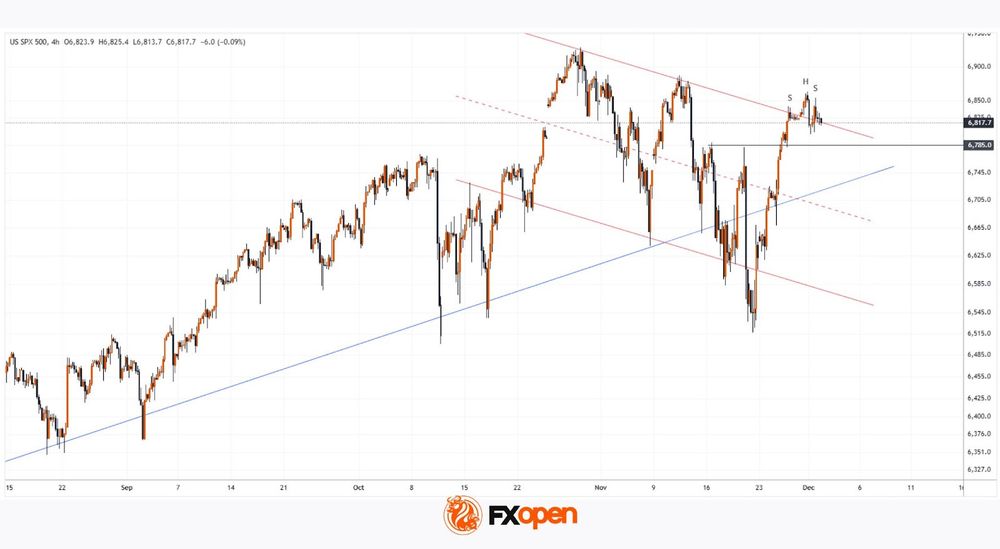
December is traditionally a favourable month for the S&P 500 (US SPX 500 mini on FXOpen):
→ Since the 1950s, December has ended higher in over 70% of years.
→ Average monthly gain is around +1.0%.
Will the index rise in 2025? Much depends on the Federal Reserve meeting on 10 December, as well as other factors, including geopolitical developments. Interest is also piqued by an upcoming statement from Trump at the White House (today, 22:00 GMT+3), though the topic remains undisclosed.
Demand-side perspective:
→ The rebound from November's low was aggressive, rising roughly +5% in 10 days.
→ Price climbed above the blue trendline that has acted as support since summer.
→ The recent dip (marked by the red trajectory) could be a temporary correction, forming a Bull Flag pattern.
Supply-side perspective:
→ The red trajectory has not yet been breached.
→ Recent price movements show a strong bearish Head and Shoulders pattern, along with signs of a Quasimodo formation, emerging around the attempt to break the upper boundary.
In the short term, the former resistance at 6785 may now act as support. Overall, the S&P 500 (US SPX 500 mini on FXOpen) is likely to adopt a wait-and-see stance, adjusting as economic news, delayed by the government shutdown, is released.
The EUR/USD pair retreated to 1.1612 on Tuesday, pulling back from a recent two-week high. The catalyst for the move was a significant repricing of US interest rate expectations following weak manufacturing data. The ISM Manufacturing Index confirmed a ninth consecutive month of contraction, with the pace of decline the fastest in four months.
This data solidified market expectations for a Federal Reserve rate cut. Futures markets now imply an 88% probability of a 25-basis-point reduction at next week's FOMC meeting.
In related news, President Donald Trump announced he has selected a candidate for the next Fed Chair. Media reports suggest the leading contender is Kevin Hassett, the current head of the White House National Economic Council.
Investor attention is now focused on an upcoming speech by current Chair Jerome Powell later today, which may offer further clues on the Fed's policy trajectory.
H4 Chart:
On the H4 chart, EUR/USD continues to trade within an established ascending channel. The pair is currently testing a key resistance zone at 1.1655, where buying momentum has met significant selling pressure. A decisive breakout above this level would open the path towards the next major resistance at 1.1730.
The Stochastic Oscillator is rising from the middle zone, indicating sustained bullish momentum without overbought conditions. The MACD remains above its zero line, maintaining a stable, albeit weak, buy signal. Conversely, a break and close below the key support at 1.1545 would signal a deeper correction, likely targeting the lower boundary of the current range near 1.1468.
H1 Chart:
On the H1 chart, the pair is undergoing a correction after being rejected from local resistance at 1.1652. Buyers are currently defending the price above the middle Bollinger Band, suggesting short-term bullish control remains intact.
The Stochastic Oscillator is in overbought territory (above 80) and is turning down, pointing to a near-term corrective pullback. However, the MACD remains in positive territory, supporting the broader upward bias. This technical picture suggests a brief downward pause is likely, with a potential retest of support in the 1.1600–1.1585 zone. A successful hold above this area would increase the probability of a fresh upward impulse, targeting a renewed test of 1.1652 and an eventual push towards 1.1700.
EUR/USD remains confidently bid, supported by growing expectations of Fed easing. While a short-term technical correction is underway, the broader structure on both the H4 and H1 charts remains constructive. The key for continued upside is a successful defence of the 1.1600–1.1585 support zone. A break above 1.1655 would be a significant bullish confirmation, while a failure to hold support could trigger a deeper pullback towards 1.1545.
Ukraine's second most powerful man resigned on 28 November, just as the country found itself fighting for its life on two fronts – militarily and diplomatically.
Andriy Yermak had served as the head of President Volodymyr Zelenskyy's presidential office for well over five years, long before Russia's full-scale invasion of Ukraine in February 2022. All that time he was both a solution and a problem for Zelenskyy.
It was Yermak who assumed a key role in the administration of a war-battered country in 2022, and shaped an international alliance in support of Ukraine. Early in the war, it was Yermak who encouraged Zelenskyy to assume global leadership in the fight against an axis of revisionist autocracies.
After the 2022 invasion Yermak consolidated his influence by handling both domestic and foreign affairs.
Zelenskyy relied on him to shape executive power. It was his job to select the prime minister and ministers, heads of state agencies, and to assert control over areas of law enforcement. The current prime minister, Yulia Svyrydenko, and prosecutor general, Ruslan Kravchenko, are seen as his protégés. He sidelined the parliament to shape the executive, something that goes against the constitution. With Zelenskyy's party holding a majority, members of parliament were rubber-stamping decisions taken in the Office of the President. It diminished their oversight, and their capacity to course-correct policies. For an unelected official, Yermak amassed enormous power.
Andriy Yermak was not a popular figure inside Ukraine, where he was seen by many as a mastermind behind the centralisation of power, and as a gatekeeper to Zelenskyy. Scandals surrounded his rise to power, including 'Wagnergate', an abortive special operation to arrest Wagner mercenaries in 2020.
But it was a corruption investigation in the energy sector that triggered his eventual fall. At this stage he is not a suspect, but Ukrainian civil society believes that it was Yermak who oversaw efforts to curtail the powers of investigative agencies such as the National Anti-Corruption Bureau of Ukraine (NABU) and the Special Anti-Corruption Prosecutor (SAPO), efforts that led to massive protests in the summer.
By late 2025 the shadow of Yermak was also complicating intense and excruciating talks with the Americans. In recent weeks Moscow and Washington have dialled up pressure on Kyiv to accept what Ukraine regards as wholly unreasonable peace conditions. Although Yermak was a key part of the negotiating team, Zelenskyy could not risk having Ukraine represented by somebody with a dubious reputation – Russia's propaganda operatives would certainly have used his presence to make their case to US President Donald Trump that Ukraine was hopelessly corrupt.
Any deal agreed by Yermak would have been a hard sell in Ukraine, and a continuing problem for Zelenskyy as he struggles to shape a war termination strategy that will bring the majority of citizens along with him.
But the ousting of Yermak, though undoubtedly an extremely difficult decision for the President, could – if handled correctly – ultimately strengthen Zelenskyy's position and Ukraine's wartime resilience.
The industrial-scale nature of the war and its attritional character require effective mobilization of resources and a stable international coalition in support of Ukraine.
In order to defend Ukraine's sovereignty and maintain a pathway to restoring its territorial integrity, Zelenskyy needs to increase the country's military staying power, boost the climate for military-technological innovation, and sustain high morale at home.
To protect its future Ukraine must align its position with Europeans, and ensure that the so-called 'coalition of the willing' backs that common strategy with significant resources, some to be transferred directly to state-owned companies and Ukraine's treasury. Demonstrating that Ukraine is determined to eradicate corrupt schemes and to prosecute graft is fundamental to continued and uninterrupted external finance. In 2026-2027 Kyiv needs around $60 billion to balance its budget.
At home, corruption is increasingly seen as weakening the war effort. A Chatham House survey from July 2025 shows that Ukrainian society sees fighting institutional corruption as the key element of societal resilience in wartime – 64 per cent of respondents identified it as the number one task for Ukraine.
However, just replacing one head of the president's office with another will not be enough. Zelenskyy's team, together with the parliament and active civil society, must come up with a strategy that would strengthen governance in war, andlay the foundations to win the peace. This means decentralization of power, strengthening the organs of justice, and injecting new talent into leading state agencies.
The anti-corruption agencies and courts must be protected from political interference and allowed to conduct unobstructed investigations, so that those found guilty are brought to justice and the state is compensated for losses.
The corruption scandal is a testimony to the effectiveness of these agencies: despite strong resistance from the old system. NABU and SAPO have already recovered a total of £200 million for the Ukrainian state. Other law enforcement agencies, especially the national police, the prosecutor's office and the security service of Ukraine (SBU), must also be freed from political influence, especially in the area of economic affairs. Ukraine's strategic industries (defence, energy, transport) must operate free of undue influence and with strong protection of property rights. These are vital measures if foreign capital is to consider investing in Ukraine's recovery or in future privatizations of state-owned industries.
Zelenskyy now has a chance to re-balance power and strengthen democracy by empowering the government, parliament and local authorities. Foreign policy, defence and national security are the president's constitutional realms. The new head of office should ensure the uninterrupted delivery of these key functions, and relinquish the pattern of overseeing the shadow economy and exerting influence through law enforcement.
The rest – economic policy, defence-industrial base, energy, privatization, human capital, and reconstruction – should be designed and implemented as a collaborative multi-level government initiative. Ukrainian cities and regional and local communities need to be resourced to address human security, services for war-affected populations, local economic development, and non-critical infrastructure.
Projects for a decentralized energy grid were, for too long, blocked by ministers implicated in the current corruption scandal. This could be a litmus test for whether change is really taking shape. Decentralised systems are more agile, prone to better adaptation and innovation.
Finally, people.
Zelenskyy needs a new drive to inject fresh energy into the public sector. The last government re-shuffle was too much a game of musical chairs, and no new people were really brought in. After nearly four years of full-scale, high-intensity war, exhaustion and stress are taking their toll. Sending a sign that government service is of critical importance would help to attract young people from top universities and business schools to serve Ukraine. Reaching out to Ukrainian graduates who are studying at Western universities, building on the model of the Create Ukraine fellowship, Zelenskyy could tap a new pool of talent for Ukraine.
Meritocracy and integrity should be two guiding principles to replace the system of loyalty and abuse of power cemented by Andriy Yermak.
China has issued the first batch of new rare earth export licences that should accelerate shipments to certain customers, a source said on Tuesday, fulfilling a key outcome of the summit between Presidents Donald Trump and Xi Jinping.
The approvals come after months of disruption triggered by China's introduction of rare earth export controls in April at the height of the trade war.
By forcing companies to apply for licences for each export, Beijing created shortages that brought parts of the auto supply chain to a halt and handed it enormous leverage in trade talks with Washington.
The new "general licences" are designed to ease that pressure by allowing more exports under year-long permits for individual customers, Reuters reported exclusively in November, and were a key outcome of the Trump-Xi meeting in late October.
Chinese magnet maker JL Mag Rare Earth (300748.SZ), opens new tab has received general licences for nearly all of its clients, while Ningbo Yunsheng (600366.SS), opens new tab and Beijing Zhong Ke San Huan High-Tech (000970.SZ), opens new tab have secured licences for some of their clients, the source said, declining to be identified due to the sensitivity of the matter.
The three firms and China's Ministry of Commerce did not immediately respond to questions.
All three companies sell to the automotive industry among others, according to their websites. JL Mag has a subsidiary in Europe and Ningbo Yunsheng says it has clients in Europe and the Americas.
The new licences will supplement but not replace the existing licensing regime, Reuters reported in November. For now, only large Chinese rare earth companies are eligible for general licences, but the criteria could widen if the rollout proves successful, the source said.
The new licences go some way to closing the gap between Beijing and Washington's respective accounts of what was agreed at the leaders' summit in South Korea.
While the White House likened general licences to the effective end of China's rare earth export controls, Beijing has said little about the new licences in public and given no sign it intends to dismantle its regime.
It remains to be seen how widely licences will be issued and whether they will be off limits for some customers, for example defence or sensitive sectors such as aerospace or semiconductors.
Meanwhile European firms on Monday complained again about long delays and a lack of transparency in the existing export control system.
White Label
Data API
Web Plug-ins
Poster Maker
Affiliate Program
The risk of loss in trading financial instruments such as stocks, FX, commodities, futures, bonds, ETFs and crypto can be substantial. You may sustain a total loss of the funds that you deposit with your broker. Therefore, you should carefully consider whether such trading is suitable for you in light of your circumstances and financial resources.
No decision to invest should be made without thoroughly conducting due diligence by yourself or consulting with your financial advisors. Our web content might not suit you since we don't know your financial conditions and investment needs. Our financial information might have latency or contain inaccuracy, so you should be fully responsible for any of your trading and investment decisions. The company will not be responsible for your capital loss.
Without getting permission from the website, you are not allowed to copy the website's graphics, texts, or trademarks. Intellectual property rights in the content or data incorporated into this website belong to its providers and exchange merchants.
Not Logged In
Log in to access more features

FastBull Membership
Not yet
Purchase
Log In
Sign Up