• Trade
  • Markets
  • Copy
  • Contests
  • News
  • 24/7
  • Calendar
  • Q&A
  • Chats
Trending
Screeners
SYMBOL
LAST
BID
ASK
HIGH
LOW
NET CHG.
%CHG.
SPREAD
SPX
S&P 500 Index
6857.13
6857.13
6857.13
6865.94
6827.13
+7.41
+ 0.11%
--
DJI
Dow Jones Industrial Average
47850.93
47850.93
47850.93
48049.72
47692.96
-31.96
-0.07%
--
IXIC
NASDAQ Composite Index
23505.13
23505.13
23505.13
23528.53
23372.33
+51.04
+ 0.22%
--
USDX
US Dollar Index
98.760
98.840
98.760
98.980
98.760
-0.220
-0.22%
--
EURUSD
Euro / US Dollar
1.16679
1.16686
1.16679
1.16681
1.16408
+0.00234
+ 0.20%
--
GBPUSD
Pound Sterling / US Dollar
1.33578
1.33585
1.33578
1.33585
1.33165
+0.00307
+ 0.23%
--
XAUUSD
Gold / US Dollar
4228.83
4229.24
4228.83
4230.62
4194.54
+21.66
+ 0.51%
--
WTI
Light Sweet Crude Oil
59.385
59.422
59.385
59.469
59.187
+0.002
0.00%
--

Community Accounts

Signal Accounts
--
Profit Accounts
--
Loss Accounts
--
View More

Become a signal provider

Sell trading signals to earn additional income

View More

Guide to Copy Trading

Get started with ease and confidence

View More

Signal Accounts for Members

All Signal Accounts

Best Return
  • Best Return
  • Best P/L
  • Best MDD
Past 1W
  • Past 1W
  • Past 1M
  • Past 1Y

All Contests

  • All
  • Trump Updates
  • Recommend
  • Stocks
  • Cryptocurrencies
  • Central Banks
  • Featured News
Top News Only
Share

Equinor: Preliminary Estimates Indicate Reservoirs May Contain Between 5 -18 Million Standard Cubic Meters Of Recoverable Oil Equivalents

Share

Japan Chief Cabinet Secretary Kihara: Government To Take Appropriate Steps On Excessive And Disorderly Moves In Foreign Exchange Market, If Necessary

Share

[Report: Amazon Pays €180 Million To Italy To End Tax And Labor Investigations] Amazon Has Paid A Settlement And Dismantled Its Monitoring System For Delivery Drivers In Italy, Ending An Investigation Into Alleged Tax Fraud And Illegal Labor Practices. In July 2024, The Group's Logistics Services Division Was Accused Of Circumventing Labor And Tax Laws By Relying On Cooperatives Or Limited Liability Companies To Supply Workers, Evading VAT, And Reducing Social Security Payments. Sources Say The Group Has Now Paid Approximately €180 Million To Italian Tax Authorities As Part Of A €1 Billion Settlement Involving 33 Companies

Share

Airbus - Booked 797 Gross Aircraft Orders In January-November

Share

[Market Update] Spot Gold Broke Through $4,230 Per Ounce, Up 0.51% On The Day

Share

Reserve Bank Of India Chief Malhotra: There Will Be Ample Liquidity As Long As We Are In An Easing Cycle

Share

Reserve Bank Of India Chief Malhotra: Quantum Of System Liquidity Will Be Managed To Ensure Monetary Transmission Is Happening

Share

China's Foreign Ministry: World Bank, IMF, WTO Top Officials To Join

Share

China's Foreign Ministry: China To Hold 1+1 Dialogue With International Economic Orgs On Dec 9

Share

Reserve Bank Of India Chief Malhotra: 5% Of Inr Depreciation Leads To 35 Bps Of Inflation

Share

Eurostoxx 50 Futures Up 0.14%, DAX Futures Up 0.12%, CAC 40 Futures Up 0.26%, FTSE Futures Up 0.03%

Share

Getlink - Over 1 Million Trucks Crossed Channel Since January 2025

Share

Malaysia International Reserves At $124.1 Billion On November 28 Versus$124.1 Billion On November 14 - Central Bank

Share

Reserve Bank Of India Chief Malhotra: Conscious Effort On Diversifying Gold Reserves

Share

Russian President Putin Thanks Indian Prime Minister Modi For Attention To Ukraine Peace Efforts

Share

Russian President Putin: India-Russia Relations Should Grow And Touch New Heights

Share

Russian President Putin: India Is Not Neutral, India Is On The Side Of Peace

Share

Russian President Putin: We Support Every Effort Towards Peace

Share

Russian President Putin: The World Should Return To Peace

Share

India Prime Minister Modi: We Should All Pursue Peace Together

TIME
ACT
FCST
PREV
Euro Zone IHS Markit Construction PMI (Nov)

A:--

F: --

P: --

Italy IHS Markit Construction PMI (Nov)

A:--

F: --

P: --

U.K. Markit/CIPS Construction PMI (Nov)

A:--

F: --

P: --

France 10-Year OAT Auction Avg. Yield

A:--

F: --

P: --

Euro Zone Retail Sales MoM (Oct)

A:--

F: --

P: --

Euro Zone Retail Sales YoY (Oct)

A:--

F: --

P: --

Brazil GDP YoY (Q3)

A:--

F: --

P: --

U.S. Challenger Job Cuts (Nov)

A:--

F: --

P: --

U.S. Challenger Job Cuts MoM (Nov)

A:--

F: --

P: --

U.S. Challenger Job Cuts YoY (Nov)

A:--

F: --

P: --

U.S. Initial Jobless Claims 4-Week Avg. (SA)

A:--

F: --

P: --

U.S. Weekly Initial Jobless Claims (SA)

A:--

F: --

P: --

U.S. Weekly Continued Jobless Claims (SA)

A:--

F: --

P: --

Canada Ivey PMI (SA) (Nov)

A:--

F: --

P: --

Canada Ivey PMI (Not SA) (Nov)

A:--

F: --

P: --

U.S. Non-Defense Capital Durable Goods Orders Revised MoM (Excl. Aircraft) (SA) (Sept)

A:--

F: --

P: --
U.S. Factory Orders MoM (Excl. Transport) (Sept)

A:--

F: --

P: --

U.S. Factory Orders MoM (Sept)

A:--

F: --

P: --

U.S. Factory Orders MoM (Excl. Defense) (Sept)

A:--

F: --

P: --

U.S. EIA Weekly Natural Gas Stocks Change

A:--

F: --

P: --

Saudi Arabia Crude Oil Production

A:--

F: --

P: --

U.S. Weekly Treasuries Held by Foreign Central Banks

A:--

F: --

P: --

Japan Foreign Exchange Reserves (Nov)

A:--

F: --

P: --

India Repo Rate

A:--

F: --

P: --

India Benchmark Interest Rate

A:--

F: --

P: --

India Reverse Repo Rate

A:--

F: --

P: --

India Cash Reserve Ratio

A:--

F: --

P: --

Japan Leading Indicators Prelim (Oct)

A:--

F: --

P: --

U.K. Halifax House Price Index YoY (SA) (Nov)

A:--

F: --

P: --

U.K. Halifax House Price Index MoM (SA) (Nov)

A:--

F: --

P: --

France Current Account (Not SA) (Oct)

--

F: --

P: --

France Trade Balance (SA) (Oct)

--

F: --

P: --

France Industrial Output MoM (SA) (Oct)

--

F: --

P: --

Italy Retail Sales MoM (SA) (Oct)

--

F: --

P: --

Euro Zone Employment YoY (SA) (Q3)

--

F: --

P: --

Euro Zone GDP Final YoY (Q3)

--

F: --

P: --

Euro Zone GDP Final QoQ (Q3)

--

F: --

P: --

Euro Zone Employment Final QoQ (SA) (Q3)

--

F: --

P: --

Euro Zone Employment Final (SA) (Q3)

--

F: --

P: --
Brazil PPI MoM (Oct)

--

F: --

P: --

Mexico Consumer Confidence Index (Nov)

--

F: --

P: --

Canada Unemployment Rate (SA) (Nov)

--

F: --

P: --

Canada Labor Force Participation Rate (SA) (Nov)

--

F: --

P: --

Canada Employment (SA) (Nov)

--

F: --

P: --

Canada Part-Time Employment (SA) (Nov)

--

F: --

P: --

Canada Full-time Employment (SA) (Nov)

--

F: --

P: --

U.S. Personal Income MoM (Sept)

--

F: --

P: --

U.S. Dallas Fed PCE Price Index YoY (Sept)

--

F: --

P: --

U.S. PCE Price Index YoY (SA) (Sept)

--

F: --

P: --

U.S. PCE Price Index MoM (Sept)

--

F: --

P: --

U.S. Personal Outlays MoM (SA) (Sept)

--

F: --

P: --

U.S. Core PCE Price Index MoM (Sept)

--

F: --

P: --

U.S. UMich 5-Year-Ahead Inflation Expectations Prelim YoY (Dec)

--

F: --

P: --

U.S. Core PCE Price Index YoY (Sept)

--

F: --

P: --

U.S. Real Personal Consumption Expenditures MoM (Sept)

--

F: --

P: --

U.S. 5-10 Year-Ahead Inflation Expectations (Dec)

--

F: --

P: --

U.S. UMich Current Economic Conditions Index Prelim (Dec)

--

F: --

P: --

U.S. UMich Consumer Sentiment Index Prelim (Dec)

--

F: --

P: --

U.S. UMich 1-Year-Ahead Inflation Expectations Prelim (Dec)

--

F: --

P: --

U.S. UMich Consumer Expectations Index Prelim (Dec)

--

F: --

P: --

Q&A with Experts
    • All
    • Chatrooms
    • Groups
    • Friends
    Connecting
    .
    .
    .
    Type here...
    Add Symbol or Code

      No matching data

      All
      Trump Updates
      Recommend
      Stocks
      Cryptocurrencies
      Central Banks
      Featured News
      • All
      • Russia-Ukraine Conflict
      • Middle East Flashpoint
      • All
      • Russia-Ukraine Conflict
      • Middle East Flashpoint

      Search
      Products

      Charts Free Forever

      Chats Q&A with Experts
      Screeners Economic Calendar Data Tools
      Membership Features
      Data Warehouse Market Trends Institutional Data Policy Rates Macro

      Market Trends

      Market Sentiment Order Book Forex Correlations

      Top Indicators

      Charts Free Forever
      Markets

      News

      News Analysis 24/7 Columns Education
      From Institutions From Analysts
      Topics Columnists

      Latest Views

      Latest Views

      Trending Topics

      Top Columnists

      Latest Update

      Signals

      Copy Rankings Latest Signals Become a signal provider AI Rating
      Contests
      Brokers

      Overview Brokers Assessment Rankings Regulators News Claims
      Broker listing Forex Brokers Comparison Tool Live Spread Comparison Scam
      Q&A Complaint Scam Alert Videos Tips to Detect Scam
      More

      Business
      Events
      Careers About Us Advertising Help Center

      White Label

      Data API

      Web Plug-ins

      Affiliate Program

      Awards Institution Evaluation IB Seminar Salon Event Exhibition
      Vietnam Thailand Singapore Dubai
      Fans Party Investment Sharing Session
      FastBull Summit BrokersView Expo
      Recent Searches
        Top Searches
          Markets
          News
          Analysis
          User
          24/7
          Economic Calendar
          Education
          Data
          • Names
          • Latest
          • Prev

          View All

          No data

          Scan to Download

          Faster Charts, Chat Faster!

          Download App
          English
          • English
          • Español
          • العربية
          • Bahasa Indonesia
          • Bahasa Melayu
          • Tiếng Việt
          • ภาษาไทย
          • Français
          • Italiano
          • Türkçe
          • Русский язык
          • 简中
          • 繁中
          Open Account
          Search
          Products
          Charts Free Forever
          Markets
          News
          Signals

          Copy Rankings Latest Signals Become a signal provider AI Rating
          Contests
          Brokers

          Overview Brokers Assessment Rankings Regulators News Claims
          Broker listing Forex Brokers Comparison Tool Live Spread Comparison Scam
          Q&A Complaint Scam Alert Videos Tips to Detect Scam
          More

          Business
          Events
          Careers About Us Advertising Help Center

          White Label

          Data API

          Web Plug-ins

          Affiliate Program

          Awards Institution Evaluation IB Seminar Salon Event Exhibition
          Vietnam Thailand Singapore Dubai
          Fans Party Investment Sharing Session
          FastBull Summit BrokersView Expo

          Central Banks Are in The Spotlight This Week

          FxPro

          Forex

          Economic

          Summary:

          The Fed and Bank of Canada expected to lower rates while the ECB and BoJ have opted for a wait-and-see approach this week.

          • Increased risk appetite divides G10 currencies
          • The US and Canada intend to lower rates.
          • The ECB and BoJ have opted for a wait-and-see approach.
          • Japan may resume interventions.

          Markets started the last week of October on a positive note. Rumours of a trade deal between the US and China boosted global risk appetite. Safe-haven assets such as the yen and the franc came under pressure. In contrast, the yuan's proxy currencies, the Australian and New Zealand dollars, performed better. Beijing is signalling a settlement of issues related to export controls, fentanyl and shipping fees. Washington claims that 100% tariffs are off the table and that China will increase its purchases of American soybeans.

          Investors will focus on central bank meetings and Donald Trump's tour of Asian countries. Monetary policy works on a geographical basis. North America intends to lower rates, while Europe and Asia plan to keep them steady. Concerns about a cooling labour market allow the futures market to predict a reduction in the Fed's rate from 4.25% to 4% and the Bank of Canada's rate from 2.5% to 2%.

          The Bank of Japan is unlikely to tighten monetary policy amid the change of prime minister. Sanae Takaichi and her team believe the government and the central bank should act in unison. Coupled with improved global risk appetite, this puts pressure on the yen. However, Donald Trump intends to visit Tokyo. Given the US president's reluctance to strengthen the dollar, his visit may fuel rumours of currency intervention and slow down USDJPY.

          The ECB is expected to signal the end of its policy easing cycle. According to most Bloomberg experts, the deposit rate will remain at 2% until 2027. 17% of respondents predict an increase in 2026. Divergence in monetary policy is supporting EURUSD. However, the pair is not rushing to grow. Bulls fear hawkish rhetoric from the Fed after the federal funds rate cut.
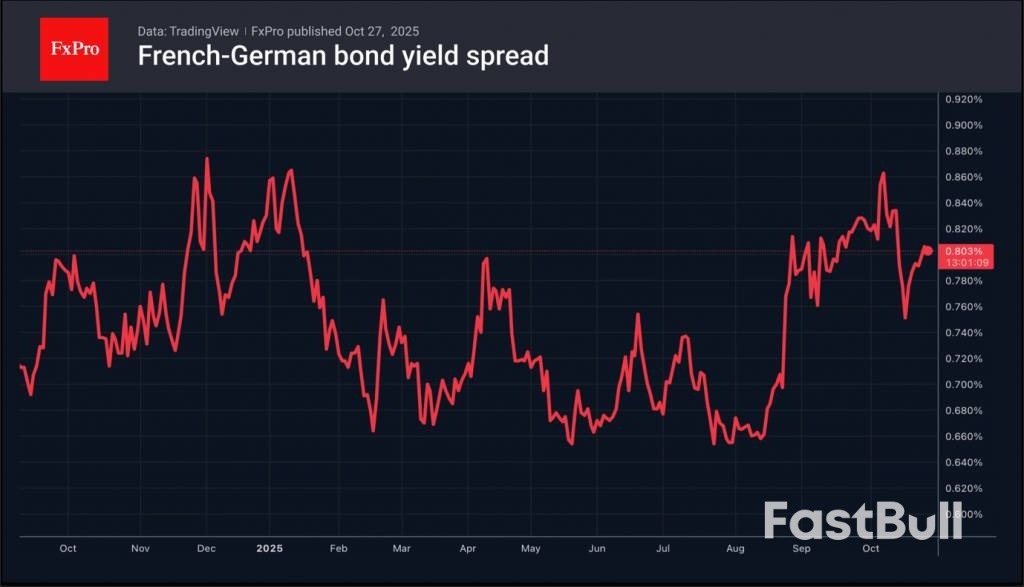
          In addition, the political drama in France is not over yet. Encouraged by the postponement of pension reform, the Socialists are demanding new concessions and intend to pass a law to increase taxes on the rich. As a result, the yield spread between local and German bonds has started to widen again, reflecting increased political risks, which is putting pressure on the euro.

          Source: FxPro

          To stay updated on all economic events of today, please check out our Economic calendar
          Risk Warnings and Disclaimers
          You understand and acknowledge that there is a high degree of risk involved in trading. Following any strategies or investment methods may lead to potential losses. The content on the site is provided by our contributors and analysts for information purposes only. You are solely responsible for determining whether any trading assets, securities, strategy, or any other product is suitable for investing based on your own investment objectives and financial situation.
          Add to Favorites
          Share

          Alternative Views: Don’t Be Afraid To Sell Some Gold

          Samantha Luan

          Forex

          Commodity

          Economic

          In the last 20 years, the price of gold has gone up almost tenfold. Anyone who bought gold in 2005, when the price was averaging US$444 per ounce, would be laughing all the way to the bank now.The price hit its highest ever level of US$4,356 per ounce two weeks ago before coming down. In fact, this year alone, gold has gained more than 58% largely due to the uncertainties in the global investment landscape.These uncertainties are due to fears of rising inflation as a result of the US tariff hikes, lower bond yields from impending cuts in US interest rates, the future direction of the US dollar and global tensions due to trade and geopolitical wars. The resultant effect is the flow of funds towards gold.

          Institutional investors — central banks and hedge funds — have moved more money than ever into gold-based products to hedge against uncertainties. Gold exchange traded funds (ETFs) saw the biggest inflow in the third quarter of this year of US$26 billion (RM109 billion).According to data from the World Gold Council, year-to-date inflow into gold ETFs was US$64 billion as at September, which is a record high.During the period, the total assets under management of gold ETFs globally reached US$472 billion.Physical gold holdings of ETFs globally hit 3,838 tonnes, just below the peak of 3,929 tonnes recorded in the first week of November 2020, when the Covid-19 pandemic was at its height.

          Gold is popular among Asian families, particularly in South Asia. India is the largest consumer of gold in Asia as it is viewed as a sign of luxury, prosperity and divinity. It is given as a gift during joyous occasions, from the birth of a baby to weddings and birthdays.But many from India and other parts of Asia also buy gold jewellery for investment purposes, and the jewellery tends to be passed on from one generation to another.

          The inheritance of gold comes with its fair share of problems, however.

          The precious metal needs to be stored safely. A safe deposit box in a bank is ideal but there are annual charges for the service. And it is not easy to divide the gold equally — a piece of jewellery or gold wafer coin cannot be broken into two or three pieces.The logical way to divide the inheritance equally is probably to sell the gold. But how many would have taken advantage of the bull run in gold and sold some of the precious metal? Most probably, only a minority.The primary reason is the emotional attachment to gold. Also, many believe its value will only rise over the long term, so why sell when they have no need for money?

          It is true that the price of gold will only rise in the long term. It has been proven time and time again that it hits a new peak whenever there is a global crisis.But every time gold hits a new peak, it tends to correct by between 30% and 40% before finding some stability and rising again to a new high. The process takes years.In January 1996, gold hit US$406 per ounce and trended downwards to a low of US$255 in August 1999, which is more than three years. It reached another peak in August 2012, when it closed at US$1,828 amid the US financial crisis. It drifted downwards to a low of US$1,060 in December 2015, a drop of more than 40% from its peak.

          The current rally can trace its start to the pandemic. Gold almost hit US$2,000 in August 2020. It settled at a low of US$1,600 in October 2022, when there were signs of the pandemic being at its tail end.

          The gold price has been on a bull run since March 2024, after Donald Trump won the Republican nomination for the US presidency.

          Real gold investors would have taken some money off the table. The institutional funds and investors who are not emotionally attached to their gold portfolio would have realised some of the investments, which are usually in the form of gold wafer coins, bars, futures or any other investment instruments with gold as an underlying asset.The precious metal does not pay any dividends. It glitters and is useful as a hedge against uncertainties. But when the uncertainties start to clear up, its glitter tends to fade. It is unlike the equity markets, where optimism grows when there is more certainty on economic and interest rate policies and the earnings of companies.

          However, gold's saving grace is that even when it is on a declining trend, the magnitude of its fall is not as great as that of investments in the equity markets. That is why gold will always remain relevant, albeit being a long-term game.In the last few days, gold has fallen more than 8% from its high of US$4,356, its biggest drop in more than 10 years. Those who went into gold in the last few months will learn the hard way that it is an investment for the long term. term returns.

          Whether the correction is only a temporary blip or will go on for a few months or years is left to be seen. But gold as an asset class will not lose its shine over the long term.The equity markets are at an all-time high. Digital coins and other asset classes are all in a bubble, especially in the US. The fear of inflation and a slowdown of the economy is very much prevalent.If and when the bubble bursts, the flight towards gold will resume. Until then, those who have gone into the asset class as an investment will have to ride the current dip.

          As for those who bought gold many years ago and are still holding it, they should not be afraid to liquidate some of it and put their money into other, undervalued asset classes.

          Source: Theedgemarkets

          To stay updated on all economic events of today, please check out our Economic calendar
          Risk Warnings and Disclaimers
          You understand and acknowledge that there is a high degree of risk involved in trading. Following any strategies or investment methods may lead to potential losses. The content on the site is provided by our contributors and analysts for information purposes only. You are solely responsible for determining whether any trading assets, securities, strategy, or any other product is suitable for investing based on your own investment objectives and financial situation.
          Add to Favorites
          Share

          Rare Earth Stocks Slide as U.S. Signals China May Delay Export Controls Ahead of Trump–Xi Summit

          Gerik

          Economic

          Commodity

          Investor Expectations Reset as Trade Truce Nears

          Shares of major U.S.-listed rare earth companies tumbled Monday after comments from top U.S. officials suggested that China could postpone its newly proposed export controls on critical minerals. The sharp decline in premarket trading Critical Metals down 8.5%, USA Rare Earth off 7.2%, and MP Materials slipping 5.3% reflects a recalibration of investor expectations for short-term supply shocks.
          These moves come just days ahead of a high-stakes meeting between President Donald Trump and Chinese President Xi Jinping, where both sides are widely expected to negotiate a new trade framework and avoid the escalation of economic tensions.

          China’s Strategic Position in the Rare Earths Market

          The market reaction underscores China's pivotal role in the global rare earths supply chain. China produces about 70% of the world's rare earths and refines nearly 90%, giving it outsized leverage over an industry essential to electronics, defense, and clean energy technologies. Earlier this month, Beijing had unveiled a new framework for tightening export controls a move widely interpreted as a warning to Western nations amid deepening distrust with the U.S.
          However, recent diplomatic signals indicate a shift. U.S. Treasury Secretary Scott Bessent told NBC's Meet The Press that an agreement is “very close,” with China expected to fully delay its export control policy for at least a year. In return, Trump is likely to back down from imposing a threatened 100% tariff on Chinese imports scheduled for November 1.

          Stock Reactions Reflect Thawing Tensions, Not Market Weakness

          Monday’s sell-off in rare earth stocks is not necessarily a bearish indicator for the sector long-term. Rather, it reflects the unwinding of a geopolitical risk premium. Traders had previously bid up the sector on fears that Chinese export restrictions would create immediate supply shortages. With that risk now potentially postponed, valuations are adjusting accordingly.
          The drop in share prices is thus a direct correlational response to the softening policy outlook not a deterioration in the underlying demand for rare earth materials. Analysts at Wolfe Research emphasized this point, noting that while details remain vague, the expected delay is more favorable than a mere licensing regime that could have still disrupted flows.

          Political Optics and the Strategic Timing of Announcements

          President Trump’s statement aboard Air Force One, expressing “a lot of respect for President Xi” and optimism about “coming away with a deal,” suggests the administration is keen to frame the upcoming summit as a diplomatic success. The timing aligns with broader trade negotiations in Asia, where Trump has already struck preliminary agreements with several Southeast Asian nations during the ASEAN summit.
          This potential rare earth détente also offers strategic cover for Trump’s recent 10% tariff move against Canada, which otherwise risks undermining investor confidence. The juxtaposition of easing tensions with China and escalating friction with allies underscores the complex, transactional nature of current U.S. trade policy.

          A Temporary Truce, Not a Structural Shift

          Even if China agrees to delay export controls, the underlying strategic rivalry over critical minerals remains unresolved. The West's overreliance on Chinese refining capacity has already sparked long-term efforts to build alternative supply chains. Monday’s stock pullback does not negate the broader bullish thesis on rare earths especially as demand continues to rise for electric vehicles, renewable energy, and defense technologies.
          If anything, a delayed restriction buys time but also reinforces the urgency of diversification. A renewed truce, while welcome for market stability, may only be temporary. Investors and policymakers alike will still need to prepare for potential disruptions in the years ahead.
          The decline in rare earth stocks reflects shifting expectations not weakening fundamentals. A potential year-long delay in Chinese export controls reduces immediate geopolitical risks but does not eliminate the structural vulnerabilities exposed by this episode. As the Trump–Xi summit approaches, markets may enjoy short-term relief, but the long game in rare earth dominance remains firmly in play.

          Source: CNBC

          To stay updated on all economic events of today, please check out our Economic calendar
          Risk Warnings and Disclaimers
          You understand and acknowledge that there is a high degree of risk involved in trading. Following any strategies or investment methods may lead to potential losses. The content on the site is provided by our contributors and analysts for information purposes only. You are solely responsible for determining whether any trading assets, securities, strategy, or any other product is suitable for investing based on your own investment objectives and financial situation.
          Add to Favorites
          Share

          Markets Rally on Softer U.S. Inflation Data, But Trade Tensions Temper Optimism

          Gerik

          Economic

          Cooler Inflation Report Triggers Broad Market Gains

          September’s consumer price index (CPI) report provided the jolt of optimism investors were waiting for, as both the monthly (0.3%) and annual (3.0%) inflation readings came in just below expectations. This marks a turning point in sentiment, reinforcing the view that inflation is moderating without producing further upside shocks. With price pressures stabilizing and earnings seasons outperforming, markets reacted with a broad rally.
          The Dow Jones Industrial Average closed above 47,000 for the first time, while the S&P 500 and Nasdaq Composite both rose roughly 2% for the week. Traders are now betting that the Federal Reserve will respond with at least one rate cut at its October meeting and another by December. The combination of softer inflation and 87% of companies beating earnings expectations a full 20 percentage points above the average beat rate has created fertile ground for renewed bullishness in equity markets.

          Trump’s Tariffs and Global Tensions Cloud the Outlook

          Despite the market’s celebratory tone, geopolitical developments continue to cast a long shadow. President Trump’s imposition of an additional 10% tariff on Canadian goods on top of existing duties highlights the fragility of global trade relations. The move came in response to a political ad in Ontario and brings the total general tariff rate on Canada to 45%. Economists warn that such tariff actions, while politically driven, can feed inflation in the long term by raising import costs.
          Indeed, although the latest CPI figures offer relief, headline inflation still ticked up from 2.9% to 3.0% year-on-year. This suggests a correlational dynamic: price growth is slowing, but not reversing, with tariff-related risks capable of reigniting inflationary pressures if trade disputes escalate further.

          Asia in Focus: China Profits Soar, Xi-Trump Meeting Approaches

          While U.S. domestic data drove the initial rally, developments in Asia are adding to the complex global picture. China’s industrial profits surged 21.6% in September the strongest growth since November 2023 driven by policy interventions that curbed internal price wars. This rebound, however, masks persistent structural issues in the Chinese economy, including falling fixed-asset investment and deflation in consumer prices.
          On the geopolitical front, anticipation is mounting for the October 30 meeting between President Trump and Chinese President Xi Jinping, set to take place at the Asia-Pacific Economic Cooperation (APEC) summit. This will be their first in-person meeting since Trump’s return to office in January, and it could determine whether a fragile U.S.-China trade détente is extended past its November 10 expiration date. Any failure to reach agreement risks reigniting trade hostilities, with direct implications for supply chains and inflation.

          Markets Up, but Uncertainty Lingers

          U.S. stock futures continued their upward momentum into Sunday evening, while Asia-Pacific markets surged Monday Japan’s Nikkei 225 broke through the 50,000 mark for the first time. UBS analysts advised investors to diversify with Asian stocks, bonds, and gold, noting that while the U.S. rally is strong, global risks and opportunities require broader portfolio exposure.
          Yet the current rally sits on uncertain foundations. A U.S. government shutdown has delayed key economic data releases such as the jobs report, leaving investors with only a partial view of the economy’s health. While earnings and inflation data support optimism, markets remain vulnerable to sudden shocks especially if the Trump-Xi meeting disappoints or inflation reverses its moderating trend.
          Markets are enjoying a period of optimism fueled by softer inflation, strong earnings, and the prospect of rate cuts. But the gains remain fragile, dependent on continued macroeconomic moderation and diplomatic breakthroughs in upcoming trade talks. With the APEC summit, central bank decisions, and geopolitical tensions all converging in the coming days, the balance between bullish momentum and downside risk is especially delicate. Investors would do well to remain cautious even as equities reach new heights.

          Source: CNBC

          To stay updated on all economic events of today, please check out our Economic calendar
          Risk Warnings and Disclaimers
          You understand and acknowledge that there is a high degree of risk involved in trading. Following any strategies or investment methods may lead to potential losses. The content on the site is provided by our contributors and analysts for information purposes only. You are solely responsible for determining whether any trading assets, securities, strategy, or any other product is suitable for investing based on your own investment objectives and financial situation.
          Add to Favorites
          Share

          German Business Confidence Jumps to Highest Level Since 2022

          Michelle

          Forex

          Economic

          German business confidence improved to its highest level since 2022 at the start of the fourth quarter, bolstering hopes that Europe's largest economy is finally emerging from two years of contraction.

          An expectations index by the Ifo institute rose to 91.6 in October from a revised 89.8 in September, a release Monday showed. That's above the 90 median estimate in a Bloomberg survey. A measure of current conditions unexpectedly fell.

          "Companies remain hopeful that the economy will pick up in the coming year," Ifo President Clemens Fuest said in a statement. "However, the current business situation was assessed as slightly worse."

          The numbers add to surveys published Friday showing German private-sector activity unexpectedly jumped in October to its highest level since 2023, putting the euro-area on a firmer footing.

          Germany saw output shrink for two years, with only marginal growth — if any — expected in 2025. In particular, the manufacturing sector is still suffering from structural problems like red tape and higher US tariffs.

          A more pronounced pick-up is forecast, helped by massive public infrastructure and defense spending as well as the European Central Bank's recent interest-rate cuts. Policymakers have lowered borrowing costs eight times this cycle, though have kept them on hold since June and are expected to leave them unchanged again on Thursday.

          But the Bundesbank and the country's leading research institutes warned this month that Chancellor Friedrich Merz's ruling coalition must implement more fundamental reforms to strengthen the economy, boost competitiveness and lift long-term growth prospects.

          It's "time to speed up on the path to reform," Bundesbank President Joachim Nagel said. "To reignite productivity and foster growth, the government must take decisive action."

          Source: Bloomberg Europe

          To stay updated on all economic events of today, please check out our Economic calendar
          Risk Warnings and Disclaimers
          You understand and acknowledge that there is a high degree of risk involved in trading. Following any strategies or investment methods may lead to potential losses. The content on the site is provided by our contributors and analysts for information purposes only. You are solely responsible for determining whether any trading assets, securities, strategy, or any other product is suitable for investing based on your own investment objectives and financial situation.
          Add to Favorites
          Share

          China’s Industrial Profits Surge in September Amid Manufacturing Revival and Policy Support

          Gerik

          Economic

          Industrial Profit Rebound Marks Strongest Growth Since 2023

          China’s industrial sector delivered a powerful rebound in September, with profits soaring 21.6% year-over-year the sharpest jump since November 2023 according to the National Bureau of Statistics (NBS). This follows a strong 20.4% gain in August, signaling a short-term momentum reversal in an economy still grappling with sluggish consumer sentiment, weak investment, and export uncertainty.
          The surge, which lifted year-to-date industrial profit growth to 3.2% (up from 0.9% in the January-August period), suggests that targeted government policies are having a measurable effect. Beijing’s campaign to suppress cutthroat price competition previously blamed for squeezing corporate margins during a prolonged stretch of producer price deflation has been instrumental in easing pressures on manufacturers.

          Policy Efforts to Curb Deflation Bear Fruit in Manufacturing

          The rebound in profitability comes even as deflationary pressures remain entrenched. September’s consumer price index fell 0.3% from a year ago, while the producer price index dropped 2.3%, extending a multi-year trend. Despite this, manufacturers appear to be benefitting from reduced internal pricing wars, allowing for margin stabilization.
          Manufacturing profits rose 9.9% in the January–September period compared to a year earlier, while the electricity, heating, and utilities sectors posted a 10.3% gain. The standout performer was high-tech manufacturing, with profits leaping 26.8% in September a development that reinforces Beijing’s strategy of industrial upgrading and technological self-reliance.
          The mining sector, by contrast, saw profits plummet by 29.3%, indicating a divergence in sectoral performance likely tied to weak commodity prices and reduced infrastructure investment. This pattern reflects a causal relationship: while targeted policies benefited advanced manufacturing and utilities, resource-dependent sectors remain exposed to cyclical and structural declines.

          Mixed Ownership Results: SOEs Languish, Private and Foreign Firms Lead

          A deeper breakdown of profitability by ownership structure reveals uneven gains. Profits at state-owned enterprises (SOEs) fell 0.3%, while foreign-invested firms especially those tied to Hong Kong, Macau, and Taiwan posted a 4.9% rise. Private companies outperformed with a 5.1% increase, suggesting a marginally more dynamic performance from non-state and foreign entities in navigating the evolving economic environment.
          This discrepancy may be partly correlational, reflecting broader inefficiencies in state-owned operations and their exposure to policy burdens, versus the greater market responsiveness of private and foreign enterprises.

          Growth Risks Persist Despite Strong Headline Data

          While September’s industrial output rose 6.5% up from 5.2% in August the broader economic landscape remains fragile. Fixed-asset investment unexpectedly contracted by 0.5% in the first nine months of the year, marking the first such decline since 2020. This suggests that despite improving industrial profits, businesses are still hesitant to commit to long-term capital expenditures a trend likely driven by weak domestic demand, housing market fragility, and tightening global trade conditions.
          Nomura economists expect export growth to slow in Q4, after climbing to 6.6% in Q3 from 6.2% in Q2, citing high base effects and rising global trade barriers. If exports decelerate as expected, the industrial profit surge may be difficult to sustain without further domestic consumption or investment stimulus.

          Limited Appetite for Broad Stimulus as Policy Priorities Shift

          Analysts believe the profit rebound and resilient output data may reduce the urgency for broad-based stimulus measures. While Chinese leaders have emphasized the need to support domestic demand, recent official rhetoric has focused more on long-term goals like technological innovation and industrial transformation than on immediate consumption recovery.
          Louise Loo of Oxford Economics noted that while Beijing acknowledges soft household sentiment and the risk of a savings glut, it appears unwilling to unleash large-scale consumption stimulus. This suggests a prioritization of supply-side reforms and strategic sectoral development over short-term demand boosts.

          Profits Rise, but Sustainability Hinges on Broader Reform

          The sharp rise in China’s industrial profits marks a welcome rebound for a sector that had been under prolonged pressure. Government intervention to moderate price competition and promote high-tech manufacturing appears to be yielding results. However, the durability of this profit recovery is uncertain, especially as exports face headwinds, investment remains subdued, and consumer confidence has yet to rebound.
          Unless these structural weaknesses are addressed through reforms that stimulate domestic demand and improve private sector confidence China’s industrial recovery may rest on unstable foundations. September’s data offers a hopeful signal, but not a definitive turning point.

          Source: Bloomberg

          To stay updated on all economic events of today, please check out our Economic calendar
          Risk Warnings and Disclaimers
          You understand and acknowledge that there is a high degree of risk involved in trading. Following any strategies or investment methods may lead to potential losses. The content on the site is provided by our contributors and analysts for information purposes only. You are solely responsible for determining whether any trading assets, securities, strategy, or any other product is suitable for investing based on your own investment objectives and financial situation.
          Add to Favorites
          Share

          Cooling U.S. Inflation Lifts Markets, but Tariff Tensions and Trump-Xi Meeting Loom Large

          Gerik

          Economic

          Inflation Eases, Markets Cheer as Fed Rate Cut Bets Rise

          Markets ended the week on a high note as new data revealed that U.S. consumer prices rose less than expected in September. The Consumer Price Index (CPI) increased by 0.3% for the month and 3% year-over-year both 0.1 percentage points lower than economists had forecast. This softer inflation print reinforces investor expectations that the Federal Reserve may cut interest rates as early as its upcoming October policy meeting and potentially again in December.
          The reaction was immediate and bullish. The Dow Jones Industrial Average closed above 47,000 for the first time, while the S&P 500 and Nasdaq Composite also gained around 2% for the week. With 87% of reporting companies beating earnings estimates significantly above the historical average of 67% the rally was further supported by solid corporate performance. If upcoming Big Tech earnings and forward guidance remain strong, major indexes could test new all-time highs.

          Tariffs Cast a Shadow Over Optimism

          Despite the positive inflation data, investor sentiment remains tempered by new geopolitical risks. Over the weekend, President Donald Trump imposed an additional 10% tariff on Canadian goods in response to an Ontario ad criticizing U.S. trade policy. The move raises Canada’s general duty exposure to 45% and could reignite trade tensions just as markets begin to stabilize.
          Economists have long cautioned that tariffs contribute to inflation by raising import costs. While September’s CPI report was slightly cooler than expected, headline inflation still ticked up from 2.9% to 3%, reflecting underlying price pressures. This suggests a correlation, though not yet causation, between tariffs and inflation, which markets will continue to watch.

          Trump-Xi Meeting Adds Uncertainty to Global Outlook

          Further complicating the macro backdrop is the upcoming high-stakes meeting between President Trump and Chinese President Xi Jinping, scheduled for October 30 at the APEC Summit. This will be their first in-person engagement since Trump began his second term. With a temporary trade détente between the U.S. and China set to expire on November 10, failure to reach a new agreement could reignite broader trade conflicts.
          According to Treasury Secretary Scott Bessent, top U.S. and Chinese officials met on the sidelines of the ASEAN Summit and established a “very successful framework” for further dialogue. Trump also announced preliminary trade agreements with four Southeast Asian nations Malaysia, Thailand, Cambodia, and Vietnam which could signal a broader pivot in U.S. trade strategy in the region.

          Market Risks Remain Amid Data Gaps

          While markets are riding a wave of optimism, there are structural risks. The U.S. government shutdown has delayed the release of crucial economic indicators, including job reports, leaving investors without a complete picture of the economy’s health. This makes the current rally more fragile, as sentiment is now highly sensitive to upcoming earnings, Fed commentary, and trade negotiations.
          David Russell of TradeStation noted that although inflation may not be accelerating, it is no longer producing surprises on the upside. This suggests inflation expectations are stabilizing, which may encourage the Fed to pause or cut rates, provided other economic indicators align.

          Short-Term Relief, Long-Term Watchfulness

          The market rally driven by softer inflation and strong earnings may extend into the week ahead, particularly if Big Tech delivers and the Fed signals dovish intent. However, geopolitical flashpoints most notably the Trump-Xi meeting and ongoing tariff actions could quickly reshape investor sentiment.
          As the APEC Summit approaches and monetary policy decisions loom, investors are entering a pivotal moment. While the macro environment has temporarily stabilized, the path forward remains dependent on diplomatic resolution, Fed flexibility, and continued corporate resilience.

          Source: CNBC

          To stay updated on all economic events of today, please check out our Economic calendar
          Risk Warnings and Disclaimers
          You understand and acknowledge that there is a high degree of risk involved in trading. Following any strategies or investment methods may lead to potential losses. The content on the site is provided by our contributors and analysts for information purposes only. You are solely responsible for determining whether any trading assets, securities, strategy, or any other product is suitable for investing based on your own investment objectives and financial situation.
          Add to Favorites
          Share
          FastBull
          Copyright © 2025 FastBull Ltd

          728 RM B 7/F GEE LOK IND BLDG NO 34 HUNG TO RD KWUN TONG KLN HONG KONG

          TelegramInstagramTwitterfacebooklinkedin
          App Store Google Play Google Play
          Products
          Charts

          Chats

          Q&A with Experts
          Screeners
          Economic Calendar
          Data
          Tools
          Membership
          Features
          Function
          Markets
          Copy Trading
          Latest Signals
          Contests
          News
          Analysis
          24/7
          Columns
          Education
          Company
          Careers
          About Us
          Contact Us
          Advertising
          Help Center
          Feedback
          User Agreement
          Privacy Policy
          Business

          White Label

          Data API

          Web Plug-ins

          Poster Maker

          Affiliate Program

          Risk Disclosure

          The risk of loss in trading financial instruments such as stocks, FX, commodities, futures, bonds, ETFs and crypto can be substantial. You may sustain a total loss of the funds that you deposit with your broker. Therefore, you should carefully consider whether such trading is suitable for you in light of your circumstances and financial resources.

          No decision to invest should be made without thoroughly conducting due diligence by yourself or consulting with your financial advisors. Our web content might not suit you since we don't know your financial conditions and investment needs. Our financial information might have latency or contain inaccuracy, so you should be fully responsible for any of your trading and investment decisions. The company will not be responsible for your capital loss.

          Without getting permission from the website, you are not allowed to copy the website's graphics, texts, or trademarks. Intellectual property rights in the content or data incorporated into this website belong to its providers and exchange merchants.

          Not Logged In

          Log in to access more features

          FastBull Membership

          Not yet

          Purchase

          Become a signal provider
          Help Center
          Customer Service
          Dark Mode
          Price Up/Down Colors

          Log In

          Sign Up

          Position
          Layout
          Fullscreen
          Default to Chart
          The chart page opens by default when you visit fastbull.com