
• Trade
  • Markets
  • Copy
  • Contests
  • 24/7
  • Calendar
  • Q&A
  • Chats
Screeners
SYMBOL
LAST
BID
ASK
HIGH
LOW
NET CHG.
%CHG.
SPREAD
SPX
S&P 500 Index
7126.05
7126.05
7126.05
7147.53
7082.71
+84.77
+ 1.20%
--
DJI
Dow Jones Industrial Average
49447.42
49447.42
49447.42
49717.98
49057.42
+868.71
+ 1.79%
--
IXIC
NASDAQ Composite Index
24468.47
24468.47
24468.47
24519.51
24286.47
+365.78
+ 1.52%
--
USDX
US Dollar Index
98.040
98.040
98.120
98.070
97.380
+0.030
+ 0.03%
--
EURUSD
Euro / US Dollar
1.17633
1.17633
1.17653
1.18488
1.17600
-0.00182
-0.15%
--
GBPUSD
Pound Sterling / US Dollar
1.35142
1.35142
1.35222
1.35989
1.35041
-0.00115
-0.09%
--
XAUUSD
Gold / US Dollar
4829.05
4829.05
4829.05
4889.53
4767.55
+39.92
+ 0.83%
--
WTI
Light Sweet Crude Oil
83.448
83.448
83.544
90.112
78.869
-6.154
-6.87%
--

Community Accounts

Signal Accounts
--
Profit Accounts
--
Loss Accounts
--
View More

Become a signal provider

Sell trading signals to earn additional income

View More

Guide to Copy Trading

Get started with ease and confidence

View More

Signal Accounts for Members

All Signal Accounts

Best Return
  • Best Return
  • Best P/L
  • Best MDD
Past 1W
  • Past 1W
  • Past 1M
  • Past 1Y

All Contests

  • All
  • Trump Updates
  • Recommend
  • Stocks
  • Cryptocurrencies
  • Central Banks
  • Featured News
Top News Only
Share

According To The New York Times, U.S. Intelligence Assessments Suggest That Iran Still Retains About 40% Of Its Pre-war Drone Stockpile And Has Dug Underground Missile Cities During The Ceasefire. It Currently Possesses About 60% Of Its Missile Launchers And Possibly As Much As 70% Of Its Missile Stockpile

Share

UN Secretary-General Guterres: All Parties Concerned Must Respect The Ceasefire And Truce

Share

UN Secretary-General António Guterres: This Is The Third Incident In Recent Weeks That Has Resulted In The Deaths Of Peacekeepers On Mission In Lebanon

Share

UN Secretary-General António Guterres Strongly Condemns Saturday's Attack On The UN Interim Force In Lebanon, Which Resulted In The Death Of A French Peacekeeper And Injuries To Three Others

Share

The China Earthquake Networks Center Officially Reported That A Magnitude 3.4 Earthquake Occurred At 05:27 On April 19 In Ando County, Nagqu City, Tibet (32.62 Degrees North Latitude, 90.36 Degrees East Longitude), With A Focal Depth Of 10 Kilometers

Share

U.S. State Department: All Parties Agreed To Release Prisoners Within Ten Days Under The Detainee Emancipation Mechanism Signed On September 14, 2025, In Order To Continue Building Trust

Share

U.S. State Department: All Parties Agreed To Facilitate The Free Movement Of Humanitarian Personnel, Assets, And Humanitarian Convoys

Share

The U.S. State Department Issued A Joint Statement On The Progress Between Representatives Of The Democratic Republic Of Congo And The Congo River Alliance/M23 Movement, Stating That The Parties Agreed Not To Attack, Damage, Remove, Or Disable Any Items Essential To The Survival Of The People

Share

The China Earthquake Networks Center Officially Reported That A 5.6-magnitude Earthquake Occurred At 04:06 On April 19 In Nias Island, Indonesia (1.30°N, 97.20°E), With A Focal Depth Of 30 Kilometers

Share

According To Nikkei: Japan Is Considering Allowing Mutual Funds To Increase Their Investments In Unlisted Companies

Share

A Joint Statement From Brazil, Mexico, And Spain: We Reaffirm The Need To Always Respect Human Rights, The Principle Of Territorial Integrity, Sovereign Equality, And The Peaceful Resolution Of Conflicts

Share

Brazil, Mexico, And Spain Issued A Joint Statement: We Express Our Deepest Concern About The Humanitarian Crisis In Cuba And Call For Necessary Measures To Alleviate It

Share

The Governments Of Brazil, Mexico, And Spain Issued A Joint Statement On The Situation In Cuba

Share

Tesla (TSLA.O): Robotaxis Are Now Available In Dallas And Houston

Share

According To Iranian State Television, A Local Commander Of The Iranian Revolutionary Guard Navy Stated That Any Vessel Ignoring Warnings In The Strait Of Hormuz Will Be Targeted. He Added That If The US Navy Attacks Iranian Ships, It Will Suffer A "heavy Blow."

Share

Iran's Chief Negotiator: The US Blockade Is An "ignorant Decision" Because It Is Impossible To Allow Other Ships To Pass Through The Strait Of Hormuz While Prohibiting Iranian Passage

Share

The Iranian Revolutionary Guard Navy Issued A Statement Saying That Ships And Their Owners Should Follow The Information Released By The Iranian Revolutionary Guard Navy, And Stated That US President Trump's Statement On The Strait Of Hormuz Was "unvalid"

Share

The Security Service Of Ukraine (SBU) Described The Shootings And Hostage Situation In Kyiv As "acts Of Terrorism."

Share

According To Iran's Tasnim News Agency, Iranian Authorities Said They Have Arrested Dozens Of People In Northern Mazandran Province Who Are Accused Of Having Links To Foreign Intelligence Networks

Share

Irish Prime Minister: All Parties Must Respect The Safety Of The Soldiers Of The United Nations Interim Force In Lebanon (UNIFIL) Who Are Carrying Out A Peace Mission

TIME
ACT
FCST
PREV
U.K. GDP YoY (SA) (Feb)

A:--

F: --

P: --
U.K. Construction Output YoY (Feb)

A:--

F: --

P: --
Euro Zone CPI YoY (Excl. Tobacco) (Mar)

A:--

F: --

P: --

Canada Existing Home Sales MoM (Mar)

A:--

F: --

P: --

Euro Zone Core CPI Final MoM (Mar)

A:--

F: --

P: --

U.S. Philadelphia Fed Manufacturing Employment Index (Apr)

A:--

F: --

P: --

U.S. Weekly Initial Jobless Claims (SA)

A:--

F: --

P: --
U.S. Weekly Continued Jobless Claims (SA)

A:--

F: --

P: --
U.S. Initial Jobless Claims 4-Week Avg. (SA)

A:--

F: --

P: --
U.S. Philadelphia Fed Business Activity Index (SA) (Apr)

A:--

F: --

P: --

New York Federal Reserve President Williams delivered a speech.
U.S. Manufacturing Capacity Utilization (Mar)

A:--

F: --

P: --

U.S. Industrial Output YoY (Mar)

A:--

F: --

P: --

U.S. Industrial Output MoM (SA) (Mar)

A:--

F: --

P: --
U.S. Capacity Utilization MoM (SA) (Mar)

A:--

F: --

P: --
U.S. Manufacturing Output MoM (SA) (Mar)

A:--

F: --

P: --
U.S. EIA Weekly Natural Gas Stocks Change

A:--

F: --

P: --

ECB Chief Economist Lane Speaks
U.S. Weekly Treasuries Held by Foreign Central Banks

A:--

F: --

P: --

Euro Zone Current Account (SA) (Feb)

A:--

F: --

P: --
Euro Zone Current Account (Not SA) (Feb)

A:--

F: --

P: --
Euro Zone Trade Balance (Not SA) (Feb)

A:--

F: --

P: --
Euro Zone Trade Balance (SA) (Feb)

A:--

F: --

P: --
India Deposit Gowth YoY

A:--

F: --

P: --

Canada New Housing Starts (Mar)

A:--

F: --

P: --
Richmond Federal Reserve President Barkin delivered a speech.
U.S. Weekly Total Rig Count

A:--

F: --

P: --

U.S. Weekly Total Oil Rig Count

A:--

F: --

P: --

FOMC Member Waller Speaks
U.K. Rightmove House Price Index YoY (Apr)

--

F: --

P: --

China, Mainland 5-Year Loan Prime Rate

--

F: --

P: --

China, Mainland 1-Year Loan Prime Rate (LPR)

--

F: --

P: --

Germany PPI MoM (Mar)

--

F: --

P: --

Germany PPI YoY (Mar)

--

F: --

P: --

Euro Zone Construction Output YoY (Feb)

--

F: --

P: --

Euro Zone Construction Output MoM (SA) (Feb)

--

F: --

P: --

Canada National Economic Confidence Index

--

F: --

P: --

Canada Trimmed CPI YoY (SA) (Mar)

--

F: --

P: --

Canada Core CPI MoM (Mar)

--

F: --

P: --

Canada Core CPI YoY (Mar)

--

F: --

P: --

Canada CPI MoM (Mar)

--

F: --

P: --

Canada CPI YoY (Mar)

--

F: --

P: --

Argentina Trade Balance (Mar)

--

F: --

P: --

U.K. Average Weekly Earnings (3-Month Average, Including Bonuses) YoY (Feb)

--

F: --

P: --

U.K. Average Weekly Earnings (3-Month Average, Excluding Bonuses) YoY (Feb)

--

F: --

P: --

U.K. 3-Month ILO Unemployment Rate (Feb)

--

F: --

P: --

U.K. Unemployment Rate (Mar)

--

F: --

P: --

U.K. Unemployment Claimant Count (Mar)

--

F: --

P: --

U.K. 3-Month ILO Employment Change (Feb)

--

F: --

P: --

Turkey Capacity Utilization (Apr)

--

F: --

P: --

Germany ZEW Economic Sentiment Index (Apr)

--

F: --

P: --

Germany ZEW Current Conditions Index (Apr)

--

F: --

P: --

Euro Zone ZEW Economic Sentiment Index (Apr)

--

F: --

P: --

Euro Zone ZEW Current Conditions Index (Apr)

--

F: --

P: --

Germany 2-Year Schatz Auction Avg. Yield

--

F: --

P: --

U.S. Retail Sales YoY (Mar)

--

F: --

P: --

U.S. Retail Sales MoM (Mar)

--

F: --

P: --

U.S. Core Retail Sales (Mar)

--

F: --

P: --

U.S. Core Retail Sales MoM (Mar)

--

F: --

P: --

Q&A with Experts
    • All
    • Chatrooms
    • Groups
    • Friends
    Connecting
    .
    .
    .
    Type here...
    Add Symbol or Code

      No matching data

      All
      Trump Updates
      Recommend
      Stocks
      Cryptocurrencies
      Central Banks
      Featured News
      • All
      • Russia-Ukraine Conflict
      • Middle East Flashpoint
      • All
      • Russia-Ukraine Conflict
      • Middle East Flashpoint

      Search
      Products

      Charts Free Forever

      Chats Q&A with Experts
      Screeners Economic Calendar Data Tools
      Membership Features
      Data Warehouse Market Trends Institutional Data Policy Rates Macro

      Market Trends

      Market Sentiment Order Book Forex Correlations

      Top Indicators

      Charts Free Forever
      Markets

      News

      24/7 Analysis Education

      Latest Views

      Latest Update

      Signals

      Copy Rankings Latest Signals Become a signal provider AI Rating
      Contests
      Brokers

      Overview Brokers Assessment Rankings Regulators News Claims
      Broker listing Forex Brokers Comparison Tool Live Spread Comparison Scam
      Q&A Complaint Scam Alert Videos Tips to Detect Scam
      More

      Business
      Events
      Careers About Us Advertising Help Center

      White Label

      Broker API

      Data API

      Web Plug-ins

      Affiliate Program

      Awards Institution Evaluation IB Seminar Salon Event Exhibition
      Vietnam Thailand Singapore Dubai
      Fans Party Investment Sharing Session
      FastBull Summit BrokersView Expo
      Recent Searches
        Top Searches
          Markets
          Analysis
          User
          24/7
          Economic Calendar
          Education
          Data
          • Names
          • Latest
          • Prev

          View All

          No data

          Scan to Download

          Faster Charts, Chat Faster!

          Download App
          English
          • English
          • Español
          • العربية
          • Bahasa Indonesia
          • Bahasa Melayu
          • Tiếng Việt
          • ภาษาไทย
          • Français
          • Italiano
          • Türkçe
          • Русский язык
          • 简中
          • 繁中
          Open Account
          Search
          Products
          Charts Free Forever
          Markets
          News
          Signals

          Copy Rankings Latest Signals Become a signal provider AI Rating
          Contests
          Brokers

          Overview Brokers Assessment Rankings Regulators News Claims
          Broker listing Forex Brokers Comparison Tool Live Spread Comparison Scam
          Q&A Complaint Scam Alert Videos Tips to Detect Scam
          More

          Business
          Events
          Careers About Us Advertising Help Center

          White Label

          Broker API

          Data API

          Web Plug-ins

          Affiliate Program

          Awards Institution Evaluation IB Seminar Salon Event Exhibition
          Vietnam Thailand Singapore Dubai
          Fans Party Investment Sharing Session
          FastBull Summit BrokersView Expo

          EUR/USD Holds Above Key Moving Averages as Bulls Eye 1.1900 Resistance in Next Technical Test

          Warren Takunda

          Traders' Opinions

          Summary:

          EUR/USD inches above 1.1790 during Friday's European session as Dollar selling persists on moderate Iran peace optimism, though gains remain capped below Thursday's 1.1825 highs.

          BUY EURUSD
          EXP
          TRADING

          1.17749

          Entry Price

          1.19200

          TP

          1.17300

          SL

          1.17633 -0.00182 -0.15%

          0.0

          Pips

          Flat

          1.17300

          SL

          Exit Price

          1.17749

          Entry Price

          1.19200

          TP
          The Euro is edging cautiously higher against the US Dollar during Friday's European session, nudging above the 1.1790 level after recovering from session lows at 1.1770 — a move that, on its surface, suggests a currency finding its footing after days of volatile, geopolitically driven price action. But look beneath the headline number, and the picture that emerges is considerably more complicated, considerably more fragile, and — if the latest diplomatic reporting from Reuters is to be believed — potentially on the verge of a rude awakening that could reverse the Euro's tentative gains with considerable speed.
          At time of writing, EUR/USD trades in the vicinity of 1.1790, holding above the session low but remaining firmly below Thursday's intraday high of 1.1825. The range-bound, hesitant character of Friday's price action speaks volumes about the state of market conviction right now — this is not the behavior of a currency pair with clear directional momentum. It is the behavior of a market waiting for information, processing contradictory signals, and unwilling to commit to a sustained move in either direction until the geopolitical fog begins to lift.
          The primary driver behind EUR/USD's modest Friday advance is the continued, broad-based weakness of the US Dollar, which has now been under selling pressure for an extended period as traders systematically reduce their safe-haven Dollar holdings in response to shifting perceptions of geopolitical risk. The narrative that drove aggressive Dollar buying in the early stages of the Middle East conflict — a flight to safety as oil prices surged, shipping routes were threatened, and the prospect of a wider regional war loomed large — has been gradually eroded by a series of diplomatic developments that, taken together, have softened the acute edge of market fear even if they have not eliminated the underlying uncertainty.
          Israel's announcement on Thursday of a ten-day ceasefire in Lebanon was interpreted by markets as a meaningful confidence-building gesture, suggesting that at least one front in the broader regional conflict is moving toward de-escalation. More significantly for Dollar sentiment, US President Donald Trump confirmed publicly that Washington and Tehran could resume peace talks as early as this weekend — a statement that carries substantial market weight given Trump's track record of using public declarations to signal genuine diplomatic intent, however unconventional his negotiating style may be.
          The cumulative effect of these developments has been to chip away at the Dollar's geopolitical risk premium — the extra demand for the Greenback that is generated purely by investors seeking shelter from global uncertainty. As that premium deflates, even modestly, the Dollar gives ground across the board, and EUR/USD is among the beneficiaries. The pair has recovered from levels that, at the height of the geopolitical panic, many analysts had feared could test the 1.1500 region, and the recovery above 1.1790 represents a meaningful technical stabilization even if the fundamental underpinnings of that move remain contested.
          But I want to be clear about something that I think the market is not fully pricing: the Dollar's weakness in this environment is not a verdict on the US economy. It is a verdict on risk appetite. And risk appetite, as we have learned repeatedly in recent weeks, can reverse within hours on a single headline.
          The most significant piece of news to cross the wires on Friday morning — and the one I believe deserves far more attention than the headline EUR/USD move would suggest — is a Reuters report citing Iranian sources that reveals a sobering reality about this weekend's planned diplomatic talks. According to the report, US and Iranian negotiators have substantially scaled back their ambitions for the upcoming discussions and are now seeking nothing more ambitious than a temporary memorandum aimed at preventing a return to open conflict — rather than the comprehensive framework agreement that markets had been beginning to price in.
          This is a critical distinction, and I think the market has not yet fully digested its implications. There is an enormous difference between a credible, structured pathway toward a lasting nuclear and security agreement — the kind of deal that would genuinely remove the geopolitical risk premium from oil prices, reopen the Strait of Hormuz, and restore the pre-war trajectory of global energy markets — and a stopgap memorandum designed simply to prevent the situation from getting worse in the immediate term. The former would be genuinely transformative for European economic prospects. The latter is, at best, a temporary stay of execution that leaves the fundamental drivers of elevated energy prices entirely unresolved.
          The nuclear issue, according to all available reporting, remains the central and most intractable sticking point in negotiations. Iran's position on uranium enrichment and its broader ballistic missile program are areas where the gap between Washington's demands and Tehran's red lines appears, as of now, unbridgeable in any short-term timeframe. A temporary memorandum that sidesteps these issues rather than resolving them is not a peace deal — it is a pause. And pauses, in the context of this conflict, have a troubling historical tendency to unravel at precisely the moment markets have become most complacent about them.
          Compounding the diplomatic uncertainty is the continued closure of the Strait of Hormuz — arguably the single most consequential development for global energy markets since the conflict began. The Strait, through which a significant portion of global seaborne oil trade passes, remains effectively shut to normal commercial traffic, and WTI Crude Oil is currently trading more than 30% above its pre-war levels as a direct consequence. That is not a rounding error. That is a structural, supply-side energy shock of the first order — one that is reshaping cost structures, inflation trajectories, and growth forecasts across every major economy in the world.
          For Europe specifically, the consequences of sustained elevated oil prices are particularly severe, given the Eurozone's deep structural dependence on crude oil imports. Unlike the United States, which has substantially increased its domestic energy production in recent years and has greater flexibility in managing supply disruptions, the Eurozone economies rely heavily on imported energy to power their industrial bases, heat homes, and fuel transportation networks. When global oil prices surge 30% and remain elevated, the transmission into Eurozone consumer prices is rapid, broad-based, and — critically — very difficult for the European Central Bank to manage through conventional monetary policy tools.
          The March inflation data already told this story with uncomfortable clarity. Eurozone HICP headline inflation was revised higher to 2.6% year-on-year — the highest reading since July 2024 — driven primarily by the energy component, while core inflation actually edged slightly lower, confirming that the price pressure is supply-driven rather than demand-driven. This is the stagflation fingerprint: rising prices without the underlying economic momentum that would normally accompany them. And if oil prices remain at current levels — or worse, push higher — the ECB will face mounting pressure to raise rates into an economy that is already showing signs of significant weakness.
          Let me be direct about something that I believe official commentary from both the ECB and European governments has been deliberately understating: the risk of Eurozone stagflation is real, it is rising, and it is the single greatest fundamental threat to the Euro's medium-term outlook. Stagflation — the toxic combination of stagnating economic growth and persistently elevated inflation — is the scenario that central banks fear most, because it creates a policy trap where every available tool makes at least one of the problems worse. Raising interest rates to combat inflation risks tipping a already-fragile economy into recession. Cutting rates to support growth risks entrenching inflationary expectations and losing hard-won credibility on price stability.
          The Eurozone's economic fundamentals were already under pressure before the Middle East shock arrived. GDP growth was anaemic, consumer confidence was depressed, the labour market was loosening, and business investment was subdued. The energy price surge has now added a severe supply-side cost shock to those pre-existing vulnerabilities, compressing corporate margins, squeezing household real incomes, and further dampening the economic activity that was already struggling to gain momentum after the post-COVID adjustment period.
          If the stagflation narrative gains further traction in the coming weeks — driven by more months of elevated energy prices, disappointing growth data, and an ECB that appears increasingly trapped between incompatible policy objectives — the Euro's current modest recovery will look, in retrospect, like a countertrend bounce within a more prolonged bearish trend rather than the beginning of a sustained upside move. The pair's failure to reclaim Thursday's 1.1825 high on Friday, despite continued Dollar weakness, is an early warning sign that EUR/USD upside may be more limited than the surface-level price action suggests.

          Technical AnalysisEUR/USD Holds Above Key Moving Averages as Bulls Eye 1.1900 Resistance in Next Technical Test_1

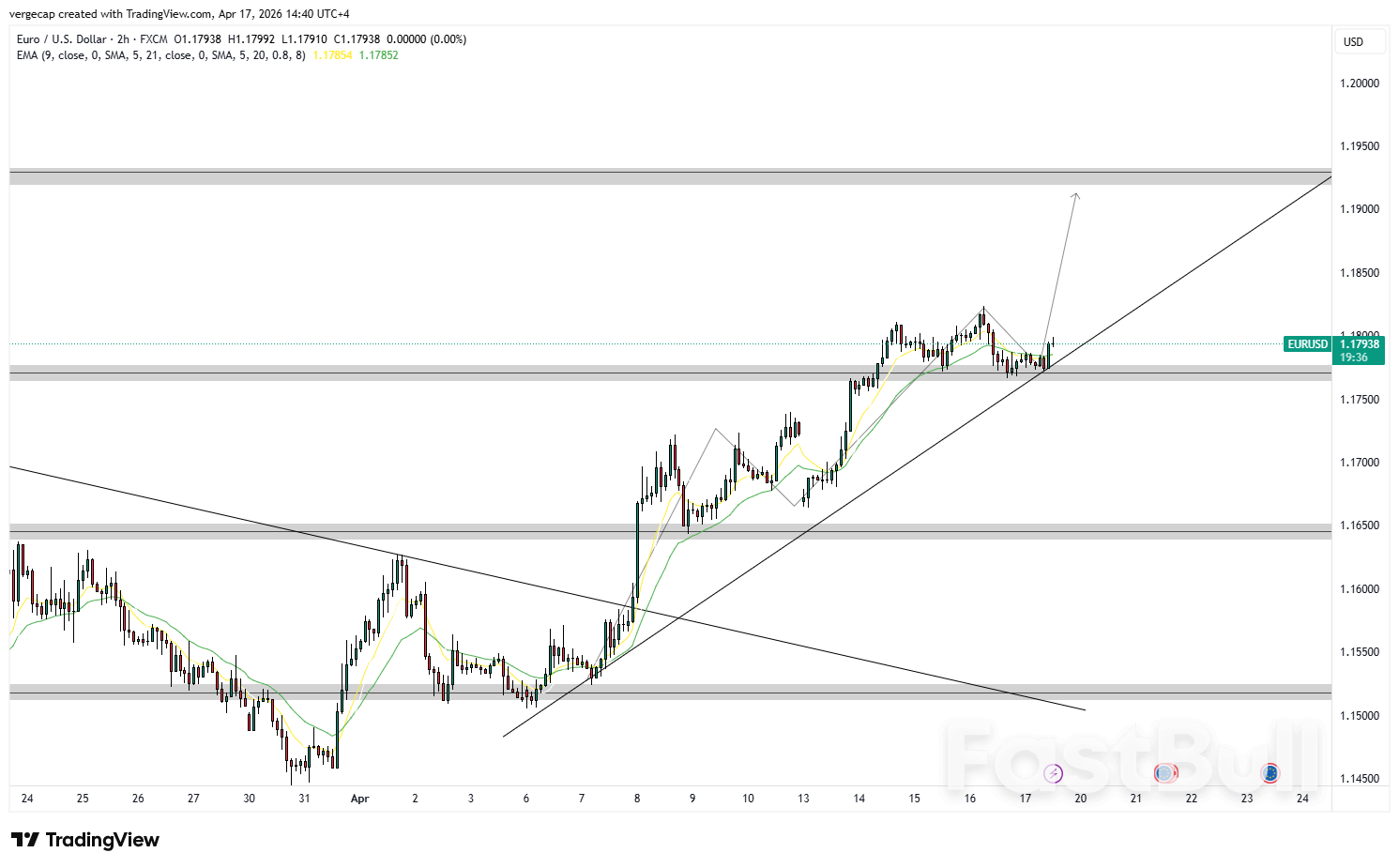
          EUR/USD remains entrenched within a powerfully bullish structure on the 2-hour chart, defined by one of the most visually compelling trend reversals visible across the major currency pairs in recent weeks. After a prolonged and orderly downtrend that carried price from the 1.1650 region all the way down toward the 1.1450–1.1500 support floor through late March and early April — guided by a well-defined descending trendline from the upper left of the chart — the pair staged a dramatic and high-velocity breakout around April 5–6 that has fundamentally rewritten the technical narrative for the Euro. That breakout, which sliced through the descending trendline with authority and accelerated sharply to the upside, has since produced a rally of approximately 400 pips from its base, and the structure that has developed in its wake is constructive, organized, and — critically — still intact.
          Price currently trades at 1.17938, sitting in a zone of near-perfect convergence between the 9-period EMA at 1.17854 and the 21-period SMA at 1.17852. The clustering of both moving averages at essentially the same price level as the current market rate is a technically significant moment — it represents a pause in momentum rather than a reversal, a consolidation phase where the market is gathering energy for the next directional move rather than signaling exhaustion of the prevailing trend. The fact that price has held above both moving averages on a closing basis throughout the recent consolidation between April 14 and 17 is an encouraging sign for bulls. It suggests that dip-buyers are active at current levels and that sellers have not been able to establish the kind of sustained momentum below the moving average cluster that would signal a more serious correction.
          The ascending trendline drawn from the April 5 breakout lows — which has guided the impulsive rally in a clean, disciplined fashion — is the defining structural element of the current bullish phase and the most critical technical reference on the chart. This trendline currently intersects in the vicinity of the 1.1760–1.1770 area and is rising with each passing session. The horizontal support band near 1.1775–1.1780, visible as a clearly marked zone on the chart, overlaps closely with the rising trendline, creating a powerful confluence support zone where both dynamic and static support reinforce each other. This layering of support forms the bedrock of the bullish case and represents the level that bulls must defend to maintain the integrity of the current trend structure.
          A sustained 2-hour close below 1.1760, accompanied by a definitive breach of the ascending trendline, would mark a meaningful deterioration in the bullish thesis and shift the near-term bias to neutral. Should such a breakdown materialize, the next layer of support lies in the 1.1650 area — a horizontal level that provided a base during the early April consolidation phase before the explosive breakout. A deeper failure below 1.1650 would bring the 1.1500 psychological support and the former downtrend lows back into focus, signaling that the rally from early April was corrective in nature rather than the beginning of a sustained trend reversal.
          On the upside, the immediate resistance to overcome is the 1.1800 psychological level, which has been acting as a near-term cap during the current consolidation. Price has repeatedly probed this area over the past several sessions without achieving a clean, sustained break — a pattern of resistance that must be resolved convincingly before bulls can claim the next leg higher with confidence. A decisive close above 1.1800 would clear the path toward the 1.1825–1.1850 zone, which corresponds to the recent swing highs from April 14–15 and represents the next meaningful resistance cluster. Beyond that, the primary upside target identified by the projected price path on the chart lies in the 1.1900–1.1940 major resistance band — a significant horizontal supply zone visible at the top of the chart that has capped price on multiple prior occasions. A sustained break of this region would represent a major technical achievement and open the door toward the 1.2000 psychological milestone, a level that would attract enormous attention from both speculative and institutional market participants.
          The moving average configuration fully supports the bullish bias. Both the 9-period EMA and 21-period SMA are sloping upward, running in tight formation just beneath current price after the pair's dramatic shift from a bearish to a bullish trend following the April 5 breakout. The prior descending trendline from the upper-left portion of the chart — which previously acted as the ceiling of the entire downtrend — has now been convincingly breached and left far below current price levels, confirming that the structural shift from downtrend to uptrend is genuine rather than a temporary counter-trend move. The convergence of the two moving averages at current price levels, combined with the ascending trendline support below, frames a tight, low-risk setup that favors continuation of the bullish trend following the current consolidation.
          The projected path drawn on the chart mirrors this reading precisely — showing a brief, shallow pullback toward the ascending trendline and moving average confluence near 1.1760–1.1780, followed by a resumption of the uptrend toward the 1.1900–1.1940 resistance ceiling. This base case remains valid as long as the ascending trendline holds on a closing basis.
          TRADE RECOMMENDATION
          BUY EUR/USD
          ENTRY PRICE: 1.1775
          STOP LOSS: 1.1730
          TAKE PROFIT: 1.1920
          Risk Warnings and Disclaimers
          You understand and acknowledge that there is a high degree of risk involved in trading. Following any strategies or investment methods may lead to potential losses. The content on the site is provided by our contributors and analysts for information purposes only. You are solely responsible for determining whether any trading assets, securities, strategy, or any other product is suitable for investing based on your own investment objectives and financial situation.
          Add to Favorites
          Share
          FastBull
          Copyright © 2026 FastBull Ltd

          728 RM B 7/F GEE LOK IND BLDG NO 34 HUNG TO RD KWUN TONG KLN HONG KONG

          TelegramInstagramTwitterfacebooklinkedin
          App Store Google Play Google Play
          Products
          Charts

          Chats

          Q&A with Experts
          Screeners
          Economic Calendar
          Data
          Tools
          Membership
          Features
          Function
          Markets
          Copy Trading
          Latest Signals
          Contests
          24/7
          Analysis
          Education
          Company
          Careers
          About Us
          Contact Us
          Advertising
          Help Center
          Feedback
          User Agreement
          Privacy Policy
          Personal Information Protection Statement
          Business

          White Label

          Broker API

          Data API

          Web Plug-ins

          Poster Maker

          Affiliate Program

          Risk Disclosure

          The risk of loss in trading financial instruments such as stocks, FX, commodities, futures, bonds, ETFs and crypto can be substantial. You may sustain a total loss of the funds that you deposit with your broker. Therefore, you should carefully consider whether such trading is suitable for you in light of your circumstances and financial resources.

          No decision to invest should be made without thoroughly conducting due diligence by yourself or consulting with your financial advisors. Our web content might not suit you since we don't know your financial conditions and investment needs. Our financial information might have latency or contain inaccuracy, so you should be fully responsible for any of your trading and investment decisions. The company will not be responsible for your capital loss.

          Without getting permission from the website, you are not allowed to copy the website's graphics, texts, or trademarks. Intellectual property rights in the content or data incorporated into this website belong to its providers and exchange merchants.

          Not Logged In

          Log in to access more features

          Connect Broker
          Become a signal provider
          Help Center
          Customer Service
          Dark Mode
          Price Up/Down Colors

          Log In

          Sign Up

          Position
          Layout
          Fullscreen
          Default to Chart
          The chart page opens by default when you visit fastbull.com