• Trade
  • Markets
  • Copy
  • Contests
  • 24/7
  • Calendar
  • Q&A
  • Chats
Screeners
SYMBOL
LAST
BID
ASK
HIGH
LOW
NET CHG.
%CHG.
SPREAD
SPX
S&P 500 Index
6616.84
6616.84
6616.84
6618.24
6534.54
+5.01
+ 0.08%
--
DJI
Dow Jones Industrial Average
46584.45
46584.45
46584.45
46606.93
46214.77
-85.42
-0.18%
--
IXIC
NASDAQ Composite Index
22017.84
22017.84
22017.84
22024.90
21611.00
+21.51
+ 0.10%
--
USDX
US Dollar Index
98.650
98.650
98.730
98.820
98.580
-0.810
-0.81%
--
EURUSD
Euro / US Dollar
1.16762
1.16762
1.16769
1.16966
1.15890
+0.00803
+ 0.69%
--
GBPUSD
Pound Sterling / US Dollar
1.34159
1.34159
1.34170
1.34171
1.32738
+0.01256
+ 0.95%
--
XAUUSD
Gold / US Dollar
4801.11
4801.11
4801.56
4857.59
4713.69
+94.94
+ 2.02%
--
WTI
Light Sweet Crude Oil
90.306
90.306
90.341
99.337
85.979
-10.651
-10.55%
--

Community Accounts

Signal Accounts
--
Profit Accounts
--
Loss Accounts
--
View More

Become a signal provider

Sell trading signals to earn additional income

View More

Guide to Copy Trading

Get started with ease and confidence

View More

Signal Accounts for Members

All Signal Accounts

Best Return
  • Best Return
  • Best P/L
  • Best MDD
Past 1W
  • Past 1W
  • Past 1M
  • Past 1Y

All Contests

  • All
  • Trump Updates
  • Recommend
  • Stocks
  • Cryptocurrencies
  • Central Banks
  • Featured News
Top News Only
Share

The Yield On Japan's 40-year Government Bonds Fell 10 Basis Points To 3.855%

Share

The Governor Of The Reserve Bank Of India Stated That The Exchange Rate Will Continue To Be Determined By The Market, And No Target Level Will Be Set. Destructive Volatility Will Continue To Be Controlled

Share

Reserve Bank Of India Governor: Despite Stronger Macroeconomic Fundamentals, The Indian Rupee Has Depreciated More Than Average Over The Past Few Years

Share

The Governor Of The Reserve Bank Of India Stated That As Of April 3, India's Foreign Exchange Reserves Stood At $697.1 Billion

Share

Sichuan Introduces 22 Policy Measures To Consolidate And Expand The Steady And Improving Economic Momentum

Share

India's Central Bank Reserve Deposit Ratio As Of April 8 Stands At 3%, With An Expected Rate Of 3% And A Previous Rate Of 3%

Share

The Yield On India's 10-year Government Bonds Rose 3 Basis Points To 6.9325%

Share

As Of April 8, India's Central Bank Reverse Repo Rate Stands At 3.35%, Unchanged From The Previous Reading Of 3.35%

Share

The Yield On Japan's 20-year Government Bonds Fell 7.5 Basis Points To 3.255%

Share

The Governor Of The Reserve Bank Of India Said The Situation In The Strait Of Hormuz Has Led To Rising Energy And Commodity Prices, Which Could Affect Economic Growth This Year

Share

Reserve Bank Of India Governor: High Energy And Commodity Prices And Supply Shocks Are Likely To Impact Economic Growth In Fiscal Year 2027

Share

Reserve Bank Of India Governor: Rising Oil Prices Could Push Up Inflation And Widen The Current Account Deficit

Share

The Governor Of The Reserve Bank Of India Stated That The Intensity, Duration, And Resulting Damage To Energy Infrastructure In The Middle East Conflict Have Increased Risks To Inflation And Economic Growth Prospects

Share

Reserve Bank Of India Governor: Upside Risks To The Inflation Outlook Have Increased Due To Rising Energy Prices And Weather Disruptions

Share

Reserve Bank Of India Governor: Monetary Policy Committee Maintains A "neutral" Policy Stance

Share

India's Central Bank Interest Rate Decision As Of April 8: 5.25%, In Line With Expectations And Unchanged From The Previous Reading Of 5.25%

Share

The Vietnamese Parliament Has Appointed Pham Duc An, A Professional Banker, As The New Central Bank Governor

Share

Reserve Bank Of India Governor: Global Economic Growth Faces Downside Risks

Share

Indonesia's Ministry Of Foreign Affairs: Indonesia Has Taken Note Of The Preliminary Findings Of The United Nations Investigation Into The Deaths Of Peacekeepers And Urges The United Nations To Conduct A Full Investigation Into The Case

Share

Indonesian Foreign Ministry: All Parties Should Respect Sovereignty, Territorial Integrity, And Diplomatic Channels

TIME
ACT
FCST
PREV
Japan Foreign Exchange Reserves (Mar)

A:--

F: --

P: --

Japan 30-Year JGB Auction Yield

A:--

F: --

P: --

Japan Leading Indicators Prelim (Feb)

A:--

F: --

P: --

South Africa IHS Markit Composite PMI (SA) (Mar)

A:--

F: --

P: --

Italy Composite PMI (Mar)

A:--

F: --

P: --

Italy Services PMI (SA) (Mar)

A:--

F: --

P: --

China, Mainland Foreign Exchange Reserves (Mar)

A:--

F: --

P: --

Euro Zone Sentix Investor Confidence Index (Apr)

A:--

F: --

P: --

U.K. Official Reserves Changes (Mar)

A:--

F: --

P: --

U.S. Durable Goods Orders MoM (Excl. Defense) (SA) (Feb)

A:--

F: --

P: --
U.S. Durable Goods Orders MoM (Feb)

A:--

F: --

P: --
U.S. Non-Defense Capital Durable Goods Orders MoM (Excl. Aircraft) (Feb)

A:--

F: --

P: --
U.S. Durable Goods Orders MoM (Excl.Transport) (Feb)

A:--

F: --

P: --
U.S. Weekly Redbook Index YoY

A:--

F: --

P: --

Canada Ivey PMI (Not SA) (Mar)

A:--

F: --

P: --

Canada Ivey PMI (SA) (Mar)

A:--

F: --

P: --

U.S. EIA Natural Gas Production Forecast For The Next Year (Apr)

A:--

F: --

P: --

U.S. EIA Short-Term Crude Production Forecast For The Next Year (Apr)

A:--

F: --

P: --

U.S. EIA Short-Term Crude Production Forecast For The Year (Apr)

A:--

F: --

P: --

EIA Monthly Short-Term Energy Outlook
U.S. 3-Year Note Auction Yield

A:--

F: --

P: --

U.S. Consumer Credit (SA) (Feb)

A:--

F: --

P: --
U.S. API Weekly Cushing Crude Oil Stocks

A:--

F: --

P: --

U.S. API Weekly Gasoline Stocks

A:--

F: --

P: --

U.S. API Weekly Crude Oil Stocks

A:--

F: --

P: --

U.S. API Weekly Refined Oil Stocks

A:--

F: --

P: --

Japan Wages MoM (Feb)

A:--

F: --

P: --

Japan Trade Balance (Feb)

A:--

F: --

P: --

India Cash Reserve Ratio

A:--

F: --

P: --

India Benchmark Interest Rate

A:--

F: --

P: --

India Reverse Repo Rate

--

F: --

P: --

U.K. Halifax House Price Index YoY (SA) (Mar)

--

F: --

P: --

U.K. Halifax House Price Index MoM (SA) (Mar)

--

F: --

P: --

France Trade Balance (SA) (Feb)

--

F: --

P: --

Germany Construction PMI (SA) (Mar)

--

F: --

P: --

U.K. Markit/CIPS Construction PMI (Mar)

--

F: --

P: --

Euro Zone PPI YoY (Feb)

--

F: --

P: --
Euro Zone Retail Sales MoM (Feb)

--

F: --

P: --

Euro Zone PPI MoM (Feb)

--

F: --

P: --

Euro Zone Retail Sales YoY (Feb)

--

F: --

P: --

Germany 10-Year Bund Auction Avg. Yield

--

F: --

P: --

U.S. MBA Mortgage Application Activity Index WoW

--

F: --

P: --

Mexico Consumer Confidence Index (Mar)

--

F: --

P: --

U.S. EIA Weekly Crude Stocks Change

--

F: --

P: --

U.S. EIA Weekly Heating Oil Stock Changes

--

F: --

P: --

U.S. EIA Weekly Gasoline Stocks Change

--

F: --

P: --

U.S. EIA Weekly Crude Demand Projected by Production

--

F: --

P: --

U.S. EIA Weekly Cushing, Oklahoma Crude Oil Stocks Change

--

F: --

P: --

U.S. EIA Weekly Crude Oil Imports Changes

--

F: --

P: --

U.S. Refinitiv/Ipsos Primary Consumer Sentiment Index (PCSI) (Apr)

--

F: --

P: --

U.S. 10-Year Note Auction Avg. Yield

--

F: --

P: --

FOMC Meeting Minutes
U.K. 3-Month RICS House Price Balance (Mar)

--

F: --

P: --

Japan Household Consumer Confidence Index (Mar)

--

F: --

P: --

Germany Industrial Output MoM (SA) (Feb)

--

F: --

P: --

Germany Exports MoM (SA) (Feb)

--

F: --

P: --
U.K. Refinitiv/Ipsos Primary Consumer Sentiment Index (PCSI) (Apr)

--

F: --

P: --

Brazil Retail Sales MoM (Feb)

--

F: --

P: --

Mexico CPI YoY (Mar)

--

F: --

P: --

Q&A with Experts
    • All
    • Chatrooms
    • Groups
    • Friends
    Visxa Benfica flag
    sonu
    have you guys ever tried "Gocharting"
    @sonu What kind of application is that?
    Visxa Benfica flag
    I've never heard of it.
    木易 flag
    盘前盘后夜盘都看不见吗
    sonu flag
    Visxa Benfica
    @sonu What kind of application is that?
    @Visxa Benficajust like trading view but you can see some advance features
    Visxa Benfica flag
    木易
    盘前盘后夜盘都看不见吗
    @木易Yes, I can see it clearly
    Visxa Benfica flag
    @木易The sessions before the London open, after the New York close, or the Asian night trading are all extremely important, especially for gold.
    Visxa Benfica flag
    sonu
    @Visxa Benficajust like trading view but you can see some advance features
    @sonu Oh, I only like Fast Bull.
    sonu flag
    Visxa Benfica
    @sonu Oh, I only like Fast Bull.
    @Visxa Benficayes no doubt fastbull chart is also nice
    Visxa Benfica flag
    sonu
    @Visxa Benficayes no doubt fastbull chart is also nice
    @sonu Yeah, you've used it too?
    Visxa Benfica flag
    Which pair are you trading?
    sonu flag
    Visxa Benfica
    @sonu Yeah, you've used it too?
    @Visxa Benficayes I use Gocharting and fastbull
    Visxa Benfica flag
    sonu
    @Visxa Benficayes I use Gocharting and fastbull
    @sonu Are you following gold, on the 5m timeframe?
    Visxa Benfica flag
    sonu flag
    not now I will do it after sometime
    Visxa Benfica flag
    sonu
    not now I will do it after sometime
    @sonu As for me, I'm still observing and looking for opportunities
    Visxa Benfica flag
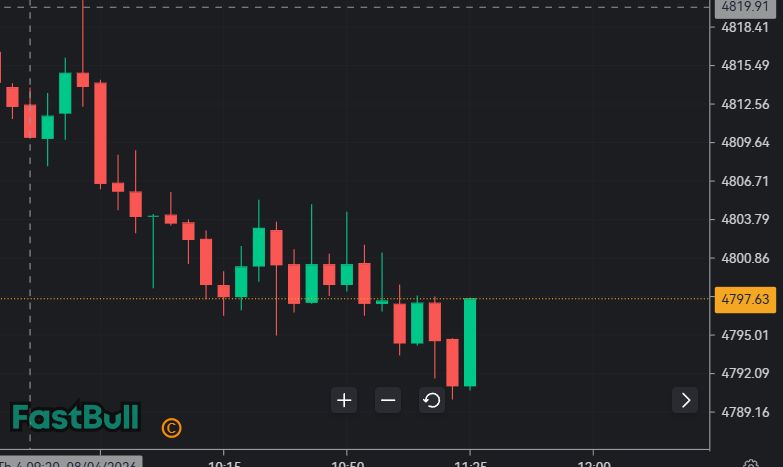
    The double bottom pattern on the gold chart has been completed; who is taking advantage of this opportunity to buy in?
    sonu flag
    Visxa Benfica
    @sonu As for me, I'm still observing and looking for opportunities
    @Visxa Benficaohh
    3371973 flag
    Anyone here, I'd like to ask for some insights for XAU. any trend for these following week? is Gold start to be bullish again?
    木木
    3371973
    Anyone here, I'd like to ask for some insights for XAU. any trend for these following week? is Gold start to be bullish again?
    @3371973 我也想听听大家的看法。目前一直在4800左右 暂时感觉趋势好像不太明显的
    3371973 flag
    木木
    @3371973 我也想听听大家的看法。目前一直在4800左右 暂时感觉趋势好像不太明显的
    I am in Asia market, @木木yes same here. 4800ish.
    Type here...
    Add Symbol or Code

      No matching data

      All
      Trump Updates
      Recommend
      Stocks
      Cryptocurrencies
      Central Banks
      Featured News
      • All
      • Russia-Ukraine Conflict
      • Middle East Flashpoint
      • All
      • Russia-Ukraine Conflict
      • Middle East Flashpoint

      Search
      Products

      Charts Free Forever

      Chats Q&A with Experts
      Screeners Economic Calendar Data Tools
      Membership Features
      Data Warehouse Market Trends Institutional Data Policy Rates Macro

      Market Trends

      Market Sentiment Order Book Forex Correlations

      Top Indicators

      Charts Free Forever
      Markets

      News

      24/7 Analysis Education

      Latest Views

      Latest Update

      Signals

      Copy Rankings Latest Signals Become a signal provider AI Rating
      Contests
      Brokers

      Overview Brokers Assessment Rankings Regulators News Claims
      Broker listing Forex Brokers Comparison Tool Live Spread Comparison Scam
      Q&A Complaint Scam Alert Videos Tips to Detect Scam
      More

      Business
      Events
      Careers About Us Advertising Help Center

      White Label

      Broker API

      Data API

      Web Plug-ins

      Affiliate Program

      Awards Institution Evaluation IB Seminar Salon Event Exhibition
      Vietnam Thailand Singapore Dubai
      Fans Party Investment Sharing Session
      FastBull Summit BrokersView Expo
      Recent Searches
        Top Searches
          Markets
          Analysis
          User
          24/7
          Economic Calendar
          Education
          Data
          • Names
          • Latest
          • Prev

          View All

          No data

          Scan to Download

          Faster Charts, Chat Faster!

          Download App
          English
          • English
          • Español
          • العربية
          • Bahasa Indonesia
          • Bahasa Melayu
          • Tiếng Việt
          • ภาษาไทย
          • Français
          • Italiano
          • Türkçe
          • Русский язык
          • 简中
          • 繁中
          Open Account
          Search
          Products
          Charts Free Forever
          Markets
          News
          Signals

          Copy Rankings Latest Signals Become a signal provider AI Rating
          Contests
          Brokers

          Overview Brokers Assessment Rankings Regulators News Claims
          Broker listing Forex Brokers Comparison Tool Live Spread Comparison Scam
          Q&A Complaint Scam Alert Videos Tips to Detect Scam
          More

          Business
          Events
          Careers About Us Advertising Help Center

          White Label

          Broker API

          Data API

          Web Plug-ins

          Affiliate Program

          Awards Institution Evaluation IB Seminar Salon Event Exhibition
          Vietnam Thailand Singapore Dubai
          Fans Party Investment Sharing Session
          FastBull Summit BrokersView Expo

          EUR/JPY Climbs to Two-Month Highs as Yen Buckles Under Oil Inflation Spiral Fears; BoJ and ECB Both Eye Rate Hikes

          Warren Takunda

          Traders' Opinions

          Summary:

          The Euro extended gains against a beleaguered Japanese Yen for a second consecutive session on Tuesday, with EUR/JPY advancing toward two-month highs near 184.65–184.75 as markets grappled with Japan's deepening inflation vulnerability amid surging oil prices, a 50% priced-in probability of a Bank of Japan rate hike in April, and growing expectations that the European Central Bank will also tighten policy in the near term.

          BUY EURJPY
          Close Time
          CLOSED

          184.750

          Entry Price

          186.300

          TP

          183.200

          SL

          184.927 -0.044 -0.02%

          19.8

          Pips

          Profit

          183.200

          SL

          184.948

          Exit Price

          184.750

          Entry Price

          186.300

          TP
          The Euro is grinding steadily higher against the Japanese Yen on Tuesday, with EUR/JPY trading around 184.47 and bulls firmly trained on the two-month high resistance band at 184.65–184.75. The move marks the second consecutive session of gains for the cross and reflects a growing divergence in how markets are assessing the economic vulnerability of Japan versus the Eurozone in the current geopolitical and inflationary environment — a divergence that, in my view, is only beginning to be fully priced in.
          At the heart of this story is oil — and more specifically, the profound and structurally asymmetric damage that elevated crude prices inflict on an economy like Japan's. As one of the world's largest net importers of energy, Japan has virtually no domestic buffer against the supply shock that has sent WTI Crude above $101 per barrel in recent sessions. Every dollar added to the price of crude translates almost directly into higher import costs, wider trade deficits, and accelerating price pressures across the Japanese economy — from household energy bills and transportation costs to manufacturing inputs and food production. And with the Strait of Hormuz still firmly under the control of the IRGC Navy, with no credible timeline for reopening, there is no near-term relief valve in sight.
          This is the environment in which the Yen finds itself on Tuesday — and it is an extraordinarily difficult one. The currency, which for decades benefited from Japan's perceived status as a creditor nation with vast overseas assets and a structurally deflationary domestic economy, is now facing a fundamentally altered reality. The very dynamics that once insulated Japan from external shocks — low inflation, low yields, current account surpluses — are being systematically dismantled by a combination of surging energy import costs and an ambitious government stimulus agenda under Prime Minister Sanae Takaichi.
          The concern that is beginning to dominate investor conversations — and which I believe deserves far more attention than it is currently receiving in mainstream financial coverage — is the risk of a genuine inflation spiral in Japan. The mechanics are straightforward but deeply troubling. High energy costs feed into headline and core inflation simultaneously. At the same time, Prime Minister Takaichi's stimulus programs — designed to cushion Japanese households from the immediate pain of higher energy prices — inject additional demand-side pressure into an already heating economy. The result is a policy trap: the government is spending more to fight inflation even as that spending risks adding fuel to the inflationary fire.
          Underlying inflation in Japan has already reached the Bank of Japan's 2% target and, critically, is expected to accelerate further if the Middle East conflict extends into the coming months. This creates an almost impossible dilemma for the BoJ. For years, the central bank struggled to generate inflation at all, keeping rates at ultra-low or negative levels and maintaining one of the most accommodative monetary policy stances in the developed world. Now, inflation is not just at target — it is threatening to overshoot it dramatically, driven not by healthy domestic demand but by an imported energy shock the BoJ has absolutely no power to directly address.
          Futures markets have moved decisively in response. As of Tuesday, markets are pricing approximately a 50% probability of a Bank of Japan rate hike in April — a remarkable development given where consensus stood just weeks ago — and are almost fully pricing in a hike before the summer. This repricing is not happening in a vacuum. On Tuesday, former BoJ Monetary Policy Committee member Seiji Adachi delivered what amounted to an explicit endorsement of the hawkish pivot, affirming publicly that the Bank is under genuine pressure to move quickly if it does not want to fall behind the curve on inflation. When former committee members begin speaking with this degree of urgency, markets listen — and rightly so.
          From my perspective as a financial reporter who has tracked the BoJ's glacial policy evolution over several years, Adachi's comments represent a significant signaling moment. The BoJ has historically been the most reluctant of the major central banks to tighten, and its communications have been carefully calibrated to avoid startling bond and currency markets. The fact that a credible former insider is now publicly warning about falling behind the curve suggests the internal debate at the BoJ has shifted materially — and that a April hike, while not yet the base case, is a live and meaningful risk that investors ignore at their peril.
          For the Yen, the cruel irony of this situation is that a rate hike — which would theoretically be positive for the currency — may not provide the relief bulls are hoping for. If the BoJ hikes into a slowing economy, crushed by energy costs and a government simultaneously borrowing heavily to fund stimulus, the result may be the worst of all worlds: tighter monetary policy that suppresses growth without adequately cooling energy-driven inflation. Japan's public debt-to-GDP ratio is already among the highest in the developed world, and further fiscal expansion to soften the inflationary blow on households will only deepen that burden, raising long-term questions about fiscal sustainability that weigh on sovereign credibility.
          On the other side of the EUR/JPY equation, the Euro is finding support from its own central bank's hawkish pivot. The European Central Bank is widely expected to hike interest rates in the near term, with April emerging as the likely meeting where policymakers pull the trigger. The newest member of the ECB's Governing Council, Dimitar Radev, offered a characteristically cautious but telling assessment in a recent Reuters interview. While Radev declined to commit explicitly to April as the date for action, he acknowledged that inflation expectations are at risk of rising faster than in the past — language that, in central bank communication terms, is anything but innocuous. His insistence that further data would be needed before confirming an April decision reads more as procedural caution than genuine dovish pushback, and markets appear to be interpreting it as such.
          The ECB's anticipated hawkish turn provides the Euro with a fundamental underpinning that the Yen currently lacks. While both economies face energy-driven inflationary pressures from the Middle East conflict, the Eurozone's monetary policy response is seen as more straightforward — hiking rates to contain inflation without the same degree of fiscal contradiction that complicates Japan's position. The result is a widening rate differential narrative that favors the Euro over the Yen and supports further EUR/JPY appreciation in the near term.

          Technical AnalysisEUR/JPY Climbs to Two-Month Highs as Yen Buckles Under Oil Inflation Spiral Fears; BoJ and ECB Both Eye Rate Hikes_1

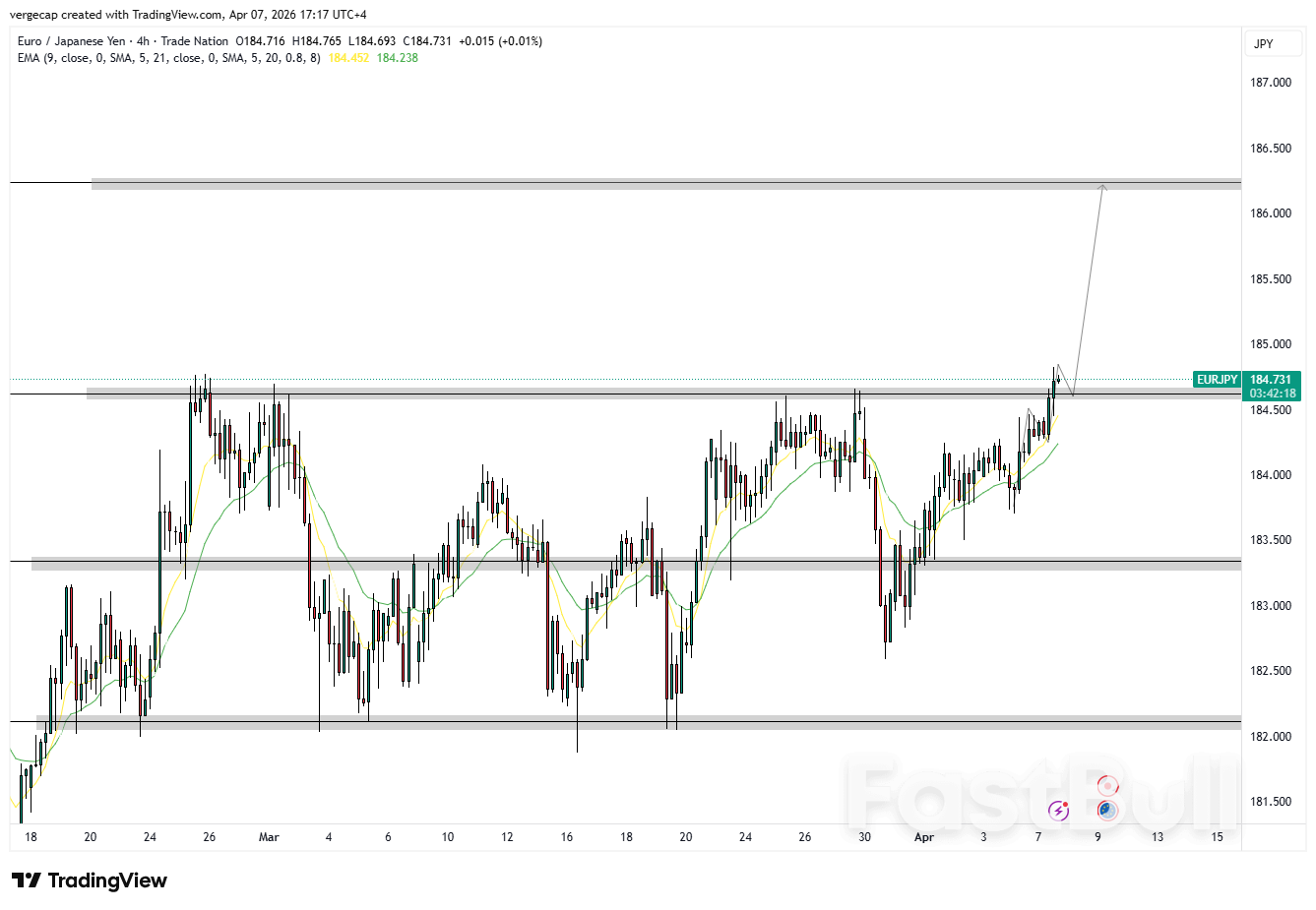
          , EUR/JPY is carving out a pivotal and potentially decisive moment on the 4-hour chart, with price breaking above a formidable multi-week resistance ceiling at 184.65–184.75 to trade around 184.731. What makes this breakout technically significant is not simply the price level itself, but the number of times this zone has repelled bullish attempts since late February — making the current close above it a meaningful structural development rather than a routine intraday fluctuation. The pair has spent the better part of six weeks trapped within a broad but well-defined range, oscillating between the 182.00 support floor and the 184.65–184.75 resistance ceiling, and the breakout now in progress represents a potential resolution of that range to the upside.
          The 9-period EMA and 21-period SMA, currently tracking at 184.45 and 184.24 respectively, have been rising in a tight bullish stack beneath price throughout the recent recovery phase from the 183.50 mid-range support. Both averages are sloping upward with conviction and are now providing a dynamic support corridor between 184.20 and 184.45. Critically, price has separated cleanly from these averages without overextending — a sign that the rally has been orderly and technically healthy rather than driven by a single explosive spike that risks immediate mean reversion. Any pullback that holds above the 184.20–184.45 EMA/SMA zone should be viewed as a continuation opportunity rather than a reversal signal.
          The 183.50 horizontal level represents the most important support reference on the 4-hour chart and has been tested and respected on multiple occasions throughout March and into early April. This zone served as both a support base during the mid-range accumulation phase and as a springboard for the current breakout attempt. A corrective pullback that finds support at or above 183.50 would preserve the bullish higher-low structure intact and keep the breakout thesis fully valid. However, a sustained 4-hour close below 183.50 would be a meaningful red flag, suggesting that the breakout above 184.65 was a false move and that the pair risks rotating back toward the lower end of the established range. In that scenario, the 182.00–182.20 structural support floor — which has held every major selloff since late February — would be the next destination for price.
          A deeper and more troubling breakdown below 182.00 would represent a full-range failure and would signal a significant shift in the medium-term outlook for EUR/JPY, potentially exposing the 181.50 region and below. Given the strong fundamental backdrop supporting the Euro and the continued Yen weakness driven by Japan's oil-inflation dilemma, such a scenario would likely require a major and unexpected shift in the geopolitical narrative — a ceasefire agreement, a surprise BoJ policy hold, or a sharp reversal in crude prices.
          On the upside, the measured move projection drawn on the chart targets the 186.00–186.50 major resistance ceiling — the dominant horizontal supply zone visible at the top of the chart that has capped price on multiple attempts. This level represents the primary bullish target following a confirmed breakout above 184.65, and the distance from the current breakout point to this target implies an approximate 130–180 pip extension — well within the range of what the pair has demonstrated it is capable of across a single directional leg. A sustained close above 186.50 would open the door toward fresh multi-month highs and would signal a more profound structural shift in EUR/JPY's medium-term trend.
          The moving average configuration reinforces the bullish conviction. The golden positioning of the 9 EMA above the 21 SMA, with both averages rising beneath an advancing price, is a classic trend-following signal on the 4-hour timeframe. The fact that this configuration has been intact and strengthening throughout the April recovery underscores that momentum is on the side of the bulls — and that dips into moving average support represent opportunity rather than warning.
          TRADE RECOMMENDATION
          BUY EUR/JPY
          ENTRY PRICE: 184.75
          STOP LOSS: 183.20
          TAKE PROFIT: 186.30
          Risk Warnings and Disclaimers
          You understand and acknowledge that there is a high degree of risk involved in trading. Following any strategies or investment methods may lead to potential losses. The content on the site is provided by our contributors and analysts for information purposes only. You are solely responsible for determining whether any trading assets, securities, strategy, or any other product is suitable for investing based on your own investment objectives and financial situation.
          Add to Favorites
          Share
          FastBull
          Copyright © 2026 FastBull Ltd

          728 RM B 7/F GEE LOK IND BLDG NO 34 HUNG TO RD KWUN TONG KLN HONG KONG

          TelegramInstagramTwitterfacebooklinkedin
          App Store Google Play Google Play
          Products
          Charts

          Chats

          Q&A with Experts
          Screeners
          Economic Calendar
          Data
          Tools
          Membership
          Features
          Function
          Markets
          Copy Trading
          Latest Signals
          Contests
          24/7
          Analysis
          Education
          Company
          Careers
          About Us
          Contact Us
          Advertising
          Help Center
          Feedback
          User Agreement
          Privacy Policy
          Personal Information Protection Statement
          Business

          White Label

          Broker API

          Data API

          Web Plug-ins

          Poster Maker

          Affiliate Program

          Risk Disclosure

          The risk of loss in trading financial instruments such as stocks, FX, commodities, futures, bonds, ETFs and crypto can be substantial. You may sustain a total loss of the funds that you deposit with your broker. Therefore, you should carefully consider whether such trading is suitable for you in light of your circumstances and financial resources.

          No decision to invest should be made without thoroughly conducting due diligence by yourself or consulting with your financial advisors. Our web content might not suit you since we don't know your financial conditions and investment needs. Our financial information might have latency or contain inaccuracy, so you should be fully responsible for any of your trading and investment decisions. The company will not be responsible for your capital loss.

          Without getting permission from the website, you are not allowed to copy the website's graphics, texts, or trademarks. Intellectual property rights in the content or data incorporated into this website belong to its providers and exchange merchants.

          Not Logged In

          Log in to access more features

          Connect Broker
          Become a signal provider
          Help Center
          Customer Service
          Dark Mode
          Price Up/Down Colors

          Log In

          Sign Up

          Position
          Layout
          Fullscreen
          Default to Chart
          The chart page opens by default when you visit fastbull.com