• Trade
  • Markets
  • Copy
  • Contests
  • News
  • 24/7
  • Calendar
  • Q&A
  • Chats
Trending
Screeners
SYMBOL
LAST
BID
ASK
HIGH
LOW
NET CHG.
%CHG.
SPREAD
SPX
S&P 500 Index
6870.39
6870.39
6870.39
6895.79
6858.28
+13.27
+ 0.19%
--
DJI
Dow Jones Industrial Average
47954.98
47954.98
47954.98
48133.54
47871.51
+104.05
+ 0.22%
--
IXIC
NASDAQ Composite Index
23578.12
23578.12
23578.12
23680.03
23506.00
+72.99
+ 0.31%
--
USDX
US Dollar Index
98.820
98.900
98.820
98.960
98.820
-0.130
-0.13%
--
EURUSD
Euro / US Dollar
1.16529
1.16538
1.16529
1.16531
1.16341
+0.00103
+ 0.09%
--
GBPUSD
Pound Sterling / US Dollar
1.33392
1.33401
1.33392
1.33392
1.33151
+0.00080
+ 0.06%
--
XAUUSD
Gold / US Dollar
4200.19
4200.64
4200.19
4211.68
4190.61
+2.28
+ 0.05%
--
WTI
Light Sweet Crude Oil
59.855
59.892
59.855
60.063
59.752
+0.046
+ 0.08%
--

Community Accounts

Signal Accounts
--
Profit Accounts
--
Loss Accounts
--
View More

Become a signal provider

Sell trading signals to earn additional income

View More

Guide to Copy Trading

Get started with ease and confidence

View More

Signal Accounts for Members

All Signal Accounts

Best Return
  • Best Return
  • Best P/L
  • Best MDD
Past 1W
  • Past 1W
  • Past 1M
  • Past 1Y

All Contests

  • All
  • Trump Updates
  • Recommend
  • Stocks
  • Cryptocurrencies
  • Central Banks
  • Featured News
Top News Only
Share

Most Active China Coke Contract Falls 6.1% To 1532 Yuan/Metric Ton

Share

Most Active China Coking Coal Contract Falls As Much As 6.6% To 1088.5 Yuan/Metric Ton

Share

China's Yuan Opens Trade At 7.0683 Per Dollar Versus Last Close At 7.0720

Share

Most Active China Coke Contract Falls 4.8%

Share

Most Active China Coking Coal Contract Falls More Than 5%

Share

China's Central Bank Sets Yuan Mid-Point At 7.0764 / Dlr Versus Last Close 7.0720

Share

Japan Chief Cabinet Secretary Kihara: Have Seen No Change In China's Export Of Rare Earths To Japan

Share

[Market Update] Spot Silver Fell Below $58/ounce, Down 0.47% On The Day

Share

Japan Chief Cabinet Secretary Kihara: Will Continue To Work Closely With USA With Heightening Regional Tension In Mind

Share

Japan Chief Cabinet Secretary Kihara: Japan Will Decide On Its Own What Is Appropriate For Its Defence Spending

Share

Japan Chief Cabinet Secretary Kihara: Ratio Of Defence Spending Versus GDP Is Not The Important Issue

Share

Taiwan Overnight Interbank Rate Opens At 0.805 Percent (Versus 0.805 Percent At Previous Session Open)

Share

USGS - Magnitude 5.8 Earthquake Strikes Yakutat, Alaska Region

Share

Japan Chief Cabinet Secretary Kihara: Very Important To Get Understanding Of Other Countries, Including USA, Over Japan's Stance

Share

[JPMorgan CEO Jamie Dimon Says Europe Has Big Problems And Internal Divisions Will Be A Major Challenge] JPMorgan Chase CEO Jamie Dimon Stated That European Bureaucracy Is Inefficient And Warned That A Weak European Continent Poses A Significant Economic Risk To The United States. Europe Has Big Problems. They've Done A Very Good Job With Social Security. But They've Also Driven Away Businesses, Investment, And Innovation. This Situation Is Gradually Improving. He Praised Some European Leaders, Saying They Are Aware Of These Problems, But He Also Cautioned That Politics Is "really Difficult."

Share

Thai Army Spokesman Says Military Launched Air Strikes In Disputed Border Area With Cambodia

Share

Bank Of Japan - Japan Nov Outstanding Bank Loans +4.2% Year-On-Year

Share

Japan's Nikkei Share Average Futures Up 0.4% In Early Trade

Share

Trump, Asked If He Would Restart Trade Talks With Canada, Says We'll Work It Out

Share

LG New Energy, A Core Subsidiary Of LG Group Specializing In Power Batteries, Has Secured A 2.06 Trillion Won Order From Mercedes-Benz

TIME
ACT
FCST
PREV
Canada Labor Force Participation Rate (SA) (Nov)

A:--

F: --

P: --

U.S. Personal Income MoM (Sept)

A:--

F: --

P: --

U.S. PCE Price Index YoY (SA) (Sept)

A:--

F: --

P: --

U.S. PCE Price Index MoM (Sept)

A:--

F: --

P: --

U.S. Personal Outlays MoM (SA) (Sept)

A:--

F: --

P: --

U.S. Core PCE Price Index MoM (Sept)

A:--

F: --

P: --

U.S. Core PCE Price Index YoY (Sept)

A:--

F: --

P: --

U.S. UMich 5-Year-Ahead Inflation Expectations Prelim YoY (Dec)

A:--

F: --

P: --

U.S. Real Personal Consumption Expenditures MoM (Sept)

A:--

F: --

P: --

U.S. 5-10 Year-Ahead Inflation Expectations (Dec)

A:--

F: --

P: --

U.S. UMich Current Economic Conditions Index Prelim (Dec)

A:--

F: --

P: --

U.S. UMich Consumer Sentiment Index Prelim (Dec)

A:--

F: --

P: --

U.S. UMich 1-Year-Ahead Inflation Expectations Prelim (Dec)

A:--

F: --

P: --

U.S. UMich Consumer Expectations Index Prelim (Dec)

A:--

F: --

P: --

U.S. Weekly Total Rig Count

A:--

F: --

P: --

U.S. Weekly Total Oil Rig Count

A:--

F: --

P: --

U.S. Unit Labor Cost Prelim (SA) (Q3)

--

F: --

P: --

U.S. Consumer Credit (SA) (Oct)

A:--

F: --

P: --

China, Mainland Foreign Exchange Reserves (Nov)

A:--

F: --

P: --

China, Mainland Exports YoY (USD) (Nov)

--

F: --

P: --

China, Mainland Imports YoY (CNH) (Nov)

--

F: --

P: --

China, Mainland Imports YoY (USD) (Nov)

--

F: --

P: --

China, Mainland Imports (CNH) (Nov)

--

F: --

P: --

China, Mainland Trade Balance (CNH) (Nov)

--

F: --

P: --

China, Mainland Exports (Nov)

--

F: --

P: --

Japan Wages MoM (Oct)

A:--

F: --

P: --

Japan Trade Balance (Oct)

A:--

F: --

P: --

Japan Nominal GDP Revised QoQ (Q3)

A:--

F: --

P: --

Japan Trade Balance (Customs Data) (SA) (Oct)

A:--

F: --

P: --

Japan GDP Annualized QoQ Revised (Q3)

A:--

F: --

P: --
China, Mainland Exports YoY (CNH) (Nov)

--

F: --

P: --

China, Mainland Trade Balance (USD) (Nov)

--

F: --

P: --

Germany Industrial Output MoM (SA) (Oct)

--

F: --

P: --

Euro Zone Sentix Investor Confidence Index (Dec)

--

F: --

P: --

Canada Leading Index MoM (Nov)

--

F: --

P: --

Canada National Economic Confidence Index

--

F: --

P: --

U.S. Dallas Fed PCE Price Index YoY (Sept)

--

F: --

P: --

China, Mainland Trade Balance (USD) (Nov)

--

F: --

P: --

U.S. 3-Year Note Auction Yield

--

F: --

P: --

U.K. BRC Overall Retail Sales YoY (Nov)

--

F: --

P: --

U.K. BRC Like-For-Like Retail Sales YoY (Nov)

--

F: --

P: --

Australia Overnight (Borrowing) Key Rate

--

F: --

P: --

RBA Rate Statement
RBA Press Conference
Germany Exports MoM (SA) (Oct)

--

F: --

P: --

U.S. NFIB Small Business Optimism Index (SA) (Nov)

--

F: --

P: --

Mexico Core CPI YoY (Nov)

--

F: --

P: --

Mexico 12-Month Inflation (CPI) (Nov)

--

F: --

P: --

Mexico PPI YoY (Nov)

--

F: --

P: --

Mexico CPI YoY (Nov)

--

F: --

P: --

U.S. Weekly Redbook Index YoY

--

F: --

P: --

U.S. JOLTS Job Openings (SA) (Oct)

--

F: --

P: --

China, Mainland M2 Money Supply YoY (Nov)

--

F: --

P: --

China, Mainland M0 Money Supply YoY (Nov)

--

F: --

P: --

China, Mainland M1 Money Supply YoY (Nov)

--

F: --

P: --

U.S. EIA Short-Term Crude Production Forecast For The Next Year (Dec)

--

F: --

P: --

U.S. EIA Short-Term Crude Production Forecast For The Year (Dec)

--

F: --

P: --

U.S. EIA Natural Gas Production Forecast For The Next Year (Dec)

--

F: --

P: --

EIA Monthly Short-Term Energy Outlook
U.S. 10-Year Note Auction Avg. Yield

--

F: --

P: --

U.S. API Weekly Cushing Crude Oil Stocks

--

F: --

P: --

Q&A with Experts
    • All
    • Chatrooms
    • Groups
    • Friends
    Connecting
    .
    .
    .
    Type here...
    Add Symbol or Code

      No matching data

      All
      Trump Updates
      Recommend
      Stocks
      Cryptocurrencies
      Central Banks
      Featured News
      • All
      • Russia-Ukraine Conflict
      • Middle East Flashpoint
      • All
      • Russia-Ukraine Conflict
      • Middle East Flashpoint

      Search
      Products

      Charts Free Forever

      Chats Q&A with Experts
      Screeners Economic Calendar Data Tools
      Membership Features
      Data Warehouse Market Trends Institutional Data Policy Rates Macro

      Market Trends

      Market Sentiment Order Book Forex Correlations

      Top Indicators

      Charts Free Forever
      Markets

      News

      News Analysis 24/7 Columns Education
      From Institutions From Analysts
      Topics Columnists

      Latest Views

      Latest Views

      Trending Topics

      Top Columnists

      Latest Update

      Signals

      Copy Rankings Latest Signals Become a signal provider AI Rating
      Contests
      Brokers

      Overview Brokers Assessment Rankings Regulators News Claims
      Broker listing Forex Brokers Comparison Tool Live Spread Comparison Scam
      Q&A Complaint Scam Alert Videos Tips to Detect Scam
      More

      Business
      Events
      Careers About Us Advertising Help Center

      White Label

      Data API

      Web Plug-ins

      Affiliate Program

      Awards Institution Evaluation IB Seminar Salon Event Exhibition
      Vietnam Thailand Singapore Dubai
      Fans Party Investment Sharing Session
      FastBull Summit BrokersView Expo
      Recent Searches
        Top Searches
          Markets
          News
          Analysis
          User
          24/7
          Economic Calendar
          Education
          Data
          • Names
          • Latest
          • Prev

          View All

          No data

          Scan to Download

          Faster Charts, Chat Faster!

          Download App
          English
          • English
          • Español
          • العربية
          • Bahasa Indonesia
          • Bahasa Melayu
          • Tiếng Việt
          • ภาษาไทย
          • Français
          • Italiano
          • Türkçe
          • Русский язык
          • 简中
          • 繁中
          Open Account
          Search
          Products
          Charts Free Forever
          Markets
          News
          Signals

          Copy Rankings Latest Signals Become a signal provider AI Rating
          Contests
          Brokers

          Overview Brokers Assessment Rankings Regulators News Claims
          Broker listing Forex Brokers Comparison Tool Live Spread Comparison Scam
          Q&A Complaint Scam Alert Videos Tips to Detect Scam
          More

          Business
          Events
          Careers About Us Advertising Help Center

          White Label

          Data API

          Web Plug-ins

          Affiliate Program

          Awards Institution Evaluation IB Seminar Salon Event Exhibition
          Vietnam Thailand Singapore Dubai
          Fans Party Investment Sharing Session
          FastBull Summit BrokersView Expo

          After Breaking Below $99,000, Where Will Bitcoin Go Next?

          Alan

          Cryptocurrency

          Summary:

          Recently, institutional outflows from Bitcoin have surged, while technical indicators have broken downward. In the short term, Bitcoin is likely to continue its decline.

          SELL BTC-USDT
          Close Time
          CLOSED

          92141.6

          Entry Price

          78000.0

          TP

          96000.0

          SL

          90942.5 +1387.7 +1.55%

          7960.6

          Pips

          Profit

          78000.0

          TP

          84181.0

          Exit Price

          92141.6

          Entry Price

          96000.0

          SL
          Fundamentals

          The most significant fundamental change for Bitcoin is the large-scale outflow from institutional investors.
          According to reports by Reuters and CoinDesk, BlackRock's flagship Bitcoin ETF (IBIT) recorded a record single-day net outflow of $523 million. This exacerbated the cumulative net redemptions seen throughout the month, pushing the total ETF outflows to the billions of dollars level. The shift to net outflows directly weakened spot market buying power, causing the price to briefly break below the key psychological level of approximately $90,000. The pace of institutional outflows has also exposed previously marginal long positions—those that entered the market via ETFs—to selling pressure. Data from Bloomberg also shows that the average entry cost for recent new investors is around $89,600. This means that as prices fall, it could trigger a cascade of stop-loss and short-selling orders, further amplifying volatility.
          In addition, macroeconomic factors are compounding sentiment: the Federal Reserve's interest rate outlook isn't noticeably dovish, and the U.S. dollar remains strong, reducing the appeal of risk assets. At the same time, concerns over an "overheated capital withdrawal" and deleveraging force some short-term arbitrage and leveraged positions to close, contributing to the downward momentum. While large-scale redemptions from ETFs are the immediate trigger, the broader macro capital flows are the key determinants of Bitcoin's medium-term direction.

          Technical Analysis

          After Breaking Below $99,000, Where Will Bitcoin Go Next?_1
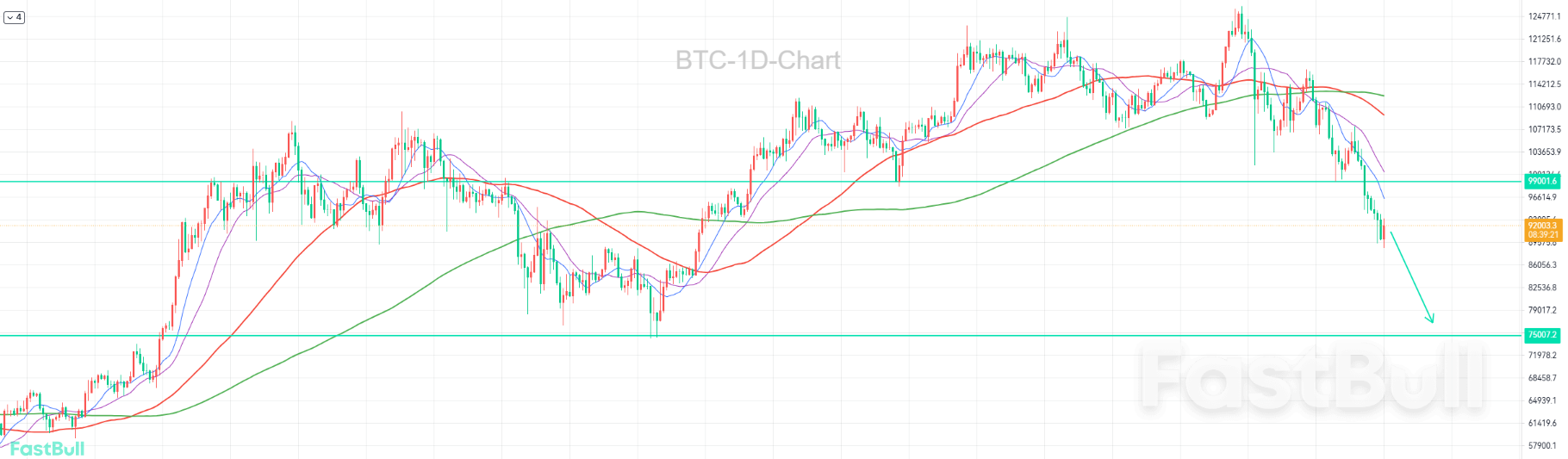
          Based on the daily chart, Bitcoin broke below the key support level of $99,000 last Friday, opening up further downside potential. The first major downside target may be around the $75,000 support level. Moreover, the continued downward trend over recent trading sessions indicates that bearish sentiment currently dominates the overall market.
          At present, the key resistance zone is around $95,000. If Bitcoin fails to hold firmly above this area, it will be difficult for bulls to regain control in the short term. The near-term support zone lies between $86,500, and a break below that could see the next historical buying zone near $80,000 reactivated. Trading volumes have expanded during declines but remained weak during rebounds, suggesting that current rallies are more likely to be technical pullbacks after forced liquidations, rather than signs of sustained buying by capital inflows.

          Trading Recommendations

          Trading direction: Sell
          Entry price: 92300
          Target price: 78000
          Stop loss: 96000
          Valid Until: December 04, 2025, 23:00:00
          Support: 88611/75000
          Resistance: 95000/99000
          Risk Warnings and Disclaimers
          You understand and acknowledge that there is a high degree of risk involved in trading. Following any strategies or investment methods may lead to potential losses. The content on the site is provided by our contributors and analysts for information purposes only. You are solely responsible for determining whether any trading assets, securities, strategy, or any other product is suitable for investing based on your own investment objectives and financial situation.
          Add to Favorites
          Share

          Dollar Surges! EURUSD Faces Major Challenge?

          Tank

          Forex

          Technical Analysis

          Summary:

          The primary reason for the EURUSD's decline is the strengthening of the U.S. dollar, which has outperformed other major currencies as market expectations for a rate cut at the Federal Reserve's December monetary policy meeting have diminished.

          SELL EURUSD
          Close Time
          CLOSED

          1.15179

          Entry Price

          1.12000

          TP

          1.17500

          SL

          1.16529 +0.00103 +0.09%

          11.9

          Pips

          Profit

          1.12000

          TP

          1.15060

          Exit Price

          1.15179

          Entry Price

          1.17500

          SL

          Fundamentals

          The Federal Reserve's dovish outlook has softened, leading to a decline in investor risk appetite and putting downward pressure on the euro. The latest harmonized Consumer Price Index (CPI) data for the Eurozone indicates that overall inflation increased month-on-month from 0.1% in September to 0.2% in October, while the annual growth rate slowed slightly from 2.2% to 2.1%, edging closer to the European Central Bank's (ECB) 2% target. Core inflation rose to 0.3% month-on-month but remained stable at 2.4% year-on-year. These figures send an intriguing signal: after energy and certain commodity prices stabilized, overall Eurozone inflationary pressures continue to ease, while services and core components maintain moderate stickiness. This combination neither justifies new monetary tightening nor compels the ECB to rapidly shift towards aggressive easing, aligning more with a neutral, dovish stance of maintaining restrictive rates over the medium term while remaining prepared to respond to economic downturns. For the euro, this implies limited carry trade advantages and a lack of clear support from interest rate expectations. Looking ahead, the euro will be influenced by the HCOB preliminary purchasing managers' index (PMI) data for November, which is scheduled for release on Friday.
          Recent movements in the EURUSD exchange rate are influenced less by fundamental factors such as interest rates and inflation, and more by the cumulative effects of macroeconomic developments and risk sentiment. On one hand, market expectations for Federal Reserve rate cuts in December have diminished, with CME FedWatch indicating the probability of a 25-basis-point reduction to 3.50%-3.75% dropping from 50.1% to 32.8%. A month ago, the market overwhelmingly anticipated a rate cut, with probabilities as high as 96%. On the other hand, recent global equity market sell-offs have reinforced risk aversion. In an environment of waning risk appetite, the U.S. dollar, traditionally perceived as a safe-haven currency, has attracted capital inflows. Investors have reduced holdings in equities and certain high-risk assets, reallocating funds into cash and highly liquid instruments. This "risk-averse dollar buying" often temporarily offsets the negative impact of weakening rate expectations, enabling the U.S. Dollar Index to remain robust at high levels and causing the euro to retreat below the 1.16 level amid consolidation. Structural changes within the U.S. macroeconomic fundamentals indicate that weak employment data is somewhat constraining the outlook for consumer spending, real estate, and the service sector. Conversely, August factory orders posted a month-on-month increase of 1.4%, aligning with market expectations and partially offsetting the previous 1.3% decline. Manufacturing demand has not experienced a sharp slowdown but is instead exhibiting a pattern of "gradual deceleration amid volatility." This structural composition causes the Federal Reserve to adopt a data-dependent approach to policy, refraining from issuing a clear easing timeline. Some officials emphasize the need for additional data to determine the next policy direction, which to some extent suppresses market expectations for rapid rate cuts and limits downside potential for the U.S. dollar.

          Technical Analysis

          In the 1D timeframe, following a MACD golden cross, the MACD line and signal line have retracted towards the zero-axis, indicating potential trend reversal signals. The Bollinger Bands are opening downward, with SMAs diverging downward, and the price is oscillating along the EMA12. A significant bearish candlestick was observed yesterday, with RSI at 39, reflecting increasing market pessimism. Current price action remains within the descending channel; unless the upper boundary is broken, a retest of the lower Bollinger Band around 1.148 is likely. In the 1W timeframe, Bollinger Bands are converging narrowly, EMA 12 is turning downward, and following the MACD death cross, the MACD line and signal line are retuning toward the zero-axis with some distance remaining, suggesting the downtrend may not be complete. RSI at 49 shows a gradual decline in highs, indicating strong market caution. Short-term support levels are positioned near the lower/middle Bollinger Band and EMA50. It is recommended to go short at the highs in the short term.
          Dollar Surges! EURUSD Faces Major Challenge?_1Dollar Surges! EURUSD Faces Major Challenge?_2

          Trading Recommendations

          Trading Direction: Sell
          Entry Price: 1.152
          Target Price: 1.12
          Stop Loss: 1.175
          Support: 1.145, 1.14, 1.12
          Resistance: 1.182, 1.192, 1.2
          Risk Warnings and Disclaimers
          You understand and acknowledge that there is a high degree of risk involved in trading. Following any strategies or investment methods may lead to potential losses. The content on the site is provided by our contributors and analysts for information purposes only. You are solely responsible for determining whether any trading assets, securities, strategy, or any other product is suitable for investing based on your own investment objectives and financial situation.
          Add to Favorites
          Share

          NFP Release! Bullish or Bearish for Gold?

          Tank

          Forex

          Commodity

          Summary:

          Diminished expectations for another Fed rate cut have lifted the U.S. dollar to its highest level since late May, a headwind for non-yielding bullion.

          SELL XAUUSD
          Close Time
          CLOSED

          4064.67

          Entry Price

          3600.00

          TP

          4390.00

          SL

          4200.19 +2.28 +0.05%

          1792.8

          Pips

          Loss

          3600.00

          TP

          4243.95

          Exit Price

          4064.67

          Entry Price

          4390.00

          SL

          Fundamentals

          The Central Bank of Russia is no longer content with token additions to its gold reserves. It has launched a full-scale offensive, sweeping up every good-delivery bar the domestic market can furnish. In a world where sanction-bound reserves are immobilised, dollar assets are frozen, and geopolitics is redrawing the global map, the Kremlin has concluded that the only balance-sheet item still capable of crossing borders unhindered is bullion.
          Behind the headlines lies far more than Moscow's well-worn mantra of "buy gold, dump dollars". The liquidity dynamics of the Russian gold market have quietly shifted, enabling the central bank to scale its operations to levels that would have been operationally impossible only a few years ago. This is not a publicity stunt. It is a structural inflection point that is injecting fresh momentum into a market already primed by fear, fiscal deficits and the accelerating dedollarisation narrative.
          For years, thin on-shore liquidity stymied sustained accumulation. Despite ranking as the world's second-largest producer, Russian miners could sell only at the pace the domestic clearing system could absorb. Sanctions severed the international outlet, yet—perversely—they have also forced the ecosystem to mature.
          The turnover rate has already reached a level at which the central bank can execute matched CNY-and-gold transactions to rotate assets for the National Wealth Fund with the same precision a liability-driven-investment (LDI) portfolio manager uses to fine-tune duration and collateral mix. The crux is that the North-West financial architecture—currently weighted around 60% RMB and 40% monetary gold—now functions as a fiscal shock absorber for the federal budget deficit in Moscow. Every uptick in the global gold price therefore not only swells the reserve base but also expands the rouble liquidity envelope that can be tapped without touching the sovereign's frozen Western assets. A higher mark-to-market valuation translates directly into a wider political option set. In short, Russia is not merely accumulating bullion—it has re-engineered its entire reserve framework around gold as the core asset.
          While headlines focus on the $300+ billion of Russian reserves immobilised abroad, inside Russia the bullion that has been freed from domestic vaults is being monetised in real time to fund military spending. For global traders this distinction is critical. A top-three producer has been severed from the international financial system, its policy reaction function reshaped by sanctions, domestic rouble liquidity ballooning, and its reserve-management office now treating gold as an operational instrument rather than a macro hedge. When a central bank sitting on almost $720 bn of reserves (including frozen assets) concludes that only physical gold is a "clean" settlement asset, the resulting flow becomes a structural bid that cannot be ignored. It is a slow-motion but powerful source of demand that is appearing just as the other drivers of gold—declining real yields, brittle geopolitics and the steady de-dollarisation wave—are already repricing the metal to a new equilibrium. In effect, Russia has become a price-insensitive, forced buyer of its own output.
          China is accumulating quietly but at scale. The Global South continues to add. Western portfolios remain structurally under-weight. Each time the market tries to declare gold "soft", another sovereign reminds participants that, in a fragmented monetary architecture, the gold is the only asset that cannot be frozen. That is why dips are shallow and why any window of weakness is instantly filled by physical offtake. Gold is no longer merely a trade. It is becoming the settlement medium of a world in which trust is evaporating faster than liquidity.
          The recent U.S. federal-government shutdown delayed the release of key employment reports, amplifying macro uncertainty and complicating the Fed's assessment of labor-market conditions. That dynamic has, in turn, lifted demand for safe-haven assets such as gold. Investors will scrutinize the belated September non-farm payroll (NFP) release for evidence of the labor market's underlying health and for clearer guidance on the U.S. rate trajectory. A print below consensus would raise the probability of a December rate cut and thereby provide additional upside to bullion; lower policy rates reduce the opportunity cost of holding a non-yielding asset. Conversely, a diminution in near-term easing expectations would exert downward pressure on gold prices.
          The minutes of the Federal Open Market Committee's October 28–29 meeting revealed that Fed officials were divided and cautious about the future path of interest rates. Although the Committee ultimately decided to cut the policy rate by 25 bp, the decision was not unanimous. Some participants leaned against an additional reduction at the December meeting. According to the CME FedWatch Tool, the market now assigns a roughly 30% probability to a rate cut next month, down from about 60% a week earlier.

          Technical Analysis

          The Bollinger Bands on the 4-hour chart are contracting, with bandwidth narrowing significantly. After a brief break above the psychological 4,100 level, the gold price met strong resistance and reversed. The short-term downtrend remains intact. The MACD is on the verge of forming a bearish crossover. Both the fast and slow lines have pulled back to the zero axis, raising the probability of a sudden directional shift. RSI reads 45, reflecting pronounced bearish sentiment. Immediate resistance is at 4,100, followed by 4,150.
          Daily Time Frame:
          On the daily chart, the MACD histogram's upward momentum is visibly waning while price has failed to print a higher high—classic bearish divergence. The probability of a continued pullback is elevated. Downside support rests first at the lower Bollinger Band (3,878) and then at the EMA50 (3,956). RSI sits at 52, placing price in a wait-and-see zone, but successive lower highs reinforce the bearish bias.
          Therefore, traders are recommended to take a strategy of selling into rallies.
          NFP Release! Bullish or Bearish for Gold?_1NFP Release! Bullish or Bearish for Gold?_2

          Trade Recommendations

          Trade Direction: Sell
          Entry Price: 4070
          Target Price: 3600
          Stop Loss: 4390
          Support: 3900/3800/3600
          Resistance Levels: 4380/4500/5000
          Risk Warnings and Disclaimers
          You understand and acknowledge that there is a high degree of risk involved in trading. Following any strategies or investment methods may lead to potential losses. The content on the site is provided by our contributors and analysts for information purposes only. You are solely responsible for determining whether any trading assets, securities, strategy, or any other product is suitable for investing based on your own investment objectives and financial situation.
          Add to Favorites
          Share

          Technical Indicators Suggests Bitcoin Reversal is Imminent

          Manuel

          Cryptocurrency

          Summary:

          If this technical pattern repeats, it could signal a strong bullish rebound from this current zone.

          BUY BTC-USDT
          Close Time
          CLOSED

          91556.0

          Entry Price

          107000.0

          TP

          82000.0

          SL

          90942.5 +1387.7 +1.55%

          9556.0

          Pips

          Loss

          82000.0

          SL

          82000.0

          Exit Price

          91556.0

          Entry Price

          107000.0

          TP

          A sharp sell-off in the cryptocurrency market has triggered a liquidation cascade, soaring past $100 million in a single 60-minute period as the price of Bitcoin (BTC) breached a critical psychological threshold.
          Bitcoin retreated to a low of $89,037 shortly before 1:00 PM (Eastern Time), extending the bearish action seen over the past few days. This represents a 4% drop on the day and a cumulative loss of 12.3% for the week, according to CoinGecko data. With Bitcoin piercing the psychologically significant $90,000 level, the overall sentiment across the crypto market has plunged into "Extreme Fear," as measured by the Crypto Fear and Greed Index.
          Major digital currencies are facing pronounced setbacks in the current session. Ethereum (ETH), XRP, and Dogecoin (DOGE) have all fallen by more than 7% over 24 hours. ETH, the second-largest cryptocurrency by market capitalization, is trading hands around $2,900, while Solana (SOL) has slipped 6% toward the $131 mark.
          In significant industry news, crypto exchange Kraken, one of the sector's most venerable platforms, has confidentially filed paperwork for an Initial Public Offering (IPO) in the United States. This strategic move occurs during a year marked by a boom in crypto-industry listings, fueled in part by a seemingly friendlier regulatory environment for the sector under the current administration.
          Kraken, founded in 2011, has been operational longer than many of its peers and has hinted for years at its plans to become a publicly traded company on the U.S. market. The company now offers a comprehensive product suite that spans over 450 digital assets, U.S. futures, stocks, Exchange Traded Funds (ETFs), and institutional services. Its recent valuation soared to $20 billion after its most recent funding round, reflecting a remarkable 33% increase in less than two months.
          In a strong indication of its ambitious vision to transform into an "exchange of everything," Coinbase appears to be developing early-stage features to integrate prediction markets and tokenized stock trading directly into its mobile application. Independent analysis of the app's code has uncovered testing interfaces that suggest the cryptocurrency platform is working toward becoming a multifaceted hub, allowing users access to diverse markets through a single, unified interface.
          This revelation stems from detailed scrutiny performed by independent researcher Jane Manchun Wong, who decompiled publicly available Coinbase app code and shared screenshots on X (formerly Twitter). According to Wong, the app displays tabs labeled "Stocks" and "Predictions," alongside regulatory disclosures suggesting integration with Kalshi, a U.S.-regulated prediction market operator. One explicit fine-print note, according to coverage, states: "Prediction markets are offered by Coinbase Financial Markets through KalshiEX LLC."Technical Indicators Suggests Bitcoin Reversal is Imminent_1

          Technical Analysis

          The BTC/USD pair rapidly declined amid the liquidation cascade, dropping to the $88,700 level. This price point is historically significant: on two prior occasions, price action briefly touched this region (back in December of last year) before mounting a sharp reversal. If this technical pattern repeats, it could signal a strong bullish rebound from this current zone. A key technical indicator bolstering this outlook is the Relative Strength Index (RSI), which plunged to 21.79 on the daily chart —levels not seen at any point during this year—a condition that typically encourages buyers to step in and take control.
          The 100-period and 200-period Moving Averages (MAs) are positioned around $111,093 and $110,305, respectively, indicating that the medium-term average price sits near the $110,000 mark. A potential upward correction could be drawn toward the vicinity of these MAs. The nearest major resistance is located at $107,400, suggesting that the price and the moving averages could converge near this zone during an initial upswing. However, a new wave of selling pressure and a decisive break below the current local low would invalidate this bullish setup, opening the path for a deeper and more significant correction.
          Trading Recommendations
          Trading direction: Buy
          Entry price: 91350
          Target price: 107000
          Stop loss: 82000
          Validity: Dec 02, 2025 15:00:00
          Risk Warnings and Disclaimers
          You understand and acknowledge that there is a high degree of risk involved in trading. Following any strategies or investment methods may lead to potential losses. The content on the site is provided by our contributors and analysts for information purposes only. You are solely responsible for determining whether any trading assets, securities, strategy, or any other product is suitable for investing based on your own investment objectives and financial situation.
          Add to Favorites
          Share

          BOJ and the Government Struggle to Stabilize the Exchange Rate Through Coordination, and the Japan-U.S. Interest Rate Differential Will Continue to Drive Market Direction

          Eva Chen

          Forex

          Summary:

          The Bank of Japan governor signaled that the path for interest rate hikes remains unchanged, yet the yen struggles to attract buyers; under the uncertainty surrounding the central bank, the yen appears highly vulnerable.

          BUY USDJPY
          Close Time
          CLOSED

          155.798

          Entry Price

          161.060

          TP

          152.500

          SL

          154.902 -0.443 -0.29%

          49.0

          Pips

          Loss

          152.500

          SL

          155.308

          Exit Price

          155.798

          Entry Price

          161.060

          TP

          Fundamentals

          Bank of Japan Governor Kazuo Ueda stated after his first bilateral meeting with Prime Minister Sanae Takaichi that the central bank remains committed to gradually adjusting the pace of monetary easing, signaling its firm intent to raise interest rates.
          Kazuo Ueda told reporters after the meeting: “The mechanism where inflation and wages rise in tandem is recovering. Therefore, I explained to the Prime Minister that we are gradually adjusting the scale of monetary easing.”
          This meeting comes as investors focus on Sanae Takaichi's stance on monetary policy and await details of the economic stimulus plan to be released this week. Kazuo Ueda stated, “We discussed foreign exchange issues. The central bank will closely monitor its impact on the economy while working closely with the government.” He also emphasized that the Bank of Japan will make appropriate policy decisions based on economic data.
          Market Watch: Despite the Bank of Japan's recent “resolute” stance on monetary policy, the yen continues to depreciate. This trend stems from multiple structural factors, policy divergences, and market expectations.
          Previously, although Japan's policy interest rates had been raised, they remained at exceptionally low levels. For instance, as of now, the Bank of Japan's benchmark interest rate stands at approximately 0.50%, while major economies like the U.S. maintain significantly higher rates. The yield on 10-year U.S. Treasury bonds has even reached around 4%.
          Interest rates directly influence capital flows. When the yield on dollar-denominated assets significantly exceeds that of yen-denominated assets, investors tend to allocate funds toward dollar assets, thereby selling yen and buying dollars.
          The interest rate differential between Japan and the U.S. is a key driver behind the JPYUSD's depreciation. Consequently, even though the Bank of Japan appears “resolute,” its policy remains relatively accommodative with low interest rates, making it difficult for the yen to benefit from the interest rate differential advantage.
          BOJ and the Government Struggle to Stabilize the Exchange Rate Through Coordination, and the Japan-U.S. Interest Rate Differential Will Continue to Drive Market Direction_1

          Technical Analysis

          On Wednesday, the USDJPY rally remains intact with an upward bias for the day. A break above the 100% retracement level of 156.05, located between 146.58 and 153.26, would pave the way for testing resistance at 158.85. Currently, as long as the 153.60 support level holds, the outlook remains bullish even if a pullback occurs.
          From a broader perspective, the current price action indicates that the corrective pattern originating from 161.94 (2024 high) has completed at 139.87, forming a three-wave structure. The larger uptrend dating back to 102.58 (2021 low) may be poised to resume, with potential to break above the 161.94 high.
          On the downside, a break below the 149.37 support level would undermine this bullish outlook and lead to the continuation of the corrective pattern, forming a new wave of decline.

          Trading Recommendations

          Trading Direction: Buy
          Entry Price: 155.80
          Target Price: 161.06
          Stop Loss: 152.50
          Valid Until: December 4, 2025 23:55:00
          Support: 154.78, 153.66, 152.88
          Resistance: 155.89, 156.78, 158.91
          Risk Warnings and Disclaimers
          You understand and acknowledge that there is a high degree of risk involved in trading. Following any strategies or investment methods may lead to potential losses. The content on the site is provided by our contributors and analysts for information purposes only. You are solely responsible for determining whether any trading assets, securities, strategy, or any other product is suitable for investing based on your own investment objectives and financial situation.
          Add to Favorites
          Share

          GBP/USD Faces Pressure as UK Price Growth Eases and Rate Cut Odds Surge

          Warren Takunda

          Traders' Opinions

          Summary:

          GBP/USD drifts lower as UK inflation softens, boosting expectations for a Bank of England rate cut ahead of the Autumn Budget. U.S. labor market data and upcoming Fed commentary add potential volatility.

          SELL GBPUSD
          Close Time
          CLOSED

          1.30800

          Entry Price

          1.28600

          TP

          1.32300

          SL

          1.33392 +0.00080 +0.06%

          11.4

          Pips

          Profit

          1.28600

          TP

          1.30686

          Exit Price

          1.30800

          Entry Price

          1.32300

          SL

          GBP/USD modestly retreated on Wednesday, following the release of UK inflation data for October that underscored a slowdown in consumer price growth. At the time of writing, the pair was trading at 1.3120, having peaked earlier at 1.3154, as investors digested the latest economic signals that may influence the Bank of England’s (BoE) policy stance.
          According to the Office for National Statistics (ONS), the UK Consumer Price Index (CPI) eased to 3.6% year-on-year in October from 3.8% in September, broadly in line with market expectations. Core CPI, which strips out volatile food and energy components, also ticked down to 3.4% from 3.5% — marking its lowest reading since March. The softening inflation data prompted a retreat in sterling, as market participants increasingly priced in a potential BoE rate cut at the central bank’s upcoming December meeting.
          Money market instruments suggest an 85% probability of a 25-basis-point rate reduction, according to London Stock Exchange data. Analysts point out that the decline in CPI reflects persistent challenges in the UK economy, with consumer spending under pressure and inflationary pressures moderating. The release of Chancellor Rachel Reeves’ Autumn Budget on November 26 is expected to be a key near-term catalyst, with sterling potentially vulnerable to fiscal policy announcements that could influence market sentiment.
          Meanwhile, U.S. data provided a mixed backdrop for global risk sentiment. Initial Jobless Claims for the week ending October 18 rose to 232,000, yet the market reaction was muted. Attention has shifted toward Thursday’s Nonfarm Payroll report for September, with consensus estimates suggesting an increase of 50,000 jobs, up from August’s revised 22,000. Traders are also awaiting updates on retail activity and durable goods orders, with the U.S. Census Bureau scheduled to release September data next week.
          Investor focus remains sharply on the Federal Reserve as well, with anticipated commentary from Governor Stephen Miran and regional Fed Presidents John Williams and Thomas Barkin expected to provide guidance on the trajectory of U.S. monetary policy. The combination of muted U.S. labor market signals and UK inflation trends may contribute to heightened volatility in GBP/USD ahead of these events.
          Technical AnalysisGBP/USD Faces Pressure as UK Price Growth Eases and Rate Cut Odds Surge_1
          On the technical front, GBP/USD faced renewed selling pressure during intraday trading. The pair fell below its 50-day exponential moving average (EMA50), breaking the bullish corrective trend line that had previously supported price action. This shift has intensified negative momentum, reinforced by the return of bearish signals on the relative strength index (RSI) after clearing oversold conditions.
          If the pair fails to reclaim the EMA50 zone, further downside targets appear likely. Key support levels are identified at 1.3040, 1.3000, and the major support zone at 1.2860. A sustained move below these levels could confirm a broader bearish phase, aligning with market expectations of a potential BoE easing cycle.

          TRADE RECOMMENDATION

          SELL GBPUSD
          ENTRY PRICE: 1.3080
          STOP LOSS: 1.3230
          TAKE PROFIT: 1.2860
          Risk Warnings and Disclaimers
          You understand and acknowledge that there is a high degree of risk involved in trading. Following any strategies or investment methods may lead to potential losses. The content on the site is provided by our contributors and analysts for information purposes only. You are solely responsible for determining whether any trading assets, securities, strategy, or any other product is suitable for investing based on your own investment objectives and financial situation.
          Add to Favorites
          Share

          Gold Extends Rebound as Risk-Off Mood Deepens Ahead of Nvidia Earnings and Fed Signals

          Warren Takunda

          Economic

          Summary:

          Gold climbs to $4,113 as global risk-off sentiment strengthens, supported by safe-haven flows ahead of Nvidia earnings, FOMC minutes and the delayed NFP report. Fed uncertainty continues to limit upside momentum.

          BUY XAUUSD
          Close Time
          CLOSED

          4119.81

          Entry Price

          4250.00

          TP

          4010.00

          SL

          4200.19 +2.28 +0.05%

          107.9

          Pips

          Profit

          4010.00

          SL

          4130.60

          Exit Price

          4119.81

          Entry Price

          4250.00

          TP

          Gold extended its recovery on Wednesday, rising toward the $4,113 level as a renewed wave of risk aversion rippled through global markets, prompting investors to rotate back into defensive assets. The metal gained nearly 1% intraday after holding firm above $4,000—a crucial psychological zone that once again acted as a strong support during Tuesday’s dip. The rebound highlights the market’s persistent inclination to treat gold as a volatility shield whenever sentiment begins to fracture.
          The broader risk environment has deteriorated meaningfully this week as concerns about stretched technology valuations continue to dominate market discussions. Investors remain increasingly cautious ahead of Nvidia’s earnings, which have become a litmus test for the entire AI-driven equity narrative. With global indices under pressure and traders questioning whether the tech rally has reached an unsustainable inflection point, the appetite for safe-haven allocations has grown steadily stronger. In my view, the current pullback in equities is less a sign of panic and more an early form of risk hedging as markets brace for a potentially pivotal week in macroeconomic data.
          The cautious tone has been amplified by anticipation surrounding the Federal Open Market Committee (FOMC) Meeting Minutes due later in the day. Markets are eager to gauge the internal dynamics of the September policy debate, particularly as Federal Reserve officials have recently shown signs of diverging views regarding the need for further rate cuts. At the same time, traders are preparing for the delayed September Nonfarm Payrolls report scheduled for Thursday. The unusual delay has only intensified the market’s sensitivity to the release, with both bulls and bears unwilling to take aggressive positions ahead of the print. The labour market’s trajectory remains one of the most important missing pieces in the Federal Reserve’s evolving narrative, and gold is reacting accordingly as uncertainty builds.
          Despite the uptick in safe-haven flows, gold’s upside potential remains naturally constrained by shifting interest-rate expectations. Several Fed policymakers have pushed back against the prospect of a December rate cut, arguing that inflation progress remains incomplete, even as cracks appear in pockets of the labour market. This mixture of lingering price pressures and mild employment softening has produced an environment in which policymakers appear more divided than they have been in months. As a result, traders have scaled back expectations for imminent rate cuts, reinforcing a “higher for longer” backdrop that tends to place a ceiling on gold’s near-term rallies. In my assessment, the metal is now entering a phase where sentiment-driven volatility may overshadow fundamental conviction, making gold’s path forward less linear and more reactive to incremental data surprises.

          Technical AnalysisGold Extends Rebound as Risk-Off Mood Deepens Ahead of Nvidia Earnings and Fed Signals_1

          On the technical front, gold’s upward push has been reinforced by a firm break above the $4,100 level, with price action now comfortably trading above the 50-day exponential moving average. This move has aligned price with a minor short-term bullish trend, suggesting that momentum remains favourable for the bulls. Momentum indicators have shown the emergence of positive signals as well, although they have already reached overbought territory. This raises the possibility that upside progression may slow or temporarily pause before the next leg higher. However, in strong trending markets, overbought conditions are not always a precursor to a pullback; rather, they can signal underlying strength among buyers who remain willing to step in on modest dips.
          The immediate technical landscape points toward potential extensions toward $4,160 and then $4,250 if buyers maintain control. A sustained daily close above $4,160 would strengthen the bullish case and open the door for a larger continuation phase targeting the upper ranges of the recent trend. Conversely, failure to hold above the $4,100 zone may expose gold to corrective pressures, particularly if Nvidia’s earnings surprise positively and help restore appetite for high-growth equities. Such a shift could briefly weaken the safe-haven narrative and trigger profit-taking among short-term traders.

          TRADE RECOMMENDATION

          BUY GOLD
          ENTRY PRICE: 4120
          STOP LOSS: 4010
          TAKE PROFIT: 4250
          Risk Warnings and Disclaimers
          You understand and acknowledge that there is a high degree of risk involved in trading. Following any strategies or investment methods may lead to potential losses. The content on the site is provided by our contributors and analysts for information purposes only. You are solely responsible for determining whether any trading assets, securities, strategy, or any other product is suitable for investing based on your own investment objectives and financial situation.
          Add to Favorites
          Share
          FastBull
          Copyright © 2025 FastBull Ltd

          728 RM B 7/F GEE LOK IND BLDG NO 34 HUNG TO RD KWUN TONG KLN HONG KONG

          TelegramInstagramTwitterfacebooklinkedin
          App Store Google Play Google Play
          Products
          Charts

          Chats

          Q&A with Experts
          Screeners
          Economic Calendar
          Data
          Tools
          Membership
          Features
          Function
          Markets
          Copy Trading
          Latest Signals
          Contests
          News
          Analysis
          24/7
          Columns
          Education
          Company
          Careers
          About Us
          Contact Us
          Advertising
          Help Center
          Feedback
          User Agreement
          Privacy Policy
          Business

          White Label

          Data API

          Web Plug-ins

          Poster Maker

          Affiliate Program

          Risk Disclosure

          The risk of loss in trading financial instruments such as stocks, FX, commodities, futures, bonds, ETFs and crypto can be substantial. You may sustain a total loss of the funds that you deposit with your broker. Therefore, you should carefully consider whether such trading is suitable for you in light of your circumstances and financial resources.

          No decision to invest should be made without thoroughly conducting due diligence by yourself or consulting with your financial advisors. Our web content might not suit you since we don't know your financial conditions and investment needs. Our financial information might have latency or contain inaccuracy, so you should be fully responsible for any of your trading and investment decisions. The company will not be responsible for your capital loss.

          Without getting permission from the website, you are not allowed to copy the website's graphics, texts, or trademarks. Intellectual property rights in the content or data incorporated into this website belong to its providers and exchange merchants.

          Not Logged In

          Log in to access more features

          FastBull Membership

          Not yet

          Purchase

          Become a signal provider
          Help Center
          Customer Service
          Dark Mode
          Price Up/Down Colors

          Log In

          Sign Up

          Position
          Layout
          Fullscreen
          Default to Chart
          The chart page opens by default when you visit fastbull.com