- AUDUSD
- XAUUSD
- XAGUSD
- WTI
- USDX


Markets
Analysis
User
24/7
Economic Calendar
Education
Data
- Names
- Latest
- Prev













A low price-to-book ratio can reflect weak returns on equity rather than a bargain. Rebuild the equity account, calculate the capital charge and test what the market price assumes.
A share trades at 16 while its reported book value is 20. The apparent discount is 20%. That arithmetic says nothing yet about whether the share is cheap. If the capital tied up in the business persistently earns less than shareholders require, a price below book can be consistent with the economics.
Residual income valuation asks whether forecast profit pays for the equity used to generate it. It turns a price-to-book comparison into a test of profitability, capital allocation and the life of any excess return. The hard part is not entering the formula. It is making earnings, book value and distributions tell the same story.
For common shareholders, residual income in year t equals earnings attributable to common equity minus the required equity return r times opening common book value. Per share: RIₜ = Eₜ − rBₜ₋₁. Equity value is current book value plus discounted future residual income. Use an equity discount rate, not a debt yield or the weighted average cost of all capital.
Consider a hypothetical share with opening book value 20 and next-year earnings 1.60. At a 10% equity requirement the capital charge is 2.00, so residual income is −0.40 despite a positive accounting profit. This is an opportunity-cost comparison, not an extra cash invoice or a prediction of imminent insolvency. Conversely, positive residual income does not mean every cash distribution is affordable.
Now use a separate scenario: opening book value 20, annual earnings of 3.00, 2.80 and 2.60, and an annual dividend of 1.20. Assume constant shares, no new capital, no repurchases and no gains or losses bypassing the earnings measure. All amounts are per share in the same currency; flows occur at year-end. Book value therefore rolls forward as opening book value plus earnings minus the dividend.
| Year | Opening book value | Earnings | Dividend | Equity charge | Residual income | Closing book value |
|---|---|---|---|---|---|---|
| 1 | 20.00 | 3.00 | 1.20 | 2.00 | 1.00 | 21.80 |
| 2 | 21.80 | 2.80 | 1.20 | 2.18 | 0.62 | 23.40 |
| 3 | 23.40 | 2.60 | 1.20 | 2.34 | 0.26 | 24.80 |
At 10%, the present value of the three residual-income amounts is 1.00 / 1.10 + 0.62 / 1.10² + 0.26 / 1.10³ = 1.6168. If residual income becomes zero from year four onward, the value is 21.6168. That terminal assumption does not close the business: it says future earnings just cover the required return on the remaining equity.
The same assumptions imply a year-three terminal equity value equal to closing book value, 24.80. Discounting the three dividends plus that terminal value also gives 21.6168. This second calculation is a useful audit. If the answers differ, look for a mismatched book-value roll-forward, timing convention or terminal assumption before calling one model more conservative.
Suppose instead that year-four residual income is 0.26 and stays at that amount indefinitely. Its value at the end of year three is 0.26 / 10% = 2.60. Discount that additional excess-value component to today: 1.9534. Total value rises to 23.5702. The difference comes entirely from prolonging the advantage, not from changing any of the first three earnings forecasts.
Do not add the full terminal equity value on top of current book value and discounted residual income. In this framework the terminal addition is terminal equity value minus terminal book value. Adding both in full counts the retained capital twice. A constant 0.26 residual income also does not mean a constant percentage ROE as book value changes; earnings and payouts must be specified consistently.
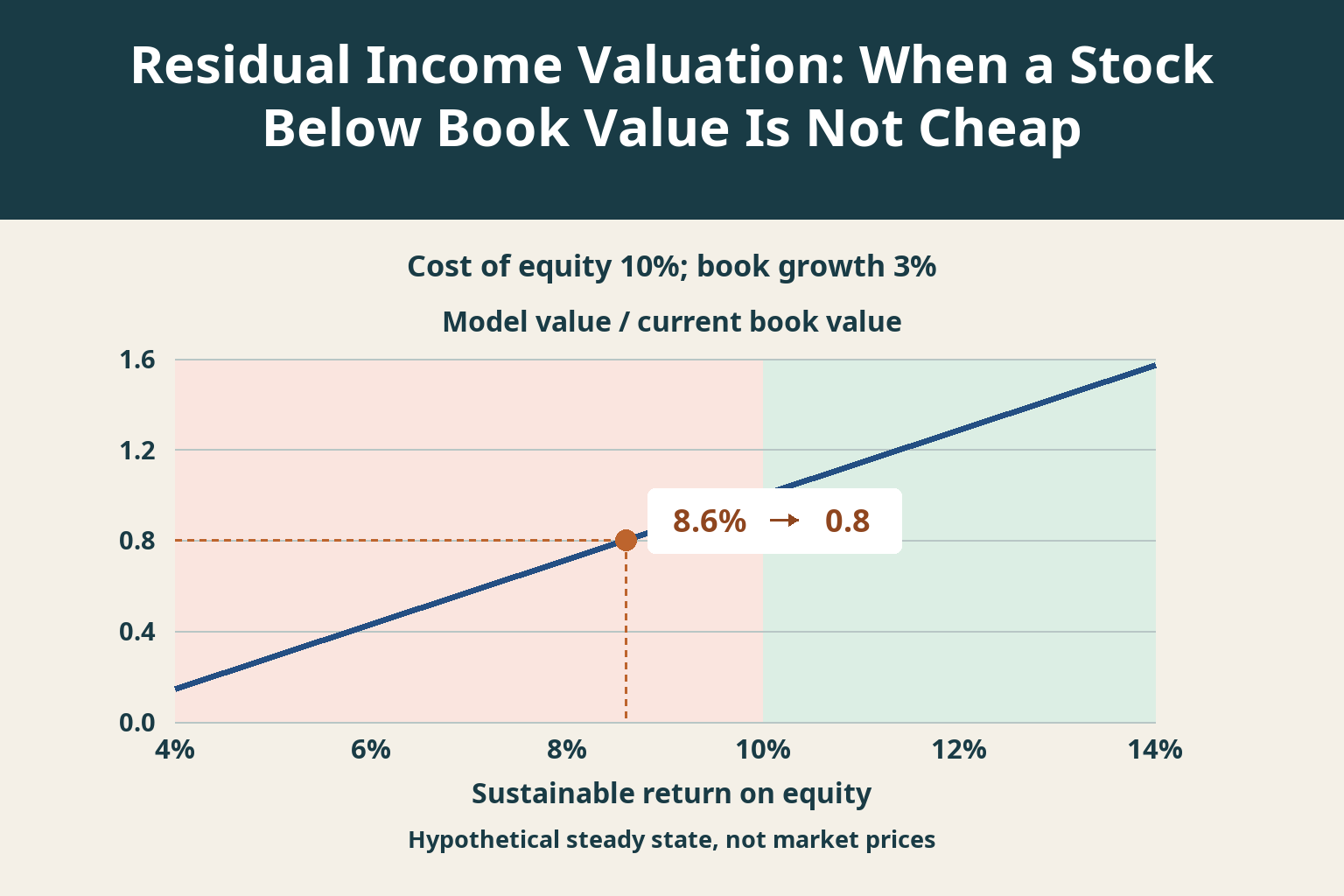
For a deliberately restrictive steady state, assume a constant ROE measured on opening book value, constant book-value growth g, unchanged shares, clean-surplus accounting and a constant equity requirement r greater than g. Retained earnings finance the growth. Under those conditions the model value-to-book ratio is (ROE − g) / (r − g). It is not a universal market rule.
Set r at 10% and g at 3%. A sustainable ROE of 8% implies a ratio of 0.7143, or value 14.2857 against book value 20. The company remains profitable. It retains 37.5% of earnings to grow book at 3%, leaving a first dividend of 1.00; 1.00 / (10% − 3%) gives the same value. A market price of 16 would sit above this scenario value despite the book discount.
Reverse the question. A price-to-book ratio of 0.8 implies ROE = 3% + 0.8 × (10% − 3%) = 8.6%, if every other steady-state assumption holds. The useful debate is then whether 8.6% is too pessimistic or too optimistic, and why. A higher growth assumption cannot automatically rescue a business whose reinvestment return stays below its equity cost.
Take common equity attributable to the same shareholders as the earnings numerator; do not silently include non-controlling interests or preferred capital. Trace opening equity to closing equity through earnings, distributions, capital transactions and other comprehensive income. An unexplained difference is a modeling warning, not a plug to hide in the terminal value.
Book value is an accounting starting point, not guaranteed liquidation proceeds. Impairments, internally generated intangible assets and fair-value movements can make comparisons misleading. A proposed adjustment must change the earnings or book-value path consistently. Removing an asset from book while keeping all of its projected income can manufacture excess returns.
Leverage can raise ROE and the risk borne by common equity at the same time. Do not hold r fixed merely to reward a higher ROE. Keep this equity-level test separate from the operating-capital question discussed in FastBull's analysis of ROIC and the cost of capital; the denominators and capital charges differ.
A book discount becomes informative only after its implied profitability has been tested. If normalized returns deteriorate, write-downs change the capital base or the required return rises, the apparent bargain may disappear without the share price moving at all.

728 RM B 7/F GEE LOK IND BLDG NO 34 HUNG TO RD KWUN TONG KLN HONG KONG





The risk of loss in trading financial instruments such as stocks, FX, commodities, futures, bonds, ETFs and crypto can be substantial. You may sustain a total loss of the funds that you deposit with your broker. Therefore, you should carefully consider whether such trading is suitable for you in light of your circumstances and financial resources.
No decision to invest should be made without thoroughly conducting due diligence by yourself or consulting with your financial advisors. Our web content might not suit you since we don't know your financial conditions and investment needs. Our financial information might have latency or contain inaccuracy, so you should be fully responsible for any of your trading and investment decisions. The company will not be responsible for your capital loss.
Without getting permission from the website, you are not allowed to copy the website's graphics, texts, or trademarks. Intellectual property rights in the content or data incorporated into this website belong to its providers and exchange merchants.
Not Logged In
Log in to access more features


Log In
Sign Up