- AUDUSD
- XAUUSD
- XAGUSD
- WTI
- USDX


Markets
Analysis
User
24/7
Economic Calendar
Education
Data
- Names
- Latest
- Prev







An equal-dollar hedge is not always the lowest-risk hedge. Recalculate a 48-contract example, test when a stale hedge increases volatility, and separate portfolio protection from margin cash needs.
A $10 million stock portfolio does not necessarily need $10 million of short index futures. If its fluctuations are larger than those of the futures contract, the lowest-variance position may require more futures notional than the portfolio is worth. But that same position can become an additional source of risk when the relationship changes.
The useful question is not whether a hedge looks balanced in dollars. It is how much of the portfolio’s movement the chosen contract can offset, over the period that matters, without creating a cash obligation the account cannot fund. A complete answer needs a hedge ratio, a contract count and a failure test.
Consider an existing long portfolio. Let V be its value at the start of the hedge and let h be short futures notional divided by V. Here a positive h means a short futures position. The portfolio return is rP; rF is the change in the futures quote divided by its starting quote. It is not the return on the margin posted.
rH = rP − h × rF
This is combined profit or loss divided by the initial portfolio value, for fixed holdings and fixed contract numbers over one measurement period. The simple model sets aside trading costs, financing, taxes and interim cash flows; those belong in the implementation assessment, not in a different denominator disguised as the same return.
The variance of that combined position is:
σH² = σP² + h²σF² − 2hρσPσF
Here σP and σF are standard deviations for the same horizon, and ρ is the correlation between the two synchronized return series. Minimizing this expression with respect to h gives:
h* = Cov(rP, rF) / Var(rF) = ρ × σP / σF
The ratio is a fitted sensitivity, closely related to beta and residual risk, not a promise about the next market move. Regress portfolio returns on futures returns, with an intercept; reversing the regression does not generally give the reciprocal hedge. A coefficient estimated against a cash index is not automatically the same as one estimated against the actual futures maturity.
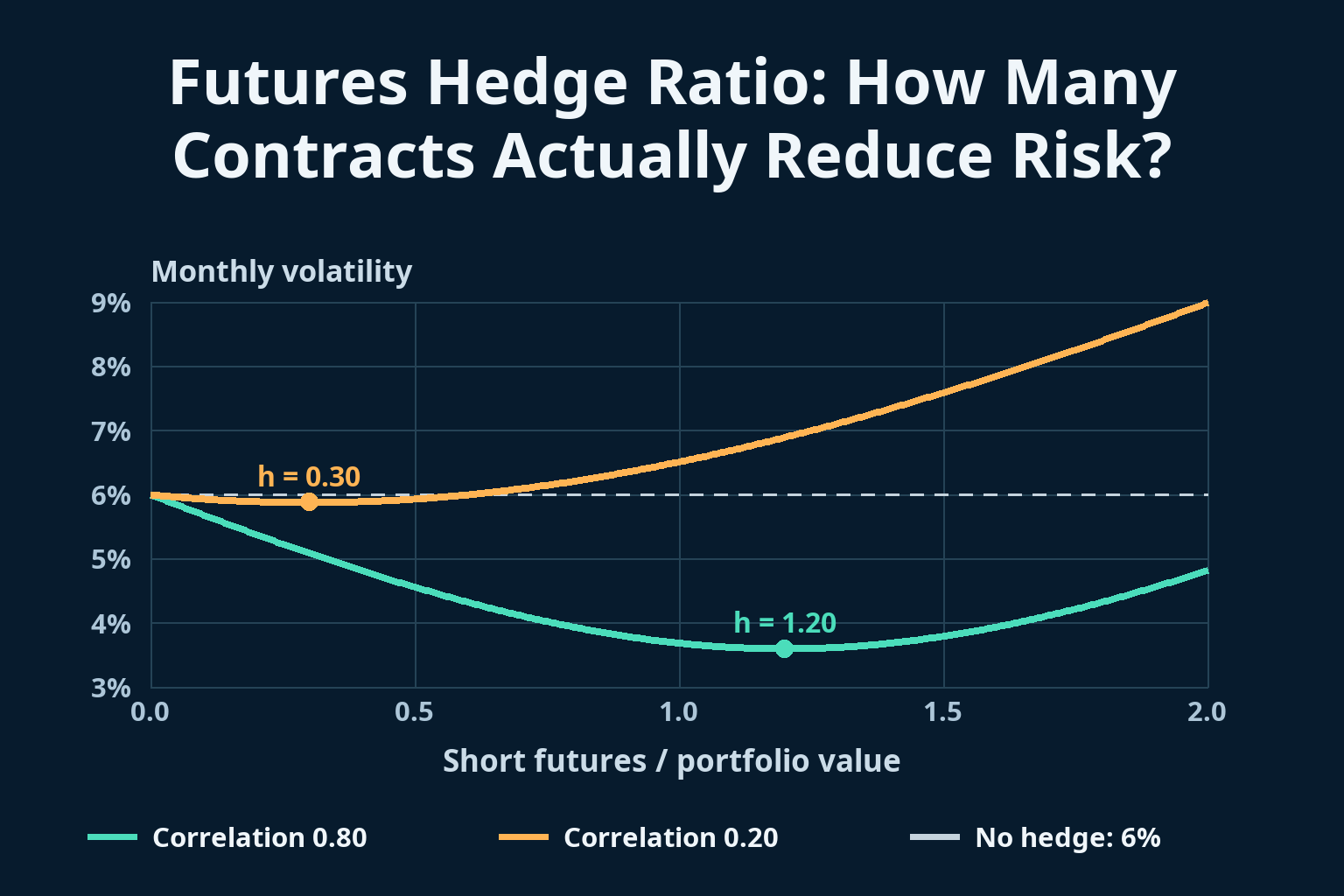
Use hypothetical monthly inputs: portfolio value $10 million, portfolio volatility 6%, futures volatility 4%, and correlation 0.80. Suppose the futures quote is 5,000 index points and the contract multiplier is $50 per point. These are teaching assumptions, not current prices or a claim about a specific portfolio.
h* = 0.80 × 6% / 4% = 1.20
Contract notional = 5,000 × $50 = $250,000
N = h* × V / contract notional = 1.20 × $10,000,000 / $250,000 = 48
The model therefore calls for 48 short contracts. Equal-dollar matching would use 40. That difference comes from the relationship between the two exposures, not from how much margin the broker collects. The table holds the 6% and 4% volatilities fixed and changes only the correlation and hedge size.
| Correlation | Hedge ratio h | Short contracts | Monthly volatility |
|---|---|---|---|
| 0.80 | 0.00 | 0 | 6.00% |
| 0.80 | 1.00 | 40 | 3.69% |
| 0.80 | 1.20 | 48 | 3.60% |
| 0.20 | 0.00 | 0 | 6.00% |
| 0.20 | 1.20 | 48 | 6.89% |
| 0.20 | 0.30 | 12 | 5.88% |
At correlation 0.80, the fitted hedge leaves 36% of the original variance: 1 − 0.80² = 0.36. Variance falls by 64%, while standard deviation falls from 6% to 3.60%, a 40% reduction. None of those figures means an 80% chance of protection, a maximum monthly loss of 3.60%, or elimination of company-specific risk.
The improvement over equal-dollar matching is modest here: 3.69% versus 3.60% monthly volatility. That is important economically. A small model advantage may not justify extra turnover, wider spreads or additional funding demands. “Optimal” means optimal for the stated variance objective and inputs, not superior under every practical constraint.
Now change correlation to 0.20 while leaving both volatility assumptions unchanged. Keeping 48 short contracts means h remains 1.20, but modeled monthly volatility rises to 6.89%—above the portfolio’s unhedged 6%. The newly fitted ratio is only 0.20 × 6% / 4% = 0.30, or 12 contracts, leaving volatility of 5.88%.
There is a useful diagnostic behind that reversal. For a fixed positive h, subtract unhedged variance from hedged variance. The hedge lowers variance only when:
ρ > hσF / (2σP)
For h = 1.20 and the assumed volatilities, the threshold is 0.40. At 0.40 there is no variance benefit; below it the old position adds variance. This is a conditional result of this model, not a universal correlation stop or an instruction to trade every time a rolling estimate crosses a line. If the volatility ratio changes, so does the threshold.
Nor does a low estimated correlation necessarily justify a smaller live hedge immediately. A short sample, stale equity prices or mismatched closing times can depress the estimate without changing the underlying economics. First determine whether the relationship has changed or the measurement has deteriorated. With negative covariance, the unconstrained solution can even call for long futures; blindly shorting a superficially similar contract is then the wrong sign.
Use the actual portfolio, valuation currency and hedge horizon. Align timestamps and adjust the portfolio series for external deposits, withdrawals and corporate actions. A daily estimate is not automatically valid for a one-month holding period. Longer horizons introduce serial dependence, changing holdings and different basis behavior.
The futures series must represent the contract and roll policy that could actually be traded. Do not feed an artificial roll jump from an unadjusted continuous chart into the covariance calculation as though it were a one-day holding return. Record maturity changes and realized roll costs separately. For commodity hedges estimated from price changes rather than percentage returns, the coefficient has a different unit: use physical exposure and contract units, not this article’s market-value scaling.
Fit the ratio in a training window, freeze it, and compare the resulting residual profit-and-loss variation in the next window with no hedge and equal-dollar matching. Inspect several economically defensible windows without simply selecting the best hindsight result. Sector concentration, acquisitions, currency exposure or a changed contract basis can invalidate an otherwise neat historical regression.
If the calculation produces a fractional number of contracts, evaluate the two neighboring integers with their actual h values. Include bid–ask spreads, commissions, roll costs, funding and any position constraints. Variance reduction and expected return are different outputs; a futures short gives up some upside as well as cushioning correlated declines. This statistical calculation also does not establish eligibility for hedge accounting.
Keep the 48-contract short and suppose the futures quote rises from 5,000 to 5,400. Cumulative futures settlement losses are 48 × 400 × $50 = $960,000. In a separate illustrative scenario, the stock portfolio rises 12%, producing a $1.2 million unrealized gain. Combined profit is $240,000 before costs, yet the futures account has still had to fund the settlement losses.
The unrealized equity gain is not automatically available as settlement cash. The $960,000 excludes initial margin, possible increases in required collateral and financing costs; an adverse move followed by a reversal can also create a larger interim cash need than the final net loss suggests. A low terminal variance is therefore not a liquidity plan.
Before implementation, a defensible review should produce five things:
The hedge is ready for a decision only when all five are consistent. A precise contract count cannot compensate for an unsuitable benchmark or an unfunded margin call.

728 RM B 7/F GEE LOK IND BLDG NO 34 HUNG TO RD KWUN TONG KLN HONG KONG





The risk of loss in trading financial instruments such as stocks, FX, commodities, futures, bonds, ETFs and crypto can be substantial. You may sustain a total loss of the funds that you deposit with your broker. Therefore, you should carefully consider whether such trading is suitable for you in light of your circumstances and financial resources.
No decision to invest should be made without thoroughly conducting due diligence by yourself or consulting with your financial advisors. Our web content might not suit you since we don't know your financial conditions and investment needs. Our financial information might have latency or contain inaccuracy, so you should be fully responsible for any of your trading and investment decisions. The company will not be responsible for your capital loss.
Without getting permission from the website, you are not allowed to copy the website's graphics, texts, or trademarks. Intellectual property rights in the content or data incorporated into this website belong to its providers and exchange merchants.
Not Logged In
Log in to access more features


Log In
Sign Up