


- XAUUSD
- XAGUSD
- WTI
- USDX



Markets
Analysis
User
24/7
Economic Calendar
Education
Data
- Names
- Latest
- Prev








 Economic Calendar

Reconstruct the January 2015 break in EUR/CHF from official reference rates, then use the same prices to compare routine volatility, stop-based loss and loss under a change in central-bank policy.
When a central bank defends an exchange-rate floor, recent volatility measures how the pair has moved under that policy. It gives little information about how far the exchange rate might move if the defence ends. In the 30 published EUR/CHF reference-rate changes through 14 January 2015, the biggest absolute move was 0.35%. The next published change was a 14.40% fall. A risk check that keeps those two conditions separate can show how much exposure sits behind a quiet chart.
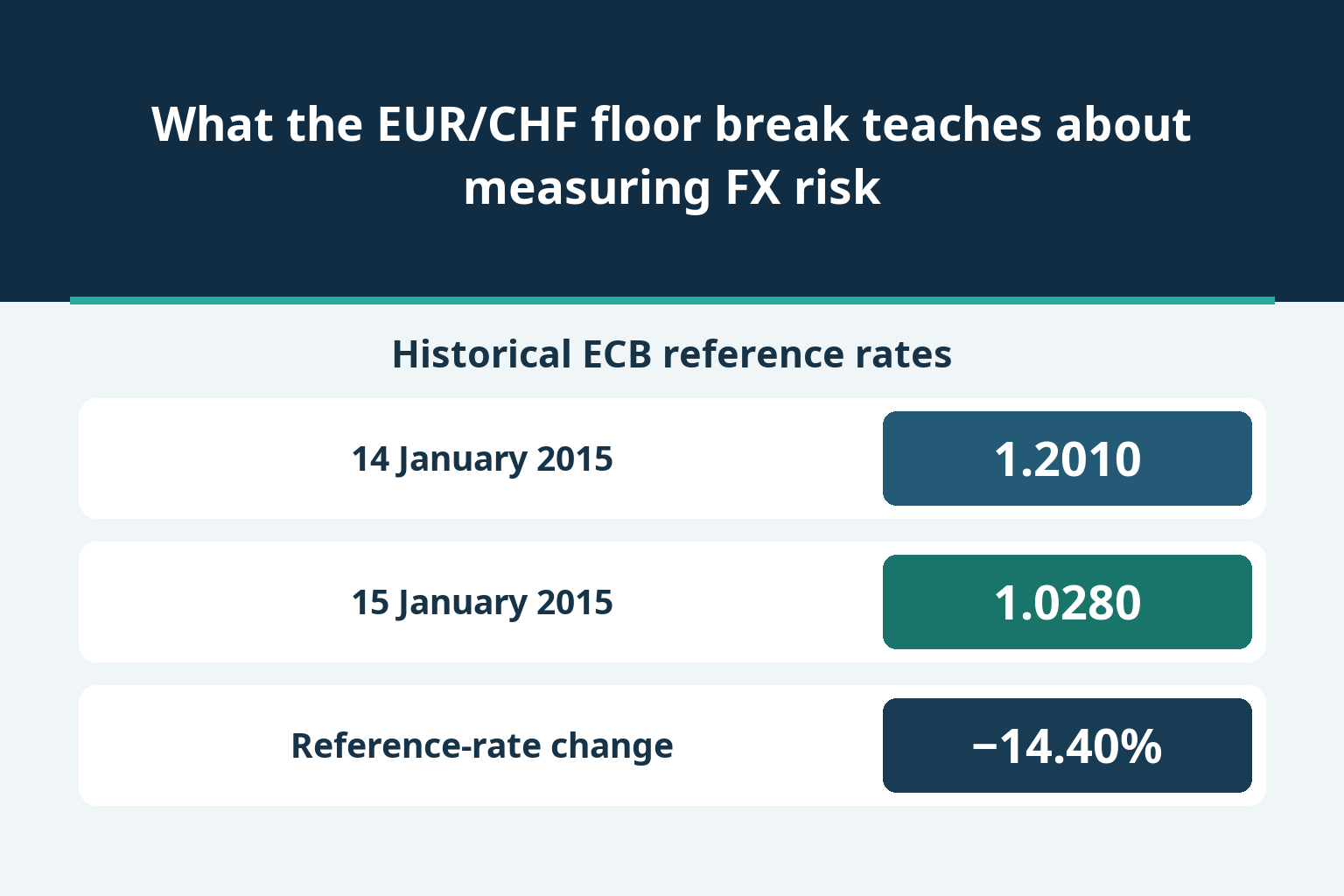
The Swiss National Bank had maintained a minimum exchange rate of CHF 1.20 per euro since September 2011. Defending that level meant being willing to buy foreign currency against francs. As the quote approached the floor, those purchases could counter demand for francs. The policy constrained the downside of EUR/CHF while it remained in force, with no equivalent policy ceiling on the upside. On 15 January 2015 the SNB discontinued the minimum exchange rate.
EUR/CHF is quoted in francs per euro. A fall from 1.2010 to 1.0280 means one euro bought 0.1730 fewer francs, a drop of 14.40% in EUR/CHF. The reciprocal quote, in euros per franc, rose 16.83%. Keep the quotation direction fixed when comparing price changes with cash exposure.
Download the ECB's daily Swiss-franc reference rates against the euro. Use 28 November 2014 as the starting observation, then take the 30 published changes from 1 December through 14 January. Compute each change as 100 × (today’s rate ÷ previous published rate − 1). Skip dates with no published rate, so a weekend or a holiday contributes no artificial zero return. The rates in the pre-break window ranged from 1.2009 to 1.2052. The largest absolute change was 0.3497%, and the sample standard deviation of the 30 changes was 0.0813 percentage points. The ECB's published marks are useful for comparing valuations on the same basis. They give no intraday path or executable bid and offer.
The three later marks are separate valuations of the same exposure, so their losses should never be added. The comparison with the 30 preceding changes shows how much the price range changed when policy changed. It supplies no statistical frequency for policy exits. An annualised volatility estimate or a probability extrapolated from those 30 returns would still be fitted to a period when the floor was in force.
Take an illustrative long position of EUR 100,000 at 1.2010, with a stop set at 1.1900 and a CHF 1,000 loss budget. For a linear position in a CHF account, the change in value before costs is EUR quantity × (scenario price − entry price). At 1.1900, the loss is CHF 1,100 if the entire position executes there. Using the ECB mark of 1.0280 to value the same exposure gives CHF 17,300 of loss. The CHF 16,200 difference between these valuations comes from the 0.1620 price interval below the chosen stop. Actual execution would depend on the order's trigger rules and the liquidity available at the time.
The size in the last column is the budget divided by the loss per euro, rounded down to a whole euro. An actual size check also rounds down to the instrument's trading increment and allows for spread, fees and liquidity. If a scenario is already specified as an executable exit bid for a long position, charging the same spread again would double-count it. For an account in another currency, convert the CHF loss at a rate consistent with the scenario. For routine stop-based calculations, see how effective stop distance translates into position size.
1. Read the central bank's current policy terms. Record the defended level, which side it constrains and which institution can change it. If the floor has already ended, estimate ordinary volatility from data after the policy change before using it for routine sizing.
2. Map the policy exit to a direction in the actual quote. A lower EUR/CHF hurts a long EUR position against CHF. Apply the same stronger-franc scenario to any other positions that lose when CHF appreciates, then add their cash losses in account currency.
3. Compare the ordinary stop case with two plausible exit marks. Keep the historical episode's date and quotation convention in the worksheet. If the pair, policy design, instrument or liquidity differs materially, rebuild the scenario for those conditions instead of copying the 14.40% move.
4. Check which quote triggers the stop, how partial fills are handled and whether a limit price can leave a residual position open. When reviewing an actual trade, use timestamps and fills from the order record. The public reference series can help explain the market move around those fills.
The practical test is whether the position still fits the cash-loss budget when the policy premise fails. That calculation can constrain exposure even when the preceding month gives no warning through daily volatility.

728 RM B 7/F GEE LOK IND BLDG NO 34 HUNG TO RD KWUN TONG KLN HONG KONG


The risk of loss in trading financial instruments such as stocks, FX, commodities, futures, bonds, ETFs and crypto can be substantial. You may sustain a total loss of the funds that you deposit with your broker. Therefore, you should carefully consider whether such trading is suitable for you in light of your circumstances and financial resources.
No decision to invest should be made without thoroughly conducting due diligence by yourself or consulting with your financial advisors. Our web content might not suit you since we don't know your financial conditions and investment needs. Our financial information might have latency or contain inaccuracy, so you should be fully responsible for any of your trading and investment decisions. The company will not be responsible for your capital loss.
Without getting permission from the website, you are not allowed to copy the website's graphics, texts, or trademarks. Intellectual property rights in the content or data incorporated into this website belong to its providers and exchange merchants.
Not Logged In
Log in to access more features


Log In
Sign Up


