


- WTI
- XAUUSD
- XAGUSD
- USDX


Markets
Analysis
User
24/7
Economic Calendar
Education
Data
- Names
- Latest
- Prev







An ETN’s index reference, exchange price and eventual cash payment answer different questions. A reproducible example separates issuer credit risk from an expensive entry and shows why neither an indicative value nor a rising benchmark guarantees repayment.
A rising index cannot, by itself, tell an exchange-traded note holder how much money will come back. The index helps calculate a payment under the note’s terms. The investor’s purchase price determines the amount at risk. The ability of the issuer, and any applicable guarantor, to meet the obligation determines whether the promised cash is actually paid.
These are separate questions even when all three numbers appear on the same trading screen. For an unsecured ETN, the central distinction is between owning a fund’s assets through its shares and holding a contractual claim against a borrower.
This article concerns the unsecured debt structure described in the SEC’s ETN investor education material. It does not assume that every product called an ETN worldwide has identical legal terms. In this structure, the note links a payment to a reference index or benchmark, usually with specified deductions or adjustments. It does not give the holder ownership of the index constituents.
The comparison with a conventional asset-holding ETF is useful at this point. A fund share represents an interest in a portfolio; its asset value and its exchange price can differ, as explained in how ETF asset values, market prices and creation mechanisms fit together. An unsecured ETN holder instead needs to identify who owes the payment. Assets an issuer might hold for its own hedging do not turn that note into a fund share.
Read the legal issuer’s name, not just the brand on the product page. A financing subsidiary and a named guarantor may have different roles. A guarantee, where one exists, requires examination of its scope and the guarantor’s ability to perform; it is not ownership of a segregated index portfolio. Listing on an exchange does not remove those questions.
The first number is the formula-based reference amount. An indicative value can help describe index-linked performance after the adjustments specified in the documents. It is not necessarily a bid, an immediately available redemption payment, a credit-adjusted fair value or a final amount recoverable after default. Check which index, valuation time and fee convention the published figure uses.
The second number is the actual purchase or sale price. A quoted reference of 100 does not force a willing seller to accept 100, nor does it oblige someone to buy from you at that level. Bid-offer spreads, available size, supply, demand and credit concerns can affect execution. A market premium is a price comparison, not a measure of how much extra the issuer owes.
The third number is cash ultimately received, with its date. Under normal performance, that may follow a maturity or redemption formula. Following a credit event, the relevant claim, treatment and payment timing need to be established separately. Substituting the screen’s indicative value for eventual cash skips the principal risk of an unsecured note.
Build a fictional, unleveraged note with a reference base of 100 and one year remaining. At purchase, the reference index is 1,000 and the note’s reference amount is normalized to 100. At the scheduled maturity observation, the index is 1,080, an 8% increase. For this example only, deduct a fixed amount of 1 once at final settlement. This is an invented calculation rule, not an actual ETN fee or a 1% annual charging convention.
The normal-performance amount is Q = 100 × 1,080/1,000 − 1 = 107. There are no interim distributions, leverage, inverse daily resets, additional charges, taxes, currency changes, trading costs or early redemptions. The calculation describes a conditional future payment; it is not a present-value model or a market quotation.
Consider two alternative hypothetical entry-price scenarios, 100 and 112, using the same starting reference and sufficient available trading size. Paying 112 means paying a 12% premium to the initial reference of 100. We specify the price as a separate input; neither the index formula nor an issuance restriction produces that exact premium automatically.
In the normal branch, the investor receives 107 at the end of year one. In a separate stress branch, assume the issuer fails to pay then and any applicable guarantee does not restore the scheduled payment. For arithmetic only, suppose the claim is finally resolved at the end of year two with a single total cash payment of 40 and no remaining claim or other receipts.
Both 40 and the extra year are deliberately chosen stress inputs. They are not an observed recovery, an estimate for any issuer or a standard resolution timetable. In particular, 40 is not calculated by applying a supposed “ETN recovery rate” to 107. The normal formula amount is also not automatically the legally recognized claim following an acceleration, default or resolution.
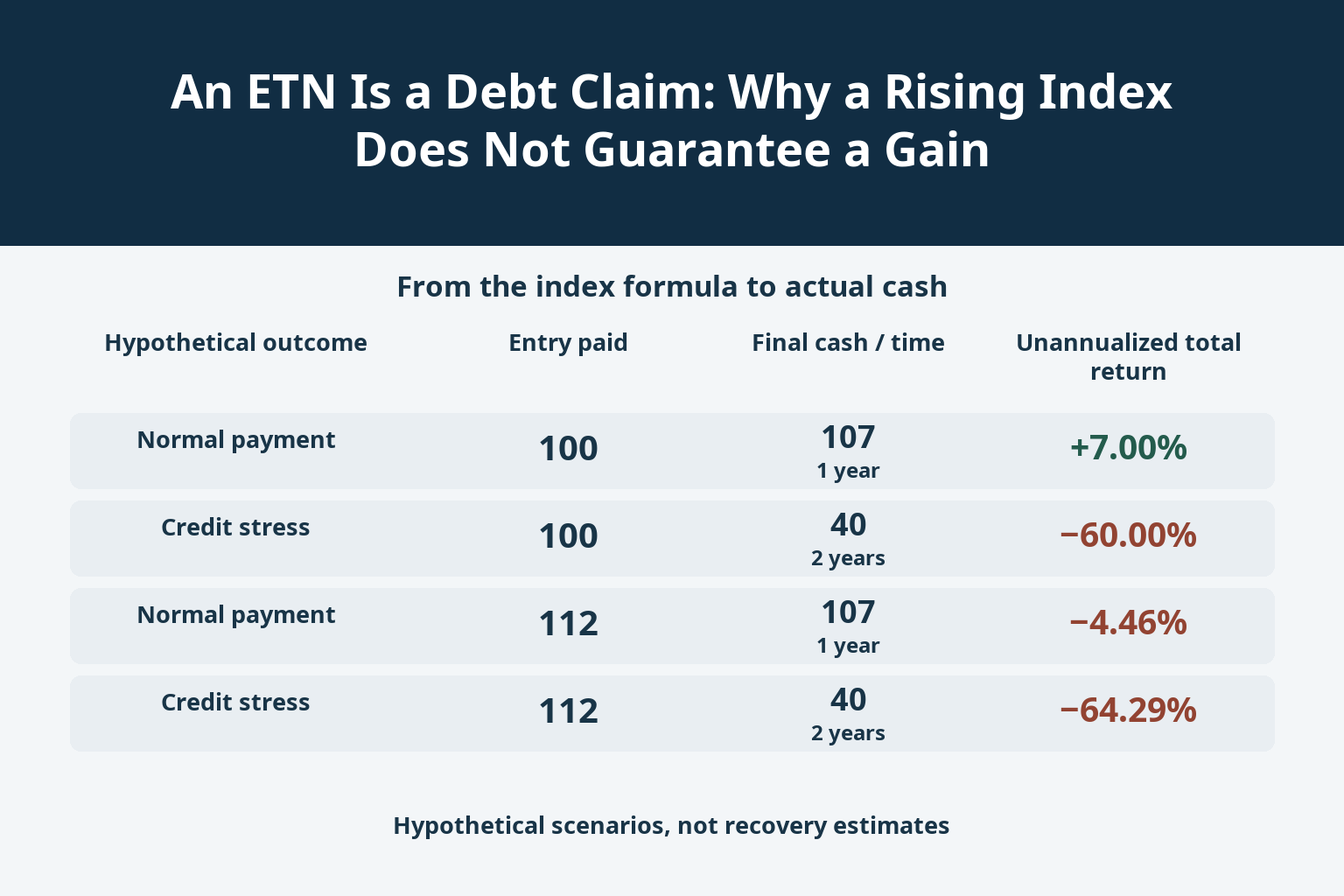
| Hypothetical outcome | Entry paid | Normal formula amount | Final cash received | Receipt after purchase | Total return |
|---|---|---|---|---|---|
| Normal payment; entry at reference | 100 | 107 | 107 | 1 year | +7.00% |
| Credit stress; entry at reference | 100 | 107, for comparison only | 40, assumed | 2 years, assumed | −60.00% |
| Normal payment; premium entry | 112 | 107 | 107 | 1 year | −4.46% |
| Credit stress; premium entry | 112 | 107, for comparison only | 40, assumed | 2 years, assumed | −64.29% |
Every row uses final cash divided by the purchase price, minus one. For example, 107/112 − 1 is approximately −4.46%, while 40/100 − 1 is −60%. These are unannualized total returns over different assumed holding periods. They do not rank one-year and two-year investments on an equal-time basis, and no discount rate has been applied to the delayed cash.
A real credit event may involve different claim amounts, guarantees, creditor ranking, multiple payments or no payment. None can be inferred from an 8% index gain. The model specifies final resolution only to avoid pretending that an unresolved residual claim has a known value of zero.
The 112-to-107 row has no credit loss. The issuer performs exactly as the fictional terms require, but the investor paid more than the eventual entitlement. Under this particular fixed-fee formula, the index gain needed to break even is (purchase price + 1)/100 − 1. It is 1% for an entry at 100 and 13% for an entry at 112.
That 13% threshold is conditional on full payment and the stated formula. It does not mean a sufficiently large index rally can guarantee repayment through a credit event. Raising the contractual reference amount and improving the ability to pay are different things.
Supply restrictions can add a separate complication. If an issuer stops issuing more notes while demand persists, the market price may diverge from the formula reference. Additional supply, if it later resumes, may compress a premium. Neither the direction, timing nor size of that adjustment is assured. The 12% entry premium here is a scenario input, not a prediction about an issuance suspension.
Exchange sale, investor-requested redemption and issuer-initiated early repayment are different routes. The documents may specify different valuation dates, minimum quantities, notice requirements and charges. A small holder may be able to trade on the exchange without being able to exercise a direct redemption right on the same terms.
Also separate the date an instruction becomes binding from the date the payment is calculated. If the latter comes later, today’s displayed reference need not be the amount ultimately payable. An issuer call or another early-termination provision may shorten the intended holding period or change the observation schedule. Those provisions must be read in the relevant issue documents; this example includes none of them.
A discount to an indicative value is not, by itself, a clean estimate of default probability. Credit, liquidity, execution costs, timing and the payment formula can all affect the comparison. Buying below a reference therefore does not establish a secured claim on assets worth that reference amount.
Confidence in the index exposure is supported when the formula is understood, the relevant payment obligations are met and the chosen exit route works as expected. It weakens when any of those conditions changes. The essential question is not just whether the benchmark rises, but who must turn that benchmark into cash, under which terms, and when.

728 RM B 7/F GEE LOK IND BLDG NO 34 HUNG TO RD KWUN TONG KLN HONG KONG





The risk of loss in trading financial instruments such as stocks, FX, commodities, futures, bonds, ETFs and crypto can be substantial. You may sustain a total loss of the funds that you deposit with your broker. Therefore, you should carefully consider whether such trading is suitable for you in light of your circumstances and financial resources.
No decision to invest should be made without thoroughly conducting due diligence by yourself or consulting with your financial advisors. Our web content might not suit you since we don't know your financial conditions and investment needs. Our financial information might have latency or contain inaccuracy, so you should be fully responsible for any of your trading and investment decisions. The company will not be responsible for your capital loss.
Without getting permission from the website, you are not allowed to copy the website's graphics, texts, or trademarks. Intellectual property rights in the content or data incorporated into this website belong to its providers and exchange merchants.
Not Logged In
Log in to access more features


Log In
Sign Up