- USDJPY
- XAUUSD
- XAGUSD
- WTI
- USDX


Markets
Analysis
User
24/7
Economic Calendar
Education
Data
- Names
- Latest
- Prev










Promising 8% daily returns, baked beans crypto attracted investors to a precarious DeFi trap. We examine the mechanics behind its inevitable, systemic collapse.
The decentralised finance boom birthed numerous high-yield projects, but few sparked as much debate as baked beans crypto. Promising 8% daily returns, this BNB smart contract drew millions in deposits. This guide explains how its mechanics function, explores the inherent risks, and reveals why such platforms ultimately collapse, helping informed investors avoid unsustainable DeFi traps.
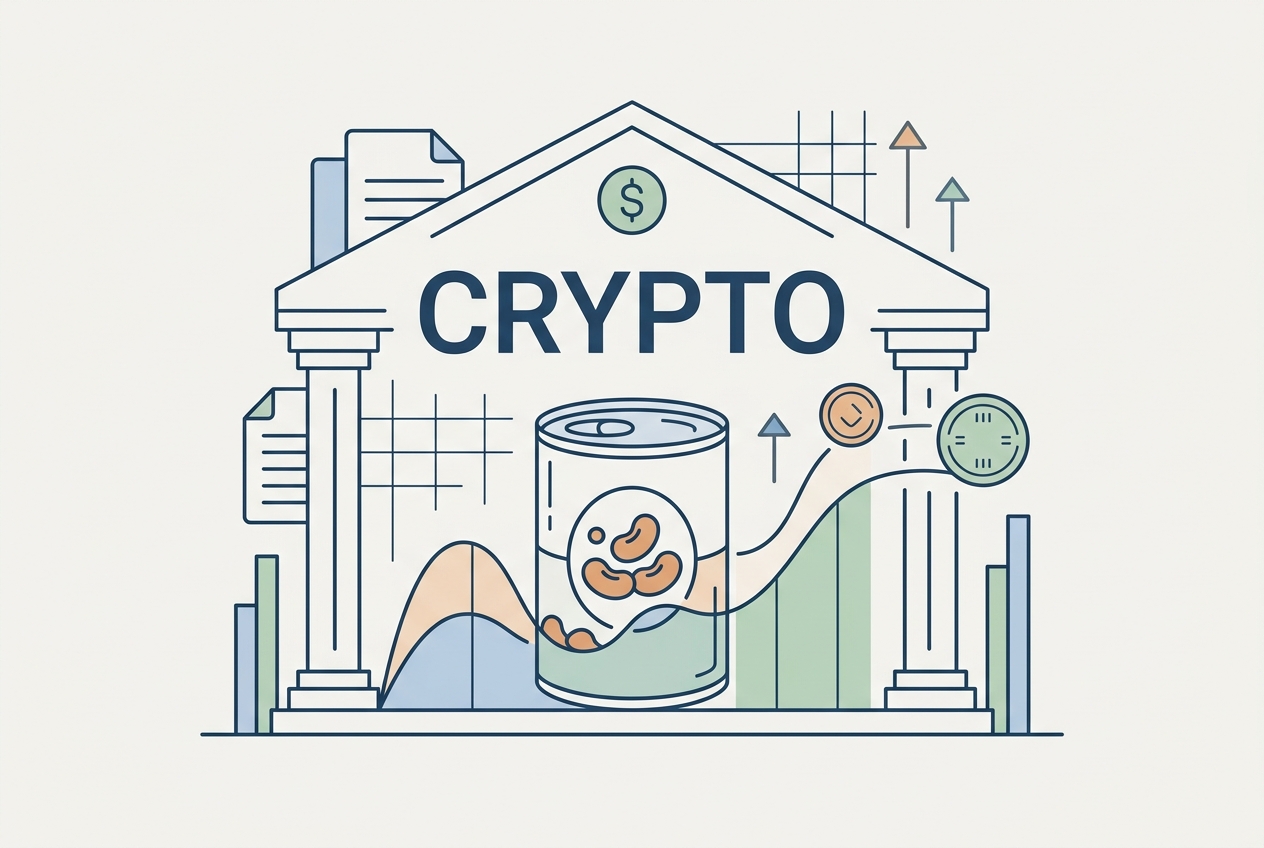
Baked Beans is a decentralised application (dApp) operating on the BNB Chain. In this comprehensive baked beans crypto review, it is important to clarify that this protocol functions as a reward pool rather than a traditional blockchain miner. Users deposit BNB tokens in exchange for daily yields, but the platform does not use computing power to validate network transactions.
Once users deposit their BNB, the funds are permanently locked in the contract and cannot be withdrawn as a lump sum. Instead, investors receive "Beans," an internal metric representing their share of the reward pool. The platform advertises up to an 8% daily payout, provided the smart contract maintains sufficient liquidity.
| Feature | Claimed Mechanic | Economic Reality |
|---|---|---|
| Initial Deposit | Locked for ecosystem stability | Principal is unrecoverable |
| Daily Returns | Up to 8% daily yield | Highly variable, drops near zero |
| Sustainability | Supported by the "6/1" reinvestment rule | Dependent entirely on new users |
| Developer Fees | 3% maintenance fee | Guaranteed profit for anonymous creators |
The protocol relies on a gamified system built around three primary actions: Baking, Re-baking, and Eating. "Baking" refers to the initial deposit of BNB into the contract. "Re-baking" is the process of compounding daily rewards by reinvesting them to increase the user’s overall Bean count. "Eating" is the act of withdrawing the accumulated BNB rewards to a personal wallet.
The developers heavily promoted a specific "6/1" strategy to maintain contract sustainability. Users were encouraged to Re-bake for six days and Eat on the seventh. This mechanic was designed to delay mass withdrawals, artificially inflating the total value locked (TVL) while penalising users who withdrew too frequently by slashing their daily return rate.
Understanding the source of the yield is critical for any DeFi investment. In traditional finance or legitimate decentralised exchanges, yield is generated through trading fees, lending interest, or external revenue. In the Baked Beans system, the yield is generated exclusively by the deposits of new users.
When a new investor bakes their BNB, those funds are used to pay the daily 8% rewards to earlier participants. This structure means the project possesses no actual utility or external profit generation. Because the entire system relies on a constant influx of fresh capital, the advertised daily return is functionally unsustainable once new deposits slow down.
Evaluating the legitimacy of high-yield DeFi miners requires looking past aggressive marketing claims. In 2023, the official BNB Chain security network explicitly listed Baked Beans as a high-risk "Ponzi BNB token mining dApp". The protocol relies entirely on the greater fool theory, where early participants profit at the direct expense of later investors.
The protocol completely lacks external utility. It does not offer lending services, token swapping, liquidity provision for external markets, or any real-world enterprise application. The smart contract acts as an isolated ecosystem where money only moves between the developers, who take a 3% fee on deposits and withdrawals, and the users.
Because there is no mechanism to generate external value, the platform is mathematically dependent on new depositors. If marketing efforts fail and new users stop buying in, the contract balance inevitably drains. This economic model perfectly mirrors a traditional Ponzi scheme, simply adapted and automated for blockchain technology.
The initial success of this protocol spawned hundreds of identical clones and forks across various blockchains, including networks like Avalanche and Polygon. Projects with names mimicking the original promised similar or even higher daily returns. In almost every case, these copycat contracts followed the exact same trajectory.
They experienced a brief period of rapid growth driven by affiliate marketing and influencer promotions. However, within weeks, the daily reward rate plummeted as the contract balance decayed. Early adopters and automated bot snipers drained the liquidity, leaving the vast majority of retail investors with permanent financial losses.
Proponents often point to smart contract audits as proof of legitimacy. Baked Beans was audited by a firm called Ethos, which returned a positive result regarding the code structure. However, an audit only verifies that the code is free from hacking vulnerabilities; it does not endorse the economic viability of the project.
Furthermore, the developers remained entirely anonymous, operating without regulatory oversight. Eventually, financial regulators took notice, and the Australian Securities and Investments Commission (ASIC) added Baked Beans domains to its Moneysmart Investor Alert List as unlicensed entities. Without a known team or legal accountability, investors have no recourse when the contract runs dry.
Depositing funds into a locked smart contract carries immense financial risk. The most glaring danger is the irreversible nature of the initial investment. Because users can never withdraw their principal amount, they must rely entirely on the daily percentage payouts to eventually break even, which mathematically requires an ever-growing user base.
For those looking for high-risk ventures, researching a list of crypto gambling sites might ironically offer more transparency regarding the odds of losing capital than these opaque DeFi miners. When you gamble crypto on regulated or established platforms, the house edge is mathematically defined. Conversely, miner contracts can be unpredictably drained by early whales.
Whether an investor can withdraw profitably depends entirely on when they enter the project. The 8% daily return is highly variable and programmed to decrease as the contract balance shrinks. If a user deposits funds late in the protocol's lifecycle, the daily return rate will rapidly drop to fractions of a percent.
Consequently, late entrants mathematically cannot recover their initial deposit. While the "Eat" function will technically process the withdrawal, the BNB received will be minuscule compared to the locked principal. The smart contract code functions flawlessly to process withdrawals, but the underlying economic reality means most users operate at a severe net loss.
The lifespan of a DeFi miner contract is incredibly short. While the original protocol survived for several months due to aggressive compounding rules and viral marketing, its peak was fleeting. Solvency is purely dictated by the ratio of incoming deposits to outgoing withdrawals.
Once daily withdrawals outpace new investments, the contract balance enters a death spiral. Investors notice the declining balance, panic, and begin withdrawing daily rather than compounding, which accelerates the collapse. Most clones and forks become entirely insolvent or practically worthless within 30 to 60 days of launch.
While the promise of passive income is alluring, this protocol is a textbook example of unsustainable tokenomics. The lack of utility, reliance on new capital, and permanently locked principal make it a highly dangerous financial venture. Engaging with this platform is closer to participating in a zero-sum game than making a legitimate investment.
To put it in perspective, speculators might explore the top 10 crypto gambling sites for entertainment, but they should not confuse high-yield Ponzi dApps with secure decentralised finance. Platforms featured in discussions around online gambling crypto generally admit to being games of chance, whereas DeFi miners falsely market themselves as guaranteed investments.
At its peak in early 2022, the contract held tens of thousands of BNB, equating to millions of dollars in total value locked. However, as the influx of new users slowed, the daily 8% payouts began eating into the core reserves. The balance suffered a precipitous decline as the mathematical constraints caught up with the marketing.
Today, the original contract holds negligible liquidity. The promised 8% return has dropped to near zero, meaning it would take years for a new depositor to recoup even a fraction of their funds. The collapse was not caused by a malicious hack, but by the programmed reality of its own tokenomics.
The only true winners in this ecosystem were the anonymous developers and the earliest participants. The developers secured a guaranteed 3% tax on every deposit and withdrawal, ensuring they profited regardless of the contract's overall health. Early adopters who utilised the affiliate referral program also managed to extract significant BNB before the collapse.
The vast majority of investors lost their capital because the system required an exponentially growing base of new users to sustain payouts. Those who bought in after the initial hype cycle provided the exit liquidity for the early adopters. This underscores the importance of seeking out the best gambling crypto coins or utility tokens with transparent mechanics, rather than locking funds in zero-utility reward pools.
It is a decentralised application on the BNB Chain that requires users to permanently lock their tokens in exchange for promised daily returns. It operates as a high-risk reward pool dependent entirely on new deposits.
Yes, prominent blockchain security authorities like the BNB Chain have classified it as a Ponzi scheme. It relies solely on new capital to pay early investors, ensuring a mathematical collapse for late adopters.
Users deposit BNB into a locked smart contract and earn "Beans," which generate a variable daily yield. Investors must regularly reinvest their earnings to maintain their return rate before eventually withdrawing profits.
Your initial deposit is permanently locked, and the advertised daily yields drop drastically as the contract loses funds. The vast majority of investors never recover their principal capital.
Ultimately, baked beans crypto serves as a cautionary tale for decentralised finance investors. While early adopters temporarily profited, the project's inherent Ponzi mechanics guaranteed long-term failure for the majority. Investors should prioritize platforms with transparent revenue models and avoid locked-liquidity reward pools that depend entirely on an endless supply of new deposits.

728 RM B 7/F GEE LOK IND BLDG NO 34 HUNG TO RD KWUN TONG KLN HONG KONG


The risk of loss in trading financial instruments such as stocks, FX, commodities, futures, bonds, ETFs and crypto can be substantial. You may sustain a total loss of the funds that you deposit with your broker. Therefore, you should carefully consider whether such trading is suitable for you in light of your circumstances and financial resources.
No decision to invest should be made without thoroughly conducting due diligence by yourself or consulting with your financial advisors. Our web content might not suit you since we don't know your financial conditions and investment needs. Our financial information might have latency or contain inaccuracy, so you should be fully responsible for any of your trading and investment decisions. The company will not be responsible for your capital loss.
Without getting permission from the website, you are not allowed to copy the website's graphics, texts, or trademarks. Intellectual property rights in the content or data incorporated into this website belong to its providers and exchange merchants.
Not Logged In
Log in to access more features


Log In
Sign Up