


- XAUUSD
- XAGUSD
- WTI
- USDX



Markets
Analysis
User
24/7
Economic Calendar
Education
Data
- Names
- Latest
- Prev








 Economic Calendar

XRP fell after the Senate delayed the CLARITY Act vote, extending U.S. crypto regulatory uncertainty. Learn why traders reacted and what comes next.
XRP prices dropped after the Senate failed to advance a key crypto bill, an event often described as a delay but more consequential than a routine scheduling change. On September 15, 2026, senators rejected a procedural motion to advance the Digital Asset Market Clarity Act, leaving a comprehensive federal framework for digital assets unresolved.
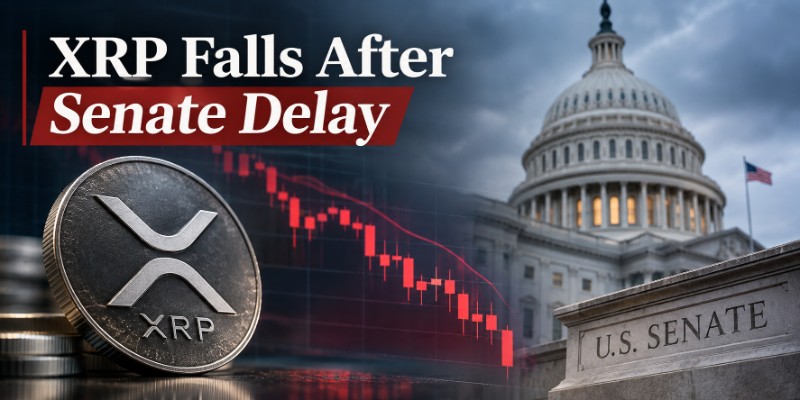
The measure, known as the CLARITY Act and introduced as H.R. 3633, was designed to establish a regulatory structure for digital assets and clarify the roles of the Securities and Exchange Commission (SEC) and the Commodity Futures Trading Commission (CFTC). Crypto companies argued that clearer rules could reduce uncertainty over how digital assets are issued, traded and supervised.
The Senate did not hold a final vote on the entire bill. Instead, it considered a procedural motion to invoke cloture on a motion to proceed. Cloture limits debate and required 60 votes in this case. The motion failed by 49 votes to 50, with Senator Chris Coons not voting. Four Republicans—Susan Collins, Josh Hawley, Jerry Moran and Thom Tillis—joined Democrats in opposing it. The Senate's official daily record confirms the result and notes that Tillis voted no to preserve the ability to seek reconsideration.
That distinction matters: the vote did not decide XRP's legal status or prohibit the token. It prevented the bill from moving to the next stage. The setback nevertheless weakened expectations that Congress would soon provide a durable framework for the U.S. crypto market.
XRP reacted sharply because traders had treated progress on U.S. crypto legislation as a potential positive catalyst. Clearer SEC-CFTC boundaries could help exchanges and institutions assess compliance obligations and reduce conflicting interpretations of federal rules.
When the Senate motion failed, investors had to reassess the timing of that potential improvement. Instead of moving closer to a comprehensive law, the market faced a longer period of uncertainty. Traders who had positioned for regulatory progress may have taken profits when the expected catalyst failed to materialize.
The immediate reaction was significant. CoinDesk reported that XRP fell nearly 10% to around $1.30 during Asian trading after the vote. Ether and Solana each lost close to 5%, while Bitcoin fell nearly 3%. The broad decline suggests the Senate setback weighed on crypto-market sentiment rather than creating a problem unique to XRP.
Regulatory uncertainty has long been part of XRP's investment story. Ripple's legal dispute with the SEC made U.S. regulatory treatment particularly relevant to the token. Even when a crypto asset has an established market, uncertainty over which rules apply can affect the willingness of exchanges, institutions and financial firms to expand their involvement.
The CLARITY Act was designed to address a broader market problem, not to create a special rule for XRP. Its proposed framework would help define how digital commodities are regulated and how responsibilities are divided between the SEC and CFTC. For XRP holders, that could matter indirectly: clearer rules may make it easier for U.S. platforms and institutions to assess listing, custody, trading and investment products.
However, the failed vote did not automatically reverse an existing regulatory position or determine that XRP should be treated as a security. Traders can react to the loss of a future catalyst even when a vote does not directly change an asset's current legal status.
The timing made the legislative setback a clear catalyst, but it should not be treated as the only cause of every price move. Crypto assets often fall together when traders reduce risk. The simultaneous declines in Bitcoin, Ether and Solana show that selling pressure extended beyond XRP. Interest-rate expectations, liquidity, derivatives positioning and profit-taking can all amplify a reaction to political news.
The Federal Reserve's policy decision was also approaching at the time, adding another source of uncertainty for risk assets. The failed motion weakened confidence in a near-term regulatory catalyst, while broader market conditions shaped the scale of the decline.
The failed procedural vote did not permanently kill the CLARITY Act. Senator Thom Tillis entered a motion to reconsider the result on the same day, preserving a possible route for the Senate to revisit the measure. That procedural step did not guarantee another vote or ensure that the bill would pass.
The November 3, 2026, midterm elections have made the longer-term path less predictable. Democrats won control of both chambers, but the new Congress will not take office until January 2027. The outgoing Congress therefore has a limited period in which it could reconsider pending legislation. Any revised bill may also face different priorities, committee leadership and demands over consumer protections, ethics safeguards and regulatory oversight.
A new version could eventually attract bipartisan support, but it may differ from the proposal that failed in September. For XRP investors, this means regulatory clarity remains a longer-term possibility rather than an immediate catalyst.
Congress is not the only source of regulatory developments. The SEC and CFTC have already taken steps to clarify how existing federal laws apply to digital assets. On March 17, 2026, the agencies issued a joint interpretation covering categories such as digital commodities, digital securities, stablecoins, digital collectibles and digital tools. It also addressed when a non-security crypto asset may become subject to, or cease to be subject to, an investment contract.
For XRP, agency guidance may help exchanges, institutional investors and financial businesses assess their compliance obligations. It could support the development of regulated products and services without waiting for Congress to pass a new law.
There is, however, an important distinction between agency guidance and legislation. Regulatory interpretations can be amended, withdrawn or challenged in court. A law passed by Congress would generally provide a more durable framework. Agency action may reduce some uncertainty, but it cannot fully replace the market-wide clarity the CLARITY Act was intended to establish.
The Senate setback is one factor in XRP's market outlook, but traders should avoid making decisions based on political headlines alone. Several indicators can help show whether selling pressure is easing or whether the market remains vulnerable.
Bitcoin's price direction is one useful signal. Bitcoin remains an important gauge of broader cryptocurrency sentiment. When it experiences significant selling pressure, XRP and other major altcoins can also decline, even without asset-specific negative news. A sustained recovery in Bitcoin could improve market conditions for XRP, although it would not guarantee an immediate rebound.
XRP trading volume and liquidity also matter. Volume can help investors assess the strength of a price movement. A decline accompanied by unusually high selling volume may indicate strong distribution, while declining volume during consolidation could suggest that immediate selling pressure is weakening. Thin order books can also amplify price movements when large traders execute orders.
Institutional participation is another factor. Investors can monitor developments involving regulated investment products, fund flows, exchange access and institutional custody. Stronger participation could help offset negative sentiment surrounding legislative delays, although these developments should be assessed independently of the CLARITY Act.
Finally, traders should follow further U.S. regulatory developments. Statements, proposed rules and formal actions from the SEC and CFTC could influence expectations about XRP's accessibility and its role in regulated financial markets.
A recovery remains possible, but it depends on more than whether the CLARITY Act eventually passes.
If lawmakers reach a new bipartisan agreement, regulatory uncertainty could decline and improve sentiment toward XRP and the broader cryptocurrency market. Clearer agency guidance or stronger institutional demand could also provide support even without immediate congressional action.
On the other hand, prolonged political disagreements could keep uncertainty elevated. If this coincides with weak Bitcoin performance, declining liquidity or broader risk aversion, XRP could face additional selling pressure.
Traders should distinguish between a technical rebound and a fundamental improvement. A short-term price recovery does not necessarily mean that the regulatory outlook has changed.
XRP prices dropped after the Senate failed to advance the CLARITY Act because investors had expected progress on U.S. crypto market-structure legislation. The failed procedural vote removed an important near-term catalyst and reinforced uncertainty about the industry's regulatory future.
The November midterms and the transition to a new Congress have made the legislative outlook less predictable. Nevertheless, the CLARITY Act is not the only factor shaping XRP's outlook. Regulatory developments, institutional participation, market liquidity and broader cryptocurrency sentiment will continue to influence its price.
For investors, the key distinction is that a stalled bill does not automatically mean a negative legal outcome for XRP. It means that one potential source of regulatory certainty remains unresolved.

728 RM B 7/F GEE LOK IND BLDG NO 34 HUNG TO RD KWUN TONG KLN HONG KONG


The risk of loss in trading financial instruments such as stocks, FX, commodities, futures, bonds, ETFs and crypto can be substantial. You may sustain a total loss of the funds that you deposit with your broker. Therefore, you should carefully consider whether such trading is suitable for you in light of your circumstances and financial resources.
No decision to invest should be made without thoroughly conducting due diligence by yourself or consulting with your financial advisors. Our web content might not suit you since we don't know your financial conditions and investment needs. Our financial information might have latency or contain inaccuracy, so you should be fully responsible for any of your trading and investment decisions. The company will not be responsible for your capital loss.
Without getting permission from the website, you are not allowed to copy the website's graphics, texts, or trademarks. Intellectual property rights in the content or data incorporated into this website belong to its providers and exchange merchants.
Not Logged In
Log in to access more features


Log In
Sign Up


