


- XAUUSD
- XAGUSD
- WTI
- USDX



Markets
Analysis
User
24/7
Economic Calendar
Education
Data
- Names
- Latest
- Prev








 Economic Calendar

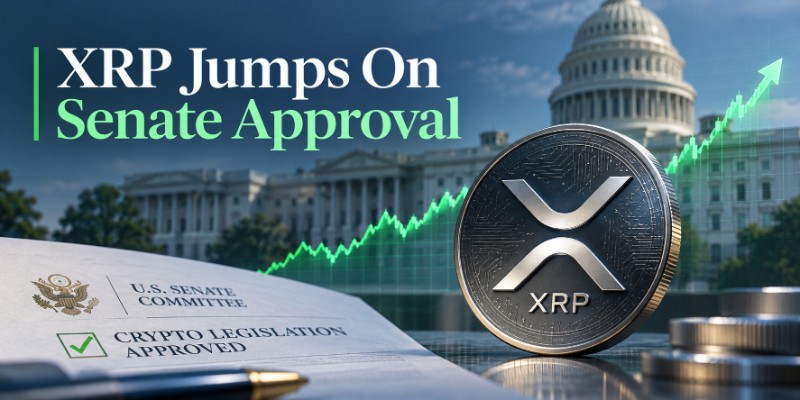
XRP surged after the Senate Banking Committee advanced the CLARITY Act, renewing hopes for clearer U.S. crypto rules while the bill still faced further votes.
The XRP price surged following Senate committee approval of new legislation on May 14, 2026, when the U.S. Senate Banking Committee advanced the Digital Asset Market Clarity Act, widely known as the CLARITY Act, in a 15-9 bipartisan vote. The decision renewed expectations for clearer U.S. cryptocurrency regulations, although the bill still faced significant legislative hurdles.
The immediate catalyst was the Senate Banking Committee's approval of the Digital Asset Market Clarity Act on May 14, 2026. Led by Chairman Tim Scott, the committee advanced the legislation in a bipartisan 15-9 vote following months of negotiations.
The proposal aims to establish a clearer regulatory framework for digital assets, addressing longstanding disagreements over how cryptocurrencies should be classified and supervised in the United States.
The committee's decision attracted considerable attention across cryptocurrency markets. According to CoinDesk's May 15 market report, XRP gained approximately 4.5% over 24 hours, reaching around $1.49. Its weekly performance also improved, with gains of approximately 7.6%.
Bitcoin and other major cryptocurrencies advanced as well, but XRP's stronger performance highlighted how closely its market sentiment remains connected to developments in U.S. cryptocurrency regulation.
The reaction was not simply about another legislative announcement. Investors interpreted the committee vote as evidence that lawmakers were making progress toward resolving regulatory uncertainty that had affected the cryptocurrency industry for years.
Nevertheless, a positive market reaction does not necessarily indicate that a new law will pass or that XRP will continue rising. Traders were responding to improved expectations rather than an immediate change in the token's legal status.
The Digital Asset Market Clarity Act is designed to establish a more defined regulatory structure for the U.S. cryptocurrency market.
One of the industry's longstanding concerns has been the division of authority between the Securities and Exchange Commission (SEC) and the Commodity Futures Trading Commission (CFTC). Uncertainty over which regulator has jurisdiction over particular digital assets and market activities has created challenges for cryptocurrency businesses, exchanges and investors.
The CLARITY Act seeks to address this issue by establishing clearer responsibilities for the two agencies. In broad terms, the proposed framework would expand the CFTC's role in overseeing digital commodities and relevant trading activities, while the SEC would retain authority over digital securities and activities covered by securities laws.
For XRP, this distinction is particularly important.
XRP has faced years of regulatory uncertainty following the SEC's December 2020 lawsuit against Ripple Labs. The dispute raised questions about how XRP transactions should be treated under U.S. securities laws and created uncertainty for exchanges, institutional investors and other market participants.
Although subsequent court developments provided important clarification, they did not eliminate every regulatory question surrounding the broader cryptocurrency market.
A comprehensive federal market-structure law could provide more consistent rules for exchanges, intermediaries, custody services and digital asset transactions.
For XRP investors, clearer rules could have several potential implications:
However, these potential benefits depend on the legislation's final provisions and implementation. Committee approval alone does not guarantee that all XRP-related activities will receive favorable regulatory treatment.
Institutional participation is an important factor in determining whether XRP can sustain a longer-term price recovery.
Retail traders can react quickly to headlines, technical indicators and short-term market sentiment. Large financial institutions, however, generally need to consider additional factors, including regulatory compliance, custody arrangements, reporting obligations and operational risks.
When regulatory responsibilities remain unclear, institutions may delay launching new products or expanding their exposure to certain digital assets.
The CLARITY Act could help address some of these concerns by establishing a more predictable market structure.
For XRP, this matters because its potential use extends beyond speculative cryptocurrency trading. Ripple has promoted the XRP Ledger as infrastructure for cross-border payments, asset tokenization and other financial applications.
A clearer regulatory environment could make it easier for financial institutions to assess these applications and determine whether they fit within existing compliance frameworks. It could also improve the environment for exchanges and financial service providers seeking to expand XRP-related offerings.
Still, regulatory progress should not be confused with confirmed institutional demand. A committee vote does not automatically produce new investment products, increase transaction volumes or guarantee additional capital inflows.
Investors therefore need to distinguish between the potential benefits of regulatory reform and measurable changes in market participation.
Despite the positive reaction in May, the CLARITY Act still needed to overcome several legislative obstacles.
Following the Banking Committee's 15-9 vote, the legislation needed further consideration in the Senate, including coordination with a separate version handled by the Senate Agriculture Committee. The combined legislation would then need sufficient support to advance through the full Senate before completing the remaining legislative process.
Political disagreements, regulatory concerns and differences over specific provisions remained potential obstacles.
Several Democrats wanted stronger ethics provisions addressing potential conflicts of interest involving government officials and their cryptocurrency investments. Other disagreements involved decentralized finance, law enforcement powers and the treatment of stablecoin rewards.
These issues made bipartisan support uncertain, even though two Democratic senators had supported the May committee approval.
The distinction is important: the May vote represented genuine legislative progress, but it did not mean the CLARITY Act had become law. The legislation still needed broader political agreement and additional votes before it could establish a federal regulatory framework.
The September setback demonstrated how quickly regulatory expectations can influence XRP's price.
On September 15, 2026, the Senate failed to invoke cloture on the motion to proceed with H.R. 3633, the CLARITY Act. The procedural vote ended 49-50, falling short of the 60 votes required to advance the measure. The result represented a significant setback for the cryptocurrency industry's legislative efforts.
Negotiations had produced substantial proposed changes, but disagreements remained over ethics safeguards, regulatory resources and provisions addressing money laundering and terrorist financing.
According to CoinDesk's September 16 report, XRP fell nearly 10% to approximately $1.30 in Asian trading after the Senate setback, as the broader cryptocurrency market also experienced selling pressure.
The reaction highlighted an important characteristic of XRP: its valuation can be particularly sensitive to developments affecting the U.S. regulatory environment.
Nevertheless, the procedural setback did not reverse existing court decisions or automatically change XRP's legal treatment. It meant that the broader federal market-structure framework remained unresolved.
Senator Thom Tillis subsequently filed a motion to reconsider, leaving a potential route for further consideration. However, the failed vote significantly weakened expectations for near-term regulatory reform.
The episode also demonstrated why XRP's initial price reaction in May should be viewed as a response to regulatory optimism rather than a permanent change in its legal environment.
Several developments could influence XRP's price following the initial regulatory-driven rally.
1. Further progress on the CLARITY Act
Any renewed bipartisan negotiations, reconsideration vote or revised legislative proposal could restore market optimism. Investors should pay attention to actual voting schedules and legislative developments rather than relying exclusively on political statements.
2. SEC and CFTC regulatory developments
Even without comprehensive legislation, regulatory guidance and agency decisions could influence how digital assets are treated in the United States. Changes affecting exchanges, custody providers and institutional trading could be relevant to XRP.
3. XRP investment product flows
Institutional demand is another important indicator. Investors can monitor spot XRP ETF net inflows, assets under management and trading volumes to determine whether interest is translating into sustained capital allocation.
4. Broader cryptocurrency market conditions
XRP does not trade independently of the wider market. Bitcoin's direction, interest rate expectations, dollar movements and overall risk appetite can influence cryptocurrency valuations. Even favorable regulatory developments may produce limited price gains during a broader market downturn.
These indicators provide a more comprehensive picture than a single legislative headline. In particular, sustained investment inflows and stronger trading activity would offer more concrete evidence of improving demand than short-lived price movements following political announcements.
The Senate Banking Committee's May approval demonstrated that bipartisan progress on cryptocurrency regulation was possible. For XRP, this created expectations of a more predictable U.S. market environment and potentially greater institutional participation.
However, the subsequent September procedural failure showed that legislative progress can be reversed by political disagreements and unresolved policy issues.
As of November 6, 2026, the CLARITY Act has not cleared the Senate's procedural hurdle. Consequently, investors should distinguish between the optimism generated by the May committee approval and the regulatory outcomes that still need to materialize.
A sustainable XRP recovery will likely require more than positive regulatory headlines. Progress toward a workable federal framework, stronger institutional participation, healthy market liquidity and growing real-world activity on the XRP Ledger would provide a more convincing foundation.
The key question for XRP is no longer simply whether lawmakers support clearer cryptocurrency rules, but whether that support can translate into enforceable legislation and measurable improvements in the digital asset market.

728 RM B 7/F GEE LOK IND BLDG NO 34 HUNG TO RD KWUN TONG KLN HONG KONG


The risk of loss in trading financial instruments such as stocks, FX, commodities, futures, bonds, ETFs and crypto can be substantial. You may sustain a total loss of the funds that you deposit with your broker. Therefore, you should carefully consider whether such trading is suitable for you in light of your circumstances and financial resources.
No decision to invest should be made without thoroughly conducting due diligence by yourself or consulting with your financial advisors. Our web content might not suit you since we don't know your financial conditions and investment needs. Our financial information might have latency or contain inaccuracy, so you should be fully responsible for any of your trading and investment decisions. The company will not be responsible for your capital loss.
Without getting permission from the website, you are not allowed to copy the website's graphics, texts, or trademarks. Intellectual property rights in the content or data incorporated into this website belong to its providers and exchange merchants.
Not Logged In
Log in to access more features


Log In
Sign Up


