


- XAUUSD
- XAGUSD
- WTI
- USDX


Markets
Analysis
User
24/7
Economic Calendar
Education
Data
- Names
- Latest
- Prev









What time does the stock market close? Find NYSE and Nasdaq closing times, pre-market and after-hours trading, holiday schedules, and time zones.
The U.S. stock market closes at 4:00 p.m. Eastern Time (ET) on regular trading days. Both the New York Stock Exchange (NYSE) and Nasdaq follow this schedule, opening at 9:30 a.m. ET, Monday through Friday. However, holidays, early closures, and extended-hours trading can affect when investors can buy and sell stocks.
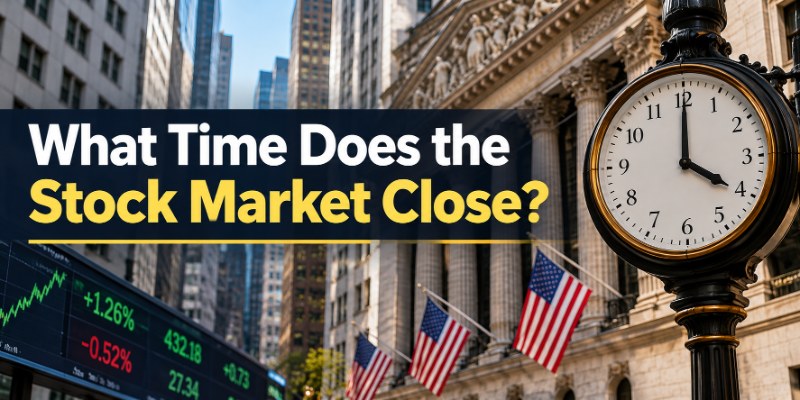
Table of Contents
The NYSE and Nasdaq normally close at 4:00 p.m. ET. Their regular trading session lasts 6.5 hours, beginning at 9:30 a.m. ET.
Here is the standard U.S. stock market schedule:
| Trading Session | Eastern Time (ET) |
|---|---|
| Pre-market trading | 4:00 a.m. – 9:30 a.m. |
| Regular market hours | 9:30 a.m. – 4:00 p.m. |
| After-hours trading | 4:00 p.m. – 8:00 p.m. |
| Regular market close | 4:00 p.m. |
Pre-market and after-hours availability depends on the exchange, trading venue, and brokerage. Not every investor can trade throughout the full extended-hours window.
The regular closing time remains 4:00 p.m. ET whether the U.S. is observing Eastern Standard Time (EST) or Eastern Daylight Time (EDT).
You can check the official NYSE trading hours and holiday calendar for scheduled closures and early closing days.
For investors outside New York, the closing time depends on their local time zone.
| Time Zone | Market Opens | Market Closes |
|---|---|---|
| Eastern (ET) | 9:30 a.m. | 4:00 p.m. |
| Central (CT) | 8:30 a.m. | 3:00 p.m. |
| Mountain (MT) | 7:30 a.m. | 2:00 p.m. |
| Pacific (PT) | 6:30 a.m. | 1:00 p.m. |
These times apply to regular trading sessions on the NYSE and Nasdaq.
International investors also need to account for U.S. daylight saving time, which generally begins in March and ends in November.
| Location | US Summer Time (EDT) Close | US Winter Time (EST) Close |
|---|---|---|
| London | 9:00 p.m.* | 9:00 p.m.* |
| Singapore | 4:00 a.m. next day | 5:00 a.m. next day |
| Hong Kong | 4:00 a.m. next day | 5:00 a.m. next day |
| Tokyo | 5:00 a.m. next day | 6:00 a.m. next day |
| Sydney | 6:00 a.m. next day* | 8:00 a.m. next day* |
*London and Sydney also observe daylight saving time, but their clock changes do not align exactly with the United States. Closing times can differ during transition weeks.*
For overseas investors, the U.S. trading session often extends into the following calendar day. A Friday market close in New York, for example, occurs on Saturday morning in much of Asia.
Yes. The U.S. stock market follows a holiday calendar, and some trading sessions end earlier than usual.
On designated early-close days, the NYSE and Nasdaq typically stop regular stock trading at 1:00 p.m. ET, three hours before the normal close.
| Date | Holiday or Event | Market Status |
|---|---|---|
| January 1 | New Year's Day | Closed |
| January 19 | Martin Luther King Jr. Day | Closed |
| February 16 | Presidents' Day | Closed |
| April 3 | Good Friday | Closed |
| May 25 | Memorial Day | Closed |
| June 19 | Juneteenth | Closed |
| July 3 | Independence Day (observed) | Closed |
| September 7 | Labor Day | Closed |
| November 26 | Thanksgiving Day | Closed |
| November 27 | Day after Thanksgiving | Closes at 1:00 p.m. |
| December 24 | Christmas Eve | Closes at 1:00 p.m. |
| December 25 | Christmas Day | Closed |
The remaining scheduled early-close dates in 2026 are November 27 and December 24. Both exchanges are scheduled to close at 1:00 p.m. ET on those days.
Holiday schedules can change, so investors should check the official Nasdaq holiday schedule before placing time-sensitive trades.
Yes. The regular stock market closes at 4:00 p.m. ET, but eligible investors can continue trading through after-hours sessions.
The standard Nasdaq after-hours session runs from 4:00 p.m. to 8:00 p.m. ET. Trading takes place electronically, and access depends on the brokerage.
For example, a company might release its quarterly earnings at 4:15 p.m. ET, shortly after the regular market closes. Investors with extended-hours access may be able to react immediately rather than waiting until the next morning.
However, after-hours trading differs from regular trading in several ways:
A stock trading at $100 at the regular close could move to $105 after an earnings announcement. That after-hours price does not guarantee the stock will open at $105 the next morning.
The NYSE and Nasdaq do not operate their regular trading sessions 24 hours a day.
Some brokerages offer overnight stock trading through alternative trading venues, but supported securities, execution conditions, and trading hours vary.
Nasdaq has also outlined plans for nearly continuous weekday trading, including a proposed overnight session. Its broader trading-hours expansion depends on regulatory and market infrastructure requirements.
Investors should distinguish overnight brokerage access from the regular exchange trading session.
The 4:00 p.m. ET close is more than the end of the trading day. It is a major reference point for stock prices, portfolio valuations, and market performance.
On the NYSE, the closing auction takes place at 4:00 p.m. ET, bringing together eligible buy and sell orders to establish an official closing price.
Institutional investors, index funds, and other market participants often concentrate activity near the closing bell.
This can produce substantial trading volume during the final minutes of the session, particularly on days involving index rebalancing, options expiration, or major economic developments.
It depends on the order type and brokerage settings.
A regular-session day order that remains unfilled generally expires at the end of its applicable trading session. A good-til-canceled order may remain active for future eligible sessions, subject to broker rules.
An order specifically authorized for extended-hours trading may execute after 4:00 p.m. ET if the security is eligible and a matching order is available.
Investors should check the order's time-in-force and trading-session settings rather than assuming every order will execute after the closing bell.
The New York Stock Exchange closes at 4:00 p.m. Eastern Time on regular trading days. Scheduled early-close sessions generally end at 1:00 p.m. ET.
Nasdaq closes at 4:00 p.m. ET, Monday through Friday, excluding market holidays. Eligible after-hours trading generally continues until 8:00 p.m. ET.
The U.S. stock market normally closes at 4:00 p.m. ET on Fridays. Certain Fridays, including the day after Thanksgiving, have an early 1:00 p.m. ET close.
No. Regular NYSE and Nasdaq trading sessions are closed on weekends, although some alternative venues may offer trading outside the standard weekday schedule.
In 2026, the NYSE and Nasdaq are scheduled to close at 1:00 p.m. ET on Thursday, December 24. Both exchanges will be closed on Christmas Day.
It closes at 4:00 p.m. Eastern Time. That means 4:00 p.m. EST during standard time and 4:00 p.m. EDT during daylight saving time.
The U.S. stock market normally closes at 4:00 p.m. ET, with regular trading beginning at 9:30 a.m. ET. On scheduled early-close days, trading ends at 1:00 p.m. ET instead.
After-hours trading can extend access until 8:00 p.m. ET, but liquidity, prices, and order execution may differ from the regular session.
For most investors, the key is to follow the official NYSE or Nasdaq calendar, account for time zone changes, and confirm their brokerage's trading hours before placing an order.

728 RM B 7/F GEE LOK IND BLDG NO 34 HUNG TO RD KWUN TONG KLN HONG KONG


The risk of loss in trading financial instruments such as stocks, FX, commodities, futures, bonds, ETFs and crypto can be substantial. You may sustain a total loss of the funds that you deposit with your broker. Therefore, you should carefully consider whether such trading is suitable for you in light of your circumstances and financial resources.
No decision to invest should be made without thoroughly conducting due diligence by yourself or consulting with your financial advisors. Our web content might not suit you since we don't know your financial conditions and investment needs. Our financial information might have latency or contain inaccuracy, so you should be fully responsible for any of your trading and investment decisions. The company will not be responsible for your capital loss.
Without getting permission from the website, you are not allowed to copy the website's graphics, texts, or trademarks. Intellectual property rights in the content or data incorporated into this website belong to its providers and exchange merchants.
Not Logged In
Log in to access more features


Log In
Sign Up


