


- EURUSD
- XAUUSD
- XAGUSD
- WTI
- USDX


Markets
Analysis
User
24/7
Economic Calendar
Education
Data
- Names
- Latest
- Prev







Learn what paper trading is, how it works, its benefits and limitations, and how beginners can practice trading strategies without risking real money.
Paper trading is a way to practice buying and selling financial assets without using real money. Instead of placing actual orders with a broker, traders use virtual funds to simulate trades and track how their decisions would perform in the market.
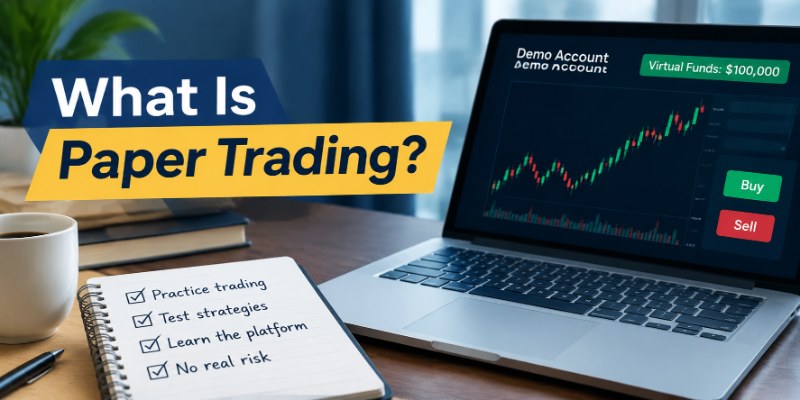
It is particularly useful for beginners who want to understand how trading works before committing capital. Experienced traders also use paper trading to test new strategies, practice risk management, and become familiar with trading platforms.
However, simulated results do not always reflect what happens in live markets. Understanding how paper trading works, what it can teach you, and where it falls short can help you use it more effectively.
Table of Contents
Paper trading is the practice of simulating financial market transactions without risking actual money. The term originally referred to writing down hypothetical buy and sell orders on paper and tracking their results.
Today, most paper trading takes place through online brokerage platforms and trading simulators. These tools provide virtual accounts with a set amount of simulated capital, allowing users to place hypothetical trades using real or delayed market prices.
For example, suppose you have $50,000 in virtual funds and want to practice trading stocks. You could use $5,000 of that balance to simulate purchasing 50 shares of a stock priced at $100.
If the share price rises to $110, your simulated position would show a $500 profit before transaction costs. If it falls to $90, the position would show a $500 loss.
Neither outcome affects your actual bank account.
Paper trading can be used to practice different financial instruments, including:
The exact instruments available depend on the trading simulator or brokerage platform.
Paper trading generally follows the same basic process as live trading, except that transactions use virtual money instead of real capital.
Most platforms provide a simulated trading account with an initial balance. Users can then select assets, place hypothetical orders, and monitor their positions.
Here is how the process typically works:
1. Open a paper trading account
Choose a broker or trading platform that offers a demo or paper trading account. Some platforms provide access without requiring an initial deposit.
2. Receive virtual funds
The platform assigns a simulated balance, such as $10,000, $50,000, or $100,000. This money is used exclusively for practice.
3. Select an asset
Choose a stock, currency pair, ETF, cryptocurrency, or another supported instrument that you want to trade.
4. Place simulated orders
You can practice different order types, including:
The platform processes these hypothetical orders according to its simulation rules.
5. Monitor performance
Track your open positions, account balance, unrealized gains and losses, and completed transactions.
6. Review and improve
Analyze your trades to identify mistakes, evaluate strategies, and improve your decision-making.
The objective is not simply to generate virtual profits. It is to develop a repeatable trading process that can be evaluated under different market conditions.
Although paper trading attempts to replicate real market activity, several important differences can affect the results.
| Feature | Paper Trading | Live Trading |
|---|---|---|
| Capital | Virtual funds | Real money |
| Financial risk | No direct capital loss | Actual financial losses possible |
| Execution | Simulated | Real market execution |
| Emotions | Usually less intense | Fear and greed affect decisions |
| Slippage | May be simplified | Can affect actual execution prices |
| Commissions | May be excluded or simulated | Depend on broker and instrument |
| Market impact | Usually not reflected | Can affect execution |
| Profits and losses | Hypothetical | Real financial outcomes |
One of the biggest differences is execution quality.
In a simulated account, an order may be filled at the displayed market price. In live trading, prices can change before an order is executed, particularly during periods of high volatility.
Liquidity also matters. A simulated platform may allow a trader to enter or exit a position easily, even when a real market would have limited buyers or sellers.
For this reason, profitable paper trading results should not be treated as proof that the same strategy will make money with real capital.
Paper trading offers several advantages, especially for people who are new to financial markets.
Beginners can learn how to read price charts, understand market movements, and place different types of orders without worrying about losing money.
It also provides an opportunity to become familiar with trading platforms, technical indicators, and other tools.
Traders can experiment with different approaches, such as:
For example, a trader could test whether buying a stock when its 50-day moving average crosses above its 200-day moving average produces consistent results.
By recording multiple trades, they can evaluate whether the strategy performs well across different market conditions.
Paper trading allows users to practice setting stop-loss and take-profit levels, calculating position sizes, and managing exposure.
A trader can also test how much of their simulated account they are willing to risk on a single position.
These habits can help establish a more disciplined approach before real money is involved.
Placing the first trade can feel intimidating, particularly for beginners unfamiliar with order execution and market volatility.
A simulated account provides an opportunity to become comfortable with the process. Traders can make mistakes, review them, and try different approaches without losing capital.
Paper trading can also help users evaluate brokerage platforms before opening or funding a live account.
They can explore charting features, available order types, watchlists, research tools, and the overall trading interface.
For example, Interactive Brokers provides a paper trading environment that allows users to practice with many of its trading tools. Its paper trading guide also explains some differences between simulated and live executions.
Despite its benefits, paper trading has limitations that traders should understand.
This is arguably the biggest limitation.
When trading with virtual money, a $1,000 loss may feel insignificant. When the same amount comes out of a real account, the emotional impact can be very different.
Fear, greed, hesitation, and overconfidence can influence decisions in live markets. A simulator cannot fully reproduce these psychological pressures.
Paper trading platforms do not always replicate real-world execution.
For example, a simulated order might be filled immediately at the displayed price, even when a live order could experience slippage or partial execution.
Some platforms also simplify liquidity, order-book depth, and transaction costs.
A trader who earns consistent simulated profits may assume they are ready to trade with substantial capital.
However, good results in a demo account do not guarantee similar performance in live markets.
A strategy that works under simulated conditions may struggle when execution costs, changing liquidity, and emotional pressure are introduced.
Depending on the platform, certain order types, financial instruments, and account functions may not be supported.
For example, complex options strategies or specialized order types may behave differently from their live-market equivalents.
Traders should check the simulator's limitations before using its results to evaluate a strategy.
Getting started does not require a large investment or advanced financial knowledge. A basic simulator and a clear practice plan are usually enough.
Follow these steps:
Step 1: Choose a trading simulator
Find a platform that supports the financial instruments you want to practice. Check whether it provides real-time market data, realistic order types, and performance tracking.
Step 2: Set a realistic virtual balance
Choose an amount similar to the capital you might eventually use in live trading.
For example, if you expect to start with $2,000, practicing with $100,000 in virtual funds may create unrealistic expectations about position sizing and risk.
Step 3: Develop a trading strategy
Before placing trades, establish clear rules for:
Step 4: Record every trade
Maintain a trading journal with the entry price, exit price, position size, trading reason, and outcome.
You should also record whether you followed your original trading plan.
Step 5: Review your performance
After completing a reasonable number of trades, evaluate your results.
Useful metrics include:
Looking at these metrics together provides a better picture of performance than focusing on profits alone.
There is no universal period for paper trading. The appropriate duration depends on your experience, strategy, and ability to follow a consistent trading plan.
Beginners may benefit from practicing for several weeks or months. More experienced traders might need less time when testing a familiar strategy on a new platform.
Rather than focusing exclusively on the number of days, consider whether you can demonstrate the following:
A strategy that produces a few profitable trades is not necessarily reliable. A larger sample of consistently executed trades provides more useful information.
Moving from paper trading to live trading should be based on preparation rather than excitement about simulated profits.
Before making the transition, make sure you understand the risks of the instruments you intend to trade and have demonstrated discipline in your simulated account.
If you decide to start trading live, consider these precautions:
It is also important to remember that live trading can involve commissions, spreads, financing charges, and other costs that reduce returns.
Paper trading should prepare you for these realities, not create the expectation that trading will be easy.
Paper trading and backtesting are both used to evaluate trading strategies, but they work differently.
| Feature | Paper Trading | Backtesting |
|---|---|---|
| Market data | Live or delayed prices | Historical prices |
| Trading process | Simulated trades | Historical simulation |
| Main purpose | Practice and strategy testing | Evaluate past strategy performance |
| Market conditions | Current or simulated | Previously recorded |
| Main limitation | Unrealistic execution and emotions | Overfitting and historical bias |
Paper trading evaluates how a strategy performs in a simulated trading environment as market prices change.
Backtesting applies trading rules to historical market data to estimate how the strategy would have performed in the past.
Both methods can be useful. Backtesting helps identify potentially promising strategies, while paper trading provides an opportunity to test them under current market conditions.
Yes. Paper trading is a useful starting point for beginners and a practical testing tool for experienced traders.
It helps users understand trading platforms, practice order execution, test strategies, and develop risk management habits without risking actual capital.
However, it should not be treated as a guarantee of future trading success. Simulated accounts cannot fully reproduce the financial pressure, execution challenges, and emotional decisions involved in live markets.
The best approach is to treat paper trading as a training environment. Focus on developing a consistent process, measuring performance, and learning from mistakes rather than chasing virtual profits.
Once you can follow your trading rules consistently, you will have a stronger foundation for deciding whether to move into live trading.
Many brokers and trading platforms offer free paper trading accounts. However, some platforms may require registration, a funded brokerage account, or a subscription to access certain features.
No. Paper trading uses virtual funds, so profits are simulated rather than withdrawable. To earn or lose actual money, you must place trades in a live account.
Yes. It allows beginners to learn market basics, practice placing orders, and understand trading strategies without risking their savings.
The terms are often used interchangeably. A demo account is a simulated trading environment provided by a broker or platform, while paper trading describes the broader practice of testing trades without real capital.
Some platforms provide real-time prices, while others use delayed or historical data. Check the platform's market data policy before relying on simulated results.
No. Paper trading can help evaluate a strategy, but simulated performance does not guarantee future profits. Real execution costs, liquidity, and psychological factors can produce different results.

728 RM B 7/F GEE LOK IND BLDG NO 34 HUNG TO RD KWUN TONG KLN HONG KONG


The risk of loss in trading financial instruments such as stocks, FX, commodities, futures, bonds, ETFs and crypto can be substantial. You may sustain a total loss of the funds that you deposit with your broker. Therefore, you should carefully consider whether such trading is suitable for you in light of your circumstances and financial resources.
No decision to invest should be made without thoroughly conducting due diligence by yourself or consulting with your financial advisors. Our web content might not suit you since we don't know your financial conditions and investment needs. Our financial information might have latency or contain inaccuracy, so you should be fully responsible for any of your trading and investment decisions. The company will not be responsible for your capital loss.
Without getting permission from the website, you are not allowed to copy the website's graphics, texts, or trademarks. Intellectual property rights in the content or data incorporated into this website belong to its providers and exchange merchants.
Not Logged In
Log in to access more features


Log In
Sign Up


