


- WTI
- XAUUSD
- XAGUSD
- USDX


Markets
Analysis
User
24/7
Economic Calendar
Education
Data
- Names
- Latest
- Prev









What is a stock option? Learn how employee stock options work, how much you can earn, when you can sell them, and what taxes you may owe.
An employee stock option gives you the right to buy company shares at a predetermined price, usually after meeting vesting requirements. It can become valuable if the stock price rises, but receiving options does not guarantee a profit. Understanding when you can exercise them, what they cost, and how you make money is essential.
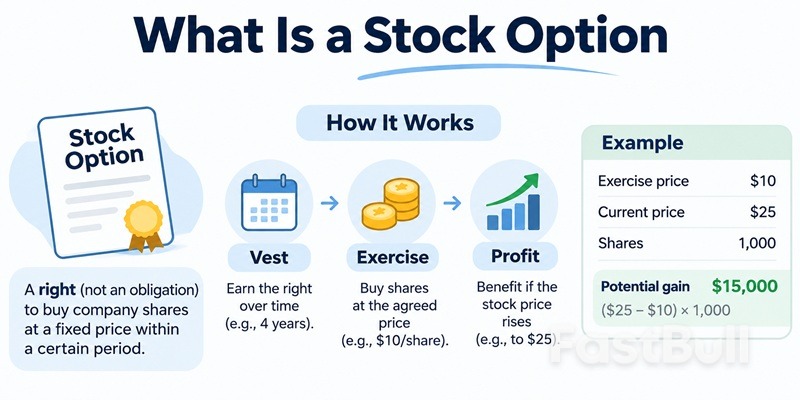
A stock option is a contract that gives someone the right, but not the obligation, to buy shares at a fixed price before a specified expiration date. When offered by an employer, it is a form of equity compensation that allows employees to benefit from the company's growth.
For example, a company might grant you 1,000 stock options with an exercise price of $10 per share. If the company's stock later reaches $25, you could potentially buy those shares for $10 each, creating a $15 difference per share.
However, receiving 1,000 options does not mean you immediately own 1,000 shares. You must typically wait for the options to vest and then exercise them to acquire the stock.
Are stock options part of your salary? They can be part of your total compensation package, alongside your base salary and bonuses. However, stock options are not cash wages, and their eventual value is uncertain. A job offer that includes $20,000 worth of stock options does not necessarily mean you will receive $20,000 in cash.
Companies offer stock options to attract employees, encourage long-term retention, and give workers a financial interest in business performance.
It is also important to distinguish employee stock options from options traded on financial exchanges. Investors trade call and put options to gain exposure to stock price movements or manage risk. Employee stock options, by contrast, are generally granted as compensation and usually cannot be freely traded.
Employee stock options typically move through three stages: grant, vesting, and exercise. Each determines when you receive the right to buy shares, how much you must pay, and whether the options have financial value.
Grant: Your employer awards you a specified number of options under an agreement that establishes the exercise price (also called the strike price), vesting schedule, and expiration date. The exercise price is usually fixed when the options are granted.
Vesting: You earn the right to exercise your options over time. For example, under a four-year vesting schedule with a one-year cliff, 25% of your options may vest after your first year, with the remainder vesting monthly over the following three years. Actual schedules vary by company.
Exercise: Once options are vested and exercisable, you can use them to purchase company shares at the agreed exercise price. Depending on the plan, you may need to pay the purchase cost yourself or use a cashless exercise arrangement.
Vesting and exercising are not the same thing. Vesting gives you the right to purchase shares, while exercising converts that right into stock ownership. Exercising may also trigger taxes, depending on the type of option.
Suppose you have 1,000 fully vested stock options with a $10 exercise price. The company's shares are now trading at $25.
| Item | Amount |
|---|---|
| Vested stock options | 1,000 |
| Exercise price per share | $10 |
| Current stock price | $25 |
| Total exercise cost | $10,000 |
| Market value of shares | $25,000 |
| Potential gain before taxes and fees | $15,000 |
The calculation is straightforward:
Potential gain = (Stock Price − Exercise Price) × Number of Shares
($25 − $10) × 1,000 = $15,000
If you could exercise and immediately sell all the shares at $25, the difference would be $15,000 before taxes and transaction costs. If you exercise but keep the shares, that difference is not cash you have received, and the stock price could change before you sell.
What if the stock price falls to $7? Exercising at $10 would mean paying more than the shares' current market value. In that situation, employees would generally avoid exercising unless there were other reasons to do so. The options could regain value if the stock recovers before expiration, but they could also expire worthless.
The key point: Stock options create an opportunity to profit from rising share prices, not a guaranteed payment. Their actual value depends on the exercise price, vesting conditions, expiration date, taxes, and whether you can sell the shares.
You generally cannot sell employee stock options directly because most plans restrict transfers. To turn them into cash, you usually need to exercise your vested options, receive company shares, and then sell those shares when permitted.
How quickly you can receive money depends largely on whether your employer is publicly traded or privately held.
Public companies: If the shares are publicly traded, you may be able to exercise and sell them immediately through a cashless exercise, subject to company trading windows, securities laws, and other restrictions. The sale proceeds can cover the exercise cost and applicable tax withholding, with the remaining amount paid to you.
Private companies: Selling shares can be much harder. Even after exercising your options, you may have to wait for an IPO, acquisition, approved secondary sale, or company share repurchase. Some employees pay to exercise options but cannot immediately recover that money.
What happens if you leave your job? Unvested options are typically forfeited, while vested options may remain exercisable for a limited period. Some plans provide a 90-day window, although deadlines vary. For ISOs, exercising more than three months after leaving employment generally means losing favorable ISO tax treatment, subject to exceptions.
Options also have expiration dates. If you fail to exercise before the applicable deadline, they generally expire without value, even if the company has performed well.
Before exercising, check your plan documents for the expiration date, post-termination exercise window, total purchase cost, and restrictions on selling the resulting shares.
In the United States, stock option taxes depend mainly on the type of option you receive and when you exercise or sell your shares. The two common categories are Incentive Stock Options (ISOs) and Nonqualified Stock Options (NSOs).
| Tax Feature | ISO | NSO |
|---|---|---|
| At grant | Generally no tax | Generally no tax |
| At exercise | No regular income tax, but AMT may apply | The spread is generally taxed as ordinary compensation income |
| When shares are sold | May qualify for long-term capital gains treatment | Post-exercise gains or losses are generally capital gains or losses |
With an NSO, suppose you exercise 1,000 options at $10 when the shares are worth $25. The $15,000 difference is generally treated as taxable compensation income at exercise, even if you keep the shares rather than sell them. Any subsequent increase or decrease in share value is generally treated as a capital gain or loss when you sell.
ISOs offer different treatment. You generally owe no regular federal income tax when exercising, but the difference between the exercise price and fair market value can create an Alternative Minimum Tax (AMT) adjustment. This means you could owe taxes before receiving cash from selling shares.
To qualify for favorable long-term capital gains treatment under the regular federal tax rules, ISO shares generally must be sold more than two years after the grant date and more than one year after exercise. Selling earlier can cause part of the gain to be taxed as ordinary income.
What is the $100,000 rule for stock options? Under U.S. tax rules, no more than $100,000 in grant-date fair market value of shares underlying ISOs can first become exercisable in a single calendar year. Any excess is treated as NSOs for tax purposes.
For example, if 6,000 options covering shares valued at $20 each on the grant date first become exercisable in one year, the total is $120,000. Assuming no other relevant grants, the excess $20,000 in grant-date share value, representing 1,000 options, would receive NSO treatment.
This limit is based on the shares' value when the options were granted, not your eventual profit. For detailed U.S. tax rules, consult the IRS stock options guidance.
Stock options can be valuable compensation, especially at a growing company, but they are not always better than cash or other equity awards. Their value depends on the company's performance, your exercise price, and your ability to convert shares into cash.
Understanding how stock options compare with other compensation can help you evaluate a job offer:
| Compensation | Main Advantage | Main Limitation |
|---|---|---|
| Stock Options | Potential gains if the share price rises above the exercise price | May require upfront cash and can expire worthless |
| RSUs | Shares generally delivered without an exercise payment | Value fluctuates with the stock price; vesting and liquidity restrictions apply |
| Cash Bonuses | Predictable cash value once earned and paid | No additional gains from future stock appreciation |
Stock options may be particularly attractive if the exercise price is low relative to the company's future share value and you expect to remain employed long enough to vest. However, even valuable options can become difficult to use if exercising requires substantial cash or the shares cannot be sold.
When evaluating an offer, ask how many options you will receive, what percentage of the company they represent on a fully diluted basis, the exercise price, vesting schedule, and how employees can eventually sell shares. Also consider possible dilution from future fundraising and whether you can afford the exercise costs and taxes.
Stock options should be evaluated as potential future compensation, not guaranteed income. A strong base salary combined with reasonable equity upside may be more financially secure than accepting a significantly lower salary in exchange for options with an uncertain payout.
Conclusion: Employee stock options provide an opportunity to benefit from a company's success, but their value depends on more than rising share prices. Exercise costs, vesting requirements, tax treatment, and liquidity all affect how much money you ultimately receive. Understanding these conditions helps you make better compensation decisions.

728 RM B 7/F GEE LOK IND BLDG NO 34 HUNG TO RD KWUN TONG KLN HONG KONG


The risk of loss in trading financial instruments such as stocks, FX, commodities, futures, bonds, ETFs and crypto can be substantial. You may sustain a total loss of the funds that you deposit with your broker. Therefore, you should carefully consider whether such trading is suitable for you in light of your circumstances and financial resources.
No decision to invest should be made without thoroughly conducting due diligence by yourself or consulting with your financial advisors. Our web content might not suit you since we don't know your financial conditions and investment needs. Our financial information might have latency or contain inaccuracy, so you should be fully responsible for any of your trading and investment decisions. The company will not be responsible for your capital loss.
Without getting permission from the website, you are not allowed to copy the website's graphics, texts, or trademarks. Intellectual property rights in the content or data incorporated into this website belong to its providers and exchange merchants.
Not Logged In
Log in to access more features


Log In
Sign Up