Markets
News
Analysis
User
24/7
Economic Calendar
Education
Data
- Names
- Latest
- Prev


Signal Accounts for Members
All Signal Accounts
All Contests


U.K. Trade Balance (Oct)A:--
F: --
P: --
U.K. Services Index MoMA:--
F: --
P: --
U.K. Construction Output MoM (SA) (Oct)A:--
F: --
P: --
U.K. Industrial Output YoY (Oct)A:--
F: --
P: --
U.K. Trade Balance (SA) (Oct)A:--
F: --
P: --
U.K. Trade Balance EU (SA) (Oct)A:--
F: --
P: --
U.K. Manufacturing Output YoY (Oct)A:--
F: --
P: --
U.K. GDP MoM (Oct)A:--
F: --
P: --
U.K. GDP YoY (SA) (Oct)A:--
F: --
P: --
U.K. Industrial Output MoM (Oct)A:--
F: --
P: --
U.K. Construction Output YoY (Oct)A:--
F: --
P: --
France HICP Final MoM (Nov)A:--
F: --
P: --
China, Mainland Outstanding Loans Growth YoY (Nov)A:--
F: --
P: --
China, Mainland M2 Money Supply YoY (Nov)A:--
F: --
P: --
China, Mainland M0 Money Supply YoY (Nov)A:--
F: --
P: --
China, Mainland M1 Money Supply YoY (Nov)A:--
F: --
P: --
India CPI YoY (Nov)A:--
F: --
P: --
India Deposit Gowth YoYA:--
F: --
P: --
Brazil Services Growth YoY (Oct)A:--
F: --
P: --
Mexico Industrial Output YoY (Oct)A:--
F: --
P: --
Russia Trade Balance (Oct)A:--
F: --
P: --
Philadelphia Fed President Henry Paulson delivers a speech
Canada Building Permits MoM (SA) (Oct)A:--
F: --
P: --
Canada Wholesale Sales YoY (Oct)A:--
F: --
P: --
Canada Wholesale Inventory MoM (Oct)A:--
F: --
P: --
Canada Wholesale Inventory YoY (Oct)A:--
F: --
P: --
Canada Wholesale Sales MoM (SA) (Oct)A:--
F: --
P: --
Germany Current Account (Not SA) (Oct)A:--
F: --
P: --
U.S. Weekly Total Rig CountA:--
F: --
P: --
U.S. Weekly Total Oil Rig CountA:--
F: --
P: --
Japan Tankan Large Non-Manufacturing Diffusion Index (Q4)--
F: --
P: --
Japan Tankan Small Manufacturing Outlook Index (Q4)--
F: --
P: --
Japan Tankan Large Non-Manufacturing Outlook Index (Q4)--
F: --
P: --
Japan Tankan Large Manufacturing Outlook Index (Q4)--
F: --
P: --
Japan Tankan Small Manufacturing Diffusion Index (Q4)--
F: --
P: --
Japan Tankan Large Manufacturing Diffusion Index (Q4)--
F: --
P: --
Japan Tankan Large-Enterprise Capital Expenditure YoY (Q4)--
F: --
P: --
U.K. Rightmove House Price Index YoY (Dec)--
F: --
P: --
China, Mainland Industrial Output YoY (YTD) (Nov)--
F: --
P: --
China, Mainland Urban Area Unemployment Rate (Nov)--
F: --
P: --
Saudi Arabia CPI YoY (Nov)--
F: --
P: --
Euro Zone Industrial Output YoY (Oct)--
F: --
P: --
Euro Zone Industrial Output MoM (Oct)--
F: --
P: --
Canada Existing Home Sales MoM (Nov)--
F: --
P: --
Euro Zone Total Reserve Assets (Nov)--
F: --
P: --
U.K. Inflation Rate Expectations--
F: --
P: --
Canada National Economic Confidence Index--
F: --
P: --
Canada New Housing Starts (Nov)--
F: --
P: --
U.S. NY Fed Manufacturing Employment Index (Dec)--
F: --
P: --
U.S. NY Fed Manufacturing Index (Dec)--
F: --
P: --
Canada Core CPI YoY (Nov)--
F: --
P: --
Canada Manufacturing Unfilled Orders MoM (Oct)--
F: --
P: --
Canada Manufacturing New Orders MoM (Oct)--
F: --
P: --
Canada Core CPI MoM (Nov)--
F: --
P: --
Canada Manufacturing Inventory MoM (Oct)--
F: --
P: --
Canada CPI YoY (Nov)--
F: --
P: --
Canada CPI MoM (Nov)--
F: --
P: --
Canada CPI YoY (SA) (Nov)--
F: --
P: --
Canada Core CPI MoM (SA) (Nov)--
F: --
P: --
Canada CPI MoM (SA) (Nov)--
F: --
P: --


No matching data
Latest Views
Latest Views
Trending Topics
Top Columnists
Latest Update
White Label
Data API
Web Plug-ins
Affiliate Program
View All

No data
Cryptocurrencies are becoming a core part of the economy in Venezuela as citizens turn to digital assets to shield themselves from a collapsing currency and tighter government controls.
From small family stores to large retail chains, shops across the country now accept crypto through platforms such as Binance and Airtm. Some businesses even use stablecoins to pay employees, while universities have begun offering courses dedicated to digital assets.
“There’s lots of places accepting it now,” shopper Victor Sousa, who paid for phone accessories with USDt (USDT), told the Financial Times. “The plan is to one day have my savings in crypto.”
Venezuela ranked 13th globally for crypto adoption, according to the Chainalysis 2024 Crypto Adoption Index report, which noted a 110% increase in usage in the year.
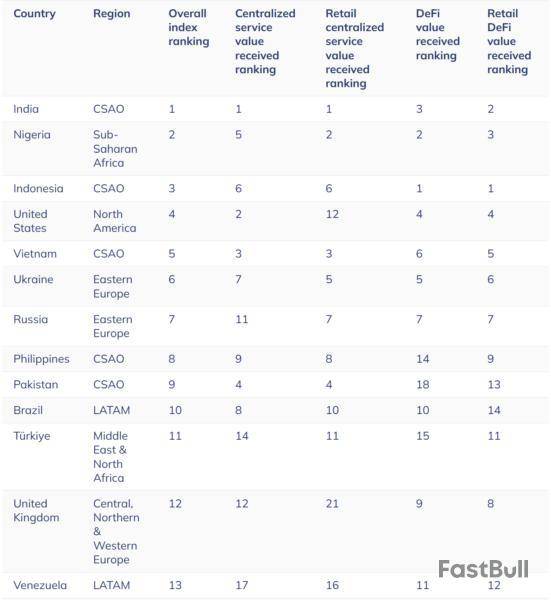
Bolívar’s crash pushes Venezuelans into crypto
The continued slide of the bolívar currency has intensified demand for crypto. Since the government stopped defending the currency in October, it has lost more than 70% of its value. Inflation reached 229% in May, according to the Venezuelan Finance Observatory (OVF).
“Venezuelans started using cryptocurrencies out of necessity,” said economist Aarón Olmos. He noted that they face inflation, low wages, foreign currency shortages and difficulty opening bank accounts.
However, access is not always smooth. With US sanctions on Venezuela’s financial sector, Binance restricts services linked to sanctioned banks and individuals. Connectivity issues also hinder widespread use. Still, experts say the ecosystem is resilient, per the FT report.
The government’s stance on crypto remains inconsistent. Venezuela launched its own digital currency, the petro, in 2018, but the project collapsed last year. The main exchange regulator was shut down in 2023 following corruption allegations tied to oil-linked transactions.
Cointelegraph reached out to Binance for comment, but had not received a response by publication.
Crypto remittances surge in Venezuela
As Cointelegraph reported, crypto remittances have become a crucial lifeline for Venezuelans as the country’s economy sinks deeper into crisis. In 2023, digital assets made up 9% of the $5.4 billion in remittances sent home, about $461 million.
Families are increasingly relying on cryptocurrencies over traditional services like Western Union, which are weighed down by high fees, delays and currency shortages.
Meanwhile, military tensions are rising between the US and Venezuela. On Tuesday, Venezuela’s defense minister announced the deployment of naval vessels and drones to patrol the country’s Caribbean coast following Washington’s decision to send an amphibious squadron of three warships, joined later by a missile cruiser and a nuclear-powered submarine, to the region.
The buildup comes after the Trump administration accused President Nicolás Maduro of working with cartels and expanded its pursuit of Venezuelan leaders, doubling the reward for Maduro’s capture to $50 million and offering $25 million for Interior Minister Diosdado Cabello.
TL;DR
Whale Wallets Reduce Exposure as Price Climbs
Recent data from CryptoQuant shows large XRP holders have been moving funds out of their positions. The data, shared by analyst Maartunn, points to steady selling activity from whale wallets. These exits began building up in late 2024 and became more visible in 2025.
XRP Whales are selling heavily
It’s clear distribution. On-chain data tells the story. In data, we trust. pic.twitter.com/MoMk1Fx4Lg
— Maartunn (@JA_Maartun) August 27, 2025
Notably, the chart shows a clear shift toward outflows, which tends to happen when large investors begin reducing exposure. Despite the price continuing to rise during this period, the selling suggests thatmajor holdersare not buying into the rally. Instead, they appear to be handing over their positions to retail buyers.
A short pause in this pattern was observed around the middle of the year, but selling picked up again not long after. The overall trend has stayed consistent since, with large accounts continuing to move assets out of long-term storage.Positive Sentiment Grows Among Retail Traders
According to data from Coinalyze, traders remain optimistic. The current funding rate stands at 0.0114. The predicted funding rate is even higher at 0.0159. Both rates suggest that many participants expect XRP to move higher and are paying fees to hold long positions.
At the same time, open interest has edged up to $2.875 billion. This increase shows that more traders are using leverage as they anticipate more upward movement. With funding rates high and open interest climbing, retail confidence appears strong.
However, when retail traders increase leverage while large holders exit, price swings tend to follow. This often results in higher volatility, especially if new inflows can’t keep up with the selling pressure from larger wallets.Chart Levels to Watch in the Short Term
XRP closed the last daily session with strength, setting a new short-term high. A report from CRYPTOWZRD noted that the price action was led by the XRP/BTC pair. The daily candle finished in the green, and momentum is currently with the bulls. Traders are now watching lower time frames for a possible scalp trade.
XRP Daily Technical Outlook:$XRP closed strongly bullish and made a new Daily high, which is a sign of very strong upside momentum. XRPBTC led the move, and I expect to see more volatility tomorrow to get a quick scalp opportunity from it pic.twitter.com/UmRQO40pgp
— CRYPTOWZRD (@cryptoWZRD_) August 27, 2025
On the intraday chart, $2.94 served as a support area. A bounce from that level could open room for new long positions. On the upside, a clean break above $3.13 may offer another entry point. Until one of these levels is clearly broken, many traders are staying patient and waiting for confirmation.Price Action and New XRP Rewards Card
As of press time, theXRP pricewas trading above $3. Over the past 24 hours, the price has risen by 4%. Over the week, the gain stands at 4%. The daily trading volume was $6.63 billion, and the asset moved between $2.89 and $3.05 during that period.
In other developments, Gemini has teamed up with Ripple to release a new credit card linked to XRP. Issued in partnership with WebBank, the card gives users 4% cash back in XRP on fuel, EV charging, and ride services. It offers 3% back on dining, 2% on groceries, and 1% on all other spending.
Gemini said it is also working with select merchants to offer as much as 10% back on certain purchases.
0740 GMT - Bitcoin stays under pressure after hitting a nearly seven-week low in the previous session. The cryptocurrency has continued to consolidate from the record high reached earlier in August. It briefly recovered after Federal Reserve Chair Jerome Powell signalled interest-rate cuts could resume shortly, boosting risky assets. However, it has since retreated with crypto news outlets attributing the decline to a bitcoin whale--an investor with large holdings of the cryptocurrency--offloading the asset. Bitcoin falls 0.5% to $110,852 after hitting a low of $108,829 Tuesday, LSEG data show. It reached an all-time high of $124,480 on August 14.(renae.dyer@wsj.com)
0733 GMT - The March 2028 gilt trades cheap as yields on the bond have risen from 3.834% on August 1 to 4.024% currently, Tradeweb data show. The cheap valuation is likely to support the gilt when it is auctioned at 0900 GMT, RBC Capital Markets strategists say in a note. Wednesday's sale could be the final tap of the bond, before a new 3-year benchmark bond is launched, the strategists say. (miriam.mukuru@wsj.com)
0725 GMT - The euro could correct lower after recent gains against the dollar due to eurozone debt concerns, Commerzbank's Antje Praefcke says in a note. French Prime Minister Francois Bayrou's government is expected to be toppled in a confidence vote next month over its plans to cut the budget deficit. This highlights how the euro could weaken if euro-area debt gets out of hand, Praefcke says. If vulnerable eurozone countries fail to implement reforms, this could increase pressure on the EU to take on joint debt and on the European Central Bank to push down yields through additional bond purchases and/or a lower interest rates. "That, in turn, would be negative for the euro." The euro falls 0.2% to $1.1616. (renae.dyer@wsj.com)
0709 GMT - The mood among German consumers is getting uglier, offering little hope of an economic recovery powered by household spending, Claus Vistesen at Pantheon Macroeconomics warns. A forecast of sentiment among German consumers compiled by GfK slipped to minus 23.6 for September, furthering a trend of weaker confidence as Europe's largest economy struggles to gain traction. "This is a warning shot for consumer spending," though a major consumption boom was never likely anyway, Vistesen says. (joshua.kirby@wsj.com; @joshualeokirby)
0641 GMT - The dollar recovers marginally but lingering concerns about the Federal Reserve's independence keep the currency at weaker levels. President Trump said on Monday he would fire Federal Reserve Governor Lisa Cook effective immediately over allegations of mortgage fraud. Cook is suing Trump with her attorney saying the claims lack any factual or legal basis. Trump's move raises fresh worries about the Fed's independence as the president puts pressure on the central bank to cut interest rates. If Cook were replaced, the majority of the Fed's board could be in favor of rate cuts following the appointment of Trump ally Stephen Miran, Deutsche Bank analysts say in a note. The DXY dollar index rises 0.2% to 98.392, having fallen as low as 98.085 on Tuesday, LSEG data show. (renae.dyer@wsj.com)
0627 GMT - This week's surge in French political risk doesn't bode well for the coming rating reviews from Fitch Ratings on Sept. 12, Moody's Ratings on Oct. 24, and S&P Global Ratings on Nov. 28, Citi's rates strategists say in a note. "All three ratings are at AA- and any downgrade would take France to the single-A tier," they say. On Monday, French Prime Minister Francois Bayrou called a confidence vote for Sept. 8, as his administration struggles to gain support for deep spending cuts. The 10-year French OAT yield is flat at 3.498%, while the 10-year German Bund yield is up 0.3 basis point at 2.727%, according to Tradeweb. (emese.bartha@wsj.com)
0618 GMT - Shares in French banks sold off after the country's prime minister called a confidence vote, pushing government bond yields up and weighing on the sector. Equity investors bid up bank's cost of equity on fears of political instability and a potential sovereign-credit downgrade, Jefferies analysts Joseph Dickerson and Theo Massing write. "We see this as more of a cost of equity issue near term, given this is a prospective economic growth matter more than anything else," they say. A government collapse could lead to economic players taking a wait-and-see approach toward France with focus shifting back to the country's fiscal trajectory if the 2026 budget fails to pass. "This approach has already been factored into allocation decisions following the events of last summer," they say, referring to a previous political crisis. (elena.vardon@wsj.com)
0609 GMT - Tariff-related pressure on Asia-Pacific companies' credit quality is expected to intensify in the coming quarters, S&P Global Ratings says. About 12% of rated Asia-Pacific issuers face material tariff-related impact, with roughly 40% of that group carrying a negative outlook, credit analyst Simon Wong says. The auto sector faces the most direct tariff impact, while chemicals and metals-and-mining companies are most exposed to indirect effects, he notes. "While the latest U.S. tariff differential among Asia-Pacific countries has narrowed, we believe trade flows and supply chains will continue to reshape," Wong says. "This presents a category of risk in itself." (jihye.lee@wsj.com)
0606 GMT - U.S. Treasury yields rise in Asian trade, reversing Tuesday's falls which came after President Trump's move to fire Federal Reserve governor Lisa Cook on alleged fraudulent information on mortgage applications. "Markets fear that if Trump succeeds in ousting Cook--and he has often tested limits successfully--he could tilt decision-making at the Fed in his favour, indirectly influencing policy," says Swissquote Bank's Ipek Ozkardeskaya in a note. Wednesday's potential Treasury drivers include a $70 billion auction of five-year notes, while the U.S. data calendar is light ahead of key indicators Thursday and Friday. The two-year Treasury yield rises 1.8 basis points to 3.661%; the 10-year yield is up 1.7 basis points at 4.272%, while the 30-year yield is up 1.6 basis points at 4.924%, according to Tradeweb. (emese.bartha@wsj.com)
0552 GMT - The fact that the Federal Reserve's flexible average inflation targeting is gone matters, because the Fed will view potential deviations from targets in a different manner under the new policy framework, says MFS Investment Management's Benoit Anne in a note. No more averaging and it means that potentially the Fed may have to be a bit more reactive under certain circumstances, the head of MFS IM's market insights group says. The other important consideration that is covered by the new policy strategy is that the relative importance of the employment mandate appears to have been upgraded, he says. (emese.bartha@wsj.com)
0548 GMT - UBS lowers its long U.S. five-year Treasury yield target to 3.60% from 3.70% previously, following the Federal Reserve's Jackson Hole Symposium, strategist Reinout De Bock says in a note. UBS, meanwhile, is looking for a better entry point, he says. "[We] are waiting for better entry points to go long the front-end ahead of the release of the August jobs report on Friday, September 5," the strategist says. The five-year Treasury yield rises 1.7 basis points to 3.754%, according to LSEG. The new stop level to the trade is 3.90%. (emese.bartha@wsj.com)
0543 GMT - September looks like the last chance for the European Central Bank to lower interest rates in the eurozone, Pantheon Macroeconomics' Claus Vistesen and Melanie Debono write in a note. The bank at its last meeting in July held its key rate at 2.00%, and investors now mostly expect the governing council to keep its hands off the scissors and next month's meeting in Frankfurt. That could change if consumer-price inflation proves weaker than expected in August, Vistesen and Debono say, with figures for eurozone CPI due to be released next week. Inflation is meanwhile likely to spike further ahead as energy and good prices gain pace, the economists say." The window for further easing this year will slam shut as inflation rebounds from September," they say. (joshua.kirby@wsj.com; @joshualeokirby)
XRP set a new benchmark on Wall Street’s largest crypto trading venue, the Chicago Mercantile Exchange (CME). Ripple’s powering token became the fastest CME contract in history to surpass $1 billion in open interest (OI).
The token crossed this milestone in just over three months since launching in May 2025.
Record Futures Growth Sparks Fresh Speculation Over Spot XRP ETF Approval
The CME Group confirmed the achievement in an update on August 26, describing it as a sign of increasing maturity in crypto derivatives markets.
“Our Crypto futures suite just surpassed $30 billion in notional open interest for the first time ever. Our SOL and XRP futures, along with ETH options, each crossed $1 billion in OI, with XRP being the fastest-ever contract to do so, hitting the mark in just over 3 months. This is a huge sign of market maturity, with new capital entering the market,” CME wrote.
The speed of XRP’s rise on CME has fueled a fresh round of speculation about the potential for a spot XRP ETF.
Nate Geraci, president of the ETF Store, noted that XRP already has over $800 million in futures-based ETFs. In his opinion, the demand for spot products is being underestimated.
“CME Group says XRP futures contracts have crossed over $1B in open interest… fastest-ever contract to do so. There’s already $800+ million in futures-based XRP ETFs. Think people might be underestimating demand for spot XRP ETFs,” he said.
Prediction markets appear to agree, currently assigning an 82% chance that a Ripple-backed ETF will be approved before the end of 2025.
The milestone comes against the backdrop of XRP’s paradoxical market position. With a market capitalization of around $178 billion, XRP is the world’s third-largest cryptocurrency.
On paper, it is bigger than asset management giant BlackRock, whose market capitalization was $176 billion as of this writing.
Yet, according to Nate Geraci, it remains among professionals’ most disparaged assets. Pro-XRP attorney John E. Deaton reinforced that view.
“XRP is the single most hated crypto by institutional and professional traders/holders. XRP is the most loved crypto by retail investors/holders,” wrote Deaton.
This tension between institutional skepticism and grassroots loyalty has defined XRP’s trajectory for a long time.
Retail holders have embraced it as a token with utility-driven potential, hence the “XRP has cult-like following” adage.
Meanwhile, institutions remain cautious due to Ripple’s recently concluded but longstanding legal battles with US regulators.
Futures Momentum Meets Skepticism Over XRP’s Long-Term Value
However, not everyone is convinced that XRP’s futures success will translate into long-term value.
Some critics argue that stablecoins, smart contracts, and oracle solutions like Chainlink have eclipsed the asset’s original function as a bridge currency.
They contend that bridge tokens face structural limitations, since every purchase for transaction purposes is matched by an immediate sale, producing neutral demand pressure.
The XRP Ledger itself has also been criticized for limited adoption and functionality compared to more feature-rich networks.
While the momentum on CME speaks for itself, investors are impatient about the XRP price.
As of this writing, XRP was trading for $3.00, up by over 3% in the last 24 hours.
XRP’s surge to $1 billion in open interest suggests that capital flows into the asset at scale. This may be toward speculating, hedging, or gaining exposure to potential regulatory breakthroughs.
If regulators approve a spot ETF, it would mark a critical test of whether XRP’s loyal retail base. It could also reveal whether a growing futures market can translate into sustained institutional adoption.
Google Cloud is building its own blockchain network, named Google Cloud Universal Ledger (GCUL), for the financial sector, according to Rich Widmann, Google Cloud's Web3 Head of Strategy, who announced this on Tuesday.
Widmann wrote in a LinkedIn post that GCUL aims to provide financial institutions with a "performant, credibly neutral" blockchain platform that enables Python-based smart contracts.
"Besides bringing to bear Google's distribution, GCUL is a neutral infrastructure layer," Widmann said in the post. "Tether won't use Circle's blockchain - and Adyen probably won't use Stripe's blockchain. But any financial institution can build with GCUL."
GCUL is currently in a private testnet, and further details will be revealed at a later date, according to Widmann's post.
Google Cloud officially described GCUL as a new service for the financial market, accessible through a single API and programmable to enable payment automation and digital asset management. The company also stated that GCUL was designed with a focus on compliance and will operate as a private, permissioned system.
While Widmann described GCUL as a Layer 1 network, the permissioned and private nature of Google Cloud's upcoming blockchain has resulted in community skepticism, with some arguing that it should not be mistakenly described as a decentralized blockchain.
Google Cloud had previously announced the GCUL initiative in March, in collaboration with the CME Group, where CME was piloting solutions on the platform for use in wholesale payments and asset tokenization.
Disclaimer: The Block is an independent media outlet that delivers news, research, and data. As of November 2023, Foresight Ventures is a majority investor of The Block. Foresight Ventures invests in other companies in the crypto space. Crypto exchange Bitget is an anchor LP for Foresight Ventures. The Block continues to operate independently to deliver objective, impactful, and timely information about the crypto industry. Here are our current financial disclosures.
© 2025 The Block. All Rights Reserved. This article is provided for informational purposes only. It is not offered or intended to be used as legal, tax, investment, financial, or other advice.
US Commerce Secretary Howard Lutnick said the Department of Commerce will begin publishing economic statistics, including gross domestic product (GDP) data, on the blockchain.
Lutnick made the announcement during a White House cabinet meeting on Tuesday, describing the effort as a move to expand blockchain-based data distribution across government agencies. Speaking to US President Donald Trump and other government officials, he said:
Lutnick said the initiative will begin with GDP figures and could expand across federal departments after the Commerce Department finishes “ironing out all of the details” for the implementation.
Global adoption shows blockchain’s potential for governments
Other governments have already adopted the technology in public administration.
In 2016, Estonia’s government integrated Guardtime’s KSI blockchain into its e-Health system to secure over a million patient records. The same infrastructure now underpins parts of its digital ID network, making the Baltic nation an early pioneer.
In 2018, the European Commission and the European Blockchain Partnership launched the European Blockchain Services Infrastructure (EBSI), a permissioned network built on Hyperledger Besu. Member states such as France, Slovenia and Denmark host validator nodes, giving it a decentralized structure designed to deliver cross-border public services that are verifiable and trustworthy.
In 2021, Singapore and Australia trialed a blockchain system to issue and verify cross-border trade documents, reducing paperwork and cutting costs. And in 2024, California’s Department of Motor Vehicles digitized 42 million car titles on a permissioned Avalanche blockchain to curb lien fraud and streamline vehicle transfers.
Before his fallout with US President Donald Trump, Elon Musk floated the idea of running parts of the US government on the blockchain, a proposal that drew comparisons to Europe’s EBSI project.
Blockchain can record data, but can’t control its accuracy
The plan comes as Trump has repeatedly questioned the reliability of US economic data.
In April, he downplayed a 0.3% first-quarter GDP contraction as a tariff-driven blip, and in May, he dismissed a Congressional Budget Office forecast of 1.8% growth as biased while predicting the economy could expand by as much as 9%.
On Aug. 1, Trump fired Bureau of Labor Statistics Commissioner Erika McEntarfer after a July jobs report showed only 73,000 new positions and sharp downward revisions to earlier months, accusing her of releasing “rigged” data and sparking alarm among economists.
As Cointelegraph has reported, blockchain offers governments advantages for handling data, from tamper-proof recordkeeping and secure digital identities to transparent information sharing and auditable transactions.
However, while the technology can secure how data is stored and shared, it does not address the accuracy of the data itself.
Trade Secrets: Elon Musk Dogecoin pump incoming? SOL tipped to hit $300 in 2025
Key takeaways:
Solana struggles to sustain $200 as onchain activity weakens and leveraged demand remains subdued.
A spot ETF approval and institutional support could lift SOL, but current fundamentals suggest limited rally potential.
Solana’s native token (SOL) has repeatedly failed to hold levels above $200 over the past six weeks, leading traders to question what is limiting the upside. The concern is heightened by the fact that competitors Ether (ETH) and BNB (BNB) recently reached new all-time highs.
The potential approval of a Solana spot exchange-traded fund (ETF) in the United States, combined with companies signaling intentions to add SOL to their corporate reserve strategies, could push the token above $250. However, three conditions must be met before a sustainable rally can take hold.
Sluggish onchain and futures data makes investors cautious
For SOL buyers to regain confidence, onchain activity on Solana must strengthen. Network fees fell 17% compared with the prior week, while the number of transactions dropped 10%. Meanwhile, fees on BNB Chain rose 6%, while transaction levels remained flat. Ethereum’s layer-2 activity also showed growth, with transactions on Base rising 14% and Arbitrum gaining 20%.
In relative terms, Solana’s fee levels remain notable given the network’s $12.5 billion in total value locked (TVL), compared with Ethereum’s nearly $100 billion. Still, Solana’s chain revenue has declined 91% from January’s peak, a downturn that coincided with the launch of the Official Trump (TRUMP) token and the broader memecoin frenzy.
The lack of demand for bullish leverage on SOL futures adds to the cautious sentiment.
In neutral conditions, perpetual futures typically show an annualized premium between 8% and 14%, reflecting capital costs and counterparty risk. The current 10% rate indicates balanced demand, which is not inherently negative, but it is mildly concerning given that SOL’s price has already gained 39% over the past two months.
Binance’s top-trader long-to-short ratio has shifted sharply toward bearish positioning. This indicator provides a broader measure of sentiment since it incorporates futures, margin, and spot markets.
Demand for bullish SOL exposure on Binance reached a monthly high last Saturday but has since dropped significantly. According to derivatives data, whales and market makers are not aggressively bearish, yet they remain cautious about SOL breaking decisively above $200.
Institutional backing and SEC actions remain key catalysts
SOL’s price showed little reaction to reports that Galaxy Digital, Multicoin Capital, and Jump Crypto are working to raise $1 billion for a Solana-focused digital asset treasury company. Bloomberg added that the Solana Foundation has endorsed the initiative, yet the news failed to spark momentum.
The final obstacle for SOL’s path toward $250 lies with the pending decision from the US Securities and Exchange Commission (SEC) on multiple Solana spot ETF filings. Bloomberg analyst Eric Balchunas estimates approval odds above 90%, though the SEC’s final deadline falls in mid-October.
While SOL could still climb above $200 before these catalysts play out, the likelihood of a sustainable rally remains low given weaker onchain activity, limited demand for bullish leverage, and lingering uncertainty around the ETF outcome.
This article is for general information purposes and is not intended to be and should not be taken as legal or investment advice. The views, thoughts, and opinions expressed here are the author’s alone and do not necessarily reflect or represent the views and opinions of Cointelegraph.
White Label
Data API
Web Plug-ins
Poster Maker
Affiliate Program
The risk of loss in trading financial instruments such as stocks, FX, commodities, futures, bonds, ETFs and crypto can be substantial. You may sustain a total loss of the funds that you deposit with your broker. Therefore, you should carefully consider whether such trading is suitable for you in light of your circumstances and financial resources.
No decision to invest should be made without thoroughly conducting due diligence by yourself or consulting with your financial advisors. Our web content might not suit you since we don't know your financial conditions and investment needs. Our financial information might have latency or contain inaccuracy, so you should be fully responsible for any of your trading and investment decisions. The company will not be responsible for your capital loss.
Without getting permission from the website, you are not allowed to copy the website's graphics, texts, or trademarks. Intellectual property rights in the content or data incorporated into this website belong to its providers and exchange merchants.
Not Logged In
Log in to access more features

FastBull Membership
Not yet
Purchase
Log In
Sign Up