Markets
News
Analysis
User
24/7
Economic Calendar
Education
Data
- Names
- Latest
- Prev


Signal Accounts for Members
All Signal Accounts
All Contests


France Trade Balance (SA) (Oct)A:--
F: --
Euro Zone Employment YoY (SA) (Q3)A:--
F: --
Canada Part-Time Employment (SA) (Nov)A:--
F: --
P: --
Canada Unemployment Rate (SA) (Nov)A:--
F: --
P: --
Canada Full-time Employment (SA) (Nov)A:--
F: --
P: --
Canada Labor Force Participation Rate (SA) (Nov)A:--
F: --
P: --
Canada Employment (SA) (Nov)A:--
F: --
P: --
U.S. PCE Price Index MoM (Sept)A:--
F: --
P: --
U.S. Personal Income MoM (Sept)A:--
F: --
P: --
U.S. Core PCE Price Index MoM (Sept)A:--
F: --
P: --
U.S. PCE Price Index YoY (SA) (Sept)A:--
F: --
P: --
U.S. Core PCE Price Index YoY (Sept)A:--
F: --
P: --
U.S. Personal Outlays MoM (SA) (Sept)A:--
F: --
U.S. 5-10 Year-Ahead Inflation Expectations (Dec)A:--
F: --
P: --
U.S. Real Personal Consumption Expenditures MoM (Sept)A:--
F: --
U.S. Weekly Total Rig CountA:--
F: --
P: --
U.S. Weekly Total Oil Rig CountA:--
F: --
P: --
U.S. Consumer Credit (SA) (Oct)A:--
F: --
China, Mainland Foreign Exchange Reserves (Nov)A:--
F: --
P: --
Japan Trade Balance (Oct)A:--
F: --
P: --
Japan Nominal GDP Revised QoQ (Q3)A:--
F: --
P: --
China, Mainland Imports YoY (CNH) (Nov)A:--
F: --
P: --
China, Mainland Exports (Nov)A:--
F: --
P: --
China, Mainland Imports (CNH) (Nov)A:--
F: --
P: --
China, Mainland Trade Balance (CNH) (Nov)A:--
F: --
P: --
China, Mainland Exports YoY (USD) (Nov)A:--
F: --
P: --
China, Mainland Imports YoY (USD) (Nov)A:--
F: --
P: --
Germany Industrial Output MoM (SA) (Oct)A:--
F: --
Euro Zone Sentix Investor Confidence Index (Dec)A:--
F: --
P: --
Canada National Economic Confidence IndexA:--
F: --
P: --
U.K. BRC Like-For-Like Retail Sales YoY (Nov)--
F: --
P: --
U.K. BRC Overall Retail Sales YoY (Nov)--
F: --
P: --
Australia Overnight (Borrowing) Key Rate--
F: --
P: --
RBA Rate Statement
RBA Press Conference
Germany Exports MoM (SA) (Oct)--
F: --
P: --
U.S. NFIB Small Business Optimism Index (SA) (Nov)--
F: --
P: --
Mexico 12-Month Inflation (CPI) (Nov)--
F: --
P: --
Mexico Core CPI YoY (Nov)--
F: --
P: --
Mexico PPI YoY (Nov)--
F: --
P: --
U.S. Weekly Redbook Index YoY--
F: --
P: --
U.S. JOLTS Job Openings (SA) (Oct)--
F: --
P: --
China, Mainland M1 Money Supply YoY (Nov)--
F: --
P: --
China, Mainland M0 Money Supply YoY (Nov)--
F: --
P: --
China, Mainland M2 Money Supply YoY (Nov)--
F: --
P: --
U.S. EIA Short-Term Crude Production Forecast For The Year (Dec)--
F: --
P: --
U.S. EIA Natural Gas Production Forecast For The Next Year (Dec)--
F: --
P: --
U.S. EIA Short-Term Crude Production Forecast For The Next Year (Dec)--
F: --
P: --
EIA Monthly Short-Term Energy Outlook
U.S. API Weekly Gasoline Stocks--
F: --
P: --
U.S. API Weekly Cushing Crude Oil Stocks--
F: --
P: --
U.S. API Weekly Crude Oil Stocks--
F: --
P: --
U.S. API Weekly Refined Oil Stocks--
F: --
P: --
South Korea Unemployment Rate (SA) (Nov)--
F: --
P: --
Japan Reuters Tankan Non-Manufacturers Index (Dec)--
F: --
P: --
Japan Reuters Tankan Manufacturers Index (Dec)--
F: --
P: --
Japan Domestic Enterprise Commodity Price Index MoM (Nov)--
F: --
P: --
Japan Domestic Enterprise Commodity Price Index YoY (Nov)--
F: --
P: --
China, Mainland PPI YoY (Nov)--
F: --
P: --
China, Mainland CPI MoM (Nov)--
F: --
P: --
Italy Industrial Output YoY (SA) (Oct)--
F: --
P: --


No matching data
Latest Views
Latest Views
Trending Topics
Top Columnists
Latest Update
White Label
Data API
Web Plug-ins
Affiliate Program
View All

No data
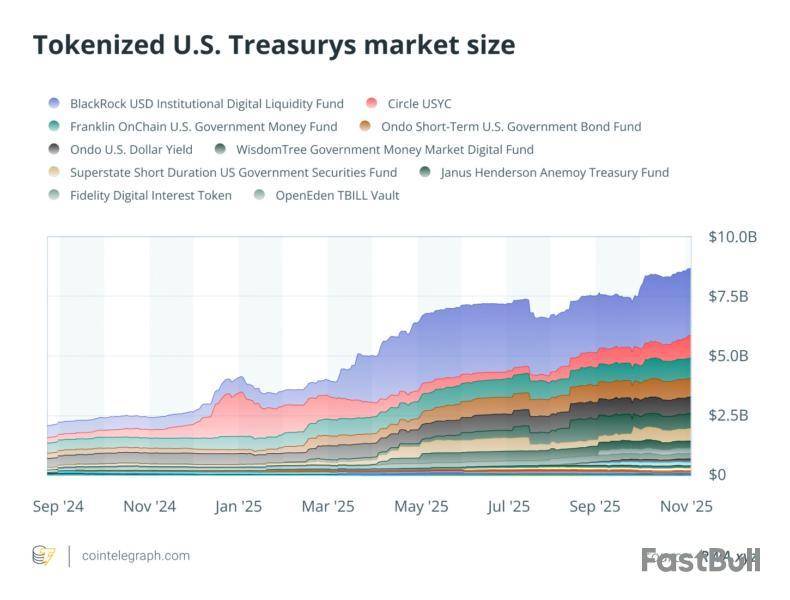
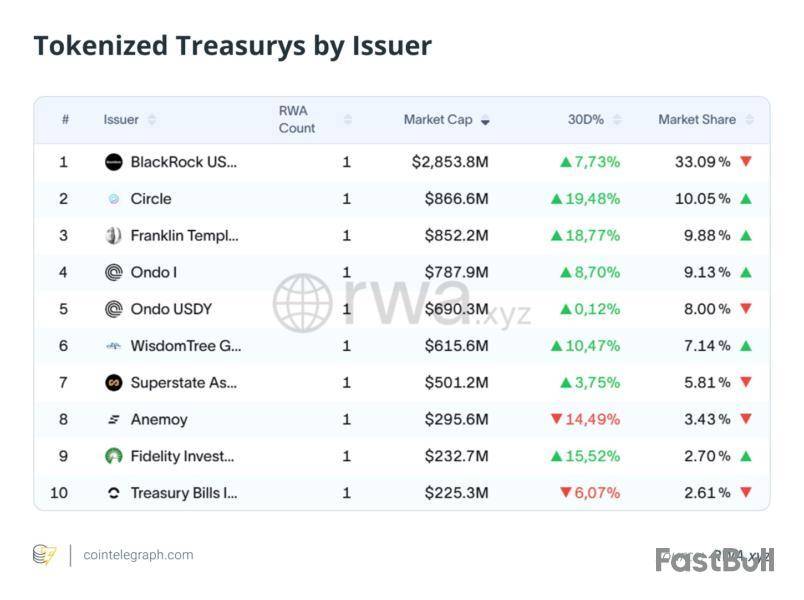
From yield to collateral: The $8.6 billion turning point Tokenized U.S. Treasuries, the largest class of real-world assets (RWA) after stablecoins, have entered a new phase. Tokenized money-market funds (MMFs), which pool cash into short-term U.S. government securities, are shifting from passive yield to collateral for trading, credit and repo transactions. As of late October, the total market cap of tokenized Treasuries reached $8.6 billion, up from $7.4 billion in mid-September. The increase was led by BlackRock’s BUIDL, which reached about $2.85 billion, followed by Circle’s USYC at $866 million and Franklin Templeton’s BENJI at $865 million. Fidelity’s newly launched tokenized MMF also showed impressive growth and rose to $232 million.
Institutional adoption: Exchanges, banks and custodians step in
Digital representations of Treasury bills are starting to move through the same settlement and margin systems that support traditional collateral markets. The first practical test of fund-as-collateral came in June, when BUIDL was approved on Crypto.com and Deribit. By late September, Bybit extended the concept, announcing it would accept QCDT, a DFSA-approved tokenized money-market fund backed by U.S. Treasuries, as collateral. The token can be posted by professional clients on the exchange’s trading platform in place of cash or stablecoins. This allows them to earn the underlying yield from the Treasury fund and maintain trading exposure.
In traditional banking, DBS became the first to move toward actively testing tokenized funds. The Singapore lender confirmed that it will make Franklin Templeton’s sgBENJI, which is the onchain version of its U.S. Government Money Fund, available for trading and lending on the DBS Digital Exchange, together with Ripple’s RLUSD stablecoin. The bank is also running pilot transactions to use sgBENJI as repo and credit collateral. The project turns tokenized money-market funds from a passive investment into a working part of the bank’s financing infrastructure.
Infrastructure and messaging: The hidden engine of tokenized finance
The infrastructure that links banks and blockchain systems has also advanced. Chainlink and Swift, working with UBS Tokenize, completed a pilot that processed subscriptions and redemptions for a tokenized fund using standard ISO 20022 messages. In simple terms, the test showed that the same message format banks already use to settle securities and payments can now trigger smart-contract actions on a blockchain.
The pilot marks a clear step toward interoperability. Tokenized funds have so far existed in separate digital systems that required custom links to connect with banks. Using ISO 20022 as the message format gives both sides a shared language. It allows custodians and fund administrators to move tokenized assets through the same settlement and reporting processes already used for traditional securities.
For investors and institutions, this means tokenized Treasuries are starting to fit into the normal financial workflow rather than sitting apart as a crypto experiment.
Market composition and frictions
The market is still led by a handful of large funds, but it is slowly diversifying. BlackRock’s BUIDL still holds the largest share of the market at about 33% of total tokenized Treasuries. Franklin Templeton’s BENJI, Ondo’s OUSG and Circle’s USYC each account for about 9% to 10%.
A quick look at the table below shows how this balance is starting to shift. The space once dominated almost entirely by one instrument now has several regulated managers sharing meaningful portions of the market. This distribution spreads liquidity and makes collateral acceptance more practical for venues and banks that prefer diversified exposure.
Where tokenized Treasuries still meet friction is not on the demand side, but through regulatory hurdles. Most of the funds are open only to Qualified Purchasers under U.S. securities law, typically institutions or high net worth individuals (HNWI).
The cut-off times are another subtle but important limit. Like traditional money-market funds, tokenized versions only allow redemptions and new subscriptions at specific times of the day. During periods of heavy redemptions or liquidity stress, this schedule can delay withdrawals or injections of liquidity. This makes them behave less like 24/7 crypto assets and more like traditional funds.
Tokenized funds still trade on less liquid markets and depend on blockchain settlement cycles. Therefore, exchanges tend to discount their posted value more heavily than they would conventional Treasury bills. For example, venues such as Deribit apply margin reductions of about 10%. Treasuries in traditional repo markets, on the other hand, only carry haircuts of about 2%.
The difference reflects operational rather than credit risk, such as delays in redemption, onchain transfer finality and lower secondary-market liquidity. As tokenized Treasuries mature and reporting standards tighten, these discounts are expected to narrow toward conventional money-market norms.
Outlook: From pilots to production
The coming quarter will be about connecting the pilots mentioned in this article. The repo tests by the DBS, experiments by exchanges and the Swift x Chainlink ISO 20022 integration all point toward routine intraday collateral use.
On the regulatory front, the U.S. CFTC commenced its Tokenized Collateral and Stablecoins Initiative on Sept. 23. If these consultations and repo programs progress, tokenized Treasuries should shift from pilot projects to production-level tools. They will function as an active layer of the global collateral stack, bridging bank balance sheets, stablecoin liquidity and onchain finance.
This article does not contain investment advice or recommendations. Every investment and trading move involves risk, and readers should conduct their own research when making a decision.
This article is for general information purposes and is not intended to be and should not be taken as legal or investment advice. The views, thoughts, and opinions expressed here are the author’s alone and do not necessarily reflect or represent the views and opinions of Cointelegraph.
Cointelegraph does not endorse the content of this article nor any product mentioned herein. Readers should do their own research before taking any action related to any product or company mentioned and carry full responsibility for their decisions.
A prominent crypto commentator known as Remi Relief has expanded on theories linking Ripple, SWIFT, and the global banking system to the long-term valuation of XRP.
His post on the social media platform X came in response to a discussion initiated by well-known analyst Paul Barron, who questioned whether Ripple’s strategy has always been to bridge the increasingly fragmented world of bank-issued stablecoins. The idea brings attention to XRP’s utility in facilitating liquidity between institutional networks, with Remi Relief noting that this could push the XRP price to $1,000.
The Ripple/SWIFT Dual-System Theories
Remi Relief proposed that the global payment structure could split into two interconnected systems where both ultimately rely on XRP for settlement and support the cryptocurrency’s price at $1,000. The first theory proposes a revamped version of SWIFT that would retain much of its existing framework but incorporate blockchain-based assets such as XRP, XDC, HBAR, and Chainlink to achieve faster transaction speeds and improved efficiency. Despite these upgrades, it would still face skepticism from some financial institutions due to it being weaponized in the past.
The second theory is the setup of a new Ripple-based network built in collaboration with Thunes, which would function as a more trusted and independent channel for cross-border payments. This system would be much quicker, much cheaper and more trusted by countries.
In Remi’s view, both models would coexist for a time, giving banks and governments the freedom to choose based on transaction scale, cost, and reliability. However, he believes that the Ripple-Thunes system will later gain dominance and overtake SWIFT as more and more banks use that system.
Regardless of which of the two theories prevails, Remi Relief pointed out that both have the potential to lead to a $1,000 XRP more quickly than most people think.
Paul Barron’s Perspective On Institutional Stablecoins
Paul Barron’s initial post that prompted Remi Relief’s response is based on the growing race among major banks to issue their own stablecoins. He pointed out that while SWIFT continues to promote neutral rails, banks like JPMorgan, Bank of America, Citi, and Wells Fargo are developing US-based consortium stablecoins. Similarly, European institutions such as ING and Deutsche Bank plan to launch euro-denominated versions by 2026.
Barron warned that this trend toward proprietary stablecoin systems would fragment the global financial network even further and create walled gardens where each bank’s stablecoin operates in isolation.
In his view, such fragmentation will bring out the original purpose of XRP, and this might have been the plan of Ripple CEO Brad Garlinghouse all along. The plan has always been to use XRP as a bridge asset capable of allowing interoperability between otherwise disconnected financial ecosystems. This function aligns with Ripple’s long-standing vision for the XRP Ledger as a neutral settlement layer for easy cross-border value transfer between different digital and fiat systems.
At the time of writing, XRP is trading at $2.41 and is a long way away from trading at $1,000.
Fermi hard fork, which would reduce the block interval by 40%, is now available for the BSC network. BNB Chain developers stated this in a recent tweet.
The Fermi hard fork would drop the block interval by 40% from 750ms to 450ms; this move is expected to boost transaction efficiency, throughput and the network's overall performance.
BNB Chain Developers@BNBChainDevsNov 03, 2025The Fermi Hardfork release is now available for the BSC network.
This upgrade reduces the block interval from 750ms to 450ms, significantly improving transaction efficiency, network throughput, and overall performance. The shorter block time enables faster processing and a… pic.twitter.com/WDIn6161Jj
This is expected as it is believed that a shorter block time enables faster processing and a smoother user experience.
According to the information shared in the tweet, Fermi hard fork is scheduled to go live on the BSC testnet on Nov. 10, 2025, at 2.25 a.m. UTC. The mainnet launch is yet to be decided, and it is expected to be done after a stress test is performed on the testnet.
More on Fermi hard fork
Fermi hard fork, bsc v.1.6.2, is a critical upgrade to further reduce the block interval from 750ms to 450ms, allowing for a better user experience.
Fermi would include five BEPs, including BEP-590: Extended Voting Rules for Fast Finality Stability; BEP-619: Short Block Interval Phase Three: 0.45 Seconds; BEP-592: Non-Consensus Based Block-Level Access List; BEP-593: Incremental Snapshot and BEP-610: Implement EVM Super Instruction.
Besides the BEPs, v1.6.2 also includes several improvements for miner, MEV and performance, as well as new features.
BNB issues security update
Amid the recent Balancer exploit, in which $117 million were stolen in various assets, BNB Chain has issued a security update, confirming that no BNB Chain projects have been affected by the exploit.
As a precaution, BNB Chain urges forked projects to remain on high alert and consider pausing operations, adding that its team and partners were actively monitoring the situation.
Bitcoin miner-turned-AI diversifier Cipher Mining announced a 15-year, $5.5 billion lease agreement with Amazon Web Services to provide space and power for AI workloads during its third-quarter update on Monday.
Under the agreement, Cipher will provide 300 MW of capacity in 2026, featuring both air- and liquid-cooled racks. Delivery will occur in two phases, beginning in July and finishing in the fourth quarter of 2026, with rent starting in August.
Cipher also announced a new joint venture to develop a 1-gigawatt site in West Texas named "Colchis." Cipher will provide most of the financing, giving it approximately 95% equity ownership, assuming standard lease and development terms under a future high-performance computing lease, the firm said.
The site includes a direct connection agreement with American Electric Power, which will build dual interconnections targeting 2028 energization, pending grid operator ERCOT's final review. The 620-acre site, located next to an existing substation, is fully suited for HPC data center development, the firm stated.
Cipher previously signed a 10-year, 168 MW AI hosting agreement with Fluidstack in September, backed by a $1.4 billion guarantee from Google, which received a 5.4% equity stake.
"The third quarter was truly transformative for Cipher," CEO Tyler Page said. "We executed a pivotal transaction with Fluidstack and Google, which firmly established our credibility in the HPC space. We are now following that transaction with another major step forward by signing our first direct lease with a Tier 1 hyperscaler."
Following the news, Cipher's stock gained over 33% in early market trading on Monday, according to The Block's CIFR price page. It is currently changing hands for $24.81 — having gained over 400% year-to-date.

CIFR/USD price chart. Image: The Block/TradingView.
Cipher reports net loss of $3 million for Q3
Cipher reported a net loss of $3 million, or $0.01 per share, for the third quarter alongside adjusted earnings of $41 million, or $0.10 per diluted share. The company said its AI hosting contracts now represent roughly $8.5 billion in total lease payments and also highlighted the completion of a $1.3 billion convertible note offering during the quarter.
Other AI-diversifying bitcoin miners have seen similar gains for their stocks as the burgeoning AI industry seeks to tap into their lucrative power capacity and infrastructure contracts. While bitcoin mining ASIC chips are not suitable for AI workloads, these firms often have access to critical power supply contracts, physical data centers, and other tech that can be adapted for GPU-hosting amid the boom.
Earlier on Monday, IREN announced it has signed a five-year, $9.7 billion AI cloud deal with Microsoft, providing the tech giant access to its Nvidia GB300 GPUs. IREN's stock surged nearly 30% at one point during pre-market trading.
Disclaimer: The Block is an independent media outlet that delivers news, research, and data. As of November 2023, Foresight Ventures is a majority investor of The Block. Foresight Ventures invests in other companies in the crypto space. Crypto exchange Bitget is an anchor LP for Foresight Ventures. The Block continues to operate independently to deliver objective, impactful, and timely information about the crypto industry. Here are our current financial disclosures.
© 2025 The Block. All Rights Reserved. This article is provided for informational purposes only. It is not offered or intended to be used as legal, tax, investment, financial, or other advice.
At current prices in early November 2025, the cryptocurrency community has no reasons to stay bullish from a technical perspective, the pseudonymous trader @PhilakoneCrypto says. This cycle should already be over by now, and institutional-driven purchases are not mirrored by price moves.
Bull market over: Four reasons by top trader
Despite most people being bullish about the midterm prospects of the crypto market, they all might be terribly wrong. From the perspective of cycle theory, this bull market is over, seasoned crypto trader @PhilakoneCrypto shared with his 178,000 followers in X (formerly Twitter).
Philakone@PhilakoneCryptoNov 03, 2025The longest bull market after bitcoin halving was 546 days. We're on day 562.
The longest bull market from the bottom in 2018 to the top in 2021 was 1,047 days.
We're on day 1,078.
October was green for 6 years straight. We're red in 2025.
Institutions and governments are buying…
He stressed that the longest bullish market in terms of post-halving days amount to 546 days, and we are on day 562 now.
Also, given the broader perspective, the previous bull run from the 2018 bottom to the 2021 top lasted 1,047 days, and we are now 1,078 days away from the FTX/Alameda collapse.
Bitcoin managed to close October in green for six years in a row before closing the month in red last week.
The overhyped institutional purchases have little-to-no effect on price performance, which is yet another signal of market exhaustion:
Institutions and governments are buying crypto, but we're not moving. They're using you as exit liquidity soon and will liquidity hunt you to buy back much cheaper.
As a result, charts and technical data give crypto holders "zero reasons to be bullish" today, the trader points out.
Fundstrat's Mark Newton disagrees
Historically, the longitude of cryptocurrency cycles increases thanks to the market maturing and becoming more liquid. However, most analysts still point to Q4, 2025, as the potential most likely target for the market peak.
As covered by U.Today previously, some experts are still bullish on crypto in the midterm. Mark Newton, Fundstrat Global Advisors' Head of Technical Strategy, highlighted that reliable tech analysis indicators only hint at accumulation.
Bitcoin , the largest cryptocurrency, lost the level of $110,000 today. As of press time, it is trading at $108,000, down 2.16% in 24 hours.
Crypto's market cap lost 2.7% overnight and touched $3.6 trillion, CoinMarketCap data says.
From yield to collateral: The $8.6 billion turning point Tokenized U.S. Treasurys, the largest class of real-world assets (RWA) after stablecoins, have entered a new phase. Tokenized money-market funds (MMFs), which pool cash into short-term U.S. government securities, are shifting from passive yield to collateral for trading, credit and repo transactions. As of late October, the total market cap of tokenized Treasurys reached $8.6 billion, up from $7.4 billion in mid-September. The increase was led by BlackRock’s BUIDL, which reached about $2.85 billion, followed by Circle’s USYC at $866 million and Franklin Templeton’s BENJI at $865 million. Fidelity’s newly launched tokenized MMF also showed impressive growth and rose to $232 million.
Institutional adoption: Exchanges, banks and custodians step in
Digital representations of Treasury bills are starting to move through the same settlement and margin systems that support traditional collateral markets. The first practical test of fund-as-collateral came in June, when BUIDL was approved on Crypto.com and Deribit. By late September, Bybit extended the concept, announcing it would accept QCDT, a DFSA-approved tokenized money-market fund backed by U.S. Treasurys, as collateral. The token can be posted by professional clients on the exchange’s trading platform in place of cash or stablecoins. This allows them to earn the underlying yield from the Treasury fund and maintain trading exposure.
In traditional banking, DBS became the first to move toward actively testing tokenized funds. The Singapore lender confirmed that it will make Franklin Templeton’s sgBENJI, which is the onchain version of its U.S. Government Money Fund, available for trading and lending on the DBS Digital Exchange, together with Ripple’s RLUSD stablecoin. The bank is also running pilot transactions to use sgBENJI as repo and credit collateral. The project turns tokenized money-market funds from a passive investment into a working part of the bank’s financing infrastructure.
Infrastructure and messaging: The hidden engine of tokenized finance
The infrastructure that links banks and blockchain systems has also advanced. Chainlink and Swift, working with UBS Tokenize, completed a pilot that processed subscriptions and redemptions for a tokenized fund using standard ISO 20022 messages. In simple terms, the test showed that the same message format banks already use to settle securities and payments can now trigger smart-contract actions on a blockchain.
The pilot marks a clear step toward interoperability. Tokenized funds have so far existed in separate digital systems that required custom links to connect with banks. Using ISO 20022 as the message format gives both sides a shared language. It allows custodians and fund administrators to move tokenized assets through the same settlement and reporting processes already used for traditional securities.
For investors and institutions, this means tokenized Treasurys are starting to fit into the normal financial workflow rather than sitting apart as a crypto experiment.
Market composition and frictions
The market is still led by a handful of large funds, but it is slowly diversifying. BlackRock’s BUIDL still holds the largest share of the market at about 33% of total tokenized Treasurys. Franklin Templeton’s BENJI, Ondo’s OUSG and Circle’s USYC each account for about 9% to 10%.
A quick look at the table below shows how this balance is starting to shift. The space once dominated almost entirely by one instrument now has several regulated managers sharing meaningful portions of the market. This distribution spreads liquidity and makes collateral acceptance more practical for venues and banks that prefer diversified exposure.
Where tokenized Treasurys still meet friction is not on the demand side, but through regulatory hurdles. Most of the funds are open only to Qualified Purchasers under U.S. securities law, typically institutions or high net worth individuals (HNWI).
The cut-off times are another subtle but important limit. Like traditional money-market funds, tokenized versions only allow redemptions and new subscriptions at specific times of the day. During periods of heavy redemptions or liquidity stress, this schedule can delay withdrawals or injections of liquidity. This makes them behave less like 24/7 crypto assets and more like traditional funds.
Tokenized funds still trade on less liquid markets and depend on blockchain settlement cycles. Therefore, exchanges tend to discount their posted value more heavily than they would conventional Treasury bills. For example, venues such as Deribit apply margin reductions of about 10%. Treasurys in traditional repo markets, on the other hand, only carry haircuts of about 2%.
The difference reflects operational rather than credit risk, such as delays in redemption, onchain transfer finality and lower secondary-market liquidity. As tokenized Treasurys mature and reporting standards tighten, these discounts are expected to narrow toward conventional money-market norms.
Outlook: From pilots to production
The coming quarter will be about connecting the pilots mentioned in this article. The repo tests by the DBS, experiments by exchanges and the Swift x Chainlink ISO 20022 integration all point toward routine intraday collateral use.
On the regulatory front, the U.S. CFTC commenced its Tokenized Collateral and Stablecoins Initiative on Sept. 23. If these consultations and repo programs progress, tokenized Treasurys should shift from pilot projects to production-level tools. They will function as an active layer of the global collateral stack, bridging bank balance sheets, stablecoin liquidity and onchain finance.
This article does not contain investment advice or recommendations. Every investment and trading move involves risk, and readers should conduct their own research when making a decision.
This article is for general information purposes and is not intended to be and should not be taken as legal or investment advice. The views, thoughts, and opinions expressed here are the author’s alone and do not necessarily reflect or represent the views and opinions of Cointelegraph.
Cointelegraph does not endorse the content of this article nor any product mentioned herein. Readers should do their own research before taking any action related to any product or company mentioned and carry full responsibility for their decisions.
Digital asset investment products saw $360 million in outflows last week after Federal Reserve Chair Jerome Powell signaled hesitation on future interest rate cuts.
Bitcoin ETFs took the hardest hit, losing $946 million, while Solana attracted a record $421 million in inflows.
Powell’s Hawkish Stance Rattles Markets
Outflows followed comments from Powell indicating another rate cut in December was not assured. He warned that loosening policy too quickly could threaten progress on inflation, while slow action might weigh on economic growth.
Investors viewed his remarks as hawkish, dampening hopes for swift monetary easing. These signals triggered withdrawals from digital asset products, especially in the US. US investors led outflows, pulling $439 million from crypto products.

While US investors exited, Germany and Switzerland recorded modest inflows of $32 million and $30.8 million, showing ongoing regional confidence. Additionally, the lack of major US economic data releases contributed to market uncertainty through the week.
Bitcoin products posted the largest declines, losing $946 million over the week. This made Bitcoin the most exposed asset to monetary policy shifts.
The timing coincided with a broader risk-off period, as market participants reconsidered their hopes for aggressive rate cuts.
Solana Bucks the Trend with Record Institutional Demand
Amid retreat elsewhere, Solana stood out. The blockchain platform received $421 million in inflows, the second-highest weekly total for the asset.

This increase was primarily driven by the launch of newly launched US Solana ETFs, including Bitwise’s BSOL, which drew record inflows during its first trading week.
SoSoValue reported that Solana ETFs recorded four consecutive days of net inflows totalling $200 million after their launch.
At the same time, Bitcoin and Ethereum Spot ETFs saw outflows, reinforcing Solana’s contrarian momentum. This suggests institutional investors now view Solana as an attractive, differentiated asset.
The launch of Solana ETFs marks a key moment for institutional access to the network, praised for transaction speed and low fees.
Grayscale’s GSOL, which launched on NYSE Arca on October 29, offers direct SOL exposure alongside possible staking rewards, aligning with Solana’s proof-of-stake approach. These features set Solana ETFs apart from traditional Bitcoin products and appeal to yield-seeking investors.
Year-to-date, Solana inflows have reached $3.3 billion, confirming its status as one of the fastest-growing digital assets among institutions.
Sustained demand shows confidence in the platform’s technical strengths and ecosystem expansion, even as broad market headwinds persist.
White Label
Data API
Web Plug-ins
Poster Maker
Affiliate Program
The risk of loss in trading financial instruments such as stocks, FX, commodities, futures, bonds, ETFs and crypto can be substantial. You may sustain a total loss of the funds that you deposit with your broker. Therefore, you should carefully consider whether such trading is suitable for you in light of your circumstances and financial resources.
No decision to invest should be made without thoroughly conducting due diligence by yourself or consulting with your financial advisors. Our web content might not suit you since we don't know your financial conditions and investment needs. Our financial information might have latency or contain inaccuracy, so you should be fully responsible for any of your trading and investment decisions. The company will not be responsible for your capital loss.
Without getting permission from the website, you are not allowed to copy the website's graphics, texts, or trademarks. Intellectual property rights in the content or data incorporated into this website belong to its providers and exchange merchants.
Not Logged In
Log in to access more features

FastBull Membership
Not yet
Purchase
Log In
Sign Up