Markets
News
Analysis
User
24/7
Economic Calendar
Education
Data
- Names
- Latest
- Prev


Signal Accounts for Members
All Signal Accounts
All Contests


Turkey Trade BalanceA:--
F: --
P: --
Germany Construction PMI (SA) (Nov)A:--
F: --
P: --
Euro Zone IHS Markit Construction PMI (Nov)A:--
F: --
P: --
Italy IHS Markit Construction PMI (Nov)A:--
F: --
P: --
U.K. Markit/CIPS Construction PMI (Nov)A:--
F: --
P: --
France 10-Year OAT Auction Avg. YieldA:--
F: --
P: --
Euro Zone Retail Sales MoM (Oct)A:--
F: --
P: --
Euro Zone Retail Sales YoY (Oct)A:--
F: --
P: --
Brazil GDP YoY (Q3)A:--
F: --
P: --
U.S. Challenger Job Cuts (Nov)A:--
F: --
P: --
U.S. Challenger Job Cuts MoM (Nov)A:--
F: --
P: --
U.S. Challenger Job Cuts YoY (Nov)A:--
F: --
P: --
U.S. Initial Jobless Claims 4-Week Avg. (SA)A:--
F: --
P: --
U.S. Weekly Initial Jobless Claims (SA)A:--
F: --
P: --
U.S. Weekly Continued Jobless Claims (SA)A:--
F: --
P: --
Canada Ivey PMI (SA) (Nov)A:--
F: --
P: --
Canada Ivey PMI (Not SA) (Nov)A:--
F: --
P: --
U.S. Non-Defense Capital Durable Goods Orders Revised MoM (Excl. Aircraft) (SA) (Sept)A:--
F: --
U.S. Factory Orders MoM (Excl. Transport) (Sept)A:--
F: --
P: --
U.S. Factory Orders MoM (Sept)A:--
F: --
P: --
U.S. Factory Orders MoM (Excl. Defense) (Sept)A:--
F: --
P: --
U.S. EIA Weekly Natural Gas Stocks ChangeA:--
F: --
P: --
Saudi Arabia Crude Oil ProductionA:--
F: --
P: --
U.S. Weekly Treasuries Held by Foreign Central BanksA:--
F: --
P: --
Japan Foreign Exchange Reserves (Nov)A:--
F: --
P: --
India Repo RateA:--
F: --
P: --
India Benchmark Interest RateA:--
F: --
P: --
India Reverse Repo RateA:--
F: --
P: --
India Cash Reserve RatioA:--
F: --
P: --
Japan Leading Indicators Prelim (Oct)A:--
F: --
P: --
U.K. Halifax House Price Index YoY (SA) (Nov)--
F: --
P: --
U.K. Halifax House Price Index MoM (SA) (Nov)--
F: --
P: --
France Current Account (Not SA) (Oct)--
F: --
P: --
France Trade Balance (SA) (Oct)--
F: --
P: --
France Industrial Output MoM (SA) (Oct)--
F: --
P: --
Italy Retail Sales MoM (SA) (Oct)--
F: --
P: --
Euro Zone Employment YoY (SA) (Q3)--
F: --
P: --
Euro Zone GDP Final YoY (Q3)--
F: --
P: --
Euro Zone GDP Final QoQ (Q3)--
F: --
P: --
Euro Zone Employment Final QoQ (SA) (Q3)--
F: --
P: --
Euro Zone Employment Final (SA) (Q3)--
F: --
Brazil PPI MoM (Oct)--
F: --
P: --
Mexico Consumer Confidence Index (Nov)--
F: --
P: --
Canada Unemployment Rate (SA) (Nov)--
F: --
P: --
Canada Labor Force Participation Rate (SA) (Nov)--
F: --
P: --
Canada Employment (SA) (Nov)--
F: --
P: --
Canada Part-Time Employment (SA) (Nov)--
F: --
P: --
Canada Full-time Employment (SA) (Nov)--
F: --
P: --
U.S. Dallas Fed PCE Price Index YoY (Sept)--
F: --
P: --
U.S. PCE Price Index YoY (SA) (Sept)--
F: --
P: --
U.S. PCE Price Index MoM (Sept)--
F: --
P: --
U.S. Personal Outlays MoM (SA) (Sept)--
F: --
P: --
U.S. Core PCE Price Index MoM (Sept)--
F: --
P: --
U.S. UMich 5-Year-Ahead Inflation Expectations Prelim YoY (Dec)--
F: --
P: --
U.S. Core PCE Price Index YoY (Sept)--
F: --
P: --
U.S. 5-10 Year-Ahead Inflation Expectations (Dec)--
F: --
P: --
U.S. UMich Current Economic Conditions Index Prelim (Dec)--
F: --
P: --
U.S. UMich Consumer Sentiment Index Prelim (Dec)--
F: --
P: --
U.S. UMich 1-Year-Ahead Inflation Expectations Prelim (Dec)--
F: --
P: --
U.S. UMich Consumer Expectations Index Prelim (Dec)--
F: --
P: --


No matching data
Latest Views
Latest Views
Trending Topics
Top Columnists
Latest Update
White Label
Data API
Web Plug-ins
Affiliate Program
View All

No data
Bitcoin's historic playbook is no longer relevant, according to research and brokerage firm K33's October outlook, which argues that the familiar four-year halving cycle — once the market's metronome — has been rendered obsolete by the rise of institutional adoption, sovereign participation, and macro policy alignment.
Bitcoin hit new all-time highs this week in both U.S. dollars and euros — its first euro-denominated record since January 2025.
"The 4-year cycle is dead, long live the king," K33 Head of Research Vetle Lunde wrote in the report, suggesting that this time is indeed different and bitcoin has entered a fundamentally new regime where structural forces, not retail mania, dictate its trajectory.
However, Lunde conceded the market looks overheated in the near term, noting that bitcoin ETF and derivatives exposure surged by over 63,000 BTC ($7.75 billion) in a single week — the strongest accumulation of 2025. Open interest on CME futures jumped by nearly 15,000 BTC, while U.S. ETFs absorbed over 31,600 BTC in seven days. Historically, similar spikes have marked local tops and mean reversion plays. Still, the analyst expects only short-term consolidation, not a structural reversal.
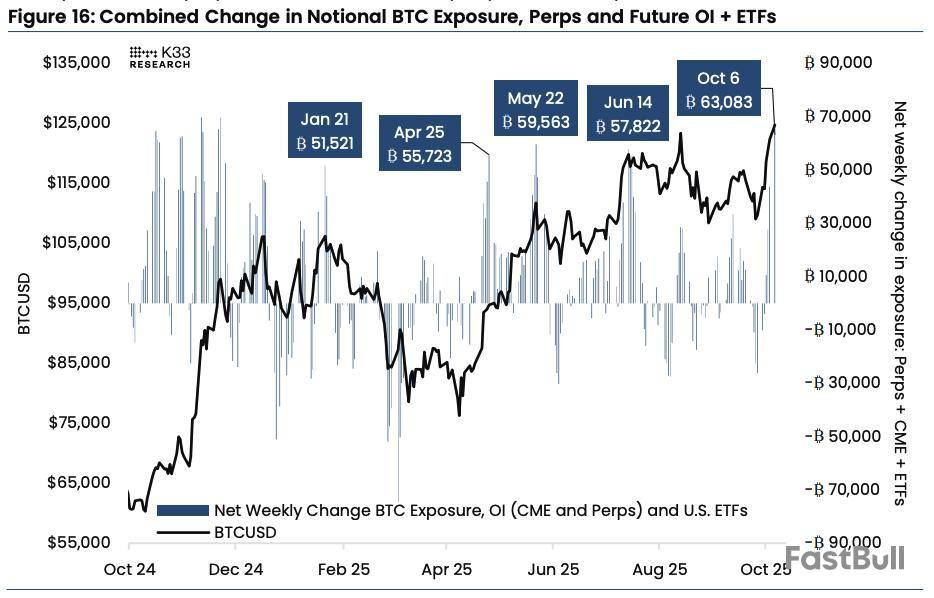
Combined change in notional BTC exposure, perps, and futures OI + ETFs. Image: K33.
K33 positions 2025's rally as the antithesis of prior euphoric bitcoin peaks. In 2017, optimism over CME's futures launch fueled a blow-off top, and in 2021, the dream of ETFs ended in Securities and Exchange Commission rejection. However, in 2025, those dreams are a reality, Lunde said, and bitcoin is now a material part of the global institutional market.
BlackRock now manages roughly $100 billion in bitcoin ETF assets, Morgan Stanley is guiding clients toward up to 4% crypto allocations, and Washington D.C. has embraced a crypto-friendly agenda — including President Trump's Strategic Bitcoin Reserve and plans to open 401(k) plans to digital assets, the analyst noted.
"During the 2021 climax, tighter monetary policy and expected post-COVID sobriety coincided with the peak. In 2026, Trump is expected to replace Jerome Powell with a rate-cutting marionette, putting out the fire from the expansionary Big Beautiful Bill with gasoline," Lunde said. "Abundance, rather than restrictive austerity, is on the books, a setup clearly favoring scarce assets like bitcoin."
No October peak?
While historical fractal analysis suggests bitcoin could be nearing a cyclical high — 1,051 days from the November 2022 bottom, roughly matching the approximate 1,060-day expansions of prior bull runs — Lunde dismissed such symmetry as a coincidence.
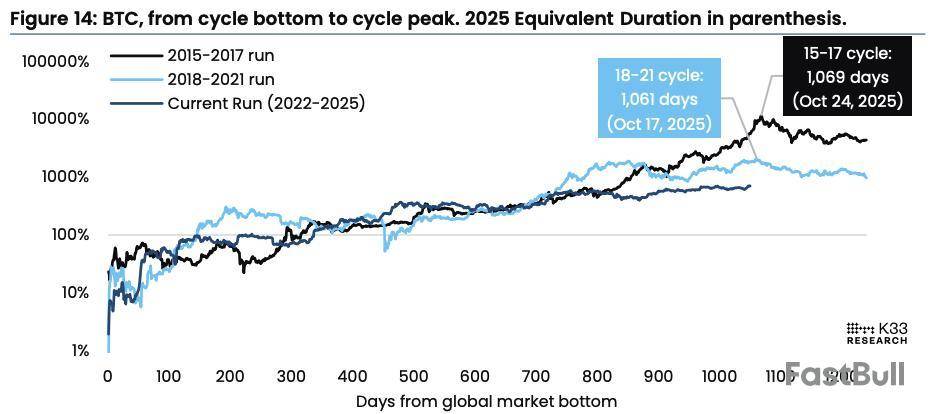
BTC from cycle bottom to cycle peak. Image: K33.
"Fractals are lazy," he said. Instead, K33 applies a six-part framework of market risk factors, including assessment of funding rates, RSI, bitcoin dominance decline, perps vs. spot volumes, social trends, and supply dynamics.
Only two indicators — perp/spot divergence and an overbought RSI metric — currently flash red. By K33's measure, that keeps the market outside the "danger zone" typical of prior peaks, and means bitcoin's price action remains healthy. "Nothing points toward another repeat of the dreaded 4-year cycle," Lunde concluded.
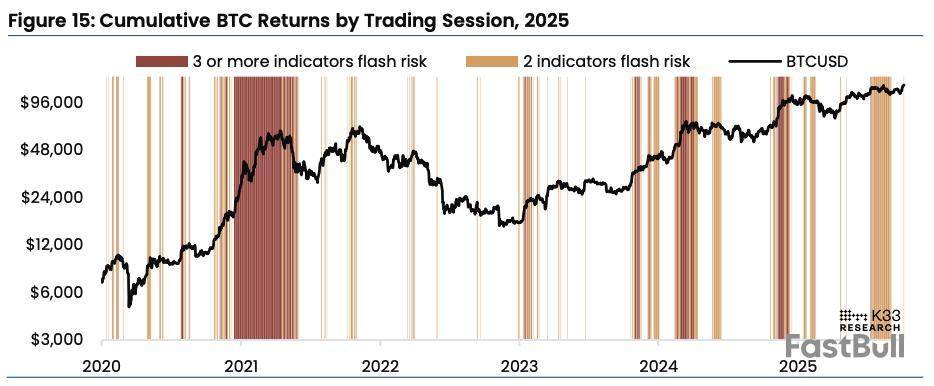
Cumulative BTC returns by trading session, 2025. Image: K33.
Disclaimer: The Block is an independent media outlet that delivers news, research, and data. As of November 2023, Foresight Ventures is a majority investor of The Block. Foresight Ventures invests in other companies in the crypto space. Crypto exchange Bitget is an anchor LP for Foresight Ventures. The Block continues to operate independently to deliver objective, impactful, and timely information about the crypto industry. Here are our current financial disclosures.
© 2025 The Block. All Rights Reserved. This article is provided for informational purposes only. It is not offered or intended to be used as legal, tax, investment, financial, or other advice.
Inspired by Michael Saylor’s Bitcoin playbook, Joseph Lubin believes Ethereum treasury companies could provide outsized returns on yield and investment opportunities to their Bitcoin counterparts.
Speaking exclusively to Cointelegraph at Token2049 in Singapore, the Ethereum co-founder unpacked his thesis for why Ether (ETH) digital asset treasuries (DATs) present superior opportunities to the Bitcoin (BTC) treasury movement popularized by Saylor’s Strategy Bitcoin play.
“I’d much rather have something that potentially has more impact. It certainly is as solid as Bitcoin, and I would argue more solid because of the functionality and the organic demand for it to pay for transactions and storage,” Lubin said.
The Ethereum co-founder is actively championing ETH DATs after he was appointed chairman of the ETH-based treasury company SharpLink Gaming.
The Nasdaq-listed iGaming company has bought more than $2 billion worth of Ether since adopting a treasury strategy in August.
Inspired by Michael Saylor
Lubin admitted that his impetus to head up an ETH treasury company was inspired by Saylor and his financial engineering constructs, which are based on Bitcoin as a reserve asset.
“I was fortunate enough to sit down and have dinner with him in December and heard his rationale for doing all that. It was basically about finding better treasury capital assets for his company,” Lubin said.
Lubin presents a very optimistic outlook for Ethereum’s medium-term future. He describes the ecosystem hitting its “broadband moment” in 2025, with the protocol more horizontally and vertically scalable and crying out for cheaper, abundant block space to be used.
He added that Ethereum had scaled too quickly in the past 18 months, which left a “glut of block space” that simply didn’t have enough builders, applications and transactions to fill the void.
“I really thought that there were doldrums in our ecosystem. That was all about price because there was too much Ether and too much cheap block space,” Lubin said.
The solution? Start a movement of ETH DATs that aggressively acquire the underlying token of the protocol and actively stake and invest Ether.
“We thought maybe we could light a fire under the Ethereum ecosystem. And that’s worked out really nicely. We’ve got a few companies and we’re differentiating ourselves in exciting ways,” he said.
Supply-demand dynamics to boost Ether
The Ethereum DAT landscape is quickly growing, but it is dominated by two significant players: Lubin’s SharpLink and Tom Lee’s BitMine.
The latter is the proverbial whale. Driven by Lee’s fervent bull case for Ether, the company has acquired 2.65 million ETH as of Oct. 8. Its holdings are worth $11 billion, far greater than SharpLink’s 839,636 ETH stack worth $3.69 billion.
Lubin told Cointelegraph that he had initially anticipated a sprint to accumulate ETH, but this has since changed after Lee publicly set a target of acquiring 5% of Ether’s total monetary base.
The long-term goal for Lubin is to grow the concentration of Ether per fully diluted share while protecting the price of the equity. Following that, SharpLink will aim to continue earning yield on its staked Ether.
Lubin envisions a future where SharpLink borrows against its ETH, invests in Ethereum-centric companies, and stakes in supporting protocols.
Weighing up the risks
The DAT movement will go down as one of the meta-narratives of 2025. However, skeptics remain concerned about the systemic risks that treasury companies are taking on by incurring significant debt to purchase protocol tokens.
Lubin played down any talk of a cataclysmic collapse caused by DATs, while cautioning against companies being over-leveraged.
Lubin anticipates the price of ETH growing as supply-demand dynamics tighten, driven by ETH DAT buying.
“The financial industry is rushing into our ecosystem,” he said. “Other enterprises are rushing into our ecosystem. It’s our broadband moment. Everybody’s paying serious attention to what we’re doing. We’re not going to get out over our skis.”
Bitcoin is approaching its 21 million coin limit, and the question of who actually holds it is more fascinating than ever. Retail investors still dominate, but institutions, ETFs, and even governments are quietly increasing their stakes.
A recent study from U.S.-based Bitcoin financial firm River sheds light on the current distribution.
Individuals Still in Control
It is estimated that individuals hold about 65.9% of circulating Bitcoin, around 13.83 million coins. This includes private wallets and accounts on exchanges that are classified as individual. Businesses control 6.2%, while ETFs and funds – the growing institutional presence – hold 7.8%. Governments make up a smaller slice at 1.5%, mostly from seized or strategically held coins.
The report points out that these figures are “inferred from filings, address tagging and prior research.” They are estimates, not a perfect snapshot of the blockchain.
But the trend is clear: individuals are still the main holders, though institutions are steadily building their positions.
Exchanges and Corporates Hold Big Stakes
Some of the largest Bitcoin wallets belong not to people, but to exchanges.
Binance’s primary cold wallet alone holds around 248,600 BTC, worth over $26 billion. Robinhood and Bitfinex follow with 140,600 and 130,010 BTC, respectively. These wallets are mostly for managing liquidity and protecting customer funds, not for active trading.
On the corporate side, Strategy (formerly MicroStrategy) leads, owning 640,031 BTC.
Other public companies, including Tesla, Block, and GameStop, hold a combined total of about 693,000+ BTC, showing that corporate adoption is becoming a serious trend.
Governments Are Joining In
Sovereign Bitcoin holdings are small but significant.
The United States approved a Strategic Bitcoin Reserve in 2025 from seized coins. China holds an estimated 194,000 BTC, mostly from the 2019 PlusToken scam. The UK, Ukraine, Bhutan, and El Salvador also maintain reserves, showing Bitcoin is increasingly recognized as a strategic digital asset.
Mid-Tier Holders Are Growing
Wallets holding between 100 and 1,000 BTC have grown from 3.9 million BTC to 4.76 million BTC over the past year.
Small institutions, funds and even wealthy individuals are stacking sats more aggressively.
Bitcoin ownership is slowly spreading beyond the largest players.
What This Means
Bitcoin remains a community-driven asset at heart, but it is clearly maturing. Individuals still dominate, but institutional investors, corporate treasuries, ETFs, and governments are steadily reshaping the landscape.
Dormant wallets, Satoshi’s untouched coins, and the rise of mid-tier holders all point to a market that is growing up and getting more complex by the day.
FAQs
How much Bitcoin do institutions own?Institutions, including ETFs, funds, and public companies, hold a significant and growing share, estimated at around 7.8% of the total circulating supply.
How many Bitcoins are left to be mined?With the total supply capped at 21 million, there are just under 1.5 million Bitcoin left to be mined, making new coins increasingly scarce.
What percentage of Bitcoin is lost forever?It is estimated that around 20% of all Bitcoin (roughly 4 million coins) may be permanently lost or inaccessible in dormant wallets, reducing the active supply.
The price of XRP experienced a 4.54% drop yesterday, and that was the biggest daily decrease for it since the last week of September. Along the way, the altcoin lost the $3 price mark and found the bottom at around the $2.85 level. While a 5% dip may not be considered serious in crypto, the market cap decrease worth $7 billion is much more a stark indicator of how big it was.
But today's story is not about what already happened with the XRP price but rather what lies ahead for the fourth biggest cryptocurrency.
If you take a look at the XRP price chart, you will see a pretty interesting pattern — a death cross. When the 23-day moving average crossed below the 50-day one, it confirmed a technical formation that usually signals a prolonged phase of pressure.BINANCE:XRPUSD by TradingView">
The timing makes it even more relevant, as the cross happened right as the sell-off was happening, showing the weakness that pushed XRP under the $3 threshold.
Best "worst" scenario
The best "worst" scenario now is finding support at the 200-day moving average on the daily time frame, which currently sits at $2.64. That level has been a real game-changer in the past, and if it can hold on to it, it will show that the bigger uptrend is still in place, even with some short-term setbacks.
If XRP drops to $2.64, that will be the lowest it has been since early August, and it could shake confidence. But it would also show a clear floor, where it might start building up again.
For traders on the other side, the best way to neutralize the pattern and ease concerns raised by the death cross is to quickly regain $3 and push above $3.10. Until then, XRP is trading under a bearish setup.
Ethereum, the world’s second-largest cryptocurrency, has entered a cooling phase after weeks of strong performance. ETH is currently trading near $4,487, slipping around 4% in the past 24 hours.
While the long-term picture for Ethereum looks promising, recent weakness shows that traders are taking a step back, raising the question—why is ETH falling now?
Short-Term Selling Pressure Led To Failed Breakout
One of the biggest reasons for the dip is short-term profit-taking. Data shows significant capital outflows from Ethereum over the past week, including a sharp $225 million migration on October 7. This reflects traders moving money out of ETH, either to lock in profits or to rotate into other assets.
At the same time, technical indicators suggest that ETH’s upward momentum has slowed, with signals like the MACD and KDJ flashing near-term exhaustion.
Ethereum tried to push past the $4,800 resistance multiple times but failed to hold gains above that level. This created a bearish divergence on short-term charts, signaling that buying momentum was weakening.
Too Many Long Bets
Another factor weighing on the price is positioning. More than 70% of leveraged traders are betting on ETH going higher. While this shows optimism, it also creates risk.
If selling pressure rises, these overleveraged long positions could trigger liquidations, leading to sharper price drops.
Whales and Institutions Still Confident
Despite the short-term weakness, long-term sentiment remains strong. Whale wallets have been adding more ETH, including BitMNR’s increase to 2.83M ETH holding, showing confidence in future gains.
At the institutional level, the SEC’s approval of Grayscale’s ETH ETF and Fidelity’s expansion of its tokenized ETH fund show growing institutional interest in Ethereum, which could boost demand.
What’s Next for Ethereum?
For now, ETH faces a key support zone between $4,250 and $4,400. Despite the dip, analysts stay positive, noting that a strong rebound from current support could reignite buying and push Ethereum back toward $4,700 and beyond.
However, if this level breaks, it may open the door toward $5,500–$665,0 in the coming months.
On the downside, losing support near $3,825 could trigger a deeper correction.
FAQs
Why is Ethereum price down today?Ethereum’s price is down due to short-term profit-taking by traders and a failure to break through the key $4,800 resistance level, causing a pullback.
Is Ethereum a good buy during this dip?Long-term indicators remain strong, with whales accumulating more ETH and institutional products like ETFs gaining approval, suggesting confidence in future growth.
What is the Ethereum price prediction?Analysts remain positive, suggesting a rebound from the $4,250-$4,400 support zone could push ETH back toward $4,700, with longer-term targets near $5,500.
Are institutions still investing in Ethereum?Yes, institutional interest remains strong, evidenced by the SEC’s approval of Grayscale’s ETH ETF and Fidelity’s expansion of its tokenized Ethereum fund.
Ethereum digital asset treasury (DAT) Bit Digital announced on Wednesday that it had added 31,057 ETH, bringing the digital asset treasury's total to 150,244 ETH, which is valued at about $675 million.
The company said that it utilized the net proceeds from its recently completed $150 million convertible note offering to fund its latest round of Ethereum purchases. Last month, it proposed a convertible note offering to purchase more ETH. Kraken Financial, Jump Trading Credit, and Jane Street Capital participated in the offering, Bit Digital said Wednesday.
"The structure of our convertible notes allowed us to raise capital at a premium to mNAV, and we have deployed those proceeds directly into ETH," Bit Digital CEO Sam Tabar said in a statement. "Our guiding principle is to grow NAV per share, with the goal of creating long-term value for shareholders."
NAV, or net asset value, helps measure how leveraged a DAT is by taking its total crypto assets held, minus liabilities, and then dividing the assets by the company's shares. An adjusted NAV, or mNAV, takes into account discounts and restrictions on tokens purchased.
"The initial conversion price for the convertible notes of $4.16 per share represents an 8.2% premium to the company’s estimated mNAV at the time of deal pricing," Bit Digital added.
Tabar told The Block last week that many companies building Ethereum treasuries are using "extremely risky" debt to acquire ETH. He said DATs should consider using unsecured debt financing over secured debt financing as a better hedge against a bearish market.
Founded in 2015, Bit Digital pivoted from a bitcoin mining operator to becoming "a pure-play" Ethereum staking and treasury company in July. At the time, the Nasdaq-listed company, ticker symbol BTBT, sold 280 bitcoin and used $173 million from a recent equity raise to fund the acquisition of Ethereum.
Disclaimer: The Block is an independent media outlet that delivers news, research, and data. As of November 2023, Foresight Ventures is a majority investor of The Block. Foresight Ventures invests in other companies in the crypto space. Crypto exchange Bitget is an anchor LP for Foresight Ventures. The Block continues to operate independently to deliver objective, impactful, and timely information about the crypto industry. Here are our current financial disclosures.
© 2025 The Block. All Rights Reserved. This article is provided for informational purposes only. It is not offered or intended to be used as legal, tax, investment, financial, or other advice.
Historically, the Dogecoin price has recorded some of the most legendary rallies in the crypto space. Over the last couple of bull markets, the meme coin seems to have started a trend of outperforming its previous cycle’s performance, notching way more gains than anyone expected. Following this trend, the Dogecoin price is once again approaching a point where it could initiate another rally, and this time around, a crypto analyst predicts that it will reach double-digit values.
The Anatomy Of The Historical Breakout
Crypto analyst Dima Potts has predicted a possible 37x rally for the Dogecoin price this bull cycle. This forecast is gleaned from the previous cycle performances of the meme coin, with each one registering higher gains than the previous bull market.
Mainly, each rally has been triggered when the Dogecoin price has broken out of a descending trendline, highlighted in yellow in the chart below, that begins from the top of the last cycle. This was the case back in 2017, and a repeat of this same breakout in 2021 solidified the trend for the meme coin.

After the first breakout was completed back in 2017, the price would rise sharply over the next few months. By the time the bull market was drawing to a close in 2018, the Dogecoin price had completed an 83x rally, rising from below $0.0004 to above $0.0014.
The descending trendline began once again with the top in 2018, spanning over two years again before breaking out in 2021. Once the breakout was confirmed in 2021, just like it did in 2017, it triggered a multi-month Dogecoin price rally, and before the end of the year, the price rose a cumulative 183x, moving from under $0.004 to over $0.7.
Why The Dogecoin Price Can Rally Above $11
Using this established trend, Dima Potts has outlined how the Dogecoin price could follow the same path. Right now, the altcoin is nearing the completion of the descending trendline, and the only thing that remains is a breakout. The main level of interest lies at $0.4,1, and the analyst believes that if the Dogecoin price closes a week above this level, then the trend would be confirmed.
In the most bullish scenario, the price would follow the trend of each cycle’s explosion being higher than the last, suggesting a possible 283x return. However, the crypto analyst takes a more conservative stance, predicting that a 37x rally from the price at which Dogecoin started 2025is likely. This would put the price at $11.71, given that Dogecoin started the year with a price of $0.31.
White Label
Data API
Web Plug-ins
Poster Maker
Affiliate Program
The risk of loss in trading financial instruments such as stocks, FX, commodities, futures, bonds, ETFs and crypto can be substantial. You may sustain a total loss of the funds that you deposit with your broker. Therefore, you should carefully consider whether such trading is suitable for you in light of your circumstances and financial resources.
No decision to invest should be made without thoroughly conducting due diligence by yourself or consulting with your financial advisors. Our web content might not suit you since we don't know your financial conditions and investment needs. Our financial information might have latency or contain inaccuracy, so you should be fully responsible for any of your trading and investment decisions. The company will not be responsible for your capital loss.
Without getting permission from the website, you are not allowed to copy the website's graphics, texts, or trademarks. Intellectual property rights in the content or data incorporated into this website belong to its providers and exchange merchants.
Not Logged In
Log in to access more features

FastBull Membership
Not yet
Purchase
Log In
Sign Up