


- EURUSD
- XAUUSD
- XAGUSD
- WTI
- USDX


















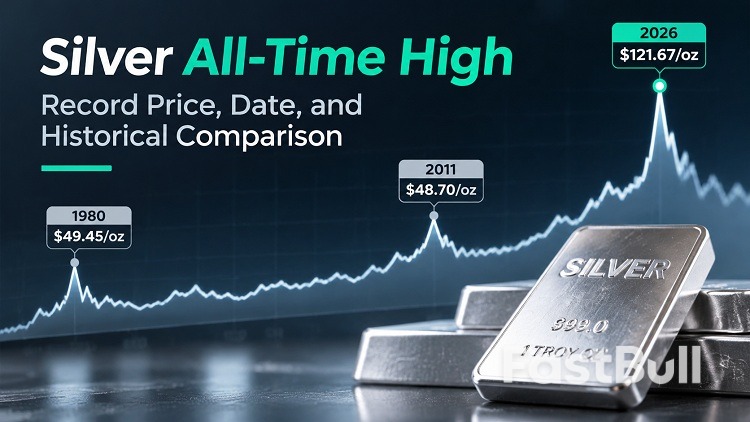
Silver's nominal all-time high is approximately $121.67 per troy ounce, reached on January 29, 2026. This record surpassed the previous nominal peaks of 1980 and 2011. However, after adjusting for inflation, the 1980 peak remains significantly higher in today's dollars.
What Is Silver's All-Time High Price?
Silver's nominal all-time high is approximately $121.67 per troy ounce, recorded on January 29, 2026. This marked a major milestone for the precious metal, as it more than doubled the previous nominal record of approximately $49.45 set in January 1980.
The 2026 peak followed an unusually strong rally that began in 2025. After spending decades below its previous record, silver broke above $50 per ounce in October 2025, accelerated past $100 in January 2026, and eventually climbed above $120.
Historical price sources may report slightly different figures, generally around $121.60 to $121.67. These differences can result from the pricing benchmark, market data provider, and whether the reported figure represents a spot price or an intraday market high. For this article, $121.67 is used as the nominal record shown in the historical price series.
Silver prices are typically quoted per troy ounce, which equals approximately 31.1 grams. This is different from the standard ounce used to measure everyday goods.
When Did Silver Reach Its All-Time High?
Silver reached its nominal record in January 2026 after a rapid rally that pushed the metal through several important price levels. The move from below $50 to above $120 happened in less than a year, making it one of the most dramatic advances in silver's modern trading history.
Silver Breaks Above $50 for the First Time in 2025
For more than four decades, silver struggled to move sustainably above its January 1980 nominal peak of approximately $49.45 per ounce.
That changed in October 2025, when silver moved above $50 for the first time since 1980. The breakout was significant because it removed a major historical price barrier that had remained in place for decades.
The rally continued through the final months of 2025. Silver climbed above $60 and approached $83 by late December. Strong investment demand, concerns about physical supply availability, and continued industrial consumption helped support the advance.
Silver Surges Past $100 Before Setting a New Record
The rally accelerated in January 2026. On January 23, silver broke above $100 per ounce for the first time, attracting even more attention from investors and traders.
Just six days later, on January 29, silver reached a new nominal record of approximately $121.67 per ounce. The move reflected a combination of safe-haven demand, tight physical market conditions, and increasingly aggressive speculative buying.
However, the rally was not sustainable at that pace. Silver experienced a sharp reversal almost immediately after reaching its record, showing how quickly momentum can change in a relatively small and volatile precious metals market.
How Does the 2026 Silver Record Compare With Previous Highs?
Silver has experienced several major price rallies over the past century. The 1980, 2011, and 2026 peaks are particularly important because they show how different economic conditions and investment trends have influenced the metal's value.
| Historical Peak | Date | Nominal Price |
|---|---|---|
| 1980 | January 18, 1980 | $49.45 |
| 2011 | April 28, 2011 | $48.70 |
| 2026 | January 29, 2026 | $121.67 |
These historical figures use the cited London benchmark prices for 1980 and 2011 and the reported spot-price high for 2026. Different benchmarks, including intraday futures prices, can produce different historical figures.
Silver's Nominal Record vs. Inflation-Adjusted Record
A nominal price shows the actual dollar amount at the time of a transaction. An inflation-adjusted price accounts for changes in the purchasing power of money over time.
This distinction matters because $49.45 in 1980 had considerably more purchasing power than $49.45 today. Using the U.S. Consumer Price Index for All Urban Consumers (CPI-U), historical prices can be converted into equivalent August 2026 dollars.
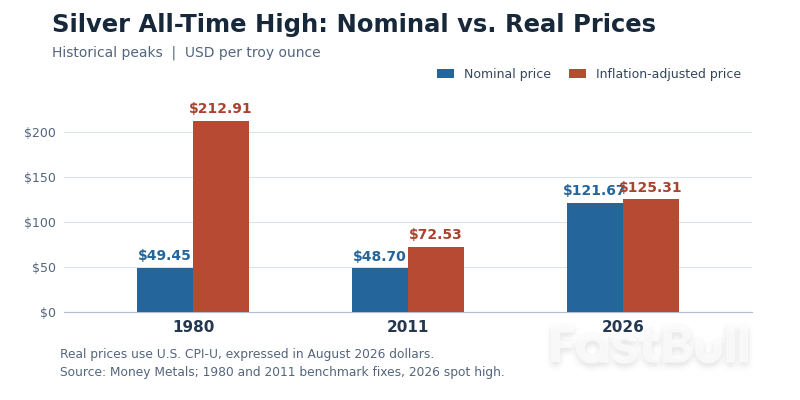
Based on this calculation, the three major historical peaks compare as follows:
- 1980: $49.45 nominally, equivalent to approximately $212.91 in August 2026 dollars.
- 2011: $48.70 nominally, equivalent to approximately $72.53 in August 2026 dollars.
- 2026: $121.67 nominally, equivalent to approximately $125.31 in August 2026 dollars.
The comparison reveals an important distinction. Although silver's 2026 peak established a new nominal record, it still fell well short of the inflation-adjusted high set in 1980.
To match the 1980 peak's purchasing power, silver would need to trade above $212 per ounce using the same August 2026 CPI basis. The result also depends on the selected historical price benchmark and CPI reference month.
What Caused the 1980 and 2011 Silver Price Peaks?
The earlier silver rallies had different causes from the 2026 surge.
The 1980 peak was heavily influenced by the Hunt brothers' attempt to corner the silver market. Nelson Bunker Hunt and William Herbert Hunt accumulated substantial silver positions, attempting to gain control over a large share of the available market. Their buying activity helped push prices sharply higher.
However, regulatory intervention, tighter trading conditions, and the breakdown of their strategy triggered a dramatic reversal. On March 27, 1980, known as Silver Thursday, silver closed at approximately $10.80 per ounce on COMEX, illustrating how quickly the market could collapse.
The 2011 rally was driven more by investment demand and economic uncertainty. Concerns about sovereign debt, the European debt crisis, monetary stimulus, and the global economic outlook encouraged investors to seek precious metals as alternative stores of value.
Silver approached $50 per ounce in April 2011 but failed to establish a lasting breakout above its previous nominal record.
Why Did Silver Hit an All-Time High in 2026?
Silver's record-breaking rally resulted from several overlapping factors. Supply constraints and industrial demand provided longer-term support, while geopolitical uncertainty, investment flows, and speculative trading accelerated the move toward $120 per ounce.
Strong Industrial Demand and Persistent Supply Deficits
Silver is both a precious metal and an industrial commodity. It is widely used in electronics, solar panels, electric vehicles, charging infrastructure, and electrical components.
According to the Silver Institute's November 2026 market update, the global silver market is forecast to record its sixth consecutive annual deficit, with demand exceeding supply by approximately 35 million ounces in 2026. The cumulative shortfall from 2021 through 2026 is estimated at 746 million ounces.
However, the demand picture is more complicated than simply saying industrial consumption is increasing. Total industrial demand is forecast to decline by 3% to 640 million ounces in 2026, partly because high silver prices have encouraged solar manufacturers to reduce silver use or substitute other materials.
Industrial demand outside photovoltaics is expected to grow by 4.5% to 492 million ounces, supported by automotive electrification, electronics, and other applications. Meanwhile, mine production is forecast to remain broadly flat at 834 million ounces, while recycling is expected to increase by 6% to 210 million ounces.
This combination helps explain why the market can remain in a supply deficit even as some categories of demand weaken. However, a supply deficit does not automatically guarantee higher prices, particularly when investment demand and physical market conditions change.
Safe-Haven Demand and Expectations for Lower Interest Rates
Geopolitical tensions, economic uncertainty, and expectations of lower U.S. interest rates encouraged investors to increase their exposure to precious metals.
Unlike bonds or savings accounts, silver does not generate interest. When interest rates and real yields fall, the opportunity cost of holding silver generally decreases. A weaker U.S. dollar can also make dollar-priced silver more affordable for international buyers.
These conditions helped support the January 2026 rally. However, changing interest-rate expectations, a stronger dollar, and rising bond yields later became headwinds for precious metals.
Speculative Buying and Tight Physical Market Conditions
Another important factor behind silver's rapid advance was the combination of strong investment demand and limited physical market liquidity, particularly in London.
As prices broke through $50 and then $100, momentum traders and retail investors increased their exposure. Demand for physical silver bars and coins also surged, while social media attention encouraged more speculative buying.
These forces created a feedback loop: rising prices attracted new buyers, whose purchases pushed prices higher. But the same mechanism could work in reverse once buying momentum weakened.
In other words, supply constraints helped create the conditions for a rally, but speculative activity amplified the speed and size of the move.
What Happened to Silver After Its All-Time High?
Silver's record-breaking rally was followed by a dramatic sell-off. On January 30, 2026, just one day after reaching its all-time high, silver lost more than 25% of its value in a single trading session.
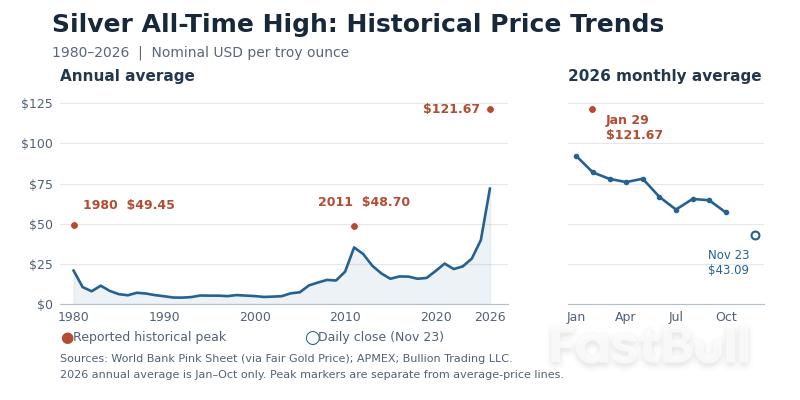
The decline continued over the following months. The historical price series in the chart above shows a daily close of $43.09 on November 23, 2026, approximately 65% below the January record. Actual spot quotations can vary slightly between providers and benchmarks.
Why Silver Prices Fell Sharply After January 2026
The initial sell-off was driven by profit-taking, technical selling, and stop-loss orders. After such a rapid rally, many investors had substantial gains to protect. Once prices began falling, leveraged traders faced increasing pressure to close positions, accelerating the decline.
Changing expectations for U.S. monetary policy also contributed to the reversal. Expectations of higher interest rates, a stronger dollar, and rising bond yields made non-interest-bearing precious metals less attractive.
Meanwhile, elevated prices encouraged recycling and reduced demand in price-sensitive industries. Solar manufacturers also accelerated efforts to reduce silver consumption or use alternative materials.
The Silver Institute's November 2026 update noted that investment demand had become more subdued after the exceptionally strong retail buying seen in late 2025 and early 2026. Silver-backed exchange-traded product holdings had also declined during the year, although some inflows returned later.
The decline illustrates an important feature of the silver market: prices can fall sharply even when global demand continues to exceed supply.
What Could Influence Silver Prices Going Forward?
Whether silver can approach its all-time high again depends on several factors:
- Industrial demand: Growth in electronics, vehicle electrification, and energy infrastructure could support consumption, while material substitution in solar panels could limit demand.
- Mine production and recycling: Slow production growth may maintain supply pressures, but higher recycling volumes could narrow the market deficit.
- Interest rates and the U.S. dollar: Lower real interest rates and a weaker dollar generally support precious metals, while the opposite can weigh on prices.
- Investment demand: Renewed inflows into silver-backed exchange-traded products and physical bullion could strengthen prices, while investor outflows could add further selling pressure.
Silver's return to $121.67 would require a substantial recovery from its November 2026 levels. Although another record is possible, supply deficits alone are unlikely to produce such a rally without stronger investment demand and supportive market conditions.
Silver's price history demonstrates that long-term fundamentals and short-term market sentiment can produce very different outcomes. Investors should consider both when assessing the possibility of another all-time high.
Sources: Reuters: Silver's January 2026 record and subsequent sell-off; The Silver Institute: 2026 supply and demand outlook; Money Metals: Inflation-adjusted silver price history.