


- XAUUSD
- XAGUSD
- WTI
- USDX


Markets
Analysis
User
24/7
Economic Calendar
Education
Data
- Names
- Latest
- Prev









 Economic Calendar




Compare Ripple RLUSD vs XRP usage in payments, settlement, liquidity, and trading. Learn how the stablecoin and native token serve different roles on XRPL.
Ripple RLUSD and XRP operate within the same financial ecosystem, but they serve different purposes. RLUSD provides a dollar-pegged digital asset for payments and settlement, while XRP supports network transactions, liquidity, and cross-currency transfers. Understanding Ripple RLUSD vs XRP usage helps explain why businesses, financial institutions, and traders may use both assets rather than choose one over the other.
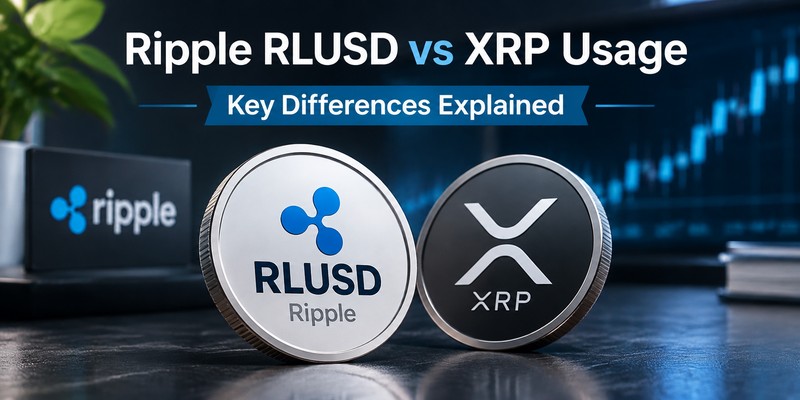
Table of Contents
The fundamental difference is how each asset maintains its value and what it is designed to accomplish.
Ripple USD (RLUSD) is a stablecoin designed to maintain a value of approximately $1. It is backed by reserves consisting of U.S. dollar deposits, short-term U.S. Treasuries, and other eligible cash-equivalent assets. Its primary purpose is to move and hold dollar-denominated value without the price fluctuations normally associated with cryptocurrencies.
XRP, meanwhile, is the native cryptocurrency of the XRP Ledger (XRPL). Its price changes according to market supply and demand. Unlike RLUSD, XRP does not represent a claim on dollar reserves or promise redemption at a fixed price.
Both assets can facilitate blockchain transactions, but their economic functions differ.
| Feature | RLUSD | XRP |
|---|---|---|
| Asset type | USD-backed stablecoin | Native cryptocurrency |
| Price behavior | Designed to remain near $1 | Market-driven |
| Primary purpose | Payments and dollar settlement | Liquidity, transfers, and network operations |
| Issuance | Managed by a regulated issuer | Fixed initial supply |
| Reserve backing | Cash and eligible liquid assets | No fiat reserve backing |
| Blockchain availability | XRPL and supported EVM networks | Native to XRPL |
| Main users | Payment providers, institutions, traders | Traders, liquidity providers, developers, institutions |
Another important distinction involves control. RLUSD is issued by Standard Custody & Trust Company, a Ripple subsidiary supervised by the New York State Department of Financial Services. XRP operates as the native asset of a decentralized blockchain and does not depend on a stablecoin issuer.
These differences determine how the two assets fit into financial applications.
RLUSD primarily addresses a practical problem: businesses need to transfer money efficiently without exposing the transferred amount to unpredictable cryptocurrency price movements.
Consider a company that needs to pay an overseas supplier $250,000.
Using RLUSD, the company can transfer an equivalent amount in dollar-denominated tokens through a supported blockchain. The receiving party can retain the stablecoin, use it for another payment, or seek conversion into traditional currency through an appropriate provider.
Because RLUSD targets a stable dollar value, businesses can manage payment amounts without continuously adjusting for XRP market fluctuations.
Financial institutions and payment providers can use RLUSD to transfer dollar-denominated value between markets.
Ripple integrated RLUSD into its Ripple Payments infrastructure in April 2025, expanding the stablecoin's role in enterprise payment services.
According to Ripple's official RLUSD documentation, the asset supports payments, trading, treasury management, and institutional settlement.
Companies holding digital assets may prefer stablecoins when preserving dollar-denominated balances is more important than potential investment returns.
RLUSD can also serve as a trading pair, allowing market participants to exchange cryptocurrencies against a dollar-linked asset.
However, its stablecoin design does not eliminate counterparty, liquidity, redemption, or blockchain-related risks. Its usefulness depends partly on available trading venues, redemption arrangements, and jurisdictional restrictions.
XRP serves a different function. Rather than representing digital dollars, it provides a native asset that can move between participants and facilitate exchanges involving different currencies.
One important application is cross-currency liquidity.
Imagine a payment provider converting one currency into another. Instead of maintaining substantial balances in every destination currency, it may use XRP as an intermediary when sufficient liquidity exists.
The general process involves converting the originating currency into XRP, transferring the XRP, and converting it into the destination currency.
This approach can reduce reliance on certain prefunded accounts, although actual efficiency depends on liquidity, transaction costs, exchange access, and execution conditions.
XRP also performs functions that RLUSD cannot replace directly on the XRP Ledger.
Every XRPL transaction requires a small fee paid in XRP. Accounts also have XRP reserve requirements, helping limit unnecessary ledger growth.
Furthermore, XRP can act as an intermediary within the XRPL's decentralized exchange through a mechanism called auto-bridging.
As explained in the XRP Ledger's technical documentation, this mechanism can route trades through XRP when doing so offers a more favorable exchange rate than a direct token-to-token transaction.
These functions exist independently of RLUSD adoption. Even when users transfer RLUSD on XRPL, XRP remains necessary for the network's underlying transaction fees.
However, RLUSD transfers on Ethereum or other supported EVM networks use those networks' fee mechanisms instead. They do not automatically require XRP.
The introduction of RLUSD has raised an important question among cryptocurrency investors: if financial institutions can transfer stablecoins directly, will they still need XRP?
The answer depends on the transaction.
For dollar-denominated payments, RLUSD may be more convenient because businesses know approximately how much value the recipient will receive. There is no need to introduce a volatile intermediary asset when both parties already accept dollar-based settlement.
However, RLUSD cannot automatically replace XRP in transactions involving different currencies.
A payment between two markets may still require currency conversion, particularly when the recipient needs local currency rather than digital dollars. XRP can participate in these conversions when trading routes offer sufficient liquidity and competitive execution costs.
The XRP Ledger also supports transactions involving multiple issued assets, allowing different liquidity sources to interact.
Consequently, increased RLUSD usage does not necessarily reduce XRP's usefulness. The two assets may compete in certain payment scenarios while complementing each other elsewhere.
One potential advantage of Ripple's ecosystem is that XRP and RLUSD can participate in connected liquidity markets.
On XRPL, users can exchange issued tokens through the network's decentralized exchange and automated market maker infrastructure, subject to available liquidity.
For example, a trader holding RLUSD might exchange it for XRP to access another trading pair. Alternatively, a payment provider could use XRP as an intermediate asset when converting between two currencies.
The most efficient route depends on the available order books, liquidity pools, transaction costs, and market conditions.
Ripple has been expanding the role of stablecoins within its payments infrastructure.
In June 2026, Ripple and Bitso announced an expanded partnership involving MXNB, a Mexican peso-backed stablecoin, and RLUSD. The initiative aims to improve enterprise settlement between the United States and Mexico through XRPL infrastructure.
The official Ripple announcement illustrates how multiple currency-backed digital assets can support international payment operations.
Such arrangements may also create opportunities for XRP-based liquidity routing, although the existence of stablecoin payment infrastructure does not guarantee XRP will be used in every transaction.
Actual demand depends on the payment route and the financial advantages available to participants.
Choosing between RLUSD and XRP is primarily a question of intended use rather than which asset is technologically superior.
For businesses making dollar-denominated payments, RLUSD offers a clearer accounting unit. A company expecting to distribute $100,000 does not need to calculate how many XRP tokens will equal that amount when settlement occurs.
For traders, the distinction is different.
RLUSD can provide exposure to a dollar-linked asset without requiring conversion into traditional bank deposits after every transaction. XRP, by contrast, provides exposure to cryptocurrency price movements and can be used in trading strategies involving market volatility.
Developers also have different considerations.
Applications involving dollar payments, tokenized assets, or stablecoin settlement may benefit from RLUSD integration. Applications requiring XRPL-native functionality, liquidity routing, or interaction with the network's underlying economic mechanisms may rely on XRP.
Neither asset is universally preferable. Their suitability depends on the application's requirements, market access, and acceptable risks.
Although both assets operate within Ripple's broader ecosystem, their risk profiles are substantially different.
RLUSD carries risks associated with its issuer, reserve management, redemption conditions, and market liquidity. While its design targets a stable dollar value, secondary-market prices can temporarily deviate from $1.
Redemption access also matters. Not every wallet holder or exchange customer necessarily qualifies for direct redemption with the issuer.
XRP involves a different set of risks.
Because XRP has no fixed dollar redemption value, holders face market volatility. Its price may respond to cryptocurrency market conditions, liquidity changes, regulation, and speculative demand.
For institutions, volatility can complicate settlement planning unless transactions are executed quickly and supported by adequate liquidity.
Both assets also face operational considerations, including custody security, blockchain infrastructure, counterparty exposure, and regional regulatory requirements.
These factors should be evaluated independently of transaction speed or blockchain fees.
RLUSD adoption could benefit activity across the XRP Ledger, but its impact on XRP demand is not automatic.
More stablecoin payments may increase network transactions, liquidity provision, and participation in decentralized markets. Some of these activities require XRP for fees or involve XRP trading pairs.
However, transaction fees are small, and RLUSD can operate on networks beyond XRPL. Increased stablecoin circulation therefore does not translate directly into equivalent XRP purchasing demand.
A stronger relationship would emerge if growing RLUSD activity consistently generated meaningful XRP-based trading, bridging, or liquidity requirements.
Ultimately, Ripple RLUSD vs XRP usage reflects two distinct financial functions: RLUSD provides dollar-denominated stability, while XRP offers a market-priced native asset for liquidity and network operations. Their long-term importance will depend on actual payment adoption, available liquidity, and the economic value each provides.

728 RM B 7/F GEE LOK IND BLDG NO 34 HUNG TO RD KWUN TONG KLN HONG KONG


The risk of loss in trading financial instruments such as stocks, FX, commodities, futures, bonds, ETFs and crypto can be substantial. You may sustain a total loss of the funds that you deposit with your broker. Therefore, you should carefully consider whether such trading is suitable for you in light of your circumstances and financial resources.
No decision to invest should be made without thoroughly conducting due diligence by yourself or consulting with your financial advisors. Our web content might not suit you since we don't know your financial conditions and investment needs. Our financial information might have latency or contain inaccuracy, so you should be fully responsible for any of your trading and investment decisions. The company will not be responsible for your capital loss.
Without getting permission from the website, you are not allowed to copy the website's graphics, texts, or trademarks. Intellectual property rights in the content or data incorporated into this website belong to its providers and exchange merchants.
Not Logged In
Log in to access more features


Log In
Sign Up


