Markets
News
Analysis
User
24/7
Economic Calendar
Education
Data
- Names
- Latest
- Prev


Signal Accounts for Members
All Signal Accounts
All Contests


Turkey Consumer Confidence Index (Dec)A:--
F: --
P: --
U.K. Retail Sales YoY (SA) (Nov)A:--
F: --
U.K. Core Retail Sales YoY (SA) (Nov)A:--
F: --
U.K. Retail Sales MoM (SA) (Nov)A:--
F: --
P: --
France PPI MoM (Nov)A:--
F: --
P: --
Euro Zone Current Account (Not SA) (Oct)A:--
F: --
P: --
Euro Zone Current Account (SA) (Oct)A:--
F: --
P: --
Russia Key RateA:--
F: --
P: --
U.K. CBI Distributive Trades (Dec)A:--
F: --
P: --
U.K. CBI Retail Sales Expectations Index (Dec)A:--
F: --
P: --
Brazil Current Account (Nov)A:--
F: --
P: --
Canada Retail Sales MoM (SA) (Oct)A:--
F: --
Canada New Housing Price Index MoM (Nov)A:--
F: --
P: --
Canada Core Retail Sales MoM (SA) (Oct)A:--
F: --
U.S. Existing Home Sales Annualized MoM (Nov)A:--
F: --
U.S. UMich Consumer Sentiment Index Final (Dec)A:--
F: --
P: --
U.S. Conference Board Employment Trends Index (SA) (Nov)A:--
F: --
Euro Zone Consumer Confidence Index Prelim (Dec)A:--
F: --
P: --
U.S. UMich 1-Year-Ahead Inflation Expectations Final (Dec)A:--
F: --
P: --
U.S. UMich Consumer Expectations Index Final (Dec)A:--
F: --
P: --
U.S. UMich Current Economic Conditions Index Final (Dec)A:--
F: --
P: --
U.S. Existing Home Sales Annualized Total (Nov)A:--
F: --
U.S. Weekly Total Rig CountA:--
F: --
P: --
U.S. Weekly Total Oil Rig CountA:--
F: --
P: --
China, Mainland 5-Year Loan Prime RateA:--
F: --
P: --
China, Mainland 1-Year Loan Prime Rate (LPR)A:--
F: --
P: --
U.K. Current Account (Q3)A:--
F: --
U.K. GDP Final YoY (Q3)A:--
F: --
P: --
U.K. GDP Final QoQ (Q3)A:--
F: --
P: --
Italy PPI YoY (Nov)A:--
F: --
P: --
Mexico Economic Activity Index YoY (Oct)--
F: --
P: --
Canada National Economic Confidence Index--
F: --
P: --
Canada Industrial Product Price Index YoY (Nov)--
F: --
P: --
U.S. Chicago Fed National Activity Index (Nov)--
F: --
P: --
Canada Industrial Product Price Index MoM (Nov)--
F: --
P: --
RBA Monetary Policy Meeting Minutes
Euro Zone Total Reserve Assets (Nov)--
F: --
P: --
Mexico Trade Balance (Nov)--
F: --
P: --
Canada GDP YoY (Oct)--
F: --
P: --
Canada GDP MoM (SA) (Oct)--
F: --
P: --
U.S. Core PCE Price Index Prelim YoY (Q3)--
F: --
P: --
U.S. PCE Price Index Prelim YoY (Q3)--
F: --
P: --
U.S. Annualized Real GDP Prelim (Q3)--
F: --
P: --
U.S. Non-Defense Capital Durable Goods Orders MoM (Excl. Aircraft) (Oct)--
F: --
P: --
U.S. PCE Price Index Prelim QoQ (SA) (Q3)--
F: --
P: --
U.S. Core PCE Price Index Annualized QoQ Prelim (SA) (Q3)--
F: --
P: --
U.S. GDP Deflator Prelim QoQ (SA) (Q3)--
F: --
P: --
U.S. Durable Goods Orders MoM (Excl. Defense) (SA) (Oct)--
F: --
P: --
U.S. Durable Goods Orders MoM (Excl.Transport) (Oct)--
F: --
P: --
U.S. Real Personal Consumption Expenditures Prelim QoQ (Q3)--
F: --
P: --
U.S. Real GDP Annualized QoQ Prelim (SA) (Q3)--
F: --
P: --
U.S. Durable Goods Orders MoM (Oct)--
F: --
P: --
U.S. Weekly Redbook Index YoY--
F: --
P: --
U.S. Manufacturing Output MoM (SA) (Nov)--
F: --
P: --
U.S. Manufacturing Capacity Utilization (Nov)--
F: --
P: --
U.S. Industrial Output YoY (Nov)--
F: --
P: --
U.S. Industrial Output MoM (SA) (Nov)--
F: --
P: --
U.S. Capacity Utilization MoM (SA) (Nov)--
F: --
P: --
U.S. Conference Board Present Situation Index (Dec)--
F: --
P: --
U.S. Richmond Fed Manufacturing Composite Index (Dec)--
F: --
P: --


No matching data
Latest Views
Latest Views
Trending Topics
Top Columnists
Latest Update
White Label
Data API
Web Plug-ins
Affiliate Program
View All

No data
Ripple’s price has been consolidating over the past few weeks following a strong uptrend against both USDT and BTC.
Given its current position, the market still appears poised for at least one more rally before a potential reversal takes shape.Technical Analysis
By ShayanThe USDT Pair
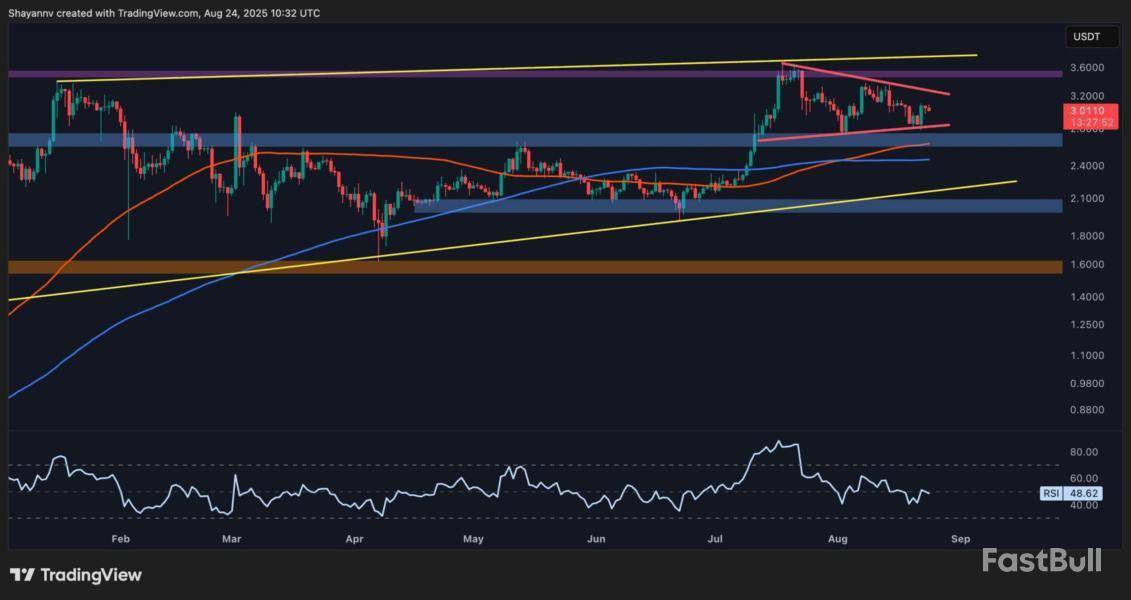
On the USDT chart, Ripple’s token has been consolidating within a symmetrical triangle, positioned just beneath the upper boundary of the broader ascending channel that has guided the price action in recent months. Since symmetrical triangles can resolve in either direction, the next decisive breakout will determine the market’s trajectory.
Currently, XRP is trading above both the 100-day and 200-day moving averages, which have recently shown a bullish crossover. This setup favors a breakout to the upside, potentially carrying the price beyond both the triangle and the larger channel. However, if XRP falls back below these moving averages, the outlook would turn bearish, opening the door for a decline toward the $2.10 support zone.
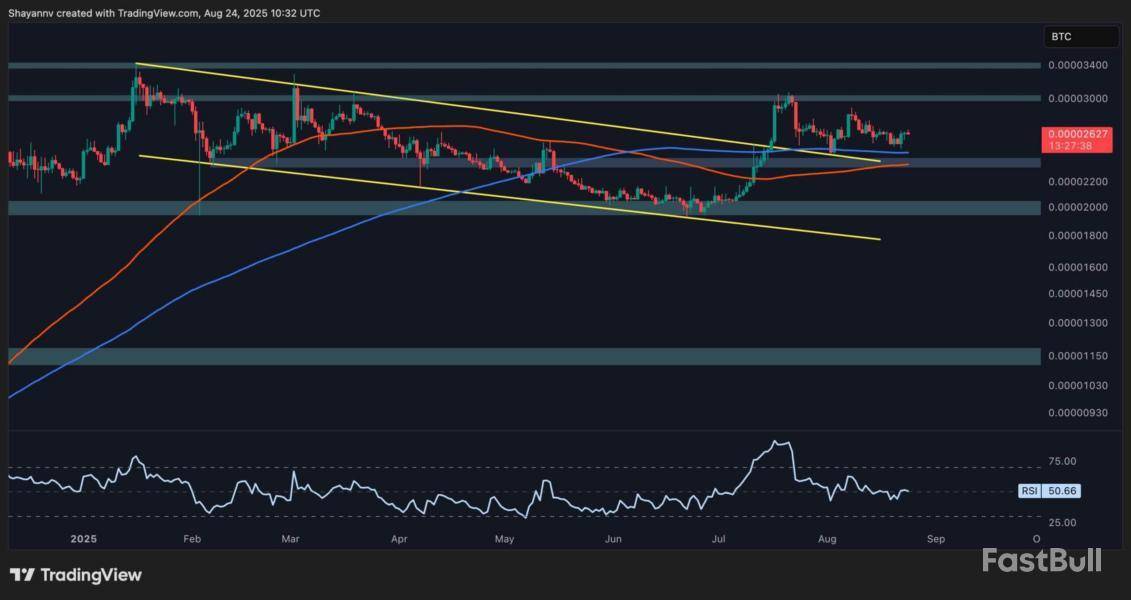
On the XRP/BTC chart, the price has also been consolidating, mirroring the USDT pair’s behavior after breaking out of a descending channel and moving above both the 100-day and 200-day moving averages. The key difference here is that these moving averages have not yet formed a bullish crossover, suggesting the market may not be ready for a decisive breakout just yet.
Still, with the asset holding above both moving averages and the critical 2,400 SAT support area, the outlook remains constructive. If momentum builds, a rally toward the 3,000 SAT level seems likely, with even a potential retest of the 3,400 SAT resistance zone on the table.
While ETH remains in a strong uptrend on higher timeframes, the bearish divergences on both daily and 4H RSI suggest caution. A potential correction toward $4.1K should not be ruled out unless buyers manage to defend $4.4K and push the price above the $4.8K ATH with convincing momentum.Technical Analysis
By ShayanThe Daily Chart
On the daily timeframe, Ethereum has formed a slightly higher high at $4,884 compared to its previous peak. However, RSI has failed to make a corresponding higher high, forming a bearish divergence, a classic warning of potential exhaustion in the trend.
The price is currently consolidating just below the new ATH, within the upper boundary of the ascending channel. Immediate support lies at $4,400–$4,450, followed by the Fib retracement cluster at $4,070–$3,900, which aligns with the channel’s midline and remains a high-probability demand zone if a correction deepens.
The 4-hour chart highlights a sharp liquidity sweep toward $4,884, followed by consolidation. Similar to the daily chart, RSI is showing bearish divergence as the price pushed higher while momentum faded. This indicates that buyers are losing strength despite achieving higher highs.
Key short-term supports sit at $4,477 (0.5 Fib) and $4,380–$4,311 (0.618–0.702 retracements). A breakdown below these levels could accelerate selling toward $4K, confirming a short-term market structure shift. On the upside, ETH needs to reclaim the $4.8K with strong momentum to invalidate the divergence and extend the bullish leg.
By Shayan
Ethereum has recently revisited its all-time high levels near $4,800–$4,900, with futures trading activity surging in parallel. The Futures Volume Bubble Map provides insight into how derivatives markets are behaving, offering a valuable gauge of whether speculative activity is cooling or overheating. This tool is crucial for assessing market risk and identifying potential reversal or continuation points.
The latest data shows that as ETH rallied toward its highs, futures volume expanded sharply, with multiple red bubbles (overheating) appearing on the map. Historically, such conditions have often coincided with local tops or periods of heavy volatility, as rising leverage increases the risk of liquidation cascades.
Looking back, similar overheating phases in early and late 2021 preceded significant corrections after Ethereum topped. By contrast, green phases (cooling) have typically marked accumulation zones, where leverage resets and ETH is prepared for a fresh leg higher.
At present, ETH futures suggest a stretched derivatives market, with speculative activity reaching overheated levels near ATH. This aligns with the bearish RSI divergences observed on the spot charts, which point to weakening momentum despite higher prices. While an unexpected surge toward a new ATH remains possible under these conditions, the setup signals increased short-term risk of volatility and corrective moves.
Bitcoin’s fee market has entered an unusual phase, raising questions about the fate of the fees and their implications for the network’s economic security. Since the decline in non-monetary activity like Ordinals and Runes in late 2024, on-chain usage has dropped sharply.
The result has been a growing number of blocks that clear at almost no cost to users, which often averages just 1 satoshi per virtual byte or less.Where Did All the Bitcoin Fees Go?
For those looking to send bitcoin quickly and cheaply, this environment seems ideal. But the same cannot be said for miners, who rely on fees to supplement theshrinkingblock subsidy after the 2024 halving. The collapse of fee pressure exposes a deeper vulnerability in Bitcoin’s long-term sustainability, according to the latest note shared by Galaxy Digital.
Median daily fees have fallen more than 80% since April 2024, and as of August 2025, nearly 15% of all blocks can be classified as “free blocks.” At the same time, almost half of the blocks in recent months have not reached maximum weight, which revealed an unusually thin mempool and highlighted the absence of competition for blockspace.
The disappearance of fees can be traced to several structural changes. One is the dramatic surge and decline of OP_RETURN transactions, which spiked during the peak of Runes adoption in 2024, and at times accounted for 40-60% of daily activity. Their retreat back to roughly 20% of transactions has released congestion, thereby lowering overall fees. Yet OP_RETURN remains central to debate, especially as Bitcoin Core’s upcoming v30 release could allow larger and multiple OP_RETURN outputs per transaction.
Supporters argue that because these outputs are provably unspendable, they do not increase the burden on the UTXO set. Critics, however, warn that they consume scarce blockspace that could otherwise be used for monetary transactions. This has sparked concerns about spam and sustainability.
Another factor behind weaker fees is the migration of activity away from Bitcoin’s base layer altogether. Spot ETFs now hold around 1.3 million BTC, locking up supply that rarely moves on-chain and thereby reducing transaction demand. At the same time, speculative use cases such as NFTs and meme coins have shifted to faster and cheaper alternatives like Solana, where users find a smoother experience compared to Bitcoin’s relatively constrained environment.
This displacement means that transactions that once competed aggressively for inclusion in blocks are now occurring elsewhere, further undermining fee revenue for miners.
Beyond immediate fee pressures, Galaxy also examined the UTXO set to assess long-term security risks. The analysts found that millions of coins remain in legacy formats such as P2PK and P2PKH, some of which are inherently vulnerable to quantum attacks due to exposed public keys. On the other hand, adoption of P2WPKH has grown to dominate unspent balances, while Taproot continues to gain traction for advanced use cases.“Settlement Layer Without Settlement”
For now, the lull offers a window of cheap transactions, but the long-term picture is “murkier” as a declining fee market poses serious questions to the network security.
Post 2024, miners are left with 3.125 BTC in block rewards, and miner incentives are increasingly exposed to fluctuations in organic demand. But as BTC activity shifts toward ETFs, custodial platforms, and faster alternative L1s, Galaxy said that the core network risks becoming a “settlement layer without sufficient settlement activity.” As reliance on off-chain “paper Bitcoin” grows and fees dry up, Bitcoin’s long-term security hinges on a level of usage that remains uncertain.
“Fee volatility is nothing new, but Bitcoin does need real reasons to use the chain. “
One year has passed since the arrest of Telegram CEO and co-founder Pavel Durov, sparking outrage from free speech activists and concern over the future of platform moderation.
On Aug. 24, 2024, Durov was arrested at the Paris-Le Bourget Airport in Paris, France as part of an investigation by the French National Judicial Police. The 12 charges later filed against him claim that he is complicit in serious crimes committed by users on his platform.
Durov has expressed confusion and frustration about the case in recent interviews. Free speech advocates harshly criticized the arrest, stating it has serious implications for free speech and platform development.
Now, one year later, there is little progress in the case, and new challenges to user privacy on messaging platforms are rising.
One year after Durov’s arrest, no trial set
Durov was arrested last year after France’s L’Office Mineurs (OFMIN) — the criminal enforcement agency that oversees crimes against minors — issued a warrant in a preliminary investigation of Telegram.
Investigators claimed that Telegram does not moderate content, and therefore, Durov was complicit in alleged offenses ranging from fraud, drug trafficking, cyberbullying and organized crime.
In a statement, Telegram claimed that it abided by EU laws, including the Digital Services Act and that its moderation is within industry standards.
The TON Society, an organization behind developing The Open Network based on Telegram’s former blockchain project, called the arrest “a direct assault on a basic human right.” Famed whistleblower Edward Snowden accused French President Emmanuel Macron of “taking hostages for gaining access to private communications.”
Durov didn’t break his silence until September 2024, when he said in a statement on Telegram that the company was “prepared to leave markets that aren’t compatible with our principles.” He also claimed he was surprised by the arrest, given that Telegram reportedly has numerous mechanisms through which it cooperates with authorities.
Durov said that the arrest had a personal toll as well, stating that his partner, Juli Vavilova, had a miscarriage due to stress from the investigation.
He wouldn’t make his first court appearance until December and, a few months later, won limited freedom to travel to the United Arab Emirates to conduct business while the case against him in France is ongoing.
In a June interview with Tucker Carlson, Durov clarified that he is not currently standing trial but rather obligated to appear in front of so-called “investigative judges” whose job is to “find out whether there is enough evidence to put me on trial.”
He called the current requirement that he stay in France “very strange and very unnecessary,” given that procedurally, he must only appear in court every few months. He said that he hopes the situation can be resolved, or that he can at least have the travel restriction lifted, in the next few months.
As of Aug. 24, the investigation is still ongoing.
Governments curb encrypted messengers globally
Durov’s case comes as regulators across the globe take aim at encrypted messaging services.
Denmark, which currently holds the presidency of the European Council, has put forward a bill that would require encrypted messaging platforms, including WhatsApp, Signal and Telegram, to scan every message, photo and video sent by users.
The bill, called the “Regulation to Prevent and Combat Child Sexual Abuse,” or “Chat Control” by critics, has reportedly secured the support of 19 of the 27 member states. In order to pass, it must have support from at least 15 countries, and those countries must contain at least 65% of the EU’s population.
The European Crypto Initiative has asked citizens to call their members of European Parliament and said it would engage directly with regulators at a stakeholder session in September.
Durov said that he would rather Telegram exit certain markets than comply with regulations that violate the company’s ethical principles regarding privacy.
“Telegram would rather exit a market than undermine encryption with backdoors and violate basic human rights. Unlike some of our competitors, we don’t trade privacy for market share,” he said.
In Durov’s home country of Russia, the government has cracked down on encrypted messengers, banning WhatsApp and Telegram, alleging that they are used for fraud and terrorism. It has also banned Facebook, Instagram and X.
In place of these, the government has developed the messaging app Max, along with VK, a social media platform itself developed by Durov. Durov left VK in 2014 after refusing to hand over user data on Ukrainian protestors demonstrating against the pro-Russian president Viktor Yanukovych.
Max, which reportedly integrates government services and peer-to-peer payments directly into the app, has been accused of storing user data, including contact lists, metadata, IP addresses and timestamps, and making that data available to authorities. Phones sold in Russia will come with the app pre-installed starting Sept. 1.
The world over, encrypted messengers are under increasing pressure to compromise privacy. Whether it be in an increasingly authoritarian country or under the very legitimate concern of child safety, user privacy, once taken away, is not easily won back. Durov’s case, while it proceeds at a glacial pace, will undoubtedly have implications for how messengers are regulated and allowed to develop.
Opinion by: Dipendra Jain, co-founder of TCX
Regulation has become the baseline for crypto. From the United States’ regulatory enforcement to Dubai’s comprehensive crypto rulebook and India’s renewed debate on formalizing Bitcoin reserves, governments are rewriting the rules of digital finance. As listed institutions, retailers and social networks weigh in on digital asset rails, stablecoins and yield mechanisms, the real story is no longer what’s next, but who is building what comes next.
Speculation once drove adoption, but structured compliance catalyzes scale across the Asia-Middle East corridor. Hubs like the United Arab Emirates and India represent the treatment of regulation as the backbone of innovation. The UAE is pushing a unified virtual asset service providers (VASP) framework to accelerate global crypto ambitions. At the same time, India is opening the door for offshore crypto exchanges to return, with approvals now subject to the review of the Financial Intelligence Unit (FIU).
As regulatory frameworks formalize, platforms must align with new taxation, data governance and licensing rules to access expanding markets without friction. The global center of gravity is tilting eastward, and the question is: Who will master the age of “permissioned scale,” where sustainable growth comes from thriving within regulation, not skirting them?
Jurisdictional intelligence and the demographic interplay
Once sufficient for market entry, understanding jurisdictional rules is no longer enough. The Dubai Virtual Assets Regulatory Authority (VARA) has issued 36 full licenses and supports over 400 registered companies. VARA is also piloting tokenized gold and DeFi products, which promise growing enthusiasm to experiment with real-world assets beyond established solutions within a controlled environment.
But regulation alone renders platforms powerless if they fail to meet users where they are. With over 1.12 billion cellular mobile connections in India, 55.3% have internet access, and only 27% of adults meet basic financial literacy requirements. Platforms must recognize the need to bridge the knowledge gap through education-embedded user journeys. Crypto platforms can offer far more efficient, blockchain-based fintech solutions in remittance-heavy Cambodia and the Philippines, where such transactions make up 9% of GDP, by leveraging stablecoins to simplify transfers, reduce costs, and enhance transparency.
Financial sovereignty will remain aspirational for underbanked populations and emerging markets without contextualized features and user-oriented solutions. Platforms that embed jurisdictional intelligence at their core and localize products with compliance and cultural relevance will set the standard for future adoption. This ultimately differentiates between short-term participation and long-term leadership.
Compliance as a competitive moat
The industry is at a juncture where compliance has become the ultimate competitive moat. Low-cost, government-backed payment rails are displacing traditional payment flows, challenging global card networks like Mastercard and Visa. Today, regulated fiat-crypto integration carries similar potential to displace legacy infrastructure, which can only be unlocked by those actively building trusted access by working within regulatory parameters.
Related: The rise of Money2: The next financial system has already begun
When there is regulatory clarity, progress and adoption will follow. The UAE attracted $34 billion in crypto inflows in the Middle East last year. India’s Unified Payments Interface (UPI) is another example of how regulation can boost fraud indicators in safeguarding user funds. Collective efforts across borders can encourage crypto platforms to integrate automated compliance and risk monitoring at the protocol level.
A regulated foundation also makes cross-border capital flow more viable. This allows them to meet institutional demands for transparent, scalable access to diversified liquidity and global capital markets. Permissioned scale is underway, where regulation, payments and liquidity infrastructure extend in sync. Stablecoin developments further complement this infrastructure, providing a strong, programmable medium for cross-border settlements that bridge traditional finance and crypto ecosystems.
AI and RWA as financial democratisation enablers
AI introduces three indispensable elements: real-time regulatory interpretation, fraud detection and parity-based trading. Platforms can navigate jurisdictional requirements by injecting regulatory intelligence directly into trading mechanisms while optimizing user experience.
Real-world assets (RWAs) further expand that opportunity. Tokenized real estate, sovereign bonds, and commodities such as gold are gaining traction, with a projection to grow into a $10 trillion market by 2030, particularly in economies seeking to diversify wealth pools and investment options. In ESG sectors like agriculture, carbon credits and trade receivables, tokenization removes friction, reduces reliance on intermediaries and accelerates settlement timelines. It creates liquidity for underserved participants, including small- and medium-size enterprises (SMEs), while offering institutional investors new, risk-adjusted, diversified returns.
Partnerships across capital markets and crypto companies also lay the groundwork for tokenized private equity and other frontier assets. While still deemed mainly uncharted waters, clarity is poised to catch up as giants like BlackRock, eToro, Robinhood and Coinbase call for RWA representation in mainstream portfolios.
An AI-native approach that can price, route and settle RWA trades must integrate compliance throughout the stack, from onboarding and identity verification to transaction monitoring and regulatory reporting. This compliant, AI-powered core will become a definitive innovation for the next generation of financial infrastructure.
Victorious platforms are those that scale by design
The payoff from speculative surges has faded. Today’s growth comes from platforms designed to scale with the rules. When regulation is a given, the true differentiator lies in those who will build trust, liquidity, and utility that endures across jurisdictions.
Leadership in this emerging reality will come from platforms fluent in regulatory nuance, grounded in user behavior and equipped with the technology to unlock compliant access to global capital and real-world assets. As the Asia-Middle East corridor sets the pace, the platforms that master permissioned scale will write crypto’s next playbook.
Opinion by: Dipendra Jain, co-founder of TCX.
This article is for general information purposes and is not intended to be and should not be taken as legal or investment advice. The views, thoughts, and opinions expressed here are the author’s alone and do not necessarily reflect or represent the views and opinions of Cointelegraph.
Despite the broader market showing signs of fatigue, the BNB price train is still on track. Over the past 24 hours, Binance Coin has slipped 1.5%, now trading at $877. Given its relentless performance, this pullback, however, looks more like a scheduled pause than a derailment.
In the past month alone, BNB has gained 15%, while three-month returns sit at 30%, and the yearly swing is an impressive 51%. At just 2% below its all-time high of $899, the token is still within striking distance of a breakout that could carry it into four-digit territory for the first time.
Spot Demand Builds Through HODL Waves
Supporting this steady climb is the expansion across multiple HODL wave cohorts: a metric that tracks the percentage of circulating supply held across different holding periods.
Between July 24 and August 23, three key cohorts all grew their holdings: one-year to two-year wallets rose from 6.55% to 7.52%, three-month to six-month holdings surged from 1.62% to 7.30%, and one-month to three-month wallets ticked slightly higher from 2.29% to 2.306%.
These increases confirm that both long-term and mid-term investors are buying into strength rather than waiting for dips, adding fresh fuel to the BNB price train.
Want more token insights like this? Sign up for Editor Harsh Notariya’s Daily Crypto Newsletter here.
Futures Open Interest Keeps Momentum Alive
It isn’t just spot markets that are feeding the rally. BNB futures open interest has been climbing steadily alongside prices, hitting a three-month peak of $1.27 billion on August 22. The current levels are still around the same zone.
Rising open interest means leveraged traders are piling in, amplifying the potential for both upward surges and sudden squeezes. If momentum favors the bulls, short liquidations could accelerate the move past $899 and unlock higher price discovery levels.
On the flip side, a sudden long squeeze could trigger volatility and pullback, but the current alignment of spot and derivatives suggests the bias remains upward.
Futures open interest measures the total number of outstanding futures contracts that have not been settled, showing how much capital is tied to derivatives.
BNB Price Action: $898 Is the Gateway to Four Digits
BNB is testing critical resistance zones that could define its next move. The token recently pulled back from $898, which aligns with the 0.618 Fibonacci extension, often seen as the strongest barrier in an uptrend. The BNB price is currently trading a notch under another key resistance level of $882.
With $898–$899 marking its historical high and one of the toughest resistance zones, a decisive candle close above that level could open the tracks toward $922 and $952.
Once BNB breaks past $898 strongly and into price discovery, the first four-digit target stands at $1,038. If spot and derivatives momentum holds, this may only be the beginning of a longer rally, where $1,000 is less a destination and more a milestone on the journey.
However, if the BNB price breaks under $812, a key retracement zone, it would invalidate the bullish hypothesis in the short term. That would momentarily put a halt to the BNB price train.
White Label
Data API
Web Plug-ins
Poster Maker
Affiliate Program
The risk of loss in trading financial instruments such as stocks, FX, commodities, futures, bonds, ETFs and crypto can be substantial. You may sustain a total loss of the funds that you deposit with your broker. Therefore, you should carefully consider whether such trading is suitable for you in light of your circumstances and financial resources.
No decision to invest should be made without thoroughly conducting due diligence by yourself or consulting with your financial advisors. Our web content might not suit you since we don't know your financial conditions and investment needs. Our financial information might have latency or contain inaccuracy, so you should be fully responsible for any of your trading and investment decisions. The company will not be responsible for your capital loss.
Without getting permission from the website, you are not allowed to copy the website's graphics, texts, or trademarks. Intellectual property rights in the content or data incorporated into this website belong to its providers and exchange merchants.
Not Logged In
Log in to access more features

FastBull Membership
Not yet
Purchase
Log In
Sign Up