• Trade
  • Markets
  • Copy
  • Contests
  • 24/7
  • Calendar
  • Q&A
  • Chats
Screeners
SYMBOL
LAST
BID
ASK
HIGH
LOW
NET CHG.
%CHG.
SPREAD
SOURCE
SPX
S&P 500 Index
7688.62
7688.62
7688.62
7715.57
7635.81
+119.70
+ 1.58%
--
--
DJI
Dow Jones Industrial Average
53356.12
53356.12
53356.12
53492.40
52410.23
+1569.40
+ 3.03%
--
--
IXIC
NASDAQ Composite Index
25736.52
25736.52
25736.52
26048.83
25602.14
+364.52
+ 1.44%
--
--
USDX
US Dollar Index
101.410
101.410
101.490
101.460
101.023
+0.065
+ 0.06%
--
--
EURUSD
Euro / US Dollar
1.12203
1.12203
1.12210
1.12678
1.12162
-0.00072
-0.06%
--
--
GBPUSD
Pound Sterling / US Dollar
1.34748
1.34748
1.34761
1.35003
1.34476
+0.00041
+ 0.03%
--
--
XAUUSD
Gold / US Dollar
4126.70
4126.70
4127.13
4146.77
4057.55
+65.85
+ 1.62%
--
--
WTI
Light Sweet Crude Oil
88.981
88.981
89.011
89.040
86.001
+1.617
+ 1.85%
--
--

Community Accounts

Signal Accounts
--
Profit Accounts
--
Loss Accounts
--
View More

Become a signal provider

Sell trading signals to earn additional income

View More

Guide to Copy Trading

Get started with ease and confidence

View More

Signal Accounts for Members

All Signal Accounts

Best Return
  • Best Return
  • Best P/L
  • Best MDD
Past 1W
  • Past 1W
  • Past 1M
  • Past 1Y

All Contests

  • All
  • Recommend
  • Stocks
  • Cryptocurrencies
  • Central Banks
  • Trump Updates
  • Featured News
Top News Only
Share

Bank Of England: New Activities Related To Artificial Intelligence Account For One-fifth Of Growth This Year

Share

Traders Have Increased Their Bets On A Bank Of England Rate Hike, Seeing A 35% Chance Of A December Increase

Share

The Bank Of England's Core Forecast Indicates That The CPI Will Fall Back To The 2% Target In The Third Quarter Of 2028

Share

The Bank Of England: The Government Budget Is Expected To Reduce Inflation By 0.25 Percentage Points By The Second Quarter Of 2027, After Which Inflation Will Rise By The Same Amount A Year Later As The Effects Subside

Share

The UK's FTSE 100 Index Gave Up Some Gains After The Bank Of England's Decision, And Is Currently Up 0.6%

Share

The Bank Of England Has Raised Its GDP Growth Forecast, Now Expecting 1.6% In 2026, 1.3% In 2027, And 1.2% In 2028; In July, It Had Forecast 1.1% In 2026, 1.1% In 2027, And 1.7% In 2028

Share

Italy's Deputy Economy Minister Said That After Criticism, Italy Is Prepared To Consider Revising Its Exit Tax Proposal For Wealthy People Leaving The Country

Share

BOE Monetary Policy Committee Member Greene: Evidence For The Second Round Is Limited, But The Risks Are Clearly Skewed To The Upside

Share

Bank Of England: Adverse Scenario Indicates That CPI Will Peak At 6.2% In The Third Quarter Of 2027

Share

The Bank Of England's Benchmark Forecast Shows That The CPI Will Be 4.4% In The First Quarter Of 2027, 3.1% In The First Quarter Of 2028, And 1.9% In The First Quarter Of 2029

Share

Bank Of England's Lombardy: Further Interest Rate Hikes May Be Necessary In The Short Term

Share

Bank Of England Official Ramsden: Confidence In Domestic Inflation Slowing Has Weakened

Share

Bank Of England Board Member Mann: We Are Currently In An Environment Where The Second Round Of Effects Is More Persistent

Share

Bank Of England Governor Bailey: Energy Prices Have Already Created Sufficient Inflationary Pressure During The Transmission Process To Support An Interest Rate Hike

Share

British Government Bond Gains Narrowed After The Bank Of England Announced Measures That Pushed The Yield On Two-year Government Bonds Up 1 Basis Point To 4.75%

Share

The Bank Of England Has Raised Its GDP Growth Forecast: It Expects 1.6% In 2026, 1.3% In 2027, And 1.2% In 2028

Share

Bank Of England Chief Economist Peel: A Single 25 Basis Point Rate Hike Is Unlikely To Be Enough

Share

Bank Of England's Taylor: This Is Currently An Insurance Rate Hike For Risk Management Purposes

Share

The Bank Of England Projects The Unemployment Rate To Be 4.8% In 2026, 4.9% In 2027, And 5.1% In 2028

Share

Bank Of England Chief Economist Peel: Changes In Wage And Price Dynamics Warrant Attention

TIME
ACT
FCST
PREV
IMPACT
U.S. EIA Weekly Gasoline Stocks Change

A:--

F: --

P: --

WTI
  • WTI
  • XAUUSD
  • XAGUSD
  • USDX
U.S. EIA Weekly Cushing, Oklahoma Crude Oil Stocks Change

A:--

F: --

P: --

WTI
  • WTI
  • XAUUSD
  • XAGUSD
  • USDX
U.S. EIA Weekly Crude Demand Projected by Production

A:--

F: --

P: --

WTI
  • WTI
  • XAUUSD
  • XAGUSD
  • USDX
U.S. EIA Weekly Crude Oil Imports Changes

A:--

F: --

P: --

WTI
  • WTI
  • XAUUSD
  • XAGUSD
  • USDX
U.S. EIA Weekly Heating Oil Stock Changes

A:--

F: --

P: --

WTI
  • WTI
  • XAUUSD
  • XAGUSD
  • USDX
Brazil CAGED Net Payroll Jobs (Sept)

A:--

F: --

P: --

XAUUSD
  • XAUUSD
  • XAGUSD
  • WTI
  • USDX
Brazil Selic Interest Rate

A:--

F: --

P: --

XAUUSD
  • XAUUSD
  • XAGUSD
  • WTI
  • USDX
Japan IHS Markit Composite PMI (Oct)

A:--

F: --

P: --

USDJPY
  • USDJPY
  • XAUUSD
  • XAGUSD
  • WTI
Japan IHS Markit Services PMI (Oct)

A:--

F: --

P: --

USDJPY
  • USDJPY
  • XAUUSD
  • XAGUSD
  • WTI
Australia Trade Balance (SA) (Sept)

A:--

F: --

P: --
AUDUSD
  • AUDUSD
  • XAUUSD
  • XAGUSD
  • WTI
  • USDX
Australia Exports MoM (SA) (Sept)

A:--

F: --

P: --
AUDUSD
  • AUDUSD
  • XAUUSD
  • XAGUSD
  • WTI
Japan 10-Year Note Auction Yield

A:--

F: --

P: --

USDJPY
  • USDJPY
  • XAUUSD
  • XAGUSD
  • WTI
  • USDX
Indonesia GDP YoY (Q3)

A:--

F: --

P: --

XAUUSD
  • XAUUSD
  • XAGUSD
  • WTI
  • USDX
Russia IHS Markit Services PMI (Oct)

A:--

F: --

P: --

WTI
  • WTI
  • XAUUSD
  • XAGUSD
  • USDX
South Africa IHS Markit Composite PMI (SA) (Oct)

A:--

F: --

P: --

XAUUSD
  • XAUUSD
  • XAGUSD
  • WTI
  • USDX
France Industrial Output MoM (SA) (Sept)

A:--

F: --

P: --
EURUSD
  • EURUSD
  • XAUUSD
  • XAGUSD
  • WTI
  • USDX
Germany Construction PMI (SA) (Oct)

A:--

F: --

P: --

EURUSD
  • EURUSD
  • XAUUSD
  • XAGUSD
  • WTI
  • USDX
Italy Retail Sales MoM (SA) (Sept)

A:--

F: --

P: --

EURUSD
  • EURUSD
  • XAUUSD
  • XAGUSD
  • WTI
  • USDX
U.K. Markit/CIPS Construction PMI (Oct)

A:--

F: --

P: --

GBPUSD
  • GBPUSD
  • XAUUSD
  • XAGUSD
  • WTI
  • USDX
Euro Zone PPI YoY (Sept)

A:--

F: --

P: --
EURUSD
  • EURUSD
  • XAUUSD
  • XAGUSD
  • WTI
  • USDX
Euro Zone PPI MoM (Sept)

A:--

F: --

P: --
EURUSD
  • EURUSD
  • XAUUSD
  • XAGUSD
  • WTI
  • USDX
France 10-Year OAT Auction Avg. Yield

A:--

F: --

P: --

EURUSD
  • EURUSD
  • XAUUSD
  • XAGUSD
  • WTI
  • USDX
U.S. Challenger Job Cuts YoY (Oct)

A:--

F: --

P: --

USDX
  • USDX
  • XAUUSD
  • XAGUSD
  • WTI
U.S. Challenger Job Cuts (Oct)

A:--

F: --

P: --

USDX
  • USDX
  • XAUUSD
  • XAGUSD
  • WTI
U.S. Challenger Job Cuts MoM (Oct)

A:--

F: --

P: --

USDX
  • USDX
  • XAUUSD
  • XAGUSD
  • WTI
Mexico Consumer Confidence Index (Oct)

A:--

F: --

P: --

XAUUSD
  • XAUUSD
  • XAGUSD
  • WTI
  • USDX
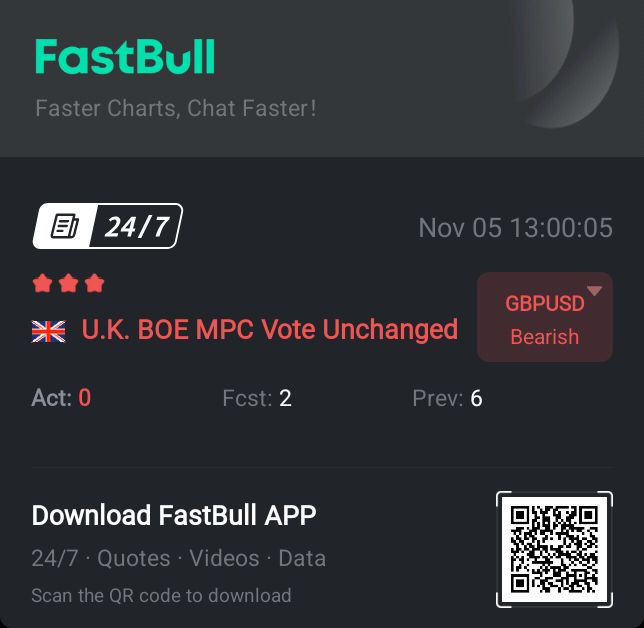
U.K. BOE MPC Vote Unchanged

A:--

F: --

P: --

GBPUSD
  • GBPUSD
  • XAUUSD
  • XAGUSD
  • WTI
  • USDX
U.K. BOE MPC Vote Hike

A:--

F: --

P: --

GBPUSD
  • GBPUSD
  • XAUUSD
  • XAGUSD
  • WTI
  • USDX
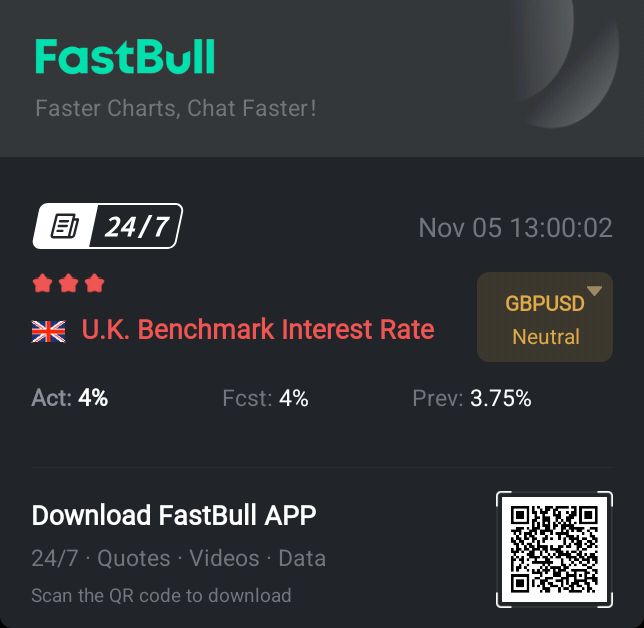
U.K. Benchmark Interest Rate

A:--

F: --

P: --

GBPUSD
  • GBPUSD
  • XAUUSD
  • XAGUSD
  • WTI
  • USDX
U.K. BOE MPC Vote Cut

A:--

F: --

P: --

GBPUSD
  • GBPUSD
  • XAUUSD
  • XAGUSD
  • WTI
  • USDX
MPC Rate Statement
Bank of England Governor Bailey held a press conference on monetary policy.
Brazil IHS Markit Services PMI (Oct)

--

F: --

P: --

Brazil IHS Markit Composite PMI (Oct)

--

F: --

P: --

U.S. Weekly Initial Jobless Claims (SA)

--

F: --

P: --

U.S. Weekly Continued Jobless Claims (SA)

--

F: --

P: --

U.S. Initial Jobless Claims 4-Week Avg. (SA)

--

F: --

P: --

FOMC Member Hammack Speaks
Richmond Federal Reserve President Barkin delivered a speech.
ECB President Lagarde Speaks
U.S. EIA Weekly Natural Gas Stocks Change

--

F: --

P: --

Bank of Canada Governor Macklem and Senior Deputy Governor Rogers testified before a Senate committee.
ECB Chief Economist Lane Speaks
ECB President Lagarde Speaks
Mexico Policy Interest Rate

--

F: --

P: --

U.S. Weekly Treasuries Held by Foreign Central Banks

--

F: --

P: --

Japan Wages MoM (Sept)

--

F: --

P: --

Germany Industrial Output MoM (SA) (Sept)

--

F: --

P: --

U.K. Halifax House Price Index YoY (SA) (Oct)

--

F: --

P: --

U.K. Halifax House Price Index MoM (SA) (Oct)

--

F: --

P: --

France Trade Balance (SA) (Sept)

--

F: --

P: --

New York Fed President Williams and ECB Chief Economist Lane participated in discussions at the 2026 ECB Monetary Markets Conference.
Euro Zone Retail Sales YoY (Sept)

--

F: --

P: --

Euro Zone Retail Sales MoM (Sept)

--

F: --

P: --

India Deposit Gowth YoY

--

F: --

P: --

Canada Employment (SA) (Oct)

--

F: --

P: --

Q&A with Experts
    • All
    • Chatrooms
    • Groups
    • Friends
    Size flag
    Areeba Mini❣️❣️
    @Sizewaw nice opportunity 😃
    @Areeba Mini❣️❣️Yeah, mate. It's shaping up nicely so far..
    Nawhdir flag
    where will...
    "Nawhdir" recalled a message
    Nawhdir flag
    Skylark flag
    john
    @salman andI like gold is holding unto gains,,the 4130 is now acting as a support for the buyers
    @johnyesh which is just consolidating at the moment maybe because of the London launch break
    Skylark flag
    Nawhdir
    where will...
    @Nawhdirwhere will you what neighbor?
    Areeba Mini❣️❣️ flag
    Size
    @Areeba Mini❣️❣️Yeah, mate. It's shaping up nicely so far..
    @SizeAlright, I'll take a look right now
    Nawhdir flag
    Skylark
    @Nawhdirwhere will you what neighbor?
    @Skylarktherefore, i want to search clue
    Skylark flag
    Nawhdir
    @Nawhdiryou have some nice move here bro.
    Skylark flag
    Nawhdir
    @Skylarktherefore, i want to search clue
    @Nawhdirsearch clue??? little bit confused bro.
    Skylark flag
    Skylark flag
    Skylark flag
    Skylark
    @Nawhdir@Areeba Mini❣️❣️check this out
    Nawhdir flag
    Skylark
    @Nawhdiryou have some nice move here bro.
    @Skylarkthats still yesterday selling condition
    Skylark flag
    Skylark
    @Areeba Mini❣️❣️@NawhdirAre going to have some bearish move here?
    Skylark flag
    Nawhdir
    @Skylarkthats still yesterday selling condition
    @Nawhdiryes I see that and its still moving pretty well.
    Oscar flag
    gold is selling guys
    Nawhdir flag
    Skylark
    @Areeba Mini❣️❣️@NawhdirAre going to have some bearish move here?
    @Skylarkbenchmar interest rates. we have to make sure that the news cointinualy
    Nawhdir flag
    Nawhdir
    @Skylarkbenchmar interest rates. we have to make sure that the news cointinualy
    if true, that would be happened
    Nawhdir flag
    Nawhdir
    if true, that would be happened
    #happening
    Type here...
    Add Symbol or Code

      No matching data

      All
      Recommend
      Stocks
      Cryptocurrencies
      Central Banks
      Trump Updates
      Featured News
      • All
      • Russia-Ukraine Conflict
      • Middle East Flashpoint
      • All
      • Russia-Ukraine Conflict
      • Middle East Flashpoint
      Search
      Products

      Charts Free Forever

      Chats Q&A with Experts
      Screeners Economic Calendar Data Tools
      Membership Features
      Data Warehouse Market Trends Institutional Data Policy Rates Macro

      Market Trends

      Market Sentiment Order Book Forex Correlations

      Top Indicators

      Charts Free Forever
      Markets

      News

      24/7 Analysis Education

      Latest Views

      Latest Update

      Signals

      Copy Rankings Latest Signals Become a signal provider AI Rating
      Contests
      Brokers

      Overview Brokers Assessment Rankings Regulators News Claims
      Broker listing Forex Brokers Comparison Tool Live Spread Comparison Scam
      Q&A Complaint Scam Alert Videos Tips to Detect Scam
      More

      Business
      Events
      Careers About Us Advertising Help Center

      White Label

      Broker API

      Data API

      Web Plug-ins

      Affiliate Program

      Awards Institution Evaluation IB Seminar Salon Event Exhibition
      Vietnam Thailand Singapore Dubai
      Fans Party Investment Sharing Session
      FastBull Summit BrokersView Expo
      Recent Searches
        Top Searches
          Markets
          Analysis
          User
          24/7
          Economic Calendar
          Education
          Data
          • Names
          • Latest
          • Prev

          View All

          No data

          Scan to Download

          Faster Charts, Chat Faster!

          Download
          English
          • English
          • Español
          • العربية
          • Bahasa Indonesia
          • Bahasa Melayu
          • Tiếng Việt
          • ภาษาไทย
          • Français
          • Italiano
          • Türkçe
          • Русский язык
          • 简中
          • 繁中
          Open Account
          Search
          Products
          Charts Free Forever
          Markets
          News
          Signals

          Copy Rankings Latest Signals Become a signal provider AI Rating
          Contests
          Brokers

          Overview Brokers Assessment Rankings Regulators News Claims
          Broker listing Forex Brokers Comparison Tool Live Spread Comparison Scam
          Q&A Complaint Scam Alert Videos Tips to Detect Scam
          More

          Business
          Events
          Careers About Us Advertising Help Center

          White Label

          Broker API

          Data API

          Web Plug-ins

          Affiliate Program

          Awards Institution Evaluation IB Seminar Salon Event Exhibition
          Vietnam Thailand Singapore Dubai
          Fans Party Investment Sharing Session
          FastBull Summit BrokersView Expo

          Put vs Call: Key Differences, How They Work, and When to Use Each

          zhan chen
          Summary:

          Learn the difference between put vs call options, how each contract works, potential profits and risks, and when traders use puts or calls.

          Options trading can seem complicated at first, especially when terms like puts, calls, strike prices, and expiration dates appear together. However, understanding the difference between a put and a call is one of the most important steps toward learning how options work. The basic distinction is simple: a call gives the buyer the right to purchase an asset at a specified price, while a put gives the buyer the right to sell it. Both can be used to speculate on price movements, manage portfolio risk, or build more advanced trading strategies.
          Put vs Call: Key Differences, How They Work, and When to Use Each_1

          Table of Contents

          • 1. What Is a Call Option?
          • 2. What Is a Put Option?
          • 3. Put vs Call: Key Differences
          • 4. Buying vs Selling Puts and Calls
          • 5. How Do Strike Price and Premium Affect Puts and Calls?
          • 6. When Should You Use a Call vs a Put?
          • 7. What Factors Affect the Value of Puts and Calls?
          • 8. Common Mistakes When Trading Puts and Calls
          • 9. Frequently Asked Questions
          • 10. Final Thoughts

          What Is a Call Option?

          A call option is a financial contract that gives the buyer the right, but not the obligation, to purchase an underlying asset at a predetermined price, known as the strike price, before or on the expiration date.

          Traders generally buy call options when they expect the price of an asset to increase. Instead of purchasing shares directly, they can pay an options premium for the opportunity to benefit from a potential price rise.

          For example, suppose a stock is trading at $50. You purchase a call option with a $55 strike price and pay a premium of $2 per share.

          If the stock rises to $65 before expiration, the option has $10 of intrinsic value per share. After subtracting the $2 premium, your potential profit is $8 per share, excluding transaction costs.

          If the stock remains below $55 at expiration, the option may expire worthless, and you lose the premium paid.

          Key characteristics of a call option:

          • Market outlook: Generally bullish.
          • Buyer's right: Purchase the underlying asset.
          • Potential profit: Unlimited for a long stock call.
          • Maximum loss: Premium paid.
          • Common purpose: Speculating on rising prices or gaining exposure with less upfront capital.

          What Is a Put Option?

          A put option gives the buyer the right, but not the obligation, to sell an underlying asset at a specified strike price before or on the expiration date.

          Traders typically purchase put options when they expect an asset's price to decline. A put can also serve as a form of portfolio protection, allowing an investor to establish a minimum potential selling price for an existing stock position.

          Consider a stock trading at $50. You buy a put option with a $45 strike price and pay a premium of $2 per share.

          If the stock falls to $35 before expiration, the put has $10 of intrinsic value per share. After deducting the $2 premium, your potential profit is $8 per share.

          However, if the stock stays above $45 at expiration, the put may expire worthless, resulting in a loss of the $2 premium.

          Key characteristics of a put option:

          • Market outlook: Generally bearish.
          • Buyer's right: Sell the underlying asset.
          • Potential profit: Limited because the underlying asset cannot fall below zero.
          • Maximum loss: Premium paid.
          • Common purpose: Speculating on falling prices or protecting existing investments.

          Put vs Call: Key Differences

          Although both puts and calls are options contracts, they serve different purposes. The most important differences involve the buyer's rights, market expectations, and potential returns.

          FeatureCall OptionPut Option
          Buyer's rightRight to buyRight to sell
          Typical outlookBullishBearish
          Profits whenPrice risesPrice falls
          Maximum buyer lossPremium paidPremium paid
          Maximum profitUnlimitedLimited
          Common useUpside speculationDownside protection
          Seller's obligationSell the assetBuy the asset

          The direction of the expected price movement is usually the easiest way to distinguish the two.

          A call buyer generally wants the underlying asset to rise above the strike price sufficiently to cover the premium. A put buyer generally wants the asset to fall below the strike price sufficiently to offset the premium.

          However, market direction is not the only factor. Time until expiration, implied volatility, and the option's premium can all influence whether a trade becomes profitable.

          Buying vs Selling Puts and Calls

          Another important distinction in options trading is whether you buy or sell a contract.

          Buying an option gives you a right, while selling an option creates an obligation if the contract is assigned.

          There are four basic positions:

          1. Buy a Call

          You expect the underlying asset to rise. Your maximum loss is generally limited to the premium paid, while your potential profit is theoretically unlimited.

          2. Sell a Call

          You receive a premium in exchange for accepting the obligation to sell the underlying asset at the strike price if assigned. An uncovered or naked short call has theoretically unlimited loss potential.

          3. Buy a Put

          You expect the underlying asset to decline. You can potentially profit from falling prices, while your maximum loss is generally limited to the premium paid.

          4. Sell a Put

          You receive a premium and accept the obligation to buy the underlying asset at the strike price if assigned. If the asset falls significantly, your potential losses can be substantial.

          Understanding these four positions is essential because buying and selling the same option type can produce very different risk profiles.

          How Do Strike Price and Premium Affect Puts and Calls?

          Two terms appear in almost every options transaction: strike price and premium.

          The strike price is the predetermined price at which the underlying asset can be bought or sold through the contract.

          The premium is the amount the option buyer pays to acquire the contract. For standard US equity options, one contract typically represents 100 shares, although contract specifications can vary.

          Options can also be classified into three categories:

          • In the money (ITM): A call is ITM when the stock price is above its strike price. A put is ITM when the stock price is below its strike price.
          • At the money (ATM): The stock price is approximately equal to the strike price.
          • Out of the money (OTM): A call is OTM when the stock price is below its strike price. A put is OTM when the stock price is above its strike price.

          These classifications help traders evaluate an option's current intrinsic value, but they do not guarantee profitability.

          An option can be in the money and still produce a loss if the premium paid exceeds its intrinsic value at expiration.

          When Should You Use a Call vs a Put?

          Choosing between a put and a call depends on your market outlook and trading objectives.

          When to Consider Buying Calls

          A call option may be suitable when you expect a stock, ETF, or index to rise within a specific period.

          For example, if a company announces stronger-than-expected earnings and you believe its share price could increase, buying a call may provide leveraged exposure to that potential movement.

          Calls can also be useful when traders want to participate in potential upside without purchasing the underlying shares outright.

          However, the market must move sufficiently in the expected direction before expiration to offset the premium and other trading costs.

          When to Consider Buying Puts

          A put option may be useful when you expect an asset's price to decline or want protection against potential losses.

          For example, an investor holding 100 shares of a company at $100 might purchase a put with a $90 strike price.

          If the stock drops sharply, the put can help offset some of the decline by providing the right to sell shares at $90, subject to the premium paid.

          This approach is commonly known as a protective put.

          Puts can also be used for bearish speculation without directly short-selling shares.

          What Factors Affect the Value of Puts and Calls?

          The underlying asset's price is important, but several other factors influence options premiums.

          1. Underlying Asset Price

          A rising stock price generally benefits calls and hurts puts. A falling stock price generally benefits puts and hurts calls, all else being equal.

          2. Time to Expiration

          Options have limited lifespans. As expiration approaches, their time value generally decreases. This process is known as time decay, or theta.

          3. Implied Volatility

          Implied volatility reflects the market's expectations of future price fluctuations. Higher implied volatility generally increases both call and put premiums because larger price movements become more likely.

          4. Interest Rates

          Interest rates can influence option pricing, although their effects depend on the underlying asset, strike price, and expiration period.

          5. Dividends

          Expected dividends can affect stock prices and options valuations. Traders should consider upcoming ex-dividend dates when evaluating positions, particularly around expiration.

          Common Mistakes When Trading Puts and Calls

          Understanding the mechanics of options does not automatically make trading them profitable. Beginners often make several avoidable mistakes.

          • Ignoring expiration dates: An option can lose value over time even if the underlying asset moves in the expected direction.
          • Buying contracts based only on low premiums: Cheap options may have very low probabilities of finishing profitably.
          • Overlooking implied volatility: High premiums can make it difficult to generate a profit, even when the market moves favorably.
          • Confusing buying and selling: Selling options creates obligations and can expose traders to losses beyond the premium received.
          • Using excessive leverage: Options can amplify gains and losses relative to the initial capital committed.
          • Ignoring liquidity: Wide bid-ask spreads can increase transaction costs and make positions harder to close at favorable prices.

          Before trading, understand the contract specifications, potential assignment, margin requirements, and maximum possible loss.

          For a more detailed explanation of options risks and mechanics, consult the SEC's Options Investor Bulletin and the Options Industry Council's educational resources.

          Frequently Asked Questions

          Is a put or call better for beginners?

          Neither is automatically better. Calls are generally easier to understand when learning bullish strategies, while puts are useful for understanding bearish positions and portfolio protection. Beginners should learn the risks of both before trading with real money.

          Can you buy puts and calls on the same stock?

          Yes. Traders can purchase both puts and calls on the same underlying asset. One example is a long straddle, which involves buying a call and a put with the same strike price and expiration date to potentially benefit from a significant price movement in either direction.

          Can you lose more than you invest in puts and calls?

          When buying standard options, the maximum loss is generally the premium paid, plus applicable transaction costs. However, selling uncovered options can create much larger losses. Naked calls, in particular, have theoretically unlimited loss potential.

          Do puts make money when stocks go down?

          They can. A purchased put generally increases in intrinsic value as the underlying stock falls below its strike price. However, the decline must be sufficient to overcome the premium and trading costs for the position to generate a net profit.

          Final Thoughts

          The difference between put vs call options comes down to the right to sell versus the right to buy. Calls are generally used when traders anticipate rising prices, while puts are commonly used when they expect falling prices or want to protect an existing investment.

          Neither contract guarantees a profit. Strike prices, premiums, expiration dates, implied volatility, and market conditions all influence the outcome. Understanding these factors before entering a position is essential for managing risk and making more informed options trading decisions.

          Risk Warnings and Disclaimers
          You understand and acknowledge that there is a high degree of risk involved in trading. Following any strategies or investment methods may lead to potential losses. The content on the site is provided by our contributors and analysts for information purposes only. You are solely responsible for determining whether any trading assets, securities, strategy, or any other product is suitable for investing based on your own investment objectives and financial situation.
          Add to Favorites
          Share
          FastBull
          Copyright © 2026 FastBull Ltd

          728 RM B 7/F GEE LOK IND BLDG NO 34 HUNG TO RD KWUN TONG KLN HONG KONG

          TelegramInstagramTwitterfacebooklinkedin
          App Store Google Play Android Windows
          Products
          Charts

          Chats

          Q&A with Experts
          Screeners
          Economic Calendar
          Data
          Tools
          Membership
          Features
          Function
          Markets
          Copy Trading
          Latest Signals
          Contests
          24/7
          Analysis
          Education
          Company
          Careers
          About Us
          Contact Us
          Advertising
          Download FastBull
          Help Center
          Feedback
          User Agreement
          Privacy Policy
          Personal Information Protection Statement
          Business

          White Label

          Broker API

          Data API

          Web Plug-ins

          Poster Maker

          Affiliate Program

          Risk Disclosure

          The risk of loss in trading financial instruments such as stocks, FX, commodities, futures, bonds, ETFs and crypto can be substantial. You may sustain a total loss of the funds that you deposit with your broker. Therefore, you should carefully consider whether such trading is suitable for you in light of your circumstances and financial resources.

          No decision to invest should be made without thoroughly conducting due diligence by yourself or consulting with your financial advisors. Our web content might not suit you since we don't know your financial conditions and investment needs. Our financial information might have latency or contain inaccuracy, so you should be fully responsible for any of your trading and investment decisions. The company will not be responsible for your capital loss.

          Without getting permission from the website, you are not allowed to copy the website's graphics, texts, or trademarks. Intellectual property rights in the content or data incorporated into this website belong to its providers and exchange merchants.

          Not Logged In

          Log in to access more features

          Connect Broker
          Become a signal provider
          Help Center
          Customer Service
          Dark Mode
          Price Up/Down Colors

          Log In

          Sign Up

          Position
          Layout
          Fullscreen
          Default to Chart
          The chart page opens by default when you visit fastbull.com