• Trade
  • Markets
  • Copy
  • Contests
  • 24/7
  • Calendar
  • Q&A
  • Chats
Screeners
SYMBOL
LAST
BID
ASK
HIGH
LOW
NET CHG.
%CHG.
SPREAD
SOURCE
SPX
S&P 500 Index
7297.49
7297.49
7297.49
7304.10
7211.46
+114.71
+ 1.60%
--
--
DJI
Dow Jones Industrial Average
50774.94
50774.94
50774.94
50830.19
50398.29
+591.99
+ 1.18%
--
--
IXIC
NASDAQ Composite Index
24129.49
24129.49
24129.49
24149.09
23690.60
+543.69
+ 2.31%
--
--
USDX
US Dollar Index
103.945
103.945
104.025
103.962
103.545
+0.255
+ 0.25%
--
--
EURUSD
Euro / US Dollar
1.09331
1.09331
1.09372
1.09861
1.09294
-0.00345
-0.31%
--
--
GBPUSD
Pound Sterling / US Dollar
1.30933
1.30933
1.31023
1.31343
1.30897
-0.00101
-0.08%
--
--
XAUUSD
Gold / US Dollar
3645.33
3645.33
3645.74
3685.14
3557.62
+79.74
+ 2.24%
--
--
WTI
Light Sweet Crude Oil
82.468
82.468
82.498
85.988
82.099
-1.836
-2.18%
--
--

Community Accounts

Signal Accounts
--
Profit Accounts
--
Loss Accounts
--
View More

Become a signal provider

Sell trading signals to earn additional income

View More

Guide to Copy Trading

Get started with ease and confidence

View More

Signal Accounts for Members

All Signal Accounts

Best Return
  • Best Return
  • Best P/L
  • Best MDD
Past 1W
  • Past 1W
  • Past 1M
  • Past 1Y

All Contests

  • All
  • Recommend
  • Stocks
  • Cryptocurrencies
  • Central Banks
  • Trump Updates
  • Featured News
Top News Only
Share

Recently, An Iranian State Media Outlet Released An AI-generated Video Threatening Violent Attacks On Some Of The Largest U.S. Tech Companies, Including SpaceX, Amazon, And Microsoft

Share

According To The Bank Of Korea's Semiconductor Report, South Korean Companies Have Added Approximately 576 Trillion Won More Than Usual This Year, Thanks To The Semiconductor Boom. The Stimulating Effect Of This Excess Income Will Be Delayed, Supporting Domestic Demand From Next Year Onwards

Share

A Spokesperson For The Taiwan Affairs Office Of The State Council Answered Reporters' Questions Regarding The Results Of The "Nine-in-One" Elections In Taiwan

Share

The Commander Of The Islamic Revolutionary Guard Corps Ground Forces Praised The Army And Navy On Navy Day, Emphasizing Unity In The Fight Against US And Israeli Aggression

Share

Japan Is Considering Using Fiscal Investment And Financing Programs To Provide Funding For Dual-use Industries

Share

The Saudi-led Coalition's Air Defense Systems Intercepted And Destroyed Two Ballistic Missiles Launched By The Houthis Toward The East. Debris From The Interception Fell, Causing No Civilian Casualties. Any Attempt To Target Civilians Or Civilian Objects Will Be Met With A Response

Share

Market News: At Least Two SpaceX Executives Have Been Fired After Discovering That Iran Used Starlink To Attack U.S. Forces

Share

The United Arab Emirates (UAE) Announced Its Solidarity With The Kingdom Of Bahrain And Condemned The Offensive Remarks And Accusations Made At The Meeting In Beirut

Share

The Secretary-General Of The Gulf Cooperation Council (GCC) Called On The Lebanese Authorities To Prevent Their Territory From Being Used To Harm Or Incite Actions Against GCC Member States

Share

Iraqi National Security Advisor: Our Constitution Clearly Stipulates That No Party Is Allowed To Use Our Territory To Attack Neighboring Countries

Share

US Media: Iran Used Elon Musk's Starlink Technology To Assist In Launching Attacks Against The United States

Share

The Argentine Government Has Imposed Sanctions On Five Other Entities For Holding Shares In An Oil Company In The Falklands (Malta Islands)

Share

The Saudi-led Coalition Destroyed Houthi Targets Used To Support Their Missile And Drone Attacks On Civilians

Share

A Senior Iranian Military Officer Said That The Iranian Regular Army Lost 108 Ground Troops And Was Wounded In A 40-day War With The United States And Israel

Share

Houthi Rebels Attacked Two Power Plants In Southern Saudi Arabia

Share

Yemeni Armed Forces: A Series Of High-quality Military Operations Will Be Announced Later At 10:40 In The Heart Of Saudi Arabia

Share

US President Trump: The US Securities And Exchange Commission Will Soon Mandate The Use Of Artificial Intelligence Systems

Share

Israeli Opposition Leader Eisenkot Spoke With All The Leaders Of The "Change Camp"

Share

According To The Times Of Israel: Eisenkot, Chairman Of Israel's Justice Party And The Man Tasked With Forming The New Israeli Government, Invited Netanyahu To A Meeting Tonight, Saying That Netanyahu Has 24 Hours To Prove That His Proposed "rotation" Plan Is Sincere

Share

The Norwegian Government Website Published A Joint Statement From Its Foreign Ministers, Emphasizing The Necessity Of Holding Elections In Palestine

TIME
ACT
FCST
PREV
IMPACT
Euro Zone M3 Money Supply YoY (Oct)

A:--

F: --

P: --

EURUSD
  • EURUSD
  • XAUUSD
  • XAGUSD
  • WTI
  • USDX
Euro Zone Private Sector Credit YoY (Oct)

A:--

F: --

P: --

EURUSD
  • EURUSD
  • XAUUSD
  • XAGUSD
  • WTI
  • USDX
South Africa PPI YoY (Oct)

A:--

F: --

P: --

XAUUSD
  • XAUUSD
  • XAGUSD
  • WTI
  • USDX
France Unemployment Class-A (Oct)

A:--

F: --

P: --

EURUSD
  • EURUSD
  • XAUUSD
  • XAGUSD
  • WTI
  • USDX
Brazil Current Account (Oct)

A:--

F: --

P: --

XAUUSD
  • XAUUSD
  • XAGUSD
  • WTI
  • USDX
Brazil PPI MoM (Oct)

A:--

F: --

P: --

XAUUSD
  • XAUUSD
  • XAGUSD
  • WTI
  • USDX
Mexico Unemployment Rate (Not SA) (Oct)

A:--

F: --

P: --

XAUUSD
  • XAUUSD
  • XAGUSD
  • WTI
  • USDX
Japan Tokyo CPI YoY (Nov)

A:--

F: --

P: --
USDJPY
  • USDJPY
  • XAUUSD
  • XAGUSD
  • WTI
Japan Tokyo Core CPI YoY (Nov)

A:--

F: --

P: --

USDJPY
  • USDJPY
  • XAUUSD
  • XAGUSD
  • WTI
Japan Tokyo CPI MoM (Nov)

A:--

F: --

P: --

USDJPY
  • USDJPY
  • XAUUSD
  • XAGUSD
  • WTI
Japan Tokyo CPI MoM (Excl. Food & Energy) (Nov)

A:--

F: --

P: --

USDJPY
  • USDJPY
  • XAUUSD
  • XAGUSD
  • WTI
China, Mainland Industrial Profit YoY (YTD) (Oct)

A:--

F: --

P: --

XAUUSD
  • XAUUSD
  • XAGUSD
  • WTI
  • USDX
Turkey Economic Sentiment Indicator (Nov)

A:--

F: --

P: --

XAUUSD
  • XAUUSD
  • XAGUSD
  • WTI
  • USDX
Germany Unemployment Rate (SA) (Nov)

A:--

F: --

P: --

EURUSD
  • EURUSD
  • XAUUSD
  • XAGUSD
  • WTI
  • USDX
Euro Zone Consumer Confidence Index Final (Nov)

A:--

F: --

P: --

EURUSD
  • EURUSD
  • XAUUSD
  • XAGUSD
  • WTI
  • USDX
Euro Zone Services Sentiment Index (Nov)

A:--

F: --

P: --
EURUSD
  • EURUSD
  • XAUUSD
  • XAGUSD
  • WTI
  • USDX
Euro Zone Economic Sentiment Indicator (Nov)

A:--

F: --

P: --
EURUSD
  • EURUSD
  • XAUUSD
  • XAGUSD
  • WTI
  • USDX
Euro Zone Industrial Climate Index (Nov)

A:--

F: --

P: --
EURUSD
  • EURUSD
  • XAUUSD
  • XAGUSD
  • WTI
  • USDX
Euro Zone Selling Price Expectations (Nov)

A:--

F: --

P: --

EURUSD
  • EURUSD
  • XAUUSD
  • XAGUSD
  • WTI
  • USDX
Euro Zone Consumer Inflation Expectations (Nov)

A:--

F: --

P: --

EURUSD
  • EURUSD
  • XAUUSD
  • XAGUSD
  • WTI
  • USDX
Italy 10-Year BTP Bond Auction Avg. Yield

A:--

F: --

P: --

EURUSD
  • EURUSD
  • XAUUSD
  • XAGUSD
  • WTI
  • USDX
Italy 5-Year BTP Bond Auction Avg. Yield

A:--

F: --

P: --

EURUSD
  • EURUSD
  • XAUUSD
  • XAGUSD
  • WTI
  • USDX
India Deposit Gowth YoY

A:--

F: --

P: --

XAUUSD
  • XAUUSD
  • XAGUSD
  • WTI
  • USDX
Brazil Unemployment Rate (Oct)

A:--

F: --

P: --

XAUUSD
  • XAUUSD
  • XAGUSD
  • WTI
  • USDX
Mexico Trade Balance (Oct)

A:--

F: --

P: --

XAUUSD
  • XAUUSD
  • XAGUSD
  • WTI
  • USDX
Canada Current Account (SA) (Q3)

A:--

F: --

P: --
WTI
  • WTI
  • XAUUSD
  • XAGUSD
  • USDX
U.S. Wholesale Inventory MoM (SA) (Oct)

A:--

F: --

P: --
USDX
  • USDX
  • XAUUSD
  • XAGUSD
  • WTI
U.S. Dallas Fed PCE Price Index YoY (Oct)

A:--

F: --

P: --

USDX
  • USDX
  • XAUUSD
  • XAGUSD
  • WTI
Canada Federal Government Budget Balance (Sept)

A:--

F: --

P: --

USDCAD
  • USDCAD
  • XAUUSD
  • XAGUSD
  • WTI
  • USDX
U.S. Weekly Treasuries Held by Foreign Central Banks

A:--

F: --

P: --

USDX
  • USDX
  • XAUUSD
  • XAGUSD
  • WTI
South Korea Industrial Output MoM (SA) (Oct)

--

F: --

P: --

South Korea Services Output MoM (Oct)

--

F: --

P: --

South Korea Retail Sales MoM (Oct)

--

F: --

P: --

Japan Retail Sales (Oct)

--

F: --

P: --

Japan Retail Sales YoY (Oct)

--

F: --

P: --
Japan Industrial Output Prelim MoM (Oct)

--

F: --

P: --

Japan Industrial Inventory MoM (Oct)

--

F: --

P: --

Japan Retail Sales MoM (SA) (Oct)

--

F: --

P: --
Japan Industrial Output Prelim YoY (Oct)

--

F: --

P: --

BOJ Gov Ueda Speaks
China, Mainland NBS Manufacturing PMI (Nov)

--

F: --

P: --

China, Mainland Composite PMI (Nov)

--

F: --

P: --

China, Mainland NBS Non-manufacturing PMI (Nov)

--

F: --

P: --

Japan Construction Orders YoY (Oct)

--

F: --

P: --

Japan New Housing Starts YoY (Oct)

--

F: --

P: --

Germany Actual Retail Sales MoM (Oct)

--

F: --

P: --

Turkey Trade Balance (Oct)

--

F: --

P: --

U.K. M4 Money Supply YoY (Oct)

--

F: --

P: --

U.K. M4 Money Supply MoM (Oct)

--

F: --

P: --

U.K. Mortgage Lending (Oct)

--

F: --

P: --

U.K. Mortgage Approvals (Oct)

--

F: --

P: --

Italy HICP Prelim YoY (Nov)

--

F: --

P: --

India Quarterly GDP YoY (Q3)

--

F: --

P: --

India Industrial Production Index YoY (Oct)

--

F: --

P: --

India Manufacturing Output MoM (Oct)

--

F: --

P: --

Italy PPI YoY (Oct)

--

F: --

P: --

South Africa Trade Balance (Oct)

--

F: --

P: --

Germany GDP Final QoQ (SA) (Nov)

--

F: --

P: --

Germany CPI Final MoM (Nov)

--

F: --

P: --

Canada National Economic Confidence Index

--

F: --

P: --

Germany HICP Prelim YoY (Nov)

--

F: --

P: --

Q&A with Experts
    • All
    • Chatrooms
    • Groups
    • Friends
    Skylark flag
    mohammed
    @Skylarkلا املك المال للتداول ظروفي لا تسمح
    @mohammed  No worries bro, I totally understand. Don't force yourself at all.
    Skylark flag
    mohammed
    @Skylarkلا املك المال للتداول ظروفي لا تسمح
    @mohammed If you don't mind me asking, what circumstances is it? Maybe I can understand your situation better
    mohammed flag
    Skylark
    @mohammed  No worries bro, I totally understand. Don't force yourself at all.
    @Skylarkهل يمكنك ان تساعدني
    mohammed flag
    Skylark
    @mohammed If you don't mind me asking, what circumstances is it? Maybe I can understand your situation better
    @Skylarkانا اشتغل و انفق علي عائلتي و اريد تحسين وضعنا و لكن لا يتبقي اي مال فهل تستطيع مساعدتي و تعمل لي ايداع و اقسم لك اني سوف ارده لك حين اربح
    6185406 flag
    xauusd
    6185539 flag
    Saludos a todos
    mohammed flag
    6185539
    Saludos a todos
    @6185539من فضلك ساعديني
    Skylark flag
    6185539
    Saludos a todos
    @Visitor6185539 Hello to you. Greetings to you, my friend. How are you doing today, visitor? Hope you are good. Welcome to the chat room.
    Skylark flag
    6185539
    Saludos a todos
    @Visitor6185539 Done. Now, I would love to know your name so I can address you properly whenever I see you in the chat room and not call you visitor and identify you whenever you come
    Skylark flag
    mohammed
    @Skylarkانا اشتغل و انفق علي عائلتي و اريد تحسين وضعنا و لكن لا يتبقي اي مال فهل تستطيع مساعدتي و تعمل لي ايداع و اقسم لك اني سوف ارده لك حين اربح
    @mohammed Sorry bro, I didn't get the translation of this message which you sent. That is why I haven't replied you, but I'll reply you in a bit.
    Skylark flag
    6185406
    xauusd
    @Visitor6185406 Hello to you,Visitor. Welcome to the chat room. How are you doing today? Hope you are doing okay. What's happening on your end?
    Skylark flag
    6185406
    xauusd
    @Visitor6185406 Tell me visitor, what's up with gold? What's happening with gold? Are you also trading gold this weekend? Do you trade 24/7?
    mohammed flag
    Skylark
    @mohammed Sorry bro, I didn't get the translation of this message which you sent. That is why I haven't replied you, but I'll reply you in a bit.
    @SkylarkI work and provide for my family, and I want to improve our situation, but I have no money left over. Could you please help me by making a deposit for me? I swear I will pay you back as soon as I make a profit
    6185931 flag
    مرحبا
    khalid flag
    مرحبا
    Chandra Kh flag
    Yahea mostfa flag
    مرحبا كيف الحال
    Yahea mostfa flag
    اواجه مشكله في الشارت
    Yahea mostfa flag
    انتي متصل بالانترنت واعمل على التطبيق ولكن الشارت عالق والشموع لا تتحرك ولا يوجد توقيت عليها مع العلم انني اعمل على بيتكوين
    "5606863" recalled a message
    Type here...
    Add Symbol or Code

      No matching data

      All
      Recommend
      Stocks
      Cryptocurrencies
      Central Banks
      Trump Updates
      Featured News
      • All
      • Russia-Ukraine Conflict
      • Middle East Flashpoint
      • All
      • Russia-Ukraine Conflict
      • Middle East Flashpoint
      Search
      Products

      Charts Free Forever

      Chats Q&A with Experts
      Screeners Economic Calendar Data Tools
      Membership Features
      Data Warehouse Market Trends Institutional Data Policy Rates Macro

      Market Trends

      Market Sentiment Order Book Forex Correlations

      Top Indicators

      Charts Free Forever
      Markets

      News

      24/7 Analysis Education

      Latest Views

      Latest Update

      Signals

      Copy Rankings Latest Signals Become a signal provider AI Rating
      Contests
      Brokers

      Overview Brokers Assessment Rankings Regulators News Claims
      Broker listing Forex Brokers Comparison Tool Live Spread Comparison Scam
      Q&A Complaint Scam Alert Videos Tips to Detect Scam
      More

      Business
      Events
      Careers About Us Advertising Help Center

      White Label

      Broker API

      Data API

      Web Plug-ins

      Affiliate Program

      Awards Institution Evaluation IB Seminar Salon Event Exhibition
      Vietnam Thailand Singapore Dubai
      Fans Party Investment Sharing Session
      FastBull Summit BrokersView Expo
      Recent Searches
        Top Searches
          Markets
          Analysis
          User
          24/7
          Economic Calendar
          Education
          Data
          • Names
          • Latest
          • Prev

          View All

          No data

          Scan to Download

          Faster Charts, Chat Faster!

          Download
          English
          • English
          • Español
          • العربية
          • Bahasa Indonesia
          • Bahasa Melayu
          • Tiếng Việt
          • ภาษาไทย
          • Français
          • Italiano
          • Türkçe
          • Русский язык
          • 简中
          • 繁中
          Open Account
          Search
          Products
          Charts Free Forever
          Markets
          News
          Signals

          Copy Rankings Latest Signals Become a signal provider AI Rating
          Contests
          Brokers

          Overview Brokers Assessment Rankings Regulators News Claims
          Broker listing Forex Brokers Comparison Tool Live Spread Comparison Scam
          Q&A Complaint Scam Alert Videos Tips to Detect Scam
          More

          Business
          Events
          Careers About Us Advertising Help Center

          White Label

          Broker API

          Data API

          Web Plug-ins

          Affiliate Program

          Awards Institution Evaluation IB Seminar Salon Event Exhibition
          Vietnam Thailand Singapore Dubai
          Fans Party Investment Sharing Session
          FastBull Summit BrokersView Expo

          Put Options Explained: How They Work and Examples

          zhan chen
          Summary:

          Learn how put options work with clear examples of buying and selling puts. Understand strike prices, premiums, breakeven points, potential profits, and risks.

          A put option gives its buyer the right, but not the obligation, to sell an underlying asset at a predetermined price within a specified period. Investors use put options to profit from falling prices, protect existing stock positions, or generate income by selling contracts. Understanding how both sides work is essential before trading.
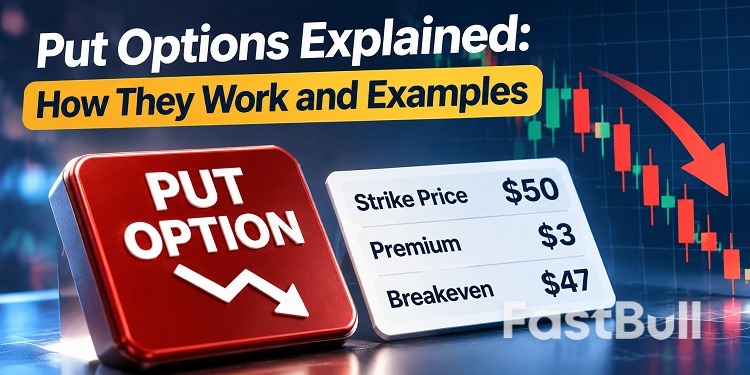
          Put Options Explained: How They Work and Examples_1

          What Is a Put Option?

          A put option is a financial contract that gives the buyer the right to sell an underlying asset, such as a stock or ETF, at a specified price called the strike price. The contract also has an expiration date, which determines when the buyer's exercise rights end.

          Put options are commonly associated with bearish market expectations because their value generally increases when the underlying asset's price falls, all else being equal. However, investors can also use them to hedge against potential losses in an existing portfolio.

          Every put option has two sides:

          • Put buyer: Pays a premium and receives the right to sell the underlying asset at the strike price. The buyer can exercise the option but is not required to do so.
          • Put seller: Receives the premium and takes on the obligation to buy the underlying asset at the strike price if assigned.

          For standard U.S. equity options, one contract typically represents 100 shares of the underlying stock. However, corporate actions such as stock splits and mergers can result in adjusted contracts with different deliverable amounts. The Options Clearing Corporation's equity option specifications provide more details about standard contract terms.

          How a Put Option Gives You the Right to Sell

          The main feature of a put option is the right to sell an asset at a predetermined price, even if its market price falls below that level.

          For example, suppose a stock currently trades at $50, and an investor buys a put option with a $50 strike price. If the stock falls to $40 before expiration, the investor can still sell the shares for $50 by exercising the option. The difference between the strike price and the market price is $10 per share.

          This right becomes valuable when the market price drops below the strike price. If the stock rises above $50 instead, the buyer generally has no reason to exercise the put because selling shares at $50 would be less attractive than selling them at the higher market price.

          Importantly, buying a put does not automatically mean the investor owns the underlying shares. Investors can purchase puts to speculate on a price decline without holding the stock, although exercising the contract involves selling the underlying shares and may create a short stock position if the investor does not own them.

          Key Terms You Need to Understand

          Before trading put options, it helps to understand five basic terms:

          • Strike Price: The predetermined price at which the put buyer can sell the underlying asset.
          • Premium: The price paid by the buyer and received by the seller for the option contract. For standard stock options, quoted premiums are generally multiplied by 100 to calculate the cost of one contract.
          • Expiration Date: The date when the option contract expires and its exercise rights end.
          • Underlying Asset: The stock, ETF, index, or other financial instrument on which the option is based.
          • Exercise and Assignment: Exercise occurs when the buyer uses the option's rights. Assignment occurs when the seller is selected to fulfill the corresponding obligation.

          How Do Put Options Work?

          Put options work differently depending on whether an investor buys or sells the contract. Buyers generally seek to benefit from falling prices or protect their holdings, while sellers collect premiums in exchange for accepting the obligation to purchase the underlying asset if assigned.
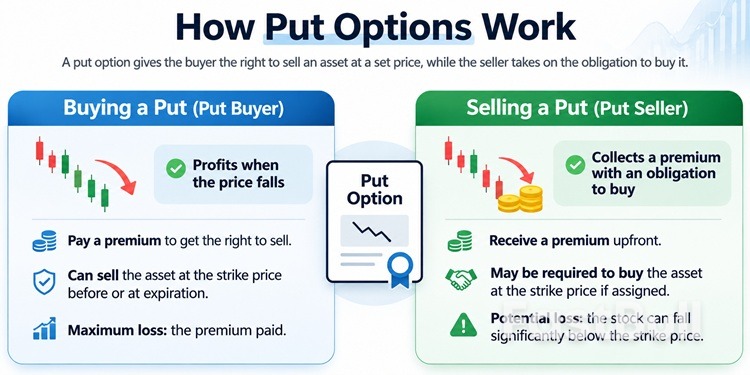
          Put Options Explained: How They Work and Examples_2
          Buying a put gives the investor the right to sell an asset, while selling a put creates an obligation to buy it if assigned.

          Buying a Put Option

          Buying a put option is a common strategy for investors who expect a stock's price to decline. The buyer pays a premium upfront and gains the right to sell the stock at the strike price during the contract's exercise period.

          For example, an investor buys a put option on a stock trading at $60, with a strike price of $55 and a premium of $2 per share. Assuming one standard contract, the initial cost is $200.

          If the stock falls to $45 at expiration, the put has $10 per share of intrinsic value. Its total expiration value is $1,000, giving the buyer a net profit of $800 before fees and commissions.

          If the stock remains above $55 at expiration, the option expires without intrinsic value, and the buyer loses the $200 premium. This is why the buyer's maximum loss on a standalone long put is generally limited to the premium paid. The investor may also sell the option before expiration to close the position rather than exercise it.

          Buying puts can also serve as portfolio insurance. For example, an investor holding 100 shares of a company may buy a put with a strike price below the current stock price. If the stock declines sharply, the put can help offset some of the losses in the shares.

          Selling a Put Option

          Selling a put option, also called writing a put, involves receiving a premium upfront in exchange for agreeing to buy the underlying asset at the strike price if assigned.

          This strategy is generally used by investors who are neutral to moderately bullish on a stock and are willing to own it at a predetermined price.

          For example, suppose a stock trades at $50, and an investor sells a put with a $45 strike price for a premium of $2 per share. The seller receives $200 for one standard contract.

          • If the stock stays above $45 at expiration: The option may expire worthless, allowing the seller to keep the $200 premium.
          • If the stock falls below $45: The buyer may exercise the put, and the seller may be assigned to purchase 100 shares at $45 each.

          In a cash-secured put strategy, the seller keeps enough cash available to cover the potential stock purchase. This approach allows investors to collect premiums while potentially buying shares at a lower effective cost. However, the stock can fall well below the strike price, resulting in substantial losses.

          Unlike buyers, put sellers do not have the right to decide whether to fulfill the contract after assignment. They must meet their contractual obligations. American-style options can be exercised before expiration, so assignment may happen earlier than expected. The Options Industry Council's explanation of options assignment provides further details.

          What Happens When a Put Option Expires?

          When a put option reaches expiration, its value depends on the underlying asset's market price relative to the strike price. Options are generally classified into three categories:

          Option StatusStock Price vs. Strike PriceMeaning for the Put Buyer
          In the Money (ITM)Stock price below strike priceHas intrinsic value and may be exercised.
          At the Money (ATM)Stock price approximately equal to strike priceHas little or no intrinsic value.
          Out of the Money (OTM)Stock price above strike priceHas no intrinsic value and generally expires worthless.

          For example, if a put has a $50 strike price, it is in the money when the stock trades at $45, at the money when the stock is around $50, and out of the money when the stock trades at $55.

          However, being in the money does not necessarily mean the buyer has made a profit. The option's intrinsic value must exceed the premium paid for the trade to be profitable at expiration, excluding transaction costs.

          At expiration, an in-the-money put may be exercised according to the contract and brokerage procedures. The seller may then be assigned and required to purchase the underlying shares. An out-of-the-money put generally expires without value, leaving the buyer with the premium paid as a loss and allowing the seller to retain the premium.

          Put Option Examples: Buying vs. Selling

          To understand how put options work in practice, consider a stock trading at $50. An investor buys or sells a put option with a $50 strike price and a premium of $3 per share. Since one standard stock option contract typically represents 100 shares, the total premium is $300.

          The same contract creates different outcomes for the buyer and seller depending on the stock price at expiration.

          Stock Price at ExpirationPut Buyer's Profit/LossPut Seller's Profit/Loss
          $40+$700-$700
          $47$0$0
          $50-$300+$300
          $55-$300+$300

          These results assume the positions are held until expiration, one standard 100-share contract is used, and transaction costs are excluded.

          When the stock falls to $40: The put buyer can sell the shares for $50 even though their market value is only $40. The option has $10 per share of intrinsic value, or $1,000 for the contract. After subtracting the $300 premium, the buyer earns $700. The seller experiences the opposite result, losing $700.

          When the stock falls to $47: The put has $3 per share of intrinsic value, exactly matching the $3 premium. The buyer breaks even, and the seller also breaks even before transaction costs.

          When the stock stays at $50 or rises to $55: The put expires without intrinsic value. The buyer loses the $300 premium, while the seller keeps the entire amount.

          This comparison shows why buying a put is generally attractive when an investor expects a significant price decline, while selling a put can be suitable for someone willing to purchase the stock at a lower effective price.
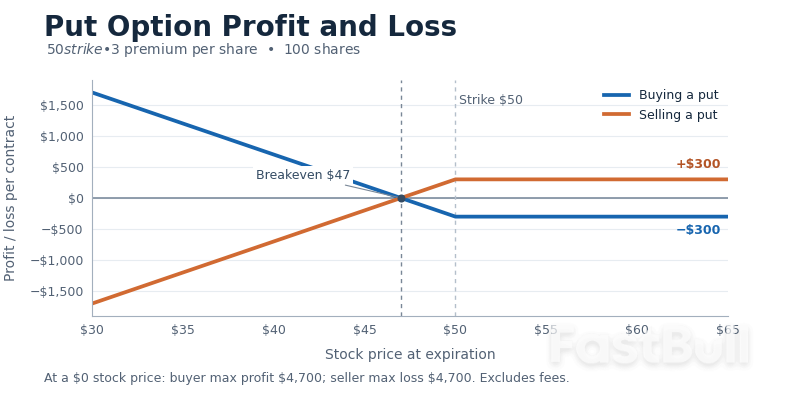
          Put Options Explained: How They Work and Examples_3
          Put option profit and loss at expiration: the buyer benefits from a falling stock price, while the seller benefits when the stock stays above the strike price.

          Put Option Profit, Loss, and Breakeven

          Calculating the potential profit or loss of a put option requires comparing its strike price, premium, and the underlying stock price at expiration. The calculation differs depending on whether the investor buys or sells the contract.

          Put Option Breakeven and Profit Formulas

          For a standard stock put option, the buyer's profit or loss at expiration can be calculated as:

          Put Buyer Profit/Loss = [Max(Strike Price - Stock Price at Expiration, 0) - Premium] × 100

          The seller's result is the opposite:

          Put Seller Profit/Loss = [Premium - Max(Strike Price - Stock Price at Expiration, 0)] × 100

          These formulas assume one standard contract representing 100 shares. For adjusted contracts, the actual contract deliverable must be used instead.

          The key figures for each position are:

          • Breakeven Price: Strike Price - Premium. For the $50 strike put with a $3 premium, the breakeven price is $47.
          • Buyer's Maximum Loss: Premium × 100. In this example, the buyer can lose up to $300 if the option expires worthless.
          • Buyer's Maximum Profit: (Strike Price - Premium) × 100, assuming the stock price falls to zero. Here, the maximum profit is $4,700.
          • Seller's Maximum Profit: Premium × 100. The seller can earn up to $300 if the option expires worthless.
          • Seller's Maximum Loss: (Strike Price - Premium) × 100, assuming the stock price falls to zero. Here, the maximum loss is $4,700.

          The buyer's potential profit is limited because a stock price cannot fall below zero. The seller's potential loss is also technically limited for a standard equity put, but it can still be substantial if the underlying stock declines sharply.

          These breakeven and maximum profit or loss figures describe the position at expiration. Before expiration, an option's market value can also change with time remaining, implied volatility, and other pricing factors.

          Put vs. Call Options: Key Differences

          Put and call options are two basic types of options contracts. Both give buyers the right, but not the obligation, to trade an underlying asset at a predetermined strike price. The main difference is the direction of the transaction: a put gives the buyer the right to sell, while a call gives the buyer the right to buy.

          FeaturePut OptionCall Option
          Buyer's RightRight to sellRight to buy
          Seller's ObligationBuy the asset if assignedSell the asset if assigned
          Typical Buyer OutlookBearishBullish
          Buyer Benefits WhenAsset price fallsAsset price rises
          Buyer's Maximum LossPremium paidPremium paid
          Seller's Main RiskHaving to buy the asset at the strike priceHaving to sell the asset at the strike price

          For example, if an investor expects a stock to fall from $50 to $40, buying a put may provide an opportunity to profit from the decline. If the investor instead expects the stock to rise from $50 to $60, buying a call may be more appropriate.

          Investors can also sell puts or calls to collect premiums, but doing so creates different obligations and risks. The choice depends on the investor's market outlook, willingness to hold the underlying asset, and ability to manage potential losses.

          Risks of Buying and Selling Put Options

          Put options can help investors manage market exposure or pursue specific trading opportunities, but they also involve risks. The potential outcomes depend on the underlying asset's price movement, time remaining until expiration, implied volatility, and the investor's position.

          Risks of Buying Put Options

          Although the maximum loss for a standalone long put position is generally limited to the premium paid, several factors can cause the option to lose value:

          • The stock does not fall as expected: If the stock stays above the strike price until expiration, the put may expire worthless, and the buyer loses the entire premium.
          • Time decay: Options lose time value as expiration approaches, all else being equal. Even if the stock price remains relatively stable, the put can become less valuable over time.
          • Implied volatility declines: A drop in expected market volatility can reduce an option's premium, potentially causing a loss even when the stock moves in the expected direction.
          • Insufficient price movement: A stock may fall but not enough to offset the premium paid. In this case, the buyer can still lose money.

          Buyers should consider the strike price, expiration date, premium, and potential price movement before entering a trade. A correct bearish outlook alone does not guarantee a profitable put position.

          Risks of Selling Put Options

          Selling a put option generates premium income upfront, but the seller takes on the obligation to buy the underlying asset if assigned. The main risks include:

          • Significant downside exposure: If the stock price drops sharply, the seller may have to buy shares at a strike price well above their current market value.
          • Early assignment: American-style options can be exercised before expiration. A put seller may therefore be assigned earlier than expected.
          • Capital requirements: Cash-secured put sellers need enough available cash to purchase the shares if assigned. Other put-selling strategies may involve margin requirements and additional risks.
          • Limited upside: The maximum profit is generally restricted to the premium received, even if the stock price rises substantially.
          • Market gaps: Unexpected earnings announcements, economic news, or other events can cause a stock to fall sharply, increasing the seller's potential loss.

          Before selling puts, investors should consider whether they are comfortable owning the underlying stock at the effective purchase price, calculated as the strike price minus the premium received. They should also make sure they can meet the potential financial obligation.

          Put options can serve different purposes depending on how they are used. Buying puts can provide downside exposure or portfolio protection, while selling puts can generate premium income for investors willing to purchase the underlying asset. Understanding the payoff, breakeven price, and risks of each position is essential before trading.

          Risk Warnings and Disclaimers
          You understand and acknowledge that there is a high degree of risk involved in trading. Following any strategies or investment methods may lead to potential losses. The content on the site is provided by our contributors and analysts for information purposes only. You are solely responsible for determining whether any trading assets, securities, strategy, or any other product is suitable for investing based on your own investment objectives and financial situation.
          Add to Favorites
          Share
          FastBull
          Copyright © 2026 FastBull Ltd

          728 RM B 7/F GEE LOK IND BLDG NO 34 HUNG TO RD KWUN TONG KLN HONG KONG

          TelegramInstagramTwitterfacebooklinkedin
          App Store Google Play Android Windows
          Products
          Charts

          Chats

          Q&A with Experts
          Screeners
          Economic Calendar
          Data
          Tools
          Membership
          Features
          Function
          Markets
          Copy Trading
          Latest Signals
          Contests
          24/7
          Analysis
          Education
          Company
          Careers
          About Us
          Contact Us
          Advertising
          Download FastBull
          Help Center
          Feedback
          User Agreement
          Privacy Policy
          Personal Information Protection Statement
          Business

          White Label

          Broker API

          Data API

          Web Plug-ins

          Poster Maker

          Affiliate Program

          Risk Disclosure

          The risk of loss in trading financial instruments such as stocks, FX, commodities, futures, bonds, ETFs and crypto can be substantial. You may sustain a total loss of the funds that you deposit with your broker. Therefore, you should carefully consider whether such trading is suitable for you in light of your circumstances and financial resources.

          No decision to invest should be made without thoroughly conducting due diligence by yourself or consulting with your financial advisors. Our web content might not suit you since we don't know your financial conditions and investment needs. Our financial information might have latency or contain inaccuracy, so you should be fully responsible for any of your trading and investment decisions. The company will not be responsible for your capital loss.

          Without getting permission from the website, you are not allowed to copy the website's graphics, texts, or trademarks. Intellectual property rights in the content or data incorporated into this website belong to its providers and exchange merchants.

          Not Logged In

          Log in to access more features

          Connect Broker
          Become a signal provider
          Help Center
          Customer Service
          Dark Mode
          Price Up/Down Colors

          Log In

          Sign Up

          Position
          Layout
          Fullscreen
          Default to Chart
          The chart page opens by default when you visit fastbull.com