- XAUUSD
- XAGUSD
- WTI
- USDX


Markets
Analysis
User
24/7
Economic Calendar
Education
Data
- Names
- Latest
- Prev


















A surge in operating cash flow can come from collecting old receivables, selling down stock or paying suppliers later. Reconcile the cash increase before treating it as sustainable earnings power.
Operating cash flow more than doubles while net profit falls. Is that a sign of stronger earnings quality, or a reason to look harder? It can be either. The cash is real, but the source determines whether the improvement can support a valuation beyond the current reporting period.
The useful distinction is between cash generated by more profitable operations and cash released from the balance sheet. Collecting an old invoice improves liquidity without creating a second sale. Running down inventory can free cash while the business shrinks. Delaying a supplier payment leaves money in the bank today and an obligation for tomorrow. None of these facts, by itself, establishes misconduct.
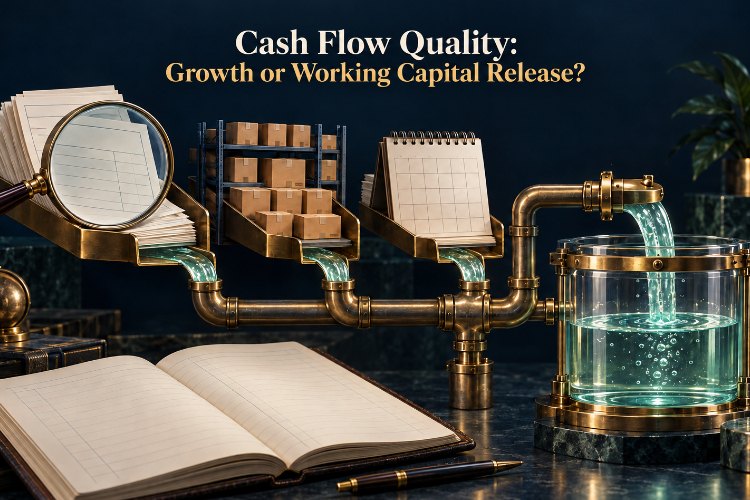
Consider a hypothetical nonfinancial company. All amounts are in millions of one currency; the periods have the same length, accounting classification and consolidation scope. There are no acquisition, currency or reclassification effects. The working-capital entries below are cash contributions, not closing balances: positive figures add cash and negative figures absorb it.
| Cash-flow bridge | Period A | Period B |
|---|---|---|
| Net profit | 100 | 90 |
| Depreciation and amortization added back | 20 | 20 |
| Other net noncash adjustments | 10 | 10 |
| Receivables: cash contribution | −40 | +20 |
| Inventory: cash contribution | −30 | +15 |
| Operating payables: cash contribution | +25 | +35 |
| Operating cash flow | 85 | 190 |
In A, working capital absorbs 45: −40 − 30 + 25. In B, it releases 70: 20 + 15 + 35. That is a 115 improvement, offset by the 10 decline in profit. Operating cash flow therefore rises by 105, from 85 to 190, or about 123.53%, even though profit falls 10%.
The cash-flow-to-profit ratio jumps from 0.85 to about 2.11. Calling the second number automatically “better quality” misses the entire explanation. Before working-capital movements, this simplified bridge falls from 130 to 120. That subtotal is an analytical aid, not a claim that normalized cash flow must equal 120: a growing or seasonal business still needs an appropriate working-capital allowance.
For receivables, ask whether collections improved because customers paid faster, overdue invoices were recovered, or sales slowed. Check revenue, aging, overdue balances and subsequent collections together. A lasting reduction in collection time can reduce the capital tied up in the business; recovering a finite stock of old invoices cannot be repeated indefinitely. Receivables sold or financed require a separate look at terms and classification.
For inventory, distinguish better stock management from liquidation. Lower stock with stable availability, deliveries and margins supports an efficiency explanation. Lower stock alongside discounting, lost orders or production cuts supports a different one. An inventory write-down is itself noncash: a fall in the balance does not prove customers paid for the goods.
For payables, compare the movement with purchases, agreed payment terms, amounts overdue and supplier-finance disclosures. Higher payables may reflect increased purchasing or improved bargaining power, but cash can also rise because bills remain unpaid. Supplier finance can change the timing and source of payment; inspect obligations and maturities rather than assuming every balance called a payable is economically identical.
The shortcut “receivables fell, therefore that amount became cash” works only after other effects are excluded. Acquisitions, disposals, foreign-exchange translation, impairments and reclassifications can move balances without equivalent operating cash receipts. Begin with the reported reconciliation and use the notes to explain differences from opening-to-closing balances.
Keep reporting periods and accounting policies comparable. A holiday-driven quarter is not a clean benchmark for another season; compare the same quarter a year earlier and a rolling twelve months as well. Interest and dividend classification can vary with the applicable framework and policy. This operating-company bridge should not be applied mechanically to banks or insurers, where financial assets and liabilities are central to the business itself.
If capital expenditure is 50 in both periods, a simple operating-cash-flow-minus-capex measure rises from 35 to 140. The label “free cash flow” has not removed the 115 swing in working capital. This is a defined analytical measure, not a universal financial-statement subtotal, and it is not automatically FCFF or cash available for immediate shareholder distribution.
A reduction in essential maintenance spending can also flatter cash after capex while weakening future capacity. Check whether spending was deferred, whether assets are aging, and how leases or other capital obligations are treated. Borrowing or selling a long-term asset may increase the bank balance, but that does not make it an improvement in operating cash flow.
The valuation consequence is specific: do not capitalize a one-off release as though it were recurring earnings. When building a DCF terminal value with consistent growth and reinvestment, the long-run cash assumption must reflect ongoing funding needs, not a temporary collection or payment-timing benefit.
Use a conditional stress case, not a forecast. Keep next-period profit at 90 and noncash adjustments at 30. Assume receivables and inventory contribute zero, while the extra 35 of payables is paid down. Operating cash flow becomes 90 + 30 − 35 = 85; after capex of 50, the simple free-cash-flow measure is 35.
The exercise does not prove that 190 was deceptive or that 85 will occur. It shows which assumptions carry the investment case. Permanent collection efficiency may justify a lower working-capital base, but it does not produce the same release every year. If payment terms revert or suppliers demand settlement, the favorable timing benefit can reverse.
Start with a bridge separating profit, noncash adjustments and each major operating balance. Then test the explanations against aging schedules, orders, margins, stock availability and payment maturities. Supplier-finance notes should clarify terms, obligations and amounts already paid to suppliers by finance providers; missing detail is a reason to preserve uncertainty, not invent a hidden financing conclusion.
Finally, compare several equivalent periods and rebuild cash after necessary investment. Improving profits and collections without rising overdue supplier obligations make a stronger case than a single high ratio. If profit is close to zero or negative, the ratio itself can be misleading. The decisive question is whether the same business can keep producing cash after the finite release has run its course.

728 RM B 7/F GEE LOK IND BLDG NO 34 HUNG TO RD KWUN TONG KLN HONG KONG





The risk of loss in trading financial instruments such as stocks, FX, commodities, futures, bonds, ETFs and crypto can be substantial. You may sustain a total loss of the funds that you deposit with your broker. Therefore, you should carefully consider whether such trading is suitable for you in light of your circumstances and financial resources.
No decision to invest should be made without thoroughly conducting due diligence by yourself or consulting with your financial advisors. Our web content might not suit you since we don't know your financial conditions and investment needs. Our financial information might have latency or contain inaccuracy, so you should be fully responsible for any of your trading and investment decisions. The company will not be responsible for your capital loss.
Without getting permission from the website, you are not allowed to copy the website's graphics, texts, or trademarks. Intellectual property rights in the content or data incorporated into this website belong to its providers and exchange merchants.
Not Logged In
Log in to access more features


Log In
Sign Up