


- XAUUSD
- XAGUSD
- WTI
- USDX


Markets
Analysis
User
24/7
Economic Calendar
Education
Data
- Names
- Latest
- Prev










Why is Nvidia stock plunging in 2026? Explore the key reasons behind NVDA’s decline, including China chip restrictions, AI spending concerns, competition, and valuation risks.
Nvidia stock has come under pressure in October 2026, leaving investors wondering why one of the biggest winners of the AI boom is struggling. The answer goes beyond a single disappointing headline. China export restrictions, growing competition, inflation concerns, and questions about AI spending are all weighing on NVDA, even as Nvidia's underlying business continues to grow.
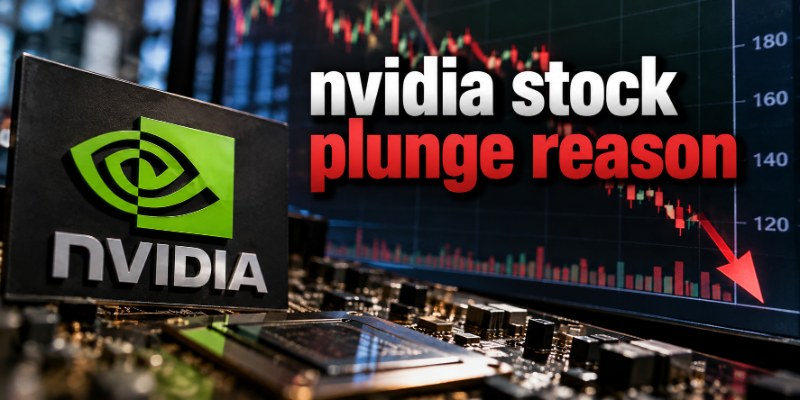
Table of Contents
The main reason behind Nvidia's recent stock decline is a combination of company-specific risks and broader pressure on technology stocks.
On October 14, Nvidia shares fell approximately 3.6% in afternoon trading as hotter-than-expected U.S. inflation data pushed Treasury yields higher. At the same time, investors were digesting reports of declining Nvidia chip shipments to China and increasing competition from alternative AI processors.
These developments have made investors reconsider how much they are willing to pay for Nvidia's future earnings.
Nvidia reached a 52-week high of approximately $243.37 on October 6, 2026. By the October 29 close, shares were around $213.66, representing a decline of roughly 12.2% from that high.
That is a meaningful correction, although it does not qualify as a 20% bear-market decline.
The distinction matters because Nvidia's falling share price does not necessarily mean its business is shrinking. Investors may simply be adjusting their expectations after a strong rally.
| Factor | Why It Matters for NVDA |
|---|---|
| China export restrictions | Limit Nvidia's access to a major AI chip market |
| Competition from Huawei and custom chips | Threatens market share and pricing power |
| High stock valuation | Makes shares vulnerable to changes in growth expectations |
| Inflation and interest rates | Put pressure on expensive technology stocks |
| AI spending concerns | Raise questions about the sustainability of chip demand |
| Profit margin pressure | Could reduce earnings growth despite strong sales |
These risks are connected. When investors become less confident about future growth, they may assign Nvidia a lower valuation even without an immediate deterioration in earnings.
China remains an important market for AI computing hardware, but Nvidia's ability to sell its most advanced chips there has been constrained by U.S. export regulations.
Reports based on IDC data indicate that Nvidia shipped approximately 678,000 AI accelerators to China during the first half of 2026, down 44% from the same period a year earlier.
Its reported share of China's AI chip market fell to 34%, while Huawei gained ground with a share of approximately 28%.
These figures highlight a problem that extends beyond short-term revenue.
If Chinese technology companies build their AI infrastructure around domestic processors, Nvidia may struggle to regain customers even if export restrictions eventually ease.
This creates two risks for investors: lost sales today and potentially weaker competitive positioning tomorrow.
The concern is not that Nvidia has lost its global leadership in AI chips. It is that geopolitical restrictions could permanently reduce its opportunity in one of the world's largest technology markets.
Nvidia's extraordinary growth has been supported by massive investment in AI infrastructure.
Microsoft, Alphabet, Amazon, Meta, and other technology companies have spent heavily on data centers, GPUs, networking equipment, and computing capacity.
That spending has been enormously beneficial for Nvidia.
However, investors increasingly want evidence that AI infrastructure investments will generate attractive financial returns.
Building AI data centers is expensive. Companies must pay for hardware, electricity, cooling, networking, and ongoing operations.
If AI-related revenue fails to grow quickly enough, major customers could eventually slow their capital expenditure plans.
Even a moderate slowdown could affect Nvidia because its valuation reflects expectations of continued strong growth.
This does not mean the AI investment cycle is ending. It means the market is paying closer attention to whether spending can remain elevated over several years.
Nvidia remains the leading supplier of high-performance AI accelerators, supported by its CUDA software ecosystem and integrated computing platforms.
But its customers are also developing alternatives.
Google has its Tensor Processing Units, Amazon develops Trainium processors, and Microsoft has invested in its Maia AI chip family.
AMD is another competitor targeting the AI accelerator market.
Custom chips can be attractive for large cloud companies because they may offer lower costs or better efficiency for specific workloads.
They do not need to outperform Nvidia across every application to become commercially meaningful.
If hyperscalers shift some AI workloads to their own processors, Nvidia could face slower growth in certain product categories.
The key issue is not whether competitors will completely replace Nvidia. It is whether Nvidia can maintain its market share, pricing power, and margins as customers gain more choices.
Nvidia's share price is also influenced by economic conditions that have little to do with chip demand.
Higher inflation can push bond yields upward and reduce expectations for interest-rate cuts.
That matters particularly for growth stocks.
When interest rates rise, investors generally place a lower present value on earnings expected far into the future. Companies trading at elevated earnings multiples can therefore experience larger price declines.
This dynamic was visible during the October 14 selloff, when stronger inflation data contributed to broad weakness across technology and semiconductor stocks.
Nvidia is especially sensitive to changes in market sentiment because investors expect it to deliver substantial earnings growth for years.
Even strong companies can experience sharp corrections when financial conditions become less favorable.
One of Nvidia's biggest stock-market challenges is that investors already expect exceptional results.
Strong earnings alone may not be enough to push NVDA higher.
The company often needs to exceed forecasts, deliver convincing guidance, and reassure investors that future demand remains robust.
Consider two possible situations:
In either case, the stock could decline despite impressive headline results.
This is the difference between a successful company and a successful investment at a particular price.
A business can continue expanding while its stock falls because the market previously priced in even faster growth.
Despite the stock decline, Nvidia's latest reported financial results show that demand for its AI products remains strong.
According to Nvidia's official second-quarter fiscal 2027 earnings release, the company reported record revenue for the quarter ended July 26, 2026.
| Financial Metric | Q2 FY2027 Result | Year-over-Year Change |
|---|---|---|
| Total revenue | $96.2 billion | +106% |
| Data Center revenue | $89.0 billion | +117% |
| GAAP net income | $59.7 billion | +126% |
| GAAP gross margin | 75.0% | +2.6 percentage points |
| GAAP diluted EPS | $2.46 | +128% |
The numbers do not suggest an immediate collapse in Nvidia's core business. Revenue more than doubled year over year, while Data Center sales continued to dominate its growth.
Management also projected approximately $108 billion in revenue for the following quarter, although that outlook excluded Data Center compute revenue from China.
That last detail is important. Nvidia is still growing rapidly, but the company is planning around significant geopolitical limitations.
Investors buy stocks based on future expectations, not simply past performance.
Nvidia's recent results demonstrate substantial demand for AI infrastructure. However, the stock market must also consider how long that demand can continue and whether future profits justify the share price.
If earnings grow more slowly than expected, Nvidia's valuation multiple could contract.
For example, a stock trading at 35 times expected earnings would be worth roughly 20% less at 28 times earnings, assuming the earnings forecast remained unchanged.
This illustrates how a share price can fall sharply without a comparable decline in company profits.
A recovery is possible, particularly if Nvidia continues delivering strong earnings and investors regain confidence in long-term AI spending.
However, the timing and size of any rebound will depend on several developments.
In a bullish scenario, Nvidia maintains its leadership in AI computing while demand for advanced chips continues expanding.
The company benefits from increased AI inference workloads, the rollout of newer architectures, and continued investment by major cloud providers.
Strong revenue growth and stable profit margins could encourage investors to assign Nvidia a higher valuation again.
An improvement in export conditions would provide another potential catalyst, although it is not necessary for Nvidia to continue growing outside China.
Nvidia could continue reporting impressive financial results while its share price moves sideways or experiences additional corrections.
This would be consistent with a market gradually adjusting its valuation expectations.
Revenue growth might remain strong but moderate from exceptionally high levels. Meanwhile, concerns about interest rates, competition, and AI infrastructure spending could limit near-term gains.
Under this scenario, the company remains financially successful, but investors experience more modest returns than during the earlier AI-driven rally.
The bearish case would become more convincing if major technology companies reduced AI capital expenditure, competitors gained meaningful market share, or Nvidia experienced sustained margin pressure.
Export restrictions could also create further problems if they expand or prevent Nvidia from participating in important overseas markets.
A combination of slower earnings growth and a lower valuation multiple could produce additional stock declines.
These scenarios describe possible outcomes rather than specific price forecasts.
The next major developments will help determine whether Nvidia's recent correction is temporary or signals a more lasting change in market expectations.
| Indicator | Positive Signal | Warning Sign |
|---|---|---|
| Data Center revenue | Continued strong growth | Growth slows more than expected |
| Gross margin | Remains near recent levels | Sustained margin compression |
| AI capital expenditure | Cloud providers maintain spending | Major customers reduce investment |
| China export policy | Improved market access | Additional restrictions |
| AI chip competition | Nvidia maintains leadership | Custom chips capture more workloads |
| Interest rates | Lower yields support valuations | Higher yields pressure growth stocks |
Nvidia's gross margin deserves particular attention. The company reported a 75.0% GAAP gross margin in its latest quarter and guided for approximately 74.0% in the following quarter.
A modest decline does not necessarily indicate serious trouble. Product transitions, manufacturing costs, and changes in sales mix can all affect profitability.
However, sustained margin weakness combined with slowing revenue growth would be more concerning.
Investors can also monitor Nvidia's official financial reports and quarterly earnings updates for changes in guidance, revenue composition, and management commentary.
A lower stock price can improve the potential return on an investment, but it does not automatically make the shares cheap.
The decision depends on whether Nvidia's future earnings can support its valuation and how much additional volatility an investor is prepared to accept.
For long-term investors, the most important questions are whether AI computing demand will continue expanding, whether Nvidia can defend its competitive advantages, and whether its current valuation provides enough room for disappointing results.
Short-term traders face a different challenge. Nvidia's price movements can be driven by inflation releases, earnings announcements, export policy headlines, and broader Nasdaq sentiment.
A sharp decline may attract buyers, but it can also be followed by further selling if the original concerns remain unresolved.
Investors should therefore distinguish between a correction caused mainly by market sentiment and one supported by deteriorating business fundamentals.
Nvidia's financial performance currently provides reasons for optimism, while competition, geopolitical restrictions, and valuation remain legitimate risks.
The Nvidia stock plunge in 2026 is not the result of one major business failure.
Instead, investors are responding to several overlapping concerns: weaker access to China's AI chip market, increasing competition, uncertainty surrounding future AI spending, and macroeconomic pressure on expensive technology stocks.
At the same time, Nvidia continues to report exceptional revenue growth and strong profitability.
That creates an important distinction. Nvidia's stock has weakened, but its core business has not shown a comparable deterioration.
Whether NVDA recovers will depend less on its past success and more on its ability to sustain growth, protect margins, and justify investor expectations.
For now, the central question is not whether Nvidia remains a leading AI company. It is how much investors should pay for that leadership.
This article is for informational purposes only and does not constitute investment advice.

728 RM B 7/F GEE LOK IND BLDG NO 34 HUNG TO RD KWUN TONG KLN HONG KONG


The risk of loss in trading financial instruments such as stocks, FX, commodities, futures, bonds, ETFs and crypto can be substantial. You may sustain a total loss of the funds that you deposit with your broker. Therefore, you should carefully consider whether such trading is suitable for you in light of your circumstances and financial resources.
No decision to invest should be made without thoroughly conducting due diligence by yourself or consulting with your financial advisors. Our web content might not suit you since we don't know your financial conditions and investment needs. Our financial information might have latency or contain inaccuracy, so you should be fully responsible for any of your trading and investment decisions. The company will not be responsible for your capital loss.
Without getting permission from the website, you are not allowed to copy the website's graphics, texts, or trademarks. Intellectual property rights in the content or data incorporated into this website belong to its providers and exchange merchants.
Not Logged In
Log in to access more features


Log In
Sign Up