• Trade
  • Markets
  • Copy
  • Contests
  • News
  • 24/7
  • Calendar
  • Q&A
  • Chats
Trending
Screeners
SYMBOL
LAST
BID
ASK
HIGH
LOW
NET CHG.
%CHG.
SPREAD
SPX
S&P 500 Index
6827.42
6827.42
6827.42
6899.86
6801.80
-73.58
-1.07%
--
DJI
Dow Jones Industrial Average
48458.04
48458.04
48458.04
48886.86
48334.10
-245.98
-0.51%
--
IXIC
NASDAQ Composite Index
23195.16
23195.16
23195.16
23554.89
23094.51
-398.69
-1.69%
--
USDX
US Dollar Index
97.950
98.030
97.950
98.500
97.950
-0.370
-0.38%
--
EURUSD
Euro / US Dollar
1.17394
1.17409
1.17394
1.17496
1.17192
+0.00011
+ 0.01%
--
GBPUSD
Pound Sterling / US Dollar
1.33707
1.33732
1.33707
1.33997
1.33419
-0.00148
-0.11%
--
XAUUSD
Gold / US Dollar
4299.39
4299.39
4299.39
4353.41
4257.10
+20.10
+ 0.47%
--
WTI
Light Sweet Crude Oil
57.233
57.485
57.233
58.011
56.969
-0.408
-0.71%
--

Community Accounts

Signal Accounts
--
Profit Accounts
--
Loss Accounts
--
View More

Become a signal provider

Sell trading signals to earn additional income

View More

Guide to Copy Trading

Get started with ease and confidence

View More

Signal Accounts for Members

All Signal Accounts

Best Return
  • Best Return
  • Best P/L
  • Best MDD
Past 1W
  • Past 1W
  • Past 1M
  • Past 1Y

All Contests

  • All
  • Trump Updates
  • Recommend
  • Stocks
  • Cryptocurrencies
  • Central Banks
  • Featured News
Top News Only
Share

Cambodian Prime Minister Hun Manet Says He Had Phone Calls With Trump And Malaysian Leader Anwar About Ceasefire

Share

Cambodia's Hun Manet Says USA, Malaysia Should Verify 'Which Side Fired First' In Latest Conflict

Share

Cambodia's Hun Manet: Cambodia Maintains Its Stance In Seeking Peaceful Resolution Of Disputes

Share

Nasdaq Companies: Allergan, Ferrovia, Insmed, Monolithic Power Systems, Seagate Technology, And Western Digital Will Be Added To The NASDAQ 100 Index. Biogen, CdW, GlobalFoundries, Lululemon, ON Semiconductor, And Tradedesk Will Be Removed From The NASDAQ 100 Index

Share

Witkoff Headed To Berlin This Weekend To Meet With Zelenskiy, European Leaders -Wsj Reporter On X

Share

Russia Attacks Two Ukrainian Ports, Damaging Three Turkish-Owned Vessels

Share

[Historic Flooding Occurs In At Least Four Rivers In Washington State Due To Days Of Torrential Rains] Multiple Areas In Washington State Have Been Hit By Severe Flooding Due To Days Of Torrential Rains, With At Least Four Rivers Experiencing Historic Flooding. Reporters Learned On The 12th That The Floods Caused By The Torrential Rains In Washington State Have Destroyed Homes And Closed Several Highways. Experts Warn That Even More Severe Flooding May Occur In The Future. A State Of Emergency Has Been Declared In Washington State

Share

Trump Says Proposed Free Economic Zone In Donbas Would Work

Share

Trump: I Think My Voice Should Be Heard

Share

Trump Says Will Be Choosing New Fed Chair In Near Future

Share

Trump Says Proposed Free Economic Zone In Donbas Complex But Would Work

Share

Trump Says Land Strikes In Venezuela Will Start Happening

Share

US President Trump: Thailand And Cambodia Are In A Good Situation

Share

State Media: North Korean Leader Kim Hails Troops Returning From Russia Mission

Share

The 10-year Treasury Yield Rose About 5 Basis Points During The "Fed Rate Cut Week," And The 2/10-year Yield Spread Widened By About 9 Basis Points. On Friday (December 12), In Late New York Trading, The Yield On The Benchmark 10-year US Treasury Note Rose 2.75 Basis Points To 4.1841%, A Cumulative Increase Of 4.90 Basis Points For The Week, Trading Within A Range Of 4.1002%-4.2074%. It Rose Steadily From Monday To Wednesday (before The Fed Announced Its Rate Cut And Treasury Bill Purchase Program), Subsequently Exhibiting A V-shaped Recovery. The 2-year Treasury Yield Fell 1.82 Basis Points To 3.5222%, A Cumulative Decrease Of 3.81 Basis Points For The Week, Trading Within A Range Of 3.6253%-3.4989%

Share

Trump: Lots Of Progress Being Made On Russia-Ukraine

Share

NOPA November US Soybean Crush Estimated At 220.285 Million Bushels

Share

SPDR Gold Trust Reports Holdings Up 0.22%, Or 2.28 Tonnes, To 1053.11 Tonnes By Dec 12

Share

Brazil's Moraes: We Knew Truth Would Prevail Once It Reached USA Authorities

Share

Brazil's Moraes Thanks President Lula's Commitment To Removal Of USA Sanctions Against Him

TIME
ACT
FCST
PREV
U.K. Trade Balance Non-EU (SA) (Oct)

A:--

F: --

P: --

U.K. Trade Balance (Oct)

A:--

F: --

P: --

U.K. Services Index MoM

A:--

F: --

P: --

U.K. Construction Output MoM (SA) (Oct)

A:--

F: --

P: --

U.K. Industrial Output YoY (Oct)

A:--

F: --

P: --

U.K. Trade Balance (SA) (Oct)

A:--

F: --

P: --

U.K. Trade Balance EU (SA) (Oct)

A:--

F: --

P: --

U.K. Manufacturing Output YoY (Oct)

A:--

F: --

P: --

U.K. GDP MoM (Oct)

A:--

F: --

P: --

U.K. GDP YoY (SA) (Oct)

A:--

F: --

P: --

U.K. Industrial Output MoM (Oct)

A:--

F: --

P: --

U.K. Construction Output YoY (Oct)

A:--

F: --

P: --

France HICP Final MoM (Nov)

A:--

F: --

P: --

China, Mainland Outstanding Loans Growth YoY (Nov)

A:--

F: --

P: --

China, Mainland M2 Money Supply YoY (Nov)

A:--

F: --

P: --

China, Mainland M0 Money Supply YoY (Nov)

A:--

F: --

P: --

China, Mainland M1 Money Supply YoY (Nov)

A:--

F: --

P: --

India CPI YoY (Nov)

A:--

F: --

P: --

India Deposit Gowth YoY

A:--

F: --

P: --

Brazil Services Growth YoY (Oct)

A:--

F: --

P: --

Mexico Industrial Output YoY (Oct)

A:--

F: --

P: --

Russia Trade Balance (Oct)

A:--

F: --

P: --

Philadelphia Fed President Henry Paulson delivers a speech
Canada Building Permits MoM (SA) (Oct)

A:--

F: --

P: --

Canada Wholesale Sales YoY (Oct)

A:--

F: --

P: --

Canada Wholesale Inventory MoM (Oct)

A:--

F: --

P: --

Canada Wholesale Inventory YoY (Oct)

A:--

F: --

P: --

Canada Wholesale Sales MoM (SA) (Oct)

A:--

F: --

P: --

Germany Current Account (Not SA) (Oct)

A:--

F: --

P: --

U.S. Weekly Total Rig Count

A:--

F: --

P: --

U.S. Weekly Total Oil Rig Count

A:--

F: --

P: --

Japan Tankan Large Non-Manufacturing Diffusion Index (Q4)

--

F: --

P: --

Japan Tankan Small Manufacturing Outlook Index (Q4)

--

F: --

P: --

Japan Tankan Large Non-Manufacturing Outlook Index (Q4)

--

F: --

P: --

Japan Tankan Large Manufacturing Outlook Index (Q4)

--

F: --

P: --

Japan Tankan Small Manufacturing Diffusion Index (Q4)

--

F: --

P: --

Japan Tankan Large Manufacturing Diffusion Index (Q4)

--

F: --

P: --

Japan Tankan Large-Enterprise Capital Expenditure YoY (Q4)

--

F: --

P: --

U.K. Rightmove House Price Index YoY (Dec)

--

F: --

P: --

China, Mainland Industrial Output YoY (YTD) (Nov)

--

F: --

P: --

China, Mainland Urban Area Unemployment Rate (Nov)

--

F: --

P: --

Saudi Arabia CPI YoY (Nov)

--

F: --

P: --

Euro Zone Industrial Output YoY (Oct)

--

F: --

P: --

Euro Zone Industrial Output MoM (Oct)

--

F: --

P: --

Canada Existing Home Sales MoM (Nov)

--

F: --

P: --

Euro Zone Total Reserve Assets (Nov)

--

F: --

P: --

U.K. Inflation Rate Expectations

--

F: --

P: --

Canada National Economic Confidence Index

--

F: --

P: --

Canada New Housing Starts (Nov)

--

F: --

P: --

U.S. NY Fed Manufacturing Employment Index (Dec)

--

F: --

P: --

U.S. NY Fed Manufacturing Index (Dec)

--

F: --

P: --

Canada Core CPI YoY (Nov)

--

F: --

P: --

Canada Manufacturing Unfilled Orders MoM (Oct)

--

F: --

P: --

Canada Manufacturing New Orders MoM (Oct)

--

F: --

P: --

Canada Core CPI MoM (Nov)

--

F: --

P: --

Canada Manufacturing Inventory MoM (Oct)

--

F: --

P: --

Canada CPI YoY (Nov)

--

F: --

P: --

Canada CPI MoM (Nov)

--

F: --

P: --

Canada CPI YoY (SA) (Nov)

--

F: --

P: --

Canada Core CPI MoM (SA) (Nov)

--

F: --

P: --

Q&A with Experts
    • All
    • Chatrooms
    • Groups
    • Friends
    Connecting
    .
    .
    .
    Type here...
    Add Symbol or Code

      No matching data

      All
      Trump Updates
      Recommend
      Stocks
      Cryptocurrencies
      Central Banks
      Featured News
      • All
      • Russia-Ukraine Conflict
      • Middle East Flashpoint
      • All
      • Russia-Ukraine Conflict
      • Middle East Flashpoint
      Search
      Products

      Charts Free Forever

      Chats Q&A with Experts
      Screeners Economic Calendar Data Tools
      Membership Features
      Data Warehouse Market Trends Institutional Data Policy Rates Macro

      Market Trends

      Market Sentiment Order Book Forex Correlations

      Top Indicators

      Charts Free Forever
      Markets

      News

      News Analysis 24/7 Columns Education
      From Institutions From Analysts
      Topics Columnists

      Latest Views

      Latest Views

      Trending Topics

      Top Columnists

      Latest Update

      Signals

      Copy Rankings Latest Signals Become a signal provider AI Rating
      Contests
      Brokers

      Overview Brokers Assessment Rankings Regulators News Claims
      Broker listing Forex Brokers Comparison Tool Live Spread Comparison Scam
      Q&A Complaint Scam Alert Videos Tips to Detect Scam
      More

      Business
      Events
      Careers About Us Advertising Help Center

      White Label

      Data API

      Web Plug-ins

      Affiliate Program

      Awards Institution Evaluation IB Seminar Salon Event Exhibition
      Vietnam Thailand Singapore Dubai
      Fans Party Investment Sharing Session
      FastBull Summit BrokersView Expo
      Recent Searches
        Top Searches
          Markets
          News
          Analysis
          User
          24/7
          Economic Calendar
          Education
          Data
          • Names
          • Latest
          • Prev

          View All

          No data

          Scan to Download

          Faster Charts, Chat Faster!

          Download App
          English
          • English
          • Español
          • العربية
          • Bahasa Indonesia
          • Bahasa Melayu
          • Tiếng Việt
          • ภาษาไทย
          • Français
          • Italiano
          • Türkçe
          • Русский язык
          • 简中
          • 繁中
          Open Account
          Search
          Products
          Charts Free Forever
          Markets
          News
          Signals

          Copy Rankings Latest Signals Become a signal provider AI Rating
          Contests
          Brokers

          Overview Brokers Assessment Rankings Regulators News Claims
          Broker listing Forex Brokers Comparison Tool Live Spread Comparison Scam
          Q&A Complaint Scam Alert Videos Tips to Detect Scam
          More

          Business
          Events
          Careers About Us Advertising Help Center

          White Label

          Data API

          Web Plug-ins

          Affiliate Program

          Awards Institution Evaluation IB Seminar Salon Event Exhibition
          Vietnam Thailand Singapore Dubai
          Fans Party Investment Sharing Session
          FastBull Summit BrokersView Expo

          In the global chips arms race, Europe makes its move

          Summary:

          Will it work better than it did a decade ago?
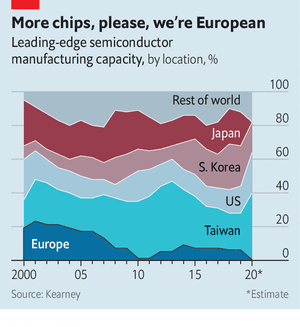
          IN 2013 THE EU launched an ambitious project. The aim was to double the share of microchips made in Europe to 20% of the global total by 2020. Nearly a decade later it remains stubbornly stuck at 10%. If that were not bad enough, Europe no longer makes any of the most advanced chips of the sort that go into data centres or smartphones (see chart). So, prompted by shortages of semiconductors and their growing importance for all sorts of industries, the bloc is having another go.
          In the global chips arms race, Europe makes its move_1
          Judged by numbers alone, the EU’s new Chips Act, unveiled at recent, could move the needle. It is meant to generate public and private investment of more than €43bn ($49bn), about as much as a similar package working its way through America’s Congress. More than two-thirds of this money is supposed to take the form of state subsidies for new leading-edge chip fabrication plants, or “mega fabs”—thanks to a more generous interpretation of EU restrictions on state aid. The rest will go to other chipmaking infrastructure.
          Reality is likely to prove trickier. To understand why, it helps to see the semiconductor industry not just as a collection of huge fabs, of which the most sophisticated can cost more than $20bn a pop, but as a global ecosystem of thousands of companies. Even more than in other high-tech industries, research and development (R&D) usually takes years and costs billions. New chips are designed by specialised firms using complex software made by other companies still. And after chips leave a fab, contract manufacturers assemble, test and package them (ATP, in the lingo).
          Seen though this ecosystemic lens, the EU’s position is both stronger and weaker than its small share of global chip output might suggest. Start with the strengths. The continent maintains a leading position in semiconductor R&D. One of the industry’s main brain trusts, the Interuniversity Microelectronics Centre (better known as IMEC), is based in Belgium.
          Europe’s firms also make many of the machines that make fabs tick. ASML, a Dutch firm with a market value of €230bn, is the sole global supplier of the lithographic equipment without which fabs cannot etch the most advanced processors. Only Nvidia, an American chip-designer, and Taiwan Semiconductor Manufacturing Company (TSMC), the world’s biggest contract manufacturer of chips, are worth more. An array of smaller European outfits enjoy dominant positions in the complex chipmaking supply chain. Carl Zeiss SMT makes lenses for ASML’s lithography machines (and is co-owned by it). Siltronic manufactures silicon wafers onto which chips are etched. Aixtron manufactures specialised gear to deposit layers of chemicals onto those wafers to make circuits.
          Once you widen the aperture to the whole ecosystem, Europe’s biggest chipmakers, Infineon, NXP and STMicroelectronics, also appear less benighted. Yes, half of the continent’s capacity is for chips with structures (“nodes”) measuring 180 nanometres (billionths of a metre) or more, generations behind the technological cutting edge, dominated by TSMC and Samsung of South Korea, whose transistors come in at a few nanometres. But those nano-electronics are most useful for consumer devices, the bulk of which are assembled in Asia. By contrast, the larger European nodes are sufficient for the continent’s many industrial firms that require specialised silicon for things such as cars, machine tools and sensors. “European chipmakers focus on their customer base,” explains Jan-Peter Kleinhans of SNV, a German think-tank.
          If the Chips Act is a guide, European policymakers worry that these genuine strengths are not enough to offset the EU’s weaknesses. Besides lacking cutting-edge fabs, Europe is short of companies with the know-how to design the smallest chips, such as Nvidia. It is similarly behind in ATP, where most capacity is in China and Taiwan. Once approved by member states and the European Parliament, the EU law is meant to help Europe catch up. Besides the nearly €30bn for mega-fabs, it has pencilled in €11bn for things like a virtual chip-design platform open to all comers and other infrastructure, including pilot production lines for leading-edge chips. But half of that is to come from member states and the private sector. The EU’s contribution of less than €6bn will, as with the bloc’s other programmes, come with many bureaucratic strings attached.
          A bigger problem is the act’s focus on luring giant chipmakers to build mega-fabs. TSMC and Intel, its American rival, have signalled they would consider Europe only if governments shoulder a big part of the costs (40% in Intel’s case). To enable such deals, the first of which is expected in weeks, the European Commission wants to relax state-aid rules to let member states subsidise such fabs “up to 100% of a proven funding gap” if they are “first-of-a-kind” or would “otherwise not exist in Europe”.
          If such criteria were meant to avert a subsidy race, they look copious and fuzzy enough for countries to try and game them. Worse, the resulting fabs may end up underused. By the time they are ready in a few years, the chip shortage may have turned into a glut. And if the EU’s efforts to boost Europe’s chip-design firms fail, European fabs would have to rely on foreign chip-designers for custom. Why, asks Mr Kleinhans, would American firms choose to have their chips manufactured in Europe rather than in Asia or at home?
          Thierry Breton, the EU commissioner in charge of industrial policy, envisions a Europe of “mega fabs” that not only serve the continent’s own demand, but world markets. Europe may be better off propping up its chip ecosystem by investing in things like basic research. Mr Breton doesn’t need to pick Europe’s chipmaking winners. As the EU’s semiconductor stars show, the market can do that just fine.

          Source: The Economist

          Risk Warnings and Disclaimers
          You understand and acknowledge that there is a high degree of risk involved in trading. Following any strategies or investment methods may lead to potential losses. The content on the site is provided by our contributors and analysts for information purposes only. You are solely responsible for determining whether any trading assets, securities, strategy, or any other product is suitable for investing based on your own investment objectives and financial situation.
          Comments
          Add to Favorites
          Share

          Asia Pacific trade booms despite COVID curbs: ADB

          Trade in the Asia Pacific region grew faster than the global average last year despite COVID-19 restrictions and supply chain disruptions, according to the Asian Development Bank (ADB).
          Asia Pacific trade grew almost 30 percent in the first 3 quarters of 2021, compared with global growth of about 28 percent, according to the Asian Economic Integration Report 2022 released at recent.
          Trade among economies in the region alone rebounded just over 31 percent over the period, after a 3.1 percent contraction in 2020, the Manila-based development bank said.
          In a sign of increasing regional integration during the pandemic, the share of intra-regional trade hit 58.5 percent in 2020, the highest since 1990, largely as a result of China.
          North America and Europe plus the United Kingdom had comparable figures of 39.3 percent and 63.8 percent, respectively.
          ADB Chief Economist Albert Park said the figures provided encouraging signs of a “resilient recovery” from COVID-19.
          “The pandemic has caused visible economic damage and reversed many of the region’s hard-won gains in reducing poverty,” Park said. “We must build on the achievements of regional integration and cooperation to support a return to inclusive and sustainable economic growth.”
          While North America and Europe are pushing ahead with reopening their economies amid the spread of the Omicron coronavirus variant, the Asia Pacific is taking a cautious tack, with life in much of the region not much less restricted than at the start of the pandemic.
          Major economies, including China, Hong Kong, Japan and South Korea, are continuing to impose tough restrictions on businesses, while travel in the region remains at a standstill.
          Air travel in the Asia Pacific last year was down 93.2 percent compared with pre-pandemic levels, according to the International Air Transport Association, by far the steepest decline of any region.
          Speaking to Al Jazeera ahead of the report’s release, ADB President Masatsugu Asakawa said harsh pandemic restrictions were “more difficult to justify” amid high vaccine rates and evidence of Omicron’s milder symptoms.
          “Before vaccines were available, mobility restrictions helped keep the pandemic in check, to avoid straining health systems,” Asakawa said. “But with good progress on vaccinations now, and with the Omicron variant being less severe, it looks like large-scale lockdowns are harder to justify given their large economic cost.
          “Another form of government intervention, which is continued policy support to the economy and subsidies to vulnerable people, is still very much needed.”
          Asakawa said governments must be on guard to sustain the region’s economic recovery.
          “On the macroeconomic side, we need to ensure that recovery is not delayed either by the pandemic or by other factors,” he said. “We must keep the pandemic in check not through very strict lockdowns, but by furthering progress on vaccination, as well as testing and treatment. At the same time, we must guard against volatility that could result from external factors such as the tightening of policy measures in advanced economies.”
          In December, the ADB slightly downgraded its regional growth forecast for 2021 from 7.1 percent to 7 percent, citing the rapid spread of Omicron. The development bank revised its estimate for 2022 to 5.3 percent, down from 5.4 percent.

          SOURCE: AL JAZEERA

          Risk Warnings and Disclaimers
          You understand and acknowledge that there is a high degree of risk involved in trading. Following any strategies or investment methods may lead to potential losses. The content on the site is provided by our contributors and analysts for information purposes only. You are solely responsible for determining whether any trading assets, securities, strategy, or any other product is suitable for investing based on your own investment objectives and financial situation.
          Comments
          Add to Favorites
          Share

          Policy-makers’ golden opportunity to meet green goals

          European policy-makers have a golden opportunity to address two major issues in one go this year. By amending the European Union’s fiscal rules in favour of green investments, they can make a critical contribution to meeting climate goals and help to increase the potential growth of the union by laying the foundation for higher productivity.
          If such a programme is large and credible enough, it could have two bonus outcomes. It could stimulate more private green investments, which are already growing rapidly but require these kinds of long-term political signals, and it would solidify Europe’s role as the premier actor on the most critical issue of our time.
          Debt levels are uncomfortably high in many parts of the world. Europe is not an exception, although the level of indebtedness varies considerably across the continent. Fiscal rules are prudent policies, and any relaxation, amendment or abandonment should therefore be carefully analysed. Such analysis should consider three broad factors. First, the level of debt sustainability is not static and may change over time. Second, country-specific factors and initial conditions matter. Third, the reason for the change of rules and the ‘use of proceeds’ should be taken into account as well.
          In a paper published in September 2021, Brussels-based think tank Bruegel concluded that ‘there are substantial investment needs that will be very difficult to achieve in the current fiscal setting’. The paper therefore recommends the ‘introduction of a green golden rule that excludes net green public investment from the deficit and debt calculations under the EU’s fiscal rules.’
          This recommendation is complemented by three caveats. ‘Beyond the new green golden rule and the most flexible application of existing fiscal rules, a further relaxation of deficit adjustment paths is not necessary; Fiscally weak countries should, for the moment, rely on NGEU for their green investment and cannot ignore risks to budget constraints; [There should be incentives] for private investment through appropriate taxation and regulation.’
          This is a sobering and compelling argument, and even fiscally strong countries with domestic fiscal rules – such as Germany and Sweden – should seriously consider additional national programmes. The new chancellor and prime minister in Berlin and Stockholm, Olaf Scholz and Magdalena Andersson, both former finance ministers known for fiscal zeal, have opened up for increased green investments. This is a welcome development but, given the scope of the investment needs, there is a risk these initiatives will be underwhelming, especially if they are expected to fit within current fiscal rules.
          Rating agency Scope argues that the investment gap in Germany amounts to 12% of gross domestic product and that ‘the focus over the next years should be education and supporting Germany’s transition to a digital and green economy through targeted spending and supportive policies.’ Similarly, economists in Sweden argue that the country has a unique opportunity to finance necessary climate infrastructure through borrowing that is not allowed under the current fiscal rule.
          An ambitious green investment programme has the potential to increase output in Europe. The general rule that borrowing for productivity-enhancing investments can be motivated still applies. Bruegel argues that ‘the impact of green investment on growth is uncertain’ but that ‘investment in green technology can certainly create economic growth opportunities if new products are exported globally.’ The paper emphasises that ‘green investment can have positive multiplier effects in an economy of demand shortage.’
          Finally, a public green investment drive that is credible and long term in nature also has the potential to stimulate more private investment by laying the foundation for a low-carbon economy. This is a golden opportunity given that other large regions are lagging – Europe can cement its dominance over the US in arguably the most important issue for decades to come – while $130tn worth of institutional capital have net-zero ambitions that need to be filled with real investments.
          There is a clear risk though that any national or regional ‘green pact’ will be the result of bargaining and ultimately underwhelm expectations even if it is agreed upon. That would be unfortunate, because when it comes to action on climate and growth, governments will find it difficult to overwhelm markets.

          Source: OMFIF

          Risk Warnings and Disclaimers
          You understand and acknowledge that there is a high degree of risk involved in trading. Following any strategies or investment methods may lead to potential losses. The content on the site is provided by our contributors and analysts for information purposes only. You are solely responsible for determining whether any trading assets, securities, strategy, or any other product is suitable for investing based on your own investment objectives and financial situation.
          Comments
          Add to Favorites
          Share

          Why This Could Be a Critical Year for Electric Cars

          Sales of cars powered solely by batteries surged in the United States, Europe and China last year, while deliveries of fossil fuel vehicles were stagnant. Demand for electric cars is so strong that manufacturers are requiring buyers to put down deposits months in advance. And some models are effectively sold out for the next two years.
          Battery-powered cars are having a breakthrough moment and will enter the mainstream this year as automakers begin selling electric versions of one of Americans’ favorite vehicle type: pickup trucks. Their arrival represents the biggest upheaval in the auto industry since Henry Ford introduced the Model T in 1908 and could have far-reaching consequences for factory workers, businesses and the environment. Tailpipe emissions are among the largest contributors to climate change.
          While electric vehicles still account for a small slice of the market — nearly 9 percent of the new cars sold last year worldwide were electric, up from 2.5 percent in 2019, according to the International Energy Agency — their rapid growth could make 2022 the year when the march of battery-powered cars became unstoppable, erasing any doubt that the internal combustion engine is lurching toward obsolescence.
          The proliferation of electric cars will improve air quality and help slow global warming. The air in Southern California is already a bit cleaner thanks to the popularity of electric vehicles there. And the boom is a rare piece of good news for President Biden, who has struggled to advance his climate agenda in Congress.
          The auto industry is on track to invest half a trillion dollars in the next five years to make the transition to electric vehicles, Wedbush Securities, an investment firm, estimates. That money will be spent to refit and build factories, train workers, write software, upgrade dealerships and more. Companies are planning more than a dozen new electric car and battery factories just in the United States.
          “It’s one of the biggest industrial transformations probably in the history of capitalism,” Scott Keogh, chief executive of Volkswagen Group of America, said in an interview. “The investments are massive, and the mission is massive.”
          But not everyone will benefit. Makers of mufflers, fuel injection systems and other parts could go out of business, leaving many workers jobless. Nearly three million Americans make, sell and service cars and auto parts, and industry experts say producing electric cars will require fewer workers because the cars have fewer components.
          Over time, battery ingredients like lithium, nickel and cobalt could become more sought after than oil. Prices for these materials are already skyrocketing, which could limit sales in the short term by driving up the cost of electric cars.
          The transition could also be limited by the lack of places to plug in electric cars, which has made the vehicles less appealing to people who drive long distances or apartment residents who can’t charge at home. There are fewer than 50,000 public charging stations in the United States. The infrastructure bill that Congress passed in November includes $7.5 billion for 500,000 new chargers, although experts say even that number is too small.
          And it could take time to see the climate benefits of electric cars: Replacing the 250 million existing fossil-fuel cars and light trucks could take decades unless governments provide larger incentives to car buyers. Cleaning up heavy trucks, one of the biggest sources of greenhouse gas emissions, could be even harder.
          Still, the electric car boom is already reshaping the auto industry.
          The biggest beneficiary — and the biggest threat to the established order — is Tesla. Led by Elon Musk, the company delivered nearly a million cars in 2021, a 90 percent increase from 2020.
          Tesla is still small compared with auto giants, but it commands the segment with the fastest growth. Wall Street values the company at about $1 trillion, more than 10 times as much as General Motors. That means Tesla, which is building factories in Texas and Germany, can easily expand.
          “At the rate it’s growing now, it will be bigger than G.M. in five years,” said John Casesa, a former Ford executive who is now a senior managing director at Guggenheim Securities, at a Federal Reserve Bank of Chicago forum in January.
          Most analysts figured that electric vehicles wouldn’t take off until they became as inexpensive to buy as gasoline models — a milestone that is still a few years away for moderately priced cars that most people can afford.
          But as extreme weather makes the catastrophic effects of climate change more tangible, and word gets around that electric cars are easy to maintain, cheap to refuel and fun to drive, affluent buyers are increasingly going electric.
          Porsche’s Taycan, an electric sedan that starts at about $83,000, outsold the company’s signature 911 last year. Mercedes-Benz sold nearly 100,000 electric cars and vans in 2021, a 90 percent increase from the previous year.
          Ford will soon start selling the Lightning, an electric version of the F-150 pickup truck, which has topped U.S. sales charts for decades. It initially planned to make 75,000 a year. But demand has been so strong that the company is racing to double production of the Lightning, which starts at $40,000 and runs up to more than $90,000. Ford stopped taking reservations after amassing 200,000.
          “We’re going to be able to sell every one we can build,” said Hau Thai-Tang, Ford’s chief product platform and operations officer.
          A growing selection of electric pickups and sport utility vehicles is attracting buyers uninterested in Tesla’s minimalist cars, which are most popular in coastal cities and suburbs.
          Take Eddie Berry, the owner of an auto-parts delivery business in Groveport, Ohio, near Columbus. He has long relied on pickup trucks for work and camping trips. He had little interest in electric vehicles until the Lightning. His roughly $75,000 truck will be delivered this spring.
          “There’s so much about this truck that’s going to help me,” Mr. Berry said. The locking front trunk, where an engine normally sits, will give him a secure space to carry parts. He won’t spend $80 for fuel every few days.
          And since the Lightning can be used as a power source, it will revolutionize his tailgate at Ohio State football games. “I’ll be able to set up my big-screen TV,” Mr. Berry said. “I can power the electric smoker I use for ribs and pork. I’m superexcited. I’m going to be the guy everybody’s talking about.”
          Sales of electric cars might have been even higher in 2021 but for production bottlenecks. Volkswagen sold about 17,000 ID.4 S.U.V.s in the United States, but could have sold four times as many, Mr. Keogh said.
          Mike Sullivan, owner of LAcarGUY, a dealership chain, sold out his ID.4s within weeks of their arrival. “When we have them it’s the best-selling model,” he said. Supply will increase this year when Volkswagen begins producing ID.4s in Chattanooga, Tenn., rather than importing them from Germany.
          At the upper end, electric vehicles are already competitive on price and could save buyers thousands on maintenance and gasoline. (Electric cars do not need oil changes, and electricity is generally cheaper per mile than gasoline.)
          The Tesla Model 3 and Jaguar XF P250 sedans retail for around $46,000. But owning the Tesla for five years costs $16,000 less, according to calculations by Kelley Blue Book, a vehicle valuation company.
          If Europe and China are any measure, sales of electric vehicles in the United States will continue to explode. In December, battery-powered cars outsold diesel cars in Europe for the first time. In 18 countries, including Britain, more than 20 percent of new cars were electric, according to Matthias Schmidt, an independent analyst in Berlin.
          In 2015, more than half of Europe’s new cars ran on diesel, the result of tax policies that make diesel cheaper than gasoline. But government incentives for electric cars, and penalties for carmakers that don’t meet emissions targets, have changed the equation.
          About 4 percent of new cars were electric last year in the United States, up from about 2 percent in 2020.
          The point of electric cars is to cut tailpipe emissions, a leading source of carbon dioxide and the pollutants that cause of smog. In Southern California, electric cars have already had a small impact on air quality, leading to a 4 percent reduction in nitrogen oxide emissions from passenger cars compared with what they would have been otherwise, according to the South Coast Air Quality Management District, which includes Los Angeles.
          Of course, battery-powered cars also have an environmental cost. But even taking into account the energy and raw materials they require, electric vehicles are much better for the climate than conventional cars, according to a Yale School of the Environment study.
          Inevitably, a transition this momentous will cause dislocation. Most new battery and electric car factories planned by automakers are in Southern states like Georgia, Kentucky, North Carolina and Tennessee. Their gains could come at the expense of the Midwest, which would lose internal combustion production jobs.
          That hasn’t happened yet, because gasoline vehicles still dominate sales. But as battery power takes market share, conventional models will benefit less from the cost savings that come from stamping out the same vehicle hundreds of thousands of times.
          The next few years could be perilous for carmakers that have been slow to offer electric vehicles. Toyota, a pioneer in hybrid vehicles, will not offer a car powered solely by batteries until later this year. Ram does not plan to release a competitor to Ford’s Lightning until 2024.
          Chinese companies like SAIC, which owns the British MG brand, are using the technological shift to enter Europe and other markets. Young companies like Lucid, Rivian and Nio aim to follow Tesla’s playbook.
          Old-line carmakers face a stiff learning curve. G.M. recalled its Bolt electric hatchback last year because of the risk of battery fires.
          The companies most endangered may be small machine shops in Michigan or Ontario that produce piston rings and other parts. At the moment, these businesses are busy because of pent-up demand for all vehicles, said Carla Bailo, chief executive of the Center for Automotive Research in Ann Arbor, Mich.
          “A lot of them kind of have blinders on and are not looking that far down the road,” Ms. Bailo said “That’s troubling.”

          Source: New York Times

          Risk Warnings and Disclaimers
          You understand and acknowledge that there is a high degree of risk involved in trading. Following any strategies or investment methods may lead to potential losses. The content on the site is provided by our contributors and analysts for information purposes only. You are solely responsible for determining whether any trading assets, securities, strategy, or any other product is suitable for investing based on your own investment objectives and financial situation.
          Comments
          Add to Favorites
          Share

          The Folly of ‘Modern Supply-Side’ Economics

          With inflation at 7%, the highest rate since 1982, and the Federal Reserve set to tighten monetary policy, you would think the president and Congress would be looking for ways to end the spending spree in Washington. Yet remarkably, bipartisan discussions abound to increase this year’s omnibus appropriations by 16%—almost a quarter of a trillion dollars—pass another round of Covid stimulus, and resurrect the $1.7 trillion Build Back Better bill. It is hard to recall a greater disconnect between economic reality and public policy in American history.
          This inflation has been driven by an explosion of federal spending, which was set to average 20% of gross domestic product in 2020 and 2021. Instead it doubled to 40% of GDP in a 12-month period as pandemic spending exploded. The multiple stimulus bills did more than fill the gap in aggregate demand. Spending surged as the pandemic shutdown reduced employment and production during that period by an average of 7%. In this textbook case of inflation, $1.20 of income began chasing 93 cents of goods and services, a process greased by expansive monetary policy, and that mismatch sent inflation to a 40-year high.
          Checking-account balances are still 350% of their pre-pandemic level. Of the $5.8 trillion in total Covid stimulus approved by Congress, some $400 billion has yet to be spent. Massive state surpluses have emerged from federal grants. All states combined are sitting on $113 billion in ready cash. Median household real wealth has surged by $27 trillion since the pandemic began, generating a potentially massive wealth effect on consumption.
          The producer price index, a key driver of consumer prices, rose 9.7% in 2021, while import prices, usually a moderator of inflation, rose 10.4%. And 75% of the 17% rise in housing costs last year has yet to show up in consumer prices because rental leases cause shelter costs to lag behind increases in housing costs. Shelter costs make up a third of the consumer price index.
          Inflation permanently increases entitlement spending via automatic indexing. The current 7% inflation will add $1.5 trillion in new spending over the next decade. Under current services budgeting, discretionary spending will rise by $641 billion. Given everything that’s going on in the economy, how is it possible to justify a massive increase in the omnibus appropriations bill, a new stimulus bill, or the resurrection of Build Back Better?
          In a final desperate effort to save Build Back Better and elevate government to the center of American life, Treasury Secretary Janet Yellen is trying to pitch the Biden economic agenda as “modern supply-side economics.” But whereas real supply-side economics creates a private incentive to work, save and invest, Ms. Yellen’s approach expands government benefits as a way of “fixing supply-chain bottlenecks” and substitutes “public investment” for private investment.
          In virtually every case where Ms. Yellen claims Build Back Better will expand employment and production, experience and logic suggest otherwise. Almost 43% of the first year’s cost of the bill is funding the expanded child tax credit with no work requirement. A quartet of University of Chicago economists have concluded the expanded child tax credit would reduce labor supply by 1.5 million workers, just as soaring pandemic transfer payments resulted in 2.5 million workers dropping out of the labor market. More than 20% of the bill’s first-year cost, $52 billion, would fund tax cuts for rich people in high-tax states, not exactly a supply-chain fixer.
          Build Back Better would expand ObamaCare and other healthcare subsidies, which the Congressional Budget Office has consistently found reduces the supply of labor. The CBO concluded that it is “unclear” if family and medical leave would have a positive or negative effect on employment but “the magnitude would probably be small.”
          Ms. Yellen’s modern supply-side economics argues that government can invest based on enlightened political motives more efficiently than the private sector can invest based on the profit motive. But “federal investment is estimated” by the CBO “to yield half of the typical returns on investment completed by the private sector.” The European Union, with its larger government benefits, greener policies and more government intervention in the marketplace, doesn’t seem to be benefiting from modern supply-side economics. Europe has grown at 1.57% for 20 years while the U.S. has averaged 2.1% growth—that’s more than a third higher. All of Ms. Yellen’s claims ignore the negative economic effects sure to be produced by Build Back Better’s tax increases.
          At some point, the Biden administration and Congress must accept a corollary to Adam Smith’s truism: “It is not from the benevolence of the butcher, the brewer, or the baker, that we expect our dinner, but from their regard to their own interest.” When government gives people the things they normally must work to be able to buy, many will butcher, brew, and bake less. This is the lesson of the War on Poverty. When means-tested transfer payments rose dramatically, the share of prime work-age people in the bottom 20% of American income earners who actually worked fell to 36% from 68% over the ensuing 50 years. All analysis of the labor component of the supply chain must recognize that if the government gives people things they typically get by working, many people will quit working.
          Instead of offering a phony version of President Reagan’s supply-side economics, Democrats would be better off trying to replicate President Clinton’s approach to welfare reform and spending restraint. He didn’t expand the size of government, but in his last four years in office he did preside over 4.5% average annual growth, 2.3% inflation and a reduction of the federal debt. Do Americans want more prosperity or a bigger government?
          Mr. Gramm is a former chairman of the Senate Banking Committee and a visiting scholar at American Enterprise Institute. Mr. Solon is a partner of US Policy Metrics.

          Source: The Wall Street Journal.

          Risk Warnings and Disclaimers
          You understand and acknowledge that there is a high degree of risk involved in trading. Following any strategies or investment methods may lead to potential losses. The content on the site is provided by our contributors and analysts for information purposes only. You are solely responsible for determining whether any trading assets, securities, strategy, or any other product is suitable for investing based on your own investment objectives and financial situation.
          Comments
          Add to Favorites
          Share

          Israel’s apartheid and the myth of the democratic Jewish state

          Last week, the London-based Amnesty International joined the New York-based Human Rights Watch and the Jerusalem-based B’Tselem in calling Israel’s abusive and cruel system of domination over the Palestinians an apartheid, which amounts to a crime against humanity.
          Predictably, Israel and its supporters condemned the “libellous” and “anti-Semitic” report, and rejected its detailed and well-documented findings as biased distortions. And like the two reports by B’Tselem and Human Rights Watch, it seems none of the critics bothered to read the 280 pages Amnesty produced, let alone argue against the airtight case in them.
          This trifecta of Israeli, American, and British documentation will prove an extremely important breakthrough for Palestinian human rights in terms of its timing, precedence, scope, legality, globality, boldness and ramifications.
          Indeed, the timing could not have been more critical. These human rights organisations have exposed the apartheid state of Israel as more Arab regimes have embraced it, as Western governments have appeased it, and as the unabashed Palestinian leadership has submitted to it, shamelessly scheming against fellow Palestinians and bartering their rights for Israeli travel permissions for its cronies.
          This is, of course, not the first time apartheid has been invoked internationally. A number of Israeli, British, American, and other foreign leaders have warned Israel against undermining the two-state solution by imposing dual legal regimes that “arguably” constitutes apartheid in the Palestinian territories occupied in 1967.
          But Amnesty, Human Rights Watch and B’Tselem have widened the scope beyond the West Bank and Gaza Strip, and for the first time, made the case against an Israeli apartheid regime imposed on all Palestinians from the Jordan River to the Mediterranean Sea.
          Instead of looking at the Palestinians as separate communities experiencing different sets of circumstances, as the US Department of State’s Country Report on Human Rights Practices does to muddy the waters, the three organisations document the totality of the Israeli policies and their implications for all Palestinians.
          In other words, the problem goes well beyond the occupation of 1967 to the Israeli dispossession of the Palestinians in 1948. And so, I believe, must the solution.
          The Israeli organisation, B’Tselem, has emerged as the torchbearer that inspired and encouraged its American and British counterparts to follow suit. The title of its report will prove a game-changer in the way the world sees Israeli Zionism: “A regime of Jewish supremacy from the Jordan River to the Mediterranean Sea: This is apartheid”.
          No wonder the Israeli government is so furious. Israelis are generally unperturbed by the charge of settler-colonialism and even delight at the comparison with, say, America or Australia, but they abhor the charge of apartheid.
          In the spirit of the Bennett government’s habitual venom, Foreign Minister Yair Lapid has claimed Amnesty is not a human rights organisation, but a radical entity that relies on “terrorist” groups for information, and said that “if Israel were not a Jewish state, no one in Amnesty would dare argue against it.”
          Alas, the opposite is true.
          It is terribly risky, and therefore terribly brave, for B’Tselem, Amnesty and Human Rights Watch to speak so boldly and factually against Israel’s institutionalised Jewish supremacy at a time when Israel shows no restraint in the cynical and pervasive use of anti-Semitism claims to condemn, intimidate and even ruin its Western critics.
          Needless to say, the reports do not rely on “terrorist” groups, but on the internationally recognised and credible Palestinian human rights organisations, which this cynical Israeli government labelled “terrorist” to the dismay of the international human rights community. Indeed, these groups were the first to expose Israeli apartheid in historic Palestine.
          In reaction to the official Israeli and American condemnations of the reports, some have claimed that perhaps using “controversial labels”, such as apartheid, hinders rather than helps the Palestinian cause.
          But Amnesty has not applied a political label like, say, “the great Satan”, which Tehran used to refer to America or “axis of evil” which Washington used to refer to Iran.
          It has also avoided the pitfalls of drawing analogies, refraining from resting its case on comparing Israel’s apartheid to the one in South Africa.
          Instead, it has diligently used the word “apartheid” as an international legal term that dates back to 1965 and is enshrined in the International Convention on the Elimination of Racial Discrimination, which the US and Israel have signed along with more than 170 other states.
          For Amnesty, apartheid is not a political label; it is the legal conclusion of its own exhaustive analysis of the evidence against Israel’s institutionalised system of oppression and domination over the Palestinians, which has deprived them of their economic and social rights for decades.
          As Paul O’Brien, the director of Amnesty USA has argued, his organisation agrees with the Biden administration that “Israelis and Palestinians should enjoy equal measures of freedom, security, prosperity and democracy” and asserts, “To get there, the system of oppression that exists now must be dismantled. How to get there without calling it what it is. Apartheid.”
          Alas, US and Western governments have thus far lacked the political foresight and moral courage to call a spade a spade, let alone to act against Israeli apartheid in historic Palestine, as they did against apartheid in South Africa.
          It took almost four decades for the US Congress to enact the Comprehensive Anti-Apartheid Act in 1986, and even then, President Ronald Reagan procrastinated in its implementation after his veto was overridden. However, once fully projected, US and wider Western pressure was decisive in dismantling apartheid in South Africa in the early 1990s.
          Alas, Israel’s South Africa moment may still be far off, as it solidifies its apartheid instead of dismantling it. But to paraphrase an infamous Israeli leader, pessimism is a luxury the Palestinians cannot afford.
          On the brighter side, Israel’s arrogance is eroding Western sympathy and alienating traditional allies, including many members of the influential American Jewish community, as its persistent colonisation and penetration of Palestinian lands render the Western-favoured two-state solution obsolete.
          With an almost equal number of Palestinians and Israelis living side-by-side, Israeli society will eventually have to address the question of decolonisation and equality in this distorted one-state reality and the West will have to take a stand to end Israel’s impunity.
          Last spring’s “Unity Intifada”, the uprising of young Palestinians from both sides of the Green Line, who overcame geographic and political fragmentation to expose the fallacy of the “Jewish democratic state” and demand an end to Israeli Jewish supremacy, is a preview of things to come.
          As the battle over Western public opinion rages on, international human rights organisations may well help shift the balance in favour of justice in Palestine. Israel may be a formidable military and economic power, but it is losing international legitimacy and doing so fast.

          Source: Al Jazeera.

          Risk Warnings and Disclaimers
          You understand and acknowledge that there is a high degree of risk involved in trading. Following any strategies or investment methods may lead to potential losses. The content on the site is provided by our contributors and analysts for information purposes only. You are solely responsible for determining whether any trading assets, securities, strategy, or any other product is suitable for investing based on your own investment objectives and financial situation.
          Comments
          Add to Favorites
          Share

          Investing to Stop Climate Change Is Trickier Than It Seems

          Investors who think they can both save the world and make a profit need to go back to basics. Slowing global warming has one essential requirement, that fossil fuels be left in the ground.
          Give priority to sustainability, however, and investors will be left in a difficult position: assuming the shift away from fossil fuels happens, they have the choice of making a difference, or making more profit.
          In a series of columns this week, I’ve been taking a critical look at the sustainable investing craze sweeping Wall Street. Also known as ESG, or environmental, social and governance investing, paramount among the issues it encompasses is the idea that investors can use their dollars to save the world from global warming.
          The way I see it, there are four ways the world cuts its use of fossil fuels—and so carbon emissions. However, it is done, investors who own the fossil fuels that don’t get dug up will be stuck with a loss.Investing to Stop Climate Change Is Trickier Than It Seems_1
          Here are the options for society and investors:
          Government action forces owners of coal, oil and natural gas to leave the fuel in the ground. I don’t see this as terribly plausible on its own (although readers should feel free to ask President Vladimir Putin to stop drilling). But it would be great for sustainable investors, who typically avoid or hold less of fossil fuel stocks. They wouldn’t need to do anything, but would massively beat traditional investors stuck with now-worthless underground assets that will never be extracted.
          Sustainable investors might feel smug about this outcome, but wouldn’t have made a difference, since governments did all the work. This is an example of making the correct political bet, not using your investment dollars to force change.
          This has happened to some extent with coal; the U.K. deadline of 2024 to end power production from coal hit the value of existing coal plants, forcing some to convert to other uses and others to shut before the end of their useful life.
          Shareholder’s force companies to leave fossil fuels in the ground, replacing executives and closing profitable mines and wells voluntarily. Only shareholders who really care about the environment would do this, and they might indeed make a big difference to the world. But the green-minded shareholders would take a fat loss, since it is them who would be hit. This is philanthropy as much as investment. And a major caveat: the biggest producers of oil and gas are state owned, and not susceptible to investor pressure.
          A serious experiment with this was launched last year by the Asian Development Bank, bringing together philanthropists, some financial institutions and governments with a plan to buy coal-fired power stations and retire them earlier than planned. Returns for investors are likely to be lower than they would usually accept. A private-sector plan by Citigroup, Trafigura and others to do something similar with coal mines was shelved last year.
          New technology solves the problem. Think of it as moving beyond the Oil Age: just as the Stone Age didn’t end because we ran out of stones, the saying goes, the Oil Age won’t end because we run out of oil. Fossil fuels would be worthless if it were cheaper to use micro nuclear reactors, solar, wind, green hydrogen, batteries, or fusion.
          Any investor who expects such a development should avoid fossil fuels, just as anyone anticipating the mass production of the automobile wouldn’t invest in horse-drawn cart manufacturers. But there is no need to want to save the planet; cheap new technology capable of displacing oil or gas would be immensely profitable, and the planet-saving aspect merely a welcome benefit. Solar and wind have already tipped over to appeal to mainstream investors who just want to make money, but generating or storing power cheaply when it is dark and calm is still a matter for research.
          When or if it will work out is, shall we say, hard to predict; the stone age point was made by an engineer at an oil company who hoped hydrogen fuel cells would soon be financially viable…in 1999. It is the technology of tomorrow, but perhaps it always will be. Startups working on unknown technology are inherently risky.
          Consume less. The final option is to consume less energy, economizing and accepting the hit to growth. The simplest route to this is to use taxes to force companies to internalize the cost of carbon. Clean energy would become more attractive, not because clean energy gets cheaper, as we should all want, but because fossil fuels get more expensive. Overall, a higher cost should mean lower consumption.
          European governments have taken this approach and put a price on carbon emissions for some major industries. The unwanted side effect is to make homemade products less competitive than imports from countries that don’t follow the same approach. This has led the European Union to plan a “carbon border adjustment mechanism” from 2026—a tax on imports from places which don’t charge for carbon.
          Where governments do too little, some investors think they can encourage companies to shift by buying the stocks and bonds of those that are cleaner, and selling dirty companies’ stocks and bonds. If enough people do it, runs the theory, it will change the price, sending a signal to management and lowering the cost of capital for cleaner operations. In practice, it has only worked well when it inflates a bubble, as I explained in an earlier column—and that isn’t a good long-term outcome for investors.
          The four options laid out here lead to directly opposing approaches for investors who want to improve the world. The philanthropic approach means buying fossil fuel stocks to leave the carbon in the ground. The new technology approach means buying clean-energy startups to work on fusion, algae, cranes that store power, and the like. When the government gets involved, either with regulation (option one) or taxes (option four), investors should expect fossil reserves to be worth a lot less, perhaps zero—although whether fossil fuel stocks are a good investment depends on how much of that government action is already priced in.
          Fund managers pitching ESG investing typically argue that you can use your money to help save the world without sacrificing profits. Going back to basics shows there is no such simple solution.

          Source: The Wall Street Journal.

          Risk Warnings and Disclaimers
          You understand and acknowledge that there is a high degree of risk involved in trading. Following any strategies or investment methods may lead to potential losses. The content on the site is provided by our contributors and analysts for information purposes only. You are solely responsible for determining whether any trading assets, securities, strategy, or any other product is suitable for investing based on your own investment objectives and financial situation.
          Comments
          Add to Favorites
          Share
          FastBull
          Copyright © 2025 FastBull Ltd

          728 RM B 7/F GEE LOK IND BLDG NO 34 HUNG TO RD KWUN TONG KLN HONG KONG

          TelegramInstagramTwitterfacebooklinkedin
          App Store Google Play Google Play
          Products
          Charts

          Chats

          Q&A with Experts
          Screeners
          Economic Calendar
          Data
          Tools
          Membership
          Features
          Function
          Markets
          Copy Trading
          Latest Signals
          Contests
          News
          Analysis
          24/7
          Columns
          Education
          Company
          Careers
          About Us
          Contact Us
          Advertising
          Help Center
          Feedback
          User Agreement
          Privacy Policy
          Business

          White Label

          Data API

          Web Plug-ins

          Poster Maker

          Affiliate Program

          Risk Disclosure

          The risk of loss in trading financial instruments such as stocks, FX, commodities, futures, bonds, ETFs and crypto can be substantial. You may sustain a total loss of the funds that you deposit with your broker. Therefore, you should carefully consider whether such trading is suitable for you in light of your circumstances and financial resources.

          No decision to invest should be made without thoroughly conducting due diligence by yourself or consulting with your financial advisors. Our web content might not suit you since we don't know your financial conditions and investment needs. Our financial information might have latency or contain inaccuracy, so you should be fully responsible for any of your trading and investment decisions. The company will not be responsible for your capital loss.

          Without getting permission from the website, you are not allowed to copy the website's graphics, texts, or trademarks. Intellectual property rights in the content or data incorporated into this website belong to its providers and exchange merchants.

          Not Logged In

          Log in to access more features

          FastBull Membership

          Not yet

          Purchase

          Become a signal provider
          Help Center
          Customer Service
          Dark Mode
          Price Up/Down Colors

          Log In

          Sign Up

          Position
          Layout
          Fullscreen
          Default to Chart
          The chart page opens by default when you visit fastbull.com