• Trade
  • Markets
  • Copy
  • Contests
  • News
  • 24/7
  • Calendar
  • Q&A
  • Chats
Trending
Screeners
SYMBOL
LAST
BID
ASK
HIGH
LOW
NET CHG.
%CHG.
SPREAD
SPX
S&P 500 Index
6870.39
6870.39
6870.39
6895.79
6858.28
+13.27
+ 0.19%
--
DJI
Dow Jones Industrial Average
47954.98
47954.98
47954.98
48133.54
47871.51
+104.05
+ 0.22%
--
IXIC
NASDAQ Composite Index
23578.12
23578.12
23578.12
23680.03
23506.00
+72.99
+ 0.31%
--
USDX
US Dollar Index
98.950
99.030
98.950
99.060
98.740
-0.030
-0.03%
--
EURUSD
Euro / US Dollar
1.16426
1.16443
1.16426
1.16715
1.16277
-0.00019
-0.02%
--
GBPUSD
Pound Sterling / US Dollar
1.33312
1.33342
1.33312
1.33622
1.33159
+0.00041
+ 0.03%
--
XAUUSD
Gold / US Dollar
4197.91
4197.91
4197.91
4259.16
4191.87
-9.26
-0.22%
--
WTI
Light Sweet Crude Oil
59.809
60.061
59.809
60.236
59.187
+0.426
+ 0.72%
--

Community Accounts

Signal Accounts
--
Profit Accounts
--
Loss Accounts
--
View More

Become a signal provider

Sell trading signals to earn additional income

View More

Guide to Copy Trading

Get started with ease and confidence

View More

Signal Accounts for Members

All Signal Accounts

Best Return
  • Best Return
  • Best P/L
  • Best MDD
Past 1W
  • Past 1W
  • Past 1M
  • Past 1Y

All Contests

  • All
  • Trump Updates
  • Recommend
  • Stocks
  • Cryptocurrencies
  • Central Banks
  • Featured News
Top News Only
Share

Government Spokesperson: Fourteen Arrested Over Benin Coup Attempt

Share

French President Macron: Nigeria Seeks French Help To Combat Insecurity

Share

Industry Source: EU Commission May Announce Package To Support Auto Industry On December 16

Share

Israel Foreign Currency Reserves $231.425 Billion In November Versus$231.954 Billion In October -Bank Of Israel

Share

[Moodeng Surges Over 43% In The Last 24 Hours, With A Current Market Cap Of $104 Million.] December 7Th, According To Gmgn Market Data, The Solana-Based Meme Coin Moodeng Surged Over 43% In The Past 24 Hours, With A Market Capitalization Currently Standing At 104 Million USD

Share

Jerusalem-German Chancellor Merz: We Have Not Discussed A Visit To Germany By Israeli Prime Minister Benjamin Netanyahu, Not An Issue At The Moment

Share

Israeli Prime Minister Netanyahu: We're Close To The Second Phase Of Trump's Gaza Plan

Share

West Africa's ECOWAS Bloc: 'Strongly Condemns' Attempted Military Coup In Benin

Share

Israeli Prime Minister Netanyahu: Political Annexation Of The West Bank Remains A Subject Of Discussion

Share

Israeli Prime Minister Netanyahu: Sovereign Power Of Security From The Jordan River To The Mediterranean Will Always Remain In Israel's Hands

Share

Israeli Prime Minister Netanyahu: We Believe There Is A Path To A Workable Peace With Our Palestinian Neighbors

Share

Israeli Prime Minister Netanyahu: I Will Meet Trump This Month

Share

Egypt's Net Foreign Reserves Rise To $50.216 Billion In November From $50.071 Billion In October

Share

Uganda Opposition Candidate Says He Was Beaten By Security Forces

Share

Benin's Foreign Minister Bakari:Large Part Of The Army And National Guard Still Loyalist And Are Controlling The Situation

Share

Russian Defence Ministry: Russian Troops Complete Capture Of Rivne In Ukraine's Donetsk Region

Share

Russian Defence Ministry: Russian Troops Carried Out Group Strike Overnight On Ukraine's Transport Infrastructure Facilities, Fuel And Energy Complexes, And Long-Range Drone Complexes

Share

Russian Defence Ministry: Russian Forces Capture Kucherivka In Ukraine's Kharkiv Region

Share

US Envoy Kellogg Says Ukraine Peace Deal Is Really Close

Share

US Embassy In India- US Under Secretary Of State For Political Affairs Allison Hooker Will Visit New Delhi And Bengaluru, India, From December 7 To 11

TIME
ACT
FCST
PREV
Euro Zone Employment YoY (SA) (Q3)

A:--

F: --

P: --

Euro Zone GDP Final YoY (Q3)

A:--

F: --

P: --

Euro Zone GDP Final QoQ (Q3)

A:--

F: --

P: --

Euro Zone Employment Final QoQ (SA) (Q3)

A:--

F: --

P: --

Euro Zone Employment Final (SA) (Q3)

A:--

F: --

P: --
Brazil PPI MoM (Oct)

A:--

F: --

P: --

Mexico Consumer Confidence Index (Nov)

A:--

F: --

P: --

Canada Unemployment Rate (SA) (Nov)

A:--

F: --

P: --

Canada Labor Force Participation Rate (SA) (Nov)

A:--

F: --

P: --

Canada Employment (SA) (Nov)

A:--

F: --

P: --

Canada Part-Time Employment (SA) (Nov)

A:--

F: --

P: --

Canada Full-time Employment (SA) (Nov)

A:--

F: --

P: --

U.S. Personal Income MoM (Sept)

A:--

F: --

P: --

U.S. PCE Price Index YoY (SA) (Sept)

A:--

F: --

P: --

U.S. PCE Price Index MoM (Sept)

A:--

F: --

P: --

U.S. Personal Outlays MoM (SA) (Sept)

A:--

F: --

P: --

U.S. Core PCE Price Index MoM (Sept)

A:--

F: --

P: --

U.S. Core PCE Price Index YoY (Sept)

A:--

F: --

P: --

U.S. UMich 5-Year-Ahead Inflation Expectations Prelim YoY (Dec)

A:--

F: --

P: --

U.S. Real Personal Consumption Expenditures MoM (Sept)

A:--

F: --

P: --

U.S. 5-10 Year-Ahead Inflation Expectations (Dec)

A:--

F: --

P: --

U.S. UMich Current Economic Conditions Index Prelim (Dec)

A:--

F: --

P: --

U.S. UMich Consumer Sentiment Index Prelim (Dec)

A:--

F: --

P: --

U.S. UMich 1-Year-Ahead Inflation Expectations Prelim (Dec)

A:--

F: --

P: --

U.S. UMich Consumer Expectations Index Prelim (Dec)

A:--

F: --

P: --

U.S. Weekly Total Rig Count

A:--

F: --

P: --

U.S. Weekly Total Oil Rig Count

A:--

F: --

P: --

U.S. Unit Labor Cost Prelim (SA) (Q3)

--

F: --

P: --

U.S. Consumer Credit (SA) (Oct)

A:--

F: --

P: --

China, Mainland Foreign Exchange Reserves (Nov)

A:--

F: --

P: --

China, Mainland Exports YoY (USD) (Nov)

--

F: --

P: --

China, Mainland Imports YoY (CNH) (Nov)

--

F: --

P: --

China, Mainland Imports YoY (USD) (Nov)

--

F: --

P: --

China, Mainland Imports (CNH) (Nov)

--

F: --

P: --

China, Mainland Trade Balance (CNH) (Nov)

--

F: --

P: --

China, Mainland Exports (Nov)

--

F: --

P: --

Japan Wages MoM (Oct)

--

F: --

P: --

Japan Trade Balance (Oct)

--

F: --

P: --

Japan Nominal GDP Revised QoQ (Q3)

--

F: --

P: --

Japan Trade Balance (Customs Data) (SA) (Oct)

--

F: --

P: --

Japan GDP Annualized QoQ Revised (Q3)

--

F: --

P: --
China, Mainland Exports YoY (CNH) (Nov)

--

F: --

P: --

China, Mainland Trade Balance (USD) (Nov)

--

F: --

P: --

Germany Industrial Output MoM (SA) (Oct)

--

F: --

P: --

Euro Zone Sentix Investor Confidence Index (Dec)

--

F: --

P: --

Canada Leading Index MoM (Nov)

--

F: --

P: --

Canada National Economic Confidence Index

--

F: --

P: --

U.S. Dallas Fed PCE Price Index YoY (Sept)

--

F: --

P: --

U.S. 3-Year Note Auction Yield

--

F: --

P: --

U.K. BRC Overall Retail Sales YoY (Nov)

--

F: --

P: --

U.K. BRC Like-For-Like Retail Sales YoY (Nov)

--

F: --

P: --

Australia Overnight (Borrowing) Key Rate

--

F: --

P: --

RBA Rate Statement
RBA Press Conference
Germany Exports MoM (SA) (Oct)

--

F: --

P: --

U.S. NFIB Small Business Optimism Index (SA) (Nov)

--

F: --

P: --

Mexico Core CPI YoY (Nov)

--

F: --

P: --

Mexico 12-Month Inflation (CPI) (Nov)

--

F: --

P: --

Mexico PPI YoY (Nov)

--

F: --

P: --

Mexico CPI YoY (Nov)

--

F: --

P: --

U.S. Weekly Redbook Index YoY

--

F: --

P: --

Q&A with Experts
    • All
    • Chatrooms
    • Groups
    • Friends
    Connecting
    .
    .
    .
    Type here...
    Add Symbol or Code

      No matching data

      All
      Trump Updates
      Recommend
      Stocks
      Cryptocurrencies
      Central Banks
      Featured News
      • All
      • Russia-Ukraine Conflict
      • Middle East Flashpoint
      • All
      • Russia-Ukraine Conflict
      • Middle East Flashpoint
      Search
      Products

      Charts Free Forever

      Chats Q&A with Experts
      Screeners Economic Calendar Data Tools
      Membership Features
      Data Warehouse Market Trends Institutional Data Policy Rates Macro

      Market Trends

      Market Sentiment Order Book Forex Correlations

      Top Indicators

      Charts Free Forever
      Markets

      News

      News Analysis 24/7 Columns Education
      From Institutions From Analysts
      Topics Columnists

      Latest Views

      Latest Views

      Trending Topics

      Top Columnists

      Latest Update

      Signals

      Copy Rankings Latest Signals Become a signal provider AI Rating
      Contests
      Brokers

      Overview Brokers Assessment Rankings Regulators News Claims
      Broker listing Forex Brokers Comparison Tool Live Spread Comparison Scam
      Q&A Complaint Scam Alert Videos Tips to Detect Scam
      More

      Business
      Events
      Careers About Us Advertising Help Center

      White Label

      Data API

      Web Plug-ins

      Affiliate Program

      Awards Institution Evaluation IB Seminar Salon Event Exhibition
      Vietnam Thailand Singapore Dubai
      Fans Party Investment Sharing Session
      FastBull Summit BrokersView Expo
      Recent Searches
        Top Searches
          Markets
          News
          Analysis
          User
          24/7
          Economic Calendar
          Education
          Data
          • Names
          • Latest
          • Prev

          View All

          No data

          Scan to Download

          Faster Charts, Chat Faster!

          Download App
          English
          • English
          • Español
          • العربية
          • Bahasa Indonesia
          • Bahasa Melayu
          • Tiếng Việt
          • ภาษาไทย
          • Français
          • Italiano
          • Türkçe
          • Русский язык
          • 简中
          • 繁中
          Open Account
          Search
          Products
          Charts Free Forever
          Markets
          News
          Signals

          Copy Rankings Latest Signals Become a signal provider AI Rating
          Contests
          Brokers

          Overview Brokers Assessment Rankings Regulators News Claims
          Broker listing Forex Brokers Comparison Tool Live Spread Comparison Scam
          Q&A Complaint Scam Alert Videos Tips to Detect Scam
          More

          Business
          Events
          Careers About Us Advertising Help Center

          White Label

          Data API

          Web Plug-ins

          Affiliate Program

          Awards Institution Evaluation IB Seminar Salon Event Exhibition
          Vietnam Thailand Singapore Dubai
          Fans Party Investment Sharing Session
          FastBull Summit BrokersView Expo

          How to Track Commodities With Li Keqiang Index

          Summary:

          A comparison of the Li Keqiang Index and commodity prices found that many commodity movements are highly correlated with the KCI movements. Industrials metals such as aluminium and copper show the strongest correlations, followed by crude oil, corn and wheat. Does this also mean that China's economic growth is slowing down and the corresponding demand for commodities will also decrease?
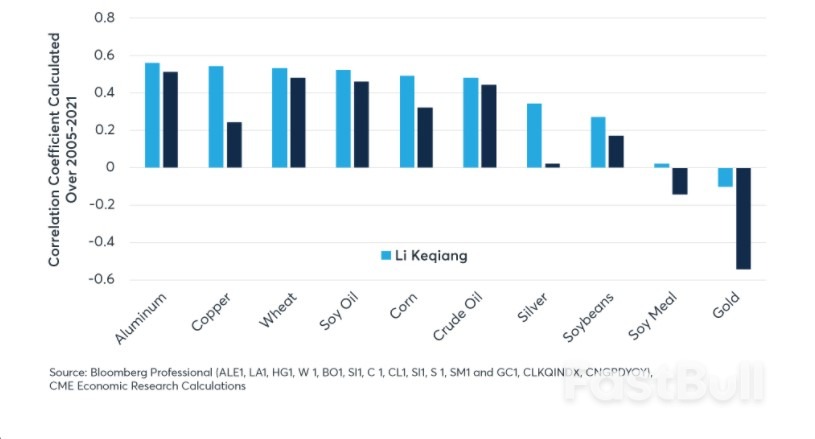
          Over the past 16 years, China' s "Li Keqiang" Index, has been highly correlated with the prices of many commodities including agricultural and energy products, and industrial metals. The pandemic period has been no exception. In fact, between 2005 and 2021, the index has consistently shown a more positive correlation with every major commodity than has China' s official GDP (Figure 1). This may be because it works especially well as a proxy for China' s manufacturing sector.

          Figure 1: Correlation between Commodities Prices and Li Keqiang Index

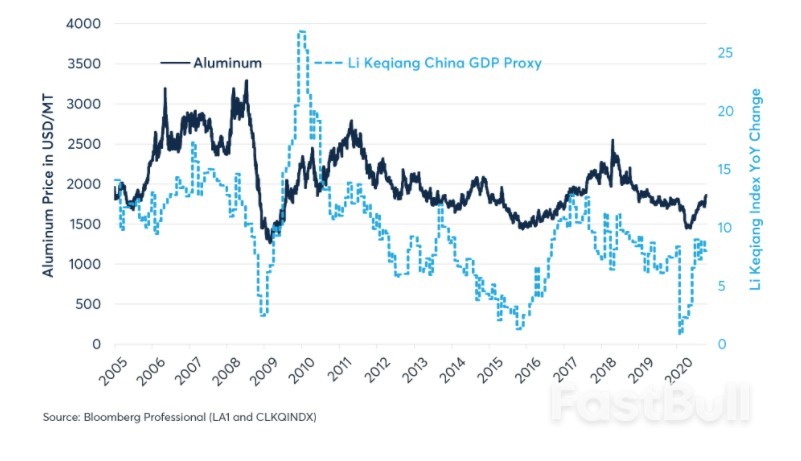
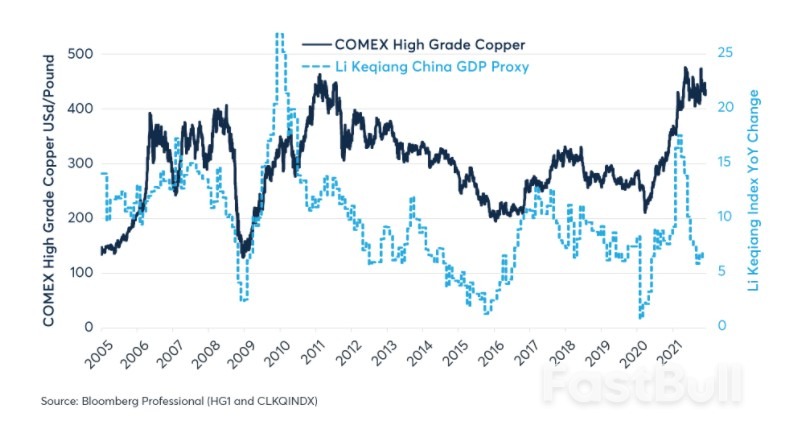
          The Li Keqiang Index includes only three components: rail freight volumes, electricity production, and bank loans.  The index dipped sharply in Q1 2020 amid China’s lockdown, corresponding to a sharp drop in the prices of most commodities.  It then rebounded to show year-on-year economic growth rates of as high as 17% by early 2021.  During this period, commodity prices surged with the prices of many goods rising 100% or more off their 2020 lows.  In recent months China’s growth has slowed sharply to around 5-6% and commodity markets have tended to see more sideways price action.
          Prior to the pandemic, the Li Keqiang Index showed a great deal more variability than China’s official GDP, which spent many years growing at an annualized pace of around 6.5-7.0% per year.  The Li Keqiang index showed much sharper slowdowns in 2009 and in 2014-16 than the official GDP did, while showing much stronger economic growth from 2010-12 and 2017-19 (Figure 2).  With a few exceptions like gold, commodity markets tended to follow what the Li Keqiang index was doing -  sometimes with a significant lag of up to one year or more.  

          Figure 2: China' s official GDP and The Li Keqiang Index

          Going into 2022, the index might continue to correlate highly with global commodity prices. China continues to consume 40%-70% of the world’ s industrial metals as well as close to one-fifth of the world’ s energy and one-sixth of the world’s food. The Li Keqiang index would likely detect any significant change in China’s pace of economic growth, and since the index is released monthly rather than quarterly, it might pick up those variations before it becomes apparent in China’ s official GDP.
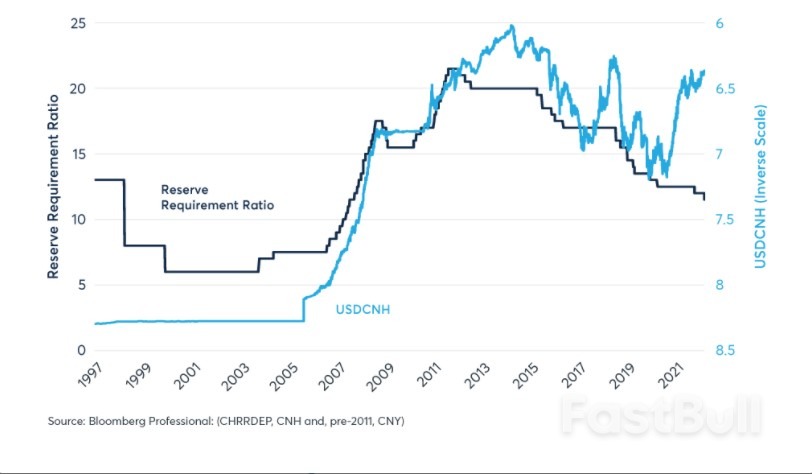
          Going into 2022, the main downside risk for China is its property sector, where construction activity is slowing, and real estate prices have begun to decline. Balanced against this risk is easier monetary policy. At a time when many central banks have either begun to tighten policy, or appear potentially poised to do so soon, the People’ s Bank of China is actively easing monetary policy, having recently reduced its reserve requirement ratio for the second time this year (Figure 3). A lower reserve requirement ratio might boost the availability loans to China’ s corporations. Bank loans account for 40% of the index.

          Figure 3: Chinese Yuan and Monetary Policy

          Here is a quick look at how different commodities have responded to variations in the Li Keqiang Index in the past:
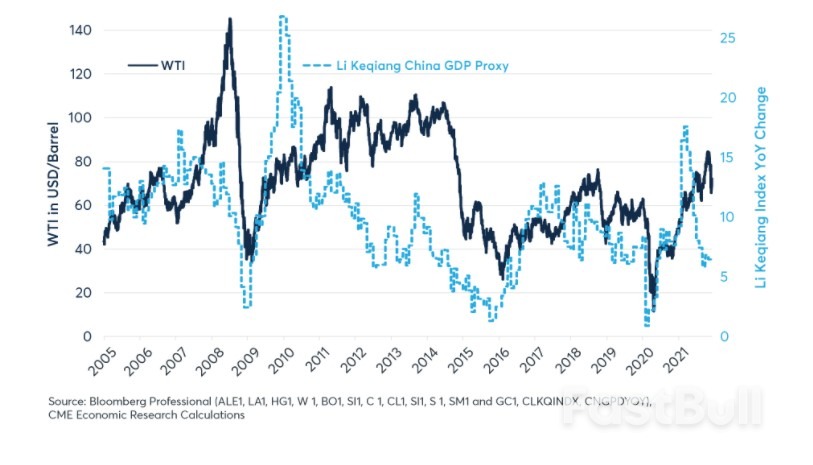
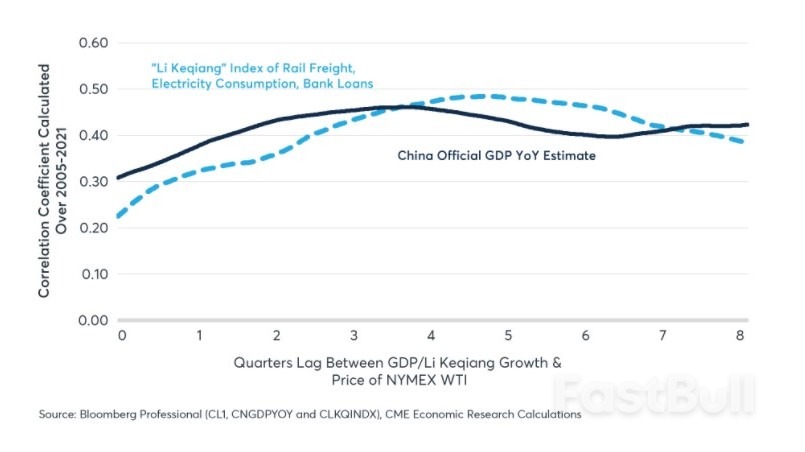
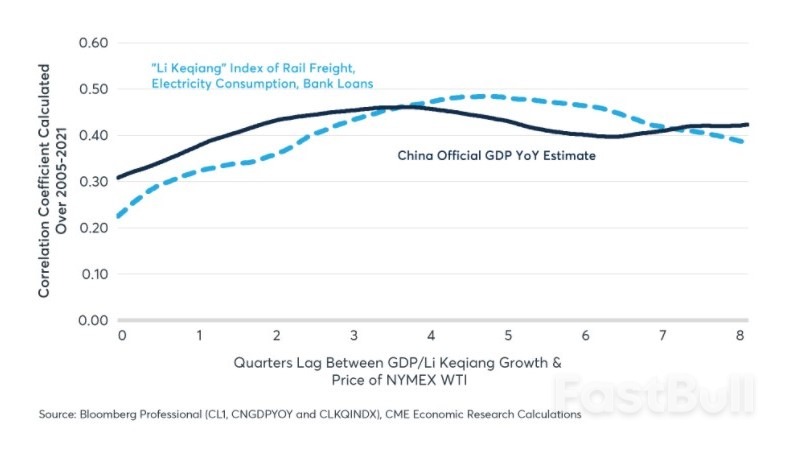
          Crude Oil: energy markets pay a great deal of attention to the swing producers of oil, but China may well be the swing consumer. Pre-pandemic oil consumption was fairly stable in Europe and the U.S., but it grew rapidly in China, especially during periods when China’ s economy was growing quickly. As such, it comes as little surprise that crude oil prices follow the Li Keqiang index, and sometimes with long lags. Peak correlation for oil comes 4-5 quarters after a change in the Li Keqiang index (Figure 4 and 5).

          Figure 4: WTI and YoY change in Li Keqiang Index

          Figure 5: Correlation between GDP & "Li Keqiang" Growth Rates and Price of NYMEX WTI

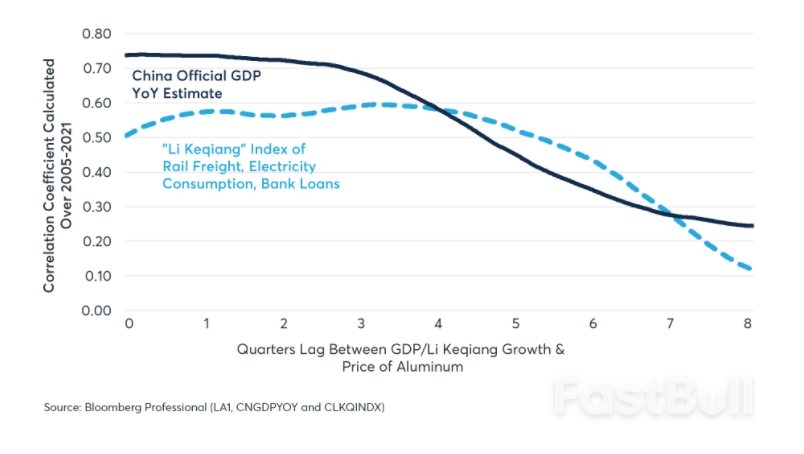
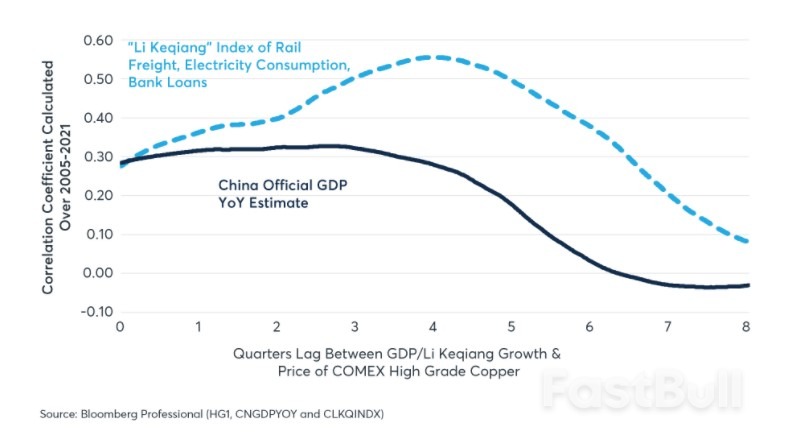
          Industrials metals: aluminum and copper show the strongest correlation to the Li Keqiang index. Unlike most other commodities, the metals have shown a strong contemporaneous correlation to changes in the Li Keqiang index as well as strong lagged correlations. That said, the correlation peaks at around one year (four quarters) for both metals (Figure 6-9).

          Figure 6: Aluminum and YoY change in Li Keqiang Index

          Figure 7: Correlation between GDP & "Li Keqiang" Growth Rates and Price of aluminum

          Figure 8: COMEX High Grade Copper and YoY change in Li Keqiang Index

          Figure 9: Correlation between GDP & "Li Keqiang" Growth Rates and Price of COMEX High Grade Copper 

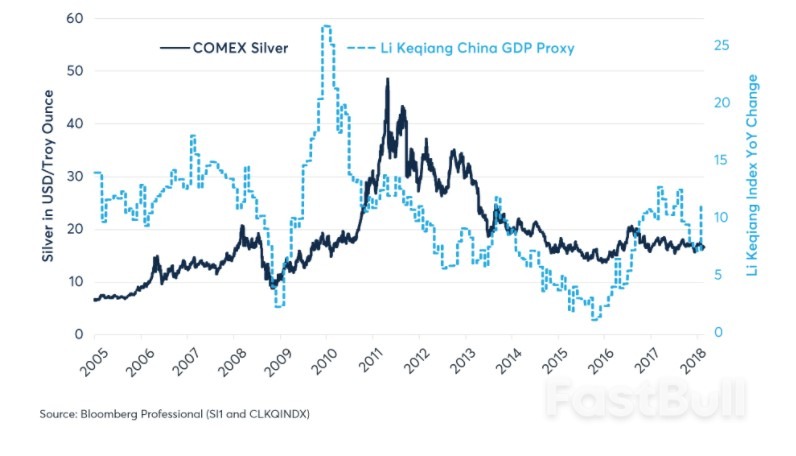
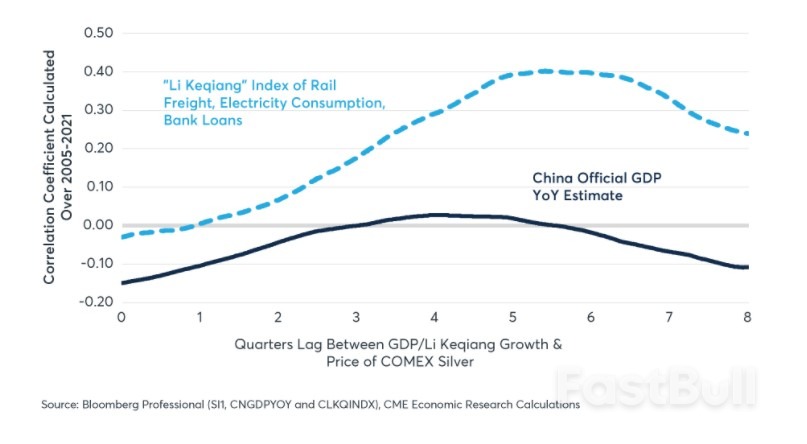
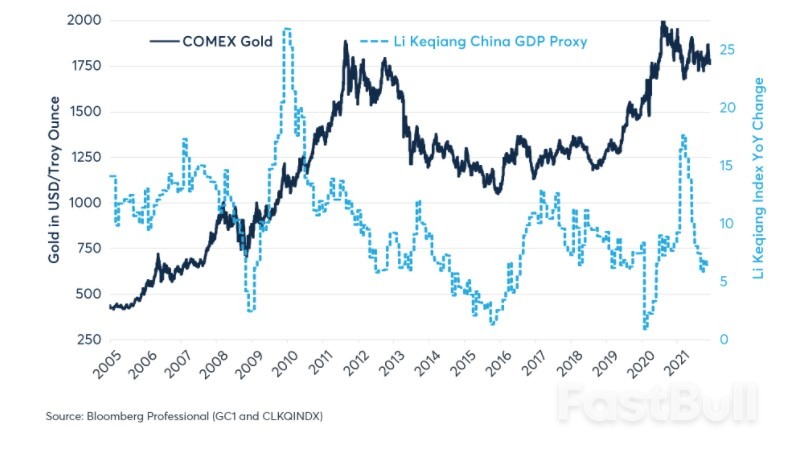
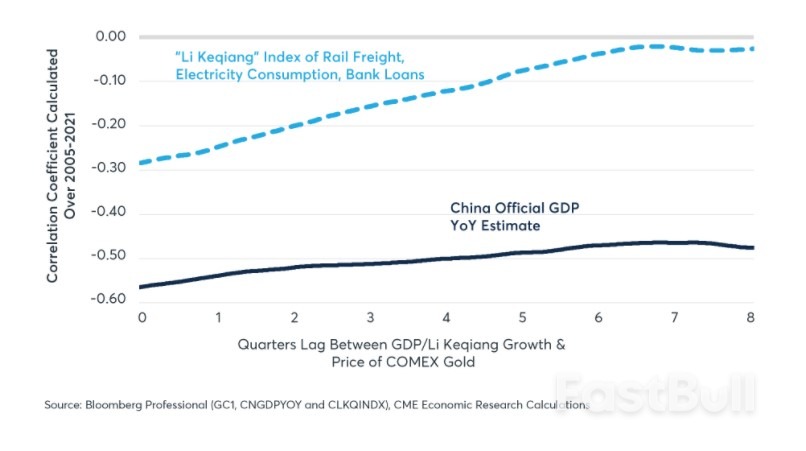
          Precious metals: silver has a somewhat weaker but still positive correlation that peaks at around 5-6 quarters after a change in the Li Keqiang index. Silver prices correlate negatively with GDP. Meanwhile, gold is one of the few commodities that correlates negatively with the Li Keqiang index.
          Stronger Chinese economic growth may be good news for most commodities but, on balance, it tends not be good news for gold (Appendix figures 7-10). Silver’s positive correlation is probably best explained by the fact that it has many industrial uses while gold has relatively few. Around 65% of silver is used for some sort of industrial purpose compared to only around 5% for gold. Unlike other metals, the yellow metal is used overwhelmingly for investment purposes.

          Figure 10: COMEX Silver and YoY change in Li Keqiang Index

          Figure 11: Correlation between GDP & "Li Keqiang" Growth Rates and Price of COMEX Silver

          Figure 12: Gold and YoY change in Li Keqiang Index

          Figure 13: Correlation between GDP & "Li Keqiang" Growth Rates and Price of COMEX Gold

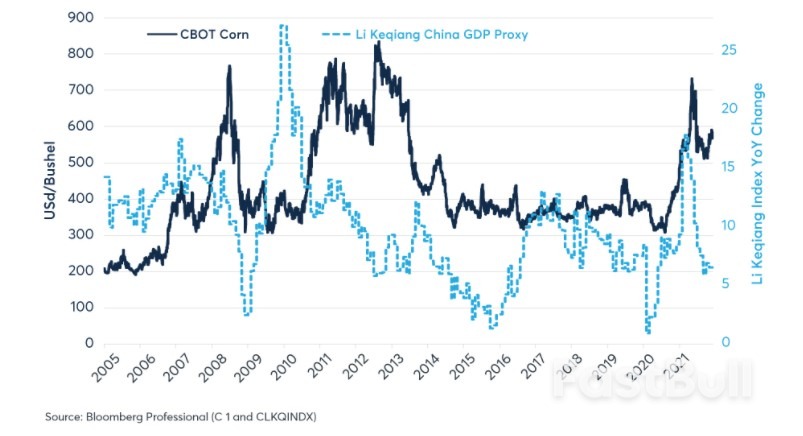
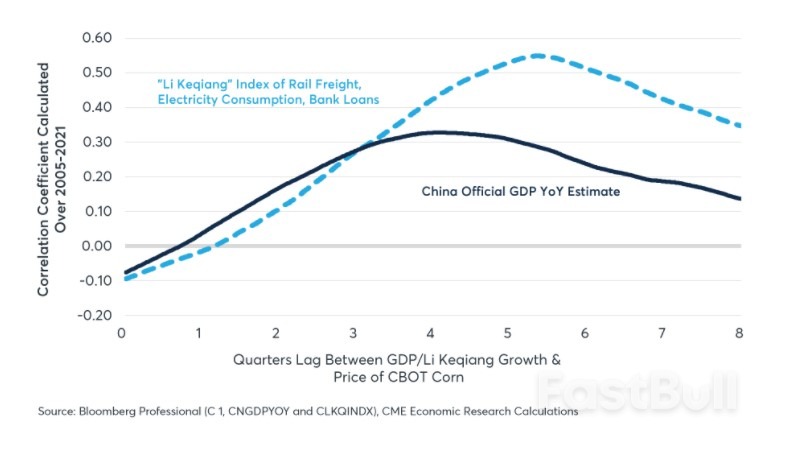
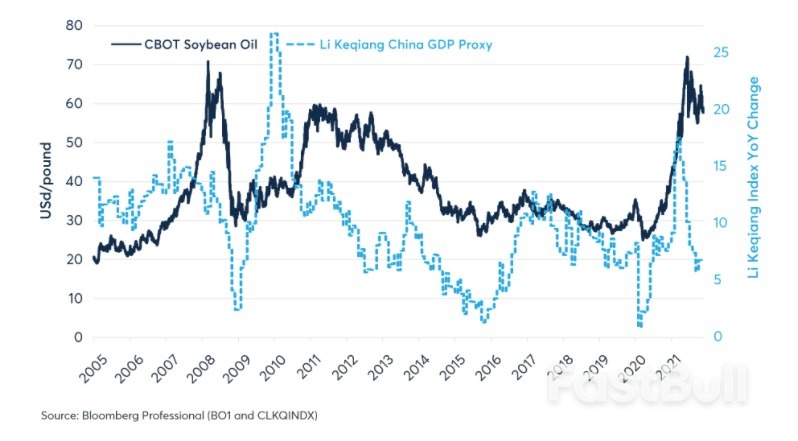
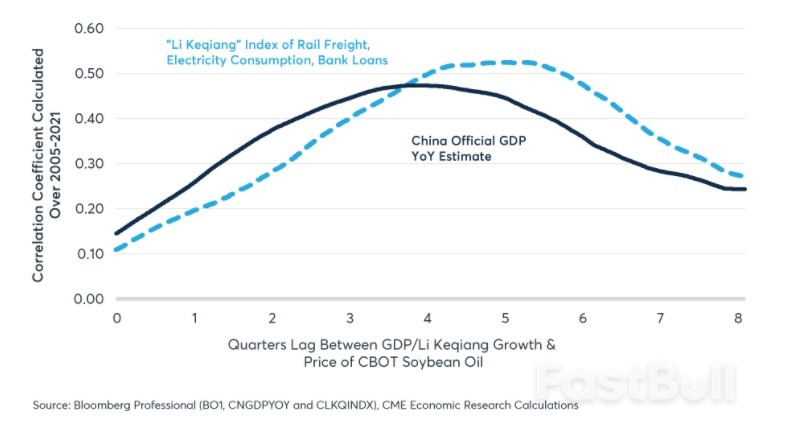
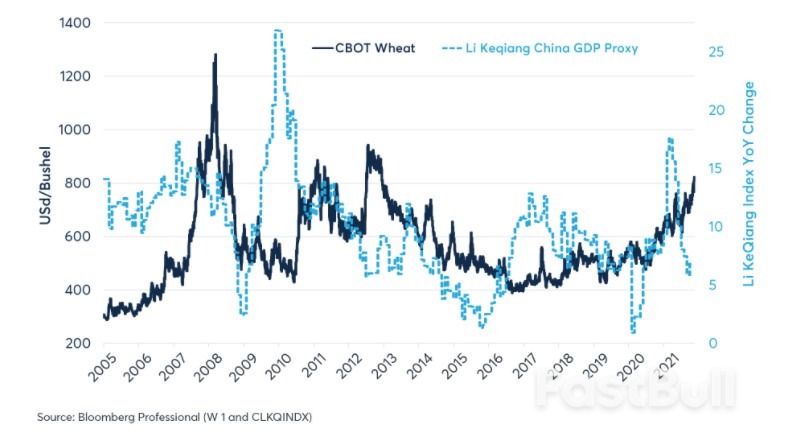
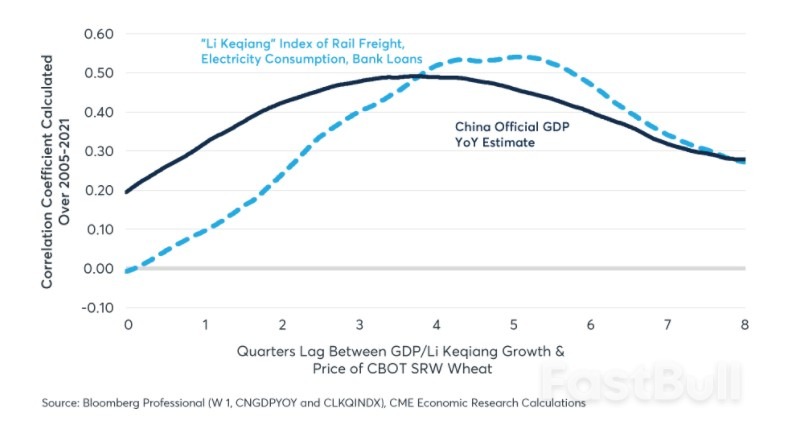
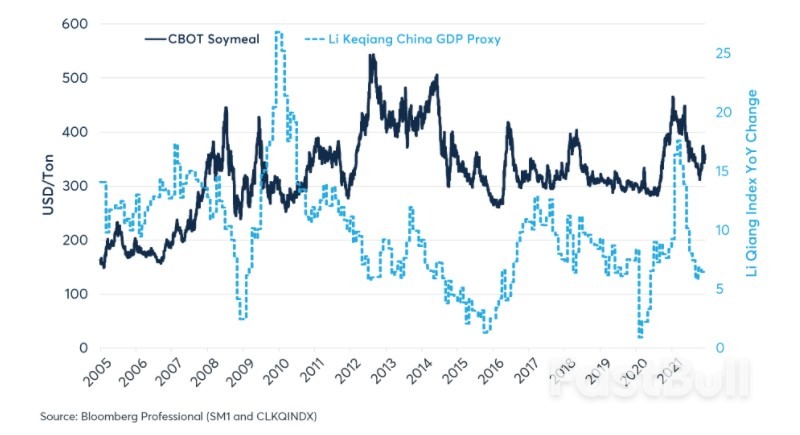
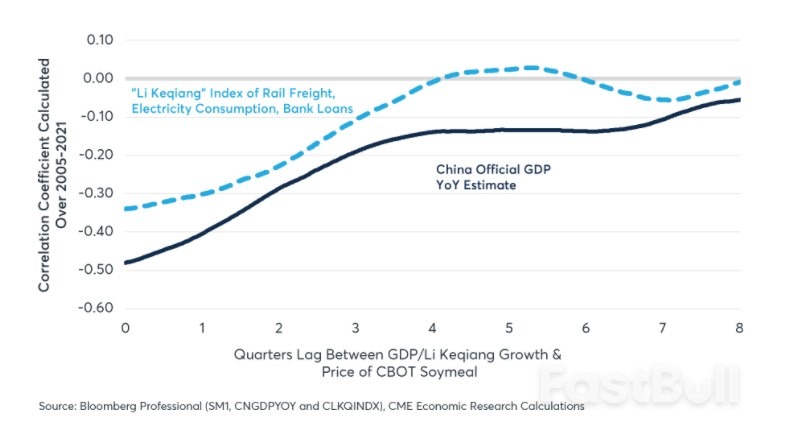
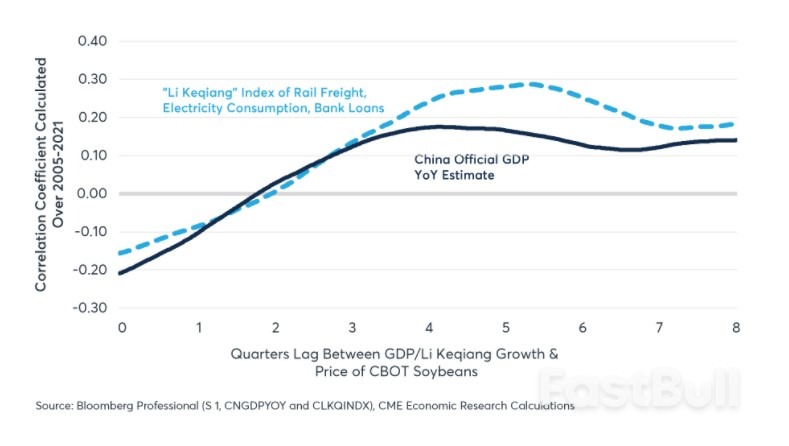
          Agricultural goods: corn, soybean oil and wheat demonstrate among the highest correlations with the Li Keqiang index and the correlation tends to peak five to six quarters after a move in the index –somewhat later than the peak correlation for metals and energy goods. Soymeal, like gold, tends to have a negative correlation with Li Keqiang. The difference is that corn, wheat and soybean oil can be used as biofuels and tend to correlate positively with crude oil prices. As such, they may be more heavily influenced by changes in the pace of China’s growth rate.
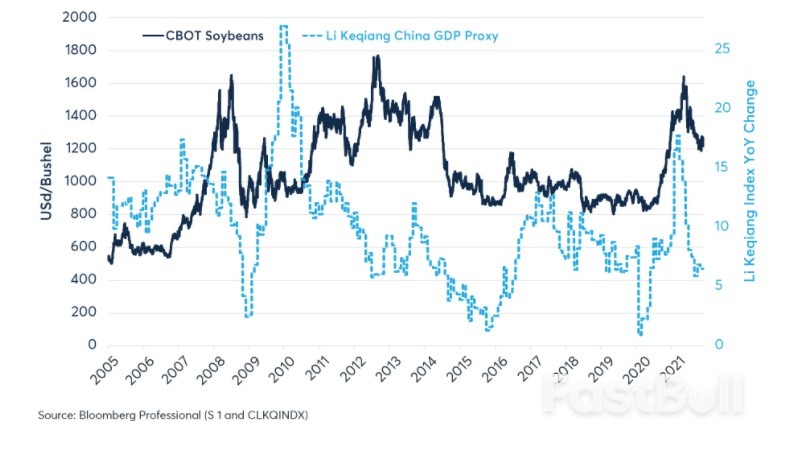
          By contrast, soybean meal is used primarily as animal feed and, like lean hog prices, shows little response to changes in the pace of Chinese growth. Finally, soybeans fall somewhere between bean oil, which is strongly correlated, and soymeal, which shows little correlation (Figure 14-23).

          Figure 14: CBTO Corn and YoY change in Li Keqiang Index

          Figure 15: Correlation between GDP & "Li Keqiang" Growth Rates and Price of CBTO Corn


          Figure 16: CBTO Soy Oil and YoY change in Li Keqiang Index

          Figure 17: Correlation between GDP & "Li Keqiang" Growth Rates and Price of CBTO Soy Oil

          Figure 18: CBTO Wheat and YoY change in Li Keqiang Index

          Figure 19: Correlation between GDP & "Li Keqiang" Growth Rates and Price of CBTO Wheat

          Figure 20: CBTO Soymeal and YoY change in Li Keqiang Index

          Figure 21: Correlation between GDP & "Li Keqiang" Growth Rates and Price of CBTO Soymeal  


          Figure 22: CBTO Soybean and YoY change in Li Keqiang Index

          Figure 23: Correlation between GDP & "Li Keqiang" Growth Rates and Price of CBTO Soybean

           Conclusion

          The bottom line is that variations in the pace of China’s growth rate have continued to reverberate through commodity markets, often with significant lags of one year of more.
          For the moment, many commodity markets may still be benefitting from the extraordinary rebound in China’s manufacturing sector in the second half of 2020 and the first half of 2021. The future of China’s manufacturing growth depends on which forces prove more powerful: booming demand for manufactured goods and an easier monetary policy or a sharp slowdown in the pace of growth in China’s real estate and construction sectors. Data from the second half of 2021 suggest that the pace of growth in China has slowed substantially and, if the past is any guide, this might suggest somewhat softer demand for many commodities in 2022.

          Reference: Erik Norland, Tracking Commodities With Li Keqiang Index, CME Group

          Risk Warnings and Disclaimers
          You understand and acknowledge that there is a high degree of risk involved in trading. Following any strategies or investment methods may lead to potential losses. The content on the site is provided by our contributors and analysts for information purposes only. You are solely responsible for determining whether any trading assets, securities, strategy, or any other product is suitable for investing based on your own investment objectives and financial situation.
          Comments
          Add to Favorites
          Share

          The key word for the global economy in 2022 is "recovery".

          Global growth faces downside risks

          We estimate global growth will ease to around 4.5% next year from its rapid 5.8% early recovery rebound estimated this year. However, that lower estimate remains well above its long-run potential of around 3%.
          Risk to the economic outlook in 2022 is mostly on the downside. Output will expand by around 3.5% in the US, 4.4% in the euro area, 3.6% in Japan and 4.6% in the UK. China will grow nearer its longer-run trend of 5% - normalising from its high 2021 growth but also dampened by restructuring within the property sector and supervisory tightening.
          A modest slowdown in recovery during the current quarter and first three months of next year - if not an outright fall in output - is possible as governments, notably in Europe, take new measures to slow rates of Covid-19 infection as the omicron variant goes global. Restrictions on those who are not vaccinated are being phased in. The economic rebound ought then to pick up speed again by the spring of 2022.
          The pandemic' s choke point in the advanced world remains capacities of health systems to cope with surges in more serious cases, hence re-imposition of partial lockdown and vaccination requirements. More reassuring is that the risk Covid-19 poses to economic recovery ought to continue moderating with time as governments adopt more targeted responses, the virus becomes more transmissible but less lethal and businesses and people adapt to working under more stringent public health restrictions.

          Inflation will moderate gradually

          As we slowly exit this pandemic crisis, inflation is a concern. Inflationary pressures are likely to remain more persistent than central banks project, running above pre-crisis averages even after price changes begin to moderate substantively during 2022.
          Higher and more persistent inflation has both good and bad implications for sovereign credit ratings. Somewhat higher inflation supports higher nominal economic growth, helping reduce debt-to-gross domestic product ratios, and curtails a long standing risk of deflation in the euro area and Japan. However, rising interest rates push up debt servicing costs, especially for governments with high debt and running budget deficits. Emerging economies, with weakening currencies and subject to capital outflows, are especially at risk.
          Under this context, monetary policy is set to diverge notably among the world’s largest economies. As central banks withdraw some crisis-era monetary stimuli, the process could crystallise risks associated with high debt and frothy asset prices.
          This is especially true for the UK and US, where inflation is likely to continue testing central bank mandates of keeping price increases to around 2%. The Bank of England and Federal Reserve will increase rates next year.
          By contrast, inflation is much less of a concern for the Bank of Japan, while inflation might remain below 2% in the long run in the euro area. The Bank of Japan and European Central Bank are expected to maintain their current lending rates throughout 2022. The ECB will halt the pandemic emergency purchase programme next year, although it and other asset purchase facilities may be adapted while markets adjust. The sharp increase in euro area inflation to 4.9% in November is likely to test the ECB’ s resolve in keeping policies accommodative.
          In this respect, any reduced capacity central banks have in calming financial markets might expose latent risk associated with debt accrued in the past, should high inflation increasingly constrain monetary room for manoeuvre. The latest statistics from the Bank for International Settlements show non-financial sector debt of global reporting countries hitting a new high of $225tn in the second quarter of 2021, equivalent to 273% of GDP.

          Key Support factors

          Concerns about the development of the Omicron variant and the impact of high inflation on the economy will continue to dominate the market and policy direction going into the first quarter of 2022. Investors will want to know what measures governments and central banks may take to curb price pressures while keeping their respective economies afloat as the latest virus-related restrictions put pressure on economic activity.
          With governments around the world increasing fiscal spending significantly during the pandemic, it will be politically difficult to take further stimulus measures without raising taxes. Likewise, central banks have backed themselves into an edge. Certainly, with inflation so high, they will not be keen to increase bond purchases again. If anything, the Fed may not even wait until the middle of next year to raise interest rates.
          Diverging monetary policy puts pressure on central banks otherwise reluctant to tighten policy to protect currencies from further depreciation, which may further stress underpinning inflation. Central banks are now holders of significant amounts of government debt. The resulting fiscal dominance might slow normalisation of monetary policy, although any such delay could accentuate inflation risk.
          Still, we ought not be overly pessimistic. Monetary policy innovations during the pandemic – such as the flexibility the ECB introduced with the PEPP - has enhanced the resilience of sovereign borrowers during crisis phases, assuming such innovative monetary instruments are available for redeployment in future downturns.

          Reference: Dennis Shen, Global economy set for sturdy if uneven growth in 2022 

          Risk Warnings and Disclaimers
          You understand and acknowledge that there is a high degree of risk involved in trading. Following any strategies or investment methods may lead to potential losses. The content on the site is provided by our contributors and analysts for information purposes only. You are solely responsible for determining whether any trading assets, securities, strategy, or any other product is suitable for investing based on your own investment objectives and financial situation.
          Comments
          Add to Favorites
          Share

          Can US gas meet Europe's energy needs?

          The European energy crisis is intensifying due to the cold weather, and gas prices in Europe have been pushed up to record levels. With the soaring gas prices, electricity prices in many parts of the continent have also skyrocketed and are continuing to impact the European economy. However, stimulated by high gas prices, Europe is attracting an increased supply of US LNG and European gas prices have fallen for four consecutive trading days, dropping sharply from their highs.

          US LNG "saviours"

          Geopolitical tensions between Russia and Ukraine have brought Russian-European relations to a standstill, with gas supplies from the main supplier, Russia, falling sharply. As a result, supply shortages have been accentuated in the face of a surge in heating demand in the midst of a cold winter, sending gas trading prices in Europe soaring to around $57.54 per million British thermal units, almost a third higher than a week ago, which is around $24 higher than Asian prices and more than 14 times higher than the US benchmark gas price.
          The widening price differential between European and US natural gas is attracting commodity traders to change routes and ship liquefied natural gas (LNG) originally destined for Asia to the gas-starved European continent.
          Shipping data compiled by Bloomberg shows that of the 76 US LNG cargoes in transit, 10 tankers have declared their destination as Europe, with a total capacity of 1.6 million cubic metres of heating and power plant fuel. A further 20 tankers carrying some 3.3 million cubic metres appear to be crossing the Atlantic en route to the continent. Shipping data shows that nearly a third of the cargoes are coming from Cheniere Energy's Sabine Pass LNG export terminal in Louisiana.
          Asia is usually the preferred destination for US LNG cargoes and LNG is already expensive to transport, but this has changed this winter as European gas prices have seen a significant premium, presenting significant arbitrage opportunities.

          Europe's energy crisis is "self-inflicted"

          Although European gas prices have fallen sharply in recent days, they are still up five times as much as they have been so far this year, and market concerns about Europe's energy crisis and electricity supply are still fresh. European gas stocks are on the verge of depletion, the amount of LNG shipped to Europe from the United States is still a long way from Europe's gas supply and demand gap, the amount of gas supplied by Russia is still declining, several French nuclear power plants are out of service, Germany's wind power generation is still low, and gas demand for electricity generation remains high. All the signs are that Europe is still mired in its worst energy crisis in decades.
          At a time when tensions between Russia and Europe and the US over Ukraine are reportedly high, the Yamal pipeline, which runs for over 4,000 kilometres from Russia through Belarus and Poland to Germany, has not only stopped supplying gas these days, but is even "reversing the flow of gas ". This means that Germany is selling its only gas stocks back to Poland after Russia has stopped supplying gas.
          It has to be said that Europe's gas supply crisis is somewhat self-inflicted, as the Nord Stream 2 pipeline project, which would have brought gas from Russia to Germany, was earlier halted by German and EU regulators for approval because of tensions on the Russian-Ukrainian border and opposition from the US and several countries in Eastern Europe. Although both sides have denied the political aspect of this, it is clear to all that this is not a simple commercial exercise. Towards the end of the year, faced with an extreme shortage of natural gas, Europe would rather import expensive LNG from the US than have any thoughts of easing relations with Russia.

          The pains of Europe's energy transition

          Europe's attitude towards Russia shows that it too intends to make a bold energy transition and move away from its heavy reliance on Russian gas.
          Europe has been at the forefront of the global energy transition, with fossil fuels accounting for just 35% of Europe's energy mix for power generation in 2020, with gas and coal accounting for 19% and 15% respectively, while renewables, nuclear and hydropower together account for a whopping 62.3%. With the structural shift in Europe's energy mix, traditional power plants are being phased out, while renewable energy sources are not stable enough, wind and solar are "dependent on the weather", and it is difficult to achieve an uninterrupted supply of new energy sources in adverse weather conditions, traditional fossil energy sources are still playing an important role in supporting the clean energy transition.
          Rare energy crises such as this year's are the pains that Europe will have to go through in the process of energy transition, and technological advances will be crucial to achieving complete low-carbon energy goals in the future, while energy markets should still experience significant fluctuations from time to time, making it difficult for the energy crisis to be completely lifted in the short to medium term.
          Risk Warnings and Disclaimers
          You understand and acknowledge that there is a high degree of risk involved in trading. Following any strategies or investment methods may lead to potential losses. The content on the site is provided by our contributors and analysts for information purposes only. You are solely responsible for determining whether any trading assets, securities, strategy, or any other product is suitable for investing based on your own investment objectives and financial situation.
          Comments
          Add to Favorites
          Share

          How can Vietnam become the next Asian manufacturing hub?

          In recent years, due to the rising labour costs in China, many multinational companies have moved their production lines to Vietnam as planned, and Vietnam, therefore, has taken over the transfer of some labour-intensive industries. The massive inflow of foreign direct investment into Vietnam's manufacturing sector, combined with the country's cheap labour, has led to a rapid transformation of Vietnam's economy and industrial structure, and the country's exports of electronic products and machinery have achieved rapid growth, contributing to the country's dynamic economic development. Before the outbreak of the pandemic, Vietnam was one of the fastest-growing emerging markets in the world.
          According to the data from the World Bank, Vietnam's population exceeded 97 million in 2020, approaching 100 million, indicating an availability of demographic dividend. The adequate, cheap and skilled labour force of the right age is an important support and foundation for Vietnam to achieve excellent results in a short period. The latest data shows that in the first half of this year, Vietnam's manufacturing sector contributed 53% to the economic growth, a glimpse of Vietnam's "demographic dividend".

          The economy is still strong despite the pandemic

                      Chart: Comparison of annual GDP growth rates of China and Vietnam

          As the chart shows, Vietnam has maintained high economic growth since the beginning of the new century, with the economic growth rate above 5% for a long time. In recent years, Vietnam's economic growth rate once surpassed that of China and was promoted to be one of the fastest-growing countries in the world. Even amid the pandemic, Vietnam's GDP in 2020 was 0.27 trillion USD and the economy grew by 2.91%, making it one of the few countries to achieve positive economic growth. In 2021, when the pandemic hovers over the world, the World Bank still expects Vietnam to achieve a faster growth rate overall, or specifically, 4.8%.
          Vietnam's economy has faced many difficulties and challenges this year due to the impact of the pandemic, with the country's commodity supply chain breaking down and many businesses having to close, suspend operations and many workers losing their jobs. However, there are still bright points in Vietnam's economic picture in the first 11 months of this year, which are highly rated by economists.
          Against the backdrop of the pandemic disrupting the supply chain, Vietnam's total imports and exports in the first 11 months of this year still increased by 22.9% year-on-year, with total imports and exports already reaching $602 billion and expected to reach $660 billion for the whole year. In addition, in the first 11 months of this year, Vietnam still attracted foreign direct investment (FDI) of $26.46 billion, a slight increase year on year. Among them, the processing manufacturing industry attracted $12.78 billion in foreign investment, accounting for 57.9% of the total registered capital. The industrial production index grew 3.6% year-on-year, higher than the 3% growth rate for 2020.

          Challenges facing the economy

          Similar to the economic transformation of China and Japan, Vietnam has attracted foreign investment through cheap labour, land rent and preferential policies to take up the transfer of labour-intensive industries and is expected to become the next manufacturing centre in Asia, but many problems are plaguing Vietnam.
          First of all, Vietnam is a country with a relatively small market that can hardly accommodate too much foreign investment. Meanwhile, Vietnam's infrastructure is becoming a bottleneck for its development. Due to the long and narrow territory and scattered infrastructure, the transportation interconnection between the north and south of Vietnam is also relatively limited. Analysis shows that infrastructure constraints and low environmental standards are weakening the competitiveness of Vietnam's industrial parks in attracting foreign investment, and the country's poor infrastructure and insufficient warehouse storage capacity.
          Secondly, Vietnam's major industrial clusters are still in the development stage, with high reliance on China for production components. Vietnam's production capacity and supporting supply chain are not complete, and many multinational OEMs invest in factories in Vietnam that mainly assemble products, while the procurement of raw materials, components and other areas still depend on Chinese factories.
          In addition, Vietnam is currently undertaking a typical labour-intensive industry, lacking institutional and technological innovation capacity. If it continues to remain open, it will not be difficult for Vietnam to rise to a middle-income country with this model. However, to further improve national income, Vietnam needs to make other reforms, as well as invest massively in education and research.
          Finally, under the impact of the pandemic, Vietnam's economy may face high inflationary pressure in 2022 due to rising prices of raw materials, goods and services. At the same time, the policy of stimulating investment support and enterprise support in 2022 also increases inflationary pressure, and with the continued emergence of covid-19 variants worsening the global pandemic, the Vietnamese economy still faces many new challenges in 2022.

          Conclusion

          Vietnam's manufacturing industry has achieved rapid development in the past decade, but more challenges await the country, and the road to transforming its economy is still long. Vietnam not only needs to seize the window of industrial transfer, but also needs to increase infrastructure construction and timely upgrade its education level and investment in science and technology.
          Risk Warnings and Disclaimers
          You understand and acknowledge that there is a high degree of risk involved in trading. Following any strategies or investment methods may lead to potential losses. The content on the site is provided by our contributors and analysts for information purposes only. You are solely responsible for determining whether any trading assets, securities, strategy, or any other product is suitable for investing based on your own investment objectives and financial situation.
          Comments
          Add to Favorites
          Share

          Inflation Now the Biggest Threat to the U.S. Economy

          Fed officials had expected to keep interest rates at their lowest level for at least two years beginning in 2021, and viewed higher inflationary pressures as a temporary phenomenon as the financial system recovered from the epidemic pandemic. However, they are now about to open a new era of Fed policy in 2022, which includes the possibility of including as many as three rate hikes and a faster-than-expected asset purchase program.
          The market today describes the Fed's series of policies as "the last war the Fed usually fights".In the last war, inflation was never a problem and could make the labor market hot, so they say in this war "you can't provide too much stimulus, inflation won't be a problem". They're worried about playing the wrong game.

          The Federal Reserve now sees inflation as the biggest threat to the U.S.economy

          Inflation is soaring rapidly in 2021. consumer prices rose 6.9 percent year-over-year in November, the fastest rate of growth since June 1982. A measure of Americans' confidence in the U.S. economy fell to its lowest level in a decade as price pressures weighed on people's purchasing power.
          A series of measures suggest that investors are beginning to expect prices to continue to rise, although those expectations have fallen from record highs as market participants grapple with slowing growth and the rapid spread of Omicron variants.Fed Chairman Jerome Powell echoed these sentiments in a press conference following the December FOMC meeting, suggesting that the Fed's hawkish stance is intended to put the U.S. Fed on the defensive. Officials believe that inflation will continue until at least 2024, with the personal consumption expenditure price index at 5.3% by the end of 2021, but will slow to 2.6% by the end of 2022.
          "We have to set policy now because inflation is well above target," Powell said. "If we knew the labor force participation rate would start rising in two years, would we wait two years with inflation well above the target? Probably not. What is the maximum level of employment that is consistent with real price stability? Debatable."
          For months, the Fed's rallying cry has been that inflationary pressures will subside once the U.S. economy survives the epidemic pandemic. Supply pressures have led to severe shortages, and officials have seen a huge gap persist in the U.S. labor force, with nearly 2.3 million workers still without jobs to this day. The Fed sees this as a sign that the job market may not be as tight as some measures suggest and that they will be incentivized to return to work once the epidemic subsides.
          Instead, Powell acknowledged in December that the employment cost report showing the first signs of wage pressures seemed to prove the Fed wrong, while monthly data showed inflation continued to climb. There has been a wave of subsequent viruses from Delta to Omicron that have proven to officials that such viruses can be a permanent fixture in the economy, leading them to believe that labor force contraction is here to stay.

          Officials are slowing the pace of asset purchases to raise rates in 2022

          The market expects that rates will inevitably rise next year, but the question is when and how much?In our view, this depends in part on the Fed's asset purchase program. The Fed will not raise interest rates while still buying large amounts of mortgage-backed securities and Treasuries. That's because asset purchases would stimulate the economy, while rate hikes would put the brakes on the financial system.
          However, officials announced in December that they would begin reducing bond purchases by $30 billion a month, the second adjustment to the Fed's stimulus tapering, called "accelerated tapering. Given this pace, the Fed will completely end its bond purchases by March 2022, possibly opening the door for a rate hike on March 16 or at a subsequent meeting in May or June.
          Advantage Economics' chief economist and founder Joseph Mayans' base assumption for 2022 is two rate hikes starting in June. This is largely due to some unknowns in the economy, such as the Omicron variant and how households will handle less stimulus. It will be a dichotomy throughout 2022, what does the Fed intend to do? and what it will be able to accomplish?
          Economists say viruses like the Omicron variant are unlikely to revert to restrictions similar to those in place in March 2020, as large numbers of people have already been vaccinated. Powell also said in December that a new wave of infections is unlikely to derail the Fed's plans to exit its stimulus program altogether.
          "It's really an appropriate thing for us to bring the tapering forward a few months and I don't think it has much to do with the Omicron variant", Powell said.
          Yet we believe the virus could exacerbate tensions over supply chain and employment issues, complicating the Fed's decision making. In a virus-ridden economy, the Fed's future interest rate path faces greater uncertainty than usual, and the extent to which rates climb in 2022 will depend on how inflation and the virus evolve.

          Where's the bottom line

          The Fed knows that raising rates too soon could slow the economy and expose millions of Americans to secondary unemployment, which they have absolutely no need to do if the job market has more time to wait. But letting the inflation gauge run too long may make the economy overheat. At the same time, inflation-induced declines in purchasing power could slow consumer spending and hiring. And how to properly handle the relationship between the two is an important reason why Fed officials have been slow to open up the space for rate hikes.
          It's a tricky issue for the Fed, which doesn't want to risk removing easing too soon, and doesn't want rate hikes to come too late. It's going to be a tough year, and if you think 2021 will be hard for the Fed, 2022 could be even harder.
          Risk Warnings and Disclaimers
          You understand and acknowledge that there is a high degree of risk involved in trading. Following any strategies or investment methods may lead to potential losses. The content on the site is provided by our contributors and analysts for information purposes only. You are solely responsible for determining whether any trading assets, securities, strategy, or any other product is suitable for investing based on your own investment objectives and financial situation.
          Comments
          Add to Favorites
          Share

          Differences between European and American policies and their main reasons

          The Fed officially announced the start of the tightening cycle at the November monetary policy meeting. At the same time, it accelerated the pace of taper at the December monetary policy meeting. The market expects the Fed will officially start the interest rate hike cycle in mid-2022. The European Central Bank, which is contrary to the Fed’s “frequent actions”, has been standing still. The policies of the European Central Bank and the Federal Reserve are differentiated. 

          Different monetary policy objects

          ECB has price stability as its primary object

          The primary goal of the ECB is to maintain price stability in the Eurozone, and HICP is used as a measurement standard for assessing the achievement of the price stability goal.
          The ECB revised its inflation criteria in July this year from the previous "HICP growth below but close to 2% year-on-year" to "two percent inflation over the medium term". The new inflation target emphasizes “symmetry”. The inflation rate fluctuates moderately above and below the 2% mid-term target. It is reasonable for inflation to be slightly higher than the target level for a period of time. This means that the ECB will have a higher tolerance for inflation and its policy objectives will be more flexible.

          The Fed's policy objects are maximum employment, stable prices, and moderate long-term interest rates.

          The "Statement on Longer-Run Goals and Monetary Policy Strategy” announced in August 2020 made two important changes to the Fed's monetary policy objectives: (1) Adopting an average inflation target. The Fed's long-term inflation target was changed from "2%" to "2% on average" and "long-term inflation expectations were anchored at 2%". (2) Change the assessment of the employment target from "deviations of employment from its maximum level" to "the shortfalls of employment from its maximum level".

          Different inflation structures

          In terms of inflation, the most obvious difference between the European and American inflation structure lies in the price of durable goods and the price of housing. Both the United States and Eurozone countries suffer from inflation caused by rising energy prices.
          November energy items in the United States and the Eurozone increased by 33.5% and 27.5% year-on-year respectively. However, in terms of durable goods, the prices of second-hand and new cars in the United States increased by 31.4% and 11.1% year-on-year in November; Eurozone vehicle purchase prices increased by 4.7% year-on-year, a significant increase from before the pandemic, but the increase was far less than that of the United States; The prices of furniture and home appliances in the Eurozone increased by 1.1% and 1.6% year-on-year respectively, which was lower than the ECB's mid-term target, while prices of furniture and home appliances in the United States have risen rapidly since March this year, each exceeding 6% year-on-year.
          In terms of residential prices, the year-on-year growth rate of housing rents in the United States has continued to rise since March this year and reached 3.9% in November, while the year-on-year growth rate of housing rents in the Eurozone was 1.1% in November, down 0.1 percentage point from October and well below the 2% inflation target. 

          Different employment structures

          In terms of the labour market, the eurozone and the US show different trends in unemployment rates, job vacancy rates and employee payrolls. In terms of unemployment rates, the US unemployment rate rises to 14.8% in April 2020 and then gradually falls back to 4.2% in November 2021, which is still short of the 2018-2019 average of 3.8%.
          Unemployment rates in Germany and France also rise in 2020 as a result of the epidemic, but to a lesser extent. The unemployment rate peaks at 9.0% in France in the epidemic, just 0.3 percentage points higher than the 2018-2019 average of 8.7%; the unemployment rate peaks at 6.4% in Germany in the epidemic, 1.3 percentage points higher than the 2018-2019 average German unemployment rate of 5.1%. a large number of US employees leave their jobs in 2020 and no longer work, while employees in eurozone countries retain more jobs and work fewer hours. As a result, when the economy resumes operations in 2021 after the epidemic has been contained, the US is in a hiring dilemma and companies are forced to offer higher wages to attract labor. The labor shortage pushes up wages and higher wages push up inflation; the opposite of the eurozone where inflation comes first and then wages are raised due to inflation.

          Fiscal policy is the main reason for the differences

           Fiscal policy in the US

          The US government's choice to issue cash subsidies directly to residents during the epidemic, directly leading to an increase in their incomes. in March 2020 Trump signed a $2.2 trillion fiscal stimulus package, including a $1,200 cash check for each adult earning less than $75,000 per year and $500 for each child.
          Biden signs a $1.9 trillion economic bailout in March 2021, providing a new round of stimulus checks of up to $1,400 to most Americans and adding an additional $300 in benefits to weekly unemployment benefits. The US cash subsidies, which do not fully end until 6 September 2021, have significantly boosted consumer spending, particularly on durable goods, leading to significantly higher price increases for durable goods in the US than in the Eurozone and dampened employment intentions, leading to a rapid rise in job vacancies and pushing up pay levels.
           

           Fiscal policy in the Eurozone

          In contrast, German fiscal policy under the epidemic has been more supportive than bailout-oriented. The German government subsidises companies to provide wage subsidies for workers on leave, i.e. to help residents retain their jobs if they do not work, which is equivalent to unemployment benefits. Companies replace layoffs by reducing the number of hours employees work, and the government co-pays for the companies' salaries during this time.
          In August 2020 the German government announced that this subsidy scheme would continue until the end of 2021. In addition to Germany, France also announced in October 2020 that it would provide $23.7 billion in aid to small businesses to subsidize the wages of workers on leave. Such fiscal measures have on the one hand helped to reduce the volatility of unemployment rates, but on the other hand they have weakened the income levels of the population and have not stimulated consumption as directly as the US government's cash cheques. It is the inconsistent approach of governments to the epidemic that has led to differences in the structure of their economies, which in turn has influenced monetary policy making and the direction of their economies.
           
          Risk Warnings and Disclaimers
          You understand and acknowledge that there is a high degree of risk involved in trading. Following any strategies or investment methods may lead to potential losses. The content on the site is provided by our contributors and analysts for information purposes only. You are solely responsible for determining whether any trading assets, securities, strategy, or any other product is suitable for investing based on your own investment objectives and financial situation.
          Comments
          Add to Favorites
          Share

          Population problem worsens again, Korea to have negative population growth?

          According to statistics released by Statistics Korea, the total population of South Korea will be 51.75 million (including foreigners living in Korea) in 2021, which will be 90,000 fewer than the 51.84 million in 2020. This means that Korea's population will experience negative growth of the total population from 2021 onward after peaking in 2020.
          In 2020, Korea's population will naturally decrease by 33,000 people compared to the previous year, and for the first time in history, there will be a "death crossover" - a phenomenon in which the number of deaths exceeds the number of births - but the total population, including foreign residents living in Korea, will naturally decrease. This is the first time this year. The total population is expected to drop by 14.18 million in 50 years, and there is a lot of talk of " Korea is disappearing".

          Epidemic reduces willingness to have children

          The global epidemic is raging, and this is one of the reasons why Koreans are reluctant to have children. It can be argued that the epidemic has exacerbated Korea's demographic problems. Specifically, the repeatedly festering epidemic has increased uncertainty about the economic outlook and affected Koreans' expectations for the future, which continues to reduce their willingness to have children.
          The data show that fewer than 280,000 newborns will be born in South Korea in 2020 compared to 2019, a 10% decrease from the previous year. 2021 continues the decline, and in the third quarter alone, South Korea's newborn population fell by 3.4% year-on-year, a record low since this data began in 1981, and the total fertility rate for society was 0.82%, down 0.02% from a year ago. It is reported that Korea's birth rate has been on a downward trend since 1965, and although it is falling elsewhere in the world, Korea's total fertility rate is declining particularly rapidly, making the country's demographic problems extreme.

          Extreme house prices under the epidemic

          The Global Home Price Index report released by Knight Frank, a British real estate information company, showed that South Korea's house prices rose 23.9% year-on-year in the third quarter, topping the list of 56 countries surveyed by the agency based on one item of real increase in price increases, according to the Korea Daily Asia.In fact, Korea's soaring home prices are not something that happened this year. The average price of a 99-square-meter apartment in Seoul has almost doubled from 620 million won (about $548,300) to 1.19 billion won (about $1.051 million) in the four years since the Moon Jae-in administration took office, according to a survey by the Korea Citizens' Coalition for Economic Justice Practices cited by the Korea JoongAng Daily. In this four-year period, the real income of Korean nationals rose by only about 7%.Some analysts point out that the current round of Korea's house price surge is mainly caused by the easing policies in response to the epidemic and the impact of inflation. With borrowing costs at record lows for an abnormally long period of time and the impact of inflation, the Korean people have expanded their household debt to buy houses, which has not only led to abnormally high housing prices, but also to rapid growth in household debt.
          Some time ago, the government controlled the lending policy, so that young people without parental support could not buy a house. Currently, Korea is in a crisis of confidence in its real estate policy, and the society is full of anxiety that "if you cannot buy a house now, you will never be able to buy a house. Most young people feel that the lack of a house is the reason why it is difficult to get married and have a family, and is a major reason for the declining birth rate in Korea.

          Work and childcare costs

          South Korea has the longest working hours in the world, and young Koreans have a schedule that is just enough to live well alone, making it difficult to blend in a second or third person for daily life.
          In 2018, the Korean Labor Standards Act set the maximum number of working hours in a week at 52-68, which means an average working day of up to 10.4-13.6 hours, which works out to nearly half of the day being spent at work.
          For this reason, in July of this year, Korea set the maximum working hours of 52 hours a week, which is 4.5 hours more than the average weekly working hours of Chinese employees (47.5 hours).
          Adding to this, Korea's economy has grown slowly since 2000, and the unemployment rate for young people is more than twice the overall unemployment rate, with less than 50% of those aged 20 to 29 in employment status. The money earned from hard work is only enough to meet their daily needs.
          Moreover, the cost of childcare in Korea is high, and competition among Korean children is fierce. In Seoul, the only good schools are those recognized top universities, namely Seoul National University, Koryo University and Yonsei University, and there are only a few well-known large corporations. This leads to extreme competition for Korean children right from birth. Data shows that in 2017, the average monthly tuition fee per person in Korean primary and secondary schools alone reached 271,000 won (about $251.37).
          Fundamentally, South Korea's upward path is exceptionally narrow, with a handful of large plutocrats monopolizing the country's economic lifeblood. Even despite the hard work, it is difficult for Koreans to have children. Not only is it difficult to create a better life for the next generation, but it also tends to put families in a tight spot.

          Summary

          Under the epidemic, the willingness of Koreans to have children has not only been suppressed, but the long-standing problem of housing prices has also become more prominent. In addition, the problems of stressful life and the high cost of having offspring are still pending, and the direction of Korea's population problem is not optimistic and can be said to be extremely serious.
          Risk Warnings and Disclaimers
          You understand and acknowledge that there is a high degree of risk involved in trading. Following any strategies or investment methods may lead to potential losses. The content on the site is provided by our contributors and analysts for information purposes only. You are solely responsible for determining whether any trading assets, securities, strategy, or any other product is suitable for investing based on your own investment objectives and financial situation.
          Comments
          Add to Favorites
          Share
          FastBull
          Copyright © 2025 FastBull Ltd

          728 RM B 7/F GEE LOK IND BLDG NO 34 HUNG TO RD KWUN TONG KLN HONG KONG

          TelegramInstagramTwitterfacebooklinkedin
          App Store Google Play Google Play
          Products
          Charts

          Chats

          Q&A with Experts
          Screeners
          Economic Calendar
          Data
          Tools
          Membership
          Features
          Function
          Markets
          Copy Trading
          Latest Signals
          Contests
          News
          Analysis
          24/7
          Columns
          Education
          Company
          Careers
          About Us
          Contact Us
          Advertising
          Help Center
          Feedback
          User Agreement
          Privacy Policy
          Business

          White Label

          Data API

          Web Plug-ins

          Poster Maker

          Affiliate Program

          Risk Disclosure

          The risk of loss in trading financial instruments such as stocks, FX, commodities, futures, bonds, ETFs and crypto can be substantial. You may sustain a total loss of the funds that you deposit with your broker. Therefore, you should carefully consider whether such trading is suitable for you in light of your circumstances and financial resources.

          No decision to invest should be made without thoroughly conducting due diligence by yourself or consulting with your financial advisors. Our web content might not suit you since we don't know your financial conditions and investment needs. Our financial information might have latency or contain inaccuracy, so you should be fully responsible for any of your trading and investment decisions. The company will not be responsible for your capital loss.

          Without getting permission from the website, you are not allowed to copy the website's graphics, texts, or trademarks. Intellectual property rights in the content or data incorporated into this website belong to its providers and exchange merchants.

          Not Logged In

          Log in to access more features

          FastBull Membership

          Not yet

          Purchase

          Become a signal provider
          Help Center
          Customer Service
          Dark Mode
          Price Up/Down Colors

          Log In

          Sign Up

          Position
          Layout
          Fullscreen
          Default to Chart
          The chart page opens by default when you visit fastbull.com