


- WTI
- XAUUSD
- XAGUSD
- USDX


Markets
Analysis
User
24/7
Economic Calendar
Education
Data
- Names
- Latest
- Prev









Learn how to invest for retirement, choose suitable investments, build a diversified portfolio, and grow long-term savings for retirement income.
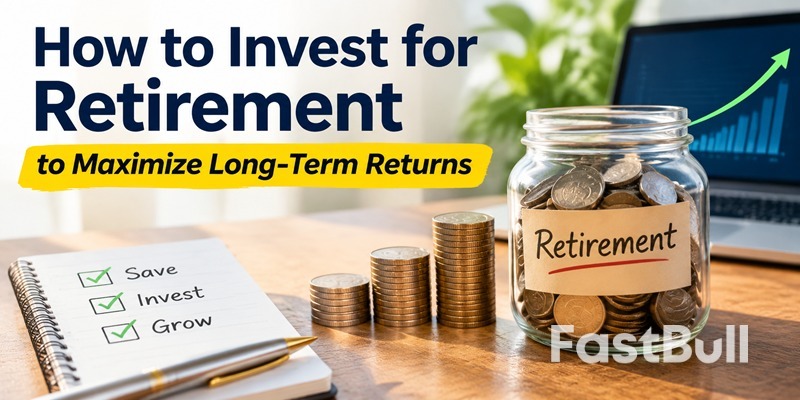
Retirement investing is not about finding the asset with the highest possible return. It is about choosing investments that can grow over time without taking more risk than you can afford. For most U.S. savers, the process starts with a savings goal, a suitable retirement account, and a diversified portfolio.
Estimate how much income you may need in retirement and how much could come from Social Security, a pension, or other sources. The gap gives you a starting savings target. Consider your expected retirement age, current savings, monthly contribution capacity, inflation, and likely healthcare costs. You do not need a perfect forecast: start with a realistic amount you can invest regularly, then increase it as your income grows.
A retirement account affects how your savings are taxed; it is not an investment itself. A traditional 401(k) generally uses pre-tax contributions, with taxes due on withdrawals. A Roth 401(k), if offered, uses after-tax contributions, and qualified withdrawals are generally tax-free. If your employer matches contributions, check the formula and consider contributing enough to receive the full match. Review the plan’s fees, investment options, and vesting rules. The IRS explains the basics of 401(k) plans.
An IRA can supplement a workplace plan or provide an option if you do not have one. Traditional IRA contributions may be deductible, depending on your income and workplace-plan coverage, while withdrawals are generally taxable. Roth IRA contributions are made with after-tax money, and qualified withdrawals are tax-free. Income eligibility, contribution limits, and deduction rules apply, so compare the tax treatment and check the IRS guidance on Traditional and Roth IRAs before contributing.
Stocks offer long-term growth potential but can be volatile, and relying on a few individual companies creates concentration risk. Broad stock index funds spread your investment across many companies and aim to track a market index. An index fund can be either a mutual fund or an ETF; ETFs trade throughout the day, while mutual funds are generally priced once daily. Focus on the fund’s holdings, diversification, and fees—not just its label. A narrowly focused ETF may still carry substantial risk.
Bonds are loans to governments or companies that typically pay interest and return principal at maturity. They can provide income and help balance stock-market volatility, but they are not risk-free. Bond prices can fall when interest rates rise, and issuers may fail to make payments. Individual bonds have maturity dates; bond funds hold collections of bonds and do not usually promise to return a fixed amount on a specific date. Check a fund’s duration, credit quality, and fees.
A target-date fund holds a mix of investments, usually stocks and bonds, and adjusts that mix as its target retirement year approaches. It can be a convenient option if you want one fund to handle diversification and rebalancing. However, funds with the same target year can have different risk levels and fees. Compare the stock allocation, expense ratio, underlying holdings, and how the fund manages investments after retirement.
Asset allocation is the balance of stocks, bonds, and cash in your portfolio. The right mix depends on your time until retirement and your ability to tolerate losses. A longer horizon may allow more exposure to stocks for growth; someone nearing retirement may need more bonds and cash to reduce the risk of selling stocks during a downturn. There is no single allocation that works for everyone.
Diversification means spreading investments across companies, sectors, regions, and asset types. It can reduce the impact of a poor-performing holding, but it cannot prevent losses in a broad market decline. Also check for overlap: owning several funds does not necessarily make a portfolio diversified if they hold many of the same companies.
Compounding occurs when investment returns stay invested and can generate returns of their own. Regular contributions give each deposit more time to grow, while reinvesting dividends and fund distributions keeps more money in the portfolio. Returns are never guaranteed, but starting early and contributing consistently gives compounding more time to work.
Fees also affect long-term results because they reduce returns year after year. Compare fund expense ratios, workplace-plan administrative charges, and advisory fees. When two investments offer similar exposure, the lower-cost option may leave more money in your account. Avoid switching funds based only on recent performance; a diversified, affordable strategy that you can stick with is more useful than constantly chasing last year’s winner. For more on portfolio mix and risk, see Investor.gov’s guide to asset allocation and diversification.
Your investment strategy should change as you get closer to retirement. Younger investors generally have more time to recover from market downturns, while those approaching retirement need to pay closer attention to protecting the savings they have already built.
In your 20s and 30s, time is your biggest advantage. You can generally afford to hold a larger share of stocks and stock index funds because you have decades to ride out market fluctuations. Start with regular contributions to a 401(k) or IRA, take advantage of employer matching, and increase your contributions as your income grows. Even modest investments can become substantial over several decades through compounding.
During your 40s and 50s, retirement becomes a more immediate financial goal. Review whether your current savings are on track and increase contributions if there is a shortfall. You may also want to gradually add bonds to reduce portfolio volatility while maintaining enough stock exposure for growth. If you have access to catch-up contributions through an eligible retirement plan, these can help you save more as retirement approaches.
At 60 and beyond, focus on balancing growth with access to cash. Keeping some investments in stocks can help your savings keep pace with inflation, while bonds and cash reserves can cover near-term expenses. Avoid moving your entire portfolio into cash simply because retirement is approaching. The goal is to reduce the risk of selling long-term investments during a market downturn without sacrificing all future growth potential.
Once you retire, your portfolio needs to support regular withdrawals rather than just accumulate wealth. One common approach is the 4% rule, which suggests withdrawing about 4% of your portfolio in the first year of retirement and adjusting that amount for inflation in later years. However, it is only a starting guideline, not a guaranteed safe withdrawal rate. Your retirement length, investment mix, market performance, taxes, and spending needs all affect how much you can withdraw sustainably.
You can also combine different income sources, such as Social Security, bond interest, dividends, and planned withdrawals from investment accounts. Rather than relying entirely on high-dividend stocks or high-yield investments, consider your portfolio's total return and how much cash you actually need each year.
The amount depends on your withdrawal rate and how long you need the money to last. Using a 4% initial withdrawal rate as a simple illustration:
| Monthly Income | Annual Income | Estimated Portfolio |
|---|---|---|
| $1,000 | $12,000 | $300,000 |
| $3,000 | $36,000 | $900,000 |
These figures are estimates before taxes and do not guarantee that your savings will last throughout retirement. If you expect to retire for 30 years or longer, have substantial healthcare expenses, or face poor market returns early in retirement, a lower withdrawal rate may be more appropriate.
There is no single official $1,000-a-month retirement rule. A common way to estimate the required savings is to divide your desired annual income by your planned withdrawal rate. For example, generating $1,000 per month requires approximately $300,000 at a 4% initial withdrawal rate, assuming the portfolio can support that strategy over time.
The 7% figure is sometimes used as an assumed annual investment return when estimating how retirement savings might grow. It is not a guaranteed return or a universally accepted retirement withdrawal rule. Actual returns vary from year to year, and inflation, fees, and taxes can reduce your real investment gains.
If you invest $20,000 in a 401(k) and make no additional contributions, its future value depends on the annual return. Assuming returns compound annually:
These are hypothetical estimates before fees, taxes, and inflation. Actual 401(k) returns depend on the investments you choose and market performance.

728 RM B 7/F GEE LOK IND BLDG NO 34 HUNG TO RD KWUN TONG KLN HONG KONG


The risk of loss in trading financial instruments such as stocks, FX, commodities, futures, bonds, ETFs and crypto can be substantial. You may sustain a total loss of the funds that you deposit with your broker. Therefore, you should carefully consider whether such trading is suitable for you in light of your circumstances and financial resources.
No decision to invest should be made without thoroughly conducting due diligence by yourself or consulting with your financial advisors. Our web content might not suit you since we don't know your financial conditions and investment needs. Our financial information might have latency or contain inaccuracy, so you should be fully responsible for any of your trading and investment decisions. The company will not be responsible for your capital loss.
Without getting permission from the website, you are not allowed to copy the website's graphics, texts, or trademarks. Intellectual property rights in the content or data incorporated into this website belong to its providers and exchange merchants.
Not Logged In
Log in to access more features


Log In
Sign Up