


- EURUSD
- XAUUSD
- XAGUSD
- WTI
- USDX


Markets
Analysis
User
24/7
Economic Calendar
Education
Data
- Names
- Latest
- Prev















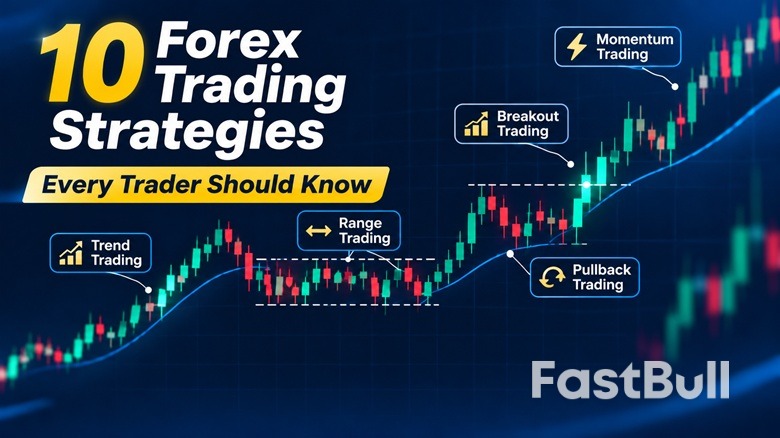
Learn 10 forex trading strategies, including trend trading, scalping, swing trading, breakout trading, and news trading, with practical tips for choosing and testing each approach.
Forex trading strategies help traders identify opportunities, plan entries and exits, and manage risk in the currency market. From trend following to news trading, each approach works differently depending on market conditions, trading goals, and time commitment. Understanding these differences can help you choose an approach you can apply consistently.
A forex trading strategy is a set of rules for deciding when to trade a currency pair, how to manage an open position, and when to exit. It may rely on technical indicators, price patterns, economic data, or interest rate differences between currencies.
A strategy is different from a trading style. A style describes how often a trader places trades and how long positions are held. Scalping and swing trading, for example, are commonly described as styles because they focus on trade duration and frequency. A strategy defines the specific conditions for entering and exiting. In practice, traders often combine a style with one or more strategies.
No single approach works in every market. Some strategies are designed for clear trends, others for sideways price action, and some respond to economic events or interest rate differences. The following methods offer different ways to analyze and trade the forex market.
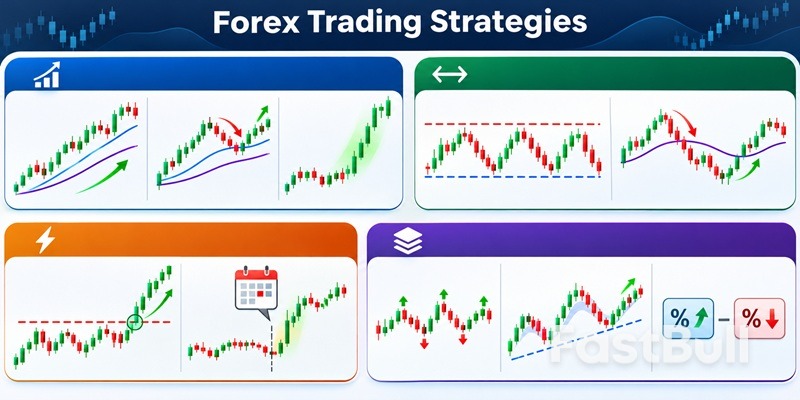
Trend trading involves opening positions in the direction of an established market move. Traders look for a sequence of higher highs and higher lows in an uptrend, or lower highs and lower lows in a downtrend, rather than trying to predict the exact turning point.
Moving averages, trendlines, and the Average Directional Index (ADX) can help assess trend direction and strength. The approach is most useful when a currency pair is moving consistently in one direction. It can generate false signals in choppy markets, and entering after a trend has already moved far may leave limited room for further gains.
Range trading focuses on currency pairs that repeatedly move between support and resistance. Traders may look for buying opportunities near the lower boundary and selling opportunities near the upper boundary, while setting exits before the opposite side of the range.
Support and resistance levels help define the range, while indicators such as the Relative Strength Index (RSI) or Stochastic Oscillator can provide additional context. This strategy is generally better suited to sideways markets. Its main risk is a breakout: once price moves decisively beyond the range, the old boundaries may no longer hold.
Breakout trading aims to capture a move when price pushes beyond an established support or resistance level. A breakout may signal that market sentiment has shifted or that a new trend is beginning.
Traders often monitor horizontal levels, chart patterns, trendlines, and momentum. Some enter as price breaks the level; others wait for a retest, when price returns to the broken level before potentially continuing in the same direction. The key risk is a false breakout, in which price briefly moves beyond a level and then reverses. Confirmation and a predefined exit plan can help manage that risk.
A pullback strategy looks for a temporary move against an established trend. Rather than chasing a sharp price move, traders wait for a retracement and then look for signs that the original trend may resume.
For example, during an uptrend, a currency pair may fall toward a previous support area or moving average before buyers return. Fibonacci retracement levels, trendlines, moving averages, and candlestick patterns can help identify potential entry areas. A pullback can also develop into a full reversal, so traders should look for confirmation instead of assuming the trend will continue.
Scalping is a short-term trading style that seeks to capture small price movements through frequent trades. Positions may be held for seconds or minutes, so scalpers need clear entry and exit rules and the ability to monitor the market closely.
Scalpers often focus on liquid currency pairs, where spreads may be narrower, and use short-term price action, moving averages, or support and resistance levels to identify setups. Because profit targets are small, spreads, commissions, and slippage can materially affect results. Frequent trading also increases transaction costs and can make emotional discipline harder.
Swing trading aims to capture price movements that develop over several days or weeks. Instead of reacting to every short-term fluctuation, traders look for opportunities to enter near potential turning points and hold positions while a larger move develops.
Support and resistance, moving averages, Fibonacci retracements, and chart patterns are commonly used to identify setups. Swing trading usually requires less screen time than scalping, but positions remain exposed to overnight price changes, economic announcements, and possible swap charges. These costs and risks should be considered before holding a trade for several days.
Mean reversion is based on the idea that price may move back toward an average after becoming unusually extended. Traders look for situations where a currency pair has moved far from its recent range or reference level and may be due for a correction.
Bollinger Bands, moving averages, and RSI can help identify stretched conditions. However, an overbought or oversold reading does not guarantee a reversal. Mean reversion is generally more suited to range-bound markets and can struggle when a strong trend keeps pushing price in one direction.
Momentum trading focuses on currency pairs showing strong directional movement. Traders aim to participate while buying or selling pressure remains strong, rather than trying to pick a market top or bottom.
Indicators such as the Moving Average Convergence Divergence (MACD), RSI, and Rate of Change (ROC) can help assess momentum. The strategy may suit markets with sustained moves, but momentum can fade quickly, especially after a major announcement. Traders need exit rules for when the move loses strength or reverses.
News trading involves taking positions around economic releases and central bank decisions that can affect currency prices. Events such as inflation reports, employment data including U.S. Nonfarm Payrolls (NFP), and interest rate announcements can trigger sharp moves.
Traders use an economic calendar to track release times and compare actual results with market expectations. Some trade immediately after a release; others wait for the initial volatility to settle. The risks include sudden reversals, wider spreads, and slippage. A stop-loss order may not always execute at the expected price during fast-moving conditions.
Carry trading seeks to benefit from the interest rate difference between two currencies. A trader typically buys a currency with a relatively higher interest rate and sells one with a lower rate, aiming to receive a positive rollover or swap payment while holding the position.
The potential return depends on the rate differential, the broker's rollover terms, and how exchange rates move. A favorable interest differential does not guarantee a profitable trade: an adverse currency move can outweigh the interest earned. Carry trades can also become vulnerable when market sentiment changes and investors move away from higher-yielding currencies.
The right approach depends on your available time, experience, risk tolerance, and the conditions in the market. Consider these factors before settling on a strategy:
Do not choose a strategy simply because it is popular or appears profitable in an example. Focus on whether you understand its rules and can follow them consistently.
Before risking real money, turn the strategy into a clear set of rules and test how it behaves. A basic process includes:
Strong historical results do not guarantee future performance. Test across different market conditions and avoid repeatedly adjusting rules just to fit past data.
Even a well-tested strategy can have losing trades. Risk management helps limit the effect of unfavorable moves and protects trading capital.
Consistency comes from following a repeatable process and managing downside risk, not from trying to win every trade.
Trend trading and basic range trading are common starting points because their core ideas are relatively straightforward. Beginners can practice identifying trends, support, and resistance on a demo account before trading with real money.
There is no universally most profitable forex strategy. Results depend on market conditions, execution, trading costs, risk management, and whether a trader can follow the rules consistently. A strategy that works in one environment may perform poorly in another.
No strategy guarantees consistent profits. A clearly defined approach, tested over different market conditions and paired with disciplined risk management, can support more consistent decision-making, but losses remain possible.
Trend, breakout, and momentum approaches are commonly applied to XAU/USD because gold can make strong directional moves. However, gold is influenced by factors such as interest rate expectations, the U.S. dollar, and geopolitical developments. Traders should assess current conditions rather than assume one strategy will always work.
No. A strategy designed for a trending market may struggle when prices move sideways, while a range-based approach can fail after a strong breakout. Traders need to understand the conditions their strategy is designed for and recognize when those conditions have changed.
Choosing a forex trading strategy is only the starting point. Test its rules, understand its limitations, and manage risk carefully before applying it with real capital.

728 RM B 7/F GEE LOK IND BLDG NO 34 HUNG TO RD KWUN TONG KLN HONG KONG





The risk of loss in trading financial instruments such as stocks, FX, commodities, futures, bonds, ETFs and crypto can be substantial. You may sustain a total loss of the funds that you deposit with your broker. Therefore, you should carefully consider whether such trading is suitable for you in light of your circumstances and financial resources.
No decision to invest should be made without thoroughly conducting due diligence by yourself or consulting with your financial advisors. Our web content might not suit you since we don't know your financial conditions and investment needs. Our financial information might have latency or contain inaccuracy, so you should be fully responsible for any of your trading and investment decisions. The company will not be responsible for your capital loss.
Without getting permission from the website, you are not allowed to copy the website's graphics, texts, or trademarks. Intellectual property rights in the content or data incorporated into this website belong to its providers and exchange merchants.
Not Logged In
Log in to access more features


Log In
Sign Up