


- EURUSD
- XAUUSD
- XAGUSD
- WTI
- USDX


















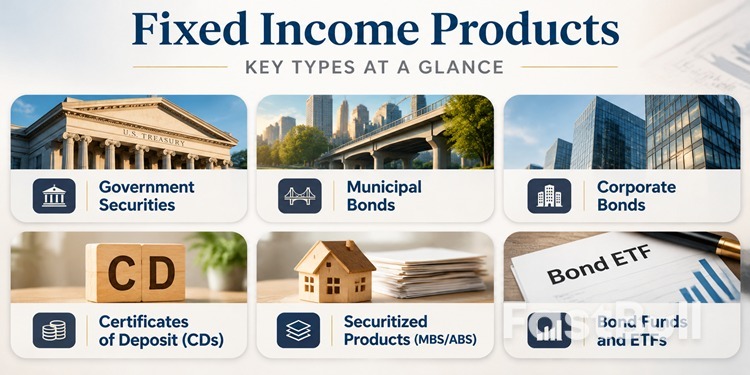
Fixed income products are investments that generate income through interest, coupon payments, or other contractual cash flows. Common examples include government and corporate bonds, municipal bonds, certificates of deposit (CDs), and bond funds. Their maturities, payment structures, risks, and tax treatment vary.
What Are Fixed Income Products and How Do They Work?
Fixed income products are financial instruments that provide income under stated terms. Many work by allowing investors to lend money to a government, company, or financial institution in exchange for interest and, in most cases, repayment of principal at maturity.
For example, a company may issue a bond to raise capital and agree to pay investors interest on set dates. At maturity, it is expected to repay the bond's face value. Other products work differently: Treasury bills are generally bought at a discount, while some loans and bonds pay interest that changes with a benchmark rate.
The term "fixed income" does not mean every payment or investment value is guaranteed. Rates may float, issuers can default, and a security sold before maturity may be worth less than its purchase price.
How Do Fixed Income Products Generate Income?
Returns depend on the product's structure. Common sources include:
- Coupon payments: Bonds often pay interest at regular intervals, commonly twice a year. A $1,000 bond with a 5% annual coupon pays $50 per year.
- Interest payments: CDs and many loans pay interest according to their terms. The rate may be fixed or variable.
- Discount-to-par returns: Treasury bills are generally sold at a discount or at face value. At maturity, investors receive the face value; any discount represents the return.
- Floating-rate payments: Some bonds and loans reset their interest rates against a benchmark, so payments can rise or fall.
- Fund distributions: Bond funds receive income from their holdings and may distribute it to shareholders. Distribution amounts can change.
What Happens When a Fixed Income Product Matures?
For an individual bond or deposit with a maturity date, the issuer or bank is expected to repay the principal when the term ends, subject to its ability to meet its obligations and the product's terms. Interest payments generally stop at maturity.
A bond mutual fund or ETF is different. It holds a portfolio of securities and generally has no set maturity date. Investors sell fund shares at the prevailing market price rather than receiving a promised principal repayment on a specific date.
What Are the Main Types of Fixed Income Products?
Fixed income products range from short-term government securities to corporate debt and pooled investment funds. The main differences are who issues them, how they generate income, when they mature, and what risks investors take.
U.S. Treasury Securities
U.S. Treasury securities are debt instruments issued by the federal government. Common types include:
- Treasury Bills (T-Bills): Short-term securities with maturities of 4 to 52 weeks. They are generally sold at a discount and pay face value at maturity.
- Treasury Notes (T-Notes): Securities with maturities of 2, 3, 5, 7, or 10 years that pay interest every six months.
- Treasury Bonds (T-Bonds): Long-term securities with 20- or 30-year maturities that generally pay interest twice a year.
- Treasury Inflation-Protected Securities (TIPS): Securities whose principal adjusts with changes in the Consumer Price Index for All Urban Consumers (CPI-U). Interest is calculated on the adjusted principal, so payment amounts can change.
Treasury securities are backed by the full faith and credit of the U.S. government. Their interest is generally subject to federal income tax but exempt from state and local income taxes. See TreasuryDirect's overview of marketable securities for product details.
Municipal Bonds
Municipal bonds are issued by states, cities, counties, and public authorities to finance projects such as schools, roads, hospitals, and utilities. Two common types are:
- General Obligation Bonds: Supported by the issuer's taxing power or general revenues.
- Revenue Bonds: Repaid primarily from revenue generated by a specific project or service, such as a toll road or water system.
Interest on many municipal bonds is exempt from federal income tax, and it may also be exempt from state and local taxes for residents of the issuing state. Tax treatment varies: some municipal bond interest is taxable or may affect the alternative minimum tax (AMT). Check the bond's official documents and your tax situation. The IRS guidance on investment income explains the general rules.
Corporate Bonds
Companies issue corporate bonds to finance expansion, acquisitions, refinancing, and operations. Investors receive interest under the bond terms, and the company is expected to repay principal at maturity.
- Investment-Grade Bonds: Have higher credit ratings and generally lower perceived default risk, so they often offer lower yields.
- High-Yield Bonds: Have lower credit ratings and greater default risk. They generally offer higher yields to compensate investors for taking that risk.
A higher yield is not automatically a better deal. It may reflect a greater chance that the issuer will miss interest payments or fail to repay principal.
Certificates of Deposit (CDs)
Certificates of deposit are bank deposits that pay interest in exchange for keeping money deposited for an agreed term. Early withdrawal from a traditional CD may trigger a penalty.
- Traditional CDs: Purchased directly from a bank, usually with a stated interest rate and maturity date.
- Brokered CDs: Issued by banks but purchased through brokerage firms. They may be sold in a secondary market before maturity, and the sale price can be above or below the amount invested.
CDs at FDIC-insured banks are generally covered up to $250,000 per depositor, per insured bank, per ownership category, subject to FDIC rules. Coverage is aggregated with other deposits in the same category at that bank. Brokered CD investors should check the issuing bank and available coverage. The FDIC deposit insurance overview explains the limits and eligible deposits.
Agency Bonds and Securitized Products
Agency bonds are issued by federal agencies or government-sponsored enterprises (GSEs). Their backing varies by issuer, and not all carry the full faith and credit guarantee of the U.S. government.
Securitized products are created by pooling loans or other financial assets and issuing securities backed by the cash flows from those assets. Examples include:
- Mortgage-Backed Securities (MBS): Backed by pools of residential or commercial mortgages. Investor payments come from mortgage principal and interest.
- Asset-Backed Securities (ABS): Backed by assets such as auto loans, credit card receivables, or student loans.
Cash flows can be affected by borrower defaults, early repayments, and changes in interest rates.
Bond Mutual Funds and ETFs
Bond mutual funds and exchange-traded funds pool investors' money to buy portfolios of government, corporate, municipal, or other debt securities. They can provide diversification and access to bonds without requiring investors to select each security themselves.
Bond ETFs trade on exchanges during market hours. Mutual funds generally transact once each business day at their net asset value (NAV). Both can fluctuate in value, charge fees, and make distributions that vary. Unlike an individual bond held to maturity, a typical bond fund does not promise to return a fixed principal amount on a specific date.
Other Fixed Income Instruments
Institutional fixed income markets also include instruments such as:
- Commercial Paper: Short-term, generally unsecured corporate debt used to fund operating expenses and other near-term needs.
- Bank Loans: Loans to businesses. Many institutional loan investments have floating rates, so interest payments can change as benchmark rates move.
Fixed Income Products: Examples and Key Differences
The table below compares common products by how they generate income and what distinguishes them.
| Product | Income Source | Key Characteristic |
|---|---|---|
| Treasury Bills | Discount to face value | Short-term U.S. government debt |
| Treasury Bonds | Coupon payments | Long-term U.S. government debt |
| Municipal Bonds | Interest payments | Potential tax advantages |
| Corporate Bonds | Coupon payments | Credit risk varies by issuer |
| CDs | Interest payments | Bank deposit with a stated term |
| Bond ETFs | Portfolio income and distributions | Diversified bond exposure |
Consider a corporate bond with a $1,000 face value and a 5% annual coupon. It pays $50 in interest each year, often in two $25 installments. If the investor buys it for $950, the current yield is about 5.26% ($50 ÷ $950).
The coupon rate, current yield, and yield to maturity (YTM) measure different things:
- Coupon Rate: Annual coupon interest divided by the bond's face value.
- Current Yield: Annual coupon interest divided by the bond's current market price.
- Yield to Maturity: The estimated annualized return if the bond is held until maturity, taking into account coupon payments and the difference between its purchase price and the amount repaid at maturity, assuming the issuer makes the required payments.
What Risks Should Investors Understand?
Fixed income products can offer more predictable cash flows than some investments, but they are not risk-free. The main risks depend on the issuer, maturity, structure, and market conditions.
Interest Rate Risk
Market interest rates and the prices of existing fixed-rate bonds generally move in opposite directions. When rates rise, older bonds with lower coupons become less attractive and their market prices tend to fall. Longer-maturity bonds are usually more sensitive to rate changes.
Credit and Default Risk
Credit risk is the possibility that an issuer will fail to make interest payments or repay principal. Lower-rated corporate bonds generally carry greater default risk than investment-grade bonds. Credit ratings help assess risk, but they are opinions, not guarantees.
Inflation, Liquidity and Reinvestment Risks
Inflation reduces the purchasing power of fixed payments. Liquidity risk arises when a security is difficult to sell without accepting a lower price. Reinvestment risk occurs when coupon or principal payments must be reinvested at lower rates. Callable bonds and mortgage-backed securities can also expose investors to early repayment, which may force them to reinvest sooner than expected.
How Do You Choose the Right Fixed Income Product?
The right product depends on when you need the money, how much risk you can accept, and whether you prioritize income, liquidity, or tax treatment.
Match the Product to Your Investment Timeline
Investors who need their money soon may compare Treasury bills or short-term CDs. Those seeking longer-term income may consider Treasury notes, corporate bonds, or municipal bonds. Bond funds can provide ongoing exposure without requiring investors to choose individual maturity dates.
Compare Yields, Credit Quality and Tax Treatment
Do not compare products by headline yield alone. Consider credit quality, maturity, fees, liquidity, and after-tax income. For municipal bonds, tax-equivalent yield can help compare tax-exempt income with taxable alternatives, but the result depends on the investor's tax bracket and state tax rules.
Individual Bonds vs. Fixed Income Funds
Individual bonds have stated payment terms and maturity dates. If the issuer meets its obligations and the investor holds the bond to maturity, principal is generally repaid at face value. Bond funds offer diversification and easier access to a portfolio, but their share prices fluctuate and they generally do not have a maturity date or promise to return the original investment.
FAQs About Fixed Income Products
Are Bonds Considered Fixed Income Products?
Yes. Government, municipal, and corporate bonds are common fixed income products. They generally pay interest under stated terms and are designed to repay principal at maturity, subject to the issuer's ability to pay.
Are Loans Fixed Income?
Loans can be part of the fixed income market when investors hold debt claims that generate contractual interest and principal payments. Some loans have floating rates, so their payments change with benchmark rates.
What Are Fixed Income Products in Investment Banking?
In investment banking, fixed income products generally include debt securities and related instruments that institutions issue, structure, trade, or distribute. Examples include government and corporate bonds, municipal debt, mortgage-backed securities, and other structured credit products.
What Is a Fixed Income Fund?
A fixed income fund is a mutual fund or ETF that invests primarily in debt securities, such as government bonds, corporate bonds, or municipal bonds. It provides exposure to a portfolio of fixed income investments, but its market value and distributions can change.