- XAUUSD
- XAGUSD
- WTI
- USDX


Markets
Analysis
User
24/7
Economic Calendar
Education
Data
- Names
- Latest
- Prev



















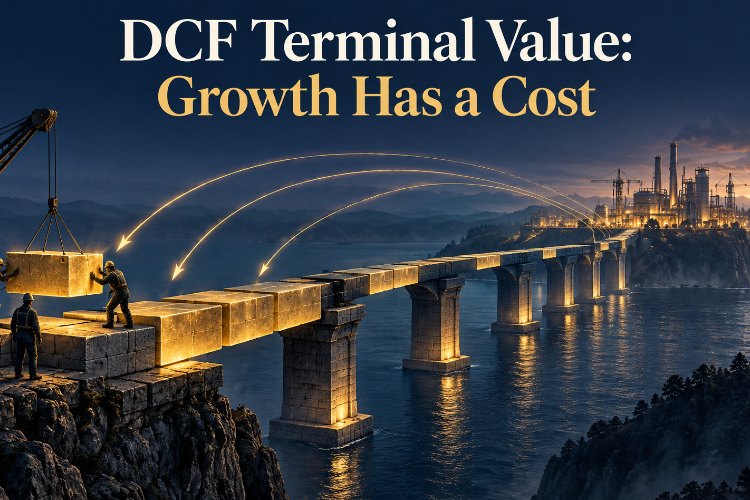
Raising perpetual growth from 3% to 4% need not lift terminal value as much as a spreadsheet suggests. Rebuild reinvestment, next-year cash flow and discounting before trusting a DCF valuation.
A DCF model can produce a higher valuation without a single improvement in the business: increase the perpetual growth assumption, leave free cash flow untouched, and the terminal value rises. The arithmetic works. The business assumptions may not.
Growth usually requires capital that cannot simultaneously be distributed to investors. A credible terminal value therefore links three things: the growth rate, the return on new investment and the cash retained to finance it. The key question is not merely whether growth is below the discount rate, but whether the model pays for the growth it promises.
Consider a hypothetical mature, nonfinancial business, with all money amounts in millions of one currency. We value nominal, year-end free cash flow to the firm, or FCFF, using a weighted average cost of capital, WACC. Equity cash flow requires the cost of equity instead; mixing the two produces an inconsistent valuation.
With five explicit forecast years, terminal value at the end of year 5 is FCFF in year 6 ÷ (WACC − g), where g is the subsequent perpetual growth rate. That figure is not today's value. Discount it by (1 + WACC) to the fifth power, then add the present values of years 1–5. Year 6 is already in the terminal calculation and must not be added separately.
The model requires g below WACC for the growing perpetuity to converge. That is necessary, not sufficient: a finite concession or an exhaustible asset does not become perpetual because the denominator is positive.
Suppose year-6 net operating profit after tax, NOPAT, is 100. The business can earn 10% on incremental invested capital, while long-run operating growth is 3%. Under a steady-state assumption, reinvestment absorbs 3% ÷ 10% = 30% of NOPAT. Cash retained is 30 and FCFF is 70. At an 8% WACC, terminal value is 70 ÷ (8% − 3%) = 1,400.
Here reinvestment includes net capital expenditure—capital spending less depreciation—and the increase in noncash operating working capital. A factory expansion or a larger inventory balance uses money even if the income statement looks strong. Treating depreciation as a permanent substitute for all new investment can overstate distributable cash.
The 10% is an assumption about returns on new capital in the stable phase, not an instruction to copy the company's historical average ROIC. Legacy assets, acquisition accounting and temporarily high margins can make that average a poor guide to the next unit invested.
Raise growth to 4%, retaining the 10% investment return. Reinvestment now takes 40% of profit, so FCFF falls to 60. Terminal value becomes 60 ÷ 4% = 1,500, not the 1,750 obtained by keeping cash flow at 70. The latter combination implicitly asks for more growth without its funding cost.
| Return on new capital | Growth | Reinvestment share | FCFF in year 6 | Terminal value |
|---|---|---|---|---|
| 10% | 3% | 30% | 70 | 1,400 |
| 10% | 4% | 40% | 60 | 1,500 |
| 8% | 3% | 37.5% | 62.5 | 1,250 |
| 8% | 4% | 50% | 50 | 1,250 |
All four scenarios deliberately hold next-year NOPAT at 100 and WACC at 8% to isolate this trade-off. When investment return merely matches the capital cost, more growth produces no additional value in this comparison. Below the cost of capital, expansion can destroy value: at a 6% return, moving growth from 3% to 4% reduces terminal value from 1,000 to about 833.33.
If the real spreadsheet holds year-5 profit fixed instead, changing growth also changes year-6 profit. Rebuild that numerator as well. The lesson is consistency, not that every company's valuation must follow the same numerical sensitivity.
Assume, separately, that FCFF in each of years 1–5 is 50, before the business reaches the stable case above. At 8%, those five cash flows have a combined present value of 199.64. The terminal value contributes 1,400 ÷ 1.08⁵ = 952.82, giving operating value of 1,152.45 before rounding components.
About 82.68% comes from the terminal component. There is no universal percentage that makes the model valid or invalid. The useful question is whether the margin, investment needs and competitive position assumed after year 5 are better supported than the precision of the headline valuation suggests.
This is operating value, not ordinary-equity value per share. The enterprise-value-to-equity bridge still has to account for eligible cash, debt and other claims. Dividing 1,152.45 directly by shares would skip that reconciliation.
Holding year-6 FCFF at 70 and growth at 3%, lifting WACC from 8% to 9% cuts terminal value to 1,166.67, a 16.67% decline. The whole DCF does not necessarily fall by that percentage: the terminal amount and every explicit cash flow also have to be discounted at the revised rate.
A growth sensitivity should recalculate reinvestment, not merely change the denominator. A margin sensitivity should explain capacity, pricing and competition. An exit-multiple cross-check should reconcile its implied growth and returns; switching to a multiple does not make the long-run assumptions disappear.
Keep currency and inflation treatment aligned. Nominal cash flows need a nominal discount rate in the same currency. A short-lived efficiency gain cannot finance rising profits forever. If the terminal year suddenly has peak margins and unusually low investment, extend the transition rather than forcing a clean-looking steady state.
First identify whose cash is being valued and the exact terminal date. Next normalize operating profit, capital spending and working capital from the underlying accounts. Write down how new investment earns the assumed return and what would erode it. Then derive reinvestment, cash flow and terminal value together; verify that next year's cash flow appears only once.
Finally, recompute present values and the equity bridge, and compare a defensible range of growth and return assumptions. If the investment case survives only when growth rises while reinvestment stays flat, it is the operating case—not the spreadsheet formatting—that needs repair. A useful DCF exposes that dependency instead of disguising it behind a precise target price.

728 RM B 7/F GEE LOK IND BLDG NO 34 HUNG TO RD KWUN TONG KLN HONG KONG





The risk of loss in trading financial instruments such as stocks, FX, commodities, futures, bonds, ETFs and crypto can be substantial. You may sustain a total loss of the funds that you deposit with your broker. Therefore, you should carefully consider whether such trading is suitable for you in light of your circumstances and financial resources.
No decision to invest should be made without thoroughly conducting due diligence by yourself or consulting with your financial advisors. Our web content might not suit you since we don't know your financial conditions and investment needs. Our financial information might have latency or contain inaccuracy, so you should be fully responsible for any of your trading and investment decisions. The company will not be responsible for your capital loss.
Without getting permission from the website, you are not allowed to copy the website's graphics, texts, or trademarks. Intellectual property rights in the content or data incorporated into this website belong to its providers and exchange merchants.
Not Logged In
Log in to access more features


Log In
Sign Up