


- XAUUSD
- XAGUSD
- WTI
- USDX



Markets
Analysis
User
24/7
Economic Calendar
Education
Data
- Names
- Latest
- Prev








 Economic Calendar

Explore David Schwartz's views on XRP deflation, how fixed supply and transaction-fee burns affect token supply, and what the mechanics mean for XRP holders.
The phrase “David Schwartz XRP deflation” refers to a feature of the XRP Ledger: transaction fees are permanently removed from the supply. David Schwartz, one of the ledger’s original architects and Ripple’s CTO emeritus, has explained why this mechanism exists and what it does—and does not—mean for XRP holders.
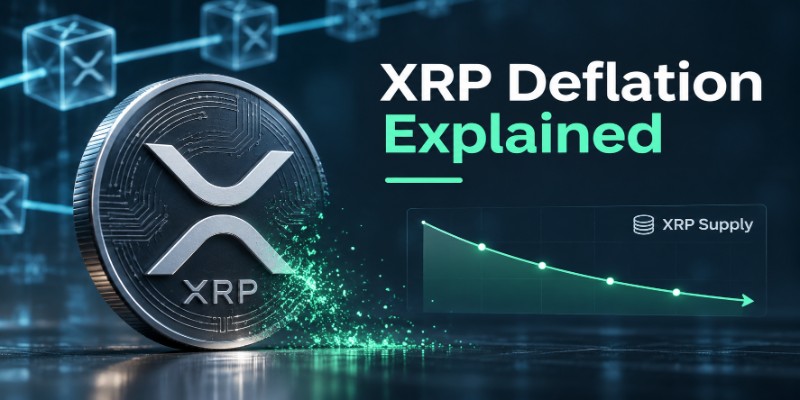
Table of Contents
David Schwartz has played a central role in explaining the XRP Ledger’s technical and economic design. His comments on deflation matter because XRP has a different supply model from cryptocurrencies that rely on mining or ongoing token issuance.
Schwartz has emphasized that the XRP Ledger is not designed to collect transaction fees as revenue for a company or a group of validators. Instead, the XRP used to pay transaction costs is destroyed by the protocol. This gradually reduces the total supply while making spam and denial-of-service attacks more expensive.
In a November 14, 2025, discussion on X, Schwartz responded to questions about whether XRP holders receive financial benefits from activity on the ledger. He explained that transaction fees and account reserves serve primarily as anti-spam measures rather than mechanisms for generating passive income. His point was that using the ledger does not give XRP holders an automatic claim on the network’s activity or on Ripple’s business.
That distinction is important. Holding XRP does not automatically produce interest, dividends or a share of transaction revenue. The ledger’s utility and the investment return earned by an XRP holder are separate questions. Schwartz’s comments therefore challenge the assumption that network activity must translate directly into passive income for token holders.
The XRP Ledger uses a transaction-fee burning mechanism. Unlike networks where transaction fees are distributed to miners or validators, the XRP Ledger permanently destroys the XRP specified as the transaction cost. No company or network participant receives that amount as revenue.
The minimum transaction cost for a standard transaction is generally 10 drops, equal to 0.00001 XRP. The fee can rise when network activity is unusually high. The amount destroyed is specified in each transaction, and the ledger’s rules apply the fee when the transaction is included in a validated ledger.
The mechanism has two connected purposes:
This is not the same as a conventional blockchain fee market in which validators earn fees. On the XRP Ledger, transaction costs are not paid to validators or Ripple; the XRP is irrevocably destroyed. The protocol therefore treats the fee as a network-protection measure rather than a source of income.
It is also useful to distinguish transaction fees from account reserves. Schwartz has mentioned both as anti-spam measures, but they work differently. A transaction fee is burned. An account reserve is a minimum XRP balance required to keep an account or certain ledger objects open; it is not the same as a fee and should not be counted as permanently destroyed supply.
In October 2026, Schwartz defended the network’s low-fee model during a discussion about whether fees should be increased to accelerate XRP burns. He argued that fee revenue is a poor way to judge a blockchain because it measures costs imposed on users, not just value created by the network. The debate reinforces the idea that maximizing the burn rate is not the XRP Ledger’s primary design goal. His October 2026 comments provide further context.
The other important part of XRP deflation is its original supply structure. Unlike Bitcoin, which introduces new coins through mining rewards, XRP was created before the XRP Ledger began operating. Its original supply was 100 billion XRP, and the protocol does not create additional native XRP through mining or ordinary issuance.
This creates a distinction between the maximum original supply and the amount that remains after fees have been burned. The 100 billion figure describes the original supply cap, not a quantity that must remain permanently in circulation. As transaction fees are destroyed, the total amount of XRP in existence gradually declines.
Ripple’s escrow system should not be confused with new token issuance. XRP released from escrow already existed within the original supply. Moving those tokens from escrow into an available balance does not create additional XRP, although it can affect how much XRP is accessible to the market at a particular time.
Escrow releases and fee burns can therefore occur at the same time without contradicting each other. One process changes the availability of existing tokens; the other permanently reduces the total supply. Investors who focus only on monthly burns may miss the broader picture if they ignore escrow movements, exchange balances and other sources of market liquidity.
The official XRP overview explains the original supply structure and Ripple’s escrow arrangements.
Although XRP’s transaction-fee mechanism creates a deflationary effect, its impact on market price depends on the scale of token destruction relative to the total supply and the strength of demand.
The original supply of 100 billion XRP is large. Even when millions of tokens are permanently removed over time, the reduction represents a relatively small proportion of the original supply. Transaction burns alone are therefore unlikely to create significant short-term price pressure.
Several factors matter when assessing the possible price effect:
If demand remains steady while the available supply gradually declines, scarcity could theoretically support the price. But the effect is conditional, not automatic. A falling total supply does not guarantee appreciation if demand weakens, holders sell, or broader cryptocurrency markets come under pressure.
Network adoption is relevant to the long-term discussion because more ledger activity can result in more transactions and, in turn, more XRP being destroyed through fees. If the number of fee-paying transactions rises, cumulative burns may increase.
The relationship is not necessarily linear. Standard fees are low, can change with network load, and are designed to keep ordinary transactions inexpensive. A rise in transaction count does not automatically produce a proportionate increase in XRP burned, particularly if the average fee remains small.
This issue was central to the October 2026 debate over whether the XRP Ledger should increase its base transaction fee. Schwartz pushed back against the idea that a higher burn rate should be pursued simply to make the network look more valuable under fee-revenue comparisons. His argument focused on the cost to users: a fee collected by a network is also a fee paid by someone trying to use it.
The design choice is significant. The XRP Ledger prioritizes efficient and inexpensive transactions rather than maximizing the amount of XRP destroyed. That does not mean adoption is irrelevant to XRP demand, but it does mean that ledger growth and token burns should not be treated as interchangeable measures.
Adoption also does not automatically translate into equivalent demand to hold XRP. Applications on the ledger may use issued tokens or stablecoins, while XRP has its own roles in transaction fees, reserves and certain payment or liquidity functions. Investors need to look at what activity is taking place, not just the headline transaction count.
For investors evaluating Schwartz’s comments, monitoring actual supply and demand is more useful than focusing exclusively on token burns. Four indicators can help provide a more complete view.
1. Total XRP burned. Cumulative destroyed XRP shows the direct effect of the fee mechanism. Compare the amount burned with the original supply and the current total supply rather than treating every increase as a major market event.
2. Escrow releases. Ripple’s escrow schedule affects the availability of existing XRP. A release can increase the amount accessible to Ripple, but it does not mean all released tokens are immediately sold. Some may be returned to escrow.
3. XRP Ledger activity. Transaction counts, payment activity and the use of decentralized applications can help show whether network usage is expanding. However, transaction numbers alone do not establish equivalent economic demand for XRP. The type and purpose of transactions also matter.
4. Institutional and market demand. Regulatory developments, exchange-traded products, payment integrations and institutional participation can influence demand independently of the fee-burning mechanism. These factors may have a much larger short-term effect on price than gradual changes in total supply.
Combining these indicators provides a more balanced picture of XRP’s token economics. It also helps separate protocol-level deflation from market narratives that assume every increase in network activity must benefit holders in the same way.
XRP is deflationary in a specific, mechanical sense: its original supply is finite, no new XRP is created through mining, and transaction fees are permanently destroyed. The total supply therefore declines gradually as fees are burned.
That does not mean XRP holders receive a direct financial reward each time the network processes a transaction. Schwartz’s comments underline the difference between a public ledger’s utility and the economic rights attached to holding its native asset. XRP does not automatically pay interest or dividends, and the fee-burning mechanism is not a substitute for investment demand.
The long-term significance of XRP deflation depends on how supply reduction interacts with network adoption, liquidity, escrow movements and demand for the asset. Burns are a genuine feature of the protocol, but they should be viewed as one component of XRP’s economic model—not as an independent reason to expect higher prices.
For technical details, the official XRP Ledger transaction cost documentation explains how fees are calculated, adjusted and permanently destroyed.

728 RM B 7/F GEE LOK IND BLDG NO 34 HUNG TO RD KWUN TONG KLN HONG KONG


The risk of loss in trading financial instruments such as stocks, FX, commodities, futures, bonds, ETFs and crypto can be substantial. You may sustain a total loss of the funds that you deposit with your broker. Therefore, you should carefully consider whether such trading is suitable for you in light of your circumstances and financial resources.
No decision to invest should be made without thoroughly conducting due diligence by yourself or consulting with your financial advisors. Our web content might not suit you since we don't know your financial conditions and investment needs. Our financial information might have latency or contain inaccuracy, so you should be fully responsible for any of your trading and investment decisions. The company will not be responsible for your capital loss.
Without getting permission from the website, you are not allowed to copy the website's graphics, texts, or trademarks. Intellectual property rights in the content or data incorporated into this website belong to its providers and exchange merchants.
Not Logged In
Log in to access more features


Log In
Sign Up


