• Trade
  • Markets
  • Copy
  • Contests
  • News
  • 24/7
  • Calendar
  • Q&A
  • Chats
Trending
Screeners
SYMBOL
LAST
BID
ASK
HIGH
LOW
NET CHG.
%CHG.
SPREAD
SPX
S&P 500 Index
6857.13
6857.13
6857.13
6865.94
6827.13
+7.41
+ 0.11%
--
DJI
Dow Jones Industrial Average
47850.93
47850.93
47850.93
48049.72
47692.96
-31.96
-0.07%
--
IXIC
NASDAQ Composite Index
23505.13
23505.13
23505.13
23528.53
23372.33
+51.04
+ 0.22%
--
USDX
US Dollar Index
98.880
98.960
98.880
98.980
98.740
-0.100
-0.10%
--
EURUSD
Euro / US Dollar
1.16539
1.16546
1.16539
1.16715
1.16408
+0.00094
+ 0.08%
--
GBPUSD
Pound Sterling / US Dollar
1.33476
1.33486
1.33476
1.33622
1.33165
+0.00205
+ 0.15%
--
XAUUSD
Gold / US Dollar
4223.92
4224.33
4223.92
4230.62
4194.54
+16.75
+ 0.40%
--
WTI
Light Sweet Crude Oil
59.493
59.523
59.493
59.543
59.187
+0.110
+ 0.19%
--

Community Accounts

Signal Accounts
--
Profit Accounts
--
Loss Accounts
--
View More

Become a signal provider

Sell trading signals to earn additional income

View More

Guide to Copy Trading

Get started with ease and confidence

View More

Signal Accounts for Members

All Signal Accounts

Best Return
  • Best Return
  • Best P/L
  • Best MDD
Past 1W
  • Past 1W
  • Past 1M
  • Past 1Y

All Contests

  • All
  • Trump Updates
  • Recommend
  • Stocks
  • Cryptocurrencies
  • Central Banks
  • Featured News
Top News Only
Share

Stats Office - Mauritius Inflation Rate At 4.0% Year-On-Year In November

Share

Kremlin - Russia, India Sign Comprehensive Joint Statement

Share

Swiss Government: Exemption Is Appropriate Given That Reinsurance Business Is Conducted Between Insurance Companies, Protection Of Clients Not Affected

Share

Morgan Stanley Expects Fed To Cut Rates By 25 Bps Each In January And April 2026 Taking Terminal Target Range To 3.0%-3.25%

Share

Azerbaijan's Socar Says Socar And Ucc Holding Sign Memorandum Of Understanding On Fuel Supply To Damascus International Airport

Share

Fca: Measures Include Review Of Credit Union Regulations & Launch Of Mutual Societies Development Unit By Fca

Share

Morgan Stanley Expects US Fed To Cut Interest Rates By 25 Bps In December 2025 Versus Prior Forecast Of No Rate Cut

Share

Russian Defence Ministry Says Russian Forces Capture Bezimenne In Ukraine's Donetsk Region

Share

Bank Of England: Regulators Announce Plans To Support Growth Of Mutuals Sector

Share

[US Government Concealed Records Of Attacks On Venezuelan Ships? US Watchdog: Lawsuit Filed] On December 4th Local Time, The Organization "US Watch" Announced That It Has Filed A Lawsuit Against The US Department Of Defense And The Department Of Justice, Alleging That The Two Departments "illegally Concealed Records Regarding US Government Attacks On Venezuelan Ships." US Watch Stated That The Lawsuit Targets Four Unanswered Requests. These Requests, Based On The Freedom Of Information Act, Aim To Obtain Records From The US Department Of Defense And The Department Of Justice Regarding The US Military Attacks On Ships On September 2nd And 15th. The US Government Claims These Ships Were "involved In Drug Trafficking" But Has Provided No Evidence. Furthermore, The Lawsuit Documents Released By The Organization Mention That Experts Say That If Survivors Of The Initial Attacks Were Killed As Reported, This Could Constitute A War Crime

Share

Standard Chartered Bought Back Total 573082 Shares On Other Exchanges For Gbp9.5 Million On Dec 4 - HKEX

Share

Russian President Putin: Russia Is Ready To Provide Uninterrupted Fuel Supplies To India

Share

French President Macron: Unity Between Europe And The US On Ukraine Is Essential, There Is No Distrust

Share

Russian President Putin: Numerous Agreements Signed Today Aimed To Strengthening Cooperation With India

Share

Russian President Putin: Talks With Indian Colleagues And Meeting With Prime Minister Modi Were Useful

Share

India Prime Minister Modi: Trying For Early Conclusion Of FTA With Eurasian Economic Union

Share

India Prime Minister Modi: India-Russia Agreed On Economic Cooperation Program To Expand Trade Till 2030

Share

India Government: Indian Firms Sign Deal With Russia's Uralchem To Set Up Urea Plant In Russia

Share

UN FAO Forecasts Global Cereal Production In 2025 At 3.003 Billion Metric Tons Versus 2.990 Billion Tons Estimated Last Month

Share

Cores - Spain October Crude Oil Imports Rise 14.8% Year-On-Year To 5.7 Million Tonnes

TIME
ACT
FCST
PREV
France 10-Year OAT Auction Avg. Yield

A:--

F: --

P: --

Euro Zone Retail Sales YoY (Oct)

A:--

F: --

P: --

Brazil GDP YoY (Q3)

A:--

F: --

P: --

U.S. Challenger Job Cuts (Nov)

A:--

F: --

P: --

U.S. Challenger Job Cuts MoM (Nov)

A:--

F: --

P: --

U.S. Challenger Job Cuts YoY (Nov)

A:--

F: --

P: --

U.S. Initial Jobless Claims 4-Week Avg. (SA)

A:--

F: --

P: --

U.S. Weekly Initial Jobless Claims (SA)

A:--

F: --

P: --

U.S. Weekly Continued Jobless Claims (SA)

A:--

F: --

P: --

Canada Ivey PMI (SA) (Nov)

A:--

F: --

P: --

Canada Ivey PMI (Not SA) (Nov)

A:--

F: --

P: --

U.S. Non-Defense Capital Durable Goods Orders Revised MoM (Excl. Aircraft) (SA) (Sept)

A:--

F: --

P: --
U.S. Factory Orders MoM (Excl. Transport) (Sept)

A:--

F: --

P: --

U.S. Factory Orders MoM (Sept)

A:--

F: --

P: --

U.S. Factory Orders MoM (Excl. Defense) (Sept)

A:--

F: --

P: --

U.S. EIA Weekly Natural Gas Stocks Change

A:--

F: --

P: --

Saudi Arabia Crude Oil Production

A:--

F: --

P: --

U.S. Weekly Treasuries Held by Foreign Central Banks

A:--

F: --

P: --

Japan Foreign Exchange Reserves (Nov)

A:--

F: --

P: --

India Repo Rate

A:--

F: --

P: --

India Benchmark Interest Rate

A:--

F: --

P: --

India Reverse Repo Rate

A:--

F: --

P: --

India Cash Reserve Ratio

A:--

F: --

P: --

Japan Leading Indicators Prelim (Oct)

A:--

F: --

P: --

U.K. Halifax House Price Index YoY (SA) (Nov)

A:--

F: --

P: --

U.K. Halifax House Price Index MoM (SA) (Nov)

A:--

F: --

P: --

France Current Account (Not SA) (Oct)

A:--

F: --

P: --

France Trade Balance (SA) (Oct)

A:--

F: --

P: --

France Industrial Output MoM (SA) (Oct)

A:--

F: --

P: --

Italy Retail Sales MoM (SA) (Oct)

A:--

F: --

P: --

Euro Zone Employment YoY (SA) (Q3)

--

F: --

P: --

Euro Zone GDP Final YoY (Q3)

--

F: --

P: --

Euro Zone GDP Final QoQ (Q3)

--

F: --

P: --

Euro Zone Employment Final QoQ (SA) (Q3)

--

F: --

P: --

Euro Zone Employment Final (SA) (Q3)

--

F: --

P: --
Brazil PPI MoM (Oct)

--

F: --

P: --

Mexico Consumer Confidence Index (Nov)

--

F: --

P: --

Canada Unemployment Rate (SA) (Nov)

--

F: --

P: --

Canada Labor Force Participation Rate (SA) (Nov)

--

F: --

P: --

Canada Employment (SA) (Nov)

--

F: --

P: --

Canada Part-Time Employment (SA) (Nov)

--

F: --

P: --

Canada Full-time Employment (SA) (Nov)

--

F: --

P: --

U.S. Personal Income MoM (Sept)

--

F: --

P: --

U.S. Dallas Fed PCE Price Index YoY (Sept)

--

F: --

P: --

U.S. PCE Price Index YoY (SA) (Sept)

--

F: --

P: --

U.S. PCE Price Index MoM (Sept)

--

F: --

P: --

U.S. Personal Outlays MoM (SA) (Sept)

--

F: --

P: --

U.S. Core PCE Price Index MoM (Sept)

--

F: --

P: --

U.S. UMich 5-Year-Ahead Inflation Expectations Prelim YoY (Dec)

--

F: --

P: --

U.S. Core PCE Price Index YoY (Sept)

--

F: --

P: --

U.S. Real Personal Consumption Expenditures MoM (Sept)

--

F: --

P: --

U.S. 5-10 Year-Ahead Inflation Expectations (Dec)

--

F: --

P: --

U.S. UMich Current Economic Conditions Index Prelim (Dec)

--

F: --

P: --

U.S. UMich Consumer Sentiment Index Prelim (Dec)

--

F: --

P: --

U.S. UMich 1-Year-Ahead Inflation Expectations Prelim (Dec)

--

F: --

P: --

U.S. UMich Consumer Expectations Index Prelim (Dec)

--

F: --

P: --

U.S. Weekly Total Rig Count

--

F: --

P: --

U.S. Weekly Total Oil Rig Count

--

F: --

P: --

U.S. Consumer Credit (SA) (Oct)

--

F: --

P: --

China, Mainland Foreign Exchange Reserves (Nov)

--

F: --

P: --

Q&A with Experts
    • All
    • Chatrooms
    • Groups
    • Friends
    Connecting
    .
    .
    .
    Type here...
    Add Symbol or Code

      No matching data

      All
      Trump Updates
      Recommend
      Stocks
      Cryptocurrencies
      Central Banks
      Featured News
      • All
      • Russia-Ukraine Conflict
      • Middle East Flashpoint
      • All
      • Russia-Ukraine Conflict
      • Middle East Flashpoint
      Search
      Products

      Charts Free Forever

      Chats Q&A with Experts
      Screeners Economic Calendar Data Tools
      Membership Features
      Data Warehouse Market Trends Institutional Data Policy Rates Macro

      Market Trends

      Market Sentiment Order Book Forex Correlations

      Top Indicators

      Charts Free Forever
      Markets

      News

      News Analysis 24/7 Columns Education
      From Institutions From Analysts
      Topics Columnists

      Latest Views

      Latest Views

      Trending Topics

      Top Columnists

      Latest Update

      Signals

      Copy Rankings Latest Signals Become a signal provider AI Rating
      Contests
      Brokers

      Overview Brokers Assessment Rankings Regulators News Claims
      Broker listing Forex Brokers Comparison Tool Live Spread Comparison Scam
      Q&A Complaint Scam Alert Videos Tips to Detect Scam
      More

      Business
      Events
      Careers About Us Advertising Help Center

      White Label

      Data API

      Web Plug-ins

      Affiliate Program

      Awards Institution Evaluation IB Seminar Salon Event Exhibition
      Vietnam Thailand Singapore Dubai
      Fans Party Investment Sharing Session
      FastBull Summit BrokersView Expo
      Recent Searches
        Top Searches
          Markets
          News
          Analysis
          User
          24/7
          Economic Calendar
          Education
          Data
          • Names
          • Latest
          • Prev

          View All

          No data

          Scan to Download

          Faster Charts, Chat Faster!

          Download App
          English
          • English
          • Español
          • العربية
          • Bahasa Indonesia
          • Bahasa Melayu
          • Tiếng Việt
          • ภาษาไทย
          • Français
          • Italiano
          • Türkçe
          • Русский язык
          • 简中
          • 繁中
          Open Account
          Search
          Products
          Charts Free Forever
          Markets
          News
          Signals

          Copy Rankings Latest Signals Become a signal provider AI Rating
          Contests
          Brokers

          Overview Brokers Assessment Rankings Regulators News Claims
          Broker listing Forex Brokers Comparison Tool Live Spread Comparison Scam
          Q&A Complaint Scam Alert Videos Tips to Detect Scam
          More

          Business
          Events
          Careers About Us Advertising Help Center

          White Label

          Data API

          Web Plug-ins

          Affiliate Program

          Awards Institution Evaluation IB Seminar Salon Event Exhibition
          Vietnam Thailand Singapore Dubai
          Fans Party Investment Sharing Session
          FastBull Summit BrokersView Expo

          2025 FastBull CFD Trading Contest Wraps Up, Revealing the Top Ten Traders!

          FastBull Events
          Summary:

          After two weeks of fierce competition, the 2025 FastBull CFD Trading Contest Season 1 has come to a successful close on July 22, 2025. We had an incredible turnout with 7,199 traders from around the globe, all demonstrating their outstanding trading skills and strategies in the FastBull community.

          2025 FastBull CFD Trading Contest Wraps Up, Revealing the Top Ten Traders!_1
          After two weeks of fierce competition, the 2025 FastBull CFD Trading Contest Season 1 has come to a successful close on July 22, 2025. We had an incredible turnout with 7,199 traders from around the globe, all demonstrating their outstanding trading skills and strategies in the FastBull community.
          With an initial virtual capital of $100,000 and up to 400x leverage, traders from around the world dived into the contest, vying for real trading accounts worth up to $5,000, with fully withdrawable profits - and potentially even the principal! We're excited to announce the top ten traders and their impressive achievements:
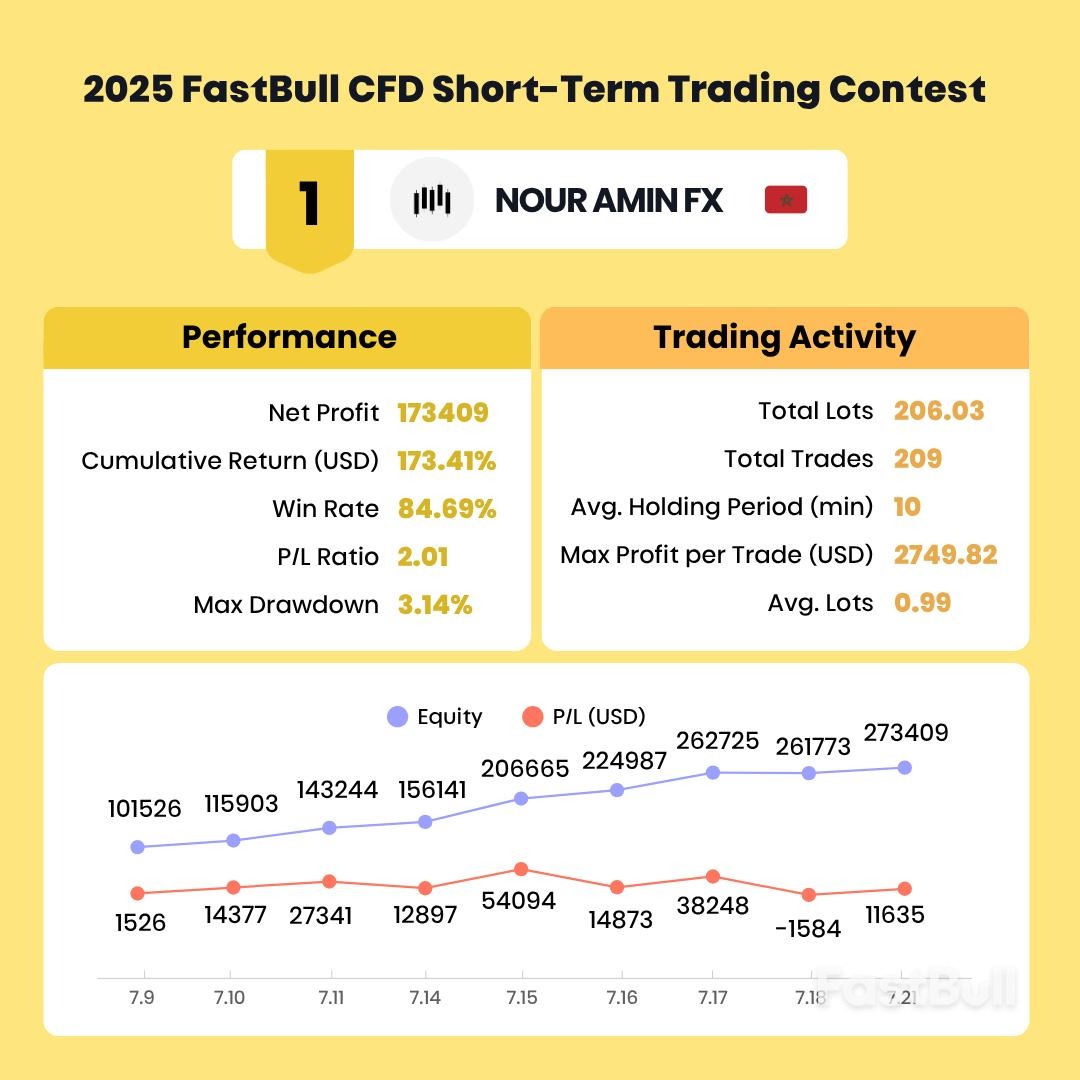
          The 1st Place:NOUR AMIN FX
          Country: Morocco
          Prize: 5,000 USD
          Contest Account Profile
          2025 FastBull CFD Trading Contest Wraps Up, Revealing the Top Ten Traders!_2
          Learn more about the trader: https://www.fastbull.com/traders/user-nouraminfx/account/3350718358018441216
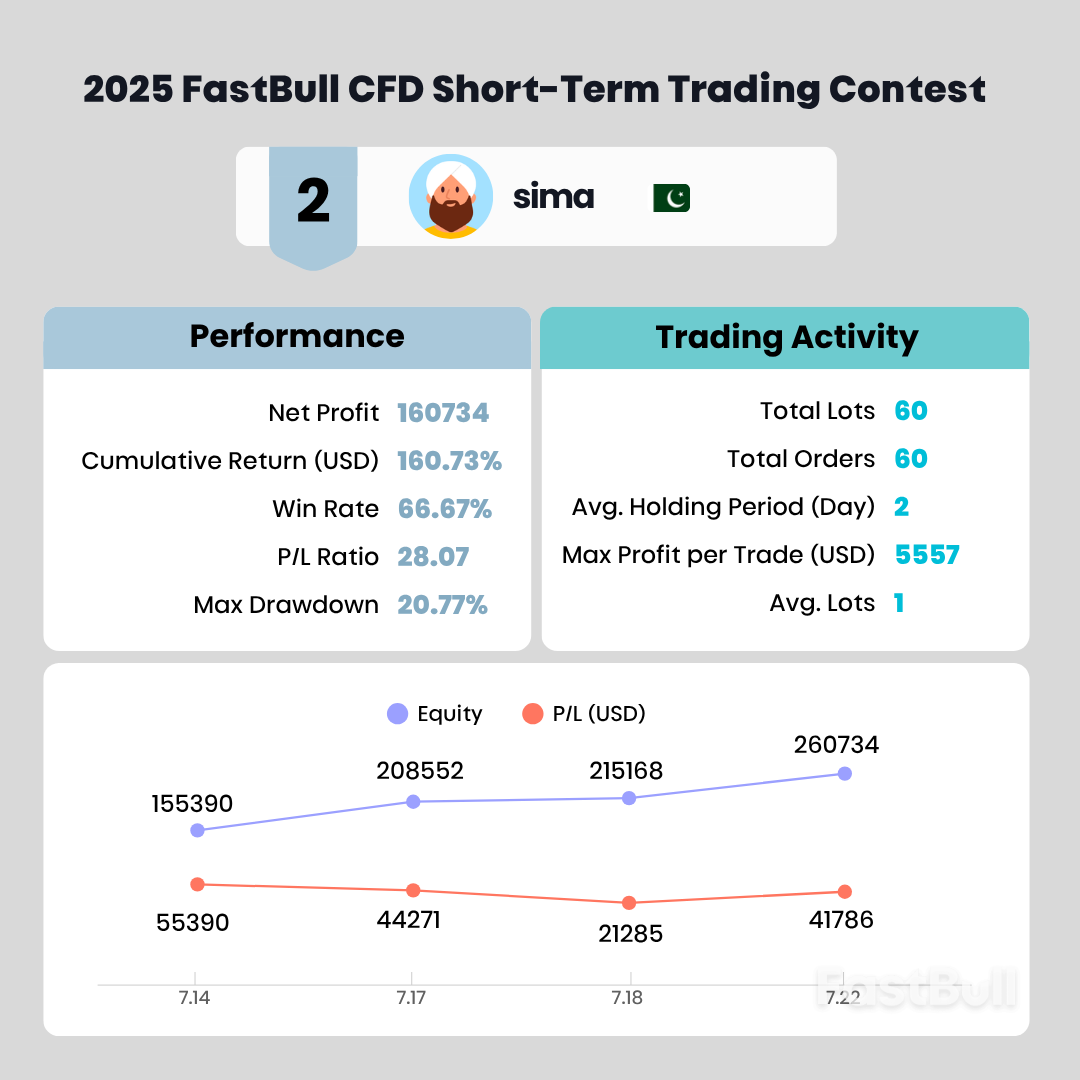
          The 2nd Place:sima
          Country: Pakistan
          Prize: 4,000 USD
          Contest Account Profile
          2025 FastBull CFD Trading Contest Wraps Up, Revealing the Top Ten Traders!_3
          Learn more about the trader: https://www.fastbull.com/traders/user-90e5lqpyko/account/3375922841019097088
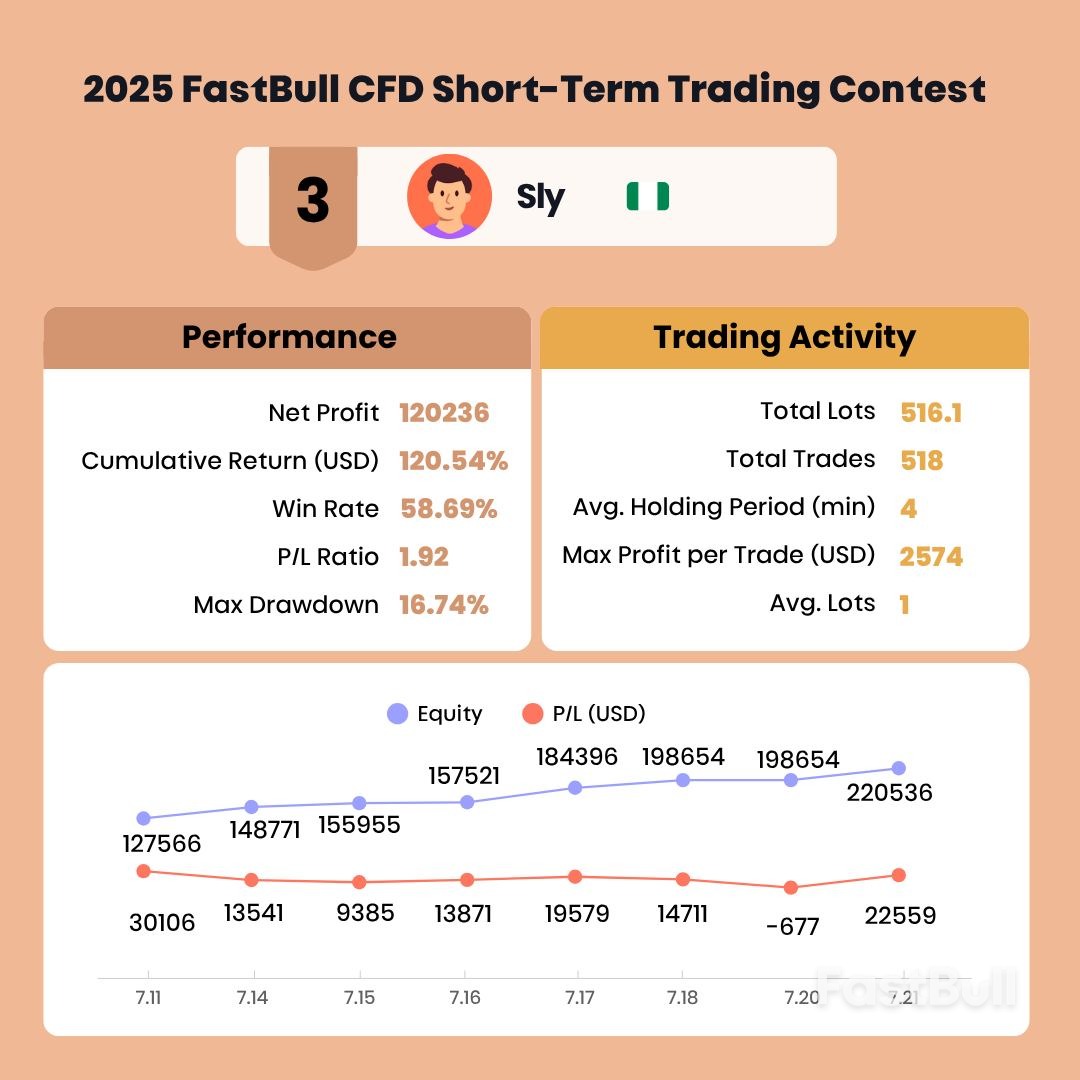
          The 3rd Place:Sly
          Country: Nigeria
          Prize: 3,000 USD
          Contest Account Profile
          2025 FastBull CFD Trading Contest Wraps Up, Revealing the Top Ten Traders!_4
          Learn more about the trader: https://www.fastbull.com/traders/user-g52604z0o3/account/3350962621398499328
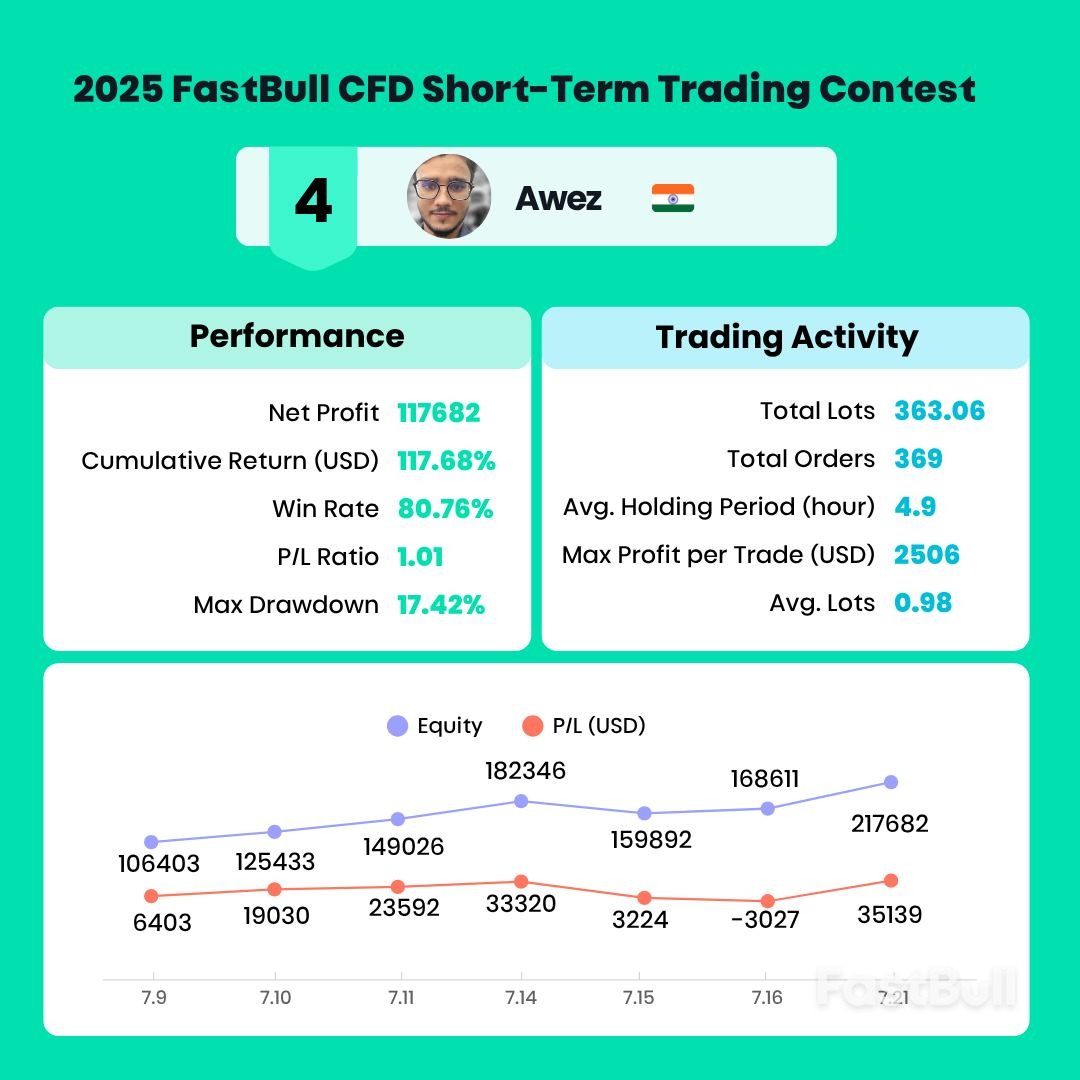
          The 4th Place:Awez
          Country: India
          Prize: 2,500 USD
          Contest Account Profile
          2025 FastBull CFD Trading Contest Wraps Up, Revealing the Top Ten Traders!_5
          Learn more about the trader: https://www.fastbull.com/traders/user-3618l48l20/account/3356218905454559232
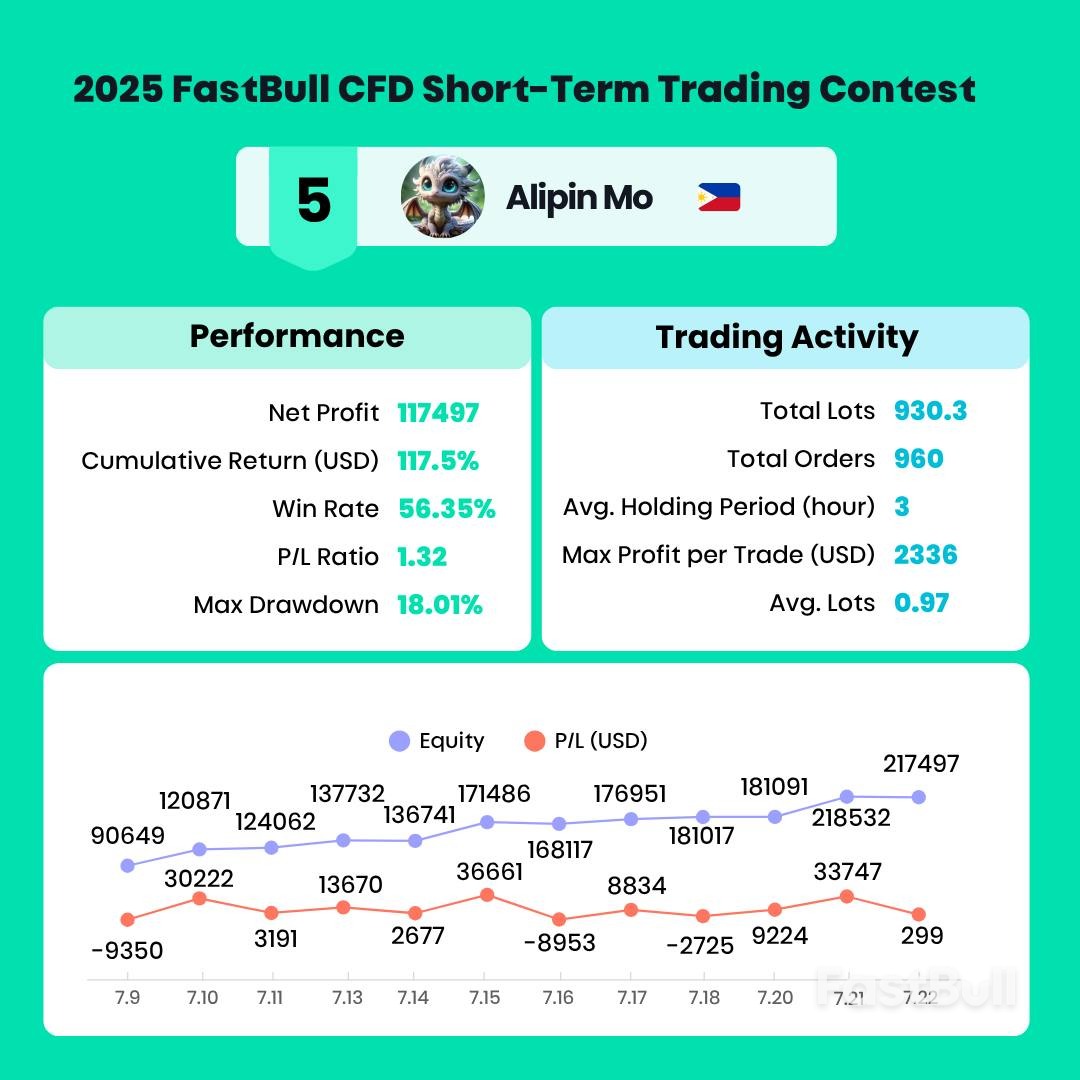
          The 5th Place:Alipin Mo
          Country: Philippines
          Prize: 2,000 USD
          Contest Account Profile
          2025 FastBull CFD Trading Contest Wraps Up, Revealing the Top Ten Traders!_6
          Learn more about the trader: https://www.fastbull.com/traders/user-57kl61mjv0/account/3369105731487932416
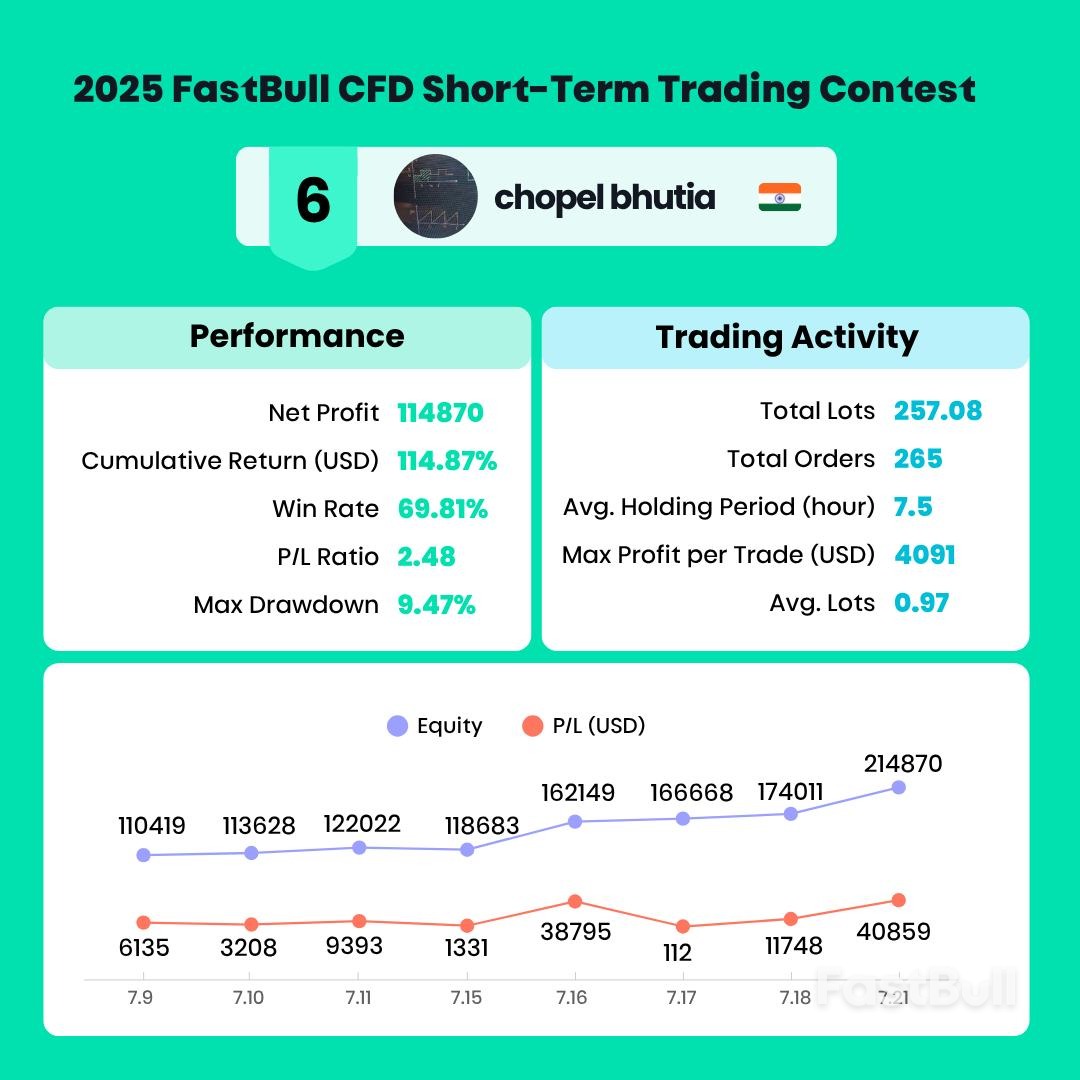
          The 6th Place:chopel bhutia
          Country: India
          Prize: 1,500 USD
          Contest Account Profile
          2025 FastBull CFD Trading Contest Wraps Up, Revealing the Top Ten Traders!_7
          Learn more about the trader: https://www.fastbull.com/traders/user-chopel/account/3359252561114808320
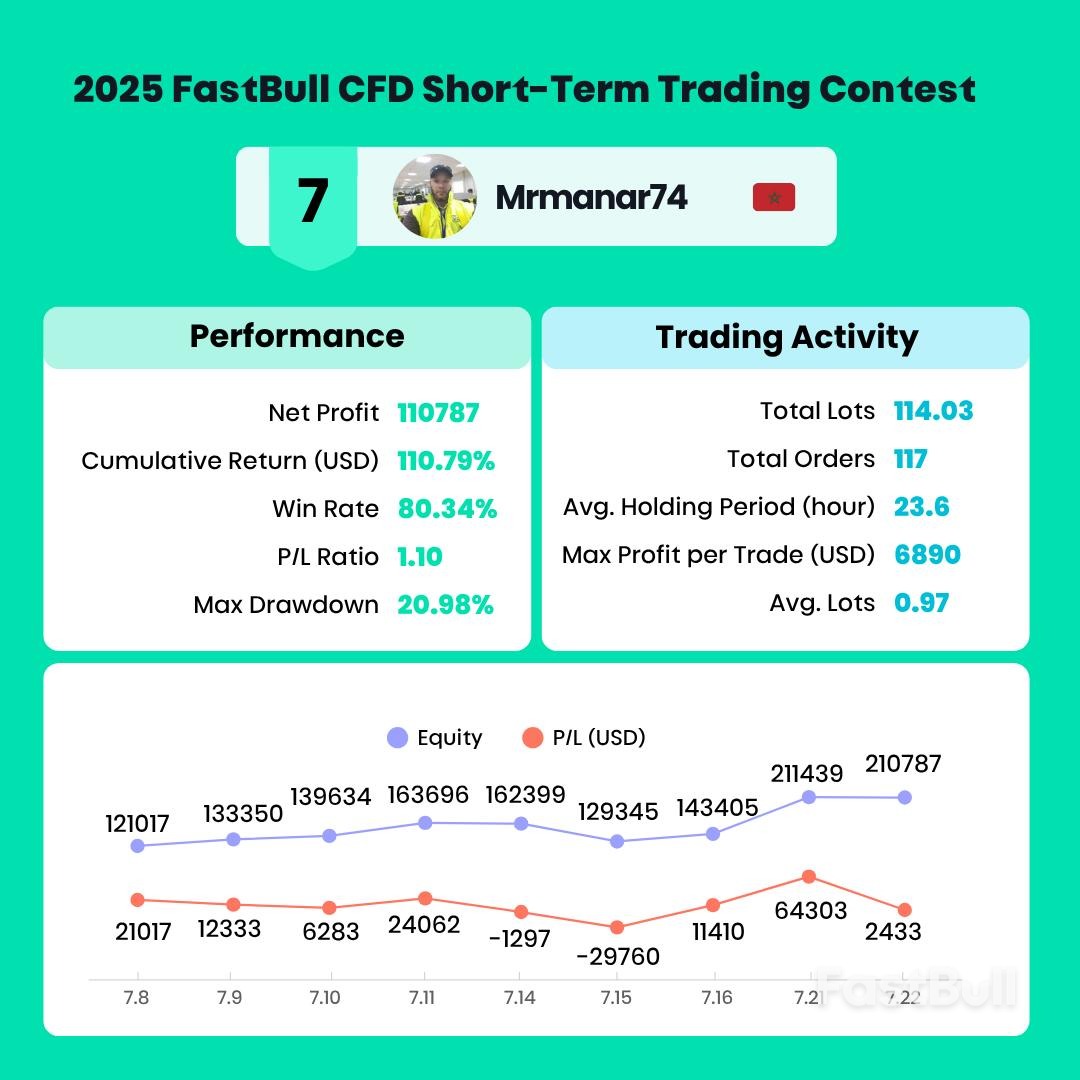
          The 7th Place:Mrmanar 74
          Country: Morocco
          Prize: 1,000 USD
          Contest Account Profile
          2025 FastBull CFD Trading Contest Wraps Up, Revealing the Top Ten Traders!_8
          Learn more about the trader: https://www.fastbull.com/traders/user-mrmanar74/account/3345689432351145984
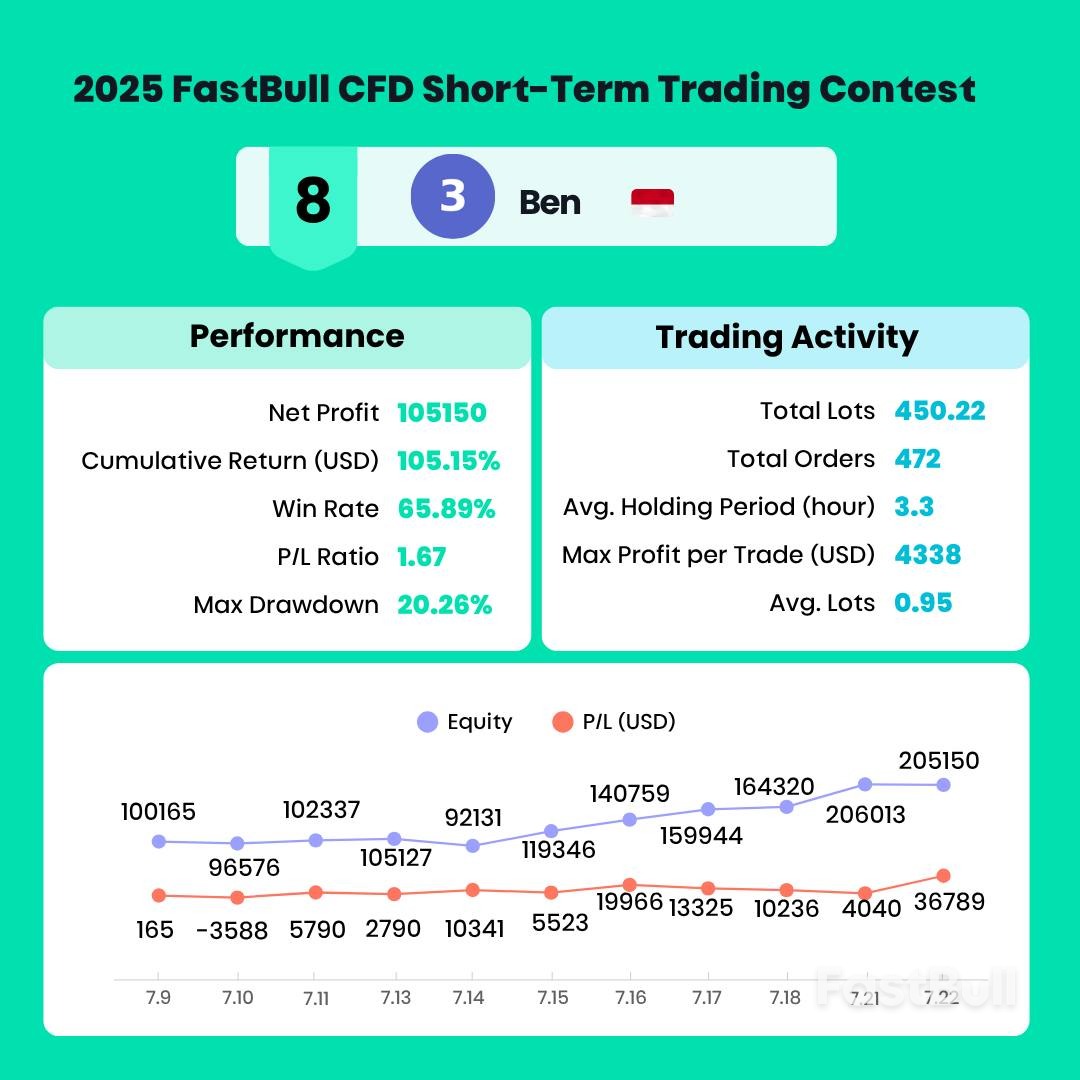
          The 8th Place:Ben
          Country: Indonesia
          Prize: 600 USD
          Contest Account Profile
          2025 FastBull CFD Trading Contest Wraps Up, Revealing the Top Ten Traders!_9
          Learn more about the trader: https://www.fastbull.com/traders/user-365krvpjx7/account/3350403176138383360
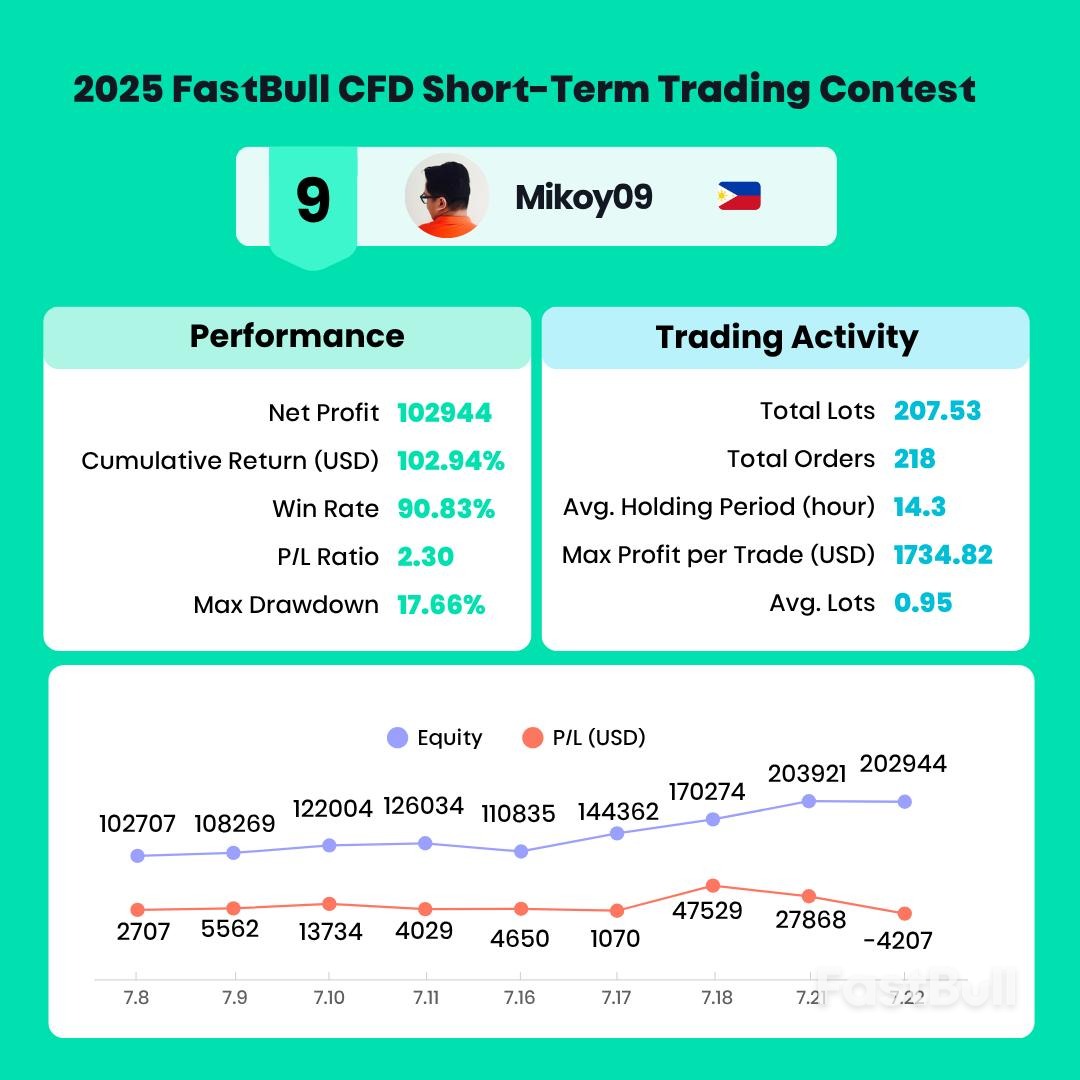
          The 9th Place:Mikoy09
          Country: Philippines
          Prize: 300 USD
          Contest Account Profile
          2025 FastBull CFD Trading Contest Wraps Up, Revealing the Top Ten Traders!_10
          Learn more about the trader: https://www.fastbull.com/traders/user-fxsupremacy/account/3370899619068379136
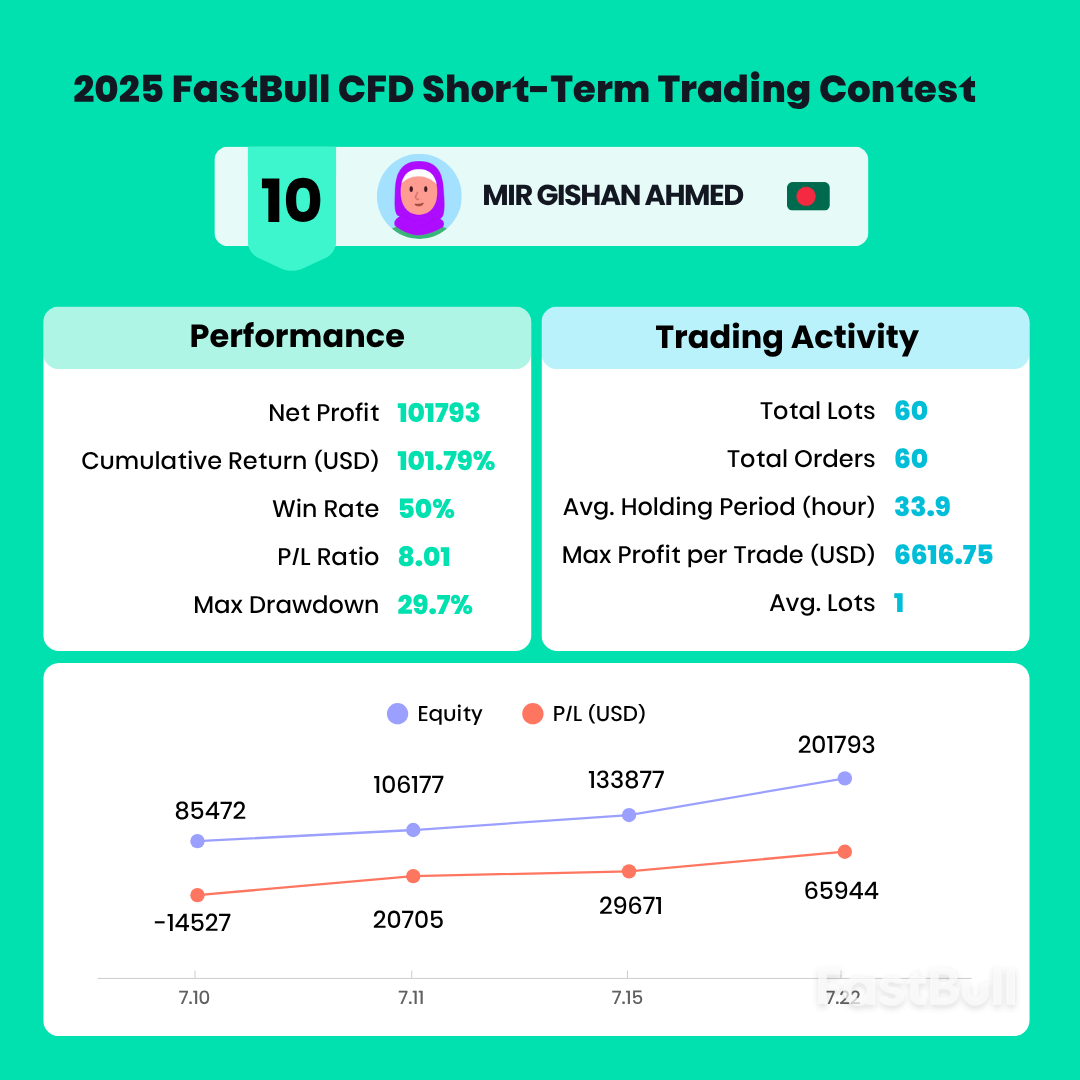
          The 10th Place:MIR GISHAN AHMED
          Country: Bangladesh
          Prize: 100 USD
          Contest Account Profile
          2025 FastBull CFD Trading Contest Wraps Up, Revealing the Top Ten Traders!_11
          Learn more about the trader: https://www.fastbull.com/traders/user-l6p81jx7g3/account/3355443784116715520
          A huge thank you to all the traders for your enthusiasm and hard work. This contest was a fantastic opportunity for traders to sharpen their skills and connect with fellow traders from around the world. Prizes will be awarded soon. FastBull will reach out to all winners via the email used for contest registration, so keep an eye out!
          Congratulations once again to all the winners! We can't wait to see even more talent in the next FastBull Trading Contest!
          Risk Warnings and Disclaimers
          You understand and acknowledge that there is a high degree of risk involved in trading. Following any strategies or investment methods may lead to potential losses. The content on the site is provided by our contributors and analysts for information purposes only. You are solely responsible for determining whether any trading assets, securities, strategy, or any other product is suitable for investing based on your own investment objectives and financial situation.
          Add to Favorites
          Share

          Cambodia Says Immediate Ceasefire Purpose Of Talks; Thailand Questions Its Sincerity

          Winkelmann

          Political

          Monday's talks to end the deadliest fighting in more than a decade between the Southeast Asian neighbours are being hosted by Malaysia, the chair of the regional ASEAN bloc. Cambodian Prime Minister Hun Manet said the talks were co-organised by the United States, and that China would also take part in them.Both Thailand and Cambodia accuse the other of starting the hostilities last week and then escalating them. On Monday, officials from both countries said clashes along the disputed border were ongoing ahead of the talks later in the day.

          "We are not confident in Cambodia, their actions so far have reflected insincerity in solving the problem," acting Thai Prime Minister Phumtham Wechayachai told reporters ahead of his departure for Kuala Lumpur."Cambodia has violated international law, but everybody wants to see peace. Nobody wants to see violence that affects civilians."

          Cambodia has strongly denied Thai accusations it has fired at civilian targets, and has instead said that Thailand has put innocent lives at risk. It has called for the international community to condemn Thailand's aggression against it."The purpose of this meeting is to achieve an immediate 'ceasefire', initiated by President Donald Trump and agreed to by the Prime Ministers of Cambodia and Thailand," Hun Manet said in a post on X as he departed for the talks.

          Phumtham Wechayachai and Thailand's Minister of Foreign Affairs Maris Sangiampongsa walks after the press conference at the base of Wing 6 of the Royal Thai Air Force ahead of their departure to Malaysia for ceasefire talks on the deadly border conflict between Thailand and Cambodia that extended to a fifth day, in Bangkok, Thailand, July 28, 2025.

          Thailand's acting prime minister, Phumtham Wechayachai and Thailand's Minister of Foreign Affairs Maris Sangiampongsa walks after the press conference at the base of Wing 6 of the Royal Thai Air Force ahead of their departure to Malaysia for ceasefire talks on the deadly border conflict between... Purchase Licensing Rights, opens new tab Read moreU.S. Secretary of State Marco Rubio said State Department officials would assist the peace efforts, after President Donald Trump had earlier said that he thought both leaders wanted to settle the conflict.

          The tensions between Thailand and Cambodia have intensified since the killing in late May of a Cambodian soldier during a brief skirmish. Border troops on both sides were reinforced amid a full-blown diplomatic crisis that brought Thailand's fragile coalition government to the brink of collapse.Malaysian Prime Minister Anwar Ibrahim had proposed ceasefire talks soon after the border dispute erupted into conflict on Thursday, and China and the United States also offered to assist in negotiations.

          Anwar said he expected to chair the negotiations after being asked by the two governments to try to find a peace settlement, state media agency Bernama reported on Sunday."So, I'm discussing the parameters, the conditions, but what is important is (an) immediate ceasefire," Anwar said.

          Thailand and Cambodia have bickered for decades over undemarcated points along their 817-km (508-mile) land border, with ownership of the ancient Hindu temples Ta Moan Thom and the 11th century Preah Vihear central to the disputes.

          Preah Vihear was awarded to Cambodia by the International Court of Justice in 1962, but the situation worsened in 2008 after Cambodia attempted to list it as a UNESCO World Heritage site. Skirmishes over several years brought at least a dozen deaths.Cambodia said in June it had asked the court to resolve its disputes with Thailand. Bangkok says it has never recognised the court's jurisdiction and prefers a bilateral approach.

          Source: Reuters

          Risk Warnings and Disclaimers
          You understand and acknowledge that there is a high degree of risk involved in trading. Following any strategies or investment methods may lead to potential losses. The content on the site is provided by our contributors and analysts for information purposes only. You are solely responsible for determining whether any trading assets, securities, strategy, or any other product is suitable for investing based on your own investment objectives and financial situation.
          Add to Favorites
          Share

          Oil Prices Tick Up as US-EU Trade Deal Buoys Sentiment Ahead of OPEC+ Decision

          Gerik

          Economic

          Commodity

          Trade Deal Eases Tensions but Offers Limited Momentum

          Brent crude hovered near $69 a barrel and West Texas Intermediate (WTI) traded above $65 on Monday after the United States and the European Union reached a last-minute trade agreement, narrowly avoiding the imposition of harsher tariffs by the August 1 deadline. While the deal imposes a 15% levy on most EU exports, it alleviates the threat of more punitive measures previously floated by President Trump.
          The news supported oil market sentiment, particularly by reducing immediate risks to global trade flows. However, as noted by Soni Kumari, commodity strategist at ANZ Group Holdings, markets had already anticipated the general tariff structure based on previous deals with Japan and others. As such, the price increase reflects relief rather than renewed bullishness, with oil prices largely expected to remain rangebound in the near term.

          OPEC+ Meeting Looms as Next Market Driver

          Attention is now shifting to the upcoming OPEC+ meeting, where member nations are expected to assess current market conditions and set production policy for September. A committee is convening Monday to review the latest supply-demand balance. Early indications suggest a further hike in output quotas is likely, which may contribute to oversupply concerns and weigh on crude prices if demand projections fail to keep pace.
          The expectation of rising supply presents a counterbalance to the positive sentiment from the trade agreement. While the recent boost in prices may be attributed to decreased geopolitical uncertainty, fundamentals remain fragile as inventories risk swelling toward the latter half of 2025.

          Global Trade Dynamics Remain Fluid

          The US-EU agreement follows a similar framework to Washington’s recent pact with Japan and is part of a broader push to finalize trade deals before US tariffs are enforced across multiple fronts. Yet the lack of detailed documentation and divergence in messaging between President Trump and European Commission President Ursula von der Leyen has left analysts wary of potential ambiguity in implementation.
          In parallel, US-China trade negotiators are meeting this week in Stockholm. Although no breakthrough is expected, media reports suggest another extension of their tariff truce is likely. Such a move could provide temporary relief to oil and commodity markets by preserving trade stability between the world’s two largest economies.
          The slight uptick in oil prices reflects temporary optimism stemming from eased trade tensions between the US and EU. However, without clearer details on trade commitments and with the prospect of increased oil supply from OPEC+, markets remain cautious. Traders are now looking to upcoming geopolitical developments and production policy shifts to determine whether the current stability in crude markets can be sustained through the volatile second half of 2025.

          Source: Bloomberg

          To stay updated on all economic events of today, please check out our Economic calendar
          Risk Warnings and Disclaimers
          You understand and acknowledge that there is a high degree of risk involved in trading. Following any strategies or investment methods may lead to potential losses. The content on the site is provided by our contributors and analysts for information purposes only. You are solely responsible for determining whether any trading assets, securities, strategy, or any other product is suitable for investing based on your own investment objectives and financial situation.
          Add to Favorites
          Share

          China’s Fiscal Deficit Hits Record as Trade Tariffs and Stimulus Push Strain Public Finances

          Gerik

          Economic

          Mounting Fiscal Deficit Reflects Trade Pressures

          In the first half of 2025, China’s consolidated fiscal deficit reached an unprecedented 5.25 trillion yuan (approximately USD 733 billion), marking a 45% increase compared to the same period in 2024. This dramatic rise was attributed to expansive government spending programs designed to counteract the economic drag stemming from extended US-China trade tensions and domestic structural weaknesses. The data, released by the Ministry of Finance on July 25, indicates that Beijing has leaned heavily on fiscal tools, particularly infrastructure investment and consumption subsidies, to stimulate demand and preserve growth momentum.
          Although a tariff ceasefire was recently agreed upon between Beijing and Washington, the economic costs of the earlier confrontation remain visible. Chinese exports to the US have declined significantly, with analysts noting that average US tariffs on Chinese goods are still 30 percentage points higher than a year ago. These elevated trade barriers continue to weigh on China’s export sector, particularly manufacturers that are heavily dependent on the US market.
          Nevertheless, China has adapted by redirecting its export flows toward other regions. This diversification strategy, combined with intensified domestic investment, enabled China’s GDP to grow by 5.3% in the first half of the year surpassing the government’s full-year target of around 5%. The resilience in GDP growth, however, must be understood as a short-term outcome of expansionary fiscal policies rather than a signal of underlying structural recovery.

          Budget Strain Intensified by Weak Revenue Base

          While spending surged, revenue collections lagged behind. Total government spending rose by 9% year-on-year to 18.8 trillion yuan in the first half of 2025. This included both general budget expenditures for public services and targeted infrastructure investments from the government fund budget. In contrast, total budget revenue contracted by 0.6%, reaching only 13.5 trillion yuan. A 1.2% drop in tax revenues highlights slowing economic activity and the limits of the current growth model in generating sustainable public income.
          One of the most alarming trends is the 6.5% fall in land-use rights transfer revenue, a critical source of funding for local governments. This decline reflects the ongoing stagnation in China’s real estate sector, which traditionally serves as both a growth engine and a vital funding mechanism for regional administrations. The weakness in land sales points to persistent contraction in real estate development and dampened investor confidence, raising concerns about local fiscal health and debt sustainability.

          Deflation Risk and Policy Dilemma Intensify

          Beyond the real estate sector, broader macroeconomic risks continue to loom. The deflationary trend has intensified, adding complexity to Beijing’s policy calculus. As consumer prices soften and private sector confidence remains fragile, the effectiveness of government spending in spurring organic demand becomes increasingly uncertain. The causal relationship between weak consumer confidence, falling real estate investment, and fiscal pressure suggests a potential feedback loop that could further erode growth prospects if not addressed with structural reforms.
          Senior Chinese policymakers are expected to convene at the end of July for a critical mid-year policy review. This internal meeting comes at a pivotal moment, with new rounds of US-China trade negotiations also scheduled. These two developments will likely shape the trajectory of China’s fiscal policy in the second half of 2025. The central question is whether Beijing will escalate stimulus efforts to maintain economic stability or shift toward a more conservative stance to curb the mounting deficit and contain public debt.
          China’s record-high fiscal deficit underscores the growing cost of shielding the economy from external shocks and internal vulnerabilities. While short-term growth targets have been met through substantial government intervention, the sustainability of this approach is in question. Falling revenues, anemic property markets, and trade frictions continue to exert pressure on the state’s financial health. The coming months will be critical as policymakers weigh the risks of further stimulus against the imperative of long-term fiscal responsibility. For now, the country walks a fine line between economic resilience and fiscal fragility.

          Source: CNBC

          To stay updated on all economic events of today, please check out our Economic calendar
          Risk Warnings and Disclaimers
          You understand and acknowledge that there is a high degree of risk involved in trading. Following any strategies or investment methods may lead to potential losses. The content on the site is provided by our contributors and analysts for information purposes only. You are solely responsible for determining whether any trading assets, securities, strategy, or any other product is suitable for investing based on your own investment objectives and financial situation.
          Add to Favorites
          Share

          Markets On Alert: Fed Fractures, Tariff Progress, And The Big Jobs Report Loom

          Pepperstone

          Economic

          Stocks

          Tariff news set to come in heavy, but will it impact markets?

          Tariff-related headlines seen through Sunday have been meaningful, with the US-China tariff pause being extended by a further 90 days, and the US-EU forging an agreement that follows a similar model to that of last week's US-Japan deal. EU exporters will now face a 15% tariff rate to its US buyers, a far more friendly rate than the 30% rate they were facing – in exchange, the EU has committed to purchasing $750b in US energy products and some $600b in other investments.

          The news flow from both the extension with China and the agreement with the EU is clearly market-friendly, and should put further upside potential into the EUR, where the single currency is already finding the love from FX players, and should also put renewed upside into EU equities.

          Importantly, for those nations still looking to achieve a last-minute floor tariff rate (on US exports) of 15%, it's all too clear from the case studies with Indonesia and Japan is that the most important factor is committing to massive levels of investment spend. Trump will now sell this hard to the US voters as a huge win for the US - so expect Trump to address the nation in a presser shortly.

          A lasting US-China deal remains a more complex issue, and while trade imbalances remain a major consideration, at the heart of any potential full agreement, we're likely going to see a commitment from China to massive investment spending.

          China/HK equity leading the gains through July

          For the China market watchers, the 24-member Politburo will gather to formulate plans for the balance of 2025. Market expectations for any new impactful policy initiatives are low, and the Chinese authorities will be quietly content to maintain the status quo, perhaps massaging around the edges, with its growth metrics tracking above its policy objectives. China and HK equity markets have been the star performers in July, so perhaps policymakers will see that as the market voting on increased confidence in China's economic trajectory.

          Central banks in focus this week

          We navigate G10 central bank meetings in the US (hold), Canada (hold) and Japan (hold), as well as in the LATAM/EM space, with policy decisions in South Africa (25bp cut expected), Chile (25bp cut expected), Columbia (25bp cut expected), and Brazil (no change).

          Dissent within the Fed's ranks

          While the BoJ meeting could be quite informative for JPY & NKY225 traders, it will likely be the FOMC meeting on Wednesday that gets the headlines, even if this is shaping up to be a low-impact event for US markets. Expect dissent from Chris Waller and Michelle Bowman, who should both vote for a 25bp cut at this meeting - a symbolic development, as the once galvanised and cohesive committee appears increasingly fractured and almost… dare I say it, politicised…

          Dissent aside, Chair Powell will continue to guide that the board will take in the incoming data “over the summer” – with traders seeing a cut in the September FOMC meeting as more likely than not, the two nonfarm payrolls prints (31 July & 5 Sept) and two CPI prints (12 Aug & 11 Sept) that hit us in the lead up to the September FOMC meeting now take on additional significance.

          A deluge of US and EU corporate earnings on the docket

          It's the big week of the US corporate earnings season, with 38% of the S&P500 market cap set to report numbers for the quarter – the lineup includes Apple, Meta, Amazon and Microsoft, but we also hear from some of the retail trader favoured names, including Coinbase and Roblox. Traders look for these names to build on what has been a solid Q2 earnings season so far, a factor which has offered increasing tailwinds to the grind higher and consecutive ATHs in the S&P500 and NAS100 seen resulted in levels of cross asset volatility crushed.

          Running the numbers, we see that a third of S&P500 companies have now reported earnings, with around 40% raising guidance, an outcome that is well above the levels seen in the Q1 reporting season. 83% of S&P 500 companies have beaten analysts' consensus expectations on EPS, with those beating doing so by an average of 6.9%.

          It's also a big week on the European corporate earnings calendar, with c20% of the Euro Stoxx companies set to report.

          US nonfarm payrolls are the main event of the week

          The flow of economic data also comes in hot, with the labour market getting close inspection. US nonfarm payrolls (NFP) is the main event risk of the week, with the market modelling a central case of 109k jobs created in July, with the range of estimates (from economists) seen between 170k and zero. The prospect of downward revisions to the prior two NFP prints is high, but likely a secondary consideration for rates and FX traders. The unemployment rate is expected to tick up to 4.2%, with the average hourly earnings metric eyed at 3.8% (from 3.7%).

          US interest rate swaps imply a 25bp cut in the September FOMC meeting at 64% probability – a sub-100k NFP, with prior NFP prints revised lower and a 4.2% U/E would probably be enough to see swaps pricing move towards 70% implied for a cut in September. The USD will take its direction from the US 2-year Treasury yield, which is most impacted by changes in Fed rate cut expectations. The S&P500 and NAS100 will be content to see payrolls coming in around 100-120k, as the combination of reasonable job growth and increased Fed cut expectations would feed the goldilocks investment backdrop.

          While the NFP report takes centre stage, staying Stateside, traders also navigate the US JOLTS (job openings) report, weekly jobless claims and the Q2 employment cost index. The US Q2 GDP print and ISM manufacturing report may also get some attention.

          Australia Q2 CPI set to guide expectations for a cut in August

          In Australia, Q2 trimmed mean CPI (due on Wednesday) is expected to come in at 0.7% q/q / 2.7%, which if realised would continue to portray a moderation in price pressures – however, that outcome would also be a touch above the RBA's own central forecast of 2.6% y/y, and while Aussie interest rate swaps once again price a 25bp cut on 12 August as a done deal, it feels as though we'd need to see a trimmed mean print at or above 3% to derail a cut in the markets eyes.

          In Europe, the preliminary July CPI release (due on Friday) may be one to keep an eye on for those holding EUR exposures - after the ECB last week suggested the bar to cut rates again in the near-term has been sufficiently raised, we'd likely need to see a strong downside surprise to the consensus call of 1.9% y/y to see the September ECB as a live event in the markets thinking.

          Source: Pepperstone

          To stay updated on all economic events of today, please check out our Economic calendar
          Risk Warnings and Disclaimers
          You understand and acknowledge that there is a high degree of risk involved in trading. Following any strategies or investment methods may lead to potential losses. The content on the site is provided by our contributors and analysts for information purposes only. You are solely responsible for determining whether any trading assets, securities, strategy, or any other product is suitable for investing based on your own investment objectives and financial situation.
          Add to Favorites
          Share

          Thailand’s Economic Fragility Deepens Amid Tourism Collapse and Consumer Weakness

          Gerik

          Economic

          Tourism Decline Reverberates Through Key Industries

          In the first half of 2025, international arrivals to Thailand dropped 4.6% year-on-year, falling to 16.7 million. The most significant contributor to this downturn is a dramatic 34% fall in Chinese visitors, whose total visits dropped to 2.26 million. Last year, Chinese travelers formed the backbone of Thai tourism, contributing over 6.7 million visits out of a total of 35.5 million.
          This steep decline is not purely economic. A highly publicized kidnapping incident involving a Chinese celebrity earlier this year caused widespread alarm among potential travelers from China, sparking safety concerns and diminishing Thailand’s attractiveness as a destination. The sharp retreat in Chinese demand has had a ripple effect, disproportionately damaging airlines, hotels, and retail businesses with high exposure to Chinese tourism.

          Stock Market Struggles Amid Regional Divergence

          The impact of declining tourism has been clearly reflected in Thailand’s capital markets. The benchmark SET Index has fallen by 13% year-to-date as of July 23, a stark contrast to gains in neighboring markets benefiting from capital outflows from the US due to concerns over Trump’s tariff policies. Sectors most exposed to tourism aviation, hospitality, and high-end retail have borne the brunt of investor pessimism.
          Airports of Thailand, which manages key hubs like Bangkok and Phuket, has seen its share price fall 35%. Bangkok Airways dropped 34%, and Asia Aviation, operator of Thai AirAsia, plummeted 53%. Hotel chains have fared similarly poorly: Erawan Group, reliant on Chinese visitors for 30% of revenue, dropped 41%; Central Plaza Hotel and Dusit Thani fell 20% and 18% respectively. In retail, Central Retail declined by 38%, with consumer sentiment further eroded by domestic economic pressures.

          Domestic Demand Weakens Under Heavy Household Debt

          Thailand’s internal economy is also showing signs of fragility. Consumer confidence has declined for five consecutive months, reaching a 28-month low in June at 52.7. Household debt remains elevated, curbing spending and dampening hopes of a robust domestic recovery. This trend suggests a correlation between high personal indebtedness and weakened internal consumption, compounding the blow dealt by external shocks in the tourism sector.
          In response, the Thai government launched stimulus measures such as the "We Travel Together" program, offering domestic tourists subsidies for hotel stays worth up to 3,000 baht per person. With a 2-billion-baht budget, the initiative aims to stimulate domestic travel through October, targeting 500,000 local participants.
          Additionally, authorities have introduced expedited immigration procedures for Chinese nationals and expanded efforts to improve tourist safety. However, structural disadvantages persist. According to the Kasikorn Research Center, hotel room rates rose 16% year-on-year to an average of 5,377 baht in 2024, reflecting rising costs that have diminished Thailand’s competitiveness compared to regional alternatives.

          Market Outlook Remains Cautious

          Despite a brief rebound in tourism-related stocks following the subsidy rollout, analysts remain cautious. Phillip Securities notes that many hospitality and transport equities have yet to reach their trough. The upcoming third quarter, traditionally a low travel season due to monsoons, is unlikely to provide meaningful relief.
          Thailand’s goal of attracting 35 million tourists this year is increasingly viewed as ambitious. Analysts from KGI Securities project that even a range of 30 to 34 million arrivals will be difficult to achieve under current conditions. They cite not only the fall in Chinese demand and the broader slowdown in manufacturing but also the erosion of Thailand’s once-cost-competitive positioning in Southeast Asia.
          Thailand’s economy is grappling with a complex blend of declining international tourism, weak household spending, and deteriorating investor confidence. The combination of external shocks including Trump’s tariff threats and internal structural weaknesses paints a grim outlook for the remainder of 2025. While short-term fiscal incentives may offer temporary stabilization, the long-term health of Thailand’s economy depends on restoring its tourism appeal, easing household debt burdens, and navigating geopolitical uncertainties that continue to weigh on trade and investment.

          Source: Nikkei Asia

          To stay updated on all economic events of today, please check out our Economic calendar
          Risk Warnings and Disclaimers
          You understand and acknowledge that there is a high degree of risk involved in trading. Following any strategies or investment methods may lead to potential losses. The content on the site is provided by our contributors and analysts for information purposes only. You are solely responsible for determining whether any trading assets, securities, strategy, or any other product is suitable for investing based on your own investment objectives and financial situation.
          Add to Favorites
          Share

          Japan’s $550 Billion US Deal Heavily Skewed Toward Loans, Minimizing Risk and Cost

          Gerik

          Economic

          China–U.S. Trade War

          Breakdown Reveals Financially Conservative Structure

          The Japanese government has revealed that the much-publicized $550 billion investment agreement with the United States will involve minimal actual capital risk, with only a fraction between 1% and 2% allocated to direct investment. According to Ryosei Akazawa, Japan’s chief trade negotiator, the remaining portion will be comprised of government-backed loans and loan guarantees issued through affiliated financial institutions.
          This structure reshapes perceptions of the agreement. While initial commentary suggested Japan would bear significant financial costs to secure US trade concessions, the actual design reflects a cautious financial strategy. Akazawa emphasized that for the vast majority of the fund, Japan will collect interest and guarantee fees, thereby profiting without risking substantial principal capital. He pointed out that the investment segment, though small, will yield profits split at a 90-10 ratio favoring the US, a deviation from Japan’s original 50-50 proposal. However, he framed the impact as negligible, potentially costing Japan only “a couple of tens of billions of yen.”

          Tariff Reduction Offers Tangible Gains for Tokyo

          Another critical element of the agreement is the projected ¥10 trillion (approximately $68 billion) in tariff savings for Japanese exporters. This benefit is especially significant in light of the newly imposed 15% tariffs on Japanese goods, including automobiles. While this rate is still high, it is considered an improvement over the previously threatened 30% tariffs by the Trump administration. By securing a universal tariff rate and potential exemptions through the deal, Japanese companies are expected to regain some pricing competitiveness in the US market.
          Akazawa noted that, in contrast to public concern over Japan’s concessions, the deal delivers substantial economic benefits. He countered domestic criticisms accusing the administration of "selling out" Japan, explaining that the agreement’s loan-based framework and the tariff savings outweigh any perceived losses from the profit-sharing clause.

          Strategic Flexibility and Third-Party Inclusion

          Interestingly, the scope of the investment fund extends beyond bilateral Japan-US interests. Akazawa confirmed that entities outside both countries may be eligible for support under the framework. For instance, a Taiwanese semiconductor manufacturer building a facility in the US could potentially benefit. This broad eligibility aligns with Japan’s geopolitical strategy to reinforce supply chains with strategic allies, especially in semiconductor manufacturing, where China’s influence looms large.
          Despite the financial details, the timeline and legal formalization of the agreement remain murky. No official joint document has been signed, and the Japanese government is pressing the White House for an executive order to implement tariff reductions without further delay. Akazawa voiced skepticism toward waiting for formal documentation, asserting that doing so could cause unnecessary delays and limit Japan’s ability to capitalize on the summer trade window.
          Japan’s urgency reflects both economic and political considerations. By implementing the fund within President Trump’s current term, Tokyo seeks to insulate the agreement from future political disruptions while aligning closely with the White House’s broader strategy of structuring trade deals around large investment pledges.

          A Model for Other US Trade Partners?

          The Trump administration has promoted the Japan deal as a template for other trade partners. On Sunday, a similar agreement was reached with the European Union, in which the EU agreed to invest $600 billion in the US in exchange for a 15% tariff ceiling. Both deals signal a pivot in US trade diplomacy: rather than removing tariffs outright, Washington now offers reduced barriers in exchange for massive capital commitments primarily structured through financial instruments that offer the US visibility and control, while allowing trade partners to mitigate financial risk.
          The $550 billion Japan-US agreement may appear massive, but in substance it reflects Tokyo’s strategic pragmatism. By channeling most of the funds through loans and guarantees, Japan ensures profitability while securing lower tariffs. The true cost of the deal is limited, and the economic returns both from tariff reductions and geopolitical alignment appear to outweigh the compromises. However, full implementation depends on US follow-through, and the absence of a binding document introduces a layer of uncertainty. As it stands, the deal serves both nations’ interests financially beneficial for Japan and politically valuable for the US and may serve as a blueprint for future US-led trade frameworks.

          Source: Bloomberg

          To stay updated on all economic events of today, please check out our Economic calendar
          Risk Warnings and Disclaimers
          You understand and acknowledge that there is a high degree of risk involved in trading. Following any strategies or investment methods may lead to potential losses. The content on the site is provided by our contributors and analysts for information purposes only. You are solely responsible for determining whether any trading assets, securities, strategy, or any other product is suitable for investing based on your own investment objectives and financial situation.
          Add to Favorites
          Share
          FastBull
          Copyright © 2025 FastBull Ltd

          728 RM B 7/F GEE LOK IND BLDG NO 34 HUNG TO RD KWUN TONG KLN HONG KONG

          TelegramInstagramTwitterfacebooklinkedin
          App Store Google Play Google Play
          Products
          Charts

          Chats

          Q&A with Experts
          Screeners
          Economic Calendar
          Data
          Tools
          Membership
          Features
          Function
          Markets
          Copy Trading
          Latest Signals
          Contests
          News
          Analysis
          24/7
          Columns
          Education
          Company
          Careers
          About Us
          Contact Us
          Advertising
          Help Center
          Feedback
          User Agreement
          Privacy Policy
          Business

          White Label

          Data API

          Web Plug-ins

          Poster Maker

          Affiliate Program

          Risk Disclosure

          The risk of loss in trading financial instruments such as stocks, FX, commodities, futures, bonds, ETFs and crypto can be substantial. You may sustain a total loss of the funds that you deposit with your broker. Therefore, you should carefully consider whether such trading is suitable for you in light of your circumstances and financial resources.

          No decision to invest should be made without thoroughly conducting due diligence by yourself or consulting with your financial advisors. Our web content might not suit you since we don't know your financial conditions and investment needs. Our financial information might have latency or contain inaccuracy, so you should be fully responsible for any of your trading and investment decisions. The company will not be responsible for your capital loss.

          Without getting permission from the website, you are not allowed to copy the website's graphics, texts, or trademarks. Intellectual property rights in the content or data incorporated into this website belong to its providers and exchange merchants.

          Not Logged In

          Log in to access more features

          FastBull Membership

          Not yet

          Purchase

          Become a signal provider
          Help Center
          Customer Service
          Dark Mode
          Price Up/Down Colors

          Log In

          Sign Up

          Position
          Layout
          Fullscreen
          Default to Chart
          The chart page opens by default when you visit fastbull.com