


US Crude Slips as Traders Weigh Russian Supply Return and Fed Outlook
Key Takeaways
-WTI trades near $98.498 after snapping a seven-session winning streak, with price consolidating around the $98.500 area.
-President Donald Trump’s decision to waive sanctions and tariffs on Russia has raised expectations of increased global oil availability.
-Tanker attacks near the Strait of Hormuz and Ukrainian strikes on Russian oil infrastructure continue to threaten supply.
-Stronger US import prices have reinforced inflation concerns ahead of the Federal Reserve’s interest rate decision.
-Traders are watching $98.500–$98.550 as resistance, with $98.400 and $98.350 as key support levels.

US crude oil retreated on Monday, 19 October, after Washington’s decision to ease restrictions on Russian energy exports prompted traders to reassess global supply conditions.
The latest move reflects a market balancing the potential return of Russian fuel, ongoing geopolitical supply risks and inflation-driven monetary policy expectations. Traders are now assessing whether buyers can defend current support or whether further downside pressure may develop.
Why Traders Are Watching Crude Oil
Attention is centred on the US decision to temporarily waive sanctions and tariffs on Russia, which could allow more Russian fuel to enter international markets. The policy shift has eased some immediate supply concerns, particularly as Turkey prepares to absorb additional Russian diesel exports.
However, attacks on tankers near the Strait of Hormuz and Ukrainian drone strikes targeting Russian oil infrastructure have kept supply risks elevated.
Monetary policy is another factor. September import prices rose more than expected, partly because of higher energy costs, reinforcing concerns about persistent inflation. Another Fed rate hike would add further pressure on oil prices.
Key factors influencing USOUSD include:
-Russian supply: The sanctions waiver could increase global fuel availability, though its execution and stability remain uncertain.
-Geopolitical risk: Tanker attacks near the Strait of Hormuz and strikes on Russian infrastructure could disrupt shipping and exports.
-Federal Reserve policy: A restrictive outlook could support a firmer US dollar and weigh on demand expectations.
-Inflation data: Stronger import prices and upcoming PCE figures may shape rate expectations and sentiment.
Key Trading Levels
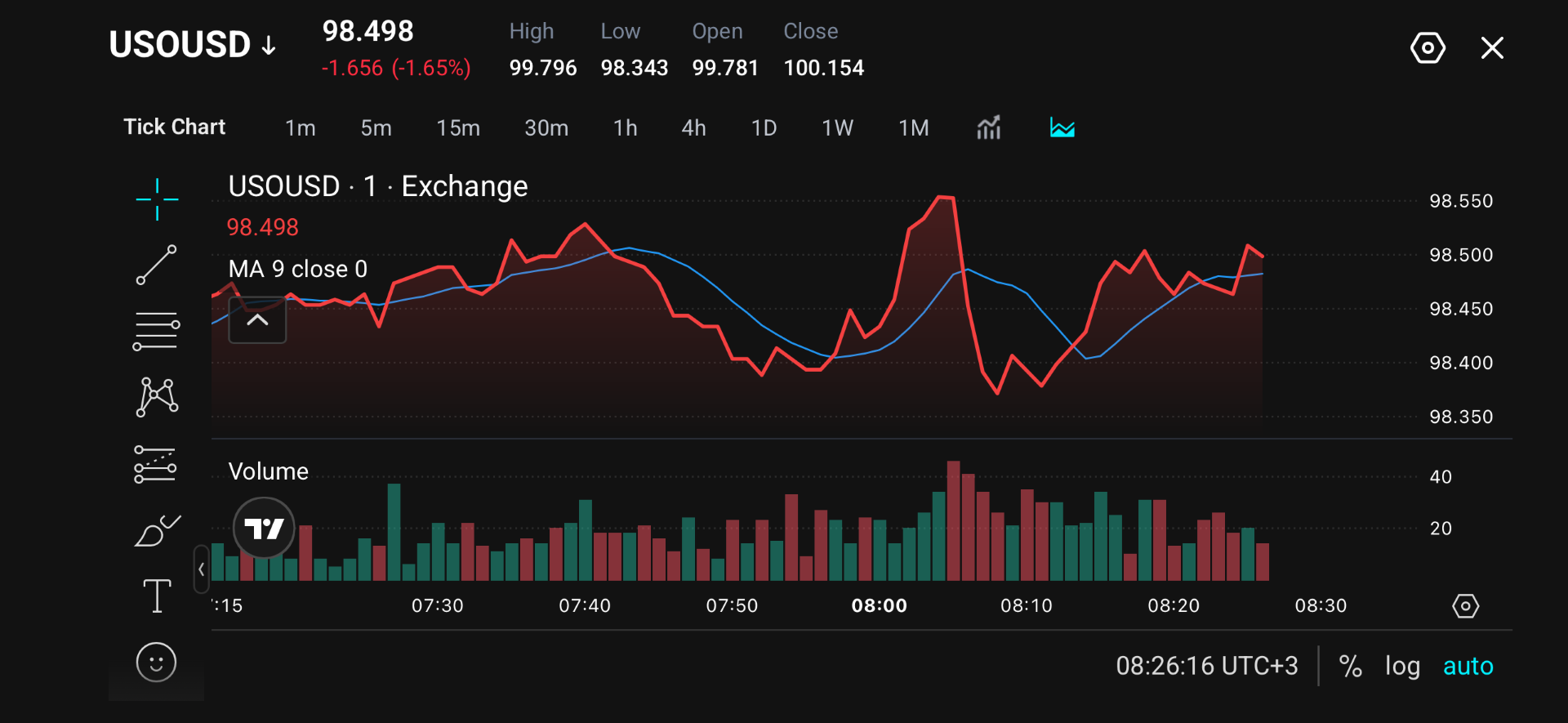
WTI is trading around $98.498 after briefly advancing towards $98.550, then falling sharply to $98.370 before recovering towards $98.500.
The $98.500 level remains the key short-term pivot, having repeatedly acted as resistance. A sustained move above $98.550 could support further recovery momentum. The nine-period moving average sits close to the current price, suggesting limited directional conviction for now.
On the downside, a break below $98.450 could bring $98.400 into focus, followed by the $98.370–$98.350 zone where buyers previously emerged.
USOUSD Prediction: Can Crude Hold $98.500?
Crude’s next move will depend on whether buyers can stabilise price near current levels while markets assess the Russian sanctions waiver and the Fed’s policy path.
Supply risks from the Strait of Hormuz and Russian infrastructure attacks may limit downside, as any shipping or export disruption could renew buying interest. A supportive outcome from easing inflation concerns could also improve sentiment and help USOUSD retest $98.550.
However, a failure to hold $98.500 could increase selling pressure and shift focus towards $98.450, $98.400 and $98.350. A restrictive Fed outlook, a firmer US dollar or weaker demand expectations could also weigh on prices.
For a more in-depth analysis, technical outlooks and potential trading scenarios, read the full article.







저작권 © 2026 FastBull Ltd


위험 경고
FX 거래는 위험도가 높으며 모든 투자자에게 적합하지 않을 수 있습니다. 레버리지는 추가적인 위험과 손실을 초래합니다. 거래하기 전에 투자 목표, 경험 수준 및 위험 허용 범위를 신중하게 고려하십시오. 초기 투자금의 일부 또는 전부를 잃을 수도 있습니다. 감당할 수 없는 돈을 투자하지 마십시오. FX 거래와 관련된 위험에 대해 스스로 교육하십시오. 질문이 있는 경우 독립적인 재무 또는 세무 자문가에게 문의하시기 바랍니다. 모든 데이터와 정보는 "있는 그대로" 제공되며 정보 제공 목적으로만 제공되며 거래나 추천 목적으로 제공되지 않습니다. 과거 성과는 미래 결과를 예측하지 않습니다.
부인 성명
본 웹사이트에 포함된 데이터는 실시간으로 정확하지 않을 수 있습니다. 본 사이트의 데이터 및 가격은 반드시 마켓이나 거래소에서 제공하는 것은 아니며, 마켓 메이커에 의해 제공될 수 있으므로 가격이 정확하지 않을 수 있으며 실제 시장 가격과 다를 수 있습니다. 즉, 해당 가격은 단지 시장 동향을 반영하기 위한 지표 가격으로 매매 목적으로는 불리합니다. 웹사이트에 포함된 데이터 제공자는 귀하의 거래 활동이나 웹사이트에 포함된 정보에 대한 의존으로 인해 귀하에게 발생한 손실에 대해 책임을 지지 않습니다.