• Trade
  • Markets
  • Copy
  • Contests
  • News
  • 24/7
  • Calendar
  • Q&A
  • Chats
Screeners
SYMBOL
LAST
ASK
BID
HIGH
LOW
NET CHG.
%CHG.
SPREAD
SPX
S&P 500 Index
6939.02
6939.02
6939.02
6964.08
6893.47
-29.99
-0.43%
--
DJI
Dow Jones Industrial Average
48892.46
48892.46
48892.46
49047.68
48459.88
-179.09
-0.36%
--
IXIC
NASDAQ Composite Index
23461.81
23461.81
23461.81
23662.25
23351.55
-223.30
-0.94%
--
USDX
US Dollar Index
97.010
97.090
97.010
97.140
96.840
+0.020
+ 0.02%
--
EURUSD
Euro / US Dollar
1.18510
1.18519
1.18510
1.18745
1.18393
+0.00019
+ 0.02%
--
GBPUSD
Pound Sterling / US Dollar
1.36922
1.36930
1.36922
1.37153
1.36600
+0.00087
+ 0.06%
--
XAUUSD
Gold / US Dollar
4781.04
4781.38
4781.04
4884.47
4402.03
-113.45
-2.32%
--
WTI
Light Sweet Crude Oil
61.951
61.981
61.951
63.933
61.181
-3.476
-5.31%
--

Community Accounts

Signal Accounts
--
Profit Accounts
--
Loss Accounts
--
View More

Become a signal provider

Sell trading signals to earn additional income

View More

Guide to Copy Trading

Get started with ease and confidence

View More

Signal Accounts for Members

All Signal Accounts

Best Return
  • Best Return
  • Best P/L
  • Best MDD
Past 1W
  • Past 1W
  • Past 1M
  • Past 1Y

All Contests

  • All
  • Trump Updates
  • Recommend
  • Stocks
  • Cryptocurrencies
  • Central Banks
  • Featured News
Top News Only
Share

Lisbon- EU's Jorgensen: Hungary Free To Challenge Russian Gas Import Ban In Court, All Members Must Comply With EU Law, Even If They Disagree

Share

New York Gold Futures Turned Positive, Rebounding Above $4,800 Per Ounce

Share

[Bitcoin Surges Above $78,000] February 2, According To Htx Market Data, Bitcoin Has Risen To Above $78,000 And Is Now Trading At $78,302

Share

Ukraine's Electricity Imports Jump 40% To Record 894 Gigawatt Hours In January

Share

Lisbon- EU Energy Commissioner Jorgensen: Last Week's Decision To Ban Russian Gas Imports Is 100% Legally Sound

Share

US Gold Futures Turns Positive, Last Up 1.3% At $4808.34/Oz

Share

Spot Palladium Rose More Than 4.00% On The Day, Currently Trading At $1,722.70 Per Ounce, Rebounding By About $150 From The Day's Low

Share

Russia's LNG Exports Rose 7% In January, Data Shows

Share

European Mining Stocks Basket Turns Positive , Erasing Earlier Losses, Last Up 0.1%

Share

EU Commission Spokesperson On Iran: We Are Urging All Parties To Abide By International Law, Show Restraint And Refrain From Taking Action, Which Could Lead To A New Escalation In Middle East

Share

EU Commission Spokesperson: We Reject Listing Of EU Armies As Terror Organizations And Accusations Of Terrorism By Iran

Share

Anfac - Spain New Car Sales +1.1% Year-On-Year In January

Share

Agrural - Brazil's Center-South 2026 Second Corn Planting Hits 13% Of Expected Area As Of Last Thursday

Share

Agrural - Brazil's 2025/26 Soybean Harvest Hits 10% Of Planted Area As Of Last Thursday

Share

Fitch: India's Fy27 Budget Targets Further, But Slower, Fiscal Consolidation

Share

Liberia Central Bank Holds Benchmark Lending Rate At 16.25%

Share

Statistics Bureau - Pakistan January CPI +5.6% Year-On-Year

Share

EU Commission Spokersperson: Current Figures Do Not Suggest EU Is Over Reliant On One Gas Supplier

Share

India 10-Year Benchmark Government Bond Yield Ends At 6.7662%, Previous Close 6.6963%

Share

Chile Central Bank Says Economic Activity Index Imacec +1.7% In December Versus Year Earlier, Mkt Expected +0.9%

TIME
ACT
FCST
PREV
U.S. Core PPI MoM (SA) (Dec)

A:--

F: --

P: --

U.S. PPI MoM Final (Excl. Food, Energy and Trade) (SA) (Dec)

A:--

F: --

P: --

U.S. PPI YoY (Excl. Food, Energy & Trade) (Dec)

A:--

F: --

P: --

U.S. Chicago PMI (Jan)

A:--

F: --

P: --
Canada Federal Government Budget Balance (Nov)

A:--

F: --

P: --

U.S. Weekly Total Oil Rig Count

A:--

F: --

P: --

U.S. Weekly Total Rig Count

A:--

F: --

P: --

China, Mainland NBS Manufacturing PMI (Jan)

A:--

F: --

P: --

China, Mainland NBS Non-manufacturing PMI (Jan)

A:--

F: --

P: --

China, Mainland Composite PMI (Jan)

A:--

F: --

P: --

South Korea Trade Balance Prelim (Jan)

A:--

F: --

P: --
Japan Manufacturing PMI Final (Jan)

A:--

F: --

P: --

South Korea IHS Markit Manufacturing PMI (SA) (Jan)

A:--

F: --

P: --

Indonesia IHS Markit Manufacturing PMI (Jan)

A:--

F: --

P: --

China, Mainland Caixin Manufacturing PMI (SA) (Jan)

A:--

F: --

P: --

Indonesia Trade Balance (Dec)

A:--

F: --

P: --

Indonesia Inflation Rate YoY (Jan)

A:--

F: --

P: --

Indonesia Core Inflation YoY (Jan)

A:--

F: --

P: --

India HSBC Manufacturing PMI Final (Jan)

A:--

F: --

P: --

Australia Commodity Price YoY (Jan)

A:--

F: --

P: --

Russia IHS Markit Manufacturing PMI (Jan)

A:--

F: --

P: --

Turkey Manufacturing PMI (Jan)

A:--

F: --

P: --

U.K. Nationwide House Price Index MoM (Jan)

A:--

F: --

P: --

U.K. Nationwide House Price Index YoY (Jan)

A:--

F: --

P: --

Germany Actual Retail Sales MoM (Dec)

A:--

F: --

P: --
Italy Manufacturing PMI (SA) (Jan)

A:--

F: --

P: --

South Africa Manufacturing PMI (Jan)

A:--

F: --

P: --

Euro Zone Manufacturing PMI Final (Jan)

A:--

F: --

P: --

U.K. Manufacturing PMI Final (Jan)

A:--

F: --

P: --

Turkey Trade Balance (Jan)

A:--

F: --

P: --

Brazil IHS Markit Manufacturing PMI (Jan)

--

F: --

P: --

Canada National Economic Confidence Index

--

F: --

P: --

Canada Manufacturing PMI (SA) (Jan)

--

F: --

P: --

U.S. IHS Markit Manufacturing PMI Final (Jan)

--

F: --

P: --

U.S. ISM Output Index (Jan)

--

F: --

P: --

U.S. ISM Inventories Index (Jan)

--

F: --

P: --

U.S. ISM Manufacturing Employment Index (Jan)

--

F: --

P: --

U.S. ISM Manufacturing New Orders Index (Jan)

--

F: --

P: --

U.S. ISM Manufacturing PMI (Jan)

--

F: --

P: --

South Korea CPI YoY (Jan)

--

F: --

P: --

Japan Monetary Base YoY (SA) (Jan)

--

F: --

P: --

Australia Building Approval Total YoY (Dec)

--

F: --

P: --

Australia Building Permits MoM (SA) (Dec)

--

F: --

P: --

Australia Building Permits YoY (SA) (Dec)

--

F: --

P: --

Australia Private Building Permits MoM (SA) (Dec)

--

F: --

P: --

Australia Overnight (Borrowing) Key Rate

--

F: --

P: --

RBA Rate Statement
Japan 10-Year Note Auction Yield

--

F: --

P: --

Saudi Arabia IHS Markit Composite PMI (Jan)

--

F: --

P: --

RBA Press Conference
Turkey PPI YoY (Jan)

--

F: --

P: --

Turkey CPI YoY (Jan)

--

F: --

P: --

Turkey CPI YoY (Excl. Energy, Food, Beverage, Tobacco & Gold) (Jan)

--

F: --

P: --

Turkey Trade Balance (Jan)

--

F: --

P: --

U.S. Weekly Redbook Index YoY

--

F: --

P: --

U.S. JOLTS Job Openings (SA) (Dec)

--

F: --

P: --

Mexico Manufacturing PMI (Jan)

--

F: --

P: --

U.S. API Weekly Refined Oil Stocks

--

F: --

P: --

U.S. API Weekly Gasoline Stocks

--

F: --

P: --

U.S. API Weekly Cushing Crude Oil Stocks

--

F: --

P: --

U.S. API Weekly Crude Oil Stocks

--

F: --

P: --

Q&A with Experts
    • All
    • Chatrooms
    • Groups
    • Friends
    EuroTrader flag
    EuroTrader
    @Tomasodomathis is another scenario i have with Eurusd just in case the first one fails me
    Nawhdir Øt flag
    EuroTrader
    @EuroTradergood
    Size flag
    3508537
    That’s likely. The USD still dominates trade settlement, reserves, debt markets, and liquidity.
    3508537 flag
    Fast Bull: Many people are focusing on sharing information about gold.
    EuroTrader flag
    3508537
    It's the same in the US.
    @Visitor3508537its the same all over the world. They don't want traders making money in gold so they use excuse as margin to restrict trading
    Size flag
    Even with diversification into Gold or other currencies, there’s no real replacement yet that matches the dollar’s depth and trust.@Visitor3508537
    EuroTrader flag
    3508537
    Fast Bull: Many people are focusing on sharing information about gold.
    @Visitor3508537Gold 🥇 is now the most traded asset so it's normal for people to focus on just gold alone
    Size flag
    Tomasodoma
    Anytime bro 🤝 Sometimes stepping back is the trade. Clarity always comes back.
    EuroTrader flag
    Nawhdir Øt
    @Nawhdir Øtbut it would be a setback. if i take a loss on the trade but I can't change the outcome
    Nawhdir Øt flag
    EuroTrader
    @EuroTraderon EUR/USD stay focused on buy setups only cousin
    Size flag
    The question is less about losing dominance and more about sharing influence over time@Visitor3508537
    Nawhdir Øt flag
    Nawhdir Øt
    but you can sell if you find confirmation, but I suggest not to swing to sell
    Size flag
    3508537
    Fast Bull: Many people are focusing on sharing information about gold.
    @Visitor3508537Gold is attracting a lot of attention right now, but high attention usually means high volatility.
    Nawhdir Øt flag
    Size
    @SizeYes, many people take advantage when fluctuations are high.
    EuroTrader flag
    Nawhdir Øt
    @Nawhdir ØtYeahh .that's the plan because i am holding for 1.4 you remember our predictions for Eurusd
    Nawhdir Øt flag
    EuroTrader
    @EuroTrader 1,4 - 1,5, yes
    EuroTrader flag
    Nawhdir Øt
    @Nawhdir Øtthe sells would be short term sells but long term Eurusd is still super bullish
    Nawhdir Øt flag
    Nawhdir Øt
    1,8 - 2, you know for who?
    3508537 flag
    Size
    Any country that abandons the current USD will face economic difficulties in transactions. Why don't they sell all their US bonds instead of just a small portion? The reason is that China is selling bonds for its own purposes; they are buying a lot of gold and oil in case they attack Taiwan in the next few years, not to abandon the USD. Russia cannot use the USD, so they have to use gold for transactions. Japan is selling US bonds to buy back the Japanese yen because the yen is weakening. Other countries are selling a portion of their US bonds to avoid risks due to Trump's erratic policies. If the currency reverts to gold, it will be very difficult to trade and exchange goods, with difficulties in transportation and calculations, and it will not generate profits like the current USD currency system, which can be invested profitably in other assets. Even if the US has public debt exceeding $40 trillion, other countries will still accept it.
    EuroTrader flag
    Nawhdir Øt
    @Nawhdir ØtYeahh that's the long term bias we all hold on Eurusd .so we look for buys along the way
    Type here...
    Add Symbol or Code

      No matching data

      All
      Trump Updates
      Recommend
      Stocks
      Cryptocurrencies
      Central Banks
      Featured News
      • All
      • Russia-Ukraine Conflict
      • Middle East Flashpoint
      • All
      • Russia-Ukraine Conflict
      • Middle East Flashpoint

      Search
      Products

      Charts Free Forever

      Chats Q&A with Experts
      Screeners Economic Calendar Data Tools
      Membership Features
      Data Warehouse Market Trends Institutional Data Policy Rates Macro

      Market Trends

      Market Sentiment Order Book Forex Correlations

      Top Indicators

      Charts Free Forever
      Markets

      News

      News Analysis 24/7 Columns Education
      From Institutions From Analysts
      Topics Columnists

      Latest Views

      Latest Views

      Trending Topics

      Top Columnists

      Latest Update

      Signals

      Copy Rankings Latest Signals Become a signal provider AI Rating
      Contests
      Brokers

      Overview Brokers Assessment Rankings Regulators News Claims
      Broker listing Forex Brokers Comparison Tool Live Spread Comparison Scam
      Q&A Complaint Scam Alert Videos Tips to Detect Scam
      More

      Business
      Events
      Careers About Us Advertising Help Center

      White Label

      Data API

      Web Plug-ins

      Affiliate Program

      Awards Institution Evaluation IB Seminar Salon Event Exhibition
      Vietnam Thailand Singapore Dubai
      Fans Party Investment Sharing Session
      FastBull Summit BrokersView Expo
      Recent Searches
        Top Searches
          Markets
          News
          Analysis
          User
          24/7
          Economic Calendar
          Education
          Data
          • Names
          • Latest
          • Prev

          View All

          No data

          Scan to Download

          Faster Charts, Chat Faster!

          Download App
          English
          • English
          • Español
          • العربية
          • Bahasa Indonesia
          • Bahasa Melayu
          • Tiếng Việt
          • ภาษาไทย
          • Français
          • Italiano
          • Türkçe
          • Русский язык
          • 简中
          • 繁中
          Open Account
          Search
          Products
          Charts Free Forever
          Markets
          News
          Signals

          Copy Rankings Latest Signals Become a signal provider AI Rating
          Contests
          Brokers

          Overview Brokers Assessment Rankings Regulators News Claims
          Broker listing Forex Brokers Comparison Tool Live Spread Comparison Scam
          Q&A Complaint Scam Alert Videos Tips to Detect Scam
          More

          Business
          Events
          Careers About Us Advertising Help Center

          White Label

          Data API

          Web Plug-ins

          Affiliate Program

          Awards Institution Evaluation IB Seminar Salon Event Exhibition
          Vietnam Thailand Singapore Dubai
          Fans Party Investment Sharing Session
          FastBull Summit BrokersView Expo

          Decline May Not Be Over, Await Secondary Test of the Low

          Alan

          Commodity

          Summary:

          Recent sharp falls in gold prices were triggered by Trump's nomination of Warsh as Fed Chair. Technical analysis suggests the downtrend may continue.

          SELL XAUUSD
          EXP
          TRADING

          4660.00

          Entry Price

          4320.00

          TP

          4810.00

          SL

          4781.04 -113.45 -2.32%

          0.0

          Pips

          Flat

          4320.00

          TP

          Exit Price

          4660.00

          Entry Price

          4810.00

          SL
          Fundamentals

          Last week, Trump's nomination of Warsh sparked market concerns that he could steer monetary policy in a more hawkish direction or place greater emphasis on curbing inflation. Investors quickly repriced uncertainty surrounding the Fed's future and interest-rate trajectory, leading to a stronger U.S. dollar and higher Treasury yields. This raised the opportunity cost of holding gold and pressured its price. Reports indicate that following the announcement, both the dollar and yields rose significantly, serving as key direct factors weighing on precious metals. In addition, this adjustment was not driven solely by fundamental repricing: structural factors amplified the decline. After gold hit historic highs, the market had accumulated substantial leveraged positions and ETF exposure. When policy risks shifted expectations and margin requirements were raised, forced liquidations and margin-driven selling quickly magnified the downward move, creating a self-reinforcing cascade. Media and exchange reports noted that the recent plunge coincided with higher futures margins and reduced liquidity on some exchanges, further exacerbating the drop.

          Technical Analysis

          Decline May Not Be Over, Await Secondary Test of the Low_1
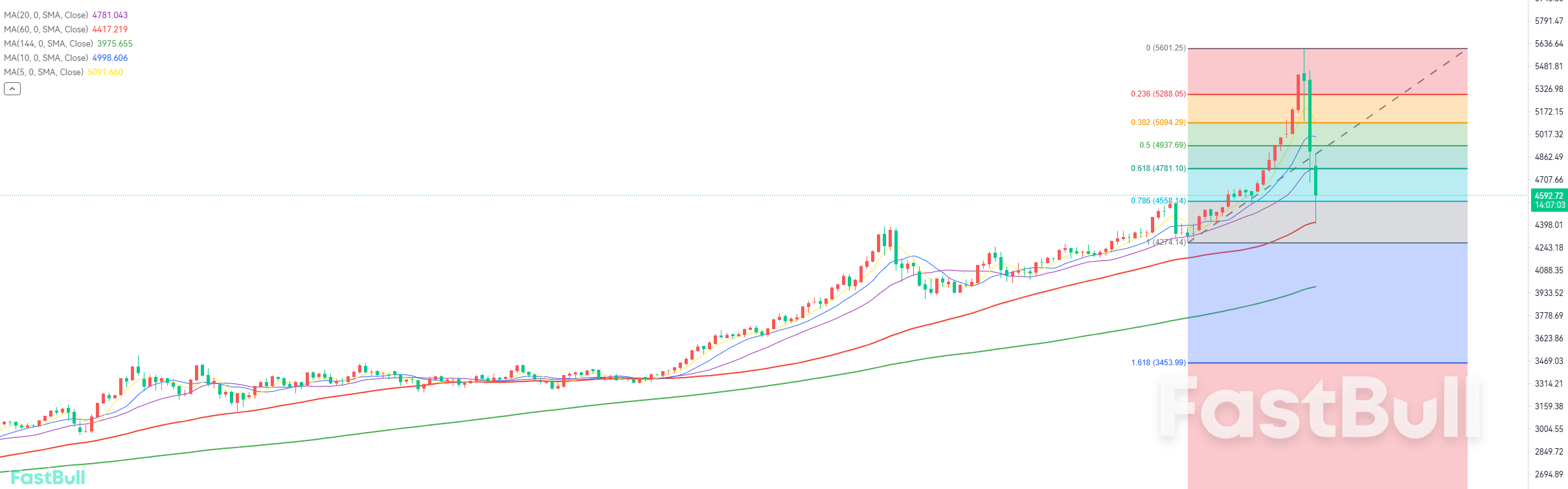
          Based on the daily chart, gold plunged for three consecutive sessions to the $4400 level, which coincides with support from the 60-day moving average, forming a resonance of support that temporarily weakened short-term bearish momentum. However, this does not signal the end of the downtrend. Meanwhile, the Relative Strength Index (RSI) has yet to enter oversold territory, further suggesting that the decline may continue.
          Currently, gold has found brief support at $4400 and may stage a short-term rebound to test resistance in the $4680–$4780 zone. If it fails to break above this resistance and weakens again, gold could retest the $4400 support and potentially fall toward the $4780 area. Conversely, if gold breaks and holds above $4780, it could open the way for an advance toward $5000.

          Trading Recommendations

          Trading direction: Sell
          Entry price: 4660.00
          Target price: 4320.00
          Stop loss: 4810.00
          Valid Until: February 16, 2026, 23:00:00
          Support: 4400.00/4274.00
          Resistance: 4680.00/4780.00
          Risk Warnings and Disclaimers
          You understand and acknowledge that there is a high degree of risk involved in trading. Following any strategies or investment methods may lead to potential losses. The content on the site is provided by our contributors and analysts for information purposes only. You are solely responsible for determining whether any trading assets, securities, strategy, or any other product is suitable for investing based on your own investment objectives and financial situation.
          Add to Favorites
          Share

          Gold Breaks Below 4500! Downward Trend Continues

          Tank

          Forex

          Commodity

          Summary:

          Gold prices have plunged to a two-week low, breaching the US$4500 mark. This decline follows an initial stabilization in market sentiment due to the easing of concerns regarding Federal Reserve independence after Kevin Warsh's nomination as Fed Chair, which was prompted by a calming of the U.S. political landscape. However, the downward trend has persisted.

          BUY XAUUSD
          EXP
          PENDING

          4100.00

          Entry Price

          5000.00

          TP

          3800.00

          SL

          4781.04 -113.45 -2.32%

          --

          Pips

          PENDING

          3800.00

          SL

          Exit Price

          4100.00

          Entry Price

          5000.00

          TP

          Fundamentals
          On Monday, CME Group raised its margin requirements, extending the decline in gold and silver after U.S. President Donald Trump nominated Kevin Warsh as the next Federal Reserve chairman. Previously, precious metals saw a significant sell-off due to President Trump's nomination of Kevin Warsh as the next Fed chair last week. "While Warsh's nomination may have been the initial catalyst, it doesn't explain the magnitude of the decline in precious metals," said Tim Waterer, chief trading analyst at KCM. "Forced selling and increased margins created a ripple effect." Analysts at JPMorgan, however, anticipate that despite recent market volatility, the upward trend will persist in the long term. Over the weekend, President Trump indicated that the U.S. is "on the verge" of a deal with Iran. Concurrently, Iran's Supreme Leader, Ayatollah Ali Khamenei, warned that any attack on Iran would trigger a regional conflict, while the U.S. continues to augment its troop presence in the region. Emma Wall, chief investment strategist at Hargreaves Lansdown, commented, "Investors and global central banks have favored gold as their preferred reserve currency, viewing it as a hedge against U.S. policy." She further noted, "Some nations have observed the potential seizure of Russian dollar assets by global powers supporting Ukraine, thus making gold a more attractive neutral reserve currency."
          Heightened market caution regarding the Federal Reserve's policy trajectory, following President Donald Trump's nomination of Kevin Warsh as the next Fed Chair, could bolster the dollar. This action is interpreted by the market as a signal of a more restrained and disciplined approach to monetary easing by the Fed. Fed officials have also adopted a cautious stance. St. Louis Fed President Alberto Musalem indicated no need for further rate cuts, deeming the 3.50%-3.75% policy range largely neutral, while Atlanta Fed President Raphael Bostic reiterated that policy should remain moderately restrictive. The U.S. ISM Manufacturing Purchasing Managers' Index (PMI) data is scheduled for release later on Monday. The index is expected to rise to 48.3 in January from 47.9 in December. A weaker-than-expected PMI report could weigh on the dollar and support commodity prices denominated in USD, as a softer dollar makes dollar-denominated gold more attractive to international purchasers.
          Technical Analysis
          In the 1W timeframe, gold has formed a bearish evening star pattern, signaling a potential short-term price peak. If it fails to hold the EMA 12, it's highly probable that the price will decline towards the middle Bollinger Band and EMA 50, which are situated around 4126 and 3800, respectively. Conversely, if support is established, a rebound to 4800 and 5000 is likely. The RSI is currently at 60, indicating predominantly optimistic market sentiment among investors. In the 1D timeframe, the Bollinger Bands have narrowed, and the moving averages are flattening. Following the evening star formation, the price has continued to decline with a large bearish candle, suggesting that the short-term downtrend is ongoing. The MACD has also generated a death cross at a high level, and the MACD line and signal line are retreating towards the zero-axis. Given the current distance from the zero-axis, this implies that the downward movement is not yet complete. Immediate support levels are identified at 4100 and 3900. The RSI is at 43, reflecting strong selling pressure in the market. It is recommended to go short before going long.
          Gold Breaks Below 4500! Downward Trend Continues_1Gold Breaks Below 4500! Downward Trend Continues_2
          Trading Recommendations
          Trading Direction: Buy
          Entry Price: 4100
          Target Price: 5000
          Stop Loss: 3800
          Support: 4500, 4200, 4100
          Resistance: 4700, 4800, 5000
          Risk Warnings and Disclaimers
          You understand and acknowledge that there is a high degree of risk involved in trading. Following any strategies or investment methods may lead to potential losses. The content on the site is provided by our contributors and analysts for information purposes only. You are solely responsible for determining whether any trading assets, securities, strategy, or any other product is suitable for investing based on your own investment objectives and financial situation.
          Add to Favorites
          Share

          Gold Maintains a High-Volatility Downtrend, Rallies Still Viewed as Selling Opportunities

          Eva Chen

          Commodity

          Summary:

          After recording extreme gains in January, gold has seen a sharp expansion in high-level volatility. Rumors of a more hawkish Fed chair candidate, combined with a rebound in the USD, triggered a rapid correction in gold prices. On Friday, gold fell below the USD 5,000 level, with short-term topping signals beginning to emerge.

          SELL XAUUSD
          EXP
          PENDING

          5400.00

          Entry Price

          4519.00

          TP

          5475.00

          SL

          4781.04 -113.45 -2.32%

          --

          Pips

          PENDING

          4519.00

          TP

          Exit Price

          5400.00

          Entry Price

          5475.00

          SL

          Fundamentals

          Gold surged at an exceptional pace in January, with the monthly gain once approaching USD 1,300. Against the backdrop of persistent geopolitical risks and ongoing global economic uncertainty, safe-haven flows poured heavily into the gold market, pushing prices toward their strongest monthly performance since 1980.
          However, market sentiment reversed noticeably in the latter half of the week. Rumors that Warsh could replace Powell as Fed chair and adopt a more hawkish stance gained traction during the Asian session, prompting markets to reassess the future path of monetary policy. Under this influence, gold prices plunged more than 4% intraday on Friday.
          As expectations for a “less dovish” Fed chair intensified, the USD staged a short-term rebound. At the same time, gold had already been in a clearly overbought condition, with the prior rapid price advance lacking fresh fundamental support.
          The intraday “flash crash” observed on Thursday signaled that the upside momentum of this rally was beginning to fade. By Friday, gold broke below the USD 5,000 psychological level, with intraday losses expanding to more than 7%. Risks at elevated price levels were rapidly released, and short-term topping signals became increasingly evident.
          During the correction, part of the safe-haven demand rotated out of gold and temporarily shifted toward USD assets. Previously accumulated floating profits amplified the incentive for profit-taking at high levels.
          Looking ahead, in the absence of renewed geopolitical escalation or strong macro-level stimulus in the near term, traders may continue to lock in profits. Gold may enter a phase of high-level consolidation or further correction in the short term, with the risk of continued volatility expansion remaining elevated.
          Gold Maintains a High-Volatility Downtrend, Rallies Still Viewed as Selling Opportunities_1

          Technical Analysis

          Gold’s consecutive sharp pullbacks on Friday are consistent with expectations of heightened volatility following institutional selling. From the perspective of the current structural trend, large price swings are likely to persist into early next month. During this period, momentum indicators are prone to frequent breakouts and are therefore not recommended as trading references. Positioning should instead be based on key institutional selling levels.

          Trade Recommendations

          Trade Direction: Sell
          Entry Price: 5400
          Target Price: 4519
          Stop Loss: 5475
          Valid Until: February 25, 2026 23:55:00
          Support: 5045 / 4990 / 4940
          Resistance: 5188 / 5241 / 5409
          Risk Warnings and Disclaimers
          You understand and acknowledge that there is a high degree of risk involved in trading. Following any strategies or investment methods may lead to potential losses. The content on the site is provided by our contributors and analysts for information purposes only. You are solely responsible for determining whether any trading assets, securities, strategy, or any other product is suitable for investing based on your own investment objectives and financial situation.
          Add to Favorites
          Share

          Silver Crashes as Trump Taps Hawk Warsh

          Warren Takunda

          Traders' Opinions

          Summary:

          Spot silver (XAG/USD) crashed over 12% on Friday in a violent correction, erasing a large portion of its recent record-setting rally

          SELL XAGUSD
          Close Time
          CLOSED

          97.500

          Entry Price

          87.000

          TP

          106.000

          SL

          83.716 -1.451 -1.70%

          589.5

          Pips

          Profit

          87.000

          TP

          91.605

          Exit Price

          97.500

          Entry Price

          106.000

          SL

          In a breathtaking reversal of fortune that underscores the extreme fragility of speculative market rallies, the silver market endured a violent and historic sell-off on Friday, surrendering a massive portion of its recent record-breaking gains. The precipitous drop, one of the most severe single-day corrections in modern memory, has sent shockwaves through the broader commodities complex and served as a stark reminder of the perils of frothy, leverage-fueled momentum.
          After a parabolic ascent that captivated and concerned investors in equal measure, spot silver (XAG/USD) finally buckled under its own weight and a shifting macroeconomic tide. At last check, the white metal was trading near $102.20 per ounce, a staggering decline of 12.30% for the session. This gut-wrenching move effectively erased a significant chunk of the gains that propelled silver to an unprecedented all-time high of $121.66 just yesterday—a peak that now stands as a sobering monument to the frenzy that preceded the collapse.
          The selling pressure, which began in Asian hours, metastasized into a full-blown liquidation event during the European trading session. Prices entered a near-freefall, momentarily breaching the critical psychological fortress of $100 to tag an intraday low of $95.08. The scale and velocity of the decline were not merely a function of disappointed bulls; they pointed directly to the forced unwinding of highly leveraged speculative positions. As stop-loss orders were triggered en masse, the selling fed upon itself, creating a vacuum of bids and exacerbating the downward spiral.
          This was not an isolated tremor but part of a broader seismic shift rattling the precious metals space. The dramatic pullback reflects a rapid and harsh reassessment of the most speculative safe-haven assets. The market narrative, which for weeks had been dominated by geopolitical fear and endless liquidity, abruptly changed key.
          The primary accelerant for today’s fire sale was a fundamental shift in the most important variable for non-yielding assets: the future path of U.S. monetary policy. The catalyst emerged from the political sphere, with the announcement that President Donald Trump intends to nominate Kevin Warsh to lead the Federal Reserve.
          The market’s reaction was immediate and unequivocal. Warsh, a former Fed governor, is perceived by investors as notably more hawkish on inflation and a staunch advocate for a more aggressive reduction of the central bank’s bloated balance sheet. His potential leadership implies a Federal Reserve that would be significantly less accommodative, and potentially more proactive in tightening financial conditions, than previously priced in.
          The consequences were instantaneous. The U.S. Dollar Index (DXY) surged, climbing off its recent lows as the prospect of higher relative yields boosted its appeal. Concurrently, U.S. Treasury yields jumped across the curve. For silver, which offers no interest or dividend, this twin development is poison. A stronger dollar makes dollar-denominated metals more expensive for foreign buyers, while higher yields increase the opportunity cost of holding a asset that generates no income. The calculus for institutional holders changed in a matter of minutes.
          Beyond the Warsh shock, today’s action embodies the classic market dynamic of "buy the rumor, sell the news" amplified to an extreme degree. The recent vertical rally, driven by a potent cocktail of Middle East tensions, global growth anxieties, and massive speculative inflows, had pushed silver into technically overbought territory of historic proportions. The market was a coiled spring, waiting for a catalyst to snap back.
          The Fed nomination provided that trigger, prompting a long-overdue wave of profit-taking. Investors who rode the spectacular surge from lower levels seized the opportunity to convert paper gains into realized profits at still-elevated prices. This organic selling merged with the forced liquidation from leveraged players, creating a perfect storm of downward pressure.
          Despite the brutal visual on today’s chart, it is crucial to maintain perspective. Even after this dramatic correction, silver remains on track to close one of its strongest monthly performances in history. The underlying fundamental drivers that fueled the rally have not vanished. Geopolitical risk, particularly in the Middle East, remains elevated. Questions surrounding global economic stamina and the ultimate trajectory of inflation are unresolved. The structural demand for tangible assets as a hedge against monetary debasement and uncertainty persists.
          What today represents is not necessarily the end of the bullish narrative, but a severe and necessary market cleanse. It has shaken out the weakest hands, reset overextended technical indicators, and forced a repricing based on a new, more hawkish Fed risk. The volatility is a tax on uncertainty, and today, that tax was levied in full.
          Going forward, investors must prepare for a new regime of elevated volatility. The market must now grapple with the implications of a potentially transformative shift at the helm of the world’s most influential central bank. Support levels around $100 and below will be tested rigorously. Whether this episode morphs into a deeper correction or proves to be a healthy consolidation within a longer-term uptrend will depend on the evolution of the Fed narrative, the persistence of geopolitical strife, and the appetite of physical buyers to step in at these lower levels.

          Technical AnalysisSilver Crashes as Trump Taps Hawk Warsh_1

          From a technical perspective, silver has shifted from a steady bullish advance into a vulnerable corrective phase on the 4-hour chart. Price had been trending higher along a well-respected ascending trendline, consistently forming higher highs and higher lows. However, the latest sharp rejection from the upper resistance zone near $118.00–$120.00 has disrupted that structure, with price now breaking back below a key horizontal support band around $104.00–$106.00.
          This former support zone, which previously acted as a platform for multiple rebounds, is now at risk of turning into resistance. The strong bearish impulse candle slicing through this region signals a change in short-term momentum and suggests that buyers are losing control after an extended run. Price is currently hovering near the psychological $100.00 level, which is providing temporary support, but the broader structure now looks increasingly fragile.
          The ascending trendline that guided the rally from early January has also been breached on an intraday basis. Unless silver can quickly reclaim levels above $105.00 and re-establish itself back above the broken support zone, the path of least resistance appears tilted to the downside. A sustained move below $99.00–$100.00 would confirm a deeper corrective phase, exposing the $95.00 region initially, followed by the $90.00–$92.00 zone where prior consolidation and demand were seen.
          On the upside, any recovery attempts are likely to face first resistance near $104.00–$106.00. A decisive break back above this area would be needed to stabilize the structure and shift focus toward $110.00. Only a sustained move beyond $116.00–$118.00 would fully revive the broader bullish trend and open the door for a retest of recent highs.
          Momentum dynamics now favor consolidation-to-bearish continuation rather than immediate trend resumption. The recent rejection from the highs and the impulsive nature of the selloff suggest fading bullish momentum and rising distribution at elevated levels. This points to increased risk of further downside probing before a more durable base can form.
          TRADE RECOMMENDATION
          SELL SILVER
          ENTRY PRICE: 97.50
          STOP LOSS: 106.00
          TAKE PROFIT: 87.00
          Risk Warnings and Disclaimers
          You understand and acknowledge that there is a high degree of risk involved in trading. Following any strategies or investment methods may lead to potential losses. The content on the site is provided by our contributors and analysts for information purposes only. You are solely responsible for determining whether any trading assets, securities, strategy, or any other product is suitable for investing based on your own investment objectives and financial situation.
          Add to Favorites
          Share

          GBP/JPY Aims Higher as UK Inflation Data Locks In BoE Delay

          Warren Takunda

          Traders' Opinions

          Summary:

          The British Pound maintains a firm stance just below its weekly highs against the Japanese Yen, trading at 211.65, as conflicting trans-Pacific policy messages create a stalemate.

          BUY GBPJPY
          Close Time
          CLOSED

          212.050

          Entry Price

          213.200

          TP

          211.600

          SL

          212.139 +0.348 +0.16%

          45.0

          Pips

          Loss

          211.600

          SL

          211.599

          Exit Price

          212.050

          Entry Price

          213.200

          TP

          In the often-predictable world of currency trading, it is the clash of narratives that breeds volatility, and the GBP/JPY cross is currently ground zero for a compelling policy dissonance. The Pound Sterling, acting as both protagonist and barometer of global risk sentiment, is holding a commanding position just shy of its weekly highs against the beleaguered Japanese Yen. As of this writing, the pair trades at 211.65, a level that encapsulates a Wednesday rebound from the 210.00 support—a recovery fueled not by UK developments, but by clarifying rhetoric from Washington that has effectively short-circuited the Yen’s fledgling recovery narrative.
          The week’s drama began with a rumor that sent shockwaves through the Tokyo markets: whispers of a potential coordinated intervention to prop up the historically weak Yen. This specter, which triggered a sharp but fleeting JPY recovery last week, was authoritatively laid to rest by none other than US Treasury Secretary Scott Bessent. In a Wednesday interview with Bloomberg, Bessent delivered a one-two punch of dollar policy. First, he explicitly denied any plans for market intervention to support JPY stability. More significantly, less than 24 hours after former President Donald Trump publicly praised a weakening dollar, Bessent forcefully affirmed the current administration’s commitment to a "strong Dollar policy." The message was unequivocal and immediately digestible for traders: do not expect a US backstop for the Yen’s woes. This single interview provided the jet fuel for the GBP/JPY’s rebound, demonstrating the outsized influence of US political and fiscal commentary on global FX flows.
          This American intervention—verbal, not market-based—effectively offset what should have been a supportive domestic development for the Yen. The released minutes from the Bank of Japan’s latest monetary policy meeting revealed a governing board increasingly tilting toward hawkishness. There was noted “general agreement” that the potent combination of persistent inflationary pressures, the Yen’s profound weakness exacerbating import costs, and sustained wage growth indeed “justify further monetary tightening.” This language marks a subtle but critical shift from the BoJ’s decades-long ultra-dovish dogma, theoretically constructing a fundamental floor for the Yen. Yet, in the face of a resolute US Treasury, these minutes read like a theoretical exercise, their impact muted by the stark reality of a widening interest rate chasm and a lack of immediate action.
          The immediate test for the BoJ’s thesis arrives later today with the release of the advanced Tokyo Consumer Price Index (CPI), a leading indicator for national trends. The data presents a critical dilemma. While the BoJ minutes speak of rising pressures, the hard data tells a moderating story: consumer inflation in Japan’s capital cooled to 2.0% year-on-year in December from 2.7% in November. The market consensus for January’s core reading suggests a further moderation. A print confirming this cooling trend could severely undermine the hawkish narrative embedded in the minutes, stripping the Yen of one of its few remaining domestic supports and inviting renewed selling pressure. The currency is caught between the BoJ’s forward-looking guidance and the market’s rear-view mirror data analysis.
          On the other side of the pair, the Pound draws strength from a more immediate and visceral source: sticky inflation. Data earlier this week revealed UK shop price inflation surged in January to its highest level in nearly two years, driven by stubbornly rising food prices and elevated fuel costs. For traders and the Bank of England alike, this is a potent signal. It directly boosts expectations for a hotter-than-anticipated Consumer Price Index reading for January when it is published later this month. In the current environment, "hot" UK data translates directly into support for Sterling, as it fiercely entrenches the argument against any near-term monetary easing from the BoE. While the Federal Reserve and the European Central Bank openly debate their first rate cuts, the UK’s inflation dynamics suggest its central bank will be among the last to pivot. This relative interest rate advantage provides a structural tailwind for the Pound against funding currencies like the Yen.

          Technical AnalysisGBP/JPY Aims Higher as UK Inflation Data Locks In BoE Delay_1

          From a technical perspective, GBPJPY remains entrenched within a well-defined bullish structure, consolidating near recent highs following a significant uptrend. On the 30-minute chart, prices are trading in a tight range just below the key 212.000 psychological level, with the current session showing a high of 211.997, a low of 211.846, and a close at 211.986 (+0.01%). This narrow price action indicates a period of equilibrium and compression as the market gathers momentum for its next directional move.
          The broader structure is bullish, characterized by a series of higher highs and higher lows from the lows near 209.000 in late January. The immediate price action is testing the upper boundary of its recent range. The key near-term support is now established at today's low of 211.846, which aligns with the previous session's consolidation. A decisive break below this level could trigger a short-term pullback toward the more significant support zone between 211.300 – 211.500, an area that represents a prior resistance-turned-support and a critical level for maintaining the near-term bullish bias. A sustained move below 211.300 would signal a deeper corrective move, initially targeting the 210.500 – 210.800 zone.
          On the upside, the immediate resistance and primary bullish target is the psychological 212.000 handle, which the price has tested but not yet decisively broken. A sustained push and a 30-minute close above 212.000 would confirm the resumption of the bullish impulse and likely invigorate momentum buying. Such a breakout would shift focus decisively toward the next resistance levels at 212.500 and 213.000, with a clear path toward the 214.000 area visible on the chart.
          Momentum indicators suggest consolidation rather than exhaustion. The minimal positive close and extremely tight range reflect a cooling in bullish momentum, reducing the risk of an immediate sharp reversal. This type of price action supports the case for continued sideways-to-higher movement as the market builds a base for the next leg up. The compression also indicates that a volatility expansion is imminent, with the breakout direction likely to dictate the short-term trend.

          TRADE RECOMMENDATION

          BUY GBPJPY
          ENTRY PRICE: 212.050 (On a sustained 30-minute close above 212.000)
          STOP LOSS: 211.600
          TAKE PROFIT: 213.200
          Risk Warnings and Disclaimers
          You understand and acknowledge that there is a high degree of risk involved in trading. Following any strategies or investment methods may lead to potential losses. The content on the site is provided by our contributors and analysts for information purposes only. You are solely responsible for determining whether any trading assets, securities, strategy, or any other product is suitable for investing based on your own investment objectives and financial situation.
          Add to Favorites
          Share

          Oil Pares Gains but Set for Sharp Monthly Advance as Geopolitical Storm Offsets Demand Fears

          Warren Takunda

          Traders' Opinions

          Summary:

          WTI crude edged lower but remained set for a strong ~12% monthly gain, as geopolitical tensions in the Middle East and supply outages sustained a significant risk premium, offsetting demand concerns.

          BUY WTI
          Close Time
          CLOSED

          64.496

          Entry Price

          72.000

          TP

          60.900

          SL

          61.951 -3.476 -5.31%

          104.1

          Pips

          Profit

          60.900

          SL

          65.537

          Exit Price

          64.496

          Entry Price

          72.000

          TP

          In a classic display of the crude market’s current dichotomy, West Texas Intermediate (WTI) futures retreated from multi-session highs on Friday, yet held firmly on track for a striking monthly advance. The benchmark was last seen trading near $64.00 per barrel during the Asian session, a mild pullback after a three-day rally that underscores the complex tug-of-war between tangible supply risks and lingering macroeconomic anxieties.
          Make no mistake: the dominant narrative for January has been one of resilience. Despite concerns over global demand growth and persistent warnings of an oversupplied market later this year, WTI is poised to close the month with a gain of roughly 12%. This impressive performance isn’t born from a surge of bullish economic data. Instead, it is almost entirely constructed atop an elevated—and still rising—geopolitical risk premium. The market is, in essence, pricing in a world where the flow of crude is perpetually one headline away from disruption.
          This week, that premium received fresh and highly volatile injections from the world’s most precarious energy flashpoint. Tensions between the United States and Iran escalated dramatically, moving beyond diplomatic posturing into the realm of tangible military threat. The catalyst was a renewed volley of threats from former U.S. President Donald Trump directed at Tehran, urging a return to nuclear talks. Iran’s response was not calibrated for de-escalation. A senior commander of the Islamic Revolutionary Guard Corps (IRGC) warned the nation would “defend itself and respond like never before” if provoked.
          The situation was immediately compounded by a significant political move from Europe. The European Union’s decision to formally designate Iran’s IRGC as a terrorist organization has further isolated the regime and narrowed the avenues for diplomatic maneuvering. The geopolitical chessboard saw pieces move rapidly: reports emerged of the U.S. bolstering its military footprint in the region, while Tehran, in a direct and provocative counter, announced plans for live-fire military exercises in the Strait of Hormuz.
          For traders and analysts, the Strait of Hormuz is the only square on this chessboard that truly matters. This narrow passage between the Persian Gulf and the Gulf of Oman is the artery of global energy transit, with about a fifth of the world’s daily oil consumption passing through its waters. Any credible threat of its disruption sends a reflexive shiver through trading desks from Singapore to London. As strategists at Westpac noted via Dow Jones Newswires, the market is grappling with the potential for "chaotic" outcomes, a scenario far removed from the relatively controlled "surgical strikes" of the past.
          Yet, even as one geopolitical front heated up, another saw a surprising, if tactical, thaw. In a notable shift, the Trump administration selectively eased certain sanctions on Venezuela’s beleaguered oil industry on Thursday. The move, clearly designed to lure U.S. investment following the U.S.-backed removal of President Nicolás Maduro earlier this month, grants specific licenses for American companies to engage in production, transport, and refining activities involving Venezuelan-origin crude. While this is a long-term play for reshaping Venezuela’s oil sector—and a strategic counter to Russian and Chinese influence there—its immediate market impact is psychological, reminding participants that barrels can re-enter the market from unexpected quarters.
          This month’s price support has been a mosaic of such disruptions. The rally was initially bolstered by a confluence of unplanned outages: production hiccups in Kazakhstan’s Tengiz field, operational freeze-offs that curtailed output in the Permian Basin, and tighter U.S. enforcement of sanctions on Russian oil purchases. These factors collectively tightened the near-term physical balance sheet, providing a fundamental floor for prices that the geopolitical drama then built upon.
          The market is walking a precarious tightrope. The 12% monthly gain is a testament to oil’s enduring sensitivity to supply shocks, real or imagined. However, the failure to hold above $64.50 suggests a market that is bullish, but not reckless. There is a palpable caution, a recognition that the current risk premium is substantial and vulnerable to rapid deflation should any of the geopolitical sparks fail to ignite a wider fire, or should tangible evidence of a supply overhang emerge.

          Technical AnalysisOil Pares Gains but Set for Sharp Monthly Advance as Geopolitical Storm Offsets Demand Fears_1

          From a technical perspective, WTI Crude Oil is showing early signs of a trend transition following a prolonged bearish phase on the 4-hour chart. Price had been entrenched in a well-defined descending channel for several months, consistently producing lower highs and lower lows. However, recent price action shows a decisive bullish break above the upper boundary of that channel, signaling a meaningful shift in market structure and increasing the probability that a medium-term base has been established.
          WTI is currently trading around the $64.00–$64.50 zone, which aligns with a major horizontal resistance-turned-support area. This level previously acted as a distribution zone during mid-2025 and has now been reclaimed with strong bullish momentum, suggesting acceptance above former supply. Holding above this region is critical; sustained price action above $63.50–$64.00 would confirm the breakout and reinforce the bullish reversal narrative. A failure to hold this level would imply a false breakout and could trigger a pullback toward $62.00, followed by the $60.00–$59.50 demand zone, where buyers previously stepped in aggressively.
          To the downside, the $56.00–$57.00 region represents the most important structural support. This area marks the cycle low and the lower bound of the broader accumulation range. A decisive break below this zone would negate the bullish thesis entirely and reopen downside risk toward the $53.00–$50.00 region, signaling a continuation of the longer-term bearish trend.
          On the upside, the next key resistance is located near $66.00–$68.00, a zone defined by prior swing highs and heavy historical trading activity. A clean break and hold above this region would likely accelerate upside momentum and expose higher targets toward $72.00, followed by the $75.00 psychological level, where sellers previously regained control. The sharp bullish expansion seen during the breakout suggests improving participation and a potential shift from corrective price action into trend continuation.
          Momentum characteristics favor continuation rather than exhaustion. The impulsive nature of the breakout contrasts sharply with the overlapping, corrective structure that preceded it—often a hallmark of trend reversals rather than short-lived retracements. Volatility expansion following prolonged compression further supports the case for sustained directional movement.

          TRADE RECOMMENDATION

          BUY WTI CRUDE OIL
          ENTRY PRICE: 64.50
          STOP LOSS: 60.90
          TAKE PROFIT: 72.00
          Risk Warnings and Disclaimers
          You understand and acknowledge that there is a high degree of risk involved in trading. Following any strategies or investment methods may lead to potential losses. The content on the site is provided by our contributors and analysts for information purposes only. You are solely responsible for determining whether any trading assets, securities, strategy, or any other product is suitable for investing based on your own investment objectives and financial situation.
          Add to Favorites
          Share

          Election Storm Approaches! USD/JPY Maintains Rebound Trend

          Tank

          Forex

          Technical Analysis

          Summary:

          The upside potential for the yen may be limited, as Tokyo's consumer price index (CPI) came in below expectations, lowering market expectations for a near-term Bank of Japan rate hike. Data released Friday by Japan's Statistics Bureau showed Tokyo CPI rose 1.5% year-on-year in January, the slowest pace since March 2022, down from 2.0% in the previous month.

          BUY USDJPY
          EXP
          PENDING

          153.400

          Entry Price

          160.000

          TP

          149.500

          SL

          154.934 +0.177 +0.11%

          --

          Pips

          PENDING

          149.500

          SL

          Exit Price

          153.400

          Entry Price

          160.000

          TP

          Fundamentals
          Markets expect coordinated intervention measures between the U.S. and Japan. Japanese Prime Minister Sanae Takaichi warned last week that officials are prepared to take necessary steps to address speculative and highly abnormal market volatility. On the other hand, yen upside may be limited because the weaker-than-expected Tokyo CPI has reduced expectations for an imminent BoJ rate hike. According to data released Friday by Japan's Statistics Bureau, Tokyo CPI rose 1.5% YoY in January, the lowest growth rate since March 2022, down from 2.0% in the previous month. Meanwhile, Tokyo's core CPI YoY growth slowed to 2.0% in January, the lowest since October 2024, down from 2.3% in December and below the market forecast of 2.2%. This report reinforced market expectations that the BoJ will remain cautious about further rate hikes. In domestic politics, Prime Minister Sanae Takaichi's Liberal Democratic Party (LDP) is widely expected to perform well in the House of Representatives snap election scheduled for February 8. Preliminary results based on interviews conducted by Nikkei and a joint poll with Yomiuri Shimbun suggest the LDP is expected to gain seats and cross the majority threshold of 233 out of 465 House seats, significantly higher than its pre-election tally of 198. Currently, the ruling coalition of the LDP and Nippon Ishin no Kai holds only a narrow majority in the House and remains in the minority in the Upper House. Takaichi called the snap election to seek clearer public endorsement for her expansionary fiscal policies, but this policy direction has raised market concerns over a potential increase in Japanese government bond issuance, pushing bond yields higher. Although the campaign is still in its early stages, the LDP's overall momentum remains strong.
          In financial markets, Japanese authorities are tackling yen depreciation pressure in a different way from before. With rare U.S. backing, Japan’s top currency official has adopted a strategy of “tactical silence” and restrained communication rather than frequent FX intervention. Atsushi Mimura, Vice Minister for International Affairs at the Ministry of Finance, who took office in 2024, has deliberately reduced public statements, making limited remarks themselves a policy signal and increasing market difficulty in judging whether and when Japan might intervene. Analysts note that without deploying large-scale intervention funds, Japan has pushed USD/JPY down by roughly 7 yen, regarded as a highly efficient operation. Recently, the yen has experienced several notable appreciations, including one following reports of unusual interest rate checks by the New York Fed, sparking speculation of a long-unseen joint U.S.–Japan intervention. Although the U.S. denied direct intervention, America's involvement in related rate checks is viewed as a significant breakthrough.
          According to Bloomberg, Trump said Thursday evening that he would announce his nominee to succeed Jerome Powell as Fed Chair on Friday morning. Earlier reports indicated former Fed Governor Kevin Warsh met with Trump at the White House, after which Warsh emerged as a leading candidate. Traders will closely watch developments and their potential impact on Fed independence and interest rate prospects. The Wall Street Journal reported Thursday that Trump reached an agreement with Senate Democrats that could avert a government shutdown and buy more time to negotiate limits on government immigration policies. Market anxiety eased after the news broke. However, it remains unclear how quickly—or even if—the House will take up the funding bills once passed by the Senate. The shutdown deadline is midnight Friday. If market worries resurface, especially regarding Fed independence and the risk of a U.S. government shutdown, the dollar's rebound may prove short-lived, and these concerns could continue to weigh on the US dollar.
          Technical Analysis
          From a daily chart perspective, USD/JPY's Bollinger Bands are opening downward, moving averages are diverging lower, and price is falling strongly along the Bollinger Lower Band. After MACD formed a death cross, upward momentum clearly weakened. Besides, the MACD and signal lines have moved below the zero axis, indicating the market has entered a bearish trend. In the short term, price has stabilized and rebounded near the EMA200, potentially returning to around the EMA12 and the Bollinger Middle Band at 155.2 and 156.5, respectively. RSI is at 38, signaling an oversold zone where investors are mainly in sell mode.
          Election Storm Approaches! USD/JPY Maintains Rebound Trend_1Election Storm Approaches! USD/JPY Maintains Rebound Trend_2
          Trading Recommendations:
          Trading direction: Buy
          Entry Price: 153.4
          Target Price: 160
          Stop Loss: 149.5
          Support: 152/150/149.5
          Resistance: 160/161/162
          Risk Warnings and Disclaimers
          You understand and acknowledge that there is a high degree of risk involved in trading. Following any strategies or investment methods may lead to potential losses. The content on the site is provided by our contributors and analysts for information purposes only. You are solely responsible for determining whether any trading assets, securities, strategy, or any other product is suitable for investing based on your own investment objectives and financial situation.
          Add to Favorites
          Share
          FastBull
          Copyright © 2026 FastBull Ltd

          728 RM B 7/F GEE LOK IND BLDG NO 34 HUNG TO RD KWUN TONG KLN HONG KONG

          TelegramInstagramTwitterfacebooklinkedin
          App Store Google Play Google Play
          Products
          Charts

          Chats

          Q&A with Experts
          Screeners
          Economic Calendar
          Data
          Tools
          Membership
          Features
          Function
          Markets
          Copy Trading
          Latest Signals
          Contests
          News
          Analysis
          24/7
          Columns
          Education
          Company
          Careers
          About Us
          Contact Us
          Advertising
          Help Center
          Feedback
          User Agreement
          Privacy Policy
          Personal Information Protection Statement
          Business

          White Label

          Data API

          Web Plug-ins

          Poster Maker

          Affiliate Program

          Risk Disclosure

          The risk of loss in trading financial instruments such as stocks, FX, commodities, futures, bonds, ETFs and crypto can be substantial. You may sustain a total loss of the funds that you deposit with your broker. Therefore, you should carefully consider whether such trading is suitable for you in light of your circumstances and financial resources.

          No decision to invest should be made without thoroughly conducting due diligence by yourself or consulting with your financial advisors. Our web content might not suit you since we don't know your financial conditions and investment needs. Our financial information might have latency or contain inaccuracy, so you should be fully responsible for any of your trading and investment decisions. The company will not be responsible for your capital loss.

          Without getting permission from the website, you are not allowed to copy the website's graphics, texts, or trademarks. Intellectual property rights in the content or data incorporated into this website belong to its providers and exchange merchants.

          Not Logged In

          Log in to access more features

          Connect Broker
          Become a signal provider
          Help Center
          Customer Service
          Dark Mode
          Price Up/Down Colors

          Log In

          Sign Up

          Position
          Layout
          Fullscreen
          Default to Chart
          The chart page opens by default when you visit fastbull.com