


- EURUSD
- XAUUSD
- XAGUSD
- WTI
- USDX


















Các sản phẩm thu nhập cố định là những khoản đầu tư tạo ra thu nhập thông qua lãi suất, thanh toán phiếu lãi hoặc các dòng tiền theo hợp đồng khác. Các ví dụ phổ biến bao gồm trái phiếu chính phủ và doanh nghiệp, trái phiếu đô thị, chứng chỉ tiền gửi (CD) và quỹ trái phiếu. Thời hạn đáo hạn, cấu trúc thanh toán, rủi ro và cách tính thuế của chúng rất đa dạng.
Sản phẩm thu nhập cố định là gì và chúng hoạt động như thế nào?
Các sản phẩm thu nhập cố định là các công cụ tài chính cung cấp thu nhập theo các điều khoản đã được xác định. Nhiều sản phẩm hoạt động bằng cách cho phép các nhà đầu tư cho chính phủ, công ty hoặc tổ chức tài chính vay tiền để đổi lấy lãi suất và, trong hầu hết các trường hợp, hoàn trả vốn gốc khi đáo hạn.
Ví dụ, một công ty có thể phát hành trái phiếu để huy động vốn và đồng ý trả lãi cho nhà đầu tư vào những ngày cố định. Khi đáo hạn, công ty dự kiến sẽ hoàn trả mệnh giá trái phiếu. Các sản phẩm khác hoạt động khác nhau: Tín phiếu kho bạc thường được mua với giá chiết khấu, trong khi một số khoản vay và trái phiếu trả lãi suất thay đổi theo lãi suất chuẩn.
Thuật ngữ "thu nhập cố định" không có nghĩa là mọi khoản thanh toán hoặc giá trị đầu tư đều được đảm bảo. Lãi suất có thể biến động, tổ chức phát hành có thể vỡ nợ, và một chứng khoán được bán trước khi đáo hạn có thể có giá trị thấp hơn giá mua ban đầu.
Các sản phẩm thu nhập cố định tạo ra thu nhập như thế nào?
Việc hoàn trả phụ thuộc vào cấu trúc của sản phẩm. Các nguồn hoàn trả phổ biến bao gồm:
- Thanh toán lãi suất định kỳ: Trái phiếu thường trả lãi theo định kỳ, thông thường là hai lần một năm. Một trái phiếu trị giá 1.000 đô la với lãi suất coupon hàng năm 5% sẽ trả 50 đô la mỗi năm.
- Lãi suất: Chứng chỉ tiền gửi (CD) và nhiều khoản vay khác phải trả lãi theo điều khoản của hợp đồng. Lãi suất có thể cố định hoặc thay đổi.
- Lợi suất chiết khấu so với mệnh giá: Tín phiếu kho bạc thường được bán với giá chiết khấu hoặc bằng mệnh giá. Khi đáo hạn, nhà đầu tư nhận được mệnh giá; bất kỳ khoản chiết khấu nào đều thể hiện lợi suất.
- Lãi suất thả nổi: Một số trái phiếu và khoản vay điều chỉnh lãi suất dựa trên một chuẩn mực nhất định, do đó các khoản thanh toán có thể tăng hoặc giảm.
- Phân phối lợi nhuận quỹ: Các quỹ trái phiếu nhận thu nhập từ các khoản đầu tư của mình và có thể phân phối cho các cổ đông. Số tiền phân phối có thể thay đổi.
Điều gì xảy ra khi một sản phẩm thu nhập cố định đáo hạn?
Đối với trái phiếu hoặc tiền gửi cá nhân có ngày đáo hạn, tổ chức phát hành hoặc ngân hàng dự kiến sẽ hoàn trả vốn gốc khi kết thúc kỳ hạn, tùy thuộc vào khả năng đáp ứng các nghĩa vụ và các điều khoản của sản phẩm. Việc trả lãi thường ngừng khi đáo hạn.
Quỹ tương hỗ trái phiếu hoặc ETF thì khác. Chúng nắm giữ một danh mục các chứng khoán và thường không có ngày đáo hạn cố định. Nhà đầu tư bán cổ phần quỹ theo giá thị trường hiện hành thay vì nhận được khoản hoàn trả vốn gốc đã hứa vào một ngày cụ thể.
Các loại sản phẩm thu nhập cố định chính là gì?
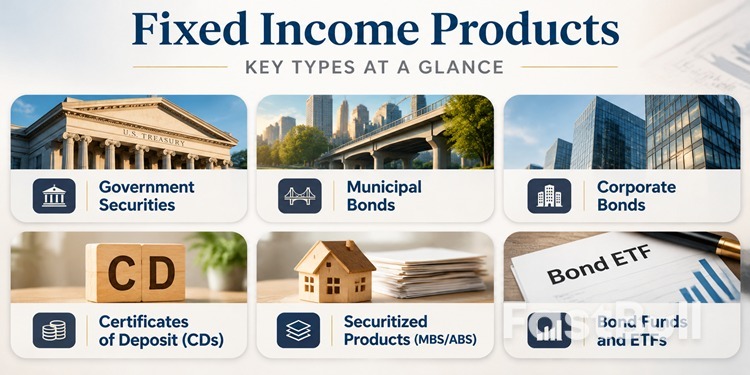
Các sản phẩm thu nhập cố định bao gồm từ trái phiếu chính phủ ngắn hạn đến trái phiếu doanh nghiệp và các quỹ đầu tư tập thể. Sự khác biệt chính nằm ở đối tượng phát hành, cách thức tạo ra thu nhập, thời điểm đáo hạn và rủi ro mà nhà đầu tư phải gánh chịu.
Chứng khoán Kho bạc Hoa Kỳ
U.S. Treasury securities are debt instruments issued by the federal government. Common types include:
- Treasury Bills (T-Bills): Short-term securities with maturities of 4 to 52 weeks. They are generally sold at a discount and pay face value at maturity.
- Treasury Notes (T-Notes): Securities with maturities of 2, 3, 5, 7, or 10 years that pay interest every six months.
- Treasury Bonds (T-Bonds): Long-term securities with 20- or 30-year maturities that generally pay interest twice a year.
- Treasury Inflation-Protected Securities (TIPS): Securities whose principal adjusts with changes in the Consumer Price Index for All Urban Consumers (CPI-U). Interest is calculated on the adjusted principal, so payment amounts can change.
Treasury securities are backed by the full faith and credit of the U.S. government. Their interest is generally subject to federal income tax but exempt from state and local income taxes. See TreasuryDirect's overview of marketable securities for product details.
Municipal Bonds
Municipal bonds are issued by states, cities, counties, and public authorities to finance projects such as schools, roads, hospitals, and utilities. Two common types are:
- General Obligation Bonds: Supported by the issuer's taxing power or general revenues.
- Revenue Bonds: Repaid primarily from revenue generated by a specific project or service, such as a toll road or water system.
Interest on many municipal bonds is exempt from federal income tax, and it may also be exempt from state and local taxes for residents of the issuing state. Tax treatment varies: some municipal bond interest is taxable or may affect the alternative minimum tax (AMT). Check the bond's official documents and your tax situation. The IRS guidance on investment income explains the general rules.
Corporate Bonds
Companies issue corporate bonds to finance expansion, acquisitions, refinancing, and operations. Investors receive interest under the bond terms, and the company is expected to repay principal at maturity.
- Investment-Grade Bonds: Have higher credit ratings and generally lower perceived default risk, so they often offer lower yields.
- High-Yield Bonds: Have lower credit ratings and greater default risk. They generally offer higher yields to compensate investors for taking that risk.
A higher yield is not automatically a better deal. It may reflect a greater chance that the issuer will miss interest payments or fail to repay principal.
Certificates of Deposit (CDs)
Certificates of deposit are bank deposits that pay interest in exchange for keeping money deposited for an agreed term. Early withdrawal from a traditional CD may trigger a penalty.
- Traditional CDs: Purchased directly from a bank, usually with a stated interest rate and maturity date.
- Brokered CDs: Issued by banks but purchased through brokerage firms. They may be sold in a secondary market before maturity, and the sale price can be above or below the amount invested.
CDs at FDIC-insured banks are generally covered up to $250,000 per depositor, per insured bank, per ownership category, subject to FDIC rules. Coverage is aggregated with other deposits in the same category at that bank. Brokered CD investors should check the issuing bank and available coverage. The FDIC deposit insurance overview explains the limits and eligible deposits.
Agency Bonds and Securitized Products
Agency bonds are issued by federal agencies or government-sponsored enterprises (GSEs). Their backing varies by issuer, and not all carry the full faith and credit guarantee of the U.S. government.
Securitized products are created by pooling loans or other financial assets and issuing securities backed by the cash flows from those assets. Examples include:
- Mortgage-Backed Securities (MBS): Backed by pools of residential or commercial mortgages. Investor payments come from mortgage principal and interest.
- Asset-Backed Securities (ABS): Backed by assets such as auto loans, credit card receivables, or student loans.
Cash flows can be affected by borrower defaults, early repayments, and changes in interest rates.
Bond Mutual Funds and ETFs
Bond mutual funds and exchange-traded funds pool investors' money to buy portfolios of government, corporate, municipal, or other debt securities. They can provide diversification and access to bonds without requiring investors to select each security themselves.
Bond ETFs trade on exchanges during market hours. Mutual funds generally transact once each business day at their net asset value (NAV). Both can fluctuate in value, charge fees, and make distributions that vary. Unlike an individual bond held to maturity, a typical bond fund does not promise to return a fixed principal amount on a specific date.
Other Fixed Income Instruments
Institutional fixed income markets also include instruments such as:
- Commercial Paper: Short-term, generally unsecured corporate debt used to fund operating expenses and other near-term needs.
- Bank Loans: Loans to businesses. Many institutional loan investments have floating rates, so interest payments can change as benchmark rates move.
Fixed Income Products: Examples and Key Differences
The table below compares common products by how they generate income and what distinguishes them.
| Product | Income Source | Key Characteristic |
|---|---|---|
| Treasury Bills | Discount to face value | Short-term U.S. government debt |
| Treasury Bonds | Coupon payments | Long-term U.S. government debt |
| Municipal Bonds | Interest payments | Potential tax advantages |
| Corporate Bonds | Coupon payments | Credit risk varies by issuer |
| CDs | Interest payments | Bank deposit with a stated term |
| Bond ETFs | Portfolio income and distributions | Diversified bond exposure |
Consider a corporate bond with a $1,000 face value and a 5% annual coupon. It pays $50 in interest each year, often in two $25 installments. If the investor buys it for $950, the current yield is about 5.26% ($50 ÷ $950).
The coupon rate, current yield, and yield to maturity (YTM) measure different things:
- Coupon Rate: Annual coupon interest divided by the bond's face value.
- Current Yield: Annual coupon interest divided by the bond's current market price.
- Yield to Maturity: The estimated annualized return if the bond is held until maturity, taking into account coupon payments and the difference between its purchase price and the amount repaid at maturity, assuming the issuer makes the required payments.
What Risks Should Investors Understand?
Fixed income products can offer more predictable cash flows than some investments, but they are not risk-free. The main risks depend on the issuer, maturity, structure, and market conditions.
Interest Rate Risk
Market interest rates and the prices of existing fixed-rate bonds generally move in opposite directions. When rates rise, older bonds with lower coupons become less attractive and their market prices tend to fall. Longer-maturity bonds are usually more sensitive to rate changes.
Credit and Default Risk
Credit risk is the possibility that an issuer will fail to make interest payments or repay principal. Lower-rated corporate bonds generally carry greater default risk than investment-grade bonds. Credit ratings help assess risk, but they are opinions, not guarantees.
Inflation, Liquidity and Reinvestment Risks
Inflation reduces the purchasing power of fixed payments. Liquidity risk arises when a security is difficult to sell without accepting a lower price. Reinvestment risk occurs when coupon or principal payments must be reinvested at lower rates. Callable bonds and mortgage-backed securities can also expose investors to early repayment, which may force them to reinvest sooner than expected.
How Do You Choose the Right Fixed Income Product?
The right product depends on when you need the money, how much risk you can accept, and whether you prioritize income, liquidity, or tax treatment.
Match the Product to Your Investment Timeline
Investors who need their money soon may compare Treasury bills or short-term CDs. Those seeking longer-term income may consider Treasury notes, corporate bonds, or municipal bonds. Bond funds can provide ongoing exposure without requiring investors to choose individual maturity dates.
Compare Yields, Credit Quality and Tax Treatment
Không nên so sánh các sản phẩm chỉ dựa trên lợi suất danh nghĩa. Hãy xem xét chất lượng tín dụng, thời hạn đáo hạn, phí, tính thanh khoản và thu nhập sau thuế. Đối với trái phiếu đô thị, lợi suất tương đương thuế có thể giúp so sánh thu nhập miễn thuế với các lựa chọn chịu thuế, nhưng kết quả phụ thuộc vào bậc thuế của nhà đầu tư và các quy định thuế của tiểu bang.
Trái phiếu riêng lẻ so với quỹ thu nhập cố định
Trái phiếu riêng lẻ có các điều khoản thanh toán và ngày đáo hạn được quy định rõ ràng. Nếu tổ chức phát hành đáp ứng các nghĩa vụ của mình và nhà đầu tư nắm giữ trái phiếu đến khi đáo hạn, vốn gốc thường được hoàn trả theo mệnh giá. Quỹ trái phiếu mang lại sự đa dạng hóa và khả năng tiếp cận danh mục đầu tư dễ dàng hơn, nhưng giá cổ phiếu của chúng biến động và chúng thường không có ngày đáo hạn hoặc cam kết hoàn trả khoản đầu tư ban đầu.
Câu hỏi thường gặp về các sản phẩm thu nhập cố định
Trái phiếu có được coi là sản phẩm thu nhập cố định không?
Đúng vậy. Trái phiếu chính phủ, trái phiếu đô thị và trái phiếu doanh nghiệp là những sản phẩm thu nhập cố định phổ biến. Chúng thường trả lãi theo các điều khoản đã định và được thiết kế để hoàn trả vốn gốc khi đáo hạn, tùy thuộc vào khả năng thanh toán của tổ chức phát hành.
Các khoản vay có phải là thu nhập cố định không?
Các khoản vay có thể thuộc thị trường thu nhập cố định khi nhà đầu tư nắm giữ các khoản nợ phát sinh lãi và gốc theo hợp đồng. Một số khoản vay có lãi suất thả nổi, do đó các khoản thanh toán thay đổi theo lãi suất chuẩn.
Các sản phẩm thu nhập cố định trong lĩnh vực ngân hàng đầu tư là gì?
Trong lĩnh vực ngân hàng đầu tư, các sản phẩm thu nhập cố định thường bao gồm các chứng khoán nợ và các công cụ liên quan mà các tổ chức phát hành, cấu trúc, giao dịch hoặc phân phối. Ví dụ bao gồm trái phiếu chính phủ và doanh nghiệp, nợ đô thị, chứng khoán thế chấp và các sản phẩm tín dụng cấu trúc khác.
Quỹ thu nhập cố định là gì?
Quỹ thu nhập cố định là một quỹ tương hỗ hoặc quỹ ETF đầu tư chủ yếu vào các chứng khoán nợ, chẳng hạn như trái phiếu chính phủ, trái phiếu doanh nghiệp hoặc trái phiếu đô thị. Nó cung cấp khả năng tiếp cận với danh mục đầu tư thu nhập cố định, nhưng giá trị thị trường và lợi nhuận phân phối của nó có thể thay đổi.