- XAUUSD
- XAGUSD
- WTI
- USDX


Thị trường
Phân tích
Người dùng
24x7
Lịch kinh tế
Học tập
Dữ liệu
- Tên
- Mới nhất
- Trước đây










Hãy đọc bài đánh giá Lucid Trading này để tìm hiểu về các quy tắc, loại tài khoản, khoản thanh toán, phí, điểm Trustpilot và liệu công ty giao dịch hợp đồng tương lai này có hợp pháp vào năm 2026 hay không.
Lucid Trading là một công ty giao dịch hợp đồng tương lai đang phát triển nhanh chóng, được xây dựng dành cho các nhà giao dịch muốn có quyền truy cập giao dịch được cấp vốn mà không cần mở tài khoản môi giới truyền thống. Bài đánh giá Lucid Trading này sẽ giải thích những gì công ty cung cấp, cách thức hoạt động của các quy tắc, những điểm phức tạp về thanh toán và phí, và liệu đây có phải là một lựa chọn hợp pháp cho các nhà giao dịch hợp đồng tương lai vào năm 2026 hay không.
Trong bài đánh giá Lucid Trading này, chúng ta sẽ đề cập đến:
Lucid Trading là một công ty giao dịch hợp đồng tương lai chuyên nghiệp, ra mắt năm 2025. Công ty cung cấp các chương trình đánh giá và tài khoản được cấp vốn cho các nhà giao dịch hợp đồng tương lai, thay vì các tài khoản môi giới truyền thống nơi người dùng gửi và giao dịch bằng vốn của chính họ. Các nhà giao dịch trả phí để truy cập tài khoản, tuân thủ các quy tắc rủi ro của Lucid Trading và có thể đủ điều kiện nhận thanh toán nếu đáp ứng các yêu cầu về hiệu suất của công ty.
Các tài liệu pháp lý công khai xác định thực thể điều hành là Lucid Trading Group LLC, mặc dù công ty không công khai thông tin người sáng lập trên trang web chính thức của mình. Điều này giúp việc xác minh thực thể pháp lý dễ dàng hơn so với việc xác minh người sáng lập hoặc lý lịch quản lý, điều mà các nhà giao dịch nên lưu ý khi đánh giá công ty.
Lượng tìm kiếm về Lucid Trading tăng nhanh chóng trong năm 2025 và 2026 chủ yếu là do thương hiệu này xuất hiện trên các trang web liên kết, các bài đánh giá trên YouTube, các trang so sánh công ty giao dịch chứng khoán tự doanh, các trang tìm kiếm mã giảm giá và các cộng đồng giao dịch. Phần lớn sự chú ý đến từ các nhà giao dịch đang tìm kiếm bằng chứng thanh toán, mã giảm giá, giải thích quy tắc và so sánh với các công ty giao dịch chứng khoán tự doanh uy tín như Topstep, Apex và Tradeify.
Lucid Trading dường như là một công ty giao dịch hợp đồng tương lai hoạt động thực sự, nhưng nó không phải là một nhà môi giới được quản lý theo quy định truyền thống. Điểm số cao trên Trustpilot là phản hồi hữu ích, nhưng không nên được coi là bằng chứng cho thấy mọi nhà giao dịch đều đủ điều kiện nhận tiền thắng cược hoặc công ty này được bảo vệ theo quy định ở cấp độ nhà môi giới.
Các tài liệu pháp lý của Lucid Trading xác định Lucid Trading Group LLC là công ty đứng sau dịch vụ này. Mô hình kinh doanh của nó dựa trên các chương trình giao dịch hợp đồng tương lai kiểu tự doanh, tài khoản mô phỏng, quy tắc tài khoản và điều kiện nhận thanh toán, thay vì các dịch vụ môi giới tiêu chuẩn.
Đây là điểm mấu chốt về mặt pháp lý: các nhà giao dịch không nên đánh giá Lucid Trading như thể đó là một nhà môi giới ngoại hối hoặc nhà môi giới hợp đồng tương lai đang nắm giữ tiền gửi của khách hàng. Trong hầu hết các mô hình công ty giao dịch tự doanh, các nhà giao dịch trả phí để được tham gia vào chương trình đánh giá hoặc chương trình được cấp vốn, và khoản thanh toán phụ thuộc vào các điều khoản hợp đồng, việc tuân thủ quy tắc và tình trạng tài khoản. Điều đó không loại bỏ rủi ro; nó chỉ thay đổi nơi rủi ro nằm ở đâu.
Trước khi mua tài khoản, các nhà giao dịch nên kiểm tra Điều khoản sử dụng, thỏa thuận tài khoản, chính sách thanh toán, các quốc gia bị hạn chế và các trang quy tắc trong Hướng dẫn Quy tắc Giao dịch Lucid .
As of June 23, 2026, the reviewed Trustpilot snapshot showed Lucid Trading with 4,309 reviews, a 4.6 out of 5 rating, and a category listing under Alternative Financial Service. That is a strong public-review profile for a newer prop firm, but it still needs context.
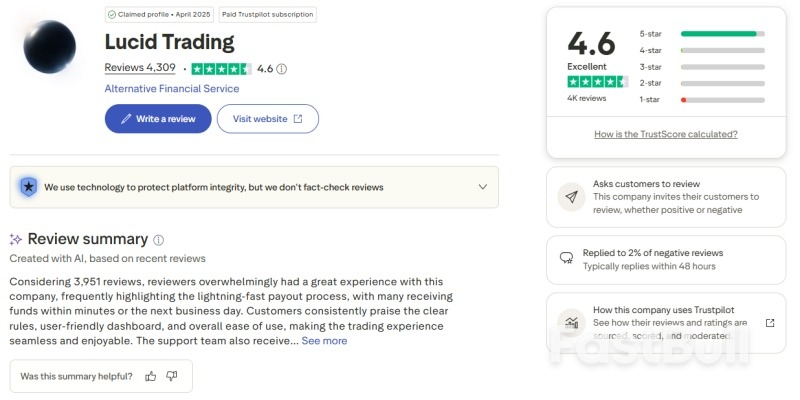
Positive reviews commonly focus on fast payouts, clear rules, a smooth lucid trading dashboard, ease of use, and responsive support. These are important because prop firm users care less about traditional spreads and more about whether the account is understandable, the platform works, and payout requests are handled quickly.
Lower-rated reviews should not be ignored. In prop firm reviews, complaints often involve verification checks, support delays, payout disputes, rule misunderstandings, or disagreement over whether a trading rule was breached. That does not automatically mean the firm is unsafe, but it does mean traders should read the negative reviews as carefully as the five-star comments on Lucid Trading Trustpilot reviews.
The smartest way to judge Lucid Trading is to verify the current rules before paying, because prop firm terms can change faster than old reviews or social media videos. A trader should not rely only on a discount page, influencer review, or one payout screenshot.
| What to Check | Why It Matters |
|---|---|
| Account rules | Drawdown, daily loss limits, and trading restrictions can determine whether the account survives. |
| Country restrictions | Some locations may be blocked or limited, even if a trader can access the website. |
| Payout conditions | Minimum profit, trading days, verification, and payout cycles affect how quickly money can be withdrawn. |
| Consistency rule | A large winning day may delay or reduce payout eligibility if it exceeds the account's allowed percentage. |
| Platform and data fees | Trading platform access, data feed costs, or activation charges can change the real cost of starting. |
| Refund and reset policy | Reset fees, chargeback rules, and refund limits can matter if the account is breached or unused. |
| Identity verification | KYC or payout verification issues can slow down withdrawals if documents do not match account details. |
For the latest account terms, traders should review the Lucid Trading Help Center before purchasing any lucid funded trading account.
Lucid Trading offers several account paths, and the best choice depends on whether you want a lower-cost evaluation, a straight-to-funded model, or an invite-only live capital program. The main options are LucidFlex, LucidPro, LucidDirect, and LucidMaxx.
| Account Type | Best For | Core Structure | Key Rule Difference |
|---|---|---|---|
| LucidFlex | Traders who want a flexible evaluation path | Evaluation first, then funded-style simulated account | LucidFlex funded accounts currently advertise no daily loss limit, no funded-stage consistency rule, and EOD trailing drawdown. |
| LucidPro | Traders who want a more traditional prop firm evaluation model | Evaluation account with upgrade to funded account after meeting objectives | LucidPro funded payouts use a 40% consistency percentage and may include buffer balance requirements. |
| LucidDirect | Traders who want to skip the evaluation phase | Straight-to-funded simulated account | LucidDirect has payout goals, a 20% consistency percentage, and daily loss limit rules on larger accounts. |
| LucidMaxx | Experienced traders invited into a higher-tier live path | Invite-only live futures prop account | LucidMaxx is positioned around instant live capital, daily uncapped payouts, and no daily loss limit. |
LucidFlex is the more flexible evaluation-style route for traders who want to prove consistency before moving into a funded-style account. According to Lucid Trading's Help Center, LucidFlex evaluation accounts use profit targets, max loss limits, and a 50% consistency requirement during the evaluation stage.
The important difference comes after funding. LucidFlex funded accounts are described as simulated futures trading accounts with a 90/10 profit split, EOD trailing drawdown, no daily loss limit, no funded-stage consistency percentage, and no payout buffer. That makes LucidFlex more attractive for traders who dislike strict daily loss limits but can still manage end-of-day drawdown risk.
LucidPro is better suited to traders who are comfortable with a more structured prop firm model. It uses an evaluation-to-funded path and has payout requirements that include minimum profit, consistency rules, and buffer balance thresholds.
The key rule to understand is the LucidPro consistency percentage. LucidPro funded accounts require the largest single-day profit to be no more than 40% of total profit during the payout cycle. This can be fair for steady traders, but it can delay payout eligibility for traders who make most of their profit in one unusually large day.
LucidDirect is the straight-to-funded option. Instead of passing an evaluation first, traders purchase a LucidDirect account and begin building simulated capital toward payout eligibility immediately.
This account type can appeal to confident traders who do not want a separate challenge phase. The trade-off is that LucidDirect has stricter payout math than it may first appear: the Help Center lists a 20% consistency percentage, payout profit goals, minimum payout requirements, and daily loss limit rules for larger account sizes.
LucidMaxx is not a standard account that every new user can simply choose at checkout. Lucid describes it as an invite-only live futures prop account designed for selected traders.
The main appeal is clear: LucidMaxx is positioned around instant live capital, daily payout requests, no payout caps, up to five accounts, no daily loss limit, and end-of-day drawdown. Because it is invite-only, traders should not treat LucidMaxx as the normal starting point for a lucid funded trading journey.
The best Lucid Trading account depends on your trading style, risk tolerance, and payout expectations. Most traders should choose based on rules first, price second.
For most newer traders, LucidFlex will likely be easier to understand than LucidDirect because the payout structure is less punishing once the funded account is reached. For aggressive traders, however, any account can become difficult if position sizing ignores drawdown, daily loss limits, or the consistency rule.
Lucid Trading rules matter because they determine whether profits are actually withdrawable. A trader can be profitable on the chart and still fail to qualify for a payout if the account violates drawdown limits, daily loss limits, consistency requirements, trading-time rules, or prohibited-strategy rules.
The safest approach is to read the latest Lucid Trading rules before buying an account or requesting a payout.
Lucid Trading's main risk controls work in different ways. Drawdown protects the account from total loss, the daily loss limit controls how much can be lost in one session, and the consistency rule checks whether profits were earned steadily instead of from one oversized trading day.
| Rule | What It Controls | Why It Affects Payouts |
|---|---|---|
| EOD drawdown | The account's maximum loss limit based on end-of-day balance calculations | If the account hits the max loss limit, the account may be liquidated or fail. |
| Daily loss limit | The maximum amount a trader can lose in one trading session | In Lucid's current wording, daily loss limit breaches can restrict trading until the next session if the max loss limit has not been reached. |
| Consistency percentage | The share of total profit made on the biggest winning day | If one day accounts for too much profit, the trader may need to keep trading before becoming payout eligible. |
Here is the simple consistency-rule trap. If a LucidPro trader has $4,000 in account profit and the largest single-day profit is $1,000, the consistency percentage is 25%. That is under the LucidPro 40% limit. But if the largest day is $2,000 out of $4,000 total profit, the percentage is 50%, so the trader may need more qualifying profit before requesting a payout.
This is why the answer to "does Lucid Trading have a consistency rule" is not one-size-fits-all. LucidPro, LucidDirect, LucidFlex evaluation accounts, and LucidMaxx rules can differ. Traders should verify the current LucidPro consistency percentage and LucidFlex drawdown rules before trading.
Lucid Trading appears more flexible than some futures prop firms on news trading, but it still restricts strategies that look unrealistic or system-abusive. Its Help Center says news trading is allowed, while traders remain responsible for volatility, slippage, and execution outcomes during news-driven markets.
Scalping is more nuanced. Genuine scalping is permitted, but microscalping is prohibited when it appears designed to exploit simulated fills rather than reflect realistic market activity. Lucid's Help Center says accounts may be flagged when more than 50% of profits come from trades held for five seconds or less.
Overnight positions depend on account status. For LucidPro, LucidFlex, and LucidDirect accounts, Lucid states that all positions must be closed by 4:45 PM EST Monday through Friday, and open positions may be automatically closed. LucidLive accounts are different: swing trading and overnight holds may be allowed if the trader meets live-account margin and onboarding requirements.
Older Lucid Trading reviews may be outdated because the firm has changed account structures, live-trading paths, payout terms, and legacy account pages over time. A video or blog post from early 2025 may not reflect the current LucidFlex, LucidPro, LucidDirect, or LucidMaxx rules.
This matters most before paying, resetting, upgrading, or requesting a payout. A trader who follows an old rule summary may misunderstand the current consistency percentage, payout goal, allowed trading times, or live-account transition process.
Before relying on any lucid trading review, discount page, or social media claim, traders should check the latest articles in the Lucid Trading Help Center. If you are using an older LucidFlex structure, also check whether any LucidFlex legacy rules still apply to your account.
Lucid Trading payouts are one of the firm's biggest selling points, but the real answer depends on account type, payout cycle, consistency rules, and whether the account falls under newer or legacy terms. Traders should read the current payout page before assuming every profit dollar is immediately withdrawable.
Lucid Trading's current funded account payout structure is generally a 90/10 split, meaning the trader keeps 90% of approved payouts and Lucid Trading keeps 10%.
The "first $10,000 rule" needs careful wording. According to LucidPro payout terms, accounts purchased or reset before November 28, 2025 at 3:00 PM EST may still be eligible for 100% of the first $10,000. Newer accounts should not assume that legacy benefit applies unless the lucid trading dashboard or official account terms confirm it.
| Payout Term | What It Means | Why Traders Should Care |
|---|---|---|
| 90/10 split | Trader keeps 90% of approved payout amounts. | This is the standard structure for many current Lucid funded trading accounts. |
| First $10,000 rule | Legacy LucidPro accounts may keep 100% of the first $10,000. | This appears tied to older purchase or reset dates, not every new account. |
| Minimum payout | Several account types list a $500 minimum payout request. | Small profits may not be withdrawable until minimum thresholds are met. |
A payout cycle at Lucid Trading is not just "make money, click withdraw." The account must meet payout rules, stay above required thresholds, and avoid violations before the request is approved.
| Cycle | What the Trader Does | What Can Delay the Payout |
|---|---|---|
| Cycle 1 | Build enough profit to meet the minimum payout goal and trading-day requirements. | A single oversized winning day may break the consistency percentage. |
| Cycle 2 | Repeat the payout requirements after the previous payout resets the cycle. | Trading after requesting a payout may cause denial if profits drop below the required level. |
| Cycle 3 | Continue building payout history while staying within drawdown and trading restrictions. | Max payout caps, account-size limits, or rule breaches can reduce or block withdrawal eligibility. |
For example, a LucidPro trader may hit the profit goal but still be ineligible if the largest single-day profit is more than 40% of total profit in that payout cycle. A LucidDirect trader may face an even tighter 20% consistency percentage, so the same trading result could qualify on one account type and fail on another.
Lucid Trading markets itself around fast payouts, but withdrawal speed depends on both account approval and payout method. The Help Center lists Plaid for instant bank transfers for U.S.-based traders, WorkMarket by ADP for U.S. and international traders, and crypto options for international traders.
| Account Type | Payout Timing Notes | Main Watchout |
|---|---|---|
| LucidFlex | Up to 5 payouts may be taken from each LucidFlex account before moving live. | Maximum payout requests are limited by account size and may be capped at 50% of profit up to a dollar limit. |
| LucidPro | Payouts depend on minimum profit, consistency, and buffer rules. | The 40% consistency rule can delay payout eligibility. |
| LucidDirect | No fixed payout window is listed after all eligibility criteria are met. | The 20% consistency rule and profit goals are stricter than many traders expect. |
| LucidMaxx | LucidMaxx is positioned around daily, uncapped payout requests. | It is invite-only and should not be treated as a normal beginner account. |
Lucid Trading does not appear to rely on monthly rebilling for its main simulated account fees, but the real cost can still be higher than the checkout price. The hidden cost is usually not a surprise subscription; it is the cost of resets, missed payout eligibility, account-rule mistakes, and trading conditions that force a trader to keep working before withdrawal.
Lucid Trading's Help Center says LucidPro Evaluation and LucidDirect accounts use a one-time fee model with no subscription and no automatic rebilling. It also says there is no activation fee to upgrade a LucidPro Evaluation to a LucidPro Funded account.
That is good for traders who dislike recurring fees. The catch is that resets are not automatic or free, and some payout models include buffer or profit-over-balance requirements. In plain English, a trader may pass the headline challenge but still need enough profit cushion to request and receive a payout safely.
The biggest hidden cost in Lucid Trading is time. A trader may make enough profit on paper but still need more trades because the largest winning day is too large relative to total profit.
Example: if a LucidPro trader makes $4,000 total profit and $2,000 came from one day, the largest day equals 50% of total profit. Since LucidPro's newer funded consistency rule is 40%, the trader may need to keep trading before becoming eligible. That extra trading creates new risk because losses can reduce profit, hit drawdown, or push the account below payout requirements.
Lucid Trading promo code searches are common because prop firm pricing changes often. A lucid trading code may reduce the upfront account price, but it does not change the rule structure unless the official checkout terms say so.
Traders should compare the discounted price against the full economic cost:
A discount helps only if the account rules match the trader's actual strategy. A cheaper account with stricter payout rules can be more expensive than a higher-priced account with cleaner withdrawal conditions.
Lucid Trading is strongest for futures traders who value fast account activation, flexible account choices, and a modern dashboard. Its main weaknesses are rule complexity, payout conditions, and the fact that it is a prop firm rather than a regulated broker.
| Pros | Cons |
|---|---|
| Multiple account types for different trading styles | Rules vary by account type and can confuse beginners |
| 90/10 profit split on many current funded accounts | Legacy 100% first $10,000 terms may not apply to newer accounts |
| No monthly rebilling on listed simulated account fees | Resets are not free or automatic |
| LucidFlex funded accounts currently have no daily loss limit and no funded consistency percentage | Other accounts may have strict consistency percentages and payout goals |
| News trading is allowed under current permitted-activity guidance | Microscalping, hedging, and HFT are prohibited |
| Strong public-review profile on Trustpilot | Trustpilot reviews do not replace reading official account agreements |
Lucid Trading is best for futures traders who already understand prop firm risk controls and can adapt their strategy to payout rules. It is not ideal for traders who want unrestricted trading, broker-level protections, or guaranteed withdrawals after one big winning day.
Lucid Trading competes in a crowded futures prop firm market where payout rules matter more than advertising claims. Topstep is the older and more established brand, Apex is known for aggressive account access and frequent promotions, and Tradeify markets itself around clear rules and live-capital progression.
| Firm | Best Known For | Payout Structure | Rule Style | Best Fit |
|---|---|---|---|---|
| Lucid Trading | Fast payouts, multiple account types, LucidFlex and LucidDirect options | Commonly 90/10, with some legacy first-$10,000 terms for older accounts | Rules vary heavily by account type | Traders who want account flexibility and can read payout terms carefully |
| Topstep | Established futures prop firm brand and structured trader development | Commonly 90/10 under newer terms, with payout milestones in funded accounts | More standardized and reputation-driven | Traders who prefer a mature brand and clearer long-term pathway |
| Apex Trader Funding | Large account access, frequent discounts, and fast challenge-style entry | Often promoted around 100% requested rewards or legacy 100% first-$25,000 terms depending on product | Promotion-heavy, with detailed payout and safety-net rules | Traders who want low upfront pricing and can manage strict payout conditions |
| Tradeify | Simple messaging, EOD drawdowns, and live-capital positioning | Often positioned around 90% split depending on product | Markets itself around no hidden rules and clear account paths | Traders who want a newer alternative with simpler public messaging |
Lucid Trading wins when traders want flexibility. LucidFlex, LucidPro, LucidDirect, and LucidMaxx serve different trader profiles, and the firm has built strong search interest around fast payouts, dashboard usability, and funded futures access.
Lucid does not win for every trader. Its account structure can feel complex, and the best account depends heavily on consistency rules, payout caps, drawdown style, and whether the trader is in a simulated or live phase. Topstep may feel safer for traders who value brand history, Apex may appeal to discount-driven traders, and Tradeify may appeal to traders who want simpler marketing and rule presentation.
The practical verdict is simple: choose Lucid Trading only if the specific account rules match your trading style. Do not choose it only because of a lucid trading promo code, a high Trustpilot score, or one fast payout screenshot.
Yes, Lucid Trading appears to be a real futures prop firm, but it is not a traditional regulated broker. Traders should verify the latest legal terms, payout rules, and account restrictions before buying any account.
The cost to start depends on the account type, account size, and any active Lucid Trading promo code. The real cost can also include resets, platform or data-related fees, and the time needed to meet payout rules.
Lucid Trading payouts can be fast after the account meets all eligibility rules and the request is approved. Withdrawal speed depends on the account type, verification status, and payout method such as Plaid, WorkMarket, or crypto.
A Lucid Trading payout can be denied if the trader violates rules, misses the profit goal, fails the consistency percentage, drops below required balance levels, or trades after submitting a request and loses eligibility. Payout requests are usually final once submitted, so traders should check every requirement first.
LucidFlex is likely the best Lucid Trading account for many traders because its funded stage has no daily loss limit, no consistency rule, and no payout buffer under current terms. LucidPro suits structured evaluation traders, LucidDirect suits traders who want to skip evaluation, and LucidMaxx is only for invited traders.
Lucid Trading đáng để cân nhắc trong năm 2026 nếu bạn muốn một công ty giao dịch hợp đồng tương lai có tốc độ thanh toán nhanh, nhiều loại tài khoản và giao diện hiện đại, nhưng nó không phải là con đường tắt không rủi ro để giao dịch có vốn. Công ty này trông có vẻ hợp pháp như một công ty giao dịch hợp đồng tương lai đang hoạt động, tuy nhiên các nhà giao dịch vẫn cần hiểu rõ về mức thua lỗ tối đa, giới hạn thanh toán, quy tắc nhất quán và các hạn chế cụ thể của từng loại tài khoản trước khi thanh toán.
Nền tảng này phù hợp nhất với nhà giao dịch hợp đồng tương lai có kỷ luật, có thể giao dịch ổn định, tránh các chiến thuật bị cấm và xác minh các quy tắc mới nhất trực tiếp từ Lucid Trading trước khi yêu cầu thanh toán. Nếu chiến lược của bạn phụ thuộc vào những ngày thắng lớn, vị thế qua đêm, phòng ngừa rủi ro hoặc các lệnh mô phỏng cực ngắn, Lucid có thể sẽ gây cảm giác hạn chế ngay cả khi giá cả ban đầu trông hấp dẫn.
Về bài đánh giá này: Bài đánh giá Lucid Trading này được thực hiện dựa trên nghiên cứu độc lập và đối chiếu với các nguồn chính thức, điều khoản tài khoản và phản hồi từ người dùng công khai. Chúng tôi không nhận được bất kỳ khoản thanh toán nào từ Lucid Trading, và công ty này không có quyền kiểm soát biên tập đối với bài viết này. Luôn luôn xác minh các quy tắc, phí, điều khoản thanh toán và hạn chế quốc gia mới nhất trên trang web chính thức của Lucid Trading trước khi mua tài khoản.

728 RM B 7/F GEE LOK IND BLDG NO 34 HUNG TO RD KWUN TONG KLN HONG KONG





Giao dịch các công cụ tài chính như cổ phiếu, tiền tệ, hàng hóa, hợp đồng tương lai, trái phiếu, quỹ hoặc tiền kỹ thuật số tiềm ẩn mức độ rủi ro cao, bao gồm rủi ro mất một phần hoặc toàn bộ vốn đầu tư, và có thể không phù hợp với mọi nhà đầu tư.
Trước khi quyết định giao dịch các công cụ tài chính hoặc tiền điện tử, bạn cần hiểu đầy đủ về rủi ro và chi phí giao dịch trên thị trường tài chính, thận trọng cân nhắc đối tượng đầu tư, và tiến hành tư vấn chuyên môn cần thiết. Dữ liệu trên trang web này không nhất thiết là theo thời gian thực hay chính xác. Dữ liệu và giá cả trên trang web không nhất thiết là thông tin do bất kỳ sở giao dịch nào cung cấp, nhưng có thể được cung cấp bởi các nhà tạo lập thị trường. Bạn chịu trách nhiệm hoàn toàn về tất cả quyết kết giao dịch bạn đã thực hiện. Chúng tôi không chấp nhận bất cứ nghĩa vụ nào trước bất kỳ tổn thất hay thiệt hại nào xảy ra từ kết quả giao dịch của bạn, hoặc trước việc bạn dựa vào thông tin có trong trang web này.
Bạn không được phép sử dụng, lưu trữ, sao chép, hiển thị, sửa đổi, truyền hay phân phối dữ liệu có trên trang web này và chưa nhận được sự cho phép rõ ràng bằng văn bản của Trang web này. Tất cả các quyền sở hữu trí tuệ đều được bảo hộ bởi các nhà cung cấp và/hoặc sở giao dịch cung cấp dữ liệu có trên trang web này.
Chưa đăng nhập
Đăng nhập để xem nội dung nhiều hơn


Đăng nhập
Đăng ký