


- USDX
- XAUUSD
- XAGUSD
- WTI


Thị trường
Phân tích
Người dùng
24x7
Lịch kinh tế
Học tập
Dữ liệu
- Tên
- Mới nhất
- Trước đây













 Lịch kinh tế



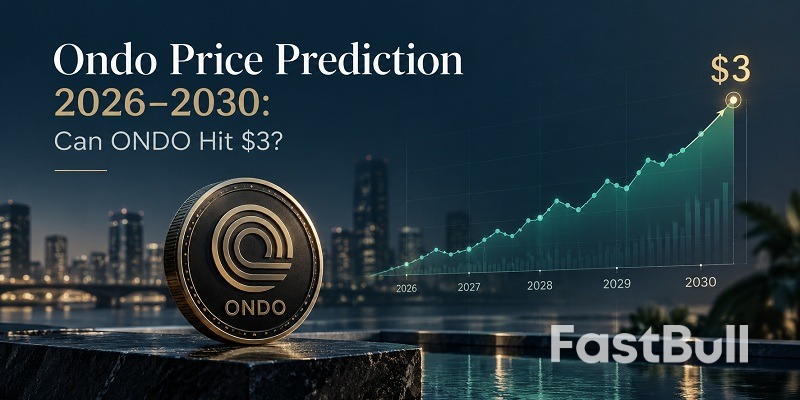
Dự đoán giá ONDO giai đoạn 2026–2030: Liệu có thể đạt 3 đô la? Khám phá dự báo giá từng năm, tiềm năng tăng trưởng RWA, các token được mở khóa và những rủi ro lớn nhất phía trước.
Ondo Finance đang đưa các tài sản tài chính truyền thống lên blockchain, nhưng liệu giá của ONDO có thể theo kịp sự phát triển của thị trường tài sản thực (RWA) hay không? Với việc mở khóa token, sự chấp nhận của các tổ chức và sự biến động của thị trường tiền điện tử định hình tương lai của nó, việc đạt được mức giá 3 đô la là điều không hề chắc chắn. Dự báo giá ONDO cho giai đoạn 2026–2030 này sẽ xem xét các mục tiêu giá thực tế, các chất xúc tác tiềm năng và những rủi ro mà nhà đầu tư không nên bỏ qua.
Những điểm chính cần ghi nhớ
Mục lục
Ondo Finance là một nền tảng dựa trên blockchain tập trung vào việc đưa các tài sản tài chính truyền thống vào tài chính phi tập trung (DeFi). Token gốc của nó, ONDO, đã thu hút sự chú ý khi các nhà đầu tư tìm kiếm cơ hội tiếp cận với lĩnh vực tài sản thực (RWA) đang phát triển. Tuy nhiên, hiệu suất thị trường của ONDO vẫn gắn bó chặt chẽ với các xu hướng tiền điện tử rộng hơn.
Được thành lập vào năm 2021, Ondo Finance chuyên về mã hóa tài sản truyền thống, bao gồm trái phiếu kho bạc Mỹ và cổ phiếu. Các sản phẩm như USDY, OUSG và Ondo Stocks nhằm mục đích đưa các công cụ tài chính truyền thống lên mạng lưới blockchain.
ONDO chủ yếu đóng vai trò là token quản trị cho Ondo DAO, cho phép người nắm giữ tham gia vào các quyết định liên quan đến các thông số và nâng cấp giao thức. Nó có nguồn cung tối đa 10 tỷ token, và không có kế hoạch lạm phát.
Điều quan trọng cần lưu ý là, việc nắm giữ ONDO không tự động mang lại cho nhà đầu tư doanh thu hoặc lợi nhuận được tạo ra từ các sản phẩm tài chính được mã hóa của Ondo. Giá trị dài hạn của nó phụ thuộc một phần vào việc liệu sự phát triển của hệ sinh thái có dẫn đến nhu cầu mạnh mẽ hơn đối với token hay không.
Tính đến ngày 26 tháng 10 năm 2026, ONDO được giao dịch ở mức khoảng 0,40 đô la , với vốn hóa thị trường khoảng 1,95 tỷ đô la và khoảng 4,87 tỷ token đang lưu hành.
ONDO đạt mức cao nhất mọi thời đại khoảng 2,14 đô la vào tháng 12 năm 2024 , đưa giá hiện tại của nó thấp hơn khoảng 81% so với mức đỉnh đó.
Diễn biến giá gần đây khá yếu, với ONDO giảm khoảng 25% trong tháng qua. Điều này phản ánh sự biến động liên tục của thị trường và sự không chắc chắn xung quanh lĩnh vực tiền điện tử.
For investors evaluating the ONDO price prediction for 2026–2030, the key question is whether growing institutional adoption of real-world assets can support a sustained price recovery despite market volatility and future token unlocks.
ONDO's future price will depend on how quickly the real-world asset (RWA) market expands, whether Ondo Finance attracts sustained institutional adoption, and how the cryptocurrency market responds to upcoming token unlocks.
The following ONDO price predictions use three scenarios: bullish, neutral, and bearish. These estimates consider RWA market growth, ONDO's token release schedule, and broader crypto market cycles. They are illustrative price ranges rather than guaranteed targets or statistically calculated forecasts.
With just over two months remaining in 2026, ONDO's short-term outlook depends largely on market sentiment and whether its price can recover from recent weakness. Trading near $0.40 in late October, ONDO faces three possible year-end scenarios:
Overall, a year-end price between $0.35 and $0.55 appears more reasonable under neutral assumptions than an immediate return to ONDO's previous all-time high.
2027: Token supply will be an important challenge. Approximately 1.71 billion ONDO tokens are scheduled to unlock in January 2027, potentially increasing the amount available for trading. Under a neutral scenario, ONDO could finish the year between $0.40 and $0.75. Strong institutional demand and a favorable crypto market could support a bullish range of $0.80–$1.40, while persistent selling pressure could keep prices around $0.18–$0.40.
2028: If tokenized financial products gain wider adoption and demand for RWA-related crypto assets strengthens, ONDO could move toward $0.55–$1.10 in the neutral scenario. A stronger market cycle could lift prices to $1.20–$2.00, although further token releases and weak market conditions could limit ONDO to $0.18–$0.45.
2029: With the current token vesting schedule expected to conclude in January 2029, investors may gain greater visibility into ONDO's long-term circulating supply. Under neutral conditions, ONDO could reach $0.70–$1.40. A sustained RWA expansion and strong crypto market could support $1.60–$2.70, while a bearish environment might keep the token near $0.20–$0.55.
These projections assume that Ondo Finance continues developing its ecosystem. However, growing adoption of tokenized assets does not automatically increase demand for ONDO itself.
By 2030, ONDO's price could depend more heavily on whether tokenized securities and other real-world assets become established parts of mainstream financial markets.
In a bullish scenario, ONDO could reach $2.20–$3.50, supported by large-scale RWA adoption, stronger institutional participation, and renewed investor interest in crypto infrastructure tokens.
Under a neutral scenario, ONDO could trade between $0.90 and $1.80, reflecting steady ecosystem growth without a major speculative rally. In a bearish scenario, regulatory obstacles, competition, and weak token demand could keep prices between $0.25 and $0.70.
Therefore, ONDO reaching $3 by 2030 is possible, but it is not our base-case forecast. Achieving that level would require substantial growth in the token's market valuation, particularly as more supply enters circulation.
The table below summarizes our illustrative ONDO year-end price forecasts under different market conditions.
| Year | Bearish Scenario | Neutral Scenario | Bullish Scenario |
|---|---|---|---|
| 2026 | $0.22–$0.35 | $0.35–$0.55 | $0.55–$0.80 |
| 2027 | $0.18–$0.40 | $0.40–$0.75 | $0.80–$1.40 |
| 2028 | $0.18–$0.45 | $0.55–$1.10 | $1.20–$2.00 |
| 2029 | $0.20–$0.55 | $0.70–$1.40 | $1.60–$2.70 |
| 2030 | $0.25–$0.70 | $0.90–$1.80 | $2.20–$3.50 |
Note: All forecasts represent potential year-end trading ranges, not guaranteed outcomes or prices maintained throughout the year. The neutral scenario is the central planning assumption, not a statistically proven most likely outcome. Actual prices may fall outside these ranges.
Market and token supply references: CoinGecko, DefiLlama, and RWA.xyz. Forecast ranges are independent scenario estimates as of October 26, 2026.
ONDO reaching $3 by 2030 isn't out of the question, but it won't be an easy climb. The growing real-world asset (RWA) market gives Ondo Finance room to expand, yet a bigger market doesn't necessarily mean a higher ONDO price. Much will depend on whether that growth translates into lasting demand for the token.
At around $0.40 in October 2026, ONDO would need to gain approximately 650%, or 7.5x its current price, to reach $3. That would also put it roughly 40% above its December 2024 all-time high of $2.14.
But there's another important factor: token supply. ONDO has a maximum supply of 10 billion tokens, and more tokens are scheduled to enter circulation over time.
Here's what a $3 price would mean for ONDO's valuation:
With ONDO's existing token vesting schedule expected to finish in 2029, the $30 billion fully diluted valuation is particularly relevant when looking ahead to 2030. Actual market capitalization would depend on how many tokens are circulating at that point.
In other words, ONDO would need enough buying demand to support a much higher valuation while absorbing additional token supply.
Several developments could help ONDO move toward $3 over the next few years.
Still, there's an important distinction. ONDO is primarily a governance token, so growth in Ondo Finance's products doesn't automatically mean more revenue for token holders or a higher token price.
A $3 ONDO price is possible by 2030, especially if the RWA sector continues expanding and the broader crypto market enters another strong growth cycle. But several things would need to go right, including stronger token demand and limited selling pressure from future unlocks.
In our earlier projections, the bullish 2030 range of $2.20–$3.50 puts $3 within reach. The neutral range of $0.90–$1.80, however, suggests ONDO could still see meaningful growth without reaching that target.
It's difficult to put a reliable percentage on the chances of ONDO reaching $3. The outcome will depend on market conditions, institutional adoption, and how investors respond to changes in token supply.
For now, $3 looks like an ambitious but possible target for 2030, rather than a price investors should count on. Ondo Finance has opportunities in the RWA market, but ONDO still needs sustained demand to turn those opportunities into long-term price growth.
ONDO's price isn't driven by Ondo Finance's progress alone. The growth of tokenized financial assets, upcoming token unlocks, and overall crypto market conditions could all influence where the token trades between 2026 and 2030. Here are three factors worth watching.
The growing demand for tokenized real-world assets could be one of ONDO's biggest long-term opportunities. By bringing U.S. Treasuries, stocks, and other financial products onto blockchain networks, Ondo Finance is positioning itself in a market that increasingly attracts traditional financial institutions.
According to RWA.xyz, the distributed value of tokenized stocks reached approximately $3.52 billion as of October 26, 2026. Ondo is one of the platforms competing for a share of this market.
Institutional partnerships could help expand that reach. In July 2026, Ondo announced a partnership with Japan's SBI Group to bring Japanese equities onchain and distribute tokenized products through SBI's network. Its collaboration with Chainlink also supports the infrastructure needed to connect traditional financial assets with blockchain applications.
These developments are encouraging, but announcements alone won't determine ONDO's price. What matters is whether they lead to more users, greater activity across Ondo's products, and stronger demand for its ecosystem.
Token unlocks are another major factor ONDO investors shouldn't ignore. Although ONDO has a fixed maximum supply of 10 billion tokens, not all of them are currently circulating. As previously locked tokens become available, the additional supply could put pressure on prices if demand doesn't keep up.
As of October 2026, approximately 4.87 billion ONDO tokens are circulating. According to Tokenomics.com, the next major unlock is scheduled for January 18, 2027, with roughly 1.71 billion ONDO set to be released, equivalent to 17.1% of the maximum supply.
Further major unlocks are scheduled for 2028 and 2029. These releases involve tokens allocated to ecosystem growth, protocol development, and early investors.
That doesn't mean every unlocked token will be sold immediately. Some may remain held or be used for ecosystem development. Still, large unlock events can make traders cautious, particularly when the broader market is already weak.
For ONDO's long-term price outlook, the important question is whether demand can grow quickly enough to absorb the increasing supply without putting prolonged pressure on the token's value.
Even with growing institutional interest, ONDO remains sensitive to the wider cryptocurrency market. Bitcoin price movements, investor risk appetite, and shifts in altcoin trading activity can all influence its short-term direction.
With ONDO trading around $0.40 in late October 2026, several price levels are worth monitoring.
On the downside, $0.39–$0.40 is an important near-term support area, where buyers may try to slow further declines. If ONDO falls below this zone, the next levels to watch are around $0.38 and $0.36.
On the upside, $0.43 is a nearby resistance level, followed by the $0.45 area. A sustained move above these levels could signal improving momentum, although stronger buying volume would help confirm any recovery.
These levels are based on daily technical indicators as of October 26, 2026, and can change as new price data becomes available. They are reference points rather than guaranteed turning points.
Looking further ahead, ONDO's ability to recover will depend on more than technical patterns. A healthier crypto market could support a rally, while persistent selling pressure and weak altcoin demand could delay a meaningful recovery.
Ondo Finance has established itself in the growing RWA sector, but that doesn't make ONDO a low-risk investment. Its future price still depends on market demand, regulatory developments, and how well the project handles competition and token supply changes. Investors should consider these risks before making long-term price assumptions.
Regulatory uncertainty remains a major challenge for tokenized financial assets. Unlike typical cryptocurrencies, products backed by stocks or government bonds must also comply with financial regulations. For example, Ondo Stocks is currently unavailable to U.S. users through its global platform, while OUSG has investor eligibility requirements. Changes in securities regulations could affect where and how Ondo's products operate.
Competition is another concern. Ondo isn't the only company bringing traditional assets onto blockchain networks. Established financial firms such as BlackRock, working through Securitize, and Franklin Templeton are also active in tokenization. As more competitors enter the market, Ondo will need to keep attracting users and developing products that stand out.
Tokenomics also matters. ONDO has a maximum supply of 10 billion tokens, but only about 4.87 billion are currently circulating. Around 1.71 billion additional tokens are scheduled to unlock in January 2027. If demand fails to keep pace with the growing supply, ONDO could face selling pressure even if Ondo Finance continues expanding.
There's also the question of how much of Ondo's business growth benefits the token itself. ONDO is primarily used for governance, and holding it doesn't automatically give investors a share of the revenue or yields generated by Ondo's financial products.
Whether ONDO makes more sense as a long-term holding or a short-term trade depends on an investor's goals and tolerance for volatility.
For long-term investors, the main attraction is Ondo's position in the RWA market. If tokenized financial assets become more widely used over the next several years, Ondo Finance could benefit. However, investors also need to consider future token unlocks, competition, and whether growing product adoption will create more demand for ONDO.
For short-term traders, ONDO's price volatility can create opportunities, particularly around major crypto market moves, partnership announcements, and token unlock events. But those same price swings can lead to substantial losses. Monitoring trading volume, support and resistance levels, and broader market sentiment is especially important.
Neither approach guarantees better returns. Long-term holders may have to sit through extended price declines, while active traders face the risk of mistiming the market.
ONDO remains an interesting token to watch as traditional finance moves further onto the blockchain. Still, its long-term success as an investment will depend on more than Ondo Finance's growth alone.
Disclaimer: This article is for informational purposes only and does not constitute financial advice. Cryptocurrency investments are highly volatile, and investors should conduct their own research before making decisions.
ONDO could reach $0.55–$0.80 by the end of 2026 in a bullish market, while a more neutral scenario suggests $0.35–$0.55. Its performance will largely depend on broader crypto market trends and demand for RWA tokens.
Chưa hẳn là quá muộn để mua ONDO, vì token này vẫn đang ở mức giá thấp hơn nhiều so với mức cao nhất mọi thời đại trước đó và lĩnh vực RWA vẫn còn dư địa tăng trưởng. Tuy nhiên, các đợt mở khóa token sắp tới và sự biến động của thị trường tiền điện tử có thể tạo ra thêm rủi ro giảm giá.
ONDO tập trung vào quản trị trong một hệ sinh thái cung cấp trái phiếu kho bạc và cổ phiếu Mỹ được mã hóa, trong khi Maple Finance (SYRUP) liên kết với hoạt động cho vay trên chuỗi và Polymesh (POLYX) hỗ trợ cơ sở hạ tầng blockchain cho các tài sản được quản lý. Mỗi token có những công dụng và yếu tố rủi ro khác nhau.
Trong một thị trường tăng mạnh, ONDO có thể vượt qua mức cao nhất mọi thời đại trước đó là 2,14 đô la, với kịch bản lạc quan năm 2030 của chúng tôi đạt mức 2,20–3,50 đô la. Mức giá 5 đô la hoặc 10 đô la mang tính đầu cơ cao hơn nhiều, ngụ ý mức định giá sau khi pha loãng hoàn toàn lần lượt là 50 tỷ đô la và 100 tỷ đô la.
ONDO có thể là một khoản đầu tư dài hạn đầy hứa hẹn nhưng cũng tiềm ẩn rủi ro cao đối với những người kỳ vọng vào sự tăng trưởng liên tục của các tài sản thực tế được mã hóa. Tuy nhiên, việc mở khóa token, sự không chắc chắn về quy định và lợi ích kinh tế trực tiếp hạn chế của token vẫn là những rủi ro quan trọng.

728 RM B 7/F GEE LOK IND BLDG NO 34 HUNG TO RD KWUN TONG KLN HONG KONG


Giao dịch các công cụ tài chính như cổ phiếu, tiền tệ, hàng hóa, hợp đồng tương lai, trái phiếu, quỹ hoặc tiền kỹ thuật số tiềm ẩn mức độ rủi ro cao, bao gồm rủi ro mất một phần hoặc toàn bộ vốn đầu tư, và có thể không phù hợp với mọi nhà đầu tư.
Trước khi quyết định giao dịch các công cụ tài chính hoặc tiền điện tử, bạn cần hiểu đầy đủ về rủi ro và chi phí giao dịch trên thị trường tài chính, thận trọng cân nhắc đối tượng đầu tư, và tiến hành tư vấn chuyên môn cần thiết. Dữ liệu trên trang web này không nhất thiết là theo thời gian thực hay chính xác. Dữ liệu và giá cả trên trang web không nhất thiết là thông tin do bất kỳ sở giao dịch nào cung cấp, nhưng có thể được cung cấp bởi các nhà tạo lập thị trường. Bạn chịu trách nhiệm hoàn toàn về tất cả quyết kết giao dịch bạn đã thực hiện. Chúng tôi không chấp nhận bất cứ nghĩa vụ nào trước bất kỳ tổn thất hay thiệt hại nào xảy ra từ kết quả giao dịch của bạn, hoặc trước việc bạn dựa vào thông tin có trong trang web này.
Bạn không được phép sử dụng, lưu trữ, sao chép, hiển thị, sửa đổi, truyền hay phân phối dữ liệu có trên trang web này và chưa nhận được sự cho phép rõ ràng bằng văn bản của Trang web này. Tất cả các quyền sở hữu trí tuệ đều được bảo hộ bởi các nhà cung cấp và/hoặc sở giao dịch cung cấp dữ liệu có trên trang web này.
Chưa đăng nhập
Đăng nhập để xem nội dung nhiều hơn


Đăng nhập
Đăng ký