


Versus Trade Review: Pro vs Raw Costs, Regulation and Withdrawal Rules
The verdict: attractive pricing needs a closer look at the contract
Versus Trade offers a credible reason to compare it with other MT5 brokers: Standard and Cent accounts start at $10, while Pro and Raw offer two different ways to pay for trading from a $100 deposit. Its appeal is not simply the advertised leverage. It is the combination of account choice, familiar trading software and relative-value CFD products. The harder questions concern which company holds the account, whether Raw actually costs less than Pro, and what happens when a withdrawal needs manual review.
The answer to ‘is Versus Trade regulated?’ is more specific than a yes/no badge. Mauritius’s FSC register contains a Versus Trade investment-dealer record, but the public client agreement names a Saint Lucia company. That distinction matters more than a brand-level rating. Use the Versus Trade broker profile to follow its regulatory information and customer feedback, then match the legal company in the actual account agreement before funding.
- Strength: four account formats separate low-entry access from spread-plus-commission pricing.
- Strength: MT5 provides a familiar desktop, mobile and web workflow.
- Strength: Standard, Pro and Raw cover several CFD markets, while Cent offers a narrower forex-and-metals entry point.
- Strength: published withdrawal and execution policies give customers specific conditions to examine.
- Limitation: the Mauritius regulatory record must not be confused with the Saint Lucia contracting entity.
- Limitation: swap-free status and negative-balance protection have conditions; neither makes trading risk-free.
- Limitation: short marketing withdrawal times and ‘0%’ payment cards do not override contractual exceptions.
Regulation: a Mauritius record is not the same as your account contract
The FSC’s public register lists ‘Versus Trade’ with a licence date of 4 September 2025 and activity SEC-2.1B, Investment Dealer (Full Service Dealer excluding Underwriting). The detail record gives a Port Louis address. This is material evidence of a regulated entity; it is not accurate to dismiss the entire brand as merely a company registration.
Separately, clause 1.1 of the publicly linked client agreement identifies Versus Trade Ltd, registered in Saint Lucia as 2024-00586. The website footer identifies that company as the operator. A company-registration number establishes incorporation, not an equivalent investment-services permission. Nor does the Mauritius entry establish that every website visitor contracts with the Mauritian entity.
Before depositing, obtain the applicable agreement and written confirmation of the entity holding the account. Check its registered address, permission and complaint route against the relevant regulator’s record. If the agreement is with the Saint Lucia company, do not assume that a Mauritius licence, UK compensation scheme or EU retail-CFD protections automatically cover it. A multilingual website and a local payment channel also do not establish local authorisation.
The broker says it segregates client funds. Segregation concerns how money is held; it is not a guarantee of immediate recovery following insolvency. The public contract also makes negative-balance protection conditional on the broker’s assessment of abuse. These are distinct protections and should not be combined into a general promise that capital is safe.
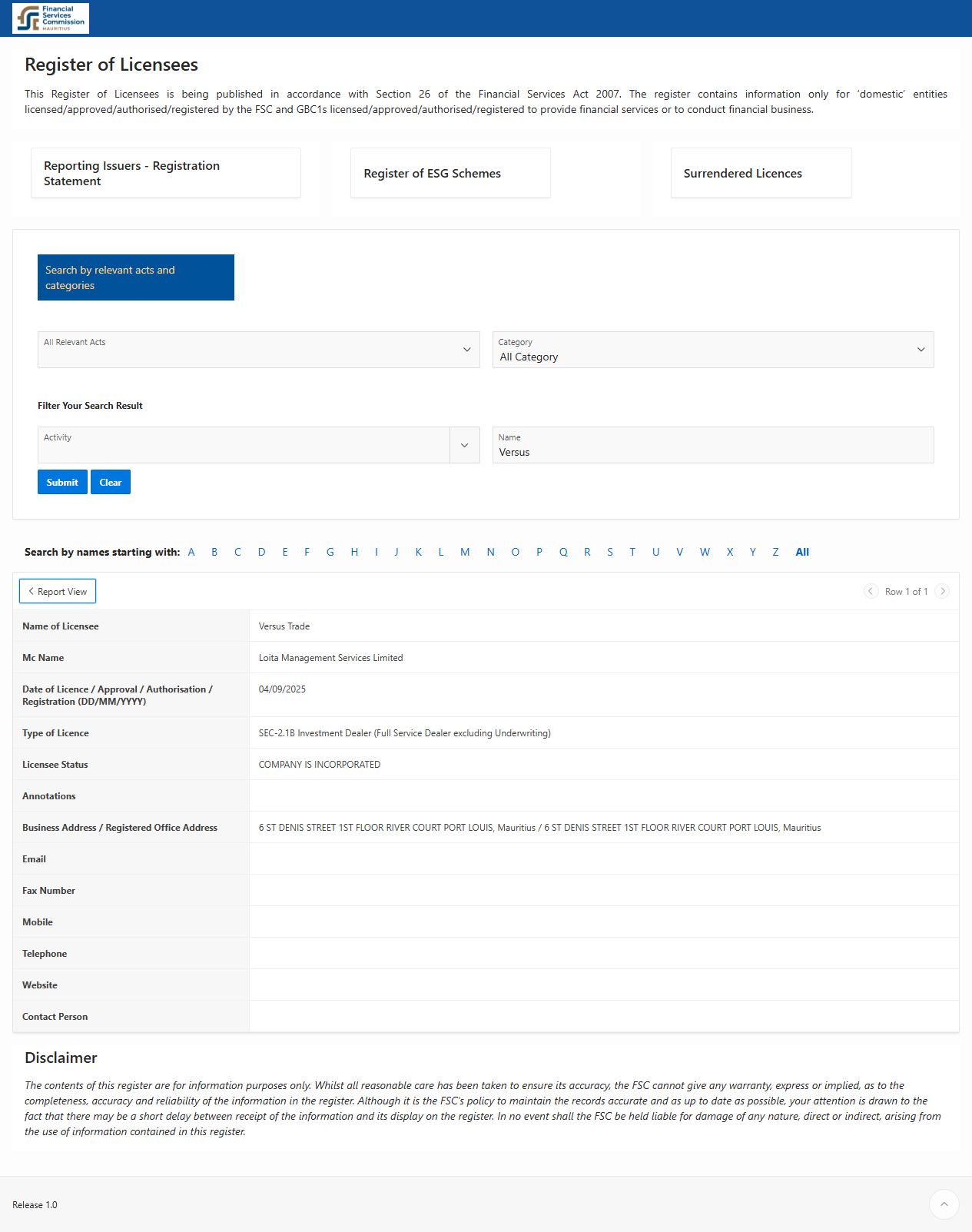
Original FSC register record: the listed activity belongs to the named Mauritian entity; individual account allocation must be established separately.
Standard, Cent, Pro and Raw: what changes between accounts?
| Account | Minimum deposit | Advertised spread from | Trading commission | Practical distinction |
|---|---|---|---|---|
| Standard | $10 | 0.4 pip | None | Multi-asset CFD access; USD/MYR base currencies |
| Cent | $10 | 1.4 pips | None | Forex and metals; balance denominated in USC |
| Pro | $100 | 0.2 pip | None | Tighter advertised spread without a separate commission |
| Raw | $100 | 0.0 pip | Up to $3 per side per lot | Separate spread and commission components |
These are advertised starting conditions, not average fills. The account pages list MT5, market execution and leverage up to 1:2000. Standard/Cent show a 60% margin-call level; Pro/Raw show 30%; all four show a 0% stop-out level. Instrument rules and account eligibility still matter. Minimum funding is an access threshold, not a sufficient trading budget.
Cent balances require particular care: 100 USC equals $1, so a large-looking terminal balance may represent little cash. That denomination alone does not tell you the instrument’s contract size or dollar risk per pip. Check the actual symbol specification and position volume. Standard’s wider market selection may be preferable for multi-asset use; Cent’s limited coverage should not be mistaken for the same product on a different display scale.
Pro vs Raw: calculate the break-even instead of buying the zero-spread headline
For a USD account trading one standard EUR/USD lot of 100,000 euros, one pip is approximately $10. A simple round-trip comparison is: spread in pips × $10, plus opening and closing commissions. Count the spread once in this approximation, not twice. Overnight financing, slippage and currency conversion sit outside it.
Assume Pro’s effective spread is 0.7 pip and Raw’s is 0.1 pip. At Raw’s advertised maximum commission of $3 each way, Pro costs about $7 and Raw about $7. Raw at zero spread would cost about $6; at 0.3 pip it would cost about $9. These are illustrative scenarios, not measured execution results or a promise that either spread will be available.
At that commission, Raw must save more than 0.6 pip versus Pro to be cheaper. With 0.7 pip on Pro, the Raw break-even spread is 0.1 pip. The broker’s homepage gives an indicative Pro EUR/USD average of 0.7 pip, whereas the Pro account card advertises a minimum from 0.2. An average and a minimum answer different questions; comparing Raw’s best-case zero with Pro’s average would bias the result.
For an assumed 20 completed one-lot trades, a $2 difference per round trip totals $40. That is more decision-useful than a headline spread on its own. Collect the effective spread and actual commission for the same symbol, session and volume. A strategy that earns only a few pips is particularly sensitive to slippage; a position held for several nights may be dominated by financing costs instead.
MT5, Versus pairs and execution: convenience does not remove counterparty risk
MT5 support is useful for traders who already rely on its charts, order types or automated workflows. It avoids learning an unfamiliar terminal. But the platform brand does not determine the broker’s solvency, complaint handling or the price at which a specific order will fill.
The Best Execution Policy is unusually important here: clauses 2.3 and 6.2 say the company acts as principal and counterparty, and is the execution venue available through its service. A Raw account therefore should not be described as proof of direct exchange access or as eliminating the dealer’s role. The policy discusses multiple price/liquidity providers, but that is a different question from who is legally on the other side of the client’s contract.
Versus pairs express a view about the relative performance of assets rather than simply whether a single market rises in dollars. Being right about one asset’s direction may still be insufficient if the other moves more strongly. Before using a pair, check its exact pricing formula, contract size, trading hours and margin. A synthetic relative-value CFD is not ownership of either underlying asset and should not be presented as an automatically hedged, low-risk investment.
Leverage and swap-free trading: the two risks a small deposit can hide
At 1:2000, a $100,000 notional position would require roughly $50 of margin, ignoring instrument adjustments. The same position still gains or loses about $500 on a 0.5% underlying move. Leverage reduces the collateral requirement; it does not reduce the position’s sensitivity. If account equity were $1,000, that move alone would consume half of it before costs.
A 0% stop-out threshold is not a sensible personal stop-loss plan. It can leave very little equity by the time the liquidation threshold is reached, and gaps can move beyond expected exit prices. Select exposure from an affordable cash loss and realistic stop distance, rather than using every dollar of available margin.
Swap-free also has two regimes. The broker says accounts for residents of Islamic countries are treated separately; its conditional programme for other residents depends on trading behaviour. Covered instruments include specified major/minor FX pairs, gold, WTI, cryptocurrencies and indices. Other instruments can attract swaps. Keeping many positions overnight may change eligibility, and loss of status can affect existing as well as future positions.
For a swing trader, therefore, ‘swap-free available’ is not a reliable lifetime financing assumption. Confirm the symbol, current status, notification rules and any applicable charges before calculating a multi-day strategy’s expected return.
Withdrawals: separate broker processing, verification and bank settlement
The withdrawal policy undertakes to process requests within 30 minutes during working hours, but it separately allows time for payment providers and further verification. The funding page says bank-card receipt can take 1–7 business days depending on the bank and country. Neither statement supports an unconditional ‘all withdrawals arrive in minutes’ promise.
Only verified accounts may withdraw, and third-party destinations are prohibited. The policy prioritises returning card deposits, then e-wallet deposits, before other methods such as bank transfer. That order matters if several funding methods were used: selecting a new destination does not necessarily override the refund sequence.
The document also allows fees depending on the payment method, country or customer classification, plus certain third-party or additional processing charges. A page displaying 0% for a channel is useful, but it is not a universal all-in fee guarantee. Ask for the applicable amount and conversion rate shown for the actual transaction.
If additional identity or payment-ownership documents are requested, the policy gives the customer 24 hours to respond; failure can lead to rejection. It says standard document reviews take one working day and complex cases up to two, subject to delays. Keep the request number, submitted documents, receipt and promised deadline. Escalate a delay by identifying which stage is stuck: account approval, broker release or payment-provider settlement. Do not publish personal identity documents in a public complaint.
Customer feedback and fees that a comparison table can miss
The BrokersView profile displayed five customer reviews: three broadly positive and two negative. Positive comments discussed onboarding, platform use and withdrawal assistance. One negative account alleged a frozen account and an unreturned $100; another was a general service complaint. These are customer statements, not an adjudicated finding. The visible entries do not establish a representative failure rate, nor does a positive review guarantee another customer’s withdrawal.
Watch for repeated, evidenced issues with identifiable timelines and substantive broker replies rather than treating a small sample’s score as a verdict. The customer-feedback section of Versus Trade’s profile is useful for tracking whether specific cases receive a response or resolution. A case without visible closure should remain described as unresolved in the available record, not automatically proved either way.
A less conspicuous cost sits in clause 12.4 of the public client agreement: after 90 days without trading, open positions, withdrawals or deposits, the company reserves the right to charge an inactivity fee under its website rules. The clause does not give a fixed monetary rate. It supports neither inventing a fee amount nor declaring that inactivity can never cost anything. Ask for the current schedule if the account will be used only occasionally.
Who should consider it—and who should look elsewhere?
An experienced, eligible MT5 user who can identify the contracting entity and compare live Pro/Raw pricing has a clearer basis for evaluating Versus Trade than a beginner attracted only by a $10 deposit. Its account choice and CFD coverage can be practical benefits. They need to be weighed against the legal scope, conditional protections and limited public customer sample.
It is a poor match for someone seeking ownership of shares, guaranteed capital, a savings substitute or automatic access to their home-country compensation scheme. Residents of restricted jurisdictions should not attempt to bypass the broker’s restrictions. The website expressly excludes, among others, the US, Canada, the UK and EU/EEA countries.
Before funding, complete five checks: identify the entity in your agreement; record the symbol’s full cost and contract size; confirm the withdrawal route and applicable fees; understand any swap-free and negative-balance exceptions; and save the formal complaint procedure. A successful small withdrawal can test a workflow, but cannot prove long-term solvency or remove the risks of a larger balance.
Questions that matter before opening an account
Is Raw always cheaper than Pro? No. At $3 per side per standard lot of EUR/USD, it needs a spread advantage exceeding roughly 0.6 pip to compensate for commission. Use the actual commission if it is lower and compare matching trading conditions.
Does the FSC listing cover every Versus Trade customer? The listing confirms a named Mauritian entity and activity. It does not allocate individual accounts. The company in the agreement, not the logo alone, is the starting point for identifying protections and recourse.
Can withdrawals take longer than 30 minutes? Yes. Broker processing, additional checks and final receipt are separate stages. Card payments can take 1–7 business days on the provider side according to the funding FAQ.
How should a disputed withdrawal be escalated? Send a factual complaint through the registered account email with account/order references, dates, the amount and supporting evidence. The public Saint Lucia agreement provides for good-faith negotiations of at least one month before court proceedings there. An account held by another entity requires its own applicable procedure; a general support reply is not the same as a formal dispute decision.
The bottom line: Versus Trade deserves a contract-level and all-in-cost assessment, not a blanket endorsement or dismissal. The most useful comparison is the protection and executable price available to your particular account—not the best number appearing anywhere under the brand. Leveraged CFDs can result in losing all trading capital.
Hottest





Copyright © 2026 FastBull Ltd


Risk Warning
FX trading is of high risk and may not be suitable for all investors. Leverage will create additional risks and loss. Before trading, please carefully consider your investment objectives, experience level and risk tolerance. You may lose part or all of your initial investment; do not invest money that you cannot afford. Educate yourself about the risks associated with FX trading. If you have any questions, please consult an independent financial or tax advisor. Any data and information are provided "as is" and only for information purpose, not for trading or recommendations. Past performance does not predict future results.
Disclaimer
The data contained in this website may not be real-time and accurate. The data and prices on this site are not necessarily provided by the market or exchange, but may be provided by market makers, so prices may be inaccurate and differ from actual market prices. Namely, this price is indicative price only to reflect market trend, and is unfavorable for trading purpose. The provider of the data contained in the Website shall not be liable for any loss incurred by you as a result of your trading activities or reliance on the information contained in the Website.