


Capital.com Review: Regulation, Real Trading Costs and Withdrawal Risks
The verdict: useful for CFD trading, not a shortcut to low-risk investing
Capital.com offers a credible proposition for traders who want spread-based CFD pricing, a choice of trading interfaces and access to multiple markets. Its regulated companies are identifiable, its international fee schedule separates several important charges, and eligible accounts have tools such as guaranteed stop-loss orders. Those are tangible advantages. They do not make every Capital.com account equally protected, every trade inexpensive or every withdrawal immediate.
The decisive questions are which company signs your contract, how long you hold positions and whether your account currency matches the cash flows you generate. A short-duration trade closed before financing is charged has a different cost structure from a leveraged position held for weeks. An international account under the Bahamas entity must not be assessed as if it automatically carried the protections of a UK or EU account.
The Capital.com broker profile on BrokersView brings together licence information and customer feedback. For the practical examples below, the reference is Capital.com’s international CFD offering and the Bahamas client agreement. Local account terms, availability and limits can differ.
Is Capital.com regulated? Match the licence to the contract
CySEC’s register identifies Capital Com SV Investments Ltd under licence 319/17 and lists capital.com among its approved domains. Capital Com (UK) Limited is identified in the FCA’s own clone warning as the genuine authorised firm with reference number 793714. The international website identifies Capital Com Online Investments Ltd as regulated by the Securities Commission of The Bahamas under SIA-F245. These are separate legal entities, not interchangeable descriptions of one worldwide account.
The most useful check is a three-way match: the company in your signed agreement, the company on the relevant regulator’s register and the approved website domain. A licence logo in a website footer does not establish where your particular account sits. Nor does a licence in one country amount to permission to solicit customers everywhere.
For the Bahamas retail account, negative balance protection is framed at account level and is subject to contractual conditions. It is not a guarantee against losing your deposit. The Bahamas client agreement also describes segregated client money, but allows pooling and certain transfers connected with positions to third parties such as liquidity providers. Some transferred sums may cease to receive the same client-money treatment. Segregation therefore should not be described as an unconditional bank-deposit guarantee.
Professional classification deserves particular care. It can change protections and the treatment of collateral. A lower fee or higher leverage limit is not automatically a good trade-off if it changes your rights in a counterparty failure. Ask for the retail-versus-professional differences in writing before accepting a reclassification.
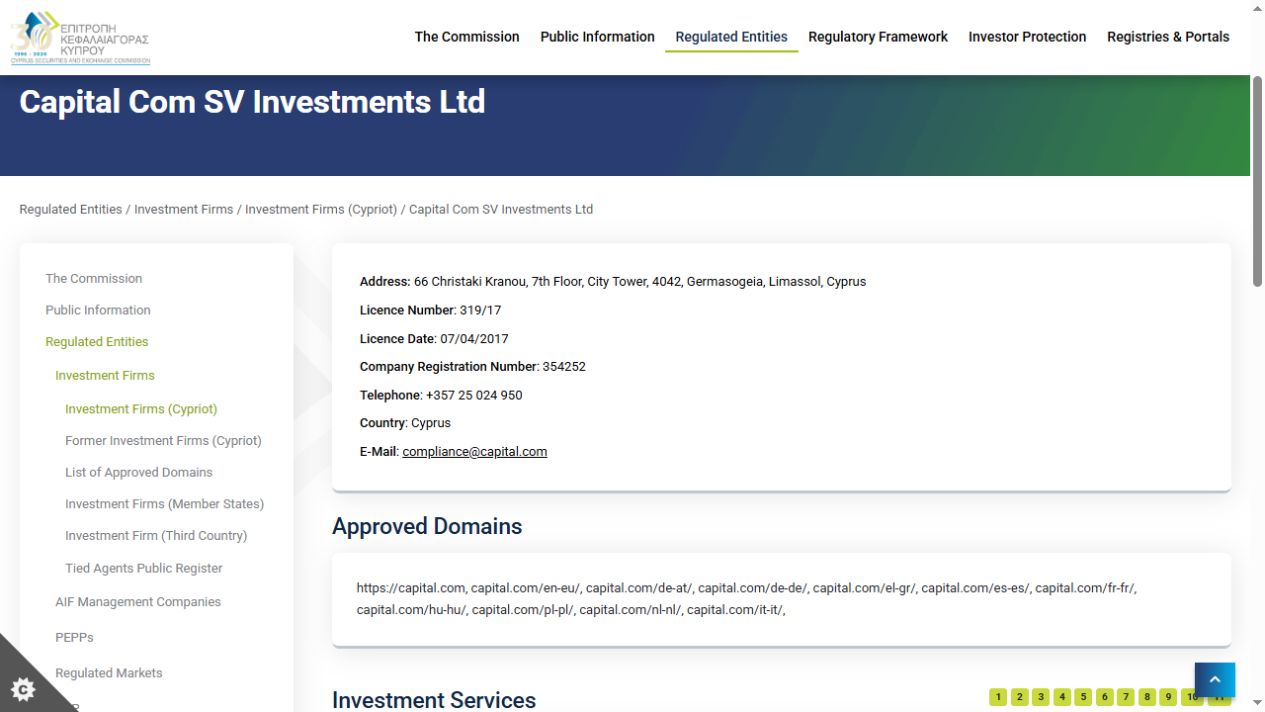
Original CySEC register: Capital Com SV Investments Ltd, licence 319/17, and approved domains. This record does not establish which entity holds an individual international account.
Regulatory warnings and clone scams are different issues
Two negative regulatory signals deserve context rather than omission. Malaysia’s Securities Commission included Capital.com in its investor-alert update of 21 March 2022. The CFTC’s June 2023 RED List announcement named CJSC Capital Com Bel with Capital.com, concerning apparent activity requiring US registration. These are jurisdiction-specific warning records; they should not be presented as a new finding that every company using the brand is fraudulent, or as cancellation of a separate European licence.
Cloning is a different risk. The FCA warned about CAPITALS, using capitals.co.in, as a clone of the genuine UK firm. A copied licence number does not authenticate the party receiving your money. Check the domain through the regulator’s record and enter the platform from that verified route, not from a messaging-app invitation or a search advertisement promising guaranteed returns.
The practical conclusion is narrow but important: an identifiable regulated group can still be unavailable or unauthorised for a particular local market, and fraudsters can impersonate it. Neither the brand name alone nor the mere presence of the word ‘warning’ settles the safety of an individual account.
Capital.com fees: zero commission is only one line of the bill
The international fees and charges schedule lists no dealing commission, but the spread remains a trading cost. Spreads are variable: a minimum or a quiet-session quote is not a promise of what you will pay during a data release, a market opening or a thinly traded period.
| Cost component | How it matters | What to check |
|---|---|---|
| Spread | The gap between buy and sell quotes; usually the main immediate cost. | Your instrument, order size and trading session—not a headline minimum. |
| Overnight funding | Can be a debit or credit on positions held across the relevant cutoff. | Direction, funding rate, cutoff and weekend/holiday treatment. |
| Currency conversion | The international retail schedule lists a 0.7% markup; professional pricing lists 0.5%. | The actual cash flow being converted, not automatically the full CFD exposure. |
| Guaranteed stop | A premium is charged if the guaranteed stop is triggered. | Availability, minimum distance and the displayed premium before submission. |
| Payments | Ordinary broker deposit and withdrawal charges are listed as zero. | Bank/intermediary costs and contractual cost-recovery exceptions. |
The 0.7% retail currency markup applies to eligible converted cash flows, including realised profit or loss, financing, guaranteed-stop fees, dividend adjustments and standalone conversions. It also matters when transferring between subaccounts in different currencies. Opening a second currency balance does not make every subsequent conversion free.
The international schedule says most 1:1 CFD trades are exempt from overnight funding, with exceptions in certain markets. That requires checking the instrument, not assuming a blanket exemption. A 1:1 CFD remains a derivative: the absence of leverage or a financing debit does not turn it into ownership of the underlying share.
Three calculations that reveal costs a headline spread misses
1. Intraday forex. Suppose a EUR/USD position is one standard lot, or EUR 100,000, and the spread is 0.8 pip. At USD 10 per pip, the spread cost is about USD 8 for an opening and closing cycle with an unchanged midpoint and unchanged spread. It is not USD 8 twice merely because there are two transactions. This is an illustrative quote, not a claim about Capital.com’s measured average spread; slippage or a changing spread would alter the outcome.
2. A week-long leveraged position. Assume USD 10,000 exposure and a hypothetical daily financing charge of 0.01%. Funding is USD 1 per day, or USD 7 over seven charged days. Add an illustrative USD 3 spread cost and the total reaches USD 10 before price movement, conversion or other charges. Against USD 500 of initial margin, that equals 2% of the margin—not 0.1% of the cash committed. Actual daily rates and the number of days charged can differ.
3. Cross-currency cash flows. A realised gain equivalent to GBP 100 converted at a 0.7% markup produces an approximate GBP 0.70 conversion cost, before exchange-rate movement. Do not multiply that percentage by a GBP 10,000 CFD notional unless that entire amount is actually being converted. Conversely, converting a whole GBP 1,000-equivalent balance would imply roughly GBP 7. The fee base matters as much as the percentage.
These examples explain why there is no single ‘cheapest account’ verdict. Frequent intraday trading is sensitive to spread and execution; multi-day strategies add financing; cross-currency activity adds conversion. Compare the complete route from deposit to final withdrawal using your normal trade size and holding period.
Platforms, markets and risk controls: flexibility with conditions
The international platform menu includes Capital.com’s own web and mobile interfaces, MetaTrader 4, MetaTrader 5 and TradingView. The current international MT5 page specifically describes automated strategies and custom tools. Older claims that the brand has no MT5 should not be repeated as a universal fact. Account eligibility, market coverage and order features still need checking for the entity and platform you will actually use.
Native applications can simplify access to a broad CFD range; MetaTrader can support an existing automation workflow; TradingView can suit chart-led trading. None of those labels demonstrates better fills, lower slippage or uninterrupted service. A platform feature list is not an execution-quality record.
A guaranteed stop can place a firmer boundary on a particular trade’s exit price than an ordinary stop, if that product and account support it. The premium is contingent on triggering, but the order still has distance and availability rules. Ordinary stops may execute at a different price when markets gap. A stop order also does not remove the separate risk that account-wide margin closeout acts first.
The Bahamas terms describe retail leverage of up to 1:200, with a separate limit for crypto CFDs, and a margin-closeout threshold of 50% of initial margin. Those are not UK or EU retail limits and not a promise for every instrument. Higher leverage reduces the deposit required for a given exposure; it does not reduce that exposure’s market risk.
Minimum deposit and withdrawals: separate eligibility from speed
The international fee page currently lists a minimum card or Apple Pay deposit of 10 in USD, EUR or GBP, and a bank-transfer minimum of EUR 50 or its account-currency equivalent. This is why a universal ‘USD 20 minimum’ can mislead readers who are looking at a different regional service. The minimum is a payment threshold, not a sensible trading budget for every position size.
For card withdrawals, the same page lists a minimum of 20 in USD, EUR or GBP; if the available balance is below the minimum, only a full withdrawal is possible. Payment methods vary by country. The help centre says withdrawal requests are typically handled within 24 hours, while receipt can take up to five business days. Additional checks may extend the process. Processing and arrival are two different clocks.
The Bahamas agreement requires available funds, completed identity and anti-money-laundering checks, and an eligible account in the customer’s own name. Money needed to support open positions is not the same as money available for withdrawal. Deposited funds generally return to their original payment route; profits or amounts beyond the original deposit can require a verified bank account.
A ‘no withdrawal fee’ statement also needs qualification. Intermediary banks can charge, and the agreement permits cost recovery in cases of no or minimal trading. Do not place unnecessary trades just to try to avoid a charge: request a written explanation of the clause and the proposed amount first.
What to do when a Capital.com withdrawal is delayed
First identify the stage. If the request is pending, check free funds, outstanding documents and the payee’s name. If it is rejected, request the exact reason and the corrective step. If it is marked processed but the money has not arrived, ask for the payment reference and identify the receiving bank or card issuer’s trace procedure. Repeatedly submitting replacement requests without understanding the first one can make the record harder to follow.
Keep the request time, amount, currency, transaction identifier, status changes and correspondence together. A screenshot of the balance alone cannot establish that the whole balance was withdrawable, while a ‘processed’ label alone cannot prove the receiving bank has credited it.
The Bahamas complaint policy provides for a written acknowledgement within three business days and a final response within 14 days, or an explanation and revised estimate if more time is needed. An unresolved complaint can be referred to the SCB with the firm’s final response. That is an escalation route, not a promise that the regulator will immediately reimburse a loss. Other entities have their own procedures.
Customer feedback: useful signals, not a withdrawal success rate
BrokersView’s Capital.com customer feedback includes both positive and negative experiences. One October 2023 reviewer praised withdrawals and Apple Pay funding. A November 2025 post described an account-name validation error while trying to add a bank account. Another August 2023 review reported application responsiveness problems and questioned weekend funding charges.
Those reports point to different tests: verify the funding route, resolve name mismatches before a large transfer and understand financing cutoffs. They do not establish that a disputed amount was legally due, that an allegation has been adjudicated, or that most users experience the same outcome. The small, dated sample is not a statistically reliable payout rate.
For newer developments, read the individual reports and their context in the Capital.com customer-review and broker-information page. Separate a documented incident from a general accusation, and a genuine customer account from an impersonator using a similar name.
Strengths and trade-offs that actually affect the decision
Strengths: identifiable regulated entities; spread-based pricing without a separate dealing commission in the international offering; multiple platform choices including current international MT5 support; guaranteed-stop functionality for eligible trades; and an explicit published breakdown of conversion, financing and payment conditions. These make comparison possible, which is more useful than an unqualified ‘safe’ label.
Trade-offs: protection is entity-specific; financing can outweigh a small entry spread on longer holdings; 0.7% retail conversion can accumulate across cash flows; and a CFD account does not provide the ownership rights of a conventional share portfolio. Regional warnings and payment verification also require attention rather than being buried beneath a list of platforms.
Capital.com is worth evaluating for an eligible trader who understands leveraged CFDs, can identify the contracting entity and budgets for the full holding period. It is a weaker match for someone seeking simple long-term share ownership, guaranteed deposit safety, unrestricted local access or a guaranteed same-day withdrawal.
Common questions before opening an account
Is Capital.com a scam? Genuine regulated Capital.com entities can be identified, but that does not authenticate a third-party website or establish local permission. Match the company, domain and contract, and consider the jurisdiction-specific warnings discussed above.
Does zero commission mean free trading? No. Spread, financing, conversion and a triggered guaranteed-stop premium can still apply. The relevant cost depends on the instrument and holding period.
Is there an inactivity fee? Do not assume an old monthly-fee claim applies to every account. The current Bahamas agreement describes possible closure and refund after a year without the specified trading activity or open positions. Closure provisions and monthly dormancy charges are different things; check the schedule attached to your own contract.
Can I buy shares outright through this international CFD account? A share CFD provides contractual price exposure, not shareholder ownership. Even an unleveraged CFD is not the underlying share.
What matters most before depositing? Confirm the legal entity and local eligibility; inspect the live order ticket and financing; align the payment-account name; and establish the withdrawal route. Those checks are more decision-useful than choosing on a minimum spread or the number of licences in a footer.
Hottest



Copyright © 2026 FastBull Ltd


Risk Warning
FX trading is of high risk and may not be suitable for all investors. Leverage will create additional risks and loss. Before trading, please carefully consider your investment objectives, experience level and risk tolerance. You may lose part or all of your initial investment; do not invest money that you cannot afford. Educate yourself about the risks associated with FX trading. If you have any questions, please consult an independent financial or tax advisor. Any data and information are provided "as is" and only for information purpose, not for trading or recommendations. Past performance does not predict future results.
Disclaimer
The data contained in this website may not be real-time and accurate. The data and prices on this site are not necessarily provided by the market or exchange, but may be provided by market makers, so prices may be inaccurate and differ from actual market prices. Namely, this price is indicative price only to reflect market trend, and is unfavorable for trading purpose. The provider of the data contained in the Website shall not be liable for any loss incurred by you as a result of your trading activities or reliance on the information contained in the Website.