


FastBull Expert Advisor Q&As | Xinxing He: Let Systems Replace Emotion and Master Gold with a Professional Trading Mindset
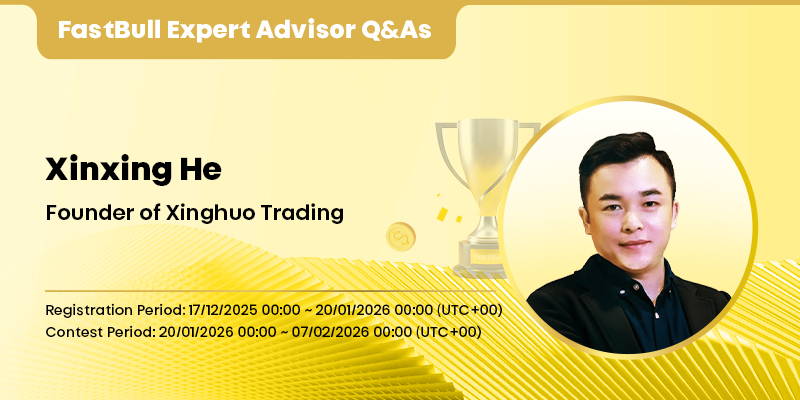
Is gold trading a gamble of luck or a battle of systems? In this episode, we sit down with Xinxing He, Founder of Xinghuo Trading and a 10-year veteran analyst with futures and fund management experience. Drawing from his professional background, He breaks down how to navigate the 400x leverage environment:
✅ Key Insights:
Leverage Management: At 400x leverage, the key is inversely binding position size to leverage, strictly capping single trades at 1%-3%.
Professional Mindset: Emphasize probability-based thinking, pre-risk assessment, and independent analysis to avoid being swayed by ranking anxiety.
Fatal Pitfall: Beware of over-trading and emotional decisions; prevent your capital from being eroded by commissions and invalid stops.
Expert Advice: Always let your trading system make decisions instead of emotions. Consistency in high-intensity contests comes from system execution.
Translation of the Q&A:
Q1: Hello Mr. He, thank you for accepting this exclusive interview with FastBull. You are participating in the 2026 FastBull GOLD Global S1 as a Trading Expert Advisor. In your view, what is the greatest value that such trading contests offer to traders?
He: The greatest value of this kind of trading contest is that it provides a low-cost, highly simulated real-world proving ground. It allows traders to experience real market volatility with zero risk of financial loss. It also exposes the shortcomings of their own trading systems through the pressure of rankings, and enables communication with players of the same level globally, breaking through cognitive limitations.
Q2: This contest uses standardized account parameters and trades only spot gold. What is the significance of this highly consistent competitive environment for testing trading abilities?
He: The significance of standardized account parameters and a single instrument lies in stripping away all external variables. It makes the contest results depend entirely on the accuracy of analyzing XAUUSD, position management capabilities, and mindset control. It is the fairest and purest test of a trader's core trading abilities.
Q3: Regarding the 400x high leverage rule, how do you suggest participants balance the conflict between pursuing high returns and preventing liquidation?
He: The core of balancing high returns and anti-liquidation under 400x leverage is the inverse binding of leverage and position size, plus strictly guarding technical risk control boundaries. I suggest controlling the size of a single position between 1% and 3% and using Fibonacci trend lines to define clear stop-loss levels. The stop-loss amount should not exceed 2% of the total funds, and one must adhere to the principle of adding to winning positions while never adding to losing ones.
Q4: How do you think the professional charting tools and market data provided by FastBull specifically help participants formulate real-time strategies?
He: The professional charting tools and market data offer specific help in three ways: First, using indicators like Fibonacci and candlestick patterns to quickly locate support and resistance levels and clarify the long or short direction. Second, synchronizing the verification of confluence signals between fundamentals and technicals to avoid single-dimension misjudgment. Third, using the review function to quickly summarize trading gains and losses to optimize strategies.
Q5: In a short-duration trading contest with clear rules, what is the most common mistake traders tend to make?
He: In short-duration contests, the most common mistake traders make is being hijacked by ranking anxiety, deviating from their trading systems, and falling into emotional trading and over-trading. They either ignore confluence signals and enter based on gut feeling, or mistakenly believe that more frequent trading leads to more profit, eventually having their capital eroded by commissions and stop-losses.
Q6: You have experience trading for futures and fund companies. In this simulated but highly realistic environment, which professional trading mindsets are equally applicable?
He: Three professional trading mindsets are fully applicable in the contest. First is probabilistic thinking: do not obsess over the P&L of a single trade, but focus on the system's long-term win rate. Second is pre-emptive risk thinking: define the stop-loss and position size before entering, then calculate the potential profit. Third is independent judgment: do not be influenced by market sentiment or the rankings of others, and stick to your own analytical logic.
Q7: As a member of the advisory group, how do you hope to help participants better understand market trends and trading logic?
He: As an advisor, I will use my Douyin account "Xinge Talks Trading" (心歌聊交易) to provide real-time market interpretation livestreams, interactive Q&A, and strategy reviews. I will help participants break down the confluence logic of fundamentals, policy, news, and technicals via livestream, and answer specific trading problems. The reviews will extract replicable experiences from excellent strategies.
Q8: If you could give participants only one general piece of advice to help them maintain stable performance in the contest, what would you emphasize?
He: The only general advice is to always let the trading system replace emotions in making decisions, and strictly adhere to the entry and stop-loss rules for every trade. Only by executing a system can one remain stable in a high-intensity contest.
Ready to test your trading workflow? Registration for 2026 FastBull GOLD Global S1 is closing soon! Contest starts Jan 20!
Hottest


Copyright © 2026 FastBull Ltd


Risk Warning
FX trading is of high risk and may not be suitable for all investors. Leverage will create additional risks and loss. Before trading, please carefully consider your investment objectives, experience level and risk tolerance. You may lose part or all of your initial investment; do not invest money that you cannot afford. Educate yourself about the risks associated with FX trading. If you have any questions, please consult an independent financial or tax advisor. Any data and information are provided "as is" and only for information purpose, not for trading or recommendations. Past performance does not predict future results.
Disclaimer
The data contained in this website may not be real-time and accurate. The data and prices on this site are not necessarily provided by the market or exchange, but may be provided by market makers, so prices may be inaccurate and differ from actual market prices. Namely, this price is indicative price only to reflect market trend, and is unfavorable for trading purpose. The provider of the data contained in the Website shall not be liable for any loss incurred by you as a result of your trading activities or reliance on the information contained in the Website.