


FastBull Expert Advisor Q&As | Xuesen Pan: Optimize Entry with Pending Orders and the Winning Rule of Stability
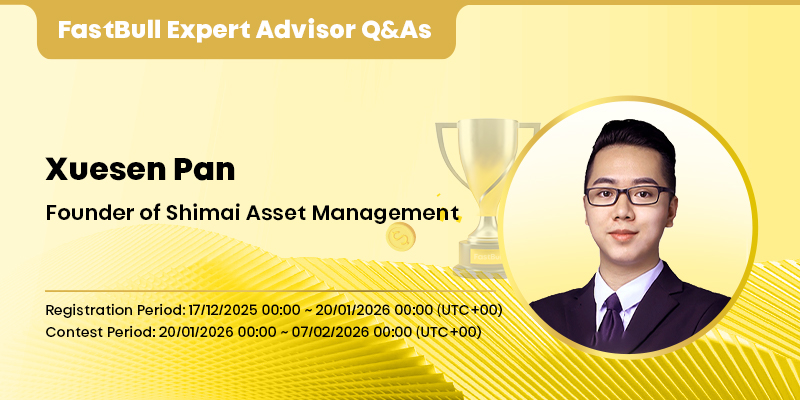
How to accurately capture trends in the volatile gold market? In this episode, we sit down with Xuesen Pan, Operations Director of MyFXtool and Climber Trading Training Camp. As a veteran with extensive experience in trading competitions, Pan breaks down how to excel in this 10-day gold trading sprint through psychological control and capital management:
✅ Key Insights:
Entry Technique: Compared to market orders, "Pending Orders" at high-value positions are recommended to optimize returns and minimize drawdowns.
Mindset Management: A 10-day contest is an ultimate test of a trader's psychology; stay rational amidst ranking fluctuations and stick to your rules.
Market Analysis: With high liquidity and volatility in late January, focus on trend-following opportunities rather than counter-trend trading.
Winning Secret: Adopt a "losing less is winning" mindset. Use scientific capital allocation and laddered entries, waiting for aggressive players to fall behind due to errors.
Translation of the Q&A:
Q1: Hello, thank you for accepting this exclusive interview with FastBull! You are participating in the 2026 FastBull GOLD Global S1 as a "Trading Expert Advisor." In your view, what is the greatest value that such trading contests offer to traders?
Xuesen Pan: Hello everyone, I am Xuesen Pan. Let me introduce myself first. I am the Operations Director of Shimai Asset Management, MyFXtool, and the Climber Trading Training Camp. These three brands are quite well-known in the trading industry. I have participated in many trading contests myself; besides being a recommended master, I compete personally and have won some rankings. On this basis, I am honored to accept this interview for the first season of the FastBull Gold Short-Term Trading Contest. I will provide some references for traders and participants based on my past experience and personal views.
Regarding this question, here is how I see it. Why did I initially like participating in this type of trading contest, regardless of the brand? I think it is based on several points.
First, as we all know, traders are relatively lonely during the trading process. Having a trading contest brings everyone together. In terms of the trading atmosphere, integrating everyone to compete is a very good thing in itself.
The second point is that if we have the opportunity to achieve a ranking—whether through strength (of course, getting a ranking is largely based on strength, though luck plays a part)—I believe this ranking holds significant value. It will be helpful for future self-marketing and for persisting in the trading profession.
The third point is based on trading itself. Short-term trading is actually about the display of a trader's short-term strategy or system. Through the contest, we can identify deficiencies in our strategies or see how we compare to other strong traders.
Q2: You have developed many trading tools. In a contest environment, how should tools and trading mindset synergize?
Xuesen Pan: Indeed, within MyFXtool, and Climber Trading Training Camp, we have developed many excellent tools and software in the industry. For our main software, we are also one of the world's largest service providers for copy-trading APIs.
Beyond that, let's talk about what tools might offer better synergy in this trading contest. For example, at MyFXtool, our account analysis tool can better review our trading trajectory. I noticed the total trading time is two weeks, about ten trading days. After each day or week of trading, using this account analysis tool allows us to better review our trade trajectory against the actual K-line movements. We can see if there are points to optimize regarding our entries and position sizing; this has great review value.
Additionally, Climber Trading Training Camp has developed some very good auxiliary trading tools. Our flagship product is the "Climber Trading Quality Inspection System." This system is developed based on trend trading strategies. As everyone knows, in the last two or three years—and in the market we foresee—whether it's forex, indices, crude oil, or precious metals (gold or silver), the market is generally trending.
In this gold trading contest, especially from December to January, we expect significant volatility in gold, as is common in January of every year. Within high volatility, trend movements likely account for a larger proportion. Our Climber Quality Inspection System is designed to catch trends. At the very least, it helps avoid counter-trend trading, finding more suitable entry points within the trend to buy at better value positions and track the market.
Q3: Under standardized account conditions, will technical skills be further amplified?
Xuesen Pan: I have interpreted the rules of this trading contest. Everyone starts with $100,000, and the trading period is about 10 days. Under identical conditions, I personally believe trading skills will definitely be a factor. Luck is part of it, as I mentioned, but trading skills are indispensable.
If you rely solely on luck, you might rank once. But if we consistently achieve relatively good results across multiple different contests over the long term—not necessarily top 3 or top 10 every time, but perhaps in the top 10% or 5% of all accounts—it represents that your overall strength in this trading environment is passable.
Therefore, in this trading contest, it is the same. I firmly believe that trading techniques and abilities will be reflected in the actual competition results.
Q4: Do you think the contest helps traders discover their own technical shortcomings?
Xuesen Pan: Here is how I view the relationship between the contest and technical shortcomings. I mentioned earlier that the contest lasts ten days. Compared to daily competitions or quarterly contests lasting three months, ten days is a medium duration—neither too long nor too short.
In a contest of this length, I personally feel it tests a trader's mindset (psychology) more than anything. Your performance in the first day or two might be poor, but those days account for a portion of the ten days. If you lose money and want to earn back the loss and make a profit in the remaining 5 or 7 days, it heavily tests your mindset because time is limited.
If you suffer a loss, or if you make a profit but give it back in a subsequent market move, the psychological pressure is immense. I believe everyone participating hopes to get a ranking. When you lose money or your ranking drops, your mindset is greatly affected.
When your mindset is affected, how you calm down and continue to execute your original trading system or rules is crucial. So, regarding this question, my conclusion is: technical shortcomings cannot be separated from trading mindset. This medium-length 10-day contest is definitely a test of everyone's trading psychology.
Q5: Without using external plugins, which function in the FastBull platform's built-in tools do you think is most helpful for short-term trading?
Xuesen Pan: I have been using FastBull for a while, and the charts are very easy to use. I use various tools and indicators across MT4, MT5, TradingView, and FastBull.
Speaking of built-in tools helpful for short-term trading, I have researched the indicators available. I feel there are many indicators for both trends and oscillation. The visual display of these images is, in my opinion, better looking than MT4.
As for which is "most helpful," it depends on the trader's style. For example, some prefer range arbitrage. For those, I personally stick to traditional indicators like MACD or RSI, or a combination of oscillators, as they are more intuitive.
If we talk about trend trading—since I mentioned gold might have large trend movements in late January (after the Western New Year and before the Asian Lunar New Year when liquidity returns)—then trend indicators are key. It depends on personal habit and what looks comfortable.
When I develop tools, I care about the UI. It's important that an indicator clearly shows me entry points. A key point about FastBull is that any indicator you apply, even with default parameters, allows you to conveniently see signal appearances, helping you track when to buy, when to add to a position, and when to exit.
Q6: The contest allows pending orders. For a volatile asset like gold, is it safer to use pending orders or enter at the market price?
Xuesen Pan: I have a strong personal view on this. Setting aside EA trading and focusing on manual trading: I often say that many traders only look at the market when they open the chart (on their phone or computer). However, the moment you open the chart isn't necessarily the best time to enter.
Many people see the market upon opening their phone, want to place a trade, and enter at an unsuitable point. This is a common problem.
Based on this, I have two views. If a manual trader focuses on short-term trading, I personally prefer using pending orders for entry. With pending orders, after analyzing the K-line (whether based on news or technicals), we try to find a more optimal position. We can't guarantee selling at the absolute top or buying at the absolute bottom, but entering via pending orders at a position with a high cost-performance ratio will definitely make your results—both returns and drawdowns—look better.
If your style is medium-term swing trading, you might not care about the precise short-term entry point. You might see the price is suitable and plan to hold for 5 or 10 days, ignoring the highs and lows of a few hours. In that case, pending orders might be less necessary; you might just buy or scale in (adding positions) to lower the average price.
However, I generally suggest that pending orders are more helpful. They allow you to get orders at better positions. Even if the order isn't triggered, it's better than entering at a bad spot. Compared to missing a profit, entering at the wrong place causes losses. Sometimes, "losing less is winning."
Q7: As a member of the experts, how do you hope to help participants better understand market trends and trading logic?
Xuesen Pan: This connects to points I made earlier. In mid-to-late January, with Western traders back and the Asian holiday yet to start, the overall trend for gold hasn't changed; the macro trend is still bullish.
For this contest, I suggest trading with the trend. Trend trading reduces holding risk. Since the fundamental bull market hasn't changed and the technical bull market persists, I suggest focusing on long positions.
Regarding micro-entries, I suggest waiting for technical pullbacks to relatively low levels to place long orders. Combining this with the previous question, you can place pending orders at low levels (lows within the bull market) and see how many get filled.
regarding trading logic, money management is critical in a contest. I saw the rules require a minimum of 100 trades. Since you need high volume, you might add positions multiple times. I suggest placing pending orders at lower levels and calculating the risk. For example, place smaller volume orders at higher levels and larger volume at lower levels. Even if the bottom orders aren't triggered, the small high-level orders won't cause massive drawdown.
Be aware of rapid drops in a bull market—sometimes $200-$400 drops happen quickly. If you have too many orders at what you thought was a low level (but wasn't the bottom), a rapid drop could ruin your ranking. So, beyond finding good points, how you allocate funds within the $100,000 account is crucial.
Q8: If you could give participants only one general piece of advice to help them maintain stable performance in the contest, what would you emphasize?
Xuesen Pan: I have a say in the 2026 FastBull GOLD Global S1. After interpreting the rules, my general advice is based on my experience in many contests.
The core advice is: realize that most people lose money in the market. So, my mantra is "losing less is winning."
Sometimes, even if we trade less or make very little profit, as long as we do not lose money, our ranking might already be in the top 20% or 10%. I believe many people will use violent or aggressive methods and will be eliminated or suffer huge losses quickly. In this scenario, just staying breakeven or making a small profit puts you in a high position.
On this basis, if we trade conservatively and then hit one or two high-quality trades—ensuring we don't lose money while adding a bit of luck—we have a chance to reach the top 5%.
Even in the last one or two days, you might be in the top 20 but not top 10. Often, the top rankers will continue trading aggressively to secure the prize money or 1st place. The competition is fierce, and they might drop down due to losses from this intense competition.
If you can hold your profit steady in the final days, you don't need to compete excessively. You might rise in the rankings simply because those above you crash. This is a small tip from my past experience in winning rankings.
Finally, I hope everyone participates enthusiastically in the 2026 FastBull GOLD Global S1. I will be a part of it too. I hope everyone achieves their desired results, and with a mix of skill and luck, wins the prize money. Thank you, everyone.
Ready to test your trading workflow? The highly anticipated 2026 FastBull Gold Global S1 has officially commenced!
Hottest



Copyright © 2026 FastBull Ltd


Risk Warning
FX trading is of high risk and may not be suitable for all investors. Leverage will create additional risks and loss. Before trading, please carefully consider your investment objectives, experience level and risk tolerance. You may lose part or all of your initial investment; do not invest money that you cannot afford. Educate yourself about the risks associated with FX trading. If you have any questions, please consult an independent financial or tax advisor. Any data and information are provided "as is" and only for information purpose, not for trading or recommendations. Past performance does not predict future results.
Disclaimer
The data contained in this website may not be real-time and accurate. The data and prices on this site are not necessarily provided by the market or exchange, but may be provided by market makers, so prices may be inaccurate and differ from actual market prices. Namely, this price is indicative price only to reflect market trend, and is unfavorable for trading purpose. The provider of the data contained in the Website shall not be liable for any loss incurred by you as a result of your trading activities or reliance on the information contained in the Website.