


- XAUUSD
- XAGUSD
- WTI
- USDX


ตลาด
การวิเคราะห์
ผู้ใช้
24x7
ปฏิทินเศรษฐกิจ
แหล่งเรียนรู้
ข้อมูล
- ชื่อ
- ค่าล่าสุด
- ครั้งก่อน









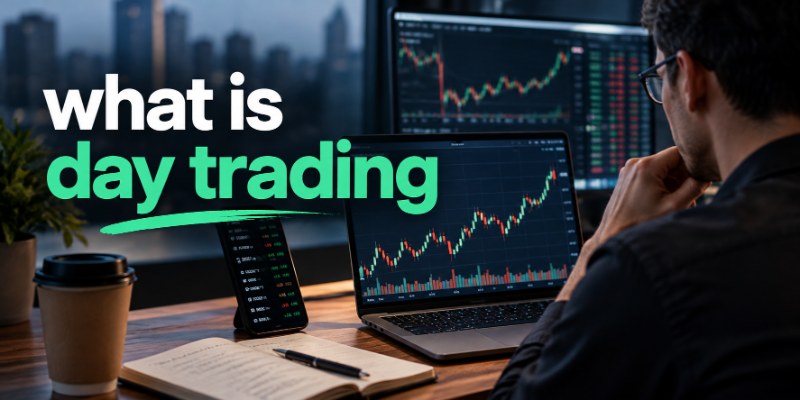
การซื้อขายรายวันคืออะไร? เรียนรู้วิธีที่นักซื้อขายรายวันสร้างรายได้ กลยุทธ์ทั่วไป ตัวอย่าง ความเสี่ยง และวิธีการเริ่มต้นซื้อขายรายวัน
การซื้อขายรายวันหมายถึงการซื้อและขายสินทรัพย์ทางการเงินภายในวันซื้อขายเดียวกัน โดยปกติเพื่อทำกำไรจากความเคลื่อนไหวของราคาในระยะสั้น แตกต่างจากการลงทุนระยะยาว นักลงทุนรายวันจะเน้นไปที่สิ่งที่เกิดขึ้นภายในเวลาไม่กี่นาทีหรือชั่วโมง มากกว่าหลายปี ศักยภาพในการทำกำไรอย่างรวดเร็วดึงดูดความสนใจ แต่การขาดทุนก็เกิดขึ้นได้เร็วเช่นกัน
สารบัญ
การซื้อขายรายวัน (Day trading) เป็นวิธีการซื้อขายที่เปิดและปิดสถานะภายในวันซื้อขายเดียวกัน โดยทั่วไปแล้วเทรดเดอร์จะหลีกเลี่ยงการถือครองสถานะข้ามคืน เพื่อลดความเสี่ยงจากข่าวสารที่ไม่คาดคิดหรือช่องว่างราคาในขณะที่ตลาดปิดทำการ
การซื้อขายรายวันเป็นเรื่องปกติในตลาดหุ้น ตลาดแลกเปลี่ยนเงินตราต่างประเทศ ตลาดคริปโตเคอร์เรนซี ตลาดฟิวเจอร์ส และตลาดที่มีสภาพคล่องสูงอื่นๆ แนวคิดพื้นฐานนั้นตรงไปตรงมา: ระบุโอกาสในการซื้อขายในระยะสั้น เข้าทำการซื้อขาย และปิดการซื้อขายก่อนที่ช่วงเวลาการซื้อขายจะสิ้นสุดลง
อย่างไรก็ตาม การซื้อขายรายวันไม่ได้หมายความถึงแค่การซื้อสินทรัพย์แล้วหวังว่าราคาจะสูงขึ้นเท่านั้น เทรดเดอร์อาจขายชอร์ตเพื่อทำกำไรจากราคาที่ลดลงได้เช่นกัน ขึ้นอยู่กับตลาดและบัญชีซื้อขาย
นักลงทุนรายวันจะติดตามกราฟราคา ปริมาณการซื้อขาย ข่าวสารตลาด และตัวชี้วัดทางเทคนิค เพื่อระบุจุดเข้าและจุดออกที่เหมาะสม
ตัวอย่างเช่น นักลงทุนอาจซื้อหุ้นหลังจากที่ราคาหุ้นทะลุแนวต้านสำคัญ โดยคาดว่าราคาจะปรับตัวสูงขึ้นต่อไป หากการคาดการณ์เป็นจริง นักลงทุนจะขายทำกำไร แต่หากราคาเคลื่อนไหวสวนทางกับที่คาดการณ์ไว้ นักลงทุนอาจปิดสถานะโดยยอมรับการขาดทุนตามที่กำหนดไว้ล่วงหน้า
เทรดเดอร์รายวันส่วนใหญ่จะทำตามขั้นตอนดังนี้:
เป้าหมายไม่ใช่การคาดการณ์ความเคลื่อนไหวของตลาดทุกครั้ง แต่เป็นการค้นหาโอกาสที่ผลตอบแทนที่อาจได้รับนั้นคุ้มค่ากับความเสี่ยง
ลองพิจารณาผู้ค้าที่ซื้อหุ้น 100 หุ้นในราคาหุ้นละ 50 ดอลลาร์
| รายละเอียดการซื้อขาย | จำนวน |
|---|---|
| ราคาแรกเข้า | 50.00 เหรียญสหรัฐ |
| หุ้นที่ซื้อ | 100 |
| มูลค่าตำแหน่งรวม | 5,000 เหรียญสหรัฐ |
| ราคาขายออก | 50.80 เหรียญสหรัฐ |
| กำไรขั้นต้น | 80 เหรียญสหรัฐ |
| ผลตอบแทนจากมูลค่าตำแหน่ง | 1.6% |
นักลงทุนจะได้กำไรขั้นต้น 80 ดอลลาร์ หากราคาหุ้นเพิ่มขึ้นเป็น 50.80 ดอลลาร์ และปิดสถานะการซื้อขาย
แต่สิ่งที่ตรงกันข้ามก็อาจเกิดขึ้นได้เช่นกัน หากราคาหุ้นลดลงเหลือ 49.20 ดอลลาร์ การซื้อขายแบบเดียวกันนี้จะทำให้ขาดทุนสุทธิ 80 ดอลลาร์
These figures exclude commissions, spreads, slippage, financing charges, and taxes.
Yes, day trading can be profitable, but consistent profitability is difficult.
A trader might make money on several trades and lose those gains in one poorly managed position. Frequent trading also increases transaction costs, while leverage can magnify losses.
Successful trading depends on more than identifying the right direction. Entry timing, position size, risk management, and execution all affect the outcome.
A profitable day is not necessarily evidence of a profitable trading strategy. Results over many trades matter much more.
Day traders use different strategies depending on market conditions, volatility, and their trading experience.
Scalping involves opening and closing trades over very short periods, sometimes within seconds or minutes.
Scalpers target small price movements and may place numerous trades throughout a session. Because each profit target is relatively small, transaction costs and execution speed can significantly affect results.
Momentum traders look for assets experiencing strong price movements, often following earnings announcements, economic reports, or other market news.
The goal is to enter while momentum remains strong and exit before the movement loses strength.
Momentum trading can be particularly risky when prices reverse suddenly.
Breakout traders watch important support and resistance levels.
For example, if a stock repeatedly struggles to move above $100, a trader might consider buying when the price breaks above that level with strong volume.
However, not every breakout continues. False breakouts can quickly turn profitable-looking trades into losses.
Reversal traders attempt to identify when an existing price trend may be ending.
A trader might look for signs that a sharp decline is losing momentum before entering a long position.
This approach requires caution because prices can continue moving against a position longer than expected.
The biggest difference between these approaches is how long positions are held and what drives trading decisions.
| Feature | Day Trading | Swing Trading | Long-Term Investing |
|---|---|---|---|
| Holding period | Minutes to hours | Days to weeks | Months to years |
| Main focus | Intraday price movements | Short-term market trends | Long-term asset value and growth |
| Trading frequency | Usually high | Moderate | Usually low |
| Overnight exposure | Usually avoided | Common | Expected |
| Time commitment | High during active sessions | Moderate | Generally lower |
| Typical analysis | Technical and market activity | Technical and fundamental | Primarily fundamental |
Day trading generally requires more active monitoring than swing trading or long-term investing.
It also involves more frequent decisions, which can increase both transaction costs and the likelihood of emotional mistakes.
Day trading offers flexibility and frequent opportunities, but it carries substantial financial risks.
Prices can move sharply within seconds, particularly during major economic announcements or company earnings releases.
Even a carefully planned trade can lose money when prices move unexpectedly. Stop-loss orders can help manage risk, but they do not guarantee execution at the requested price.
Some day traders borrow money or use leveraged products to increase their market exposure.
Leverage magnifies both profits and losses.
For example, a 2% adverse price movement on a position with five times leverage can produce a loss equivalent to roughly 10% of the trader's initial exposure-backed capital, before costs.
Depending on the product and account structure, losses can exceed the initial amount committed.
Frequent transactions can create substantial costs through spreads, commissions, slippage, and financing fees.
Psychological pressure is another challenge. Traders may chase rising prices, hold losing positions too long, or increase their position sizes after losses in an attempt to recover quickly.
The Financial Industry Regulatory Authority (FINRA) warns that day trading can be extremely risky, particularly for people with limited resources or trading experience.
Getting started requires more than opening a brokerage account. A trading plan and an understanding of the market are equally important.
Start by selecting the market you want to trade.
Stocks, forex, and cryptocurrencies operate differently in terms of trading hours, liquidity, volatility, and regulation.
Choose a broker that offers appropriate market access, transparent fees, reliable execution, and regulatory protections relevant to your jurisdiction.
Day traders commonly use candlestick charts, trading volume, support and resistance levels, moving averages, and the Relative Strength Index (RSI).
These tools can help identify market conditions, but none can consistently predict future prices.
It is also important to understand market orders, limit orders, stop orders, and how slippage affects execution.
A demo account allows traders to practice placing orders without risking real money.
Use it to test a strategy, become familiar with the trading platform, and track results.
Keep in mind that simulated trading may not accurately reproduce real-market execution, costs, or emotional pressure.
Before entering a trade, determine how much you are prepared to lose.
For example, a trader with a $5,000 account who limits planned risk to 1% per trade would set a $50 risk budget.
That does not guarantee a maximum loss of $50. Price gaps, slippage, and unexpected volatility can cause larger losses.
A trading plan should also define position sizes, entry conditions, exit rules, and a daily loss limit.
If you decide to trade with real money, begin with an amount you can afford to lose.
Record each trade, including the reason for entering, the outcome, transaction costs, and whether you followed your plan.
Reviewing results can help identify recurring mistakes and whether a strategy has performed consistently after costs.
There is no universal minimum amount required for day trading. The amount depends on the market, broker, account type, and applicable regulations.
For US stock margin accounts, the pattern day trader (PDT) framework has historically applied when a customer makes four or more day trades within five business days, provided those trades account for more than 6% of total trading activity during that period.
Under the traditional framework, designated pattern day traders generally must maintain at least $25,000 in account equity.
However, US day-trading margin requirements are subject to regulatory changes. Traders should check the latest applicable rules and their broker's requirements before relying on a particular threshold.
The FINRA day trading guidance provides information on regulatory requirements.
It may be possible to place certain trades with $100, depending on the broker, product, and jurisdiction.
However, a small account provides limited flexibility, and trading costs can consume a meaningful portion of potential profits.
Using high leverage to compensate for limited capital can make the account especially vulnerable to rapid losses.
For beginners, practicing with a demo account is generally a more practical starting point than trying to generate meaningful income from a very small balance.
Day trading may appeal to people who enjoy analyzing financial markets, making quick decisions, and actively managing risk.
But it is not an easy alternative to a regular income or a reliable way to build wealth quickly.
Unlike long-term investing, day trading demands frequent attention, disciplined execution, and the ability to accept losses without abandoning a strategy.
For people who cannot monitor markets regularly or tolerate substantial losses, swing trading or diversified long-term investing may be more suitable.
The key question is not whether day trading can make money, but whether the potential returns justify the time, costs, and financial risks involved.
Day trading is not automatically gambling, but trading without a tested strategy or risk controls can resemble gambling. Even disciplined traders face uncertainty and losses.
การซื้อขายหุ้นรายวันเป็นสิ่งที่ถูกกฎหมายในหลายประเทศ รวมถึงสหรัฐอเมริกา แต่โบรกเกอร์และหน่วยงานกำกับดูแลอาจกำหนดข้อกำหนดเฉพาะเพิ่มเติมขึ้นอยู่กับตลาดและประเภทบัญชี
เทรดเดอร์บางคนมุ่งเน้นไปที่ช่วงหนึ่งหรือสองชั่วโมงแรกของการเปิดตลาด ในขณะที่บางคนติดตามราคาตลอดทั้งวัน การเตรียมตัวและการตรวจสอบการซื้อขายอาจทำให้ใช้เวลาเพิ่มขึ้น
การซื้อขายรายวันโดยทั่วไปเป็นเรื่องท้าทายสำหรับผู้เริ่มต้น เนื่องจากความเร็ว ความผันผวน และความเสี่ยงทางการเงิน การเรียนรู้พื้นฐานของตลาดและการฝึกฝนโดยไม่ใช้เงินจริงก่อนพิจารณาการซื้อขายจริงจะช่วยได้
นักลงทุนที่มีประสบการณ์บางคนสร้างรายได้จากการซื้อขายรายวัน แต่ผลกำไรนั้นไม่แน่นอน และอาจขาดทุนอย่างมาก ดังนั้นจึงไม่ควรนำมาใช้เป็นแหล่งรายได้ที่เชื่อถือได้ หากไม่มีประวัติผลงานที่พิสูจน์ได้และยั่งยืน
การซื้อขายรายวัน (Day trading) คือการซื้อและขายสินทรัพย์ทางการเงินภายในวันเดียวกันเพื่อจับการเคลื่อนไหวของราคาในระยะสั้น กลยุทธ์ต่างๆ เช่น การเก็งกำไรระยะสั้น (scalping), การซื้อขายตามโมเมนตัม (momentum trading) และการซื้อขายตามการทะลุแนวรับ/แนวต้าน (breakout trading) เสนอวิธีการที่แตกต่างกันในการเข้าถึงตลาด แต่ไม่มีกลยุทธ์ใดที่ขจัดความเป็นไปได้ที่จะขาดทุนได้
สำหรับผู้ที่กำลังพิจารณาการซื้อขายรายวัน การเข้าใจความเสี่ยง การจัดการขนาดของตำแหน่ง และการพัฒนากระบวนการที่สม่ำเสมอมีความสำคัญมากกว่าการไล่ล่าผลกำไรอย่างรวดเร็ว
บทความนี้มีวัตถุประสงค์เพื่อการศึกษาเท่านั้นและไม่ถือเป็นคำแนะนำด้านการลงทุน

728 RM B 7/F GEE LOK IND BLDG NO 34 HUNG TO RD KWUN TONG KLN HONG KONG


ความเสี่ยงของการสูญเสียในการซื้อขายสินทรัพย์ทางการเงิน เช่น หุ้น FX สินค้าโภคภัณฑ์ ฟิวเจอร์ส พันธบัตร ETFs หรือเงินดิจิทัลอาจมีมาก คุณอาจสูญเสียเงินทุนทั้งหมดที่คุณฝากไว้กับโบรกเกอร์ของคุณ ดังนั้น คุณควรพิจารณาอย่างรอบคอบว่าการซื้อขายดังกล่าวเหมาะสมกับคุณหรือไม่ในสถานการณ์และทรัพยากรทางการเงินของคุณ
ไม่ควรตัดสินใจลงทุนโดยไม่ได้ดำเนินการตรวจสอบสถานะอย่างละเอียดถี่ถ้วนด้วยตัวเองหรือปรึกษากับที่ปรึกษาทางการเงินของคุณ เนื้อหาเว็บของเราอาจไม่เหมาะกับคุณเนื่องจากเราไม่ทราบเงื่อนไขทางการเงินและความต้องการในการลงทุนของคุณ ข้อมูลทางการเงินของเราอาจมีความล่าช้าหรือมีความไม่ถูกต้อง ดังนั้นคุณควรรับผิดชอบอย่างเต็มที่ต่อการตัดสินใจซื้อขายและการลงทุนของคุณ บริษัทจะไม่รับผิดชอบต่อการสูญเสียเงินทุนของคุณ
หากไม่ได้รับอนุญาตจากเว็บไซต์ คุณจะไม่สามารถคัดลอกกราฟิก ข้อความ หรือเครื่องหมายการค้าของเว็บไซต์ได้ สิทธิ์ในทรัพย์สินทางปัญญาในเนื้อหาหรือข้อมูลที่รวมอยู่ในเว็บไซต์นี้เป็นของผู้ให้บริการและผู้ค้าแลกเปลี่ยน
ไม่ได้ล็อกอิน
เข้าสู่ระบบเพื่อเข้าถึงฟังก์ชั่นเพิ่มเติม


เข้าสู่ระบบ
ลงทะเบียน


