


Why Investors Hold Losses and Sell Winners Too Soon
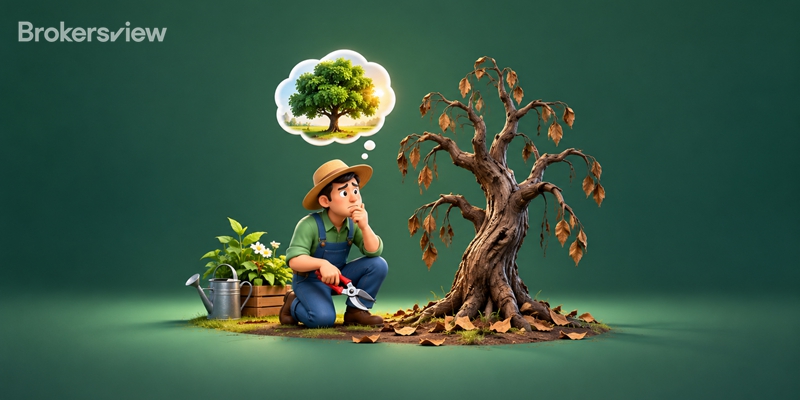
In a quiet village, a gardener named Thomas owned an orchard filled with apple trees.
Every spring, he carefully watered the soil, trimmed the branches, and waited for the harvest.
Among his trees were two that he particularly loved.
The first grew strong and produced beautiful red apples. The second had struggled for years, its branches growing thinner with every season.
One morning, Thomas noticed that the healthy tree was covered with ripe fruit.
Delighted, he immediately picked every apple.
"Better to take what I have now," he said. "What if a storm destroys them tomorrow?"
His neighbor, an experienced gardener named Henry, watched quietly.
"And what about the other tree?" Henry asked.
Thomas glanced toward the struggling tree.
"I spent years caring for it. I've bought fertilizer, repaired its supports, and watered it through every summer. I cannot give up on it now."
Months passed.
The healthy tree continued growing, producing another promising harvest. But the struggling tree became weaker.
Its roots had begun to rot, and its branches cast a long shadow over the younger trees nearby.
Henry returned one afternoon.
"Why do you harvest the healthy tree so quickly but refuse to remove the dying one?"
Thomas frowned.
"Because the healthy tree has already rewarded me. But if I cut down the other, all my years of work will have been wasted."
Henry picked up a fallen branch.
"Those years have already passed," he replied. "Keeping this tree will not bring them back."
Thomas remained silent.
"Ask yourself something," Henry continued. "If you arrived here today and found this orchard for the first time, would you choose to plant that tree in its present condition?"
Thomas looked at the rotting trunk.
"No," he admitted.
"Then why should yesterday's effort decide tomorrow's garden?"
The following spring, Thomas made a difficult choice.
He removed the dying tree, examined the soil, and planted a new sapling where conditions were suitable. He also stopped harvesting his healthy trees simply because he feared losing what they had already produced.
He learned to judge each tree by its present condition and future prospects, not by pride, fear, or the effort already spent.
And whenever he walked through the orchard, he remembered Henry's words:
"A wise gardener does not protect yesterday's decisions at the expense of tomorrow's harvest."
Industry Mapping
| Story Element | Financial Meaning |
|---|---|
| Healthy apple tree | Profitable trading position |
| Dying tree | Losing trading position |
| Harvesting apples too early | Premature profit-taking |
| Refusing to remove the tree | Reluctance to realize losses |
| Years spent caring for the tree | Sunk costs and emotional attachment |
| Henry's advice | Reassessment based on current evidence |
Investor Warning
Forex and CFD trading involves substantial risk, and emotional decision-making can increase exposure to unexpected losses.
Loss aversion may lead investors to hold losing positions longer than justified or close profitable positions prematurely. However, neither holding a position nor closing it guarantees a better financial outcome.
Investors should regularly reassess their positions based on current market conditions, predefined risk limits, and their financial circumstances rather than relying on past costs or emotional attachment.
A structured trading plan may support more consistent decisions, but it cannot eliminate market risk or guarantee profits.
Related Reading

Hottest



Copyright © 2026 FastBull Ltd


Risk Warning
FX trading is of high risk and may not be suitable for all investors. Leverage will create additional risks and loss. Before trading, please carefully consider your investment objectives, experience level and risk tolerance. You may lose part or all of your initial investment; do not invest money that you cannot afford. Educate yourself about the risks associated with FX trading. If you have any questions, please consult an independent financial or tax advisor. Any data and information are provided "as is" and only for information purpose, not for trading or recommendations. Past performance does not predict future results.
Disclaimer
The data contained in this website may not be real-time and accurate. The data and prices on this site are not necessarily provided by the market or exchange, but may be provided by market makers, so prices may be inaccurate and differ from actual market prices. Namely, this price is indicative price only to reflect market trend, and is unfavorable for trading purpose. The provider of the data contained in the Website shall not be liable for any loss incurred by you as a result of your trading activities or reliance on the information contained in the Website.